

I’m late on a bunch of stuff, but wanted to post this for the good of the order.
“‘Jobs’ are deals between workers and employers, and so ‘creating’ them out of unwilling parties is impossible. The state, though, can outlaw deals, and has,” Deirdre McCloskey is a professor of economics, history, English, and communication at the University of Illinois at Chicago
This, and other job improvement suggestions, available here for your review and discussion.
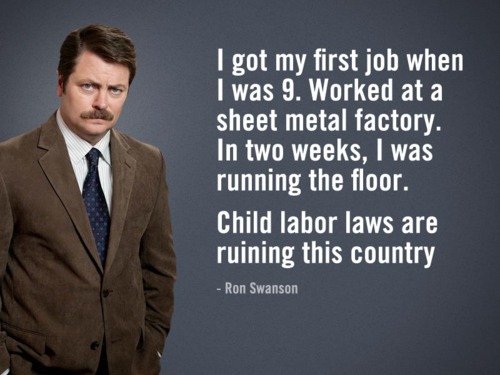
And for a little Friday fun, everyone’s favorite sit-com libertarian Ron Swanson:

Filed under: Uncategorized |


Except for Bartlett, I thought that was pretty tedious.We all know how jobs are created. When there is demand for goods or services, then businesses will start up or expand.We all know that sold2u is right: we have no impetus for private construction in most of America today and will not for several years. Take residential building off the table and many localities will suffer stagnation for a long time.In areas that are healthy, like Austin, and S Dakota, and some other places, we need more small biz lending.Local and state governments, if they have the will, can hire more teachers and cops and expand the community college systems to provide retraining for the folks who need to actually have a second chance at learning a skill.The federal government can legitimately take advantage of low interest rates to contract out the deferred maintenance of ports, airports, highways, bridges, and tunnels on an accelerated basis.But old fashioned "demand stimulus" is not a solution, because the demand for everything besides food, shelter, healthcare, and perhaps cars generally results in more work for China or Brazil, not the USA.Tax breaks and QE are worthless, too, for creating jobs, because the companies that would most benefit from them are awash in cash now. As Bartlett says, when there is lots of private liquidity plus 0% interest rates to big borrowers what's the point? Should the federal government help the states, which do not have the will or perhaps the wherewithal to help themselves? I am dubious. TX got ARRA aid and it just let the state shirk on its own responsibility.There is no greater invitation to sloth than allowing the obligation to raise revenue to be divorced from the joy of spending.
LikeLike
"There is no greater invitation to sloth than allowing the obligation to raise revenue to be divorced from the joy of spending."Why, I do believe I've just been insulted. ;-)I'm with Ron Swanson. Oppressive child labor laws are what's holding this country back. Especially in the lucrative running shoe manufacturing market.
LikeLike
Many thanks for the reason link.In the face of persistent long term unemployment, I find I'm drawn to the idea of trying massive cuts in payroll and income taxes and moving toward a consumption tax. Kind of surprised to find myself drawn to that so strongly, but the prospect of long term, sustained unemployment will do that.That said, I really have the feeling (based almost entirely anecdotal evidence) that a long period of sustained, unpleasant deleveraging, as opposed to changes in government policy, will be required to bring back a robust economy.
LikeLike
Nathaniel, I favor consumption and transfer taxes as the tax reform idea, but I do not see how they affect unemployment materially.Explain.
LikeLike
Are some of these really serious? "Close the Departments of Labor, Commerce, Agriculture, Energy, and HUD, then eliminate three fourths of all regulations." (John Stossel)Increase job growth by taking away 150K federal jobs, including all our food safety and nuclear weapons inspectors?"all labor laws protecting employees from employers, including minimum wage laws, should be repealed. " (Peter Schiff)So we can become China? Or North Korea? Or Ron Swanson?For sure, there are more serious ideas in the list. Unsurprisingly, I find myself in the Bartlett camp, but that may just be because I've been reading his blog.
LikeLike
Mark:There is no greater invitation to sloth than allowing the obligation to raise revenue to be divorced from the joy of spending. Is that a Mark-in-Austin original? I like it, and it deserves to be enshrined somewhere in an official book of quotations.
LikeLike
"We all know how jobs are created. When there is demand for goods or services, then businesses will start up or expand."Actually, I don't think we all agree on that at all. At least, we don't agree on this as more than a partial truth.
LikeLike
Scott, in 1974 I entered the ABA's than annual essay on good government. I did not win the $5K prize.My essay title was "A taxing problem: Bloc Grants and Revenue Sharing". Nixon had championed, and the Congress actually loved, his parceling out of existing LBJ era programs to the states as "revenue sharing". In the course of researching that essay I interviewed the administrative folks at the then TX Department of Public Welfare who thought they had died and gone to heaven, swimming in pig mud. It became clear to me that Nixon's proposed savings from cutting out one level of bureaucracy were offset by the absolute joy of state officials to get their hands on "free" money. I wrote the divorce line in that essay, although now I am surely paraphrasing myself.
LikeLike
When there is demand for goods or services, or a perceived demand, or a belief that there is an under-served market that a product can be created for (and thus, create demand), jobs tend to be created, if productivity or efficiency gains are insufficient to exploit the existing or expected market. What else creates jobs?
LikeLike
Let me just add a bit to that.If what this means is that jobs grow when production increases (yes), then this increase in equilibrium production could result from movement of either the demand or the supply curve. Both have to be accounted for.In more practical terms it doesn't account for the reality that there is no demand per se for many new products before they are introduced. Back to the old which comes first issue.
LikeLike
Mike:It seems to me to be fairly uncontroversial that eliminating regulations will increase jobs. That's not to say that regulations are not valuable, but there is definitely a trade-off. The right question (from an economic point of view) is whether the marginal benefit of a given regulation is greater than the marginal cost. One of the costs of regulation is a dampening on job creation.And certainly the economic enivronment at any given time will influence such a cost-benefit analysis. For example, during a time of full employment and a flush economy, the value preventing carbon "pollution" relative to creating jobs will be higher than during a time of high unemployment and a shrinking economy.With that in mind, it hardly seems crazy to me to suggest that, if creating jobs is a top priority, eliminating some regulations might be a step forward.
LikeLike
"Increase job growth by taking away 150K federal jobs, including all our food safety and nuclear weapons inspectors?"It's counter intuitive, but that extra tax money can be returned to the job producers, so that P-Diddy Dirty Money can now pay former nuclear inspectors to hold his umbrella for him when it's raining. 😉 ""Close the Departments of Labor, Commerce, Agriculture, Energy, and HUD, then eliminate three fourths of all regulations." (John Stossel)"BTW, I like John Stossel a lot, but that sort of thing is a perfect example of falling in love with process over outcome. There is no reason to expect a capricious reduction in regulation will magically create jobs, any more than there is any reason to believe a capricious increase in regulation will improve public safety. As with many things in life, it's quality, not quantity, that makes the difference. I'd rather cut 3% of really atrocious regulations (and there is at least 3% out there) than 75% of all regulation to no discernible point. Much of that regulation provides for standardization and transparency. We really don't want to have any way to compare product ingredients or agree or be able to compare claims or obligations or have agreement on contract terms or . . . ? ""all labor laws protecting employees from employers, including minimum wage laws, should be repealed. ""I'd be open to seeing minimum wage laws repealed. I don't think they actually accomplish anything (I know many disagree with me in this regards). But I'd be willing to do it just to see what, over a ten year period, the impact was. But I wouldn't do that and everything else at the same time.
LikeLike
Kevin,There will be "unmet demand" if the equilibrium point moves right (higher quantity) but production has not increased to reach equilibrium. Something has to affect either buyers or sellers' preferences and move one of the curves for that to happen. Perhaps one of the better economists can correct or clarify, but imo to say there needs to be demand is to be trapped in a Keynesian thought prison.
LikeLike
I like KW's formulation here: entrepreneurs take risks on new products for new markets to be created, and may do so even in slow times. I accept that amendment, Kev.Those folks, at the local level, need easier lending, too. Cannot rely on angels and IPOs for everything.
LikeLike
Kevin:I'd rather cut 3% of really atrocious regulations (and there is at least 3% out there) than 75% of all regulation to no discernible point.How about cutting 75% of regulation for a very discernible point, namely the point Stossel was talking about, ie creating jobs?
LikeLike
"Nathaniel, I favor consumption and transfer taxes as the tax reform idea, but I do not see how they affect unemployment materially."I should have been more clear. On my part, favoring cuts in income and payroll taxes and moving to consumption and transfer taxes, is based on something worse than a mere hunch. I certainly don't doubt that other could give better arguments for an against. I have the vague sense that cuts in income and payroll taxes might encourage some hiring. That said, if there's just no real demand out there, then I just don't see that there's any real incentive to hire and I have no idea, other than government spending, how one might go about stimulating demand in the short run.
LikeLike
"Oppressive child labor laws are what's holding this country back."They certainly made it more difficult for me to save for college.
LikeLike
I'm going to try to find out what kind of cheap little trinkets I can import from Columbia, mark them up about 100% and see if I can get them in the Dollar Store.
LikeLike
I hear there are some demolition jobs opening up.The banks have even been footing the bill for the demolitions — as much as $7,500 a pop. Four years into the housing crisis, the ongoing expense of upkeep and taxes, along with costly code violations and the price of marketing the properties, has saddled banks with a heavy burden.
LikeLike
"How about cutting 75% of regulation for a very discernible point, namely the point Stossel was talking about, ie creating jobs?"I think that's magical thinking. I also think it's tilting at windmills. Cutting the best 75% of regulation and leaving the 25% of the worst would arguably be worse than doing nothing. Additionally, you can get selective regulations repealed–and you can certainly prevent new ones–but I don't see a 75% reduction in regulation as an achievable goal. Quixotic, yes, but achievable . . . I'm dubious.
LikeLike
I don't know how this guy ever made a lick of money with an attitude like this:Mohammed el-Erian: My reaction was colored by two views I’ve expressed already: One has to do with what has happened to finance. In the mid-2000s, the thinking about finance evolved to believing it was a standalone phase in capitalist progression. Society — in particular the U.K. and U.S. — bought into the notion that the path of development was agriculture to industry to services to finance. And that explains a lot in terms of people’s mindset. The name of the industry went from “the financial services” industry to “the finance industry.” It lost sight of the fact that it services the real economy. You cannot simply exchange paper.The other catalyst to my reaction was I was at an airport early, and I saw someone on the TV say the movement was inconsequential and illegitimate. That’s not right. This reflects something that has become more important around the world, which is the desire for greater justice and fairness,.In the U.S., the bailing out of the financial sector was sold on the basis that it would allow growth and job creation to resume, and that has not happened. So the rationale for socializing those losses hasn’t played out.
LikeLike
Hey, dangit, where did you get that avatar, ims! You beat me to the punch! lolI actually googled some images yesterday but never got around to subbing one.
LikeLike
"other than government spending, how one might go about stimulating demand in the short run."Reducing or eliminating the minimum wage may stimulate hiring. A reduction in regulation with a focus, on the both the federal and state level, to regulations that complicate and slow down starting a business specifically. The quicker and easier it is to start a business, the more likely that's going to happen. Of course, unlike most of my conservative brethren, I'm not opposed to a WPA. I think the Works Progress Administration did good things, and I'd rather see our money spent on hiring folks to paint lodges in the national parks and pick up litter and plant trees along the Interstates, rather than on yet another extension in unemployment benefits. Jobs that could educate while accomplishing something productive would be a net positive. We might also consider limiting our current practice of using prisoners as legalized slave labor. That could be a market distortion.
LikeLike
"In the U.S., the bailing out of the financial sector was sold on the basis that it would allow growth and job creation to resume, and that has not happened."I'm dubious. How many of us thought that was going to be the outcome of the bailout? We're told "it was sold", but who actually bought?
LikeLike
qb, I planted an egg and it grew into a chicken after I sprinkled a little fairy dust on it.
LikeLike
"and I'd rather see our money spent on hiring folks to paint lodges in the national parks and pick up litter and plant trees along the Interstates, rather than on yet another extension in unemployment benefits."If the work needs done, I would rather see this than Obama (or Rick Perry) socialism a la Solyndra. Back at the old clubhouse, I used to argue with Ethan about the much-hyped "investment in growth industries," asking, if they are growing, why do they need subsidies? Those questions struck some as crazy. But they aren't. Better to spend money maintaining or improving actual public works and goods than the fantasy of "investing" in the "growth industries of the future."
LikeLike
"but who actually bought"the taxpayers bought it. on credit. i believe it was a predatory loan.
LikeLike
"In more practical terms it doesn't account for the reality that there is no demand per se for many new products before they are introduced."Implicit demand. If you build a better mousetrap, in your opinion, it's not unreasonable to expect there to be demand for your product, once you make it available. If you built the first mousetrap, it's not unreasonable to suspect that people will want to catch mouses, once you illustrate the function. If there is no demand for your mousetrap, your job creation capability is highly restricted. 😉 But there is a great deal of demand, on going, that has yet to be exploited. Servicing much of this demand will reduce demand for previous and now inferior products. Some of it will be genuinely new. But who doesn't want a more fuel efficient car? A cell phone that is simultaneously more powerful and less expensive? To relieve pain and to be stronger and more robust, to have more energy, to enjoy our leisure time more, to feel more pleasure, to live longer and at a greater quality . . . there is a huge unmet demand for a whole raft of imagined, yet unrealized, and largely unimagined and unrealized products. There is a vast implicit demand out there. It's what funds the pharmaceutical leviathan. Among many other things. Alas, I'm not sure the government can just decree that popular innovations to meet previous unmet implicit demand happen magically. Or private industry. To have it happen rapidly enough to spur employment and restore lost GDP growth . . . we need a few more Steve Jobs.
LikeLike
"the taxpayers bought it. on credit. i believe it was a predatory loan."Excellent!Although I didn't buy it, said no and closed the door, so I can only assume my pocket was picked in the transaction. 😉
LikeLike
"If the work needs done, I would rather see this than Obama (or Rick Perry) socialism a la Solyndra."I understand the government investing in pure research, under the rational of being useful to the space program, or DARPA, or just being of an important nature without the immediate financial incentive of private industry (super-colliders, for example). I'm not so keen on grants to private businesses, for whom the grants often represent more money that can possibly make in the competitive market, which also give them the incentive to pay themselves well . . . and, generally, I think it's a bad idea for the government to be playing VC. I'd rather VCs do that. Money spent on pure research may turn out to be a dead end, but it won't go bankrupt and appear, quite so much, to be the government burning money on the pet projects of friends and fellow travelers.
LikeLike
Kevin:It may be wishful thinking (although only marginally more wishful, I think, than the almost equally unlikely notion of cutting even 3%), but I don't see what is "magical" about it. It's simply economic reality that regulations will generally tend to restrict, not facilitate, business activity and hence job growth. (I'm sure you can find a few exception to this, if you wanted, but the 75,000+ pages of the Federal Register are not filled with such exceptions.) As I said, there may be other benefits that outweigh these costs, but they are real costs that would be eliminated if the regulations were eliminated. Nothing magical about it.Cutting the best 75% of regulation and leaving the 25% of the worst would arguably be worse than doing nothing. Maybe I am crazy, but I'm pretty sure that no one advocates cutting the "best" regulations and retaining the "worst", regardless of the percentages involved.
LikeLike
Kevin,Yes, I largely agree re the nature of such theoretical demand. We could say there is huge unmet demand for a reasonably priced, working time machine or FDA-approved, safe and effective elixir of youth. In those cases, they appear sadly to be out of technological reach.But things that are within technological reach don't come into being just because there is theoretical demand out there. As you say, we could use some more copies of Steve Jobs. But my point is that anything that affects "suppliers'" willingness or ability to increase supply (which includes supplying more at the same price, the same at a lower price) affects growth and employment just as much as whatever affects the demand side of the equation. It was Reagan, Laffer, Wanniski, Kemp et al who reminded Washington that there are two sides to the equation.
LikeLike
I didn't phrase that one comment well. If parks need cleaned up and bridges painted, do it because they need done. And research that is part of legitimate government functions is fine (I'm even cool with space exploration). But I don't want the socialist "investing" at all.
LikeLike
"elixir of youth"Burns: Smithers, this beer isn't working. I don't feel any younger or funkier.Smithers: I'll switch to the tablespoon, sir.
LikeLike
Regulations can create jobs too. For example, if you require that power plants install scrubbers on their smokestacks, the scrubbers have to come from somewhere. Viola! Government created demand and jobs through regulation. Like gov Romney said, sometimes oversimplification doesn't apply. This nonsense about regulations always killing jobs is an example.
LikeLike
Oh good qb, that means we can quit with the oil industry tax breaks.
LikeLike
'Socialist investing?' Sounds like an oxymoron to me.
LikeLike
bsimon:For example, if you require that power plants install scrubbers on their smokestacks, the scrubbers have to come from somewhere.So does the money to pay the scrubbers.See Frederic Bastiat's parable of the broken glass, which explains why an argument quite similar to yours is wrong.This nonsense about regulations always killing jobs…Generally does not mean always, a point I tried to make clear by acknowledging that exceptions could be found.
LikeLike
"Generally does not mean always, a point I tried to make clear by acknowledging that exceptions could be found."Is it generally true? Regulations can clearly kill jobs (while creating some others, both in the public and private sector, in regards to conforming to regulation; of course, this can be a drag on productivity, but arguably the cost of poor regulatory supervision, like the BP disaster, can cost much more in potential productive economic output than a functional regulatory and supervisory framework would, and costs the company, in the end, much more that the additional costs of additional safety compliance). But does regulation generally kill jobs? I would think the regulations that have the greatest impact on jobs are, of course, regulations on jobs–anything that increases the cost of employing somebody will naturally tend to cost jobs. So, laws making it difficult to fire employees in certain European nations make companies very hesitant to hire full time employees, as a possible example (I am, by no mean, intimately familiar with the European job market). Still, I would imagine there is a whole swath of regulations that could be removed without meaningfully impacting job creation. I could be mistaken, of course, but it seems unlikely that regulations on building height and speed limits and the need to limit the exposure of employees to hazardous waste are preventing jobs being created to serve pent-up demand. "For example, if you require that power plants install scrubbers on their smokestacks, the scrubbers have to come from somewhere."Yeah. China.
LikeLike
bsimon:I have an idea. The government could easily solve our unemployment problem by simply passing a regulation requiring every business in the nation to increase its staff by 15%. Viola! Government created demand and jobs via regulation!
LikeLike
"Oh good qb, that means we can quit with the oil industry tax breaks."I 100% concur on ending oil industry tax breaks. Why in the world shouldn't we? Same for ethanol subsidies.
LikeLike
"I have an idea. The government could easily solve our unemployment problem by simply passing a regulation requiring every business in the nation to increase its staff by 15%."If the government were decided who was to make what, when, and how much, we'd already have 100% employment, and it would be a workers paradise! jk, jk . . . I'm sure there's a happy medium somewhere between the old Soviet Union and anarchy.
LikeLike
"So does the money to pay the scrubbers."So does the money to pay doctors & pharmaceutical companies when the population develops lung disease at higher rates. The anti-regulation arguments tend to ignore these costs, since they're not directly borne by the regulated industries.
LikeLike
"But things that are within technological reach don't come into being just because there is theoretical demand out there." Agreed. Demand will not create jobs if suppliers will not or cannot meet said demand. The supply side is how implicit demand is met. There was implicit demand for the iPhone before the iPhone was made. If there had been no Apple and no Steve Jobs, that demand would still be implicit, and unmet.
LikeLike
"'Socialist investing?' Sounds like an oxymoron to me."It's popular with some to call it state capitalism. Same thing to me. Socialism invests, just poorly.lms, indeed, cut the "subsidies," which are tax exemptions or deductions. Fine with me.
LikeLike
bsinom:So does the money to pay doctors & pharmaceutical companies when the population develops lung disease at higher rates. Viola! Pollution creates demand and jobs!But seriously, more on externalities later. I have to run for now.
LikeLike
"Maybe I am crazy, but I'm pretty sure that no one advocates cutting the "best" regulations and retaining the "worst", regardless of the percentages involved."Generally, I seem to hear a lot of "cut regulations", rather than, "this specific regulation prevents hiring in this specific way, and should be adjusted or repealed". I think the idea that cutting regulations, or government spending, is a panacea is *highly* dependent on what, specifically, we will be cutting, or spending money on. It's like saying a hammer is good or bad. It's a tool. Banning or promoting hammers like they are in and of themselves some sort of magic talisman doesn't make a lot of sense to me. Not that you're advocating talismanic thinking, I'm just rambling on.Hammers hurt people–we must ban 75% of all hammers!
LikeLike
Scott:I will agree that eliminating some regulations may increase job creation, at a certain expense. I disagree that getting rid of 75% of all regulations will be more effective at increasing job creation than targeting specific regulations that are related to the employer-employee relationship. And sacrificing worker health by abolishing OSHA, for example, has costs that far outweigh the small increase in employment level such an action could make, IMO. I'm not an economics guy, but my understanding is that there is a minimum level of unemployment (3-4%?) that we are not likely to get under. QB:Way, way, way off-topic, but are you from western PA by any chance? This phrase caught my eye:"If the work needs done"
LikeLike
Perhaps there should be a new interdepartmental government agency tasked with developing a regulatory framework for the reduction of onerous regulation. With a nod to Firesign Theater.
LikeLike
you joke — but there is such a panel. I think i'm going to post one of those Swanson picture every Friday. see you all later.
LikeLike
The problem I have with terms like socialist investing is that its entirely unclear what are the boundaries of the category.Are public schools an example of wasteful social investing?To me citizens are an asset that we should be taking care of. Particularly as I age I find myself more concerned that the workforce of the future won't have the skills it needs to keep our economy running. And I say that for entirely selfish reasons. I'm planning my retirement on the assumption that I will have to provide entirely for myself. That will be much easier to do is we have a well-educared, innovative workforce.
LikeLike
"Are public schools an example of wasteful social investing?"No! They are awesome social investing. We should spend more on them. Especially where it comes to databases. Lots more money for databases in the public schools.
LikeLike
Mike, Heh, no, I'm not, although my wife is, and I'm quite familiar with Pittsburghese and Western Pa lingo. Her family is a constant fount of strange sayings, malapropisms, and odd pronunciations. It is impossible for them to say "_ile" for example. They write with inkpens. Their cliches and sayings are all fractured.I only write like that (and like this!) when I am rushing, leaving words out, and not using care. I do have roots not far from WPa, but when the country comes out in me it is a different flavor.
LikeLike
And btw, I've been married 26 years, and STILL I hear strange new Western Pa language from the wife and in laws.
LikeLike