Morning Report: Ukraine Situation Escalates

Vital Statistics:

 LastChange
S&P futures4,338-5.2
Oil (WTI)93.752.63
10 year government bond yield 1.94%
30 year fixed rate mortgage 4.12%

Stocks are flattish this morning despite the escalation of hostilities in Ukraine. Bonds and MBS are up.

Russia has inserted troops into the breakaway Ukraine regions, and Germany has suspended approval for the Nord 2 gas pipeline. Overnight Asian stocks were down a couple of percent, but the European markets are more sanguine about the situation. Bonds remain well bid, with the 10 year trading at 1.94%.

Commodity markets have been well-bid on this situation, with North Sea Brent oil contracts pushing close to $100 a barrel. Natural gas prices in Europe are soaring as well.

Home prices rose 17.5% YOY, according to the FHFA House Price Index. The Mountain region remains the top performer with prices rising 23% YOY.

Existing Home Sales rose 6.7% in January, according to the National Association of Realtors. The median home price rose 15.4% YOY to reach $350,300. This increase was driven at least partially by low inventory, which fell to 860,000 units, or about 1.6 month’s worth of inventory. These stats are both record lows.

“Buyers were likely anticipating further rate increases and locking-in at the low rates, and investors added to overall demand with all-cash offers,” said Lawrence Yun, NAR’s chief economist. “Consequently, housing prices continue to move solidly higher.”

The inventory of starter homes (or homes below $500k) is “disappearing” while higher priced homes are seeing increased supply. This is depressing the first time homebuyer percent, which fell to 27%. Pre-2008, that number was typically closer to 40%. Investor purchases rose to 27% as well. We are starting to see some kvetching from liberal politicians about big money managers (i.e. Blackrock, American Homes 4 Rent) crowding out the first time homebuyer.

Morning Report: Housing starts disappoint

Vital Statistics:

 LastChange
S&P futures4,440-29.2
Oil (WTI)91.35-2.23
10 year government bond yield 1.97%
30 year fixed rate mortgage 4.17%

Stocks are lower this morning on continued Ukraine fears. Bonds and MBS are flat.

The Fed released the minutes from the January FOMC meeting yesterday. The Fed will be taking it meeting by meeting, and did allow for the possibility that they might have to be more aggressive than the December dot plot indicated, which is a nod to the fact that the Fed Funds futures and the December dot plot have a pretty big difference between forecasts.

In their discussion of the outlook for monetary policy, many participants noted the influence on financial conditions of the Committee’s recent communications and viewed these communications as helpful in shifting private-sector expectations regarding the policy outlook into better alignment with the Committee’s assessment of appropriate policy. Participants continued to stress that maintaining flexibility to implement appropriate policy adjustments on the basis of risk-management considerations should be a guiding principle in conducting policy in the current highly uncertain environment. Most participants noted that, if inflation does not move down as they expect, it would be appropriate for the Committee to remove policy accommodation at a faster pace than they currently anticipate. Some participants commented on the risk that financial conditions might tighten unduly in response to a rapid removal of policy accommodation. A few participants remarked that this risk could be mitigated through clear and effective communication of the Committee’s assessments of the economic outlook, the risks around the outlook, and the appropriate path for monetary policy.

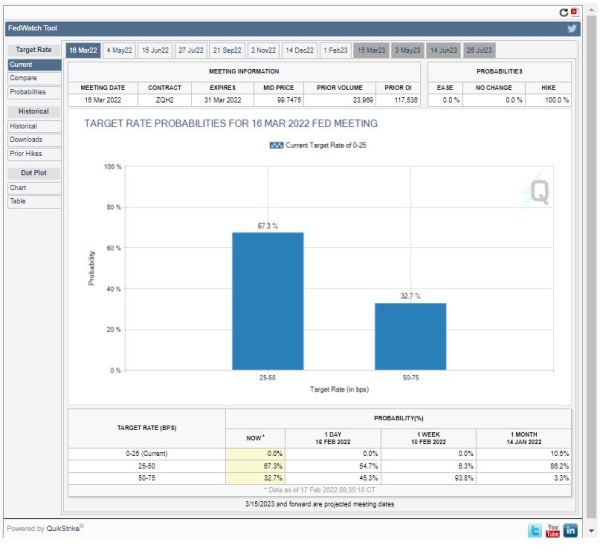
The Fed Funds futures moved ever-so-slightly less hawkish on the news, with the March futures now predicting a roughly 2/3 chance of a 25% hike and a 1/3 chance of a 50 basis point hike compared to roughly a toss-up the day before.

Bottom line, the Fed is looking at the Fed Funds futures and it realizes the market is much more hawkish than they were in December. They are still of the opinion the inflation will moderate as supply chain issues work themselves out, however they are ready to act as necessary if that turns out to not be the case. They are concerned that credit will tighten as they raise rates, but they hope that they can avoid this through clear communication.

Housing starts disappointed yet again, coming in at 1.64 million versus the 1.71 that was expected. Building Permits came in at 1.9 million, which was above expectations, so perhaps this will change in the future. Materials aka “sticks and bricks” remain expensive and that is undoubtedly affecting things. Lumber continues its upward trend:

One of the most precious commodities these days is apparently garage doors. “It used to take us 20 weeks to build a house,” said Adrian Foley, the president and C.E.O. of the Brookfield Properties development group, which develops thousands of single-family homes annually in North America. “And now it takes us 20 weeks to get a set of garage doors.”

Shortages of skilled labor are an issue as well. The US has a glut of humorless BAs, and not enough welders or electricians.

In other economic news, unemployment claim ticked up to 248k last week. This well above pre-pandemic levels, which were averaging around 220k. One data point doesn’t make a trend, but we might be seeing signs the labor market is cooling.

Morning Report: Rising utility prices increase industrial production

Vital Statistics:

 LastChange
S&P futures4,445-19.2
Oil (WTI)93.721.63
10 year government bond yield 2.00%
30 year fixed rate mortgage 4.16%

Stocks are lower this morning on no real news. Bonds and MBS are flat.

Mortgage applications fell 5.4% last week as purchases fell 1% while refis fell 9%. “Mortgage rates increased across the board last week following the recent rise in Treasury yields, which have moved higher due to unrelenting inflationary pressures and increased market expectations of more aggressive policy moves by the Federal Reserve,” said Joel Kan, MBA Associate Vice President of Economic and Industry Forecasting.  Consistent with this period of higher mortgage rates, refinance applications fell 9 percent last week and stood at around half of last year’s pace. The refinance share of applications was also at its lowest level since July 2019.”

Retail Sales rose 3.8% in January, according to Census. This was well above the 2% consensus. Ex-vehicles they rose 3%. On a YOY basis, retail sales rose 13%. December sales were revised downward however. These numbers are not adjusted for inflation.

Single-family rents increased 12% YOY in December, according to CoreLogic.

Industrial production rose 1.4% in January, according to the Fed. Much of this was driven by utilities, which had the highest increase in the history of the index, which goes back to 1972. Not sure what is driving that, as natural gas rose in January, but nothing record-breaking.

Manufacturing production, which strips out utilities, rose 0.2%. Capacity Utilization increased to 77.3%. This is 1.8% higher than pre-pandemic, but below longer-term averages.

Homebuilder sentiment edged down in January, according to the NAHB Housing Market Index.

Morning Report: Rising home prices are affecting affordability

Vital Statistics:

 LastChange
S&P futures4,43349.2
Oil (WTI)92.02-2.63
10 year government bond yield 2.04%
30 year fixed rate mortgage 4.15%

Stocks are higher this morning after Russia sent some troops home, in an apparent de-escalation of the situation in Ukraine. Bonds and MBS are down.

The Producer Price Index (a measure of inflation on the wholesale side) rose 1% MOM and almost 10% on a YOY basis. Ex-food and energy, prices rose 8.3% YOY.

Roughly 69% of American households cannot afford a median-priced home, according to research from the National Association of Homebuilders. The study considers a home affordable if the PITI payment is under 28% of gross monthly income. The income required to purchase the median home is $99,250.

Home prices rose 14.6% in the fourth quarter, according to the National Association of Realtors. The study also looked at qualifying income based on different down payment scenarios. The West Coast continues to be the most expensive single family market.

Morning Report: Q1 GDP estimates below 1%

Vital Statistics:

 LastChange
S&P futures4,4080.2
Oil (WTI)92.42-0.63
10 year government bond yield 1.99%
30 year fixed rate mortgage 4.10%

Stocks are flattish this morning on no real news. Bonds and MBS are flat.

The upcoming week will have some housing data including housing starts and the NAHB Housing Market Index. We will also get the Producer Price Index tomorrow. We will also have some Fed-Speak in the latter part of the week.

Mortgage delinquencies decreased in the fourth quarter, according to the MBA. “Mortgage delinquencies descended in the final three months of 2021, reaching levels at or below MBA’s survey averages dating back to 1979,” said Marina Walsh, CMB, MBA’s Vice President of Industry Analysis. “The fourth-quarter delinquency rate of 4.65 percent was 67 basis points lower than MBA’s survey average of 5.32 percent. Furthermore, the seriously delinquent rate, the percentage of loans that are 90 days or more past due or in the process of foreclosure, was 2.83 percent in the fourth quarter, close to the long-term average of 2.80 percent.”  

St. Louis Fed Head James Bullard thinks the Fed needs to “front-load” the rate hikes. “I do think we need to front-load more of our planned removal of accommodation than we would have previously. We’ve been surprised to the upside on inflation. This is a lot of inflation,” Bullard told CNBC’s Steve Liesman during a live “Squawk Box” interview. Our credibility is on the line here and we do have to react to the data,” he added. “However, I do think we can do it in a way that’s organized and not disruptive to markets.”

The current estimate for Q1 GDP from the Atlanta Fed is below 1%. The Atlanta Fed’s GDP Now has Q1 GDP coming in at 0.7%. This means the economy is weak and probably won’t react well to rate hikes. The Fed has a fine line to walk here as it doesn’t want to push the economy into a recession. The Fed has to be hoping beyond hope that the current spate of inflation is supply-chain driven and works itself out.

Morning Report: The Fed and the markets are out of sync

Vital Statistics:

 LastChange
S&P futures4,5057.2
Oil (WTI)91.140.43
10 year government bond yield 2.00%
30 year fixed rate mortgage 4.07%

Stocks are flattish this morning on no real news. Bonds and MBS are up small.

Yesterday’s inflation numbers caused the Fed Funds futures to recalculate their assessments for what the Fed will do this year. The March futures were predicting a 90%+ chance of a 50 basis point hike at the March meeting. The December futures are now predicting the Fed Funds rate will be at 1.75% by the end of the year. That is a lot of tightening, along with the tapering.

I would note that the current Fed funds futures prediction is WAY out of step with the dot plot from the December FOMC meeting. Here is the dot plot:

The Fed voters see the end of year Fed Funds rate at 75 basis points, while the market sees them at 175 basis points. That is a big delta between the market and the Fed. There has been the perception that the Fed is behind the curve, and I think that reflects this. Regardless, if the increase in inflation is mainly due to supply chain issues that work their way out over the summer, then I have to imagine the markets are too aggressive.

Ordinarily, an aggressive pace of tightening risks a recession in the following year. Watch the 10 year bond yield: if the Fed Funds rate begins to equal the 10 year bond yield, or even increase above it, that is a recessionary sign.

That said, this isn’t just a US phenomenon. Global sovereign yields have also increased over the past month or so. The Japanese Government Bond is yielding 23 basis points, the highest since 2016. The German Bund yields 25 basis points, the highest since 2019. Big picture, the world has been supporting weak economies by issuing lots and lots of debt, and we are probably now going to go into a deleveraging. And deleveragings are never fun.

Consumer sentiment crashed in February, according to the University of Michigan’s Consumer Sentiment Survey.

Sentiment continued its downward descent, reaching its worst level in a decade, falling a stunning 8.2% from last month and 19.7% from last February. The recent declines have been driven by weakening personal financial prospects, largely due to rising inflation, less confidence in the government’s economic policies, and the least favorable long term economic outlook in a decade. Importantly, the entire February decline was among households with incomes of $100,000 or more; their Sentiment Index fell by 16.1% from last month, and 27.5% from last year. The impact of higher inflation on personal finances was spontaneously cited by one-third of all consumers, with nearly half of all consumers expecting declines in their inflation adjusted incomes during the year ahead. In addition, fewer households cited rising net household wealth since the pandemic low in May 2020, largely due to the falling likelihood of stock price increases in 2022.

Morning Report: Bad inflation data

Vital Statistics:

 LastChange
S&P futures4,535-43.2
Oil (WTI)90.140.43
10 year government bond yield 2.00%
30 year fixed rate mortgage 3.94%

Stocks are lower this morning after inflation came in hotter than expected. Bonds and MBS are down.

Inflation rose at a 7.5% annual pace in January, according to the Consumer Price Index. Ex-food and energy, it rose 6%. Rising energy costs were the big driver of the headline number, however used cars were another item. Shelter rose 4% YOY, however the price appreciation of the past year is only beginning to be reflected in the inflation numbers. If you take away seasonal adjustments, the headline CPI rose 8.2%.

Needless to say, the bond market took a beating on these numbers. Mortgage backed securities are down a half a point, and roll rates are increasing. This should translate into higher lock prices.

Foreclosure completions increased to 4,784 properties in January, which is up 57% MOM and 235% YOY. “The increased level of foreclosure activity in January wasn’t a surprise,” said Rick Sharga, executive vice president of RealtyTrac, an ATTOM company. “Foreclosures typically slow down during the holidays in November and December and pick back up after the first of the year. This year, the increases were probably a little more dramatic than usual since foreclosure restrictions placed on mortgage servicers by the Consumer Financial Protection Bureau expired at the end of December.”

Given that the foreclosure moratorium has expired, we should expect to see increases in foreclosure activity. Will we see a repeat of 2009 – 2010? I don’t see that as even a remote possibility. What is the difference? Home equity. Home price appreciation has been so strong that borrowers who cannot afford their current mortgage payment can sell their property and move to a cheaper place. Investors who are hoping to pick up a cheap properties as the moratoriums expire are probably going to be disappointed.

Rocket CEO Dan Gilbert is being sued for alleged insider trading. The complaint alleges that Gilbert sold $500 worth of stock two months before the company announced that gain on sale margins were falling. The plaintiff alleges that guidance out of Rocket pushed the stock to $41.60, after which Gilbert sold stock. Rocket’s spike was not due to guidance, it was due to rumors on Reddit that Rocket could be a short squeeze candidate. Redditors were envisioning another Gamestop situation. Pro tip: If the float of a stock is tiny, but the founders have a lot of stock they would like to sell, it isn’t a short squeeze candidate.

I wouldn’t be surprised to see more suits like this given how god-awful mortgage banking stock have performed in the market. Just about a year ago, Loan Depot was trading above $30 a share. It is now closer to $4. That is a 87% decline. You would think the stock would be in trouble, right? Well, not exactly. The company is expected to make $0.64 this year, which gives it a P/E of 6.5. It also has a dividend yield of 7.7%. I know mortgage banking stocks are as popular as mask mandates these days, but at some point, they have to be too cheap to ignore, right?

Morning Report: New Rez reports good numbers

Vital Statistics:

 LastChange
S&P futures4,55543.2
Oil (WTI)89.44-0.23
10 year government bond yield 1.93%
30 year fixed rate mortgage 3.94%

Stocks are higher as earnings continue to come in. Bonds and MBS are up small.

Mortgage applications decreased by 8.1% last week as rates rose. Refis decreased by 7% and purchases fell by 10%. “With rates 87 basis points higher than the same week a year ago, refinance applications continued to decrease,” said Joel Kan, MBA Associate Vice President of Economic and Industry Forecasting. “Purchase activity slowed after the previous week’s gain. Both conventional and FHA purchase applications saw proportional declines, resulting in purchase activity overall dropping 10 percent. The average loan size again hit another record high at $446,000. Activity continues to be dominated by larger loan balances, as inventory remains tight for entry-level buyers.”

New Rez reported numbers yesterday which sent the stock up 7.4%. In anticipation of higher rates, New Rez has been building the servicing book. They are in a position now, at least according to their analysis that increasing rates will benefit financially – in other words, they think the increase in MSR valuation will more than offset the decline in origination that a 100 basis point increase in mortgage rates will be accretive to EPS by $0.11. Separately, New Rez announced some layoffs from the Caliber acquisition.

Mortgage bankers have been beaten up this year, especially United Wholesale and Rocket. New Rez has held up better than the rest. New Rez has a pretty decent dividend yield, so that might be helping.

Total household debt increased 2.2% to $15.58 trillion, according to the Fed. Mortgage debt increased a trillion last year. “The total increase in nominal debt during 2021 was the largest we have seen since 2007,” said Wilbert Van Der Klaauw, senior vice president at the New York Fed. “The aggregate balances of newly opened mortgage and auto loans sharply increased in 2021, corresponding to increases in home and car prices.” The biggest percentage increases were in student loan debt and credit card debt, however.

Morning Report: Small business inflation concerns are the highest since 1981

Vital Statistics:

 LastChange
S&P futures4,472-8.2
Oil (WTI)90.07-1.23
10 year government bond yield 1.96%
30 year fixed rate mortgage 3.93%

Stocks are lower this morning as bonds continue to sell off. Bonds and MBS are down.

Part of the reason for the sell-off in stocks and bonds has been the consistently hawkish direction of the Fed Funds futures. The March Fed Funds futures are now predicting a 71% chance of a 25 basis point increase and a 29% chance of a 50 basis point hike. A month ago, it was a 6% probability and markets thought there was a 25% chance that the Fed would hold rates at zero.

The consensus for the December 2022 FOMC meeting is that the Fed Funds rate will be 150-175 basis points, which represents six 25 basis point increases. Bank of America is even more aggressive, forecasting that the Fed Funds rate will be between 1.75% and 2%.

Small business optimism slid in January, according to the NFIB. “More small business owners started the New Year raising prices in an attempt to pass on higher inventory, supplies, and labor costs,” said NFIB Chief Economist Bill Dunkelberg. “In addition to inflation issues, owners are also raising compensation at record high rates to attract qualified employees to their open positions.”

The number of businesses characterizing inflation as their biggest problem reached the highest level since 1981. In addition, the net number of firms raising prices hit 61% which was the highest reading since 1974. In addition, a net 50% of small businesses reported increasing raising compensation, a 48 year high.

The slowdown in the mortgage business has hit Spanish bank Santander. It will exit the US mortgage business. “We are simplifying our business to focus on those areas where we can be successful with clients and deliver solid returns,” Tim Wennes, president and CEO of Santander Bank and its U.S. holding company, said in an interview.

The mortgage industry was understaffed in general heading into the big 2020 refi wave, and is now overstaffed. Expect more layoffs going forward.

Morning Report: Seasonal adjustments account for the big jump in payrolls.

Vital Statistics:

 LastChange
S&P futures4,5008.2
Oil (WTI)91.77-0.53
10 year government bond yield 1.92%
30 year fixed rate mortgage 3.88%

Stocks are flattish this morning as earnings continue to come in. Bonds and MBS are down small.

The week after the jobs report is usually pretty data-light, and this week is no exception. The big number will be the Consumer Price Index on Thursday.

Speaking of the jobs report, one of the explanations for the big jump in payrolls was a seasonal adjustment. Generally speaking a lot of people get hired for the holiday shopping season and then get laid off in January. BLS adjusts for that in its seasonal adjustments. This time around, the layoffs didn’t happen, as many employers decided to hang onto these temp workers since the labor market is so tight. So the 467k number more accurately represents people who ordinarily would have been let go that weren’t. I suspect that is the driver for the big difference between the ADP number (loss of 200k) and BLS (gain of 467k).

Mortgage rates continue to soar higher, reaching the highest level since late 2019. Most lenders are quoting rates in the 3.875% – 4% range. Big MBS investors like AGNC Investment noted that mortgage backed securities spreads are widening in January as investors are reluctant to catch a falling knife from the Fed.

United Wholesale is suing one of its broker partners for selling loans to Rocket and Fairway. This stems from a policy introduced last year, which made brokers agree to not sell loans to Rocket or Fairway.