Morning Report: Inflation rises 7.9%

Vital Statistics:

 LastChange
S&P futures4,232-41.2
Oil (WTI)114.105.39
10 year government bond yield 1.99%
30 year fixed rate mortgage 4.21%

Stocks are lower this morning as commodities continue to rise. Bonds and MBS are down.

Inflation at the consumer level rose 0.6% MOM and 7.9% YOY. Ex-food and energy, it rose 0.5% MOM and 6.4% YOY. Food, shelter and energy were the biggest contributors to the increases. Food prices rose 8.6% YOY which was the biggest jump since 1981. Fertilizer prices have doubled, which is filtering its way into commodity prices like wheat, corn and soybeans.

Last year’s torrid increase in home prices has yet to show up in the CPI, but it will. The shelter index rose only 4.7% YOY, while rents and home prices are appreciating close to 20%. Rising real estate prices impact the indices with a 12-18 month lag, so its impact has yet to be felt.

The labor market is still tight, according to the JOLTs index. There were 11.3 million job openings at the end of January. This is a slight decline from December, but still quite strong. The quits rate slipped to 2.8% from its record high in December. The quits rate is a leading indicator for wage growth, so wage-push inflation is on the table as well.

Nickel is still suspended in London, as far as I know. But it isn’t just nickel that is rising. Take a look at the year-over-year numbers for these metals (and coal). Pretty astounding.

These input prices will filter into final prices with a lag, so consider this to be sort of a preview of what is to come. For example, nickel is an input into stainless steel, so expect things like appliances to increase in price.

Mortgage credit availability increased in February, although we are still well below pre-pandemic levels. “Credit availability increased to its highest level since May 2021, driven by growth in jumbo loan programs, as well as those that include allowances for ARMs and expanded credit score and LTV requirements,” said Joel Kan, MBA’s Associate Vice President of Economic and Industry Forecasting. “In a period of rising mortgage rates, affordability challenges, and declining volume, lenders have made efforts to slightly broaden their product offerings.”  

Mortgage applications rose 10% last week as purchases rose 9% and refis increased 11%. On a YOY basis, the refi index is down 50%, while the purchase index is down about 7%. “Mortgage rates dropped for the first time in 12 weeks, as the war in Ukraine spurred an investor flight to quality, which pushed U.S. Treasury yields lower. A 6-basis-point decline in the 30-year fixed-rate mortgage led to a slight rebound in total refinance activity, with a larger gain in government refinances. Looking ahead, the potential for higher inflation amidst disruptions in oil and other commodity flows will likely lead to a period of volatility in rates as these effects work against each other,” said Joel Kan, MBA’s Associate Vice President of Economic and Industry Forecasting. “Purchase activity also increased, as prospective buyers acted on lower rates and the early start of the spring buying season. The average loan size remained close to record highs, with higher-balance loan applications continuing to dominate growth.”  

Mortgage lenders are glum about future prospects, according to the Fannie Mae Lender Sentiment Survey. “For the sixth consecutive quarter, mortgage lenders expressed bearishness about near-term profit margin expectations amid headwinds from declining refinance activity, slower purchase mortgage demand growth, and narrowing spreads,” said Doug Duncan, Senior Vice President and Chief Economist at Fannie Mae. “For consumers, rising interest rates, lack of supply, and strong home price appreciation have reduced refinance activity and further constrained home purchase affordability, which, of course, is dampening lenders’ expectations of future business activity. Numerous uncertainties, including heightened inflation and the Fed’s monetary policy reaction, which must now also account for the inflationary impact of Russia’s war on Ukraine, suggest increased market volatility, but the general underlying, upward rate trend aligns with lenders’ expectations.”

Morning Report: Inflation readings hit a 48 year high

Vital Statistics:

 LastChange
S&P futures4,2035.2
Oil (WTI)124.765.59
10 year government bond yield 1.86%
30 year fixed rate mortgage 4.10%

Stocks are higher this morning after yesterday’s bloodbath. Bond and MBS are down.

Bonds are subject to a push-pull situation, where investors on one hand are buying in the flight-to-safety trade, while others are selling because of inflation.

Home prices rose 19.1% YOY in January, according to CoreLogic. Home price appreciation is expected to slow to 3.8% this year, as a result of rising rates. Given the supply chain shortages and rising input costs, new homes are taking longer to build, which does little to mitigate the massive supply / demand imbalance. Inventory is at a generational low.

Nearly 6,000 homes have sold at prices $100,000 over asking price this year. January was a highly competitive month, where 70% of home sales had bidding wars.

“The housing market was in a frenzy in the beginning of 2022, with buyers competing for a limited supply of homes and sellers reaping the rewards of bid-up prices,” said Redfin Deputy Chief Economist Taylor Marr. “Buyers are likely to face strong competition at least through the next few months as demand is buoyed by the temporary drop in mortgage rates fueled by the Russian invasion of Ukraine. But bidding wars may ease a bit by summer as more new listings come on the market and mortgage rates resume their rise.  Homes are still likely to sell above list price, but the premiums will probably be lower.”

Tappable equity in US homes hit a 16 year high, according to Black Knight Financial Services. Home prices have been on a tear, and borrowers have been using cash-outs to refinance credit card debt and other liabilities. Last year, approximately $1.2 trillion of loans were cash-out refinances. About $275 billion in home equity was extracted in 2021, and that should continue.

Does this massive amount of equity extraction set us up for another 2006 debacle? Probably not. Post-cash out LTVs are about 10 points lower than they were in the bad old days.

Plus, real estate bubbles don’t come around that often. Prior to 2006 the previous bubble was during the 1920s. Bubbles are largely psychological phenomenons which require buy-in from everyone involved: lenders, buyers, regulators, etc. The memories of 2006 are too fresh for that to re-occur and the market fundamentals of supply and demand are not in place.

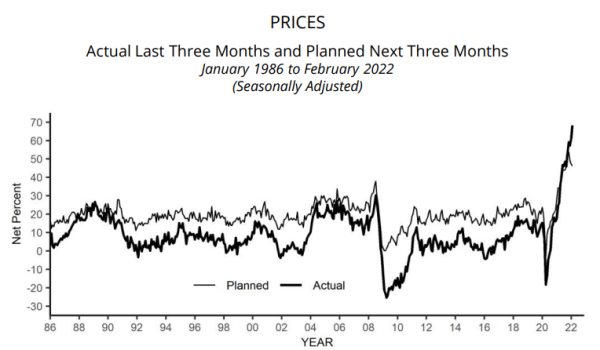
Small business optimism fell again in January, according to the NFIB. Price-raising activity is back to levels not seen since the early days of the Reagan Administration. This is the second month where small business optimism fell below the half-century average. A net 45% of small businesses reported raising compensation, which was a touch below December’s record 48%.

Note that price controls, a vestige of central planning and occasionally used in the US are making a comeback. This has always been a disastrous policy, since price controls create shortages and create black markets. The Biden Administration is already jawboning energy companies about price gouging, and as prices continue to rise, expect to see more of this.

Morning Report: Rising prices and slower growth

Vital Statistics:

 LastChange
S&P futures4,322-10.2
Oil (WTI)117.161.49
10 year government bond yield 1.79%
30 year fixed rate mortgage 4.04%

Stocks are lower this morning as the war in Ukraine continues. Bonds and MBS are up. US Treasuries are rallying, and the German Bund went negative in the overnight session

Western economies are considering an embargo on Russian oil. Since Russia is the third largest producer of oil behind the US and Saudi Arabia, this will push up prices and compound the inflation issue.

Most of the United States relies on West Texas Intermediate oil, which in theory should be unaffected by events in Russia. The East Coast refineries do get oil from international markets, however that could come from any number of sources. I think Hawaii uses Russian oil, which makes sense geographically. Ramping up production in the US will take some time, and at the moment you cannot raise capital for E&P projects.

It isn’t just oil that is rallying: Base metals like copper, aluminum and zinc are climbing, and wheat is limit up yet again. Take a look at the chart of wheat below. See those flat lines for the past two trading days? That means the contract was limit up. The commodity exchanges put daily limits on how far a price can move. This means that prices would be higher absent these limits.

Rising food prices are being driven by something most of us never think about: fertilizer. Fertilizer prices have tripled over the past year.

Rising markets attract fast money, and you have to imagine institutions investors are raising money for commodity funds hand over fist right now. Which will lead to higher commodity prices going forward.

So, rising commodity prices. What about labor?

The labor economy remains strong, according to Friday’s Employment Situation Report. Nonfarm employment rose 678,000, while the unemployment rate fell to 3.8%. Leisure and hospitality reported the biggest increase in payrolls. Average hourly earnings rose 5.1%.

The Atlanta Fed’s GDP Now estimate sees Q1 growth at 0%.

So what does this all mean with interest rates? My guess is that the Fed is going to increase rates to quell inflation, but with growth hitting the wall, the yield curve will flatten. So we could see a higher Fed Funds rate, but long term rates, such as mortgages could move up much slower. In other words, if the Fed raises the Fed Funds rate 100 basis points this year, I don’t think we will see a 100 basis point increase in mortgage rates.

Morning Report: Commodities continue to rise

Vital Statistics:

 LastChange
S&P futures4,39014.2
Oil (WTI)114.132.63
10 year government bond yield 1.87%
30 year fixed rate mortgage 4.09%


Stocks are flattish this morning as commodities rise and the war in Ukraine enters its second week. Bonds and MBS are down.


Jerome Powell’s testimony yesterday caused market participants to pare back their bets on the markets now centered on only a 25 basis point hike in March. At one point yesterday, markets were factoring in a chance of the Fed doing nothing this month. He will have another day of questioning on the Hill today.


Commodity prices continue to climb with oil hitting the highest levels since 2008. It isn’t just oil however – metals like aluminum and zinc are rising as well. The Bloomberg commodity index had the biggest weekly gain since the 1960s.


Initial jobless claims fell to 215k last week, while nonfarm productivity rose 6.6%. This is good news, as productivity is the key to higher living standards. Unit labor costs rose only 0.3%.

Morning Report: Jerome Powell heads to the Hill

Vital Statistics:

 LastChange
S&P futures4,31814.2
Oil (WTI)110.136.63
10 year government bond yield 1.79%
30 year fixed rate mortgage 3.98%

Stocks are higher this morning as commodities rise and Western firms continue to impose “self-sanctions” against Russia. Bonds and MBS are down small.

Jerome Powell heads to the Hill today for his semiannual Humphrey-Hawkins testimony. Here are his prepared remarks. On inflation:

Inflation increased sharply last year and is now running well above our longer-run objective of 2 percent. Demand is strong, and bottlenecks and supply constraints are limiting how quickly production can respond. These supply disruptions have been larger and longer lasting than anticipated, exacerbated by waves of the virus, and price increases are now spreading to a broader range of goods and services.

On tapering and reducing the size of the balance sheet:

The process of removing policy accommodation in current circumstances will involve both increases in the target range of the federal funds rate and reduction in the size of the Federal Reserve’s balance sheet. As the FOMC noted in January, the federal funds rate is our primary means of adjusting the stance of monetary policy. Reducing our balance sheet will commence after the process of raising interest rates has begun, and will proceed in a predictable manner primarily through adjustments to reinvestments.

Finally, on Ukraine:

The near-term effects on the U.S. economy of the invasion of Ukraine, the ongoing war, the sanctions, and of events to come, remain highly uncertain. Making appropriate monetary policy in this environment requires a recognition that the economy evolves in unexpected ways. We will need to be nimble in responding to incoming data and the evolving outlook.

Conclusion, inflation is not transitory, we are raising rates in March, and the effects of the Ukraine invasion are impossible to model.

United Wholesale reported fourth quarter and full year numbers. Volumes were up on a YOY basis compared to the fourth quarter of 2020, which is surprising. Margins collapsed from 305 bp to 80, which is par for the course for what we are seeing with the mortgage banks. Like crosstown rival Rocket, they expect margins to hold steady here going into the first quarter.

The economy added 475,000 jobs in February, according to ADP. The January number was revised upward big time, from -300k to +500k. About a third of the job gains were in leisure / hospitality. “Hiring remains robust but capped by reduced labor supply post-pandemic. Last month large companies showed they are well-poised to compete with higher wages and benefit offerings, and posted the strongest reading since the early days of the pandemic recovery,” said Nela Richardson, chief economist, ADP. “Small companies lost ground as they continue to struggle to keep pace with the wages and benefits needed to attract a limited pool of qualified workers.”

Mortgage applications fell marginally last week as purchases fell 2% and refis rose 1%. We are back to 2019 levels in apps. “Mortgage rates last week reached multi-year highs, putting a damper on applications activity,” said Joel Kan, MBA Associate Vice President of Economic and Industry Forecasting. “Although there was an increase in government refinance applications, higher rates continue to push potential refinance borrowers out of the market. Purchase activity remained weak, but the average loan size increased again, which indicates that home-price growth remains strong, and a greater share of the activity is occurring at the higher end of the market.”

Morning Report: Flight to safety continues

Vital Statistics:

 LastChange
S&P futures4,357-10.2
Oil (WTI)100.945.63
10 year government bond yield 1.79%
30 year fixed rate mortgage 4.09%

Stocks are lower this morning as the risk-off trade continues. Bonds and MBS are up.

The markets continue to buy sovereign debt in a flight to safety. The German Bund yield went below 0% overnight and is now sitting right above 0. The 10-year flirted with 1.7% as well.

We are seeing big moves in commodity prices again, with wheat trading at 982, up 23% since before the invasion. WTI Oil is above $100 a barrel.

I suspect that mortgage originators will get a break yet again as yields work lower and mortgage grudgingly follow. I suspect this will take a while to work out. Maybe 2022 won’t be as bad as people are fearing. Unless things take a turn south in the overall bond market, margin calls shouldn’t be an issue for lenders.

The thing I am going to watch closely is credit spreads and whether we see an impact on the banks. Some of the usual suspects in Europe (SocGen, Deutsche Bank) are taking a beating on this Russian situation, and Raiffeissen getting smoked, down almost 50% since January 31. The Russian market is more or less uninvestable at this point, and might even get downgraded from an “emerging market” to a “frontier market.” Note Russian stocks are halted again today, and Euro exchanges are beginning to suspend Russian GDRs from trading.

If credit spreads begin to widen, it will have reverberations in the mortgage market. First and foremost, it will cause a flight to safety, which means that Treasury yields will fall. It will also be beneficial to Fannie and Freddie mortgage backed securities since those are more or less guaranteed by the US Government. Non-QM might take a hit. That said, rising home prices provide a benign backdrop for housing credit.

Jerome Powell heads to the Hill tomorrow and Thursday for Humphrey-Hawkins testimony. I am not sure what he can realistically comment on Ukraine except to say that the Fed will be monitoring the economic data closely and react accordingly. Investors are paring back bullish bets on rate hikes. The March Fed Funds Futures are now pricing in only a marginal chance of a 50 basis point hike.

The December futures are centering around an end-of-year Fed Funds rate of 1.25%. They were looking at 1.75% pre-invasion.

Home Prices rose 19.6% in February, according to the Clear Capital Home Data Index. This is the most timely real estate index out there. The West and South saw prices rise 23%, while the Northeast and Midwest rose about 15.5%. Separately, home prices rose 19.1% in January, according to CoreLogic. They are expected to rise 3.8% next year.

Morning Report: Sanctions start to bite

Vital Statistics:

 LastChange
S&P futures4,327-54.2
Oil (WTI)95.243.63
10 year government bond yield 1.89%
30 year fixed rate mortgage 4.19%

Stocks are lower as markets take stock of the Ukraine situation. Bonds and MBS are up.

The reality of sanctions is begging to be evident in some of the financial markets. The Russian Ruble is in free-fall, trading as low as 110 to the dollar this morning. It entered the year at 75 to the dollar. The US Treasury has banned transactions with the Russian Central Bank, which means that Russia has no tools to manage currency rates, and this will trigger an inflationary wave in the country. Russian sovereign credit default swaps are pricing in a 50% chance of default

Russia introduced capital controls to prevent capital from fleeing the country and hiked its interbank interest rate to 20%. . Russia’s economy is about to collapse and will probably be too small to be included in the G-20 much longer.

Supposedly 3 Russian banks will be banned from SWIFT, which allows banks to transact. This will allow companies who are re-thinking their business dealings in Russia some time to get their capital out. Supposedly the sanctions include a pretty hefty fine, so pretty much every company with exposure there has their lawyers poring over the language and I guess they will choose to err on the side of caution and reduce their exposure.

What does all this mean in the short term? First of all, bonds and stocks will be driven by headlines and not by economic data. Friday’s jobs report will matter, as will Jerome Powell’s Humphrey-Hawkins testimony this week. Things like the ISM, productivity etc becomes less relevant.

Second, oil is going up. The US is going to release some reserves from the Strategic Petroleum Reserve in order to reduce prices. That said, most of the US oil comes from North America, so Russia’s output doesn’t really matter all that much.

Third, whenever you have this sort of financial contagion, you should expect credit to tighten. Hedge funds with big positions are going to get slammed with margin calls. I heard on Bloomberg that a big institution was trying to move a big block of Rosneft stock and there was no bid. The stock has gotten cut in half over the past few days.

Here is a good place for finance geeks to get the latest and greatest of what is going on. Adam Tooze’s substack is on it.

If we start to see credit tighten in the US, then the Fed is put into a bind: It needs to tighten to control inflation, but if credit markets seize up, the playbook is to do the exact opposite. The Fed Funds futures are beginning to reflect this reality. Two weeks ago, the March Fed Funds futures saw a 50% chance of a 50 basis point hike. Today, it is 10%. The December futures are now looking at 125 – 175 basis points in hikes this year. Not too long ago, we were looking at 150 – 200.

Mortgage rates will probably move down only grudgingly as the 10 year falls. MBS investors are going to be more worried about the Fed unloading its book so they are reluctant to stick their necks out too much. I see MBS spreads stable to wider as the market sorts everything out.

Rocket reported fourth quarter earnings last week. Volumes fell 29% and gain on sale fell from 4.41% to 2.8%. Earnings per share fell 71%. Rocket sees margins staying stable or increasing in the second quarter.

Morning Report: Markets sanguine about Ukraine

Vital Statistics:

 LastChange
S&P futures4,29814.2
Oil (WTI)92.07-0.93
10 year government bond yield 1.97%
30 year fixed rate mortgage 4.18%

Stocks are higher this morning as war continues in Ukraine. Bonds and MBS are down. Even though the 10-year Treasury yield dropped about 10 bps yesterday, mortgage rates fell about a basis point. I think mortgage rates will go only grudgingly lower if the 10 year rallies. The Fed is about to wrap up its purchases of MBS in March, so that tailwind is just about gone.

The markets are surprisingly sanguine about the whole Russia / Ukraine situation. I guess the markets are viewing the economic fallout from this as contained. Here is one thing to keep an eye on: If one of the sanctions is to boot Russia from SWIFT, the International Banking infrastructure, then pretty much any Russian debt is going to be unpaid, and therefore worthless.

Old times might remember a hedge fund called Long Term Capital Management, which blew up after Russia defaulted on its sovereign debt in the late 90s. Most of the exposure seems to be in European banks, although Citi supposedly has some too.

Personal Incomes were flat in January, according to the Bureau of Economic Analysis. Personal spending rose 2.1%. The Personal Consumption Expenditures Price Index, which is the Fed’s preferred measure of inflation, rose 0.6% MOM and 6.1% YOY. The core index, which excludes food and energy rose 0.5% MOM and 5.2% YOY.

Rocket reported fourth quarter numbers. Volume fell 29% compared to the fourth quarter of 2020, and gain on sale contracted from 4.41% to 2.8%. The combination of lower volumes and lower margins contributed to a 71% reduction in earnings per share. For the first quarter Rocket is forecasting volumes to fall to 52-57 billion however gain on sale is expected to increase slightly to a range of 2.8% to 3.1%.

Consumer sentiment improved marginally in the second half of February, however it remains at the lowest level in a decade, according to the University of Michigan Consumer Sentiment Survey. To put that into perspective, 2012 was when the US residential real estate market finally bottomed out. This means consumers are in a pretty foul mood. Note this is before the Russian invasion of Ukraine which probably isn’t going to help things.

From the release: “The February descent resulted from inflationary declines in personal finances, a near universal awareness of rising interest rates, falling confidence in the government’s economic policies, and the most negative long term prospects for the economy in the past decade”

Below is the chart for economic expectations:

Pending home sales fell 5.7% in January, according to NAR. “With inventory at an all-time low, buyers are still having a difficult time finding a home,” said Lawrence Yun, NAR’s chief economist. Given the situation in the market – mortgages, home costs and inventory – it would not be surprising to see a retreat in housing demand.”

Morning Report: Russia invades Ukraine

Vital Statistics:

 LastChange
S&P futures4,123-92.2
Oil (WTI)99.917.23
10 year government bond yield 1.87%
30 year fixed rate mortgage 4.2%

Stocks are lower this morning after Russia invades Ukraine. Bonds and MBS are up.

The action in the markets is pretty dramatic this morning, with the 10 year yield falling 10 basis points. Actual bond prices are up over a point, but MBS are up about half a point. Stocks are getting clobbered, and anything oil-sensitive like airlines are getting whacked. The NASDAQ 100 has entered bear market territory, falling 20.5% since late December.

We have a lot of Fed-Speak this morning. I doubt anyone will be revising their remarks on what is happening overseas, but this situation for the Fed has become quite fluid.

Oil is up big this morning, with West Texas Intermediate up 8% and North Sea Brent trading up 7.6%. Brent is trading over $100 a barrel. Natural gas futures are up big as well. None of this bodes well for gasoline prices going forward as refineries are about to switch over from producing heating oil to gasoline for the summer driving season.

The action in commodities puts the Fed in a bind since it becomes harder for them (and central banks worldwide) to engineer a soft landing. Rising commodity prices will increase inflation, however it will also depress the economy. The stagflation case is bolstered by what is going on. The Atlanta Fed GDP Now estimate has 1.3% growth in Q1, however rising gas prices translate into lower consumer spending and lower GDP growth.

The Fed Funds futures have dramatically shifted in March, with the futures now predicting a 87% chance of a 25 basis point increase and a 13% chance of 50 basis points. Given the uncertainty, I think the prediction of 150 basis points in hikes this year is probably going to get trimmed back.

The main takeaway is that the bond market will be driven by global risk on / risk off sentiment than economic numbers as long as this crisis lasts. MBS will probably lag any improvement in rates as the Fed’s tapering will be the dominant factor. Fortunately for mortgage bankers, this means we probably won’t have a repeat of the margin calls of 2020, even if rates move lower since the Fed won’t be buying. I suspect mortgage spreads will just widen as the 10 year yield falls and mortgage rates go nowhere.

Fourth quarter GDP was revised upward from 6.9% to 7% however personal consumption expenditures were revised downward. I suspect much of this growth is inventory build as supply chains catch up with demand.

New Home Sales continue to disappoint, as Jan sales came in at a seasonally adjusted annual rate of 801,000. This is 4% lower than December’s rate and 19% lower than a year ago. The median new home price came in at 397k, which is up 18% from a year ago.

Morning Report: Consumer Confidence falls

Vital Statistics:

 LastChange
S&P futures4,33232.2
Oil (WTI)91.91-0.43
10 year government bond yield 1.97%
30 year fixed rate mortgage 4.15%

Stocks are lower this morning despite continued Ukraine / Russia fears. Bonds and MBS are down.

Initial sanctions on Russia seem to be less severe than initially feared. The main piece is a halt on the Nord 2 pipeline. That said, this is apparently a “first tranche” of sanctions, so more might be coming if things don’t change.

Consumer confidence fell in February, according to the Conference Board.

“Concerns about inflation rose again in February, after posting back-to-back declines. Despite this reversal, consumers remain relatively confident about short-term growth prospects. While they do not expect the economy to pick up steam in the near future, they also do not foresee conditions worsening. Nevertheless, confidence and consumer spending will continue to face headwinds from rising prices in the coming months.”

Consumer confidence is still much better than the aftermath of the financial crisis, however it remains below pre-COVID levels. Interestingly, the University of Michigan Consumer Sentiment Index is much worse, having fallen back to 2012 levels. I suspect the Conference Board is more accurate. The labor market is much stronger today than 2012 and that is a big driver of consumer confidence. Well, that and gas prices.

Mortgage Applications fell to December 2019 lows, according to the MBA. Purchases fell by 10% while refis fell by 16%. Refinances now account for about half of all mortgages.

“Higher mortgage rates have quickly shut off refinances, with activity down in six of the first seven weeks of 2022,” said Joel Kan, MBA Associate Vice President of Economic and Industry Forecasting. “Conventional refinances in particular saw a 17 percent decrease last week. Purchase applications, already constrained by elevated sales prices and tight inventory, have also been impacted by these higher rates and declined for the third straight week. While the average loan size did not increase this week, it remained close to the survey’s record high.”

ARMs increased to 5.1% of total applications. I suspect we will be seeing more activity in this space, however the spread between an ARM and a fixed is still pretty tight, which means there isn’t much incentive to go with the ARM versus the 30 year. That said, if you plan on moving in 5 years, why not take out a 5/1 and save some money?

The non-QM space has been having issues lately, and I have been hearing about some lender out West not honoring locks. The rapid move in interest rates is exposing one of the big issues of NQM, and that is the difficulty in hedging the product. NQM loans are not deliverable into TBAs, and the rates seem to move much less frequently than TBAs. But, when they move, they move. We saw a lot of reprices last week as buyers of NQM rates re-adjusted upwards.

The big question is how does one hedge the interest rate risk? TBAs might be the least worst choice, but there hasn’t been a long enough track record of this product that you can use to come up with a correlation between conforming loans and NQM. I think a lot of people are flying blind here, and maybe some risk managers said “Wait a minute. We have no idea what our interest rate risk here is. Let’s hold off buying more paper until figure out what our exposure is.” This is all speculation of course, but I suspect that conversation is happening a lot right now.