Morning Report – Meet Stanley Fischer 12/12/13

Vital Statistics:

Last Change Percent
S&P Futures 1781.7 0.9 0.05%
Eurostoxx Index 2925.8 -21.6 -0.73%
Oil (WTI) 97.77 0.3 0.34%
LIBOR 0.243 -0.001 -0.41%
US Dollar Index (DXY) 79.98 0.089 0.11%
10 Year Govt Bond Yield 2.87% 0.01%
Current Coupon Ginnie Mae TBA 104.4 -0.1
Current Coupon Fannie Mae TBA 103.3 -0.1
RPX Composite Real Estate Index 200.7 -0.2
BankRate 30 Year Fixed Rate Mortgage 4.45
Markets are higher this morning after a good retail sales report. Initial Jobless Claims rose to 368k from 320k the week before. Import prices fell. Bonds and MBS are lower.
Stanley Fischer is mooted to be the next Vice Chairman of the Fed. He ran the Bank of Israel through the 2008 financial crisis, and his international experience is supposedly one of the reasons why Obama is interested in him. He has a experience teaching at free-market leaning University of Chicago, and left-leaning MIT. Supposedly he is skeptical of the new Fed communications strategy, which could put him in conflict with Janet Yellen. He has called QE “dangerous, but necessary.”
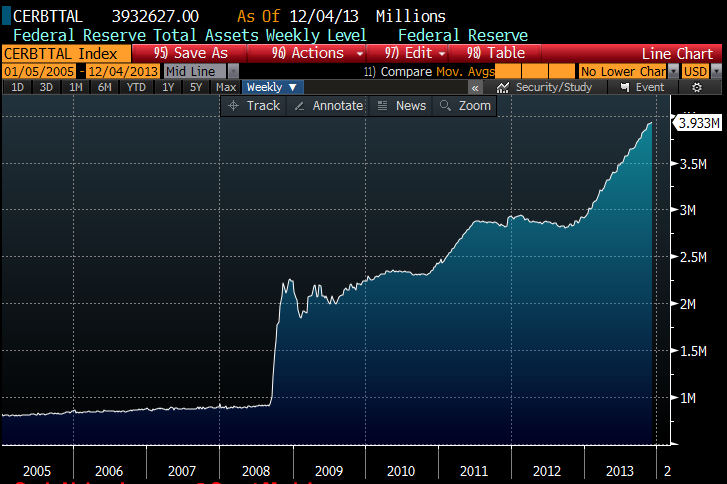
In the “now they tell us” category, QE has made the traditional method of tightening ineffective. When the Fed wants to tighten monetary policy, it would meter out the amount of money flowing into and out of the banking system on a daily basis. The Federal Funds rate was essentially the gauge they would use. Since the Fed has injected multiple trillions of liquidity into the system, the old methodology won’t work, unless they significantly drain the system, which would be disruptive to say the least. Instead it plans to repo its vast security portfolio in order to pull liquidity out of the system. Of course this won’t matter for a couple of years, but it just goes to show how much QE has changed the landscape. You can see just how much the Fed’s balance sheet has ballooned below:

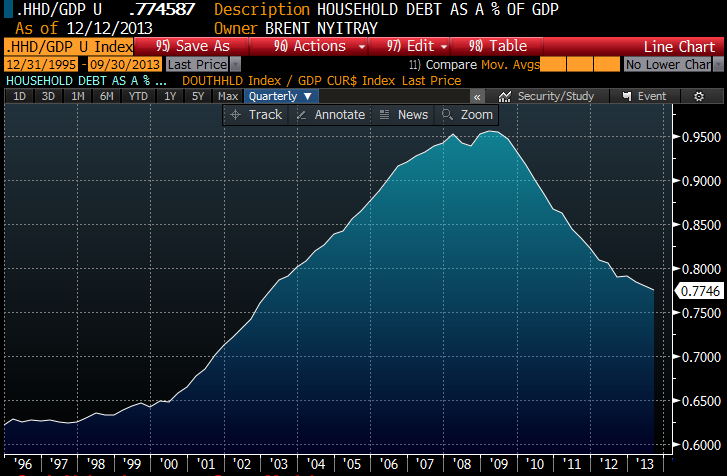
A Reuters poll of 60 economists shows they expect growth to accelerate in 2014, with GDP hitting 2.5% in Q1 and reaching 3% by year end. Continued recovery in housing, along with a pick up in capital expenditures are the keys. The consumer de-leveraging continues. You can see that household debt has fallen to 77% of GDP and is back at 2003 levels.

Morning Report – Mel is now guarding the henhouse 12/11/13

Vital Statistics:

Last Change Percent
S&P Futures 1803.5 0.4 0.02%
Eurostoxx Index 2973.6 12.7 0.43%
Oil (WTI) 98.27 -0.2 -0.24%
LIBOR 0.244 0.002 0.83%
US Dollar Index (DXY) 79.98 0.014 0.02%
10 Year Govt Bond Yield 2.82% 0.02%
Current Coupon Ginnie Mae TBA 104.8 -0.2
Current Coupon Fannie Mae TBA 103.7 -0.2
RPX Composite Real Estate Index 200.7 -0.2
BankRate 30 Year Fixed Rate Mortgage 4.42
Markets are flattish on no real news. Bonds and MBS are down small. In spite of rising rates, mortgage applications rose 1% last week as refis rose 2% and purchases rose 1%
Mel Watt was confirmed by the Senate yesterday to lead FHFA. Ed DeMarco slipped in one last G-fee increase before he left – it will be interesting to see if Watt maintains it. Exhibiting his droll sense of humor, President Obama said that Mel Watt is “just the type of regulator to make sure the kind of crisis we just went through never happens again.” Regardless of anyone’s free-market inclinations, a Mel Watt FHFA is probably better for originators than Ed DeMarco was. He wants credit loosened, he wants more mortgage activity. Watt is a CRA guy to the bone.
The other possible effect (and I’m not thoroughly convinced it will happen) is that higher coupon MBS get hit as the market factors in new prepayment assumptions. Of course that isn’t relevant for new issues, but there is a relative value trade between TBAs and existing MBS. If existing MBS get hit, TBAs probably will as well. To a LO, what this means is that your borrower won’t be able to gain as much benefit going higher up in rate as before. Again, may not happen, but is something to watch over the next few months.
The new Volcker rule is out, and it is not as harsh as the banks had feared. Principal trading in a market-making context is still allowed, although the devil is in the details and it will depend on how the regulators enforce it. The main point is that liquidity in the MBS markets should remain the way it is and not contract, which would have had the effect of raising interest rates.
It is looking like a budget confrontation isn’t happening in the new year. Paul Ryan and Patty Murray came up with a deal that weakens the sequester, and cuts the deficit by raising fees in other places. Extended unemployment benefits were not part of the deal, which means that unemployment checks will stop for millions of Americans at the beginning of the year. Also, I don’t know if the debt ceiling was addressed. So we have a couple big issues still aren’t resolved.

Morning Report – Toll Brothers reports the luxury end of the market is doing well 12/10/13

Vital Statistics:

Last Change Percent
S&P Futures 1803.5 -5.5 -0.30%
Eurostoxx Index 2964.6 -24.1 -0.81%
Oil (WTI) 98.47 1.1 1.16%
LIBOR 0.242 -0.001 -0.31%
US Dollar Index (DXY) 79.98 -0.154 -0.19%
10 Year Govt Bond Yield 2.80% -0.04%
Current Coupon Ginnie Mae TBA 104.9 0.3
Current Coupon Fannie Mae TBA 103.9 0.1
RPX Composite Real Estate Index 200.7 -0.2
BankRate 30 Year Fixed Rate Mortgage 4.44
Markets are lower this morning on no real news. Bonds and MBS are higher
Toll Brothers announced better-than expected earnings of 54 cents a share. The luxury end of the market continues to do well. Average Selling Prices increased to $703,000. Contracts were flat in the first 5 weeks of this quarter, as higher prices and interest rates tamp down demand. That said, they believe “this leveling of demand will prove temporary based on still-significant pent-up demand, the gradual strengthening of the economy and the improving prospects of our affluent customers.”
The National Federation of Independent Business Optimism Index rose to 92.5 from 91.6. This is still a relatively depressed level historically, and speaks to the great divide in American business. The S&P 500 is at record highs, while small business is still stuck in the post-bubble morass. The difference: QE is driving money into stocks, and the big US companies that make up the index have a lot of international exposure. That is why the economy feels “meh” even though the stock market is at record highs.
The Obama Administration’s latest housing scorecard is out. As of October, 1.2 million homeowners have had their principal cut through HAMP. Housing remains affordable as the NAR Housing Affordability index stands at 164.3, (lower than its peak of 213.6 in January, but well above its historical average of 135).

Morning Report – FHA lowers the upper limit on mortgages 12/9/13

Vital Statistics:


  Last Change Percent
S&P Futures  1807.0 2.0 0.11%
Eurostoxx Index 2981.6 1.6 0.05%
Oil (WTI) 97.71 0.1 0.06%
LIBOR 0.243 0.002 0.73%
US Dollar Index (DXY) 80.22 -0.098 -0.12%
10 Year Govt Bond Yield 2.85% -0.01%  
Current Coupon Ginnie Mae TBA 104.6 0.3  
Current Coupon Fannie Mae TBA 103.8 0.4  
RPX Composite Real Estate Index 200.7 -0.2  
BankRate 30 Year Fixed Rate Mortgage 4.48    


World markets are higher this morning after Friday’s stronger-than-expected jobs report. Bonds and MBS are up small as well.
 
The upcoming week is relatively data-light, so the markets will be left to fret about the FOMC meeting next week. The Street seems to be handicapping a December tapering at 50/50. Don’t forget, even if the Fed does begin to reduce asset purchases, it doesn’t necessarily follow that MBS purchases will drop. In fact, most observers think that the Fed will only reduce Treasury purchases and maintain their current rate of MBS purchases. The only reason why the Fed may want to reduce MBS purchases would be to reflect that the Fed’s current purchase rate of $40 billion a month is much higher as a percentage of total MBS issuance than it was a year ago. This is because overall issuance has fallen since the refi boom ended.
 
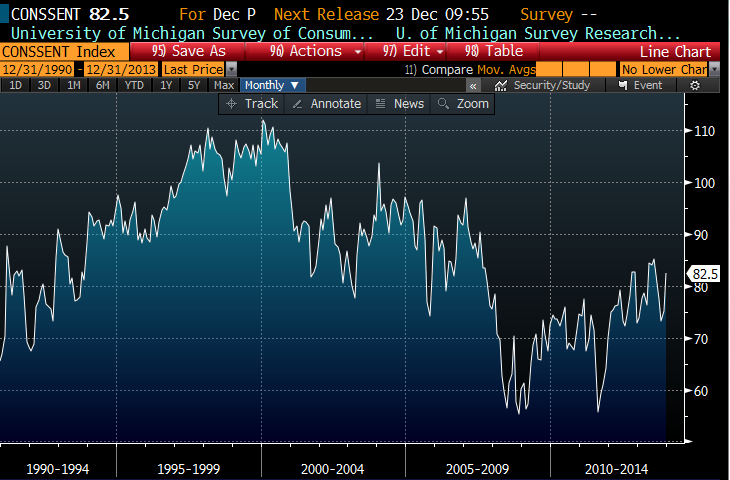
Consumer sentiment is on the rebound, but is still below what one would call “normalcy.” The chart below is of the University of Michigan Consumer Sentiment Index. You can see that we are close to post-bubble highs, but are still mired in that early 90s malaise. Consumer sentiment is a big driver of real estate activity – in fact the CEO of KB Home said that consumer sentiment matters more than interest rates, at least to the homebuilders. Things are improving, albeit slowly.


It looks like we have some sort of budget deal in Washington, which should at least take the possibility of another government shutdown off the table. It looks like some of the sharper edges of the sequester will be sanded down, and it will be paid for by increased pension contributions from Federal workers and increased airport security fees. It is a “kick the can down the road” agreement that will at least prevent some fireworks beginning next year. 


The FHA reduced the upper limit on FHA mortgages in high cost areas from $729,750 to $625,500. The jumbo market has been back for quite some time, and FHA is happy to let upper income borrowers access private capital. 

 
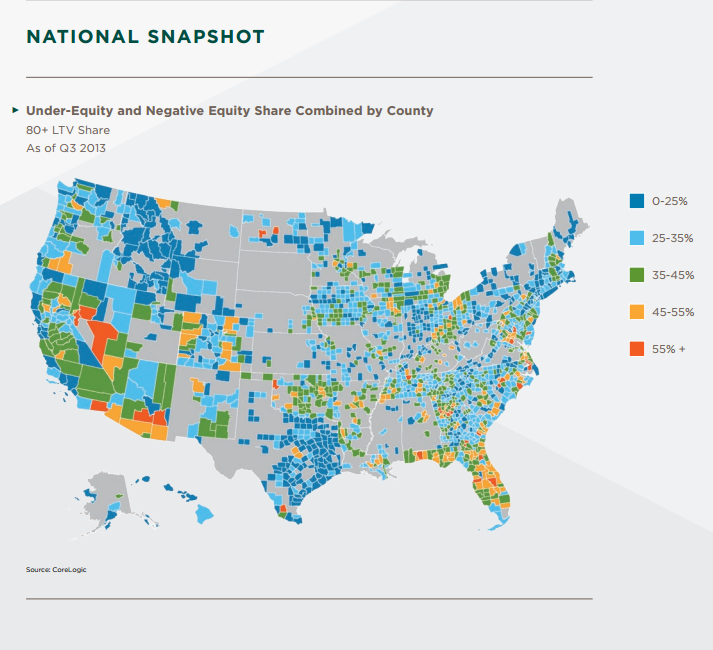
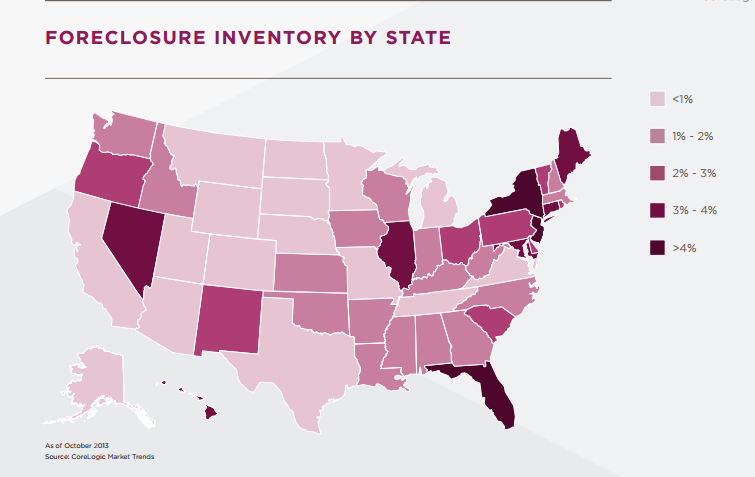
Completed foreclosures dropped 30% from a year ago, and 26% from last month, according to CoreLogic. The foreclosure pipeline is 900k homes, which is a big drop, however we are still far from “normalcy,” which would be about a quarter of that number. The judicial states still have the highest level of foreclosure inventory, as you can see from this foreclosure heat map. 


Morning Report – Goldilocks jobs report 12/6/13

Vital Statistics:


  Last Change Percent
S&P Futures  1802.1 18.1 1.01%
Eurostoxx Index 2977.9 24.7 0.84%
Oil (WTI) 97.63 0.3 0.26%
LIBOR 0.241 -0.001 -0.31%
US Dollar Index (DXY) 80.45 0.210 0.26%
10 Year Govt Bond Yield 2.85% -0.02%  
Current Coupon Ginnie Mae TBA 104.2 -0.1  
Current Coupon Fannie Mae TBA 103.5 0.1  
RPX Composite Real Estate Index 200.7 -0.2  
BankRate 30 Year Fixed Rate Mortgage 4.52    


Markets are stronger this morning on a better-than-expected jobs report. Bonds and MBS are up small, in a classic case of “buy the rumor, sell the fact.”
 
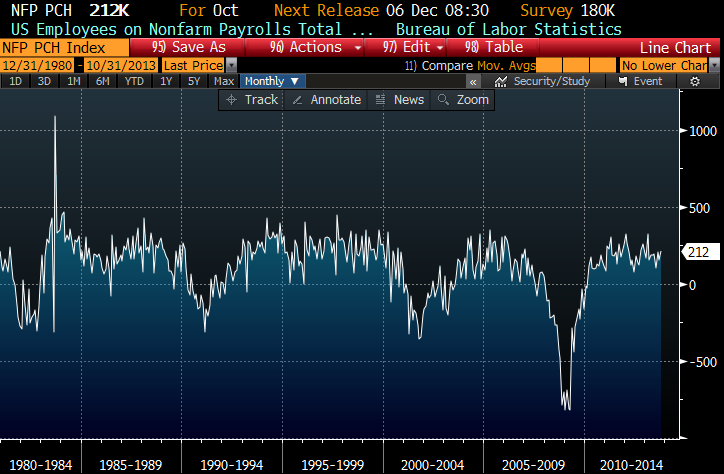
Nonfarm payrolls increased by 203,000 in November, which beat the 185,000 street estimate. The unemployment rate fell to 7% as the labor force participation rate rose from 62.8% to 63%. Personal income fell, while personal spending rose .3%. All in all, consider this a “Goldilocks” jobs report from the stock market’s perspective: strong enough to make people think about a better economy ahead, but weak enough to keep the Fed on your side. At the margin, it does make a tapering move more likely at the Fed this month.
 
It is looking like Janet Yellen and Mel Watt will be confirmed next week. 
 
Newark, NJ is moving forward with an eminent domain plan. As the cities that go this route get bigger and bigger, eventually Obama and Watt will have to take a position on this tactic. They will only be able to get away with the “it’s a local issue” dodge so long. 
 
It looks like we are close to a budget deal, which takes another government shutdown off the table. No major spending cuts, no tax increases, however some additional revenue will be raised through increasing airport security fees and PBGC premiums.

Morning Report – stronger-than-expected revision to 3Q GDP

Vital Statistics:

Last Change Percent
S&P Futures 1790.1 -1.7 -0.09%
Eurostoxx Index 2989.6 -2.2 -0.07%
Oil (WTI) 97.44 0.2 0.25%
LIBOR 0.242 0.000 -0.10%
US Dollar Index (DXY) 80.76 0.140 0.17%
10 Year Govt Bond Yield 2.86% 0.03%
Current Coupon Ginnie Mae TBA 104.3 -0.1
Current Coupon Fannie Mae TBA 103.4 -0.1
RPX Composite Real Estate Index 200.7 -0.2
BankRate 30 Year Fixed Rate Mortgage 4.52
Markets are slightly lower after a stronger-than-expected GDP report and some other good labor-market data. Bonds and MBS are selling off, and the market is setting itself up for a strong jobs report tomorrow.
The second revision to third quarter GDP came in at 3.6%, much higher than the 3.1% estimate. Consumption was a little lower than expected at 1.4%, and the inflation was at 2%. Inventory build drove the increase, and consumer spending was somewhat low, so unless spending picks up, Q3 will end up “borrowing” growth from Q4. The main takeaway from the report? Higher interest rates aren’t acting like a drag on the economy, at least not yet, which has to be a relief to the Fed.
Initial Jobless Claims printed below 300k, although that number should be taken with a grain of salt due to the Thanksgiving holiday. Challenger and Gray reported announced job cuts dropped 20% as well. The Challenger Survey looks at company press releases of restructurings and job cuts. Many of these cuts never end up materializing, but they do weigh heavily on consumer confidence.
The Street expectation for payroll growth is 185k, and a print like 220k would be considered a “blowout” number. However, historically, is that a “good” number? Actually it is. Since 1980, monthly payroll growth has averaged around 100k. During the boom years of the 95-99, payrolls averaged 224k a month. So something like 220k would be considered a “normal” expansionary number, with all the caveats about population growth, etc..

In an effort to change the subject from the growing pains of obamacare, the President gave a speech about income inequality and the need to hike the minimum wage. Politically, this is going absolutely nowhere, and all he is really doing is rallying his base. Separately, fast food workers in 100 cities today are going on strike to protest low wages. It will be interesting to see if they get any traction. The reason why inflation has been so low has been the lack of wage growth – you cannot get a wage / price spiral if the “wage” side doesn’t cooperate. The Fed wants to see a modest amount of inflation – for the average American, 3% inflation and 3% wage growth is a lot more comfortable than 0% inflation and 0% wage growth. Plus, the biggest problem for Americans is debt, and inflation is a debtor’s best friend.

Morning Report – Bonds sell off on stronger-than-expected ADP report 12/4/13

Vital Statistics:

Last Change Percent
S&P Futures 1788.0 -3.4 -0.19%
Eurostoxx Index 2988.7 -25.2 -0.84%
Oil (WTI) 97.06 1.0 1.06%
LIBOR 0.242 0.001 0.23%
US Dollar Index (DXY) 80.77 0.180 0.22%
10 Year Govt Bond Yield 2.84% 0.06%
Current Coupon Ginnie Mae TBA 104.7 -0.1
Current Coupon Fannie Mae TBA 103.4 -0.4
RPX Composite Real Estate Index 200.7 -0.2
BankRate 30 Year Fixed Rate Mortgage 4.43
Markets are lower this morning after a strong ADP employment report. Bonds and MBS are down. Later on today, we will get the ISM services index and new home sales.
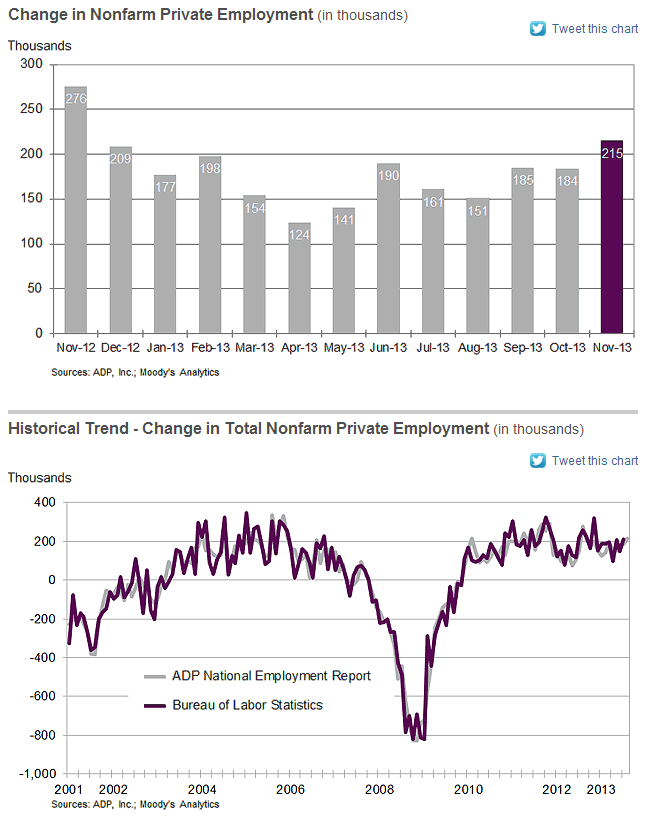
The ADP employment report showed 215k jobs added in November, above the 170k estimate. October was revised upward from 130k to 184k. The forecast for Friday’s payroll number is 175k. Lately, ADP has not been a great predictor of the upcoming jobs report, so bear that in mind. According to JP Morgan, the street is leaning heavily short going into the number, so the reaction to a strong report could be muted. Conversely a weak report could send bonds flying. A classic case of “buy the rumor, sell the fact.”

Mortgage applications fell 12.8% last week, which isn’t surprising given the holiday. Purchases dropped 4.1% while refis dipped 17.5%. Mel Watt is supposedly going to be confirmed next week and the rumor is that he wants a HARP extension for loans through 2010. So we could see some sort of refi wave, although it won’t be anything like 2012 was.
Smaller mortgage lenders have been picking up market share, according to Inside Mortgage Finance. As of Q3, they had a 60% market share vs 39% share in 2009. One reason – the big banks have tightened credit standards and are taking longer to process loans than smaller lenders. LOs, this is a good selling point to bring up with your realtor contacts – what realtor wants to get paid later rather than sooner?
Detroit has filed for bankruptcy, and it looks like pensions and creditors will likely take a hit. Detroit owes more than $18 billion and cannot perform even basic services. Half of that debt is retiree benefits. If Detroit was a company, they would be filing Chapter 7, not Chapter 11. Given the crime rate in the city, I don’t know what brings business back into Detroit. Almost on cue, Fitch, which recently cut Chicago’s rating, is predicting there will be more muni downgrades than upgrades in 2014.
Here is what the CFPB is going to be up to over the next few months.
Bill Gross’s Investment Outlook is pretty good:  If you look at asset prices, there is an implied growth rate built in. But that implied growth rate is based in part on risk-free asset prices that are being manipulated by the Fed. That implied growth hasn’t happened yet, and it may never materialize. Then what?

Morning Report – Bonds sell off on strong ISM report 12/3/13

Vital Statistics:

Last Change Percent
S&P Futures 1794.3 -5.4 -0.30%
Eurostoxx Index 3033.9 -43.3 -1.41%
Oil (WTI) 93.81 0.0 -0.01%
LIBOR 0.241 0.002 1.03%
US Dollar Index (DXY) 80.62 -0.302 -0.37%
10 Year Govt Bond Yield 2.77% -0.03%
Current Coupon Ginnie Mae TBA 105 0.1
Current Coupon Fannie Mae TBA 104.1 0.1
RPX Composite Real Estate Index 200.7 -0.2
BankRate 30 Year Fixed Rate Mortgage 4.43
Weaker overseas markets mean US stocks are soggy this morning. Bonds and MBS are rallying small. Later on this morning, we will get the ISM New York and IBD / TIPP economic optimism.
Corelogic reported that home prices were up 12.5% year over year and up .2% in October. Home prices remain 17.3% below their April 2006 peak. The .2% month-over-month gain shows that real estate price growth is moderating, which was more or less to be expected. Almost half the states in the US are within 10% of their respective historical price peaks.
Yesterday’s bond sell-off was triggered by a better-than-expected ISM report, which showed that manufacturing is improving in the US and is approaching two year highs. If you look at the historical relationship between the ISM and GDP growth, the November number of 57.3 corresponds to a 4.7% increase in real GDP. The 2013 average corresponds to a 3.6% increase. Manufacturing isn’t as large of a component of the US economy as it used to be, but it does show that at least one major sector in the US is picking up steam.
The other sector that really matters is housing / construction, and there we still have relatively moribund numbers, although they are steadily building back off the lows. Construction spending increased .8% month over month in October after falling .3% in September. We still have yet to get housing starts data since August, but building permits topped a 1 million pace in October. Part of the reason why this recovery has been so weak is that housing is usually the first industry to rebound after a recession and we are still at very depressed levels historically. Part of that has to do with the excesses of the bubble and low household formation numbers due to the lousy job market. The excesses of the bubble are more or less reversed and if anything, we have a deficit. The low household formation numbers have been driven by a lousy job market, not fertility rates 25 years ago, and therefore represents pent-up demand. This state of affairs cannot last (and won’t).
So maybe the holidays won’t be so bad after all. It looks like Cyber Monday sales were record-breaking after Black Friday sales were disappointing. Even still, it looks like the retailers are being highly promotional, which doesn’t exactly speak to a healthy consumer environment. Many noted that using a deal as “bait” fell flat on its face as customers got in line to purchase one specific item, and bought it without buying anything else. Back-to-School was lousy, so it is hard to get over-optimistic about the holiday shopping season. One other thing to note – we can now look forward to the FAA regulating internet sales.

Morning Report – Black Friday disappoints 12/2/13

Vital Statistics:

Last Change Percent
S&P Futures 1804.7 0.6 0.03%
Eurostoxx Index 3080.2 -6.4 -0.21%
Oil (WTI) 93.09 0.4 0.40%
LIBOR 0.239 0.000 -0.10%
US Dollar Index (DXY) 80.9 0.220 0.27%
10 Year Govt Bond Yield 2.78% 0.03%
Current Coupon Ginnie Mae TBA 105.3 0.0
Current Coupon Fannie Mae TBA 104.1 -0.2
RPX Composite Real Estate Index 200.7 -0.2
BankRate 30 Year Fixed Rate Mortgage 4.38
Markets are flattish as traders return from a long weekend. Bonds and MBS are down. At 10:00 we will get the ISM manufacturing report and construction spending.
There is a lot of data this week, starting with the ISM report today, GDP on Thursday, and the all-important jobs report on Friday. Given the October surprise and the fact that the bar is set pretty low for Friday’s report (180k jobs / 7.2% unemployment) bonds could be vulnerable as any upside surprise will re-ignite December taper talk.
Black Friday was disappointing according to the National Retail Federation, as retailers were highly promotional early into the holiday shopping season. We have seen Wal Mart and Target already cut profit forecasts for the year. On Thursday, we will get the comp store data dump from all the retailers as they report November same store sales. We might see some profit warnings as well. It is hard to see how the Fed sees growth accelerating into 2014 with a consumer that is still cautious.
The White House is saying that the healthcare.gov website is operating fine, therefore it made its self-imposed Dec 1 deadline. The Administration is hoping that this will mollify Democrats in red districts with cold feet about the whole thing. We’ll see if it actually “works for the vast majority of users” as HHS claims it does.

Morning Report – NAR forecasting home prices to moderate in 2014 11/27/13

Last Change Percent
S&P Futures 1805.0 3.0 0.17%
Eurostoxx Index 3084.1 21.5 0.70%
Oil (WTI) 92.22 -1.5 -1.56%
LIBOR 0.2376 0.001 0.42%
US Dollar Index (DXY) 80.67 0.059 0.07%
10 Year Govt Bond Yield 2.73% 0.02%
Current Coupon Ginnie Mae TBA 105.234 -0.2
Current Coupon Fannie Mae TBA 104.344 -0.2
RPX Composite Real Estate Index 200.67 -0.2
BankRate 30 Year Fixed Rate Mortgage 4.33
Markets are higher this morning after a mixed bag of economic reports. Due to the Thanksgiving Day holiday, this morning included reports scheduled for tomorrow. Bonds and MBS are down small.
Initial Jobless Claims came in at 316k, the lowest level in 2 months. Durable Goods orders fell 2%, which was more or less in line with Street expectations. Consumer Confidence came in higher than expected. Chicago Purchasing Managers dropped, but not as much as expected. Finally leading economic indicators rose .2%. Bottom line: so much for the theory that the government shutdown affected the economy outside of the luxury car dealerships around Tyson’s Corner.
Mortgage Applications fell slightly as rates ticked up a couple of basis points. Surprisingly, refis rose while purchases fell.
FHFA decided not to change the conforming loan limits, which really isn’t much of a surprise. Incoming FHFA Chairman Mel Watt does not have an appetite for reducing the government’s footprint in the mortgage market. Whether that means anything for FNMA shareholders (and pref holders) is an open question. Ralph Nader (yes) is agitating in defense of shareholders.
Again, I think the under-appreciated story is that Mel Watt will in fact be the new FHFA Chairman. This means principal reductions on loans held by F&F, a probable extension (and loosening) of the HARP plan, and definitely more focus on low-income lending. Watt is a CRA guy to the bone. The reason why the MBA has supported his candidacy was because he would presumably usher in a wave of refis.
Pending Home Sales dropped .6%, according to the National Association of Realtors. This is unsurprising given the government shutdown and the inability of mortgage bankers to get tax returns out of the IRS. The NAR is warning that the new QM rules may depress sales in early 2014. They also forecast home price growth to slow from 11% in 2013 to 5% in 2014. It is an interesting dynamic with tight inventory on one hand, and decreasing affordability on the other. If the job market improves, especially for the Millenials, there will be a wave of pent-up demand that is going to enter the market. Household formation has been severely depressed over the past 6 years, not due to demographics, but due to a lousy economy. Homebuilders have underbuilt for ten years, and foreclosures remain tied up in the courts in the judicial states. And while affordability may have decreased, anyone with gray hair remembers the days when a 4.5% mortgage was considered unheard-of, something that your dad might have been able to get in the 1960s, but a relic of a bygone era.