Morning Report – Harry goes nuclear, Watt does that mean? 11/26/13

Vital Statistics:

Last Change Percent
S&P Futures 1802.7 0.3 0.02%
Eurostoxx Index 3068.0 -4.8 -0.16%
Oil (WTI) 94.1 0.0 0.01%
LIBOR 0.2366 0.001 0.32%
US Dollar Index (DXY) 80.865 -0.055 -0.07%
10 Year Govt Bond Yield 2.71% -0.01%
Current Coupon Ginnie Mae TBA 105.365 0.0
Current Coupon Fannie Mae TBA 104.477 0.1
RPX Composite Real Estate Index 200.67 -0.2
BankRate 30 Year Fixed Rate Mortgage 4.34
Sorry I haven’t put one of these out in the last couple of days – been traveling for the holidays.
Markets are flattish on no major news. This week should be relatively dull, with no major economic reports. Bonds and MBS are flat as well.
We have had some economic data over the past couple of days. Pending Home Sales came in at -.6%, which is evidence the housing recovery may be slowing down a bit. That said, prices are still rising at a rapid clip, with the Case-Shiller index up 13.3% on a year-over-year basis and the FHFA House Price Index up 2% for the third quarter.
Building Permits came in at 974k, higher than the Street estimate. We didn’t get housing starts today due to the government shutdown.
One piece of news from last week – Harry Reid “went nuclear” and changed the rules regarding Presidential nominations. Now, nominees cannot be filibustered. Watt does that mean? It means Mel Watt will be the next FHFA Chairman. Mel Watt is basically a CRA guy, so expect a lot of fair-lending scrutiny. Also, he will do everything he can to expand HARP and HAMP. Watt does that mean for originators? Maybe one more refi wave.
Mel Watt wouldn’t take a position on the use of eminent domain to handle underwater mortgages, which is pretty much tacit approval of the strategy. Expect a lot of consumer friendly / investor unfriendly stuff to come down the pike. Principal mods are almost a given, although there will be push-back from investors. Not that the government is going to care about hurting hedge funds or mortgage REITs, but there are investors they do care about, namely pension funds. Pension funds have been begging the government not to do this, and this will certainly lead to interesting political dynamics.

Morning Report – Parsing the FOMC minutes 11/21/13

Vital Statistics:

Last Change Percent
S&P Futures 1783.8 4.1 0.23%
Eurostoxx Index 3050.5 3.2 0.10%
Oil (WTI) 94.25 0.4 0.43%
LIBOR 0.238 -0.001 -0.21%
US Dollar Index (DXY) 81.08 -0.035 -0.04%
10 Year Govt Bond Yield 2.81% 0.01%
Current Coupon Ginnie Mae TBA 105.3 -0.4
Current Coupon Fannie Mae TBA 104.3 -0.1
RPX Composite Real Estate Index 200.7 -0.2
BankRate 30 Year Fixed Rate Mortgage 4.38
Markets are higher this morning on no real news. Bonds and MBS continue their post-FOMC minutes sell-off.
Initial Jobless Claims came in at 323k, lower than the 335k street forecast. Inflation at the wholesale level remains muted.
The bond market sold off on the FOMC minutes, as people who had been holding out hope that the September non-move meant QE4EVA were disabused of that notion. The Fed largely dismissed the effects of the government shutdown as “temporary and limited.” Given the October jobs report and October retail sales, they are correct – we just didn’t see any effect from the shutdown except for a temporary spike in the 1 month T-bill. They again repeated the view that the economy is strengthening, and if things play out as we expect, we should be tapering QE in the next few months.
Sometimes you have to parse the Fed’s characterization of things. On the Fed’s scale:
Economic Growth – “moderate”
Inflation – “modest”
Corporate Credit – “robust”
CAPEX – “tepid”
In other words, growth is just ok, inflation is too low, business investment is way too low, and the Fed is beginning to worry about bond investors reaching for yield. This means that QE’ days are numbered as the risks of an overheated credit market are becoming larger than the risk of a credit crunch. However, low interest rates are probably here to stay until business investment, inflation, and employment are closer to where the Fed wants to see things.
One thing to keep in mind is that the Fed’s footprint has been increasing in the MBS market as issuance drops. The end of the refi boom meant lower overall MBS issuance but the Fed has been been maintaining a constant $40 billion a month. As a percentage of total volume, their footprint has been increasing. You can see it in MBS spreads, which have tightened to Treasuries. While the market has been of the view that the Fed would taper Treasury purchases first, lest it derail the nascent housing recovery, an adjustment in MBS is probably in order. This could mean a double-whammy for mortgage rates – The benchmark (Treasuries) increases in rate, and the spread to Treasuries increases as well. Float at your own peril..
I find it ironic that the Fed worries about people conflating a reduction in QE with a tightening of monetary policy, yet at the same time refers to “fiscal headwinds.” Reality Check: fiscal policy is about as loose as it gets, unless you compare it to a completely artificial benchmark of the past 5 years. Post WWII, government spending averaged around 19% of GDP. We have averaged 24% over the past 5 years. We are still at 22%. 5 of the 7 largest postwar deficits as a percent of GDP have been in the past 5 years. Calling a slight reduction in government spending as a “fiscal headwind” makes as much sense as characterizing a reduction in asset purchases from 85 billion a month to 65 billion a month as “tightening monetary policy.” It is the dieting equivalent of having a diet coke with your triple whopper value meal.
As home prices rise, negative equity has continued to fall, according to Zillow. The percentage of homes with negative equity dropped to 21% in the third quarter from 23.8% in the previous quarter. Negative equity has been a big reason why existing home sales have been so depressed. Yesterday we saw an annualized pace of 5.12 million, which is slightly below average. IMO, there is pent-up demand that is being held back by negative equity. As that condition rights itself, we should see existing home sales numbers well in excess of historical averages. The mortgage bankers who do purchase activity well will reap the benefit.

Morning Report – Median House price increases 12.8% 11/20/13

Vital Statistics:

Last Change Percent
S&P Futures 1788.5 3.3 0.18%
Eurostoxx Index 3043.7 -5.5 -0.18%
Oil (WTI) 93.71 0.4 0.40%
LIBOR 0.238 -0.001 -0.42%
US Dollar Index (DXY) 80.64 -0.066 -0.08%
10 Year Govt Bond Yield 2.73% 0.02%
Current Coupon Ginnie Mae TBA 105.6 -0.1
Current Coupon Fannie Mae TBA 104.8 0.0
RPX Composite Real Estate Index 200.7 -0.2
BankRate 30 Year Fixed Rate Mortgage 4.3
Markets are higher after retail sales came in a bit better than expected. Bonds and MBS are down small. Later on today, we will get the minutes from the October FOMC meeting. It will be interesting to see if the credibility argument is still being made.
Existing Home Sales dropped to an annualized pace of 5.12 million in October according to the National Association of Realtors. The median house price rose 12.8% from a year ago to $199.500. Days on market increased to 54 and months of supply increased to 5. Inventory on the West Coast is still tight.
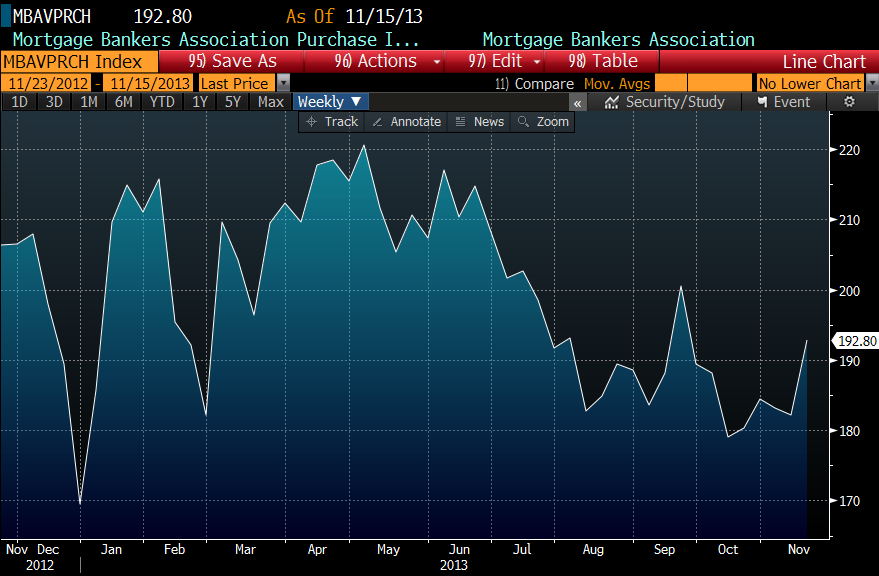
Mortgage applications fell 2.3% during the holiday-shortened week. Purchases jumped 5.8%, while refis dropped 6.5%. Not sure what drove the jump in purchases. Refis as a percent of total number of loans fell to 64.3%.
Chart: MBA Purchase Index

The Consumer Price Index came in as expected, with a .1% decrease month-over-month and a 1% increase year over year. Ex food and energy, prices rose .2% month-over-month and 1.7% year-over-year. Certainly not enough of an increase to get the Fed worked up about inflation. If anything, they probably think it is too low.

Retail Sales came in at +.4% for October, which is yet another sign that the consumer (and the economy) basically yawned at the government shutdown. For all the sturm and drang out of guys like Mark Zandi saying the shutdown would lop 1.4% off of 4Q GDP growth, we have yet to see any tangible evidence it so far. Payroll was par for the post-recession course, retail sales were above average.

Housing-related expenditures make up about 17.6% of GDP, according to CoreLogic. This is up slightly from a year ago, but well below the peak of 20.6% in 2005. Part of the reason why this recovery has been so maddeningly tepid has been the absence of housing spending, particularly housing starts. Housing starts used to average around 1.5 million units a year from the sixties to the bubble years. Since then, we have been averaged under half of that. Since housing construction usually leads us out of a recovery, it absence has meant this slog of 1% – 2% GDP growth. Note that the homebuilders were noting mid teens increases in average selling prices amidst a drop in traffic. At some point, they are going to have to pump up the volume in order to meet achieve further growth. And that could be what we have been waiting for.

I went on Louis Amaya’s show yesterday and talked about the mortgage originators, servicers, and some of the REITs. I also discussed the origination business in general and trends going forward. The link is here.

Morning Report – 11/19/13 – Fedspeak

Vital Statistics:

Last Change Percent
S&P Futures 1787.7 -1.0 -0.06%
Eurostoxx Index 3059.2 -22.1 -0.72%
Oil (WTI) 92.83 -0.2 -0.21%
LIBOR 0.239 0.002 0.74%
US Dollar Index (DXY) 80.73 -0.098 -0.12%
10 Year Govt Bond Yield 2.69% 0.03%
Current Coupon Ginnie Mae TBA 106.1 0.0
Current Coupon Fannie Mae TBA 105 -0.1
RPX Composite Real Estate Index 200.7 -0.2
BankRate 30 Year Fixed Rate Mortgage 4.33

Markets are lower this morning on no real news. The employment cost index rose .4% in the third quarter, lower than expected. Bonds and MBS are down small.

Yesterday we had some Fed-speak with Philly Fed Head Charles Plosser urging the Fed to stop playing “this bond buying game by ear” and to tell the markets how much the Fed intends to buy and then to stop once it gets to that level. Plosser also claimed that the recent low inflation numbers were transitory due to lower government spending on things like Medicare. Separately, New York Federal Reserve Chairman William Dudley said he is becoming more optimistic that 2014 and 2015 will be much stronger than 2013. He said the “fiscal drag” of the sequester is abating. Pet peeve – the Fed goes out of its way to say that reducing tapering is not “tightening,” yet refers to a tiny reduction in unprecedented postwar fiscal stimulus as “fiscal drag.” Even with the sequester, fiscal policy is still highly, highly accommodative and looks miserly only if you compare it to 2009 or 2010.
Good story out of Bloomberg on the pickle the Fed is in with respect to QE.  How to reduce tapering without increasing interest rates. The Fed would really, really like to avoid a repeat of last summer where the 10 year bond increased by 100 basis points. Yellen said in her testimony that the answer was better communication, however as everyone has acknowledged, we are in uncharted territory here. Separately, the Senate Banking Committee is scheduled to vote on Yellen Thursday, which will set the stage for a full Senate vote later this year.Tomorrow starts the big data dump for the week with a slew of economic reports. We will get the minutes from the October FOMC meeting, existing home sales, retail sales and the consumer price index.

Speaking of retail sales, the holiday shopping season is shaping up to be on the weak side. We have already seen two warnings out of Wal Mart this year, and now Best Buy is saying that promotional activity is going to hurt margins. I keep hearing anecdotal evidence that the retailers are getting promotional already, which is a bad sign ahead of Thanksgiving. On the other hand, the Despot reported better than expected 3rd quarter earnings as people are taking advantage of the increase in house prices to do some remodeling.

Remember the 2012 jobs report ahead of the election where Jack Welch tweeted “”Unbelievable jobs numbers…these Chicago guys will do anything…can’t debate so change numbers,” He was fired from Fortune over that. Well, it turns out that he may have been correct. Census may have been doing some monkey business with the report.

Small banks asked for some temporary relief from some of the new edicts coming out of CFPB and were given the Heisman. CFPB has said that they will take into account good faith efforts to comply with the rules, but as Rob Chrisman points out, the plaintiffs’ attorneys definitely will not.

Morning Report – Slowish week ahead 11/18/13

Vital Statistics:


  Last Change Percent
S&P Futures  1796.1 2.6 0.14%
Eurostoxx Index 3082.4 27.9 0.91%
Oil (WTI) 93.46 -0.4 -0.40%
LIBOR 0.237 -0.001 -0.31%
US Dollar Index (DXY) 80.67 -0.176 -0.22%
10 Year Govt Bond Yield 2.70% -0.01%  
Current Coupon Ginnie Mae TBA 105.9 0.0  
Current Coupon Fannie Mae TBA 104.8 0.0  
RPX Composite Real Estate Index 200.7 -0.2  
BankRate 30 Year Fixed Rate Mortgage 4.3    
Markets are up small this morning on no major news. Bonds and MBS are up small.
We don’t have a tremendous amount of economic data this week, although we will get the minutes from the October FOMC meeting. Analysts will be looking for clues regarding December. Remember the state of play from the Sep meeting – the Fed didn’t think the economic data warranted reducing asset purchases, but some felt like they had to do it anyway, just to maintain credibility. I don’t think the credibility argument really applies anymore, although the Fed may do a token move just to say they did it. Also the market seems pretty convinced that any changes will be on the Treasury side, not the MBS side. (That doesn’t mean mortgage rates won’t go up, they will)
Earnings season is largely over, except for the retailers. I think the consensus is that this year’s holiday season will be nothing to get all excited about. We will hear from the Despot tomorrow and Lowe’s on Wednesday. Wal Mart is watching closely to see if the obamacare insurance mandates hurt sales.
The future of Fannie and Fredie is still being worked out. The Senate has to balance the demand from liberals that the mortgage market serve all markets equitably and from conservatives that the taxpayer has to be protected. The goal is to wind down F&F and replace them with a re-insurer which will cover losses over 10%. Will Ackman and Fairholme play a role in this? That will be up to the courts.
Eminent Domain:  The bad idea that won’t die. Now Irvington, N.J. is considering. How many of these loans were CRA-driven in the first place? I wonder…

Morning Report – Private entities trying to force something with Fan and Fred 11/15/13

Vital Statistics:

Last Change Percent
S&P Futures 1791.2 3.5 0.20%
Eurostoxx Index 3057.4 3.7 0.12%
Oil (WTI) 93.88 0.1 0.13%
LIBOR 0.238 0.000 -0.15%
US Dollar Index (DXY) 80.88 -0.141 -0.17%
10 Year Govt Bond Yield 2.70% 0.01%
Current Coupon Ginnie Mae TBA 105.7 -0.2
Current Coupon Fannie Mae TBA 104.6 -0.1
RPX Composite Real Estate Index 200.7 -0.2
BankRate 30 Year Fixed Rate Mortgage 4.34
Markets are higher on no real news. Bonds and MBS are down small.
The Empire Manufacturing Survey came in lower than expected and import prices fell. Industrial Production and Capacity Utilization fell.
Bill Ackman has taken a 10% stake in Fannie Mae and Freddie Mac and may seek talks. This comes on the back of Fairholme’s bid to buy the insurance units of Fan and Fred. Fairholme’s bid would probably be denied by the government. Many in the financial community view the government’s changing the terms of the bailout just as Fannie and Fred became profitable as dirty pool. The government owns 80% of Fannie Mae and Freddie Mac’s stock and doesn’t have to do anything it doesn’t want to, but it certainly cannot relish the thought of dueling in the press with guys like Ackman, Pauson, and Berkowitz.
Housing affordability fell in the third quarter as prices rose and interest rates increased, according to the NAHB.
Janet Yellen’s testimony was pretty much as predicted. She is a dove. Reading the tea leaves, however it appears she is in no rush to begin tapering. Punch line:  I don’t know how you could have come out of that meeting thinking “I gotta short some bonds, right here.” Here is my longer take on it from yesterday: http://thenadtearsheet.blogspot.com/2013/11/janet-yellen-data-dump_14.html

Janet Yellen data dump

Janet Yellen testified in front of the Senate Banking Committee today and overall, there were few surprises. It is becoming clear that she intends to continue most of the Bernanke Fed’s policies, and to be honest I couldn’t find anything she would do differently. Her reception was generally good, and the Senators were respectful. Most of the questioning had to do with banking regulation, income inequality, the existence of asset bubbles and the size of the Fed’s balance sheet.

Here are some of the discussion points:

On current monetary policy: The Fed is seeking a strong and robust recovery, and must not jeopardize it by removing accomodation too early. She does not want to remove support while recovery is fragile. It is costly to withdraw accomodation or fail to provide adequate accomodation, and the Fed has the tools and the will to withdraw accomodation at the right time.

On asset bubbles: The Fed should attempt to detect asset bubbles when they are forming, however the first line of defense should be regulatory. Monetary policy is a blunt instrument and should be used if other measures aren’t working. She won’t rule out using monetary policy to address bubbles, but prefers that we use regulatory measures (such as increased capital requirements, higher risk retention requirements, etc) to prevent bubbles from occurring.  Separately, she sees little evidence that there are bubbles currently forming in the real estate market.

On banking regulation: Too Big To Fail imposes costs on the economy and should be avoided if possible. The government is making progress in handling too big to fail. They will raise capital standards further and the Fed is looking at requiring banks to issue additional unsecured debt at the holding company level to raise capital. She wants to ensure that the system isn’t set up to advantage the larger banks at the expense of the smaller banks.

On communication: In a nod to the volatility of the bond market over the summer, she said that she wants the Fed to communicate as clearly as possible with the markets and will redouble efforts to reduce volatility. This follows Bernanke, and is a departure from the Fed of the past, where they wanted to be as opaque as possible, lest the market anticipate what they were going to do, which would limit the effectiveness.

On QE and the balance sheet: Yellen was asked repeatedly about the effects of QE. She stressed that QE is being done to help the economy, not to help the government finance its deficit. When pressed about the size of the Fed’s balance sheet, she was forced to admit it is unprecedented for the US Central bank, but it was not unprecedented compared to other central banks. She acknowledged there are costs and risks to such a large balance sheet, and opposes any sort of Congressional audit of the Fed lest it reduce the Fed’s independence.

On income inequality: The Democratic Senators pretty much focused on income inequality, and what could be done about it. Yellen acknowledged that asset prices are rising, and that primarily benefits the rich, however the point of QE is to help the economy recover, and the best thing we can do for the middle class is to have a robust economy. She also acknowledged that QE is doing a number on seniors who rely on interest from safe assets to supplement social security. She views income inequality as a serious problem.

On the dual mandate: She stressed that the Fed must prevent inflation that is too low, and that deflation is a terrible thing. She refused to say what she thought “full employment” was, other than to give a range that it is probably in the 5% to 6% range. She also said that fiscal policy was working at cross purposes with what the Fed is trying to do. She also acknowledged that the reported unemployment rate understates the severity of the problem.

Key Takeaways:

While not admitting it, she seems to indicate the Fed goofed when it talked about withdrawing accomodation last June and causing the subsequent bond market sell-off. Expect the Fed under Yellen to be more communicative and she will probably try and clear up the confusion over tapering QE. It certainly seems she intends to err on the side of caution, provided there is no evidence of asset bubbles and inflation is at or below its 2% target rate.

The comment about full employment being in the 5% to 6% range was interesting as well. We spent many years over the past couple of decades with unemployment under 5% (it actually got below 4% in 2000). Does that mean the Fed will begin to start tightening before it ever gets to that level? Perhaps.

On asset bubbles, she does not hold the view that the Fed had a role in inflating the real estate bubble or the stock market bubble. Those bubbles were due to regulatory failure. It is ironic that the Fed has a problem with “too much money chasing too few goods” – in other words “inflation”, but is ok with “too much money chasing too few assets” – in other words a bubble. This is unsurprising; and suggests that the punch bowl might hang around a little longer than expected.

Morning Report – Here’s Janet! 11/14/13

Vital Statistics:

Last Change Percent
S&P Futures 1782.4 3.7 0.21%
Eurostoxx Index 3041.1 20.0 0.66%
Oil (WTI) 93.35 -0.5 -0.56%
LIBOR 0.238 -0.002 -0.89%
US Dollar Index (DXY) 81.08 0.156 0.19%
10 Year Govt Bond Yield 2.71% 0.01%
Current Coupon Ginnie Mae TBA 105.4 0.4
Current Coupon Fannie Mae TBA 104.5 0.1
RPX Composite Real Estate Index 200.7 -0.2
BankRate 30 Year Fixed Rate Mortgage 4.38
Markets are higher this morning on no real news. Bonds and MBS are flattish.
Wal-Mart cut its profit forecast due to the weaker economy at the lower end of the income spectrum and increased competition from dollar stores.
Finally, some economic data, although nothing market-moving. Initial Jobless Claims came in at 339k, a touch higher than the 330k forecast. Productivity was 1.9% vs Street expectaions of 2.2% and unit labor costs fell .6%. Later on today, we will get the Bloomberg Consumer Comfort index. Philly Fed President Charles Plosser will be speaking momentarily – he is a hawk so bonds could sell off on his comments.
Janet Yellen is scheduled to appear in front of the Senate Banking Committee today. Here are her prepared remarks. First thing off the bat, no mention of QE or tapering. For the most part nothing in the statement suggests any sort of change in direction from the Bernanke Fed. She intends to continue with the policy of keeping the markets informed of the Fed’s thinking, and believes that the dual mandate requires her to boost inflation if it is too low. She is committed to making sure the too big to fail banks are regulated, while at the same time she wants to lower the regulatory burden on small community banks. These sort of hearings are more or less dog and pony shows for the benefit of politicians, not public consumption. They don’t ask questions, they make statements. I don’t expect anything market-moving to come out of this, but just be aware. While there are a few people who want to use her nomination as leverage to advance other items, she should be confirmed easily.
Abby Joseph Cohen loves stocks right here..
Bidding wars on the West Coast are beginning to wane as inventory builds. Expect to see this reflected in the home price indices going forward. This could be a welcome development for the mortgage industry as professionals exit and real buyers (the ones who will need a mortgage) enter.

Morning Report – Mortgage Credit beginning to ease up 11/13/13

Vital Statistics:

Last Change Percent
S&P Futures 1755.5 -9.6 -0.54%
Eurostoxx Index 3006.0 -28.7 -0.95%
Oil (WTI) 93.31 0.3 0.29%
LIBOR 0.241 0.001 0.56%
US Dollar Index (DXY) 81.15 -0.041 -0.05%
10 Year Govt Bond Yield 2.73% -0.04%
Current Coupon Ginnie Mae TBA 105.2 0.2
Current Coupon Fannie Mae TBA 104.2 0.3
RPX Composite Real Estate Index 200.7 -0.2
BankRate 30 Year Fixed Rate Mortgage 4.51
Markets are lower after Atlanta Fed President Dennis Lockhart said a paring of U.S. bond purchases could very well take place next month. Bonds and MBS are up; however.
Mortgage Applications fell 1.8% last week, with purchases down .5% and refis down 2.3%. We had a huge move in rates last week, but it took place on Friday. This week’s numbers will probably be horrendous.
Mortgage Credit Availability increased slightly in October, according to the Mortgage Bankers Association. On one hand, some lenders increased lowered their FICO floor, but others restricted cash-out refis. The net effect was a slight increase in credit availability. FWIW, given the end of the refi boom, it looks like bankers realize they have to go our further on the credit curve. Redwood Trust announced on its conference call that it is diversifying away from strictly high quality jumbos and will look at the non-QM space.
Tri-Pointe Homes reported better than expected sales and earnings, and took up full year guidance. They are buying Weyerhaeuser’s home building unit as well. We are starting to see more M&A in the homebuilding space.
Transunion reported that the national average for 60 day delinquencies is 4.09%. The worst states are the judicial states, while the best are the northern mountain / midwest states. They have a cool interactive map where you can see DQ rates by state.

Morning Report: 5.4% mortgage by the end of 2014? 11/12/13

Vital Statistics:

Last Change Percent
S&P Futures 1763.2 -4.4 -0.25%
Eurostoxx Index 3039.5 -13.3 -0.44%
Oil (WTI) 95.06 -0.1 -0.08%
LIBOR 0.239 0.000 0.00%
US Dollar Index (DXY) 81.12 0.028 0.03%
10 Year Govt Bond Yield 2.77% 0.02%
Current Coupon Ginnie Mae TBA 105.2 -0.8
Current Coupon Fannie Mae TBA 103.9 -0.1
RPX Composite Real Estate Index 200.7 -0.2
BankRate 30 Year Fixed Rate Mortgage 4.39
Markets are lower as bond traders come back from a long weekend. Bonds and MBS continue their post jobs report sell-off.
The Chicago Fed National Activity Index ticked up a bit in September, while the 4 month moving average remained negative.
The NFIB Small Business Optimism Report fell from 93.9 to 91.6. He points out that small business is still struggling. That is an important point to remember – the S&P 500 is not a representative sample of U.S. business. Most of the big S&P names have exposure to fast-growing overseas markets and benefit from all the liquidity being pumped into the system by the world’s central banks. Small business is more affected by weak demand domestically. The government shutdown weighed on sentiment as well.
With not a lot of economic data, Fed-speak becomes more important. Dallas Fed President Richard Fisher told CNBC that the markets should bear in mind that QE cannot last forever. The balance sheet is $4 trillion and there are limits to what the Federal Reserve can do. Minneapolis Fed President Kocherlakota will talk about monetary strategy at 1:00 pm EST and Atlanta Fed President Dennis Lockhart will discuss the economy at 1:50 EST.
Homebuilder D.R. Horton reported earnings in line with estimates. Average selling prices climbed 15% as a combination of tight supply and low inventory allows the builders to hike prices at will. The stock is up in the pre-market.
NAR’s Chief Economist Lawrence Yun is making predictions about 2014. Exiting Home Sales will be flat at about 5.1 million units, prices will rise by 6% and the the 30 year fixed rate mortgage will end the year at 5.4%. New Home construction will increase to meet demand (at some point the builders will stop seeing price increases and will have to pump up volume to achieve growth). Lending standards will continue to ease and an improving job market will increase activity. If cash sales drop as a percentage of total sales, the purchase business should improve, but probably not enough to offset the end of the refi boom.