Morning Report: Janet Yellen testifying today

Stocks are flattish this morning as economic data and earnings pile in. Bonds and MBS are down.

Janet Yellen will testify in front of the House Financial Services Committee this morning at 10:00. Her prepared remarks are here. She is basically saying the economy is expected to re-accelerate after the Q1 weakness, and if that plays out as expected, the Fed will probably make the move off the zero bound later this year. The rest of the testimony will generally consist of Republicans trying to get her to say that government spending and taxes are too high, and Democrats trying to get her to say that income inequality is the biggest threat to our planet today.

Mortgage Applications fell 1.9% last week, as purchases fell 7.5% and refis rose 3.7%.

Inflation at the wholesale level came in a little hotter than expected – 0.4% on the headline number, and 0.3% on the ex-food and energy number.

Industrial Production rose 0.3% in June, a little better than the 0.2% expectation. Capacity Utilization rose to 78.4% from 78.2% last month. Manufacturing Production was flat. The Empire Manufacturing Index came in at 3.86. So manufacturing rebounded a little after a dismal start to the year.

Bank of America reported better than expected earnings this morning. Mortgage origination increased 40%.

Morning Report: Bank Earnings and Iran 7/14/15

Stocks are lower this morning after retail sales came in weaker than expected. Bonds and MBS are up.

Looks like we have a deal with Iran. Sanctions are lifted, but snap back if Iran violates any of the terms of the agreement. The immediate effect will to bring another 3 MM barrels of oil per day onto the market. Congress will have a vote on the deal.

Retail sales disappointed in June, with the headline number falling .3% versus expectations of a positive .3%. Ex autos and gas, they fell .2%, versus the .4% expectation. May strong numbers were revised down slightly. There appears to be some seasonal effects going on here (early Memorial Day “borrowed” sales from June) so don’t read too much into this number.

The NFIB Small Business Optimism Survey fell in June to 94.1 from 98.3. Weak sales and the political environment accounted for the decrease. Looks like hiring stopped in June.

Import prices fell .1% in June and are down 10% on a year-over-year basis.

Now that Tsipras has accepted the EU’s terms, he has to sell the idea back at home. Not going to be an easy task, but it will probably pass.

Hillary Clinton gave a speech yesterday on the economy, and it is more or less a grab-bag of assorted liberal ideas: increase the minimum wage, more aggressive enforcement of discrimination laws, paid family leave, free childcare, the usual.. She even went after Uber (who cheekily did a senior citizen promotion that day). It is clear she is feeling the #Bern and is worried about her left flank.

JP Morgan reported this morning that mortgage banking net income fell 20% in the quarter. Not a lot of color on mortgage banking in particular, however they are paying close attention to China (I’ll bet). The stock is up about 1 percent on the open.

Wells also reported this morning. Mortgage banking revenues fell 1% in spite of the fact that originations rose to $62 billion from $47 billion. Well’s market share fell to 13% from 28% three years ago.

Morning Report: Greece capitulates 7/13/15

Markets are higher as it looks like the Greek situation looks resolved for the time being and Chinese stocks staged another rally. Bonds and MBS are down.

Endgame continues in Greece, where Prime Minister Alexis Tsipras has agreed to bailout terms, but now must sell the agreement to his own country. The summit agreement avoided a worst-case scenario for Greece, but many of the terms of the bailout have strings attached. Dr. Cowbell is despondent over the whole episode, as the Germans are really pushing Greece hard. Memo to Tsipras: Don’t bring up the Nazis when negotiating with the Germans.

Earnings season kicks off in earnest this week, with the big banks reporting. Note the Mortgage Bankers Association Mortgage Applications index is off about 16% during the quarter, so mortgage origination numbers could be light.

We have some big economic data this week, with retail sales tomorrow, industrial production on Wed, and housing starts on Friday. Bonds should still be at the mercy of international events however.

Janet Yellen spoke on Friday and said she expects the Fed to hike rates this year, however she cited weakness in the labor market as a reason for caution. I think the Fed is determined to make at least a symbolic move to get off the zero bound, but will tighten much more gradually than it did in the past. The exit from the post stock market bubble days was pretty dramatic, about 2 percentage points a year, or 25 basis points every meeting.

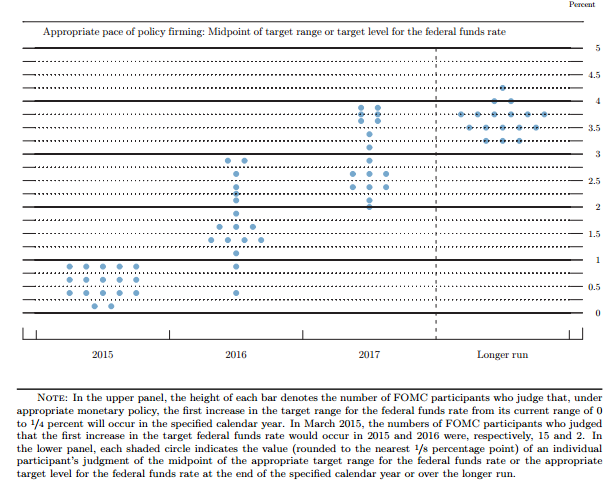
You can see from the dot graph from the June meeting that the FOMC is forecasting a slower liftoff, however we are still looking at a 350 basis point (roughly) tightening vs the 425 basis point tightening in 2004, which blew up the residential real estate bubble. Will this tightening campaign blow up the sovereign debt bubble? Or something else?

Morning Report: Mansions pile up in Greenwich 7/10/14

Markets are higher as Greece proposed a new package of spending cuts, reform, and tax increases in exchange for a new bailout. Chinese stocks rose overnight for the biggest 2-day gain since 2008. Bonds and MBS are down.

It looks like we are close to a deal to give Greece another bailout. Greece has proposed to more or less adopt the creditors’ proposals on sales and corporate tax rates. Pensions also got trimmed and the savings are more or less in line with that the creditors have wanted all along. Greece has capitulated and it looks like they will stay in the EU.

Janet Yellen will be speaking at 12:30 EST. Traders will be listening for comments regarding China and whether the melt-down there will cause the Fed to hold off raising rates.

Everywhere it seems like there is a shortage of real estate for sale. The exception is the uber-high end, especially in NYC suburbs like Greenwich, CT. At the current pace of sales, it would take 4.9 years to absorb the current inventory. Compare this to the NAR’s estimate of about 5 months nationally. IMO, there is an additional factor here – Wall Street salaries have been eroded over time as hedge funds consolidate, sales and trading jobs vanish and proprietary trading goes away. If the Chinese government orders their rich to repatriate their assets to support domestic markets, we could see more inventory in the big cities. Even if their government does not order them to repatriate, there is almost no doubt that the slowdown will affect their appetite for new properties.

Morning Report: NYSE shuts down on software error 7/9/15

There is a definite risk-on feel this morning after Chinese shares rebounded overnight. Bonds and MBS are down.

Actually a bit of a slow news day

Initial Jobless Claims rose 15k to 297,000 last week.

The FOMC minutes from the June meeting were generally taken as dovish. Housing was still characterized as “slow” and inflation remains below their target. Between Greece and China, it is hard to see how the Fed moves in September.

The New York Stock Exchange is blaming a software update for the trading suspension yesterday afternoon. Lots of people were thinking “cyber attack” yesterday.

This Sunday’s deadline for Greece might actually be a deadline. It’s “really and truly the final wake-up call for Greece, but also for us — our last chance,” EU President Donald Tusk said on Wednesday.

Wonder why so many stocks are suspended in China? It turns out many companies have been using their own stock as collateral for bank loans. These stocks have been suspended at the request of the companies themselves.

Morning Report: Don’t believe the Chinese stock market indices 7/8/15

Stocks are lower this morning as the sell-off continues in Asia. Bonds and MBS are up small.

Mortgage Applications increased 4.6% last week as purchases increased 6.6% and refis rose 2.7%. Good numbers considering last week was only 4 days.

We will get the FOMC minutes later this afternoon. The items of interest will be the big downward revision in GDP forecasts, and of course any references to Greece. The China situation really was not ripe at that point, so I don’t expect any mention there.

The EU put Greece on the clock, giving them until Saturday to come up with an agreement to stay in the EU. Europe has “a Grexit scenario prepared in detail,” European Commission President Jean-Claude Juncker said last night. Risk arbitrageurs have a term for this: showing them the downside. That is exactly what the EU is doing. The Greek ATMs are limiting withdrawals, however the Greeks have been taking out money for over 6 months, so most of them have an adequate cushion of cash at least for the time being. It won’t last forever, and the EU is pushing the Greeks to make the necessary reforms to stay in the EU. While we haven’t hit Venezuelan type shortages of goods, they are probably a month away.

Fun Chinese stock market fact: Last night the Shanghai composite fell 6%. Between the 1,331 stocks that are suspended, and the 747 shares that fell their daily 10% limit, approximately 72% of the index is non-tradeable. The A share index (which only Chinese can invest in) is down 33% since mid-June. The B share index (which foreigners can trade) is down around 43%. So when you hear someone point out that we are really only back to March levels, point out the index level is meaningless right now because 72% of the stocks aren’t trading. Oh, and the Chinese government ordered anyone with a 5% position in any company to not sell for 6 months. This is going to be a titanic battle of wills between Mr. Market and Communist Government.

Don’t forget, any economic pain in China due to the sell-off is going to be felt in commodity prices, which are already reflecting the sell-off. That will be deflationary, which the Fed fears more than inflation. IMO, unless something changes dramatically, the Fed isn’t moving in September. If they truly mean it when they say they are being data-driven, the data is screaming: wait to see what happens first. Even if they do raise the Fed Funds rate a symbolic 25 basis points, just to get off the zero bound, I don’t see how the long end of the curve moves all that much, if at all. Which means mortgage rates are probably not going to be affected.

The Obama administration has ordered HUD to re-integrate neighborhoods, using Federal funding as a carrot. LOs start thinking about FHA opportunities in areas that haven’t historically been jumbo territory. That said, I don’t know how many affluent areas get HUD grants in the first place so not sure how effective that will be. But, it might be an opportunity.

Morning Report – Chinese Stocks Collapsing 7/7/15

Markets are higher this morning as Europe and Greece still try and to seek a solution. Bonds and MBS are up.

Greece and their creditors are basically searching for a way to finance Greece’s next payment (about 3.5 billion euros) to the ECB which is due on July 20. If they default, the die is more or less cast. The final result of this negotiation will not be a bailout, but just a liquidity injection to keep things going for another month. The Greek banks have deferred tax assets and Greek government debt as their capital. They are cut off from global credit markets and have been closed to prevent a bank run. The banking system will have to be nationalized and the Greek government will have to issue some sort of scrip to pay people.

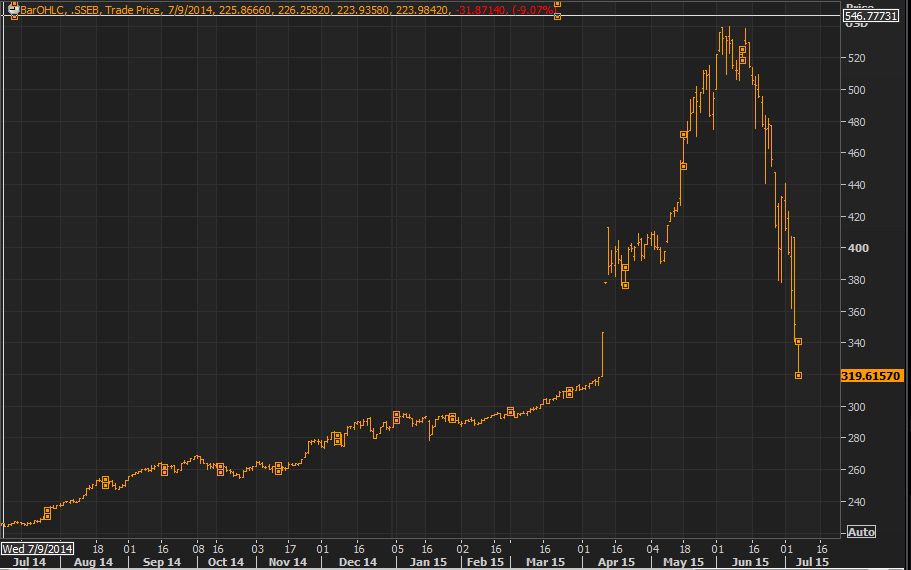
If it weren’t for the Greek Crisis, everyone would be talking about what is going on in China. Their stock market is collapsing, with the Shanghai Composite B share index down 40% in a month.  The Chinese government has been pulling out all the stops to try and support the market – cutting interest rates, increasing liquidity, creating a stock fund to buy up stocks to support the market – and none of it has been working. The Shanghia Composite B-share index dropped another 9% last night as margin traders get liquidated. To stop the selling, the Chinese government has basically suspended trading in 26% of the stocks on the Chinese exchange. Of course this does nothing but delay the inevitable. Chart: Shanghai Composite (B-shares)

Between the Greek and Chinese situations, bonds should be heading higher. We are already seeing the German Bund rally, with the yield having dropped from just over 1% to 66 basis points over the past month. Relative value trades should work US Treasuries higher as well. US investors (and loan officers) should brace themselves for a bumpy ride as the situation in Greece is hardly settled, China is a falling knife, and the Fed is in rate hike mode. Global financial stress is bond bullish, while the Fed’s posture is bond bearish. LOs, tell your borrowers they are playing with fire if they are floating.

That said, I think the overall medium term effect of the stress will be to push rates lower on the flight to safety trade. A struggling China will try and use exports to stimulate their economy, which means the US will be importing deflation. The last thing the Fed will want to do in that situation is to raise rates. As an added bonus, you could see renewed buying in MBS as investors reach for government guaranteed yield. TBA spreads to Treasuries could narrow, which means that mortgage rates could fall as fast or faster than Treasury yields. IMO, the Treasury market has been fading the moves overseas and is behind the curve.

Job openings hit 5.36 million in May, another record in the JOLTS Job Openings index. There definitely seems to be a mismatch between what employers want (someone with the wisdom of a 50 year old, the efficiency of a 40 year old, the drive of a 30 year old and the paycheck of a 20 year old) and what is actually available in the labor market.

Morning Report: Greferendum No 7/6/15

Stocks are down after Greece voted down further austerity. Bonds and MBS are up.

The jobs report last Thursday was okay for the most part. The labor force participation rate hit a new low, however.

The ISM Non-Manufacturing Index came in a little light, but was generally strong. Business Activity accelerated, however that was offset by weakening employment growth. Employment activity in the services sector has been decelerating for months.

The week after the jobs report is usually pretty data-light and this week is no exception. The highlight will be the FOMC minutes on Wednesday.

The immediate fallout of the crisis should be bond (and MBS) bullish. US stocks are down in sympathy with global markets, but there should be almost no exposure here. The ECB will probably take additional measures to boost markets via QE, so that should be stock and bond bullish here.

On to the next crisis, which is the bursting of the Chinese stock and real estate bubbles. China’s government is pulling out all the stops trying to support stock prices (the invisible hand meets the iron fist). In many ways it it reminiscent of the Japanese government in the 1990s, where they tried to artificially support markets through “price keeping operations.” Of course these measures inevitably prevent necessary adjustments from occurring, which is why Japan has stayed in economic stagnation for over a generation.

The Chinese situation has more potential to affect US markets than Greece. Chinese money is behind a lot of the price appreciation in the cities, especially at the high end. Whether it stays or goes will be dependent on what the Chinese government wants.

Morning Report: Greece officially defaults 7/1/15

Stocks are up smartly this morning on stronger economic data and the prospect of a solution in Greece. Bonds and MBS are down.

Mortgage Applications fell 4.7% last week as interest rates spiked on the strong personal spending data. Purchase applications fell 4.1% while refis dropped 5.2%. The average 30 year fixed rate mortgage rose to 4.26%.

The ADP employment survey reported that 237k jobs were created in June, higher than the 218k forecast. The Street is forecasting a rise of 230k for the jobs report tomorrow. Challenger job cuts rose to 44k.

Fed St. Louis President James Bullard spoke last night and said the Fed should consider raising rates at the Sep meeting given the strength of the latest economic data.

Vehicle sales will be coming in all day. Early returns are disappointing.

Construction spending rose .8% in May, beating the .5% estimate. Residential construction rose .3%.

The ISM Manufacturing Index rose in June from 52.8 to 53.5. A reading over 50 indicates expansion. This is good news as the decline in oil prices had depressed activity in the oil patch. New orders and employment drove the increase. The 53.5 reading would typically correspond to a GDP growth rate of 3.3%.

Last night, Greece became the first advanced economy to officially default on an IMF loan. Most Greek banks are out of money, and pensioners who are used to getting 600 euros for the month are being given less than a quarter of that – about 120 euros. ATM deposits are being limited to 60 euros a day. The first snap poll of Greek citizens has pretty convincingly rejected the EU’s offer – 53% “no”, 33% yes.

Greece has told Europe that the latest offer comprises the basis of a compromise. The Europeans are going to wait until the results of the referendum are out on July 5. If the voters say “no” to the European demands, Greece will have no other option than to print its own currency to pay workers and pensioners. IMO, a Greek exit will be bond bullish, as it will probably force a policy response out of the ECB and that means more QE.

While home prices still remain affordable compared to the bubble years, low inventory has pushed up the price / rent ratio. We are back to late 2003 levels. On a nominal (in other words, non-inflation adjusted basis), prices are approaching peak levels, but on an inflation adjusted basis, they still have a ways to go. Of course wage inflation remains muted, so that will act as a drag on home price appreciation, or at least affordability.

The latest CoreLogic Market Pulse is out, and it has some good stuff on the state of the housing economy. They discuss the most overvalued housing markets, and find 4 are in Texas. Not sure how their index works, but there you go. The other ones are Washington DC (duh), Miami FL (huh?) and Charleston SC (huh?). Overall, prices nationwide appear reasonable and sustainable, with many localities still recovering from the collapse.

Morning Report – Home price appreciation is decelerating 6/30/15

Markets are higher this morning after the Chinese stock market posted an impressive turn-around and rallied 5.5% overnight on hopes the government would do more to support stock prices. Bonds and MBS are down.

Greece’s bailout expires tonight, and they are preparing for life post-bailout. The government has scheduled a referendum for 7/5 to accept or reject the austerity. Mohammed El-Arian lays out the path forward.

After the Greek situation gets resolved, attention will turn to the melt-down in China. Chinese stocks entered bear market territory (notwithstanding yesterday’s humongous rally) and a lot of this rally is being supported by dumb money – margined retail money. People are looking to the government to do something to support the markets, and it feels a lot like the Japanese market did in the 90s, where the Ministry of Finance would call the banks during the lunch break and basically tell them to tear up their sell tickets for the day.

House prices increased 4.9% year over year in April, according to Case-Shiller. Home price appreciation is decelerating as wages fail to keep up with house prices.

Consumer confidence rose to 101.4 in June, according to the University of Michigan.

Obama just increased the cost of labor by demanding that anyone who earns just less than $1,000 a week be eligible for overtime, whether they are managerial or not. The new rules will take effect in 2016. IMO, this will only accelerate the replacement of technology for labor and the Uber-ization of the economy, but I suspect Obama isn’t thinking about that. He is focused on whipping up the base, which is lukewarm with Hillary. With employment costs already soaring from regulatory mandates, I don’t see how this helps overall employment levels. I suspect this is a variation of the French mentality that limiting hours will somehow encourage more hiring. It never ceases to amaze me that the left is completely comfortable with the concept of raising the price of gasoline and cigarettes via excise taxes in order discourage consumption, but yet they somehow imagine the laws of supply and demand are suspended in the labor markets.