Posted on August 19, 2015 by Brent Nyitray
Markets are lower this morning on overseas weakness. Bonds and MBS are down.
We will get the Fed minutes later on today. Investors will be looking for two things: the Fed’s view on potential wage inflation and the meltdown in China. For those worried about the effect of increasing interest rates, asset prices will undoubtedly be vulnerable to higher rates, however at least this time around, consumption hasn’t been driven by asset price inflation the way it was in the late 90s and the mid aughts.
That said, stocks are predicting a 100% probability that the Fed can hike rates without anyone blowing up. St. Louis Federal Reserve Bank President James Bullard was warning about asset bubbles yesterday and the need to hike rates to prevent them from blowing up. The only asset bubble I see right now is in sovereign debt, and the Fed is up to their eyeballs in it.
Real average weekly earnings rose 2.2% last week.
Mortgage Applications rose 3.6% last week. Purchases fell 1.1%, while refis rose 7.2%.
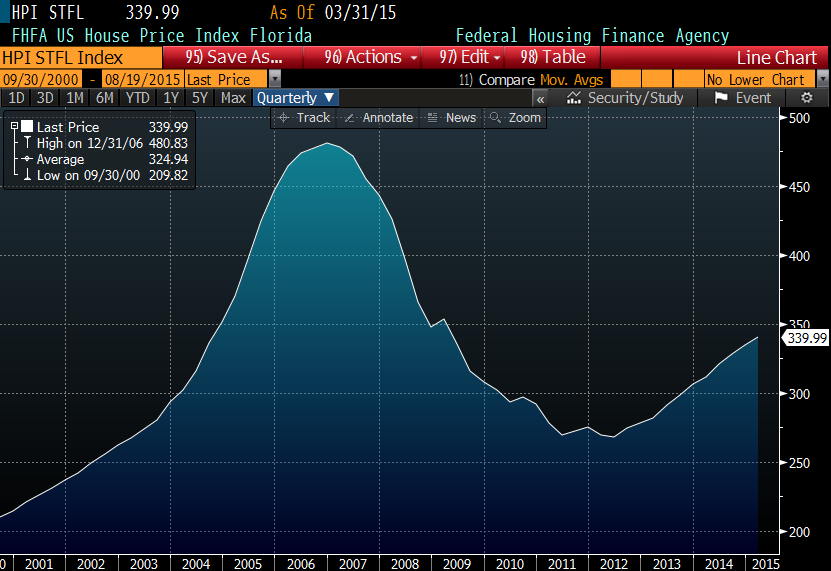
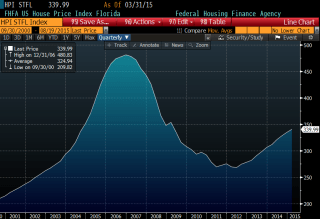
Florida real estate is getting back to the go-go days of the mid aughts. Some are worried about another bubble, but if you look at the Florida FHFA House price index, it is still 29% off of peak levels. One other difference this time: the buyers this time around are not dominated by regular people – they are dominated by institutional investors looking to earn rental income and by foreign investors looking to move money out of their home countries. In other words, if prices collapse (and I don’t know what the catalyst would be), the economic effect will be much less.
Zillow has a good article on the first time homebuyer. They note how the median home price to median income ratio for the first time homebuyer has risen from 1.7 in the 1970s to 2.6 today. That said, interest rates are much lower today than the 1970s. Note that the average years of renting has increased from 2.6 years to 6 years now. This probably represents the fact that people are waiting until they are older to get married and have kids.
Filed under: Morning Report | 63 Comments »
Posted on August 18, 2015 by Brent Nyitray
Stocks are lower this morning after WalMart earnings disappoint. Bonds and MBS are down small
Housing Starts were more or less flat in July at just over 1.2 million. June was revised higher. Multi-fam starts dropped while single family rose. Building Permits fell however from 1.33 million to 1.12 million. Multi-family permits accounted for almost all of the drop. Goldman took up their Q3 GDP tracking estimate from 2.2% to 2.4% on the number.
Speaking of housing, the Home Despot reported better than expected earnings this morning as well. An improving housing market is encouraging people to spend on renovations.
Filed under: Morning Report | 23 Comments »
Posted on August 17, 2015 by Brent Nyitray
Markets are lower after a bad reading on the Empire State Manufacturing Survey. Bonds and MBS are up.
The Empire State Manufacturing Survey hit a 6 year low, as it tumbled from 3.9 to -15. This is generally not a market-moving index and it can be volatile, but given the dearth of things to trade on this morning, this is what people are focusing on.
Homebuilder sentiment rose from 60 to 61 in July, according to the NAHB.
The highlight of the week will be the FOMC minutes on Wednesday. Bloomberg has a helpful primer on how to read them.
Oil has dropped below $42 a barrel and is back at 6 year lows. Interestingly, the consumer sentiment indices seem to have decoupled from oil prices. We saw that in the falling University of Michigan Consumer Sentiment survey last week. Oil’s drop may appear to be a momentum trade, although speccies are still net long.
Meanwhile in politics, Donald Trump remains the Republican headache that won’t go away, and the email crisis remains the Democratic headache that won’t go away. Bill and Obama went golfing over the weekend, so the fix is presumably in. That said, the Administration has thrown the book at every low-level type who mishandled classified info.
Filed under: Morning Report | 9 Comments »
Posted on August 13, 2015 by Brent Nyitray
Markets are flattish on no real news. Bonds and MBS are down.
Retail Sales rose 0.6% in July, in line with expectations. The control group, which strips out volatile items like autos, gasoline and building products rose 0.3%, below expectations. It looks like people are spending shifting spending from goods to services (ie restaurants). August’s sales will be important – it signifies back-to-school shopping, which is a good predictor of holiday sales.
Mortgage foreclosures fell to 2.09% in the second quarter from 2.22% in the first. Delinquencies fell from 5.54% to 5.3%.
Import prices fell 0.9% in July, a little less than expectations. Inflation remains nowhere to be found.
Initial Jobless Claims continue to hang around 4 decade lows. They rose slightly to 274k.
The Bloomberg Consumer Comfort index ticked up slightly to 40.7 from 40.3. Sentiment remains soggy.
As we head into the September FOMC meeting, here is a dovish take on why the Fed should maintain ZIRP. His point is that the withdrawal of QE has already softened the economy and interest rates reflect the new normal of weak global growth and no inflation. Increasing rates risks tipping the economy back into a recession. While I am somewhat sympathetic to his argument, I doubt that 25 basis points on the Fed Funds rate is going to have that big of an impact, and the Fed will go slow. Janet’s Addiction dies hard.
The rent versus buy decision is getting easier. While home prices continue to rise, rents are rising faster as vacancy rates fall. In expensive places like LA, people are spending half their income on rent. Something to point out to first time buyers who are on the fence: Buy a home and get a 30 year fixed rate mortgage, and your principal and interest payment won’t increase, ever. Beats the heck out the annual negotiation with the landlord.
Filed under: Morning Report | 48 Comments »
Posted on August 12, 2015 by Brent Nyitray
Stocks are lower in the US on overseas weakness. Bonds and MBS are up
Mortgage Applications rose 0.1% last week as purchases fell 3.5% and refis rose 3.1%.
Chinese weakness has been driving the sell-off in stocks and the rally in bonds. Does it have staying power? Can it affect the Fed’s thinking with interest rates? IMO, the answers are yes and no. The Chinese real estate bubble is deflating – the only question is whether it will be a disorderly mess or whether the government can let the air out slowly. Given the amount of state control over the economy they may be able to engineer a soft landing, but no one else has been able to do it – Japan came close, however they took their debt to GDP ratio to 2.2x and have had to endure 25 years of no growth (and counting) to do it.
The punch line however is that China’s economy will slow, and that will depress commodity prices and increase deflationary pressure worldwide. This probably is Treasury bullish at the margin, but it isn’t going to be the driver of Treasury prices – the US recovery and the Fed are. If anything, turmoil in China is going to be a secondary effect. I still think the Fed hikes rates 25 basis points in September and then waits to see what happens. If the economy accelerates, maybe they hike another 25 in December. If the economy flatlines, maybe they wait. Note the Fed has historically been reticent to make big changes in an election year, for fear of being accused of being political.
Everyone knows that Dodd-Frank’s limits on market-making has affected liquidity in asset markets. Stocks are already susceptible to air pockets as tight spreads and low commissions have made the market-making business unprofitable. However we are seeing it in other markets as well – gold, currencies, etc.. Citi makes an interesting observation: performance-chasing by professional investors is also exaggerating market moves. They call this a “fundamental change” in the markets. I wonder how much of it is due to ZIRP. If professional investors cannot make a return in buy and hold strategies because interest rates are too low, they have to chase performance. I suspect as rates go up, this dynamic will reverse as professional investors return to classic buy and hold strategies that work. That said, the market-making aspect is a new normal that we need to get used to.
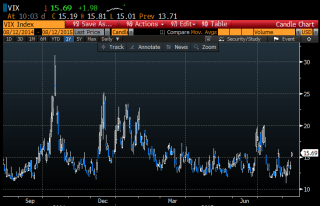
For all the sturm and drang about volatility, the VIX (a measure of fear in the market) is remarkably sanguine at 16.
Hillary Clinton gave her server and a thumb drive to the FBI last night under subpoena. Supposedly the IG found top secret messages on her server, so this could (or at least should) potentially be serious, if Obama decides to make it serious. Supposedly the admin was the one who initially leaked the story to the press, so they may treat it seriously. As a former Naval Officer who handled classified material, I know if I had taken home top secret material, I would have been thrown in jail. Also, regardless of what the Obama Administration decides to do, someone has everything that is on that server. If it is someone’s interest to not have Hillary as president, it will get leaked to the press.
Filed under: Morning Report | 12 Comments »
Posted on August 11, 2015 by Brent Nyitray
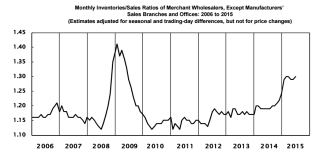
Productivity rose less than expected in the second quarter, and unit labor costs were higher than expected, which was disappointing. The first quarter numbers were revised better (productivity up and unit labor costs down), however Q1 productivity was still flat and unit labor costs were higher than inflation. These two numbers can be volatile, so it makes sense to look at a moving average. The 12 month moving average for productivity is about 0.25%. The 12 month MA for unit labor costs is about 2.1%. Anyway, flat productivity and 2% wage inflation is not symptomatic of a great labor market, despite what the numbers say.
Small business optimism rose in July, according to the NFIB. Expectations for the economy accounted for about half the rise. Employment was flat. Increasing labor costs (not only wages, but regulatory burden) are depressing the bottom line as profits fall. In fact, most are reporting that the increase in labor costs is due to mandated benefits, not wage increases. This again speaks to the bifurcated market: the big S&P 500 companies are doing well, but much of that is due to (a) rock bottom interest rates and (b) overseas exposure. Those circumstances don’t really apply to the local dry cleaner. Which is why liberals can claim: “These hugely profitable companies refuse to pay a “fair” wage” and conservatives can claim “Regulation is strangling small business and those costs are manifested in stagnant wages.” Liberals are focusing their ire at the big multinationals and conservatives focus their ire at government. There is a bit of truth in both viewpoints.
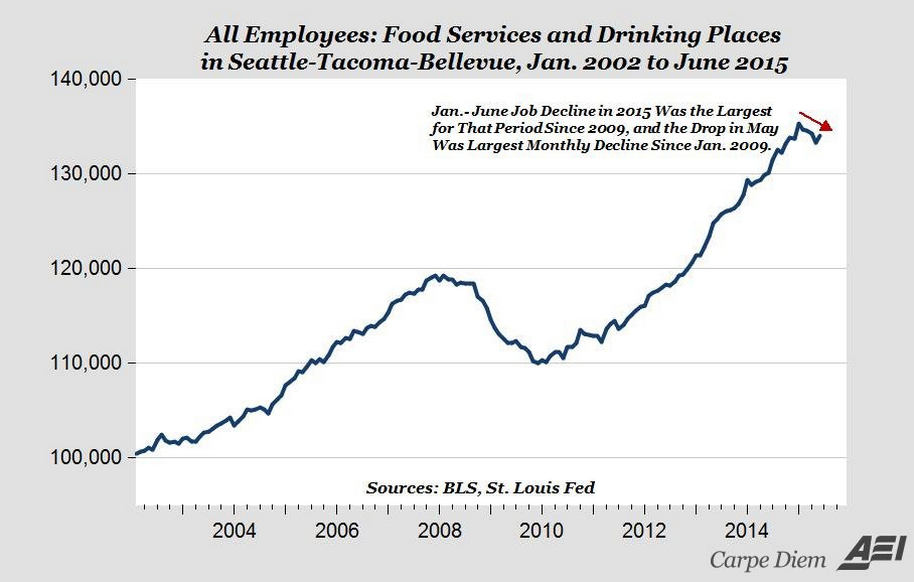
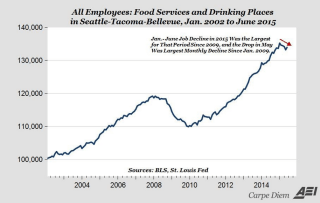
Speaking of regulations, the American Enterprise Institute crunched the numbers and it turns out that Seattle lost about 1,300 jobs from Jan – June. Of course it is still early days, but it looks like the laws of supply and demand are still applicable in the labor market, regardless of what politicians think.
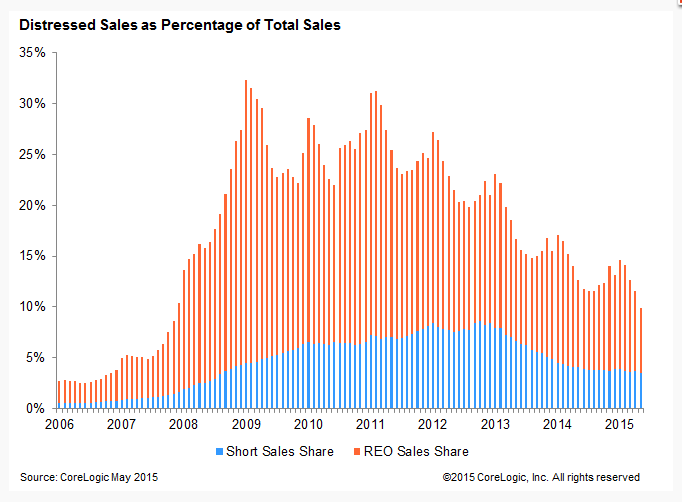
Completed foreclosures fell to 43k in June, according to CoreLogic. This is up 4.8% from May but down 14.8% from a year ago. The foreclosure inventory remains the highest in the Northeast, where the judicial states are still working through their backlog.

Filed under: Morning Report | 64 Comments »
Posted on August 10, 2015 by Brent Nyitray
Markets are higher on M&A and strength in overseas markets overnight. Bonds and MBS are down.
This week promises to be slow as we are in the dog days of summer, the week after the jobs report inevitably has a dearth of data, and earnings season is winding down. I don’t see much in the way of potential market-moving data, except for unit labor costs / productivity tomorrow. I think we would have to see a big surprise for that to move bonds around. Think we continue with the risk-on / risk-off dynamic where stock prices drive bond market movements.
The Fed’s new index – the Labor Market Conditions Index – rose 1.1% in July, and June was revised upward. This index is a meta-index of 24 different indicators.
Consumer attitudes towards housing cooled somewhat in July, according to Fannie Mae’s National Housing Survey. This seems to be driven by deterioration in people’s financial situations and their attitudes towards the economy in general. Fannie Mae notes that the survey questions were being asked when we had both the Greek situation and the Chinese stock market meltdown going on, so perhaps that is coloring the data. Given the strong support of Bernie Sanders on the left and Donald Trump on the right, it looks like people are hopping mad about their financial condition and this isn’t a spurious reading based on Greece and China.
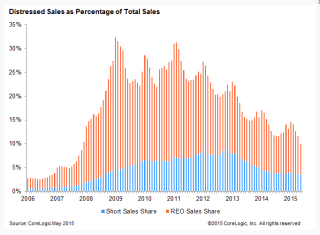
Commodities continue to drop as West Texas oil dips below $44 a barrel. Oil cannot get out of its own way, and if the Iran deal gets passed, another million barrels a day will hit the market. We have been watching Venezuela come apart at the seams as the state relies on high oil prices to provide revenue for social services. Another looming disaster is Norway, which not only is hurting from falling oil prices, but it also has a real estate bubble of its own. Another one reeling – just say the headine: Russian GDP contracted by 4.5% last quarter.
As we creep up on the September FOMC meeting, sovereign wealth funds are dumping Treasuries. Japan dumped almost $10 billion in June, the most in two years. Not sure if this sort of selling is going to impact US rates in any meaningful way – where are sovereign wealth funds going to put their cash? German Bunds, which yield 68 basis point? Portuguese bonds yielding 20 basis points more than Treasuries? Given the relative attractiveness of US Treasuries and the US dollar, I don’t see much in the way of foreign selling. As Bill Gross used to say: The US is the cleanest dirty shirt in the bunch.
Filed under: Morning Report | 23 Comments »
Posted on August 7, 2015 by Brent Nyitray
Markets are flat after the jobs report. Bonds and MBS are up small
- Payrolls 215k vs 225k expected
- Unemployment rate 5.3% in line
- Average hourly earnings 0.2% in line
- Underemployment rate 10.4%
- Labor force participation rate 62.6% in line
Filed under: Morning Report | 31 Comments »
Posted on August 6, 2015 by Brent Nyitray
Stocks are flattish on no real news. Bonds and MBS are up small.
Initial Jobless Claims came in at 270k, a decent number. Challenger and Gray announced job cuts increased 125%. The drop in energy prices is forcing job cuts in the oil patch.These are not actual firings, just company announcements that they will cut X number of jobs. Often these job cuts don’t ever happen.
Consumer comfort slipped again last week to 40.3 from 40.5. 50 is considered normalcy.
Mohammed El-Arian has a good column summing up the state of the labor market and the Fed’s thinking. “With concerns lurking behind the scenes that the Fed has gone too far in decoupling financial markets from the economy’s fundamentals, just a slight strengthening of labor market conditions (particularly on the wage front) would be enough to increase the probability of a September rate hike.” This is the case even if the economy is not strong enough that people feel the economy is better. The thinking is also that the low labor force participation rate has more to do with structural issues in the economy, which means monetary policy is simply not an effective tool to change it.
The SEC passed a rule on a 3-2 basis yesterday mandating that companies disclose the ratio of CEO pay to worker pay. This is pretty much a sop to the unions and liberal activists and it is a pretty game-able number. Stock compensation doesn’t count, and the unintended effect will probably be to increase share buybacks.
Filed under: Morning Report | 17 Comments »
Posted on August 5, 2015 by Brent Nyitray
Stocks are higher this morning as overseas markets rallied overnight. Bonds and MBS are down small.
Stocks got a boost when the ADP Employment Number came in weaker than expected. The ADP Employment number is often a decent forecast for the big payroll number on Friday. According to ADP, (the big payroll processing firm) the economy added 185k jobs last month, which was lower than the 215k forecast. We might be entering a “bad news is good news” cycle where weak economic news is considered bullish because it keeps the Fed on hold.
FRB Atlanta President Dennis Lockhart said yesterday the economic data would have to deteriorate a lot to get him not to vote for a Sep hike. Lockhart’s voice is important because he is considered more of a centrist.
Mortgage Applications rose 4.7% last week, according to the MBA. Purchases rose 3.3% while refis rose 5.9%.
Interesting take on the Millennial generation and the paradox of the labor market. How come, this far into the recovery, are Millennials still living at home with their parents? How is this possible with an unemployment rate of 5.3%? Historically, a 5.3% unemployment rate was associated with booming economies. This speaks to the disconnect between the data and what people actually perceive (and why, despite the data, people think we are still in a recession). According to the data, the labor market is strong, and those that put a lot of stock in that data believe that wage inflation is right around the corner, and therefore the Fed should start hiking rates. On the other hand, some point to the situation with the Millennial generation and say the data is, if not misleading, just not capturing the whole picture. They believe the underemployment rate (which is around 10.5% and represents people who have part-time jobs and want full-time jobs) is a better representation.
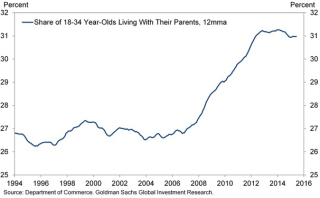
I would add, the quality off the full-time job matters. If a recent grad is working as a barista full time, they count as employed according to the Bureau of Labor Statistics. However, that grad should be working at an entry-level white collar job, which pays more than Starbucks. They aren’t and that is why they are still living at home.
Just for fun, I subtracted the unemployment rate from the underemployment rate to get a different picture on the economy. We are still at near recessionary levels, at least compared to past recoveries. Note the data only goes back to 1994. Still, an interesting chart:
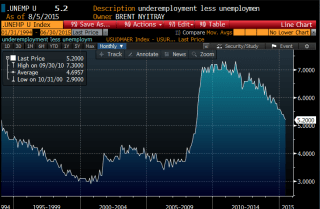
IMO, that tells a different story. We are still at levels associated with the 91-92 recession, where recent grads were working in retail and unable to get jobs, This job market seems similar. It also speaks to the just-in-time labor management style companies use nowadays. Where does this leave the Fed? Well, the last time the spread was this high, the Fed waited another two years to start hiking rates.
Filed under: Morning Report | 35 Comments »


 Brent Nyitray
 Fairlington Blade
 Let the mutherfuker burn!
 jnc4p
jnc4p Kevin S. Willis
 Michigoose
 lmsinca
 markinaustin
 Arcanaut
 novahockey
 quarterback
 ScottC
 yellojkt