Morning Report: Markets reverse ahead of the FOMC 12/15/15

Markets are higher this morning as oil and credit markets have an up day. Bonds and MBS are getting whacked.

There is no news in particular driving the rally in oil and other financial assets. Markets don’t go up in a straight line and they don’t go down in one either. Another possibility is that market participants are positioning themselves ahead of the Fed rate hike.

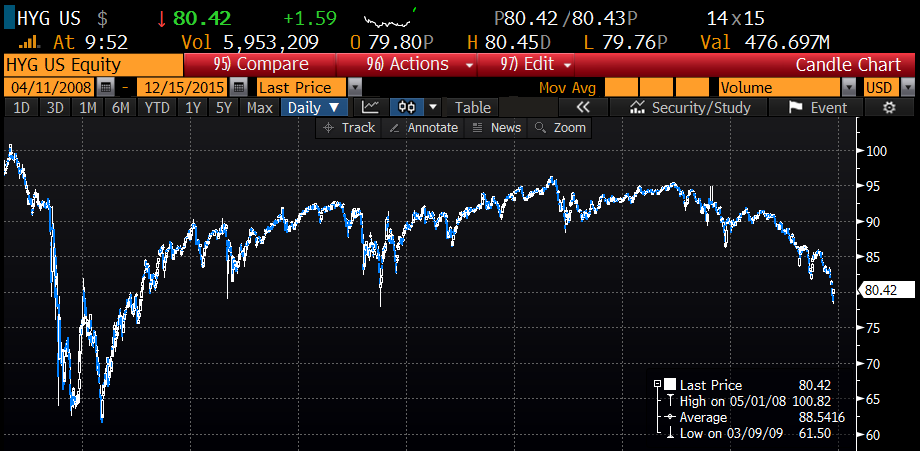
The problems in the credit markets are centered in distressed credits. The carnage is concentrated in the energy sector. For those keeping score at home, if you want to track how things are going, check out the Ishares high yield ETF HYG. The chart is below. You can see how it has been rolling over. I included the financial crisis years for perspective.

Blackrock believes the problems in the distressed markets are not systemic – in other words, don’t look for a repeat of 2008.

In economic data this morning, the consumer price index was flat on a month-over-month basis. Ex-food and energy, it increased 0.2%. On a year-over-year basis, it increased 2% ex- food and energy, which is right in line with the Fed’s target. The Bloomberg Real Average Hourly Earnings index increased to 1.6% annualized, up from an upward-revised 2.4% last week. Maybe, just maybe, wage inflation is upon us.

The Empire Manufacturing Index improved to -4.6, indicating that things are still tough in the manufacturing sector. Blame the dollar.

Homebuilder sentiment fell in December to 61 from 62. The index hit a 10 year high in October, so the sentiment is still pretty positive. The builders all reported pretty strong increases in orders and backlog, so it looks like 2016 could be a better year for the builders. The Spring Selling Season is about 2 months away. Note we will get numbers out of Lennar on Friday.

A survey of economists says that mortgage rates are going up. Probably a no-brainer, given the Fed is hiking rates. Does that mean a bad year for the housing sector? Not necessarily. Certainly an increase in rates is going to make lives tough for the refi shops. However if rates are rising because of a strengthening economy, that is probably great news for the purchase business as Millennials leave expensive rentals and buy property.

Mortgage fraud is making a comeback, according to CoreLogic. As credit loosens and purchase activity increases, you are going to see more risk of it.

Morning Report: Pain in the distressed market 12/14/15

Markets are lower this morning as oil continues to fall and problems at a high yield mutual fund begin to spill over.

No economic data today. The markets will be focused on the Fed and the evolving situation in distressed debt markets.

Marty Whitman’s Third Avenue Focused Credit Fund has suffered losses as the rout in high yield has reduced liquidity. Dodd-Frank has severely curtailed market-making operations at investment banks, and right now there are very few buyers of distressed credit as hedge funds face redemptions and investment banks cannot step in because of capital requirement. In fact, the regulators are considering additional steps to ensure a bank failure doesn’t bring down the entire financial system, which means that investment banks will probably de-risk further, making them even less likely to act as market-makers. This will be an interesting first test of a financial crisis in the new Dodd-Frank world.

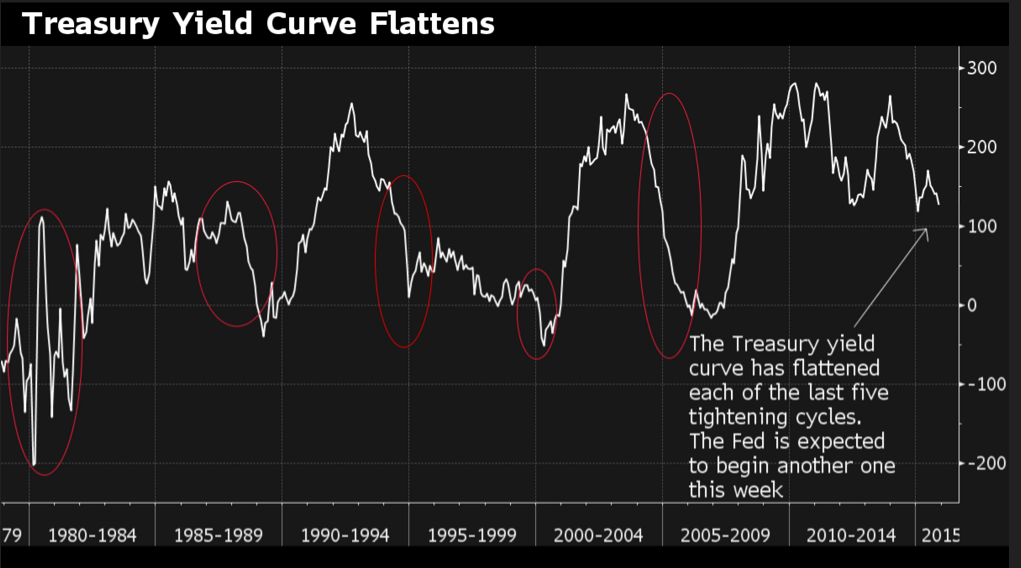
As a general rule, in credit crunches, the long bond rallies. You saw that on Friday, where the 10 year yield fell 10 basis points in spite of strong retail sales data. This week will be interesting between the evolving Third Avenue situation and the FOMC decision on Wednesday. LOs, expect bond market volatility this week.  As a general rule, tightenings have not had a dramatic effect on mortgage rates. In fact, the yield curve has flattened during all the tightening cycles since 1979. Granted, these tightenings have taken place in context of a secular bull market in bonds, so take this analysis with a grain of salt. That said, unless the economy really starts taking off (and you start seeing wage inflation), chances are that the 10 year yield increases less than the amount of the rate hike.  Note that CoreLogic is forecasting a 4.5% 30 year fixed rate mortgage by the end of 2016.


Mortgage loan performance has been improving, according to the OCC. Performing loans increased to 93.9% from 93% a year earlier. New foreclosures are down 22% YOY.

Ex GMAC Ally Financial is getting back in the mortgage business. Ally CEO said this about the move: “Don’t think of this as Ally going down the road of the old GMAC,” Brown said, referring to the home lending unit that brought Ally to the brink of collapse. The ironic thing is that the “new subprime” is auto loans, and that is Ally’s bread and butter these days. They are offering 8 year loans for new cars at rates at rates substantially below the 30-year fixed rate mortgage (think 3.5% range). Given that new cars depreciate like sushi, this is a very, very mispriced loan. If you are wondering why the Fed wants to get off the zero bound even in the face of zero inflation, there you go. Those sort of rates are a function of ZIRP and the impossibility of earning a decent rate of return. It would be ironic if the ne-er do well of mortgages had simply morphed into the ne-er to well of auto lending and we see a collapse in asset backed security liquidity.

Morning Report: Oil continues to slide 12/11/15

Stocks are lower this morning on emerging market weakness and oil. Bonds and MBS are up.

Retail Sales rose 0.2% in November, lower than expectations. Ex food, energy and building materials, they rose 0.6%, better than expectations.

Inflation at the wholesale level remains under control as the producer price index rose 0.3% in November. Ex food and energy and trade services it was up 0.1%.

Morgan Stanley is warning investors that the world’s central banks could succeed in creating inflation. Markets are definitely priced right now as if inflation is never ever coming back. We could see another bond sell-off like the “taper tantrum” of 2013. IMO, until we start seeing wage inflation we don’t have anything to worry about on that front.

Zero down-payment jumbo loans are back. Up to 2 million, provided you live and work in San Francisco

The House Financial Services Committee has picked up on the CFPB suing firms on discrimination using bogus data.

The MR will be spotty next week as I will be on the Left Coast

Morning Report: Competition for Zillow’s Z-estimate 12/10/15

Markets are rebounding this morning after several days of losses. Bonds and MBS are flat.

Initial Jobless Claims rose 13k to 282,000 last week. The story remains the same: companies are reluctant to let go of employees.

Import prices fell 0.4% in November and are down 9.4% year over year. Blame low commodity prices. Note that some strategists are starting to say the downside in oil is limited at these prices.

The Bloomberg Consumer Comfort Index rose to 40.1 from 39.6 the prior week.

Everyone knows to treat Zillow’s Z-estimates with a grain of salt. Pre-crisis, they generally overstated property values and post-crisis, they have generally been low. Their median error rate is something like 8% (which is calculated by measuring the difference between the modeled value of a house and what it actually sells for). Now Redfin is rolling out their own model, which they claim has an error rate closer to 2%.

Rental prices in Manhattan have risen so much that potential renters are balking at the asking prices. Rental vacancies are at the highest level since 2006. In November, the median monthly rent in Manhattan rose to $3661, up 4% YOY.

Morning Report: Mortgage credit tightening slightly 12/9/15

Stocks are lower this morning on no real market-moving news. Bonds and MBS are down.

Mortgage Applications rose 1.2% as refis rose 3.5% and purchases were flat.

Wholesale inventories fell by 0.1% as sales were flat.

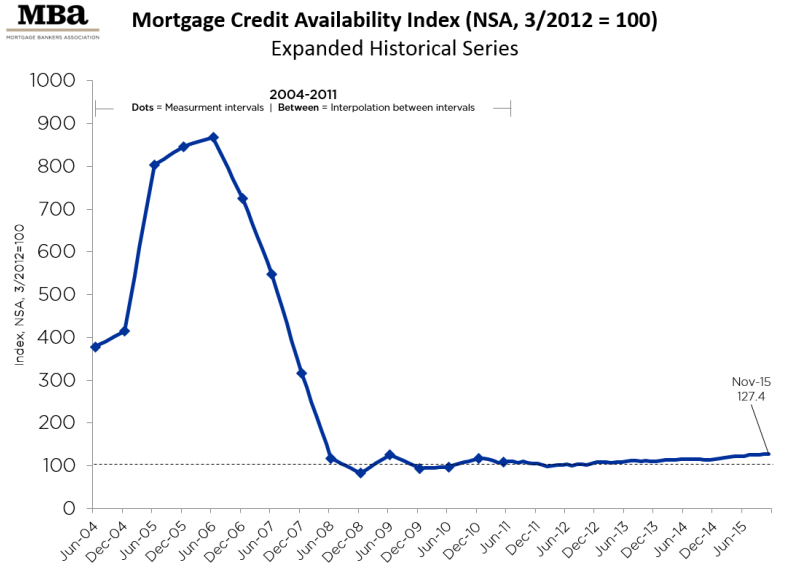
Mortgage credit availability fell in November, according to the MBA. This means credit standards increased. Conventional loans tightened while government loans loosened slightly. While mortgage credit availability has increased steadily since the US residential real estate market bottomed in 2012, it is still a shadow of its former self.

The MBA has its latest survey on mortgage bank profitability and volume. Last quarter, the average gain on a mortgage for independent mortgage bankers and the mortgage subsidiaries of banks fell from $1,522 to $1,238 (or about 55 basis points). On a year-over-year basis, it was an increase from $897 (or 42 bps) in the third quarter of 2014. Average volume in the third quarter was $614 million (or 2,609 units), which was the second highest print since 2008. Lots of useful stats in this survey.

While home prices have been appreciating at a mid single digit clip, rental prices have been increasing even faster. Last year, nearly half of all renters spent at least 30% of their in rent, which qualifies as cost-burdened. A quarter paid 50%. This is creating an affordable housing problem, especially in urban areas.

The Fannie Mae Home Purchase Sentiment Index fell a couple of points as increasing prices and limited inventory are making things difficult for potential buyers. Second, consumers are becoming a touch more pessimistic about their future incomes.

Morning Report: Commodities continue to fall 12/8/15

Stocks are lower this morning as commodity prices continue their downward spiral off of weak economic news out of China. Bonds and MBS are up.

Job openings fell in October to 5.4 million from 5.5 million. Note that payrolls increased by a lot in October (almost 300k), so that drop makes some sense.

The NFIB Small Business Optimism Index fell to 94.8 from 96.1 last month. Small business wants to hire and expand, but is finding it difficult to hire qualified workers. Small business also intends to increase capital expenditures, which have been deferred since the Great Recession.

The IBD/TIPP Economic Optimism index increased in December to 47.2 from 45.5. As a general rule, the indices tend to inverse gasoline price indices. When gas prices fall, people are generally more upbeat.

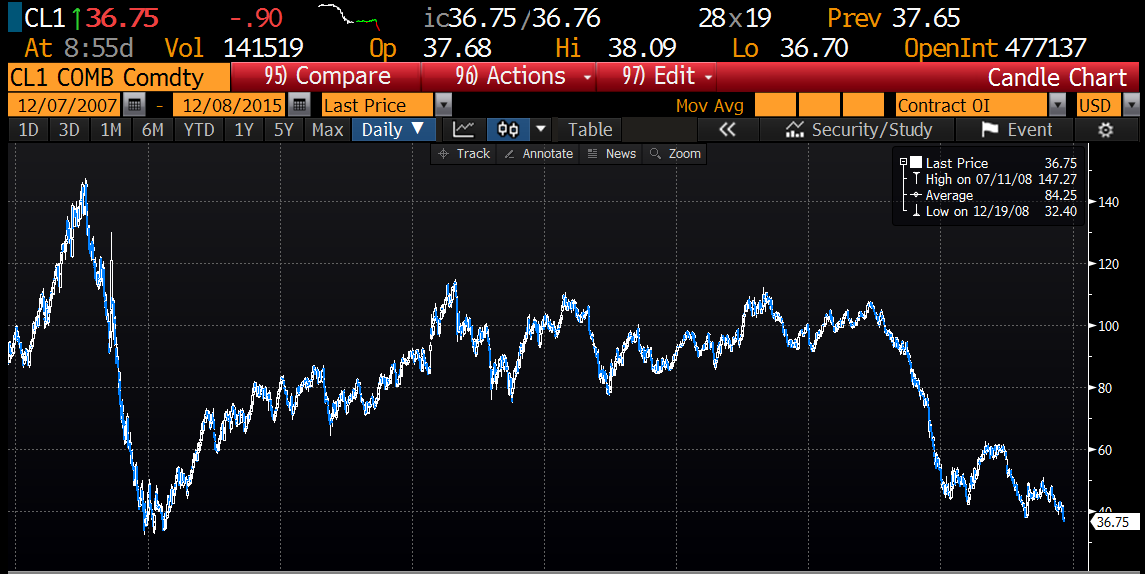
Oil continues its downward spiral. If you look at the chart below, you can see how oil has traded since 2007. We are approaching the 2008 lows in oil right now. Note that oil has its own dynamic, particularly with Iran, who will be adding about 3.8 million barrels of oil per day. The problems in the oil patch are creating problems for the banks, as oil is trading at 37 bucks a barrel and it costs something like $40 – $45 to get it out of the ground.

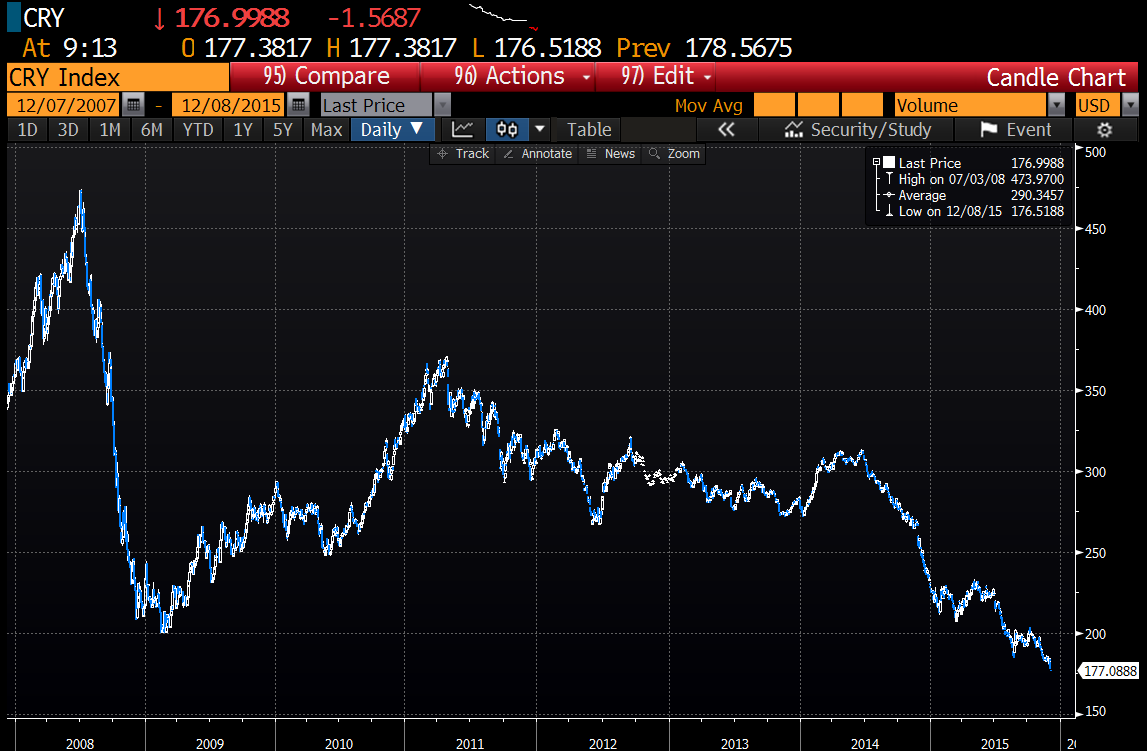
The story is more than oil, however. Commodities are down across the board, from the softs like coffee to the industrial metals like copper. This is the canary in the coal mine for global demand. The ISM data indicates manufacturing is going through a soft spot, if not a recession. If you look at the Commodity Research Bureau commodity index, you can see we are well below the lows of 2008 and are approaching the lows of 2002.

So if global demand is falling, and inflation is nonexistent, why is the Fed going to raise rates next week? At the end of the day, the Fed has more or less painted itself in a corner, and will have to move for credibility’s sake. They have telegraphed this move so much that they have to follow through. The punch line is that the Fed may hike the Fed Funds rate next week and mortgage rates might not move much, if at all.

In spite of all the carnage in the commodity markets, there is one that is holding up better than most: lumber. And that speaks to future demand for construction. Note that in last Friday’s jobs report, construction employment increased again. Next year could be the beginning of the return of housing construction, hopefully.

Speaking of homebuilders, McMansion builder Toll Brothers reported earnings this morning, and beat on the top line while missing on the bottom line. Net signed contracts increased 29% in dollars and 12% in units. ASPs increased 4.4% to $790k.

Foreclosures continue to fall, according to CoreLogic. Completed foreclosures fell 27% YOY to 27k in October. There are 463,000 homes in some state of foreclosure, which is the lowest level since November 2007.

Morning Report: Larry Summers urges the Fed to go slow in hiking rates 12/7/15

Stocks are lower as oil continues to drop. Bonds and MBS are down small.

The week after the jobs report tends to be data-light and this week is no exception. The highlight will be retail sales on Friday. Other than that, expect markets to be dull as traders position for the FOMC meeting next week.

The Labor Market Conditions Index fell to 0.5 from 2.2 in November, according to the Fed. This index is a meta-index of 19 different variables.

The latest Black Knight Mortgage Monitor is out, and they take a look at the high LTV loan universe. FHA has become the go-to high LTV loan product, and they high LTV loans account for 77% of FHA / VA origination. Fannie and Freddie did about 1% in high LTV loans. Home Price appreciation continued in September, with their proprietary home price index up 5.5% on a year-over-year basis.

Larry Summers makes the case that the Fed should go slow with raising interest rates. His main point: that the “neutral interest rate” has been declining and will continue to decline due to the changing allocation of savings versus consumption tilts more towards savings. (More savings = more demand for bonds, which pushes bond yields lower). Of course this argument focuses primarily on the baby boomers, who are retiring and ignores the millennials, which are bigger and will enter the workforce (and spend) over the next decade or so. He makes another point: some of the economic indicators are pointing towards a slowdown, and we don’t want to have monetary policy acting as a drag on an economy that is already weakening. FWIW, I think the body language out of the Fed is that they will take it slow, and I cannot see how an extra 25 or 50 basis points on the Fed Funds rate is going to be that material of a drag on the US economy. In reality, a sub-1% Fed Fund rate is still incredibly accomodative.

Jobs report in line; December tightening a go 12/4/15

Stocks are lower after the jobs report came in as expected, which puts the Fed on track for their first tightening in 9 years in a couple of weeks. Bonds and MBS are up small.

Jobs report data dump:

  • Nonfarm payrolls + 211k vs. 200k expected
  • Unemployment rate 5%, in line with expectations
  • Average Hourly Earnings +0.2% MOM / +2.3% YOY in line
  • Underemployment rate 9.9% vs 9.7% expectations
  • Labor Force Participation rate 62.5% vs. 62.4% expected

The general take on the jobs report is that it is good enough to give the Fed comfort to raise rates in two weeks. Digging in deeper, the increase in jobs were in construction (+46k), professional services (+28k), health care (+24k), restaurants (+23k) and retail (+31k). Mining and IT lost jobs.

Homebuilder Hovnanian reported numbers this morning, Revenues were flat compared to last year, while margins fell as deliveries fell 2% in units. The dollar value of net contracts increased 29%, which bodes well for next year. Backlog is up 30%.

Uber is now valued at $65 billion, which makes it about the 80th biggest company in the S&P 500, and gives it about the same market cap as Danaher. The bubble of the day is in these pre-IPO companies. By the time they actually go public, they are typically overvalued.

Negative equity fell from 16.9% a year ago to 13.4% last quarter, according to Zillow. A normal number is closer to 5%. They have a cool interactive map where you can search by county to see what percentage is underwater.

We are beginning to see some softness at the super-high end of the US residential real estate market. Some of this is undoubtedly driven by foreign demand.

Morning Report: ECB disappoints, sending bond yields higher 12/3/15

Stocks are flat after the ECB cut rates again and promised more stimulus. Bonds and MBS are down.

ECB President Mario Draghi announced more quantitative easing and a cut in rates. They maintained their main rate at 0.05% and cut the deposit rate to -.3%. Apparently it wasn’t enough as bond yields are up worldwide.

Janet Yellen will be speaking in front of Congress starting at 10:00 am.

The ISM Non-Manufacturing Index fell from 59.1 to 55.9 in November, coming in well below expectations. Note the ISM Manufacturing Index also missed estimates and came in below 50, which indicates deceleration in the manufacturing sector. The employment sub-index fell, and some business owners are blaming Obamacare for higher costs.

Factory Orders rose 1.5%, a bit better than expectations, while durable goods orders were revised downward to 2.9%. Capital Goods Orders ex-defense and aircraft (a proxy for business capital expenditures) rose 1.3%.

Job cut announcements fell 13.9% to 31,000, according to outplacement firm Challenger, Gray and Christmas. This is the lowest level in over a year.

Initial Jobless Claims rose 9k to 269k. Initial Jobless Claims are still at multi-decade lows, which is amazing when you take into account population growth.

The Bloomberg Consumer Comfort index fell again last week to the lowest level in a year. Consumers are becoming more pessimistic about the economy, with 31% having a positive view and 69% having a negative view. FWIW, November same store sales are coming in this morning from the retailers, and they look to be disappointing.

Bill Gross’s latest investment outlook is out. He is advising clients to gradually de-risk their portfolios during 2016. His thesis is that years of QE have essentially hollowed out real economies as it allows zombie corporations to continue to exist and it punishes savers and insurance companies / pension funds. Of course he is talking his own book to some extent. There is no doubt that the fear of the unintended long-term consequences of ZIRP and QE are coming into play with the Fed’s plan to raise interest rates in the US.

Morning Report: ADP jobs report comes in stronger than expected 12/2/15

Markets are flat this morning as labor costs rise. Bonds and MBS are down.

Janet Yellen will be speaking at noon today.

Mortgage applications fell 0.2% last week as purchases rose 7.7% and refis fell 6%. Not bad considering last week had the Thanksgiving holiday.

The ADP employment change came in at 217k, beating Street expectations of 190k. The prior month was revised upward. The forecast for Friday’s payroll number is 200k. If we get a similar payroll number on Friday, a rate hike in two weeks will be looking like a sure thing.

Productivity increased 2.2% in the third quarter and unit labor costs rose to 1.8%. Productivity growth has been slow, and employers are having to add people. We saw something similar in the ISM report yesterday. Employment was the bright spot in an otherwise disappointing report.

The ISM New York Index fell to 60.7 from 65.8.

While auto sales didn’t meet their lofty targets yesterday, they were the best in 14 years. Volkswagen’s US sales dropped 25% however in the wake of the emissions scandal. It looked like sales accelerated through the month as well.

Home prices rose 1.0% month-over-month in October and are up 6.8% year-over-year, according to CoreLogic. They are forecasting prices to rise 5.2% next year.