Morning Report: GDP comes in at 3.5% 12/22/16

Vital Statistics:

Last Change
S&P Futures 2259.3 -1.3
Eurostoxx Index 360.1 -0.4
Oil (WTI) 52.2 0.1
US dollar index 93.3 0.1
10 Year Govt Bond Yield 2.57%
Current Coupon Fannie Mae TBA 103
Current Coupon Ginnie Mae TBA 104
30 Year Fixed Rate Mortgage 4.29

Stocks are flattish this morning on no major news. Bonds and MBS are flat as well.

We have a slew of economic data this morning.

The final revision for third quarter GDP came in at 3.5%. This is the fastest quarterly growth rate in two years. The GDP price index increased 1.4%. The early estimate for the fourth quarter is about 2.2%. The Fed is forecasting 2% growth for 2017.

House prices rose 0.4% MOM and are up 6.2% YOY, according to the FHFA House Price Index. As you can see from the chart below, we are at record highs for the index. Note the FHFA HPI only covers loans with a GSE / government loan, so it excludes the high end and cash sales.

Durable goods orders fell 4.5% last month. Ex-transportation they increased 0.5%. The core capital goods rate rose 0.9%. The core rate is a good approximation for business capital expenditures.

Initial Jobless Claims rose to 275k last week. This is a 6 month high, but is still quite low by historical standards.

Corporate profits rose 4.3% YOY in the third quarter. If we get some sort of corporate tax reform and regulatory relief, they could rise substantially. That is what the rally in the S&P 500 is telling you.

Economic growth downshifted slightly in November, according to the Chicago Fed National Activity Index.

President Elect Donald Trump named Carl Icahn to be his adviser on regulatory overhaul. “Under President Obama, America’s business owners have been crippled by over $1 trillion in new regulations and over 750 billion hours dealing with paperwork,” Icahn said in a statement released by the Trump transition team. “It’s time to break free of excessive regulation and let our entrepreneurs do what they do best: create jobs and support communities.” There will be all sorts of conflict-of-interest issues with the appointment, as Carl owns stock in many companies that are affected by government regulation.

Refis held steady in November, despite the big increase in rates, according to Ellie Mae. Time to close picked up slightly to 49 days from 48 the month before. Adjustable rate mortgages fell to 3.9%, a new low.

Morning Report: Percentage of young adults living with parents is the highest since 1940 12/21/16

Vital Statistics:

Last Change
S&P Futures 2266.3 -0.3
Eurostoxx Index 360.2 -1.1
Oil (WTI) 52.2 0.1
US dollar index 93.0 -0.4
10 Year Govt Bond Yield 2.55%
Current Coupon Fannie Mae TBA 103
Current Coupon Ginnie Mae TBA 104
30 Year Fixed Rate Mortgage 4.29

Stocks are lower this morning on no real news. Bonds and MBS are up.

Mortgage Applications rose 2.5% last week as purchases rose 3% and refis rose 3%. Not sure how that is possible, but there it is.

Existing home sales rose 0.7% in November to an annualized pace of 5.6 million. They are up 15.4% from a year ago and are the highest level since February 2007. The Northeast led the charge, with an 8% increase. The median home price was $234,900 which is up almost 7% YOY. Total housing inventory fell for the 18th straight month to 1.85 million, which represents a 4 month supply. The first time homebuyer accounted for 32% of sales. Historically that number has been closer to 40%. The combination of rising rates and prices continue to be a headwind for the first time homebuyer, however an improvement in the economy (and subsequent wage growth) will help offset that.

The rapid home price appreciation we have seen in some markets mean that people who have been foreclosed upon may find themselves with a profit at the end. This has historically been an extremely rare event, and even today it only happens in the hottest housing markets like Seattle and Denver.

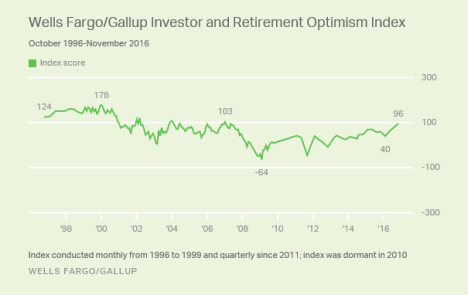
Investor confidence continues to grow, as the Wells Fargo sentiment index rose for the third straight quarter and is at a 9 year high. Optimism over the 12 month economic outlook drove the increase, and 37% cite the election for that improvement. If Trump can get through some sort of corporate tax relief, then the forward earnings estimates on the S&P 500 are too low, compared to where they were before the election. That is part of what has been driving the markets. You take corporate tax rates from 35% to 20% or 25%, and the forward P/E multiple on the S&P drops even if pre-tax earnings don’t improve.

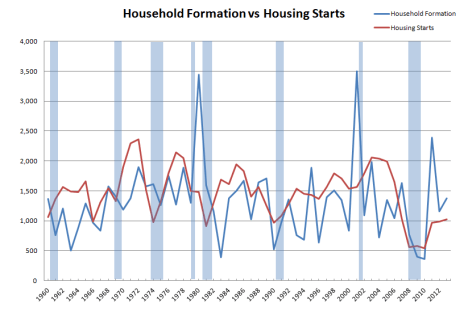
Talk about pent-up demand for housing: 40% of young adults (ages 18-34) were living with their parents in 2015, which is a 75 year high. “The number of adults under age 30 has increased by 5 million over the last decade, but the number of households for that age group grew by just 200,000 over the same period, according to the Harvard Joint Center for Housing Studies.” Housing starts have basically kept pace with household formation, but are unprepared if these people suddenly decide to move out. You can see the relationship between housing starts and household formation below: That 5 million equates to almost 4 years of housing starts based on our current run rate. That will be the catalyst to take growth from 2% to 3%+.

houshold-formation-vs-housing-starts

Morning Report: Mortgage credit remains tight 12/20/16

Vital Statistics:

Last Change
S&P Futures 2265.5 5.5
Eurostoxx Index 360.9 1.3
Oil (WTI) 52.6 0.5
US dollar index 93.6 0.4
10 Year Govt Bond Yield 2.57%
Current Coupon Fannie Mae TBA 103
Current Coupon Ginnie Mae TBA 104
30 Year Fixed Rate Mortgage 4.29

Stocks are higher this morning on no real news. Bonds and MBS are down small.

No economic data today. The financial networks are giddy over #Dow20000.

Housing credit remained tight in the third quarter, according to CoreLogic. New loan risk fell as credit scores improved and the average LTV fell to 85.8 from 86.8 a year ago. Average DTIs fell as well, to 35.4 from 35.7. I guess this index could be taken one of two ways: either credit is getting tighter, or the average borrower is getting into better financial shape as time goes on. I suspect it is a little of both. Regardless, you can see that we are a long way away from the glory days of the housing bubble, and even nowhere near the depths of the post 9/11 economy.

Ray Dalio of Bridgewater has a good piece on the incoming administration and compares it to Reagan and Thatcher in the late 70s / early 80s. Bottom line is that the reins of government will be handed from academics and activists to businesspeople, which should unleash some of the animal spirits that have been dormant for the past decade.

Quote from the article: “This particular shift by the Trump administration could have a much bigger impact on the US economy than one would calculate on the basis of changes in tax and spending policies alone because it could ignite animal spirits and attract productive capital. Regarding igniting animal spirits, if this administration can spark a virtuous cycle in which people can make money, the move out of cash (that pays them virtually nothing) to risk-on investments could be huge. Regarding attracting capital, Trump’s policies can also have a big impact because businessmen and investors move very quickly away from inhospitable environments to hospitable environments. Remember how quickly money left and came back to places like Spain and Argentina? A pro-business US with its rule of law, political stability, property rights protections, and (soon to be) favorable corporate taxes offers a uniquely attractive environment for those who make money and/or have money.”

What does that mean for the financial sector? First, it probably means a return of the private label securitization market, which will open up capital to borrowers who are currently shut out of the market. Certainly it will encourage homebuilders to begin to address the shortage of housing we currently have, with the concomitant job creation that entails. And finally, it may be the catalyst to get the Millennial first time homebuyer in a position to own a home. Granted, there are a lot of “ifs” in Dalio’s statement, but those sentiments are certainly being echoed in the stock and bond markets.

Morning Report: Lennar beats expectations 12/19/16

Vital Statistics:

Last Change
S&P Futures 2256.8 1.5
Eurostoxx Index 359.6 -0.4
Oil (WTI) 51.7 -0.2
US dollar index 93.2 0.1
10 Year Govt Bond Yield 2.55%
Current Coupon Fannie Mae TBA 103
Current Coupon Ginnie Mae TBA 104
30 Year Fixed Rate Mortgage 4.29

Stocks are up this morning on no real news. Bonds and MBS are up as well.

Not much in the way of economic data this morning, however Janet Yellen speaks at 1:30pm EST.

The flash services PMI fell slightly to 43.5.

Today the Electoral College votes for President. The vote will then go to Congress to be certified in early January.

Homebuilder Lennar reported earnings this morning, with revenues up 15%, new orders up 12%, and backlog up 17%. Average selling prices rose only 2.9% to $357k, which indicates that home price appreciation is slowing. The press release didn’t address the cancellation rate, which will probably begin to grow for the builders as higher rates kick in. Lennar has a November 30 fiscal year, so it is probably a little early to see how higher rates are affecting them.

Lenders foresee a drop in margins and demand going forward as rates rise, according to the Fannie Mae Quarterly Lender Survey.  Fully 2/3 of lenders view rates as “not favorable” at the moment. Lenders expect margin compression as well as refi shops cut prices to stay competitive. Lenders do expect to continue to ease lending standards. Lenders also intend to execute more through the GSEs and the government and plan to reduce the number of loans they hold on their balance sheet.

CoreLogic put out its forecasts for 2017. Home price appreciation will slow into 2017 as higher mortgage rates and home prices take a bite out of demand. Credit quality will remain good, however and we will start to see more HELOC activity, while refis will decrease. Vacancy rates will remain low, and rental inflation will be around 3%.

Here is a look at the effects of rising rates for the mortgage lending sector.

Morning Report: Housing starts nosedive 12/16/16

Vital Statistics:

Last Change
S&P Futures 2262.0 3.5
Eurostoxx Index 359.6 0.8
Oil (WTI) 51.1 0.2
US dollar index 93.1 -0.1
10 Year Govt Bond Yield 2.58%
Current Coupon Fannie Mae TBA 103
Current Coupon Ginnie Mae TBA 104
30 Year Fixed Rate Mortgage 4.15

Stocks are up this morning on no real news. Bonds and MBS are flat.

Housing starts fell 19% in November to an annualized rate of 1.09 million, which was way below estimates. Both single family and multi-fam fell, but multi bore the brunt of it. This is 7% lower than a year ago. Building Permits came in at 1.2 million, which was also below forecasts. Housing starts can be volatile and I wouldn’t be surprised to see this number revised upward.

Despite the low housing starts number, homebuilder sentiment is at highs not seen since the bubble years. This increase was probably due to a post-election bounce, however builders remain cautious and starts are way below historical averages. Perhaps a change in the regulatory environment will change that. “This notable rise in builder sentiment is largely attributable to a post-election bounce, as builders are hopeful that President-elect Trump will follow through on his pledge to cut burdensome regulations that are harming small businesses and housing affordability,” said NAHB Chairman Ed Brady, a home builder and developer from Bloomington, Ill. “This is particularly important, given that a recent NAHB study shows that regulatory costs for home building have increased 29 percent in the past five years.”

Donald Trump is close to choosing Larry Kudlow for the role of Chief Economist. The focus for economic growth will move from trying to improve demand to trying to improve productivity. Kudlow is a veteran of the Reagan Administration and is a firm believer in supply side economics. He has been historically a very vocal free trader, but will have to soften that approach in this administration.

Morning Report: The Fed hikes, but the dot plot is the story 12/15/16

Vital Statistics:

Last Change
S&P Futures 2252.8 0.8
Eurostoxx Index 357.0 1.3
Oil (WTI) 50.1 -0.9
US dollar index 93.0 0.6
10 Year Govt Bond Yield 2.58%
Current Coupon Fannie Mae TBA 103
Current Coupon Ginnie Mae TBA 104
30 Year Fixed Rate Mortgage 4.14

Stocks are flat this morning after the FOMC meeting yesterday. Bonds and MBS are up small.

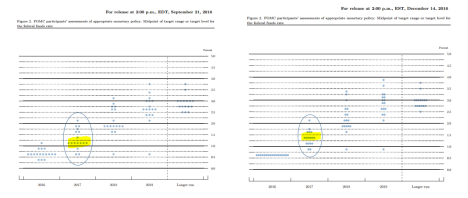
The Fed raised the Fed Funds rate a quarter of a point yesterday as expected, but the dot plot was what garnered all the attention. At the September meeting, the FOMC members were forecasting two more rate hikes in 2017, and now they are forecasting 3. That hit bonds, which sent the 2 year note yield up 12 basis points and the 10 year up 13 basis points. Overall, the language of the statement didn’t change much, and neither did the economic forecasts. Aside from a small uptick in their forecast for 2017 GDP growth, most everything else was the same. You can see the change in the central tendency for 2017 in the comparison of the dot plots below. September’s plot is on the right, and December is on the left. The yellow line represents the central tendency.

dot-plot-comparison-sep-vs-dec

Due to the volatility, most lenders shut down their lock desks, so mortgage rates didn’t really move all that much, but expect to see at least some movement, although mortgage rates tend to lag the moves in the 10 year, sometimes quite substantially. The last few tightening cycles have seen a flattening of the yield curve, so an anticipated increase of 75 basis points in the Fed funds rate doesn’t necessarily translate into a 75 basis point increase in the 10 year. Mortgage rates will almost undoubtedly increase by less than the increase in the 10 year. And if rates are going up for the right reasons (economic growth) that means the purchase business should offset some of the losses of the refi business.

Janet Yellen’s press conference was largely a non-event. She spent it dodging questions about how Donald Trump looks at the world and stressed the Fed will remain data-dependent. The issue of productivity kept coming up, and how Trump will use policies to improve on it (via regulatory reform and corporate tax cutting). Productivity growth should translate into non-inflationary wage growth, which is what everyone is hoping for.

Bottom line: The Fed is going to fade into the background again, and Donald Trump will be driving the news cycle and bond yields. If Congress adds fiscal stimulus, the Fed will probably be more aggressive. Note the dot plot is only a forecast. In fact, many of those dots represent forecasts for people who are not voting members on the FOMC. The Fed might hike 3 times in 2017, but the 10 year yield probably won’t go up as much, and mortgage rates will go up even less. 

Technical analysts are calling for the end of the secular bond bull market which began about 25 years ago.

Inflation at the consumer level increased 0.2% last month, and is up 1.7% YOY. The core rate (excluding food and energy) is up 0.2% MOM and 2.1% YOY. Healthcare and rent drove the increase.

We have some manufacturing data as well: Industrial production fell 0.4% MOM and manufacturing production fell 0.1%. Capacity Utilization was flat at 75%. The Philly Fed manufacturing index jumped to 22 from 10 and the Empire State Manufacturing Index improved to 9 from 6. Finally business inventories fell 0.2%.

Initial Jobless Claims fell 4k last week to 254,000. These are the lowest levels since the early 70s.

The median house price rose almost 8% in November, according to RedFin. According to their numbers, the median house price is 274k and months of inventory is 3.4 (meaning they see the inventory situation much tighter than NAR does in their existing home sales report).

Morning Report: FOMC day – what to watch 12/14/16

Vital Statistics:

Last Change
S&P Futures 2264.8 -3.0
Eurostoxx Index 345.1 -1.4
Oil (WTI) 52.2 -0.8
US dollar index 91.3 -0.1
10 Year Govt Bond Yield 2.44%
Current Coupon Fannie Mae TBA 103
Current Coupon Ginnie Mae TBA 104
30 Year Fixed Rate Mortgage 4.13

Markets are flat this morning as we await the FOMC decision at 2:00 pm EST. Bonds and MBS are up.

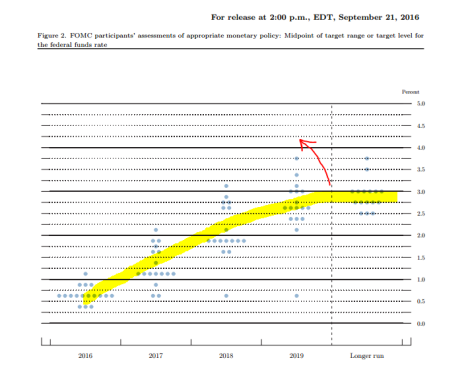
What to look for in the Fed statement: The biggest thing to watch will be the dot plot, which shows the forecasts that various members have for the Federal Funds rate. This is different than the 10 year, which determines mortgage rates. Market participants will compare the September 2016 dot plot with the December 2016 one and look for a shift in the general trend, either up or steepening.

Generally speaking the dot plots have been heading downward over the past several years as the Fed has been consistently high in its estimate for GDP growth. If the new dot plot is more aggressive (say it predicts 3 hikes for 2017, when before it was 2 hikes, then you could see a bond sell-off, which would send rates higher.

dot-plot-annotated

Janet Yellen will have a press conference at 2:30, and will probably do her best to dodge questions about Trump and his influence on the economy.

FWIW, the MBA believes the 10 year will stay below 3% and the mortgage rate will stay below 5% through 2018.

Retail Sales for November disappointed this morning, with the headline number up 0.1% and the core number (ex autos and gas) up 0.2%. November retail sales can be noisy, as more and more shoppers procrastinate. Still, this goes along with the weak Redbook same store sales number yesterday.

Inflation at the wholesale level is on the upswing, according to the Producer Price index. The PPI rose 0.4% MOM and is up 1.3% YOY. The core index is up 0.2% MOM and 1.8% YOY. Inflation remains below the Fed’s target which gives them the room to go slowly with rate hikes.

Mortgage Applications fell 4% last week as purchases fell 3% and refis fell 4%.

First time homebuyers face a shortage of real estate going into 2017, according to Redfin. For starter homes, the problem is acute. Over the past year, prices have risen 7.5% as inventory fell 12%. This increased the percent of income needed to buy a median home in that segment to 38.5%, an increase of about 2 percentage points. They are hopeful that the bottom is in with respect to tight inventory, however some of that will depend on regulatory policies of the new administration. On the plus side, credit will probably ease a bit as the financial system gets more clarity on regulation. On the negative side, immigration limits will exacerbate the construction labor shortage we currently are experiencing.

Morning Report: The FOMC meeting begins 12/13/16

Vital Statistics:

Last Change
S&P Futures 2258.6 8.0
Eurostoxx Index 356.3 2.6
Oil (WTI) 53.1 0.3
US dollar index 91.3 0.0
10 Year Govt Bond Yield 2.44%
Current Coupon Fannie Mae TBA 103
Current Coupon Ginnie Mae TBA 104
30 Year Fixed Rate Mortgage 4.13

Markets are higher this morning as Italian bank Unicredito launches a restructuring plan. Bonds and MBS are up.

The FOMC meeting begins today, with the announcement scheduled for 2:00 pm tomorrow.

Despite the expectation that the Fed will hike rates tomorrow, inflation remains pretty much nowhere to be found. Import prices fell 0.3% last month and are down 0.1% on an annualized basis. Export prices were down 0.1% MOM and down 0.3% YOY.

Holiday shopping is starting out subdued, according to Redbook. Same Store Sales were up 1% for the week ending Dec 10.

Here is a comparison of the past 3 tightening cycles: 1994-1995, 2004-2006 and the current one. The biggest differences: This tightening is happening much later in the cycle (this second hike is almost 7.5 years since the expansion began), unemployment is much lower (4.9% versus 5.5% and 6.5%) and growth is much lower. Of course the biggest difference is that the prior cycles were implemented in the context of a traditional business cycle, where a buildup in inventory caused a recession. This time around, it is the context of an asset bubble, where a buildup in bad debt caused the recession. These are fundamentally different animals, and explains why the Fed is taking baby steps this time around.

fed-tightening-cycles

One thing to watch after the FOMC announcement: Donald Trump’s twitter feed. Any sort of jawboning of the Fed by Trump will almost certainly affect bonds. In the past, Trump has been hawkish, however now that he is a politician, he might adopt a more dovish tilt, as most politicians do (at least the ones in office).

Fed watcher Tim Duy believes the markets are probably too sanguine about rate hikes in 2017. The markets are looking for two 25 basis point hikes, and he believes the risk is to the upside (i.e. a more aggressive Fed).

Small business optimism picked up in November, according to the NFIB. Expectations for an improvement in the economy and top line growth drove the improvement. We also saw a big uptick in hiring plans, although capital expenditures are still depressed. Business is looking for a cut in corporate taxes and a relaxation of regulations. Remember however, these are expectations, not a description of how business is at the moment.

Zillow has its 6 big predictions for 2017 in the real estate markets. Here are the big themes:

  • Cities will focus on denser development of smaller homes close to public transit and urban centers.
  • The drop in the homeownership rate will reverse as more Millennials become homeowners.
  • Rental affordability will improve as incomes rise and growth in rents slows.
  • New home price inflation will continue, and could be exacerbated by any sort of slowdown in immigration.
  • The suburban population will increase as city-dwellers seek more affordable housing outside of the cities.
  • Home values will grow 3.6 percent in 2017 versus 4.8% in 2016.

There were 30,000 completed foreclosures in October, according to CoreLogic. Foreclosure inventory is down 32% from a year ago. 1 million mortgages were down 90 days + which is a decrease of 25% YOY and is the lowest level since August 2007. Normalcy for foreclosures is around 22,000 a month, so we still have some wood to chop.

Donald Trump has nominated Exxon-Mobil CEO Rex Tillerson to be Secretary of State. Getting this nominee past the Senate will not be a slam-dunk, given his ties with Vladimir Putin and Russia in general. This is even more sensitive given that the CIA thinks Russia might have had something to do with the Wikileaks emails surrounding the DNC.

Separately, Donald Trump cancelled a press conference scheduled for today regarding how he will handle his business interests once he takes office.

Morning Report: How much does Trump change the Fed’s forecasts 12/12/16

Vital Statistics:

Last Change
S&P Futures 2260.0 0.0
Eurostoxx Index 354.0 -1.4
Oil (WTI) 53.5 2.0
US dollar index 91.6 -0.3
10 Year Govt Bond Yield 2.50%
Current Coupon Fannie Mae TBA 103
Current Coupon Ginnie Mae TBA 104
30 Year Fixed Rate Mortgage 4.08


Markets are flat this morning as oil rallies. Bonds and MBS are down,
Slow news day with no economic data this morning. The big event this week will be the FOMC meeting on Tuesday and Wednesday. A 25 basis point hike in the Fed Funds rate is baked in the cake – the market will however focus like a laser on the dot plot and how many hikes are expected for 2017.
In terms of economic forecasting, The Fed was almost certainly assigning a 100% probability of Hillary winning in their September forecasts. Trump’s expected policies (especially a big stimulus plan) would probably cause those forecasts to change. If anything, I would expect the Fed to begin moving the dot graph up, which would be bond bearish. That said, we have had a huge sell-off already, so the move has largely been made.
Overseas, Chinese markets got slammed overnight. The other elephant in the room for the Fed will be the fallout in global markets if China implodes. Luckily, with their capital controls, most of the carnage should be limited to China itself, however any big bust would still have major repercussions for the US dollar, US sovereign debt, and real estate.
Over the weekend, Donald Trump floated Exxon-Mobil CEO Rex Tillerson for Secretary of State, and Texas Governor Rick Perry for DOE. Wouldn’t those choices be better reversed? Donald Trump likes Tillerson because he wants “good negotiators” for the role of State. Separately, Goldman executive Gary Cohn is looking like the nominee for the National Economic Council.

Morning Report: Corporate tax reform 12/9/16

Vital Statistics:

Last Change
S&P Futures 2250.0 2.0
Eurostoxx Index 354.2 2.0
Oil (WTI) 51.3 0.4
US dollar index 91.8 0.4
10 Year Govt Bond Yield 2.41%
Current Coupon Fannie Mae TBA 103
Current Coupon Ginnie Mae TBA 104
30 Year Fixed Rate Mortgage 4.08


Stocks are higher this morning on no real news. Bonds and MBS are flat.
Slow news day.
Consumer sentiment jumped in November from 94 to 98.
Negative equity fell 0.8% from Q2 to Q3, according to CoreLogic. Currently, 8.4% of all mortgaged homes have negative equity, and another 1.6% are near negative equity. In total, 14.6% of all mortgaged homes in the US have less than 20% equity. Home price appreciation has been one driver of this, as well as borrowers who have been switching to 15 year mortgages which pay down principal faster. Over the past year, the average homeowner has picked up $12,500 in home equity.
One of the best chances for bipartisanship next year is corporate tax reform. While Republicans and Democrats disagree on how much revenue corporate taxes should bring in, most everyone agrees that our current system isn’t working. Over the past 16 years, virtually all of our competitors cut corporate taxes, however the US has maintained its 35% rate. You can see how much the market has shifted over the past 16 years in the chart below. The new plan would eliminate the incentives that companies use to shift revenues and costs to various jurisdictions in order to minimize taxes. Rates would fall, however interest would no longer be deductible.

A notable bond bear believes the tipping point in the bond market is 3% yields on the 10-year. At yields above that, he believes the stock market and the bond market would suffer a vicious sell-off.