Morning Report: Appraisals lag prices 1/11/17

Vital Statistics:

Last Change
S&P Futures 2262.0 -1.8
Eurostoxx Index 364.8 0.7
Oil (WTI) 51.1 0.3
US dollar index 93.0 0.3
10 Year Govt Bond Yield 2.37%
Current Coupon Fannie Mae TBA 103
Current Coupon Ginnie Mae TBA 104
30 Year Fixed Rate Mortgage 4.11

Markets are flat ahead of Donald Trump’s news conference. Bonds and MBS are flat.

Mortgage Applications rose 5.8% last week as purchases rose 6% and refis rose 4%.

Secretary of State nominee Rex Tillerson will face Congress today. Jeff Sessions had his time in the box yesterday.

Home sales are falling through at a faster pace than last year, according to Trulia, and it is the starter home price points that are seeing it the most. 4.3% of all sales failed in the fourth quarter, compared to 1.4% two years ago. This may have to do with the increase in the number of first time homebuyers and the drop in professional investors which makes this probably a credit story. We are also seeing people who had foreclosures and bankruptcies during the bubble years re-approach the housing market as those events fall off their credit reports.

Part of this phenomenon could in fact be the divergence between the opinions of buyers / sellers and appraisers. According to Quicken loans, appraised values came in about 1.3% lower than owner expectations in November. Interestingly, appraised values fell in November, while house prices (at least according to the home price indices) have been rising. That said, appraisal values did increase almost 4% YOY, however that is much lower than the 6% or so home price appreciation we have been seeing in the other indices. That said, since appraisals use historical comparisons, some lag is to be expected.

Bob Shiller says the animal spirits are stirring in the housing market. Of course tight credit for both buyers and builders as well as increasing interest rates will offset that somewhat, but confidence plays a huge role in economic growth. That said, demographic headwinds are going to be an issue.

In keeping with the demographic headwinds issue, the Bipartisan Policy Center Senior Health and Housing Task Force has some advice for Ben Carson and helping the Baby Boom generation age in their homes.

Morning Report: Small Business Optimism jumps 1/10/17

Vital Statistics:

Last
S&P Futures 2264.5
Eurostoxx Index 363.6
Oil (WTI) 52.1
US dollar index 92.7
10 Year Govt Bond Yield 2.39%
Current Coupon Fannie Mae TBA 103
Current Coupon Ginnie Mae TBA 104
30 Year Fixed Rate Mortgage 4.11

Stocks are flat this morning on no real news.  Bonds and MBS are flat as well.

Job openings increased to 5.5 million, according to the JOLTS report. This is at levels not seen since 2000. The quits rate has been steady at 2.1%, and that is the ultimate measure of labor market strength and a leading indicator for wage growth and inflation. As long as that number is steady, the Fed can be reasonably comfortable that inflation is going to stay low.

Small business optimism rocketed in December, according to the NFIB. The index rose 7.4 points to 105.8, the highest level since December 2004. The lion’s share of the gain was due to improving expectations, so it probably will be given back if big changes in the regulatory and tax environment don’t materialize. Job creation plans did hit a 9 year high, and capital expenditure plans jumped as well. That said, actual hiring in December was virtually unchanged from a month ago. That said, competition remains tight for skilled workers and a net 26% of respondents reported increasing compensation.

Despite the improvement for small business, some in Corporate America (the automakers) are not sure what to think. Trump’s jawboning over outsourcing has caused automakers general uncertainty, as the industry recovers from the worst slump since the Great Depression. The ultimate trade may in fact turn out that Trump will let Obama’s new fuel efficiency standards die in return for more production in the US.

Rising rates are hurting buyer sentiment, according to Fannie Mae. Their Home Purchase Sentiment Index fell for the fifth month in a row. The survey predicts that home prices will increase 2.1% next year, however the survey has been consistently lower than the professional forecasts, let alone actual price appreciation. Respondents also believe it is easier to get a mortgage than it was two years ago. Their view of the economy has improved dramatically, with roughly the same percentage of people thinking the economy is on the right track versus the wrong track. Note this optimism was reflected in the Gallup data as well.

There were 26,000 completed foreclosures in November, according to CoreLogic. The seriously delinquent rate was 2.5%, which is the lowest since August 2007. Foreclosure inventory remains concentrated in the judicial states of New York, New Jersey, and Florida. The seriously delinquent rate remains highest in NY and NJ as well, with rates of 5% and 5.6% on average.

Yesterday’s change in FHA MIP caused some strange activity in the TBA market which affected pricing. Bonds were up yesterday and pricing was generally better for most products, except for higher-coupon FHA and VA loans. That pricing actually worsened. Why? Because the change in annual MIP caused investors to bump up their prepayment assumptions for higher coupon Ginnie securities (generally those with 4% coupons and up). This makes those higher coupon mortgage backed securities worth less than last week, all things being equal. So if you priced out a FHA loan on Friday expecting to see better pricing, only to get an unpleasant surprise, the MIP change was the reason. On the bright side, refinancing just got more attractive.

Quicken CEO Dan Gilbert accused the Department of Justice of conducting a shakedown operation.

Goldman’s Dan Hatzius is handicapping a 35% of a March hike this year, while the Fed Funds futures are handicapping a 25% chance. Goldman is much more hawkish than the Fed in general, and they foresee a more linear hiking of rates while the Fed (and the futures markets) are forecasting a more gentle increase.

Morning Report: FHA mortgage insurance premiums drop 1/9/17

Vital Statistics:

Last Change
S&P Futures 2268.5 -3.0
Eurostoxx Index 263.4 -2.0
Oil (WTI) 52.9 -1.1
US dollar index 92.8 0.0
10 Year Govt Bond Yield 2.37%
Current Coupon Fannie Mae TBA 103
Current Coupon Ginnie Mae TBA 104
30 Year Fixed Rate Mortgage 4.11

Stocks are lower this morning on overseas worries. Bonds and MBS are up.

The week after the jobs report is typically data-light, however we will have a lot of Fed-speak this week, especially today, Thursday, and Friday.

The labor market conditions index slipped in December to -.3 from 1.2 in November. Note this is a meta-index of many leading and lagging indicators, so it is possible to have a so-so number just after a decent jobs report.

HUD announced they are cutting the annual insurance premium for most FHA loans by 25 basis points, which should save the typical homeowner about $500 annually. This will affect mortgages with a disbursement date after Jan 27. The reduction is due to the improving health of the housing market and the FHA’s insurance fund. Since the crisis, FHA has increased premiums by 150% to restore capital reserves. This reduction reverses that move and brings annual premiums back down to close to pre-crisis levels.

The current HUD Chairman, Julian Castro is worried that Ben Carson will roll back some of the HUD initiatives over the past several years. The one most likely to be on the chopping block is a controversial policy in which HUD sues local governments in order to force them to change their zoning laws in order to accommodate more multi-family housing. Westchester County in New York has been fighting this for the entire Obama administration.

Notwithstanding the jump in wage inflation last month, overall wage inflation has been hard to come by, not only in the US, but globally. The relationship between unemployment and wages seems to have broken down. What is going on? First, the most likely explanation is that the new jobs being created pay less than the jobs that were lost. This is the most plausible explanation, as many of the construction jobs that were lost in the bubble never came back, and most of the employment growth is coming in lower-paying health care jobs. Second, workers lost so much bargaining power in the recession that they don’t feel comfortable asking for more. A third explanation could be that the cost to employers has risen, but these costs are largely regulatory and don’t flow through to wages. Regardless of the reason, wage growth is an imperfect representation of labor market strength.

Now that it is becoming harder to find buildable lots, many homebuilders are returning to half-finished subdivisions that were abandoned as the housing bubble burst in 2007 and 2008. The supply of developed vacant lots (go-dirt) has fallen by 20% since 2011. The buyers seem to be the big national homebuilders like Lennar. The credit markets for homebuilders remains a case of “haves and have-nots.” The big builders are able to issue corporate debt at super-low interest rates while the small guys are getting turned down by the local bank.

Morning Report: Decent jobs report 1/6/16

Vital Statistics:

Last Change
S&P Futures 2266.0 2.0
Eurostoxx Index 365.3 -0.4
Oil (WTI) 54.2 0.4
US dollar index 92.6 0.6
10 Year Govt Bond Yield 2.40%
Current Coupon Fannie Mae TBA 103
Current Coupon Ginnie Mae TBA 104
30 Year Fixed Rate Mortgage 4.11

Stocks are up slightly after the jobs report. Bonds and MBS are down.

Jobs report data dump:

  • Nonfarm payrolls increased 156,000
  • November payrolls revised up to 204,000
  • Unemployment rate 4.7%
  • Labor force participation rate 62.7%
  • Average hourly earnings up 0.4% (up 2.9% annualized)

Overall, a good report. The payrolls number was a disappointment, however we did see an increase in the labor force participation rate and an increase in average hourly earnings. The employment to population ratio was steady at 59.7%. The job growth was primarily in health care and social assistance. Retail gained, as well as transportation. Finance grew as well.

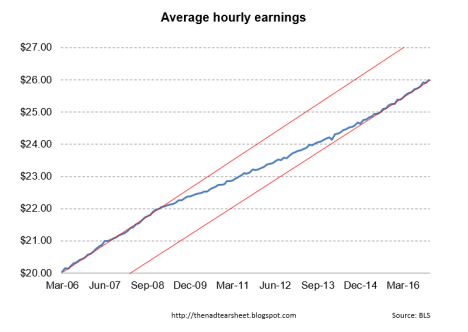
The focus for markets in on wage growth, as that is going to be the big determinant of Fed policy. I have plotted average hourly earnings over the past 10 years. You can see that the slope of the blue line (wage inflation) has almost come back to pre-crisis levels. In fact, wage inflation is the highest since 2009.  The gap between the two red lines represents the damage done by the Great Recession. The bigger question is whether employees get their raises in the form of higher benefit costs or whether it shows up in their paychecks. That will depend (in part) on whether the young Millennials get jobs, as they will help the risk pool which should (all things being equal) help lower health insurance costs for everyone else. Universities are reporting lower enrollments, which is a tell that Millennials are finding jobs. Note that sentiment indicators show that Millennials are more bearish on the economy than most, though this could be explained by partisanship.

hourly-earnings

Bonds sold off slightly on the report, with the 10-year reaching 2.4% before dropping back down. We have had some hawkish Fed-speak with Loretta Mester suggesting more than 3 hikes might be necessary and Williams saying 3 hikes would be reasonable. Remember, just because the Fed Funds rate increases, it doesn’t automatically follow that long term rate (which determine mortgage rates) will also increase. The last few tightening cycles have seen a flattening of the yield curve.

Despite the gloom for department stores and the holiday shopping season, online retailers reported an 11% increase in sales over the holiday period. We’ll have to wait until we get retail sales to see how the season actually went.

What are the most crowded trades on Wall Street? Here is your guide.

The trade gap widened in December, while factory orders fell 2.4% in November.

Morning Report: FOMC minutes reveal uncertainty over Trump 1/5/17

Vital Statistics:

Last Change
S&P Futures 2262.5 -2.0
Eurostoxx Index 365.1 -0.2
Oil (WTI) 5375.0 0.5
US dollar index 92.6 -0.4
10 Year Govt Bond Yield 2.42%
Current Coupon Fannie Mae TBA 103
Current Coupon Ginnie Mae TBA 104
30 Year Fixed Rate Mortgage 4.18


Stocks are down small on no real news. Bonds are up on the FOMC minutes from yesterday.
The private sector added 153,000 jobs in December, according to the ADP jobs report. This is below the 172,000 consensus figure. The Street is looking for 175,000 jobs in tomorrow’s payroll report. As the labor market tightens, job growth should slow.
Announced job cuts increased slightly in December, according to outplacement firm Challenger, Gray and Christmas.
Initial Jobless Claims came in at 235k last week, which is the lowest level since 1973. People that have jobs are generally keeping them.
Consumer comfort slipped last week, according to the Bloomberg Consumer Comfort Index.
The ISM Non-Manufacturing Index was flat in December, and came in above estimates. New Orders and pricing drove the increase, however employment fell.
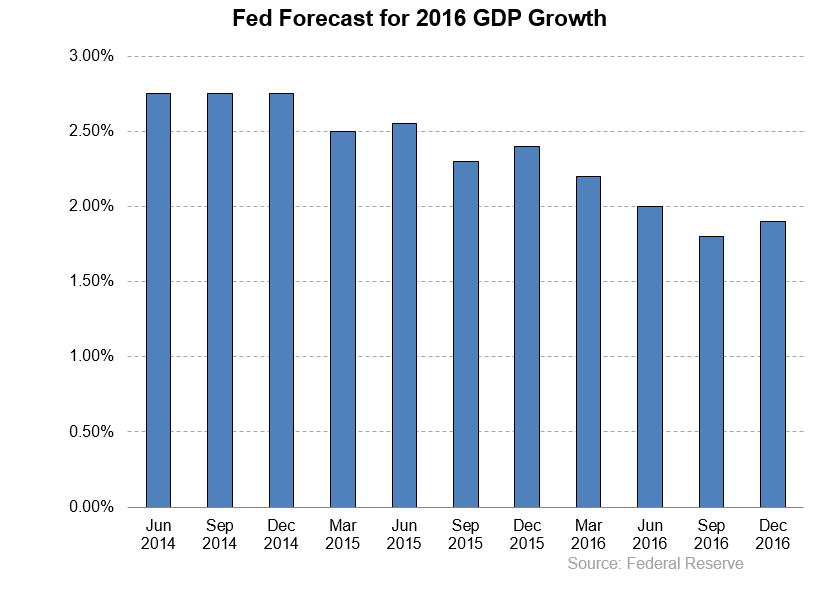
The FOMC minutes didn’t reveal much from the December meeting, aside from the fact that the interest rate forecast was based on the assumption that we would see more fiscal stimulus out of Washington, either via an infrastructure build or a tax cut. If we don’t get that, then the growth estimates, (and the assumed path of interest rate hikes) are probably too high. Note that Congress seems to be settling on repealing Obamacare as the first order of business. If so, that would probably poison the well for any sort of infrastructure spend and / or tax cuts. Which means interest rates should be heading downward, all things being equal. Bonds initially rallied on the minutes, gave back the gains, and then started rallying again this morning. Note that the Fed Funds futures are predicting two rate hikes next year, with a possibility of a third.
Note that the Fed has been consistently high in its estimates for GDP growth. The chart below looks at the Fed’s forecast for 2016 GDP growth at different points in time, starting with the June 2014 estimate.

Part of the problem with the Fed’s forecast has been that this recovery is different from the typical cyclical slowdown. In those, the issue is excess inventory, which causes companies to lay off employees. Once the excess inventory is liquidated and sufficient pent-up demand is created, the expansion begins. This time however the issue is bad debt from the bubble years, and that takes longer to work off. Instead of a V-shaped recession and recovery, we have more of a bathtub-shaped recovery. The effect of the bubble years also has a scarring effect on both consumers and business leaders (what Keynes called the animal spirits) which causes caution. That is why capital expenditures have been weak and why we are only building about 1.3 million new houses a year when we probably need 2 million a year.
Holiday sales (at least for the bricks and mortar retailers) seem to be disappointing as same store sales come in. Kohl’s and Macy’s both warned this morning and are down double digit percentages. Macy’s is cutting 10,000 jobs. Given that online is cannibalizing bricks and mortar, it is tough to draw too many conclusions from this, however it is probably helping bonds at the margin. We will get the government’s estimate of retail sales next Friday.
Mortgage Performance improved in the third quarter, according to the OCC. 94.8% of first lien mortgages were current and performing as of 9/30 compared to 93.9% last year. Foreclosure starts were down 25%.

Morning Report: Corporate America senses a shift in the winds 1/4/17

Vital Statistics:

Last Change
S&P Futures 2257.0 4.5
Eurostoxx Index 365.7 0.0
Oil (WTI) 52.5 0.1
US dollar index 93.2 -0.3
10 Year Govt Bond Yield 2.47%
Current Coupon Fannie Mae TBA 103
Current Coupon Ginnie Mae TBA 104
30 Year Fixed Rate Mortgage 4.17

Stocks are higher this morning on some good economic news out of Europe. Bonds and MBS are up small.

The FOMC minutes are scheduled to be released at 2:00 pm EST today. The focus will be on the dot plot, which showed the Committee members predicting 3 Fed Funds rate hikes this year. At her press conference, Janet Yellen downplayed the change, so investors will be looking closely at the discussion to get some more color on what the Fed is thinking. There is a chance that rates could get volatile around 2:00 pm, so just be aware if you are looking to lock around then.

HSBC took up their estimate for world growth on better US and Chinese growth prospects.

Mortgage Applications fell 12% last week as purchases fell 2% and refis fell 22%. It was a holiday week, so the numbers aren’t as bad as they look.

The Gallup Job Creation Index was unchanged last week and is at post-crisis highs.

China recently imposed new capital controls in order to prevent outflows of their currency, which restricts Chinese companies from buying foreign real estate. You are starting to see the effect of that in the high end real estate markets. Apartment prices fell 6.3% in Manhattan and you are seeing the same thing in Central London (which has been in bubble territory for years). Though we have yet to see it, you should expect to see some of the froth come off other high flying real estate markets, particularly on the West Coast.

CoreLogic looks at the change in Administrations (and ideologies) regarding housing going forward. Think tanks like the Urban Institute will take a backseat to think tanks like Cato. Expect to see a de-emphasis on fair housing issues like zoning and more of a focus on free-market solutions. Steve Mnuchin has been out calling for a re-privatization of Fannie Mae.

“Buy the election, sell the inauguration” is Morgan Stanley’s advice to equity owners. Their call is that uncertainty about Trump’s policies and the Fed will overshadow the optimism over regulatory relief and lower taxes going forward.

Wall Street lawyer Jay Clayton is the leading candidate to run the SEC. Along with Treasury Secretary Steve Mnuchin, they will hopefully get the private label securitization market back on track.

A fascinating read on the CFPB and how it operates.

It is interesting to see Corporate America begin to tout bringing jobs back to the US post-election. You have seen Ford, GM, Sprint, etc all out with headlines about planned job creation and shifting production back to the US. This could be the beginning of a trend. IMO, Corporate America has read the tea leaves from the election and realizes that they too are in the spotlight and want to get ahead of it. Ironically, Obama would have been crucified if he took on companies directly via Twitter the way Trump has. I guess only Nixon could go to China.

Morning Report: Manufacturing improves in November 1/3/17

Vital Statistics:

Last Change
S&P Futures 2250.5 15.0
Eurostoxx Index 366.1 3.0
Oil (WTI) 54.9 1.2
US dollar index 93.7 0.4
10 Year Govt Bond Yield 2.51%
Current Coupon Fannie Mae TBA 103
Current Coupon Ginnie Mae TBA 104
30 Year Fixed Rate Mortgage 4.28

Stocks are starting the year on an up note on overseas optimism. Bonds and MBS are down.

The highlight of the week will be the jobs report on Friday and the FOMC minutes from the December meeting on Wednesday. We have no Fed-speak until Friday.

Home prices rose 7.1% YOY, according to CoreLogic. They are forecasting an increase of 4.7% for 2017, as higher rates and prices affect buyers. Home prices in 27 states are now above their pre-crisis peaks. Remember, these are nominal prices, not inflation-adjusted prices.

Delinquency rates ticked up slightly in November, from 1.21% to 1.23%. On a year-over-year basis they were down from 1.58%. The peak DQ number was in early 2010 when it hit 5.59%.

Manufacturing improved in December, according the Markit PMI Index and the ISM Manufacturing Index.  New orders and pricing drove the increase. Pricing had been an issue for years. This may simply be a blip, however it does hint at inflation beginning to stir. The current level for the PMI Manufacturing Index (54.7) historically corresponds with GDP growth of 3.6%.

Construction spending rose 0.9% in November and is up 4.1% YOY. Residential Construction rose 1% and is up 3% YOY.

Barry Ritholz has his advice for 2017. His take: the secular bond bull market is over, however inflation is the real risk to bond investors, not mark-to-market losses. He also believes that secular bull markets in stocks aren’t measured from where they bottom, but from where they break out of their bear market range. This would put the beginning of the secular bull (assuming we are in one) around early 2013, not 2009. We had a secular bear market from 1966 to 1982, a secular bull market from 1982 to 2000 and a secular bear from 2000 to 2013 (if this is in fact a change of trend).

Note that corporate tax reform is a priority for the new administration. If you cut corporate taxes, then that means earnings are increasing, and the current forward P/E ratios of the S&P 500 are overstated. Of course higher interest rates, a higher dollar, and increasing wages will offset that somewhat.

Doug Kass has his surprises for 2017. This is usually a fun read and these should be looked as improbables that the markets are assigning a too-low probability to. The punch line is that the year starts off strong, however Trump’s inexperience begins to take its toll on politics and the markets, and the Administration devolves into chaos. Stocks peak in January and end the year down 15%. The 10 year shoots through 3% before falling back to 1.5% as the Fed begins QE unlimited to hold the 10 year at a specific level. Overall, it is a pessimistic take, but remember these are all “go out on a limb” sort of predictions – they aren’t base case scenarios.

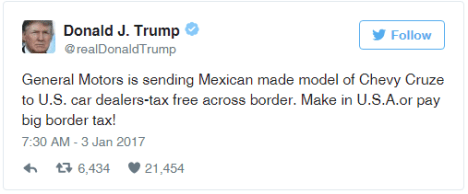
Another one of Kass’s predictions is that Trump’s security advisors finally convince him to stop Tweeting and close down his Twitter account, which causes the stock to drop 20%. Meanwhile this morning, Trump fired a shot across the bow of GM:

trump-gm

GM’s stock is down slightly pre-open, however tweets like this could give investors fits.

Larry Summers is skeptical that any sort of repatriation tax break for companies will find its way into re-investment. His view is that repatriated cash will be used for dividends, buybacks and M&A. Of course if companies don’t think there are opportunities for investment, they will return the money to stockholders, however that isn’t necessarily a given that there are no investment opportunities. Capital Expenditures have been moribund for a decade. You can only put that off so long. Secondly, if the psychology of CEOs changes from being worried about costs to being worried about missing out on business, then you will see more investment.

Morning Report: Investor optimism hits a 9 year high 12/29/16

Vital Statistics:

Last Change
S&P Futures 2246.5 1.5
Eurostoxx Index 360.7 -0.8
Oil (WTI) 53.9 -0.2
US dollar index 93.2 -0.3
10 Year Govt Bond Yield 2.49%
Current Coupon Fannie Mae TBA 103
Current Coupon Ginnie Mae TBA 104
30 Year Fixed Rate Mortgage 4.29

Stocks are flat as we head into the end of the year and volume dries up. Bonds and MBS are up again.

Initial Jobless Claims ticked up slightly to 365k last week.

Wholesale inventories increased 0.9% last month as autos and retailers had unsold items. This follows a decline in October. Chances are this inventory will be moved in December, however if it is not, it will have the effect of “borrowing” economic growth from Q1.

PHH has announced they are selling their entire MSR portfolio. New Residential was the buyer. This sale excludes the Ginnie Mae MSR, which were sold separately. The sale price is about 84 basis points of unpaid principal balance. MSR valuations were hurt during 2016 due to higher-than-expected prepayment speeds and lower interest rates. MSR valuations should firm going forward due to higher interest rates as well as new rules regarding the securitization of VA IRRLs. Higher MSR values should generally translate into better rates for the borrower.

Higher mortgage rates will probably force buyers to purchase lower-priced homes, according to a survey of realtors by Redfin. Almost half think that homebuyers will be forced to lower their price range, while another 15% think it will cause buyers to walk away. The rest either see no effect or think that sellers will decide to sit tight. Homebuilders will probably shift their production to lower price points, and builders like D.R. Horton and Pulte could be situated best. We are also seeing a migration of younger families from the coasts to the heartland, where real estate and the cost of living is much lower.

One other tidbit from the survey: more and more realtors are offering discounts.

Investor optimism hit a 9 year high, according to Gallup. There was a definite partisan birfurcation, as Republicans became more optimistic while Democrats became more pessimistic.

investor-optimism

21% of home buyers regret their choice of mortgage lender, according to a study by J.D. Power. 27% of first time home buyers regretted their choice. The complaints basically fell into two categories: The first type included a customer experience that was harmed by lack of communication, unforseen problems, and broken promises. The second type felt pressured to choose a specific type of mortgage product. They ended up being happy with their rate, but felt like they weren’t exposed to other options. Of course for the first time homebuyer, some of this is to be expected. If your only experience with getting credit is a “sign and drive” event at a car dealership, then the mortgage process will be a new experience. TRID and everything that goes with it could explain some of disappointment as well. For the second type, the borrower typically already had a relationship with the lender, but felt like the menu was limited. Note that technology is becoming more important, with 28% completing their application online last year versus 18% 2 years ago.

Morning Report: House flippers are back 12/28/16

Vital Statistics:

Last Change
S&P Futures 2266.5 5.5
Eurostoxx Index 361.3 0.8
Oil (WTI) 52.2 0.1
US dollar index 93.7 0.3
10 Year Govt Bond Yield 2.55%
Current Coupon Fannie Mae TBA 103
Current Coupon Ginnie Mae TBA 104
30 Year Fixed Rate Mortgage 4.29

Stocks are up this morning on no real news. Bonds and MBS are flat.

Pending home sales fell 2.5% in November on rising mortgage rates and tight supply, according to the National Association of Realtors. They forecast existing home sales to hit just over 5.5 million in 2017, which works out to be a 10 year high. NAR anticipates that increasing wages will offset some of the problems with affordability.

Same store sales increased 2.1% last week according to Johnson Redbook. Despite the increases in consumer confidence indices, it doesn’t appear to be translating into actual buying.

Bob Shiller (of Case-Shiller fame) thinks that next year could usher in a housing boom, provided some regulatory relief happens. Initially, he thinks that rising rates could accelerate home purchases, as buyers realize that waiting will mean higher house prices and higher rates.

House flippers are making a comeback as well. The number of house flippers has reached a 9 year high, and average profits are up to 61k from 19k at the bottom of the market. About 1/3 are financed with debt, the highest level in 8 years. The market for home flipping loans is still relatively small compared to the vanilla home loan market, but it is expected to reach almost $50 billion this year. The banks don’t seem to be making these loans directly, but are lending to smaller finance companies that do. Since these loans are non-owner occupied, a lot of the post-crisis regulations don’t apply to them or the companies that make them. Rates are in the 7% – 12% range.

Zillow is predicting a modest slowdown in home price appreciation. They are forecasting a 0.7% increase in November, which works out to be a 5.6% increase YOY. Most analysts are looking for a 3% – 5% increase in house prices for 2017.

Here is a good summary of the various important housing charts, all in one place.

The key to improving housing and mortgage lending next year is to bring back the private label securitization market. You can see below that private label securitization is still way below pre-bubble levels. Increasing interest rates could actually be a help as the risk-reward ratios of home lending decrease, which will bring in more investor money. More regulatory clarity will help issuers.

Morning Report: Home prices jump in October 12/27/16

Vital Statistics:

Last Change
S&P Futures 2261.2 1.2
Eurostoxx Index 360.5 0.5
Oil (WTI) 52.2 0.1
US dollar index 93.4 0.2
10 Year Govt Bond Yield 2.56%
Current Coupon Fannie Mae TBA 103
Current Coupon Ginnie Mae TBA 104
30 Year Fixed Rate Mortgage 4.29

Stocks are flattish this morning on no real news. Bonds and MBS are up small.

Expect a dull week with thin volume on the exchanges as many traders take this week off. We will have some minor economic reports this week, but nothing should be market-moving.

New Home Sales increased to 592k in November. This is an increase of 17% YOY. New home inventory is about 250k, which is a 5.1 month supply at current levels. The median sales price was $305k, while the average sales price was $359k. The Midwest and the West had the biggest increases in sales.

Home prices rose 5.6% in October, according to the Case-Shiller Home Price Index. Affordability measures have shown 20% – 30% decreases since home prices bottomed in 2012. While affordability is not yet at a point to suggest a reversal in home price appreciation, we are probably approaching the limits of home price appreciation unless wage growth accelerates.

Note that these indices are not inflation-adjusted. While inflation has been pretty tame over the past 10 years, it hasn’t been zero. If you adjust the index for inflation, we are still below our 2006 highs.

The national foreclosure inventory fell below 500k for the first time in 10 years, according to Black Knight Financial Services. Delinquencies ticked up on a seasonal basis, but are down almost 10% YOY. Improvements in delinquencies are getting smaller as the market normalizes.

For bond investors who were taken by surprise by the Fed’s forecast of 3 rate hikes this year, it is instructive to look at how many hikes they thought they would be making this year. In fact, no one suggested less than 2. We only had one. This again stresses the data-dependency of what the Fed is thinking. GDP growth came in slower than expected, and then we had Brexit, which caused the Fed to think about being less aggressive. Ultimately, it will depend on inflation and whether it returns. Despite inflation being below the Fed’s target rate, they still plan to tighten.

Consumer confidence jumped in November, driven primarily by the election and improving expectations for future growth. Note that the current conditions part of the index actually fell, so this is largely a jump based on the perception of the future which may not play out as assumed.