Morning Report: Non-QM AAA rated securitization coming 12/8/16

Vital Statistics:

Last Change
S&P Futures 2238.5 2.0
Eurostoxx Index 351.0 3.0
Oil (WTI) 50.2 0.4
US dollar index 91.3 0.0
10 Year Govt Bond Yield 2.37%
Current Coupon Fannie Mae TBA 103
Current Coupon Ginnie Mae TBA 104
30 Year Fixed Rate Mortgage 4.08

Stocks are up after the European Central Bank extended its quantitative easing plan. Bonds and MBS are down as the ECB lowered the monthly stimulus amount unexpectedly.

Initial Jobless Claims ticked up to 258k last week. We are still bumping around 40 year lows on initial jobless claims..

Nomura lays out 10 “black swan” events that could roil markets in 2017. Black swan events are things that are highly improbable, but not impossible. While most of these are overseas events (China floating the yuan, etc) there are a couple for the US. First would be a jump in US productivity, which would be good news for the economy as a whole, and the second would be a fight between Trump and the Fed, which would be bearish. Trump has been a critic of the Fed’s low interest rate policies in the past, however he is now a politician, and politicians love low interest rates. I wouldn’t be surprised to see a more hawkish nominee for the Fed when Yellen’s term is up, however.

I would add one more: that Donald Trump begins to douse the animal spirits by naming and shaming companies which do things he doesn’t like. Granted, politicians have always intervened in potential plant movings, etc, but they did it quietly behind the scenes, not via Twitter. This could become an issue going forward and would be bearish for the economy and the stock market. Good for bonds, however.

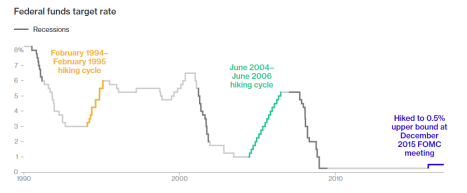
JP Morgan is out with a call saying the Fed will only hike interest rates twice next year – at the June and December meetings. They also are forecasting 1.9% GDP growth for 2017, which is slightly lower than the Fed’s forecast of 2%. They also warn of protectionism and a possible trade war if Trump follows through on renegotiating NAFTA and other treaties, which will be a drag on the economy. They also believe Congress will be willing to pass only a portion of the stimulus that Trump is looking for.

Is the private label securitization market returning? We are starting to see some green shoots, as securitizations of non-QM paper by Caliber and Sterling will get AAA ratings. Over half the loans are in California and the average FICO is 712. The big question is how overcollateralized these bonds are.

Partisan sentiment surveys are partisan 12/7/16

Vital Statistics:

Last Change
S&P Futures 2209.0 -1.0
Eurostoxx Index 346.3 2.0
Oil (WTI) 50.4 -0.5
US dollar index 91.1 0.0
10 Year Govt Bond Yield 2.37%
Current Coupon Fannie Mae TBA 103
Current Coupon Ginnie Mae TBA 104
30 Year Fixed Rate Mortgage 4.1

Markets are flattish this morning on no real news. Bonds and MBS are up small as global bonds rally on speculation the ECB will continue buying bonds into next September.

Mortgage applications fell 0.7% last week as purchases rose 0.4% and refis fell 1%.

Job Openings were little changed at 5.5 million last month, according the JOLTs job openings report. Job openings are more or less at the all-time highs of the index, which goes back to 2000. The quits rate is the key to the report: an increasing quits rate foreshadows wage inflation. So far, the quits rate is pretty much stuck at 2.1%.

Appraisals are coming in light for about 10% – 13% of all contract prices. This is mainly a problem in the hot markets where low inventory is creating bidding wars and buyers overpay.

Sentiment surveys are partisan to some extent. Prior to the election, Republicans were bearish on the housing market and Democrats were bullish. Now that Donald Trump has won, the parties have switched outlooks. It shows why you should generally take these sentiment surveys with a grain of salt. That said, the fundamentals of the housing market are strong with tight inventory and low rates (despite the Fed being in a tightening cycle).

Gallup’s Job Creation Index ticked up last week to 33, which means the percentage of firms planning to increase hiring minus the percentage of firms planning to cut jobs is 33%. Note that this is based on a telephone survey of workers, who may or may not know what their company’s actual plans are.

The post-election sell-off in the bond market has cut the refinanceable population in half, according to Black Knight Financial Services. The last time the refinanceable population was this small, refis were 37% below last quarter’s. The new rules on VA IRRLs will exacerbate that drop in refi volume. Going forward refi volume will be driven more by home price appreciation as people with mortgage rates from they heyday regain the home equity to refinance at today’s rates. Also, with the Fed tightening, now is a good time to look at swapping out from an ARM to a 30 year fixed. If the 35 year bull market in bonds is really finally over, locking in a low rate makes sense.

Mortgage credit availability improved last month according the the MBA. Credit availability increased for all 4 buckets: government, conventional, conforming, and jumbo. While the index has doubled since 2012, it is still at about 20% of the level set during the height of the bubble. It probably won’t increase meaningfully until either (a) the private label market returns, or (b) the government and GSEs increase the credit box.

It is no secret that the real estate sector is still largely done the way it has been for the past 50 years, with agents representing buyers and sellers, along with a largely manual loan process. Now a new firm is looking to use technology to disintermediate realtors. They pay realtors a 1% fee, and the company has just raised $20 million in Series B financing. Its name is Roofstock. It is a niche market – targeting sellers of tenant-occupied properties – however it could catch on.

Morning Report: Productivity Rises 12/6/16

Vital Statistics:

Last Change
S&P Futures 2207.5 3.0
Eurostoxx Index 343.2 2.0
Oil (WTI) 50.7 -1.1
US dollar index 91.0 0.0
10 Year Govt Bond Yield 2.39%
Current Coupon Fannie Mae TBA 103
Current Coupon Ginnie Mae TBA 104
30 Year Fixed Rate Mortgage 4.11

Stocks are lower this morning on no real news. Bonds and MBS are up.

Non-farm productivity improved to 3.1% in the third quarter, breaking out of a long slump. Unit labor costs increased 0.7%. Note that productivity and costs have been kind of oscillating around the zero point for the past several years. This is why wage growth has been going nowhere. New policies in terms of regulatory relief and tax reform could help improve productivity according to St. Louis Fed Head James Bullard.

Donald Trump has been discussing a potential 35% tariff on good imported from companies that offshore jobs. Not sure if this is even going to be legal, let alone legislatively possible. Tariffs are generally good for no one, except perhaps union workers. The last time we had a cocktail of tariffs and Fed tightening (1930), the economic result was nothing to write home about. While Reagan did impose tariffs against Japan, the results were mixed at best.

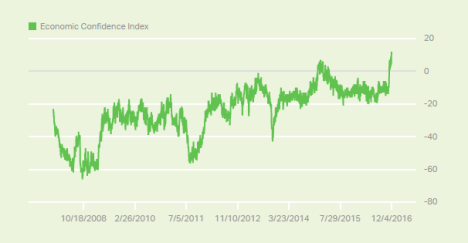
Economic confidence improved markedly in November, according to Gallup and is now at post-crisis highs. It will be interesting to see whether this translates into higher holiday spending. Separately, it could bode well for the Spring selling season, which is just around the corner (basically starts around Super Bowl Sunday).

economic confidence gallup.PNG

Luxury homebuilder Toll Brothers announced better than expected numbers this morning. Deliveries were up 29% in dollars and 22% in units, however we are seeing a moderation in inflation. Average selling prices rose 5.5% to $834k, which is well below the double-digit ASP inflation we have been seeing, especially at the high end. They discussed the Millennials and how they are targeting them: “With the millennial generation now entering their thirties and forming families, we are starting to benefit from the desire for home ownership from the affluent leading edge of this huge demographic wave. In FY 2016, approximately 22% of our settlements included one primary buyer thirty-five years of age or under. (emphasis mine). We are currently courting these customers with our core suburban homes, urban condos and rental apartment properties. We are also introducing a new product line, T|Select by Toll Brothers, which incorporates the elegance and style of a higher-end Toll Brothers home but with fewer structural options, a quicker delivery time and a slightly lower price.”

Home prices rose 1.1% MOM and are up 6.7% YOY, according to CoreLogic. The coasts remain largely overvalued, while the interior is mainly undervalued.

While rising rates are creating worries in the mortgage banking sector of the economy, banks have been on a tear since the election, outperforming the S&P 500 by 11 percentage points. This means the Street is forecasting a big increase in credit and profitability which should offset some of the doom and gloom amongst mortgage bankers. The “tell” will be the return of the private label securitization market, and the follow-on return of the first time homebuyer. Shops that focus on purchase activity should be optimistic about the future.

Morning Report: Ben Carson will run HUD 12/5/16

Vital Statistics:

Last Change
S&P Futures 2200.0 8.0
Eurostoxx Index 341.6 2.2
Oil (WTI) 52.2 0.5
US dollar index 91.3 0.0
10 Year Govt Bond Yield 2.41%
Current Coupon Fannie Mae TBA 103
Current Coupon Ginnie Mae TBA 104
30 Year Fixed Rate Mortgage 4.14

Markets are higher this morning on no real news. Bonds and MBS are down.

Slow news day, for the most part.

The week after the jobs report is usually pretty data-light and this week is no exception. Today is the last day of Fed-Speak until the FOMC meeting next week. Bonds will probably be driven more by overseas developments than anything going on the US.

The Markit PMI Services index slipped in November to 54.6 from 54.8 the month before. The ISM Non-Manufacturing PMI improved as well to a strong reading of 57.2.

Donald Trump will nominate Dr. Ben Carson as the Secretary of Housing and Urban Development. Carson is expected to reverse the Obama Administration’s aggressive enforcement of fair housing laws, including the use of disparate impact. Suffice it to say, fair housing is going to take a backseat to reforming the GSEs and the mortgage market.

Tight credit remains a driving factor in today’s mortgage market as credit is loose for some people at the high end and tight for everyone else. In fact, PIMCO estimates that between 1 and 1.4 million people who were eligible for a mortgage in 2002 (before the big subprime explosion) are unable to get a mortgage today under the new rules and regulations. The knock on effects (like tight inventory and lackluster homebuilding) remain as headwinds to the economy as a whole. This not only includes mortgage credit to borrowers, but also bank credit to small homebuilders etc.

Bond funds continue to experience withdrawals in the biggest bond bust since the Taper Tantrum.

Morning Report: Unemployment and wages fall 12/2/16

Vital Statistics:

Last Change
S&P Futures 2190.0 -2.0
Eurostoxx Index 338.2 -3.0
Oil (WTI) 51.1 0.0
US dollar index 91.5 -0.2
10 Year Govt Bond Yield 2.41%
Current Coupon Fannie Mae TBA 103
Current Coupon Ginnie Mae TBA 104
30 Year Fixed Rate Mortgage 4.14

Markets are flattish as investors digest the jobs report. Bonds and MBS are flat as well.

Jobs report data dump:

  • Payrolls up 178k vs 170 expected
  • Unemployment rate 4.6% vs. 4.9% expected
  • Labor force participation rate 62.7% vs 62.8% expected
  • Average hourly earnings down .1% vs expectations of a .2% increase

On balance, the report was mixed. While the drop in the unemployment rate was encouraging, the drop in wages was a disappointment. The drop in the labor force participation rate didn’t help things either. This probably doesn’t change the Fed’s thinking for the FOMC meeting in a couple of weeks.

The bright spot in the report: the big drop in the unemployment rate for the age 25-34 cohort. Good news for the mortgage and real estate industry. Anecdotally, college applications are falling markedly, which indicates people are getting jobs as opposed to going back to school. Overall, it means the first time homebuyer is in better shape.

Bonds initially rallied on the report, but have given back their gains.

Bill Gross isn’t buying the big rally in stocks lately. “An investor should move to cash and cash alternatives, such as high probability equity arbitrage situations,” Gross, who runs the $1.7 billion Janus Global Unconstrained Bond Fund, said. “Bond durations should be far below benchmarks.” The bond duration comment means he sees interest rates continuing to rise. In his view, equity investors are putting too much stock in things like regulatory reform and fiscal stimulus, as demographics and low productivity are likely to remain the more dominant forces in the market, which is ultimately bearish for stocks. Separately, investors pulled $4.1 billion out of taxable bond funds last week.

HUD has raised the FHA loan limit to $424,100. following the increase from Fannie Mae.

Morning Report: Steve Mnuchin on regulation and the GSEs 12/1/16

Vital Statistics:

Last Change
S&P Futures 2201.2 3.0
Eurostoxx Index 341.0 -1.0
Oil (WTI) 50.6 1.2
US dollar index 91.7 -0.3
10 Year Govt Bond Yield 2.41%
Current Coupon Fannie Mae TBA 103
Current Coupon Ginnie Mae TBA 104
30 Year Fixed Rate Mortgage 4.14

Stocks are flat this morning on no real news. Bonds and MBS are down small.

OPEC agreed to production cuts yesterday, which has sent the price of WTI over $50 a barrel.

Further evidence of strength in the labor market: announced job cuts fell to 27,000 last month, which is the lowest in a year. This is a 13% drop YOY. The retail sector had the biggest number of job cuts, largely due to the bankruptcy of American Apparel. Job cuts in the financial sector continue, however cuts in the energy sector are tapering off.

Initial Jobless Claims ticked up to 268k from 253k last week.

Manufacturing improved in November, as the ISM Manufacturing PMI increased from 52.3 to 53.2. Separately, the Markit PMI Manufacturing index ticked up to 54.1 from 53.9.

Construction Spending rose 0.5% last month and is up 3.2% YOY. Residential Construction was up 1.8% and is up 4.6% YOY.

Treasury Secretary nominee Steve Mnuchin said that Fannie Mae and Freddie Mac should exit government control, which puts him at odds with several Republicans like Jeb Hensarling who want to see the GSEs wound down. “We will make sure that when they are restructured, they are absolutely safe and don’t get taken over again. But we’ve got to get them out of government control,” Mnuchin said on an interview with Fox News. What “exit government control” actually means is an open question, however he believes that Fannie Mae is crowding out private lending. Getting private lending back into the mortgage market has been a priority since the financial crisis since 96% of all new origination still goes Fannie, Freddie, or Ginnie. I would also wager that the biggest ultimate lender to the mortgage market is the Fed, via their QE holdings of MBS. So the US mortgage market is for all intents and purposes nationalized at this point. Fannie Mae stock was up 46% on the statements. One big issue for privatizing Fannie and Fred: At the moment, all of their profits go to the government. By 2018, they will probably have no equity left, which isn’t good news for common stockholders.

Donald Trump also tapped a Quicken executive to the HUD transition team. He also named Jimmy Kemp, son of former HUD Secretary Jack Kemp, to the team as well. In many ways, these nominations signal a detente between the government and the financial sector, which should help tremendously with the goal of bringing private capital back into the mortgage market.

Separately, Mnuchin and Commerce Secretary Wilbur Ross were interviewed on CNBC, where they laid out more of their regulatory philosophy. Mnuchin said that Dodd-Frank was too complicated and the goal of financial regulation is to get banks to lend again. He cited regulatory uncertainty as a major impediment to lending. Wilbur Ross quipped that small banks have more compliance people than lending officers. Both said that lending is the engine of growth for the economy.

Liberals are screaming “hypocrisy” about Trump’s nominees, especially in the financial sector, but it is clear that having public interest attorneys running things has the system tied in knots.

Morning Report: Steve Mnuchin for Treasury Secretary 11/30/16

Vital Statistics:

Last Change
S&P Futures 2210.5 7.0
Eurostoxx Index 342.4 1.4
Oil (WTI) 48.8 3.5
US dollar index 91.7 0.4
10 Year Govt Bond Yield 2.39%
Current Coupon Fannie Mae TBA 103
Current Coupon Ginnie Mae TBA 104
30 Year Fixed Rate Mortgage 4.14

Stocks are higher this morning as oil rises. Bonds and MBS are down.

Oil ministers are meeting in Vienna today and market participants are optimistic a deal can be reached to cut production. Oil is up 7.5% this morning on speculation of a deal. Ordinarily, high oil prices are bad for markets, but these days it is considered a plus.

Donald Trump has reportedly selected Steve Mnuchin for Treasury Secretary. Mnuchin is another Goldman guy, making him the third Goldman Treasury Secretary since the mid 90s. Not much is known about his position on things like the dollar and interest rates. Given Trump’s focus on manufacturing jobs, Mnuchin could be a departure from the strong dollar policy that has been in place for several administrations.

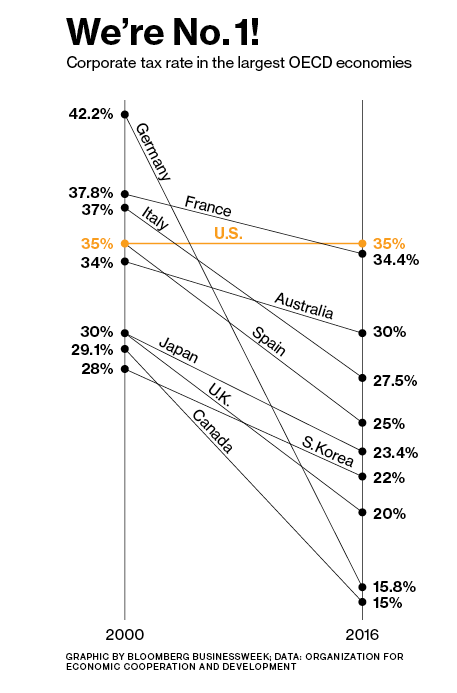
Part of Trump’s tax plan will include tax reform, where top rates will go down, however deductions will be limited. The mortgage interest deduction cap of $1 million for first and second mortgages will probably be lowered. This will probably affect only the very high end, but it is something to keep in mind for jumbo borrowers who have high DTIs to begin with. The Administration is saying that the very wealthy will get no “absolute” tax cut, but the middle class will.

Neither new Commerce Secretary Wilbur Ross nor Steve Mnuchin went out of their way to defend current Fed Head Janet Yellen, saying the decision on the remainder of her term is up to Trump. Donald Trump had been critical of Fed policy on the campaign trail, saying that interest rates were too low. Now that he is an actual politician, he may become more accepting of lower rates, as most politicians usually are. Reagan was the exception, however the 1970s inflation was so bad, people recognized that something had to be done.

Mortgage applications fell 9.4% last week as purchases fell 0.2% and refis fell 16%. Purchases held up reasonably well given the short Thanksgiving holiday.

The US added 216,000 jobs in November, according to the ADP survey. The Street was looking for 160,000 on the ADP number and has forecast 170,000 for Friday’s jobs report.

Pending home sales increased 0.1% last month as tight inventory remains an impediment to sales. Tight inventory is pushing prices up at triple the rate of wage growth, which is ultimately an untenable situation. Pending home sales rose in the Northeast, Midwest and West, while falling in the South.

The Chicago Purchasing Manager Index rose to 57.6 from 52 last month.

Personal incomes broke out of their range in October, increasing 0.6% after a string of 0.3% – 0.4% increases. Personal consumption declined however to a 0.3% increase. This bumped up the savings rate to 6% of disposable personal income, the highest since March. The PCE index for inflation is up 1.4% YOY and the PCE ex-food and energy index is up 1.7%. Nothing in this report will change the Fed’s thinking regarding the next Fed meeting.

Donald Trump announced on Twitter this morning that he will be “leaving his great business in total.” Not sure if that means a blind trust or a divestiture. A blind trust run by his kids will probably not be enough to mollify his critics.

Loan officers are painfully aware that rates have been going up. Investors have been taking it on the chin as well: the 10 year has had its worst month since 2009. Bonds have lost 2.4% this month, which is about about a years’ worth of interest at these levels. That said, the increase in rates has yet to match the 2013 “taper tantrum.” Another key piece of data: the difference between Treasuries and German Bunds is the highest on record, indicating that the correlation between US bonds and foreign bonds is breaking down. This makes sense as the Fed and the ECB have fundamentally different postures at this point.

Realtor.com has its 5 trends for 2017. Millennials move to the Midwest, home price appreciation slows, and tight inventory remain the major trends.

Morning Report: GDP revised upward 11/29/16

Vital Statistics:

Last Change
S&P Futures 2200.8 0.0
Eurostoxx Index 340.0 0.2
Oil (WTI) 45.3 -1.8
US dollar index 91.7 0.3
10 Year Govt Bond Yield 2.34%
Current Coupon Fannie Mae TBA 103
Current Coupon Ginnie Mae TBA 104
30 Year Fixed Rate Mortgage 4.14

Stocks are flat this morning as GDP surprises to the upside but oil falls as OPEC appears unable to cut production. Bonds and MBS are down.

Third quarter GDP was revised upward to 3.2% from the advance estimate of 2.9%. We will get one more revision to this number in a few weeks. Upward revisions in consumption drove the increase, while residential investment remains a drag. Business capital investment remains weak as well. The PCE Price index rose 1.4%, which means inflation remains below the Fed’s target rate. We have had a meaningful rebound in GDP after a run of 3 weak quarters.

gdp

The Case-Shiller index (considered to be the Dow Jones Industrial Average of real estate indices) surpassed its July 2006 peak in September. The index is up 5.1% YOY. The press release includes a cool table that shows the returns on real estate versus the returns on the stock market and compares those to income growth. Since 1975, real estate has increased almost 5%, and stocks have increased 8%. Since 2000, real estate has outperformed stocks. While stocks have have been a higher returning investment overall, they are typically much more volatile, and you can’t live in an ETF. Also, the press releases doesn’t address the tax benefits of real estate, which would certainly affect the analysis and improve the relative performance of real estate.

asset-returns

Corporate profits rebounded in the third quarter, rising 5.2% YOY after a 3 consecutive negative quarters. The divergence between stock prices (rising) and profits (falling) was creating an untenable situation in the stock market.

Ben Carson is reportedly going to be the next Secretary of HUD. Realtor.com has the potential implications. Though his background is in medicine, Carson does appear to follow housing: here is an editorial he wrote just over a year ago. The editorial covers fair housing issues, however doesn’t address the state of the mortgage market, and how to bring private capital back into the market. At the moment, the taxpayer bears the credit risk of the vast majority of new mortgages. Suffice it to say it doesn’t look like fair housing issues will be front and center at the new HUD, the way they have for the past 8 years.

Donald Trump named Georgia Congressman Tim Price as secretary of health and human services. Trump is meeting with Mitt Romney again for the Secretary of State position.

Consumer confidence rose sharply in November, according to the Conference Board, increasing to 107.1 from 100.8 in October. This index is back to pre-recession levels. Separately, Cyber Monday sales look to have increased 9.4% YOY.

Foreclosure starts fell to 56,500 in October, the lowest level in 12 years, according to Black Knight Financial Services. Delinquencies had a small uptick MOM, but are down YOY. Prepay speeds ticked down, but are still up markedly YOY.

Demand for houses fell in October, according to Redfin. The number of people requesting tours and submitting offers fell. Tight inventory remains the biggest issue – the number of homes listed was down almost 10% from a year ago.

Morning Report: Home Prices within 1% of peak 11/28/16

Vital Statistics:

Last Change
S&P Futures 2206.0 -58.0
Eurostoxx Index 340.9 -1.6
Oil (WTI) 47.0 0.9
US dollar index 91.7 -0.1
10 Year Govt Bond Yield 2.33%
Current Coupon Fannie Mae TBA 103
Current Coupon Ginnie Mae TBA 104
30 Year Fixed Rate Mortgage 4.14

Investors return to the markets after the Thanksgiving holiday contemplating a re-litigation of the 2016 Presidential election. Bonds and MBS are up.

Green Party candidate Jill Stein is requesting a recount in PA, MI, and WI. Donald Trump took to Twitter to condemn the effort and alleged that “millions” of votes were fraudulent. The Clinton campaign is keeping its distance but will watch to make sure outside players aren’t interfering with the process. If she manages to turn all 3 states, then she could win. One question that has come up has been whether Russia could have hacked the voting machines. That possibility looks unlikely.

Since the election, bank stocks have increased their market caps by $300 billion. The bet is that a roll-back of regulation will increase profits.

The highlight of the week will be the jobs report on Friday. The Street is looking for 170k jobs added, an unemployment rate of 4.9% and an increase in average hourly earnings of 0.2%.

The FOMC minutes from the early November meeting were a non-event, and the FOMC is definitely setting the stage for a December hike: “Most participants expressed a view that it could well become appropriate to raise the target range for the federal funds rate relatively soon, so long as incoming data provided some further evidence of continued progress toward the Committee’s objectives.” In fact, a “few” participants wanted a hike at the November meeting. The December FOMC meeting is in two weeks.

The FHFA raised the conforming limit from 417k to $424k. This was the first increase in 10 years. They also increased the high balance conforming limit to $636k.

Home Prices rose 0.1% in September and are up 5.4% YOY. Home prices are now within a percent of their peaks from June 2006.

Black Friday saw more shoppers, but less spending than in the past. About 154 million bought something in a store or online over the weekend, but they only spent about $289 as opposed to $300 a year ago. The National Retail Federation attributed the drop in spending to deep discounts offered by retailers. Black Friday online purchases were up 22% YOY.

Morning Report: Existing home sales near 10 year record 11/22/16

Vital Statistics:

Last Change
S&P Futures 2197.5 5.0
Eurostoxx Index 341.5 1.3
Oil (WTI) 48.5 1.8
US dollar index 91.3 0.1
10 Year Govt Bond Yield 2.31%
Current Coupon Fannie Mae TBA 103
Current Coupon Ginnie Mae TBA 104
30 Year Fixed Rate Mortgage 3.99

Stocks are up this morning as commodities rise on anticipated economic strength. Bonds and MBS are flat.

Existing home sales rose 2% to a seasonally-adjusted run rate of 5.6 million in October, according to the NAR. September’s numbers were revised upward to 5.49 million. October’s number is 5.9% higher than a year ago, and the highest reading since February 2007. The median home price rose 6% to $232,200. Total housing inventory dipped to 2.02 million units, which represents a 4.3 month supply at current levels. NAR considers 6.5 month’s worth to be a balanced market. Days on market ticked up to 41 days from 39 the month before. The first time homebuyer accounted for 33% of all

sales, which is up a couple percentage points from a year ago. Now, if we could just get housing starts up to catch up with the increase in sales we could have a real recovery on our hands.

The post-election rise in interest rates is beginning to affect home sales. First time homebuyers are being hit particularly hard. One loan officer has great advice however: the increase in rates may appear dramatic, but the difference in monthly payment often is not. “I tell people, interest rates are 80 percent psychological and 20 percent math. I do the math for them and their next reaction is, ‘Oh that’s all?’ Forty dollars a month, $75 a month. They initially think it’s going to be a lot more painful than that,” said Anker, who added he hasn’t lost any deals yet. ” While we have yet to see any effect in the home price indices (that will probably be a few months out) be prepared for a deceleration in home price appreciation, and maybe even flat / declining prices in the hottest markets.

The Richmond Fed Manufacturing index improved last month from -4 to 4.

Speculators in the US Eurodollar market are betting $2.1 trillion that short term rates are going up as economic growth and inflation return. Note that yesterday, all of the major stock market indices hit new highs. We have been seeing the biggest asset allocation change out of bonds and into stocks over the past week.

Donald Trump took to YouTube last night to give an update on the transition. Probably the biggest news in that was essentially a moratorium on regulations – where for every new regulation, two must be removed. Not sure how that is going to work in practice. The Trans Pacific Partnership trade deal is probably dead at this point as well. Separately, he isn’t going to launch any further investigations on Hillary Clinton.

Front-runner for Treasury Secretary Steve Mnuchin was part of a Goldman consortium that bought failed bank IndyMac, renamed it OneWest and sold it to CIT. This was post-crisis, however his confirmation hearing (if he gets the nom) will undoubtedly spend some time on the mortgage industry and past practices.

Impac said that low interest rates hurt demand for non-QM products last quarter.

When the Chinese bet on real estate, they bet big.