Morning Report: Housing starts fall 1/20/16

Another down day in stocks as global indices hit bear market levels. Yes, Virginia that is a 1-handle on the 10 year…

Housing starts fell in December from 1.17 million to 1.15 million, missing the 1.2 million Street estimate. Building permits fell from 1.28 million to 1.23 million, topping the 1.2 million estimate. Single-fam permits hit the highest level in 8 years. I sound like a broken record, but the economy isn’t going to hit the next level until housing construction returns to normalcy, about 1.5 million units per year. The plus side of this is that the housing deficit continues to grow, which means the rebound (when it happens) will be stronger and longer. Confidence and credit remain the issues at the moment.

Mortgage Applications rose 9% last week as refis rose 18.7% and purchases fell 1.6%. With the 10 year trading below 2% again, there should be refinance opportunities. With the 10 year yield falling and the Fed Fund rate increasing, the strategy to pitch is to swap out of an ARM (which is pegged to short term rates) and into a 30 year fixed.

Inflation remains under control, as the consumer price index fell 0.1% in December. Ex-food and energy it increased 0.1%.

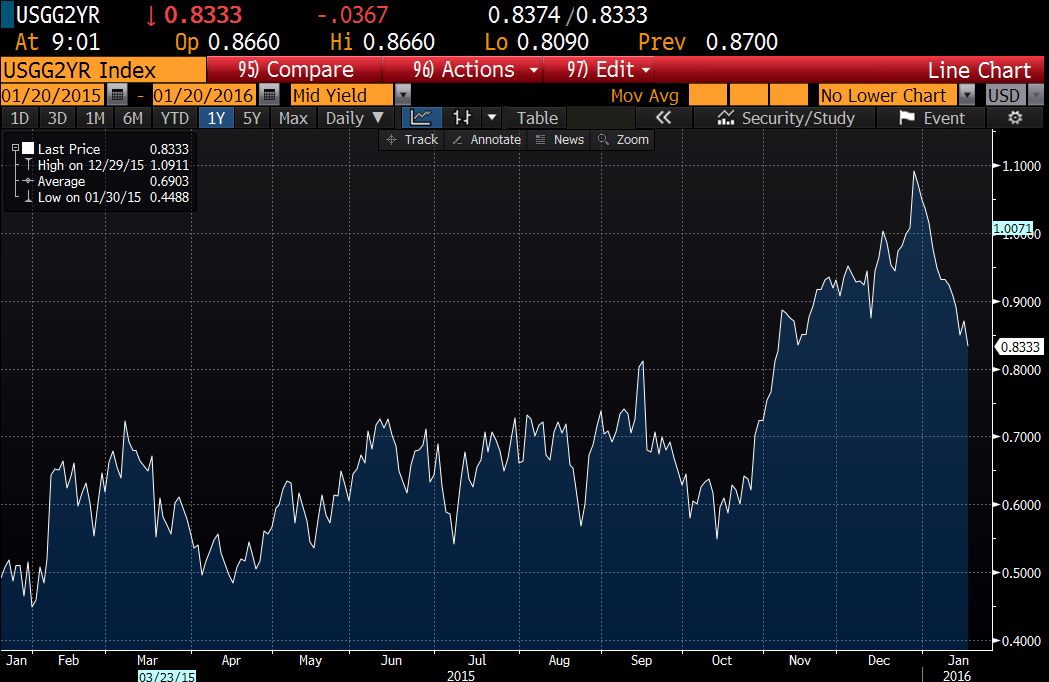
The dramatic sell-off in the markets has taken down rate hike expectations out of the Fed. You can see this in the 2 year bond yield, which has fallen 25 basis points since late December. This forecast was borne out in the latest Bank of America survey on the economic outlook. A month ago, 40% of fund managers expected no more than 2 rate hikes in 2016. Now that number is closer to 50%.

Earnings season is upon us, and the first companies to report are out of the banking sector. The main theme: a withdrawal from mortgage banking. The only big bank to report an increase in mortgage banking? Wells. Jamie Dimon said on JP Morgan’s conference call that the banks remain under assault. And politicians in DC continue to scratch their heads and wonder why the economy remains tepid.  Refer to housing starts above.

Morning Report: Markets attempt to mount a comeback 1/19/16rally

Markets are higher this morning as commodities rally. Bonds and MBS are down small.

The NAHB Homebuilders Index was unchanged at 60 last month.

Last Friday had some bad numbers with retail sales disappointing and industrial data coming in much softer than expected.

Bank of America reported better than expected numbers this morning, with mortgage production up 13%.

The 10 year bond yield touched 2% on Friday during the stock market sell-off. For those keeping score at home, the 10 year bond yield has dropped about 25 basis points since the Fed hiked rates in December.

Jeb Bush’s donors are getting cold feet. The rumor is that he needs to be in the top 3 in Iowa and New Hampshire or else they are going elsewhere. The “elsewhere” is Rubio.

On Friday, the Atlanta Fed took down their estimate for Q4 GDP to 0.6%. Luckily they waited until after the close to drop that bomb.

Revisited: Is Social Security Promising Too Much?

A few years ago I wrote a post asking Is Social Security Promising Too Much?, in which I attempted to demonstrate that the average retiree in 2011 could expect to receive a lot more in Social Security benefits than they ever paid in as FICA taxes. This was a retrospective look, so I used annual historical income levels, tax rates and treasury yields going back 53 years in order to calculate how much would have been paid in, how much compounded interest might have been earned, and how much benefit would be paid out based on those contributions. But because current SS tax rates have changed so much since the inception of the program, it recently occurred to me that it might make more sense to look at the question on a prospective rather than a retrospective basis, in order to see if changes to the program have made it any more viable. That is, rather than looking at a current retiree, I decided to look at a newcomer to the labor market, and calculate for various income levels how much the government would collect from them (at current rates) in FICA taxes over a lifetime of working, and compare it to what the SS benefits calculator says they can expect to receive in benefits when they retire, to see if the deal is a net gain or loss to the government.

The calculator actually makes this very easy, since it reports benefits in constant, 2016 dollars, and it assumes a constant income, also in 2016 dollars, from today until retirement day. So we can easily eliminate the complicating effects of inflation and assume a lifetime of constant dollars and no inflation. The last complicating factor is the issue of discounting future cash flows. $100 today is, generally speaking, worth more than $100 at some point in the future, so one would usually use a current interest rate curve to discount all future cash flows back to today in order to get a net present value (NPV) of all the cash flows. While not strictly correct, for the sake of simplicity I used a single discount factor for all cash flows, but I did look at each scenario under different interest rate assumptions.

So, I looked at a single, 22 year old in 2016, just entering the workforce, and assumed a constant income level for his entire working life, until he was 65. Then I ran the numbers on all income levels, in $10k increments, between $10K and $120k (since both taxes and benefits are capped at $118k of income), assuming current tax rates and benefits levels remain unchanged, and assuming 17 years of total benefit payouts (since the expected lifespan of a current 22 year old is roughly 82 years old). Then I discounted all future tax and benefit payments under various interest rate assumptions, to see if the entirety of the transaction from start to finish is a net positive or negative from the government’s perspective.

Below is a table of various income levels, along with both the annual tax receipts and annual benefit payouts associated with those income levels.

Income         Annual Tax @12.4%            Annual payout at age 65
10,000                     1,240                                           8,988
20,000                    2,480                                          12,348
30,000                    3,720                                          15,552
40,000                    4,960                                          18,756
50,000                    6,200                                          21,948
60,000                    7,440                                          25,152
70,000                    8,680                                          26,976
80,000                    9,920                                          28,476
90,000                   11,160                                          29,976
100,000                 12,400                                          31,476
110,000                  13,640                                          32,976
120,000                  14,880                                         34,248

And here is a table of the net present value (NPV) of all tax receipts and benefits paid for each income level at various discount rate assumptions.

Income      1%               2%           3%
10,000    (46,871)    (18,535)     (2,867)
20,000    (37,277)      (3,084)     14,820
30,000    (26,117)     13,309       33,076
40,000    (14,958)     29,702       51,333
50,000      (3,679)      46,167      69,633
60,000       7,480       62,560       87,889
70,000     32,485       87,286     111,185
80,000     60,740      113,968    135,665
90,000     88,995      140,651    160,144
100,000  117,250     167,333    184,623
110,000  145,505     194,016    209,103
120,000  176,048     222,075    234,415

So at first glance this doesn’t look too bad. With interest rates even at just 1%, only those people in the lower half of the income scale would be expected to produce a net lifetime deficit for the government, while those in the upper half would produce a lifetime surplus. And with median income in the US at $52k we can assume a relatively normal distribution both above and below that income level, which means that, again at 1% interest rate levels, the surplus created by the upper income levels should be enough to cover (and even surpass) the deficit created by those at the lower income levels. Yes, this shows that SS is still essentially a wealth transfer program, not only from the young to the old, but also from the well paid to the less well paid. But at least it appears to be financially sound, and a higher interest rate environment only helps matters. With rates at 3% all but the very lowest income levels represent a positive NPV to the government, meaning that most people will be net contributors to, not takers from, the SS pool of benefits.

There is, however, one problem with this analysis. The only reason we discount future cash flows assuming an interest rate is that, generally speaking, a dollar today is worth more than a dollar a year from now because you can take a dollar today and invest it, producing more than a dollar next year. So, for example, at 3% interest rates, I can turn $1 today into $1.03 next year, meaning that $1 next year, discounted at 3%, is worth only (approximately) 97 cents today. An outflow of 97 cents today added to an inflow of $1 next year would produce a NPV of zero.

That being the case the problem with my above analysis is that the government doesn’t invest its revenues. The government simply spends the money that it gets.  From the government’s perspective, a dollar today is worth the same as a dollar one year from now, because the government can’t take $1 today and turn into anything more than $1 next year.  One might argue that the Social Security Trust Fund does invest its excess funds in government securities, but that is an accounting fiction. The “investment” is not made into any wealth generating venture. The only place to do that is in the private market. There is no growth, no new wealth creation, and as a result this “investment” produces zero real growth. So the proper discount factor to use when analyzing SS cash flows from the government’s perspective is, in fact, zero.

That puts the analysis in an entirely new light. At zero interest rates, which again is the real return produced by SS revenues, SS is a huge loser to the government at almost every income level.

Income          0% DF
10,000          (96,572)
20,000          (99,358)
30,000          (99,545)
40,000          (99,732)
50,000          (99,719)
60,000          (99,905)
70,000          (77,096)
80,000          (48,887)
90,000          (20,678)
100,000            7,531
110,000           35,740
120,000           67,748

Only the very top income earners ($100k+) produce a positive NPV for the government, and everyone at every income level up to $60k (ie more than half of the population) produces a negative NPV of nearly $100k per person. Social Security is a horrible deal for the government, and specifically for future taxpayers as they are the ones who will have to cover the ever widening hole that the SS model produces. If I did deals like this for my company, I would be fired in fairly quick order.

That being said, if SS is a bad deal for the government, it must be a good deal for individuals who are on the other side, right? After all, if the government is losing money on the deal, individuals must be making money.  However, unlike the government, individuals could invest their contributions elsewhere if they weren’t forced to pay them into the SS trust fund, so it makes sense from their perspective to discount future cash flows at current interest rates rather than zero. It is true that, a very low interest rate environment, ie one close to zero, it actually is a pretty good deal for medium to low income earners. The NPV of the expected benefits vs expected contributions for incomes of $60k or less is nearly $100k for them. However, as rates rise, the deal quickly sours. With rates of 1%, nearly half of all income earners are under water on their SS deal, and by the time rates hit 2% only the lowest of income earners, those at $20k or less, have a positive NPV. By the time rates top 3%, pretty much everyone is getting less than they could otherwise have gotten.

So it turns out that SS is not only a bad economic deal for the government (ie future taxpayers), it’s even a bad economic deal for most individual recipients in most interest rate environments. So the question lingers: If SS is not viable program from the government’s perspective, and is a bad economic deal from the individual’s perspective, why in the world do we perpetuate this program?

Morning Report: Mortgage banking revenues fall at JP Morgan 1/14/16

Markets are up this morning after yesterday’s bloodbath. Bonds and MBS are up.

Initial Jobless Claims ticked up to 284k last week. Import prices fell 1.2% as the dollar rallied, and consumer comfort ticked up a tiny bit last week.

JP Morgan reported good numbers this morning. Mortgage Banking net income fell 21% as revenues fell 10%.

The bursting of the China bubble is going to dominate the markets for the foreseeable future. This will be an epic battle of Mr. Market versus Big Communist Government. With debt at 282% of GDP, China’s economy is more fragile than it appears. This is another reason why long term interest rates are probably not headed much higher for the foreseeable future.

Note that the Chinese stock market is dominated by retail investors, not institutions. This makes their market more volatile. They are pouring money into Chinese government debt (probably a good call), the dollar (another good call) and gold.

Note that in the President’s State of the Union address, housing was basically ignored. The country has an acute shortage of affordable housing, and housing starts are still mired well below historical averages. Getting housing back on track is the difference between 2% GDP and 3% GDP. Unfortunately, the only mention political candidates have regarding housing is that Wall Street is evil, the banks are too big, and there needs to be more government control. Which is most definitely not the way to increase credit or confidence.

Morning Report: Larry Summers warns on further rate hikes 1/13/16

Markets are higher this morning as oil rebounds a little. Bonds and MBS are up.

Mortgage Applications rose 21% last week as purchases rose 18% and refis rose 24%.

New regulations may require banks to raise up to $550 billion in the bond market by 2019. The bonds will be part of a package that are designed to prevent another 2008 from happening. They will be senior unsecured debt that converts to equity when a bank becomes insolvent. The new regs are open for comment and the ABA is working hard to lower the amount. I have trouble imagining the type of investor that would buy half a trillion of this stuff.

China’s troubles are further evidence that whenever a country appears to have “cracked the code” for seemingly perpetual growth, a real estate bubble is usually the culprit. And it always ends badly.

Larry Summers is warning the Fed that the global economy cannot withstand 4 rate hikes this year. The bond market rally is saying the same thing. Since the Fed hiked rates on Dec 16, the 10 year bond yield has fallen 20 basis points.

Boston Fed Chairman Rosengren is also warning about further growth and the effect that overseas weakness will have on the US economy.

The US is starting to require title companies to identify the people who pay cash for properties in NYC and Miami.

Morning Report: Foreclosures continue to fall 1/12/16

Markets are flat this morning on no real news. Bonds and MBS are up.

The NFIB Small Business Optimism Index rose from 94.8 to 95.2 last month. We see big positive numbers on plans to increase employment and capital expenditures. Earnings trends are down, however. Note that confidence is still depressed however.

Job openings continue remain at 16 year highs, according to the JOLTs jobs report.

The IBD / TIPP economic optimism index inched up as well last month

Junk bond spreads are widening as troubles continue in the energy patch. According to one prognosticator, the current risk premium for high yield debt is implying a 44% chance of a recession next year. Note the Fed seemed to be pretty sanguine about HY in the FOMC minutes.

China’s economic slowdown is having repercussions all over the global economy. The US is probably the most insulated, but it is wreaking havoc in South America and Asia.

There were 33,000 completed foreclosures in November, down from 41,000 last year, according to CoreLogic. The foreclosure rate of 1.2% is back to late 2007 levels.

Morning Report: Good jobs report 1/8/16

Markets are higher this morning after a turn-around in Asian markets and the strong jobs report.

Jobs report data dump

  • Nonfarm payrolls +292k vs 200k expected
  • Unemployment rate 5% in line
  • Average hourly earnings flat vs. 0.2% expected
  • Labor Force participation rate 62.6% vs. 62.5% expected

Generally a strong report – only disappointment is lack of wage growth. The labor market continues to improve, and if this trend continues, we are probably going to see another rate hike at the March FOMC meeting.

Builder KB Home reported a big miss yesterday, which sent the stock down 15%. Revenues and EPS both were shy of expectations. The slowdown in the oil patch is moving buyers down the price curve in Texas. Margins remain under pressure due to lack of available land and increasing labor costs.

We may have a new most valuable publicly-traded company. Saudi Aramco (the state-owned oil company) is thinking about an IPO, which could value the company over a trillion dollars. With oil revenues falling, the Saudi government is looking at different ways to balance the budget.

Morning Report: FOMC minutes a nonevent 1/7/16

Markets are lower again after Chinese markets got slammed down 7% overnight. Bonds and MBS are up small.

Chinese shares fell 7% in the first 30 minutes of trading and the authorities suspended trading for the rest of the day. FWIW, George Soros is comparing what is going on in China with 2008. That probably isn’t far off, given they have a real estate bubble which seems to be bursting as well.

North Korea claimed to have detonated a hydrogen bomb, but the US has so far found no evidence they actually did.

In spite of all the volatility in the markets, we aren’t really seeing much of a bid under Treasuries, or the dollar for that matter. No big flight to safety trade. The market seems to be taking the view that any problems in China will remain contained and won’t affect the Fed’s policy of normalization. Remember, the Fed was going to hike rates in September and chose not to after the late summer sell-off, so overseas markets do matter to them.

The FOMC minutes were generally upbeat yesterday, with the Fed noting the continued improvement in the labor markets, nascent wage inflation, and strong consumer spending, especially autos. Worries included the stress in the high yield markets and weakness in overseas markets. The members are still divided over how much slack remains in the labor markets, and for some the decision to raise rates was a “close call.”  Bonds didn’t react to the release, although they were strong on the day to begin with.

Initial Jobless Claims fell to 277k from 287k the week before. Announced job cuts fell 28% according to outplacement firm Challenger, Gray and Christmas.

Morning Report: ADP predicting a strong jobs report on Friday 1/6/16

Markets are getting slammed as China revalued the yuan at a weaker level than expected. Bonds and MBS are up on the flight to safety trade.

Mortgage Applications fell 11.6% last week as purchases fell 11% and refis fell 12%.

The ADP Employment Change came in at 257k, much better than the 198k Street expectation. Note Friday’s jobs report is forecasting an increase of 200k.

The ISM Non-Manufacturing Index fell to 55.3 from 55.9 last month.

Factory Orders fell 0.2% in November, while durable goods orders were flat. Capital Goods orders (a proxy for business capital expenditures) fell 0.3%.

Fed Vice Chairman Stanley Fischer says that 4 rate hikes this year is “in the ballpark” of what to expect. Note the FOMC minutes are scheduled to be released at 2:00 pm EST today.

Banks are taking down their estimates of Q3 GDP based on the lousy ISM data. Deutsche Bank took down Q4 to 0.5% from 1.5%. The Atlanta Fed took it down to 0.7% from 1.3%.

While inventories and exports are pushing down the GDP data, consumption seems to be turning around. 2015 was the best year for vehicle sales in the US since 2000. While some of that undoubtedly has to do with easy financing (some calling autos the new subprime) most was due to a replacement cycle that was long overdue.

Speaking of autos, GM is inventing in Lyft, the competitor to Uber. This is to have a foothold in the future of summonable driverless cars.

Morning Report: Dragon tail risk 1/5/16

Stocks are lower this morning on no real news. Bonds and MBS are flat

The ISM New York ticked up to 62 from 60.7 in December.

House prices rose 0.5% month-over-month and are up 6.3% year-over-year, according to CoreLogic. Home prices remain 7.3% below their April 2006 peak. Note the FHFA House Price Index has recouped its post-bubble losses.

“Dragon tail risk” is the new moniker for China risk. Overnight, the government signaled that restrictions on selling in their stock market will remain in place after they expire this week. Even if the Chinese economy “only” grows 4%, it will have effects on the global economy, particularly Asia. It would probably lop a half of a point worth of GDP from the US as well. UBS gamed out the scenario and they predict it would slow the Fed’s pace of tightening, but not stop it.

The bigger question for China is what happens when their real estate bubble bursts. If that happens, 4% GDP growth may be optimistic. The reverberations will almost certainly be felt in the US real estate market, especially at the high end in the big pricey urban markets like NYC, SF, and Seattle.

After the weak ISM numbers yesterday, the Atlanta Fed took down their estimate for Q4 GDP growth from 1.3% to 0.7%.

Byron Wein’s predictions on 2016: Another down year for the S&P, the 10 year holds below 2.5% and Hillary defeats Ted Cruz. Oil stays in the 30s, and the Fed only hikes once, in March.