Bites and Pieces: Chawanmushi (or what to do when you have a cook book with ridiculously complicated recipes)

We have a few cookbooks written by chefs. We bought The Figs Table, by Todd English, with some of our wedding money. I haven’t made much from it, though the olive oil & basil emulsion is a lovely addition to many recipes. Pesto without pine nuts. Some years later, a friend of ours gave us a cookbook on ceviche by Guillermo Pernot, the chef of Passión in Philadelphia. Last Christmas, my parents gave us the Bluestem cookbook, by the chef/owners (Colby and Megan Garrelts) of my favorite restaurant in Kansas City. The level of cooking there matches anything I’ve had in NYC/DC/SF.

A frequent problem that arises for me with recipes in such books is a combination of difficult to find ingredients and complicated recipes. Something along the lines of making two cups of basil emulsion of which you will use two tablespoons. That’s great for a menu for which you’ll serve 100 plates. Not so good if you’re left with 1 3/4 cups of basil emulsion. I tend to go out to restaurants where they make something I don’t have the time or skill to make and these cookbooks drive that philosophy home. Tom Sietsema’s recent review of high end steak houses drives that point home. It doesn’t take great skill to cook a great steak. Cassoulet is something else entirely.

Fortunately, there are the occasional gems that you can make at home without tying up your kitchen for a day. Tonight’s offering is one such recipe. It’s a light custard based on dashi stock. Dashi is the basis for miso soup. You can find powdered dashi stock at Asian markets, though the real thing is pretty easy to make. What caught my eye was that I had the ingredients on hand and it looked promising.

Chanwanmusi, hon shimeji, scallion dashi

Heat an oven to 275 degrees.

Dashi stock

1 ounce kombu (dried kelp)

4 cups water

~18 grams bonito flaks

Rinse the kombu under water and cut a few slits into it to release the flavor. Add to the water and bring to a boil. Turn off the heat, remove the kombu, and add the bonito folakes. Let steep for a minute or two until the bonito sinks to the bottom. Strain the stock and set aside. [Note: you can find freeze dried dashi stock and skip this.]

Chawanmushi broth

Combine 2 ½ cups of the dashi with 1 tablespoon of soy sauce, 1 tablespoon of mirin, ½ tsp. of rice wine vinegar, and 3 large eggs. Mix at low speed in a food processor or whisk together. Divide evenly among 4 small bowls and cover tightly with plastic wrap. Place the bowls in a casserole dish with one inch of water. [Note: I was a bit nervous about this, but the plastic won’t burn if you’ve plenty of water.] Put the casserole dish with the bowls of chawanmushi in the oven for about 40 minutes. The custard should be just set—a little jiggly in the middle, but firm overall. This is a light custard, so don’t sweat it.

Meanwhile, slice up a few mushrooms and sauté in sesame oil. Well, or butter, because let’s face it. Butter and mushrooms are a transcendent combination. If there’s anything else you want to use as a garnish, go for it. Combine the remaining dashi with soy sauce, rice wine vinegar, and mirin (about 1 tablespoon of each).

Putting it all together

Take the custards out of the oven. Pour a couple of tablespoons of the spiked dashi over the top, top with the mushrooms (and whatever else you want) and serve. This is a five star dish without that much effort. My guess is that you could get away with using chicken stock in place of the dashi and still have a stunner of a dish.

BB

Morning Report 7/6/12

Vital Statistics:

  Last Change Percent
S&P Futures  1351.0 -10.4 -0.76%
Eurostoxx Index 2261.3 -23.6 -1.03%
Oil (WTI) 84.46 -2.8 -3.16%
LIBOR 0.458 -0.002 -0.44%
US Dollar Index (DXY) 82.97 0.154 0.19%
10 Year Govt Bond Yield 1.55% -0.04%  
RPX Composite Real Estate Index 182.8 0.3  


Jobs Friday. Basically a crummy report – Nonfarm payrolls increased by 80k, less than economists forecast. The unemployment rate remained at 8.2% and the labor force participation rate remained at a depressed 63.8%.  The only bright spot was that weekly hours ticked up, as did hourly earnings. But otherwise, it was a disappointing report.

S&P futures are selling off on the number, and bonds are rallying. MBS are flat. Markets should be dull going into the weekend as a lot of players took the week off. Alcoa kicks off the earnings season on Monday. 

In the “you can’t make this up” category, San Bernardino County is considering using eminent domain to seize underwater mortgages from banks. The WSJ explains:  

“For a home with an existing $300,000 mortgage that now has a market value of $150,000, Mortgage Resolution Partners might argue the loan is worth only $120,000. If a judge agreed, the program’s private financiers would fund the city’s seizure of the loan, paying the current loan investors that reduced amount. Then, they could offer to help the homeowner refinance into a new $145,000 30-year mortgage backed by the Federal Housing Administration, which has a program allowing borrowers to have as little as 2.25% in equity”

The program would only be available for current loans. So banks (and pension funds) would take the hit on the mortgage, since current mortgages are probably carried on their books at par. The only way the partner (Mortgage Resolution Partners) can make any money is if they purchase the mortgage at a discount to the value of the underlying real estate.  So the bank would lose the difference between the mortgage amount and the discounted bid to the underlying real estate ($300,000 – $120,000 = a $180,000 loss).  The VC fund and the city would make the difference between the discounted bid on the underlying real estate and the new mortgage amount ($145,000 – $120,000 = a $25,000 gain).  Supposedly the VC fund and the city would split the profits. 

Needless to say, the Left is cheering this on. It is theft, if you ask me.

Desolation Canyon

Final pictures of Desolation Canyon, UT and CO River.  It’s pretty quiet tonight so I figured I might as well put up the final group of pictures from Utah.  She only needed 3 weeks to finish up her research and so ended up on another trip down the Colorado River through Cataract Canyon once her three weeks were finished.  She spent a night between trips in Green River and then hopped on a small plane for a quick flight to catch up to a group that was already poised to put in the water.

This is her rowing the raft loaded for three weeks.  They all took turns and got to her research area in 1 1/2 days instead of the 3 it normally takes.

One of her buddies below.

Colorado River…………….view from the air.  Haze is smoke from various fires.

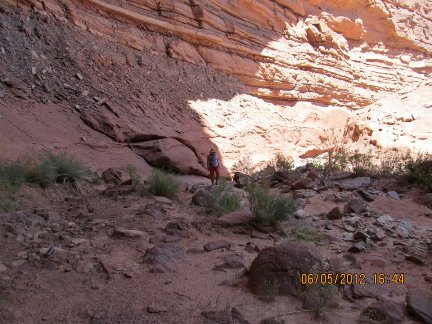
Exploring a canyon close to camp below China Doll Peak.

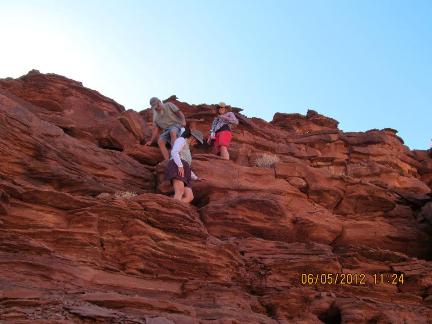
Hiking down from the peak.

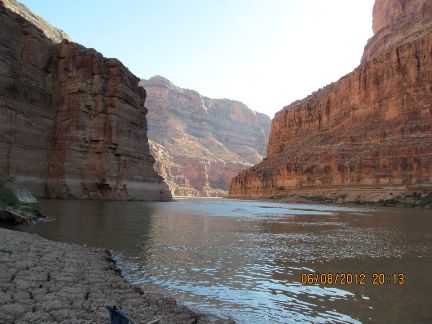
Working their way to Lake Powell.

View from the peak.

Bits & Pieces (Thursday Afternoon Open Mic)

A message from George W. Bush and Bill Clinton:

Morning Report 7/5/12

Vital Statistics:

  Last Change Percent
S&P Futures  1369.9 1.9 0.14%
Eurostoxx Index 2316.5 4.0 0.17%
Oil (WTI) 87.89 0.2 0.26%
LIBOR 0.46 0.000 0.00%
US Dollar Index (DXY) 82.66 0.877 1.07%
10 Year Govt Bond Yield 1.62% -0.01%  
RPX Composite Real Estate Index 182.8 0.3  

Markets are up slightly on moves by the ECB and some encouraging economic news on the jobs front. Overnight, the ECB lowered interest rates to 75 basis points and cut the deposit rate to zero. Bonds and MBS are up slighlty.

The ADP employment change report reported 176k new jobs were added in June, which is much higher than the 100k estimate economists were forecasting. The official non-farm payroll data will be released tomorrow. Initial Jobless claims dropped last week, falling from 388k to 374k. 

Today is the first Thursday of the month, and that means retailers are reporting same store sales.  So far, most retailers are missing estimates.

Finally, Heard on the Street discusses how the housing market is finally a bright spot in the economy, though its size relative to GDP has shrunk tremendously. 

THE PAMPHLETEER

Washington maintained the spirits of the rag-tag Continental Army through his own qualities of leadership and courage and with the help of the pamphleteer.  Paine’s The Crisis and Common Sense were disseminated among the junior officers and ordered read to the men.  It is said these were the most effective propaganda materials ever seen until then, perhaps because they rang so true.  From The Crisis:

THESE are the times that try men’s souls. The summer soldier and the sunshine patriot will, in this crisis, shrink from the service of their country; but he that stands by it now, deserves the love and thanks of man and woman. Tyranny, like hell, is not easily conquered; yet we have this consolation with us, that the harder the conflict, the more glorious the triumph. What we obtain too cheap, we esteem too lightly: it is dearness only that gives every thing its value. Heaven knows how to put a proper price upon its goods; and it would be strange indeed if so celestial an article as FREEDOM should not be highly rated. Britain, with an army to enforce her tyranny, has declared that she has a right (not only to TAX) but “to BIND us in ALL CASES WHATSOEVER” and if being bound in that manner, is not slavery, then is there not such a thing as slavery upon earth. Even the expression is impious; for so unlimited a power can belong only to God.

My Top Five Founding Fathers

This was going to be a Top Ten list, but I ran out of time.  Have to get going to the town get-together for food, music, and fireworks.

5. Benjamin Franklin – Delegate to the Second Continental Congress; helped form what was to become the Declaration of Independence; as a diplomat to France during the war he played the crucial role in securing French military support against the British, without which the outcome of the Revolution would have been very different.  As an emissary to Britain, he worked hard to keep the colonies within the Empire, but once the Revolution started he never looked back – “We must all hang together, or we will surely hang separately.”

4. Thomas Jefferson – Incredibly smart; author of one of the finest documents every produced, the Declaration of Independence; as a diplomat to France was crucial in maintaining foreign relations with the new nation’s primary ally; third President.  Jefferson was a jumble of contradictions, both politically and personally, and I have many reservations about him, but he undeniably played a crucial role in the founding of the nation.

3. John Adams – Member of both Continental Congresses; was central to the choice of George Washington as Commander in Chief of the Continental Army;  instrumental in the drafting and adoption of the Declaration of Independence; first Vice-President and second President of the US.  One of my favorites.

2.  Alexander Hamilton – The epitome of the self-made man and a model for achieving what has become the American dream; he actively fought in the war; author of the Federalist Papers; as the nation’s first Treasury Secretary and trusted confidant of Washington, he almost single-handedly laid the groundwork for the US’s rise as an economic power.  Easily the most under-appreciated Founding Father.

1.  George Washington – Architect of the defeat of the greatest military power in the world by a rag-tag group of untrained colonials; resisted the pull of establishing monarchical powers for himself;  precedent-setter for Presidential traditions including term limits.  Quite simply the single most important person in the history of these United States.

Honorable mention:

James Madison – Co-author with Hamilton of the Federalist Papers and the writer of most of the Constitution.

Thomas Paine – Author of Common Sense in 1776, a powerful treatise on the need for independence from Britain.

Samuel Adams – Brewer and patriot.  What more need be said?

How we got three branches -1775

This is largely due to little John Adams, according to his brethren including Jefferson.  Adams wrote this as part of his advice in 1775:


1. A single assembly is liable to all the vices, follies, and frailties of an individual; subject to fits of humor, starts of passion, flights of enthusiasm, partialities, or prejudice, and consequently productive of hasty results and absurd judgments. And all these errors ought to be corrected and defects supplied by some controlling power.

2. A single assembly is apt to be avaricious, and in time will not scruple to exempt itself from burdens, which it will lay, without compunction, on its constituents.

3. A single assembly is apt to grow ambitious, and after a time will not hesitate to vote itself perpetual. This was one fault of the Long Parliament; but more remarkably of Holland, whose assembly first voted themselves from annual to septennial, then for life, and after a course of years, that all vacancies happening by death or otherwise, should be filled by themselves, without any application to constituents at all.

4. A representative assembly, although extremely well qualified, and absolutely necessary, as a branch of the legislative, is unfit to exercise the executive power, for want of two essential properties, secrecy and despatch.

5. A representative assembly is still less qualified for the judicial power, because it is too numerous, too slow, and too little skilled in the laws.

***************

This reasoning was adopted in VA by Madison, in NY by Jay and Hamilton, in MA (of course) and in NC, before or during the Revolution.  It was rejected, for a time, by the new nation, but this advice ultimately seeded the Constitution that replaced the AoC.

The Speech

One of my favorite moments of the American independence movement has always been Patrick Henry’s speech to the Virginia Convention in March of 1775.   The official beginning of the Revolution, the skirmishes at Lexington and Concord in Massachusetts on April 19, were still a month away, but the situation had been coming to a boil for some time.  A year prior Massachusetts had been placed under British military rule, and on February 9, 1775, the British Parliament had officially declared Massachusetts to be in a state of rebellion.  Delegates had been sent from Massachusetts to seek support for the nascent independence movement, and conventions had been formed in the various colonies to discuss what to do.  There is no official transcription of Henry’s speech that day of March 23, 1775, but his first biographer, through notes, contemporary accounts in newspapers and interviews with people who were there, was able to piece together what was said and what is now recognized as the speech he gave.  We are all aware of Henry’s most famous conclusion, but I think the speech itself, and especially the final two paragraphs, are equally moving.

MR. PRESIDENT: No man thinks more highly than I do of the patriotism, as well as abilities, of the very worthy gentlemen who have just addressed the House. But different men often see the same subject in different lights; and, therefore, I hope it will not be thought disrespectful to those gentlemen if, entertaining as I do, opinions of a character very opposite to theirs, I shall speak forth my sentiments freely, and without reserve. This is no time for ceremony. The question before the House is one of awful moment to this country. For my own part, I consider it as nothing less than a question of freedom or slavery; and in proportion to the magnitude of the subject ought to be the freedom of the debate. It is only in this way that we can hope to arrive at truth, and fulfil the great responsibility which we hold to God and our country. Should I keep back my opinions at such a time, through fear of giving offence, I should consider myself as guilty of treason towards my country, and of an act of disloyalty toward the majesty of heaven, which I revere above all earthly kings.

Mr. President, it is natural to man to indulge in the illusions of hope. We are apt to shut our eyes against a painful truth, and listen to the song of that siren till she transforms us into beasts. Is this the part of wise men, engaged in a great and arduous struggle for liberty? Are we disposed to be of the number of those who, having eyes, see not, and, having ears, hear not, the things which so nearly concern their temporal salvation? For my part, whatever anguish of spirit it may cost, I am willing to know the whole truth; to know the worst, and to provide for it.

I have but one lamp by which my feet are guided; and that is the lamp of experience. I know of no way of judging of the future but by the past. And judging by the past, I wish to know what there has been in the conduct of the British ministry for the last ten years, to justify those hopes with which gentlemen have been pleased to solace themselves, and the House? Is it that insidious smile with which our petition has been lately received? Trust it not, sir; it will prove a snare to your feet. Suffer not yourselves to be betrayed with a kiss. Ask yourselves how this gracious reception of our petition comports with these war-like preparations which cover our waters and darken our land. Are fleets and armies necessary to a work of love and reconciliation? Have we shown ourselves so unwilling to be reconciled, that force must be called in to win back our love? Let us not deceive ourselves, sir. These are the implements of war and subjugation; the last arguments to which kings resort. I ask, gentlemen, sir, what means this martial array, if its purpose be not to force us to submission? Can gentlemen assign any other possible motive for it? Has Great Britain any enemy, in this quarter of the world, to call for all this accumulation of navies and armies? No, sir, she has none. They are meant for us; they can be meant for no other. They are sent over to bind and rivet upon us those chains which the British ministry have been so long forging. And what have we to oppose to them? Shall we try argument? Sir, we have been trying that for the last ten years. Have we anything new to offer upon the subject? Nothing. We have held the subject up in every light of which it is capable; but it has been all in vain. Shall we resort to entreaty and humble supplication? What terms shall we find which have not been already exhausted? Let us not, I beseech you, sir, deceive ourselves. Sir, we have done everything that could be done, to avert the storm which is now coming on. We have petitioned; we have remonstrated; we have supplicated; we have prostrated ourselves before the throne, and have implored its interposition to arrest the tyrannical hands of the ministry and Parliament. Our petitions have been slighted; our remonstrances have produced additional violence and insult; our supplications have been disregarded; and we have been spurned, with contempt, from the foot of the throne. In vain, after these things, may we indulge the fond hope of peace and reconciliation. There is no longer any room for hope. If we wish to be free² if we mean to preserve inviolate those inestimable privileges for which we have been so long contending²if we mean not basely to abandon the noble struggle in which we have been so long engaged, and which we have pledged ourselves never to abandon until the glorious object of our contest shall be obtained, we must fight! I repeat it, sir, we must fight! An appeal to arms and to the God of Hosts is all that is left us!

They tell us, sir, that we are weak; unable to cope with so formidable an adversary. But when shall we be stronger? Will it be the next week, or the next year? Will it be when we are totally disarmed, and when a British guard shall be stationed in every house? Shall we gather strength by irresolution and inaction? Shall we acquire the means of effectual resistance, by lying supinely on our backs, and hugging the delusive phantom of hope, until our enemies shall have bound us hand and foot? Sir, we are not weak if we make a proper use of those means which the God of nature hath placed in our power. Three millions of people, armed in the holy cause of liberty, and in such a country as that which we possess, are invincible by any force which our enemy can send against us. Besides, sir, we shall not fight our battles alone. There is a just God who presides over the destinies of nations; and who will raise up friends to fight our battles for us. The battle, sir, is not to the strong alone; it is to the vigilant, the active, the brave. Besides, sir, we have no election. If we were base enough to desire it, it is now too late to retire from the contest. There is no retreat but in submission and slavery! Our chains are forged! Their clanking may be heard on the plains of Boston! The war is inevitable²and let it come! I repeat it, sir, let it come.

It is in vain, sir, to extenuate the matter. Gentlemen may cry, Peace, Peace²but there is no peace. The war is actually begun! The next gale that sweeps from the north will bring to our ears the clash of resounding arms! Our brethren are already in the field! Why stand we here idle? What is it that gentlemen wish? What would they have? Is life so dear, or peace so sweet, as to be purchased at the price of chains and slavery? Forbid it, Almighty God! I know not what course others may take; but as for me, give me liberty or give me death!

Report on Manufactures

5 Dec. 1791Papers 10:302–4

A Question has been made concerning the Constitutional right of the Government of the United States to apply this species of encouragement, but there is certainly no good foundation for such a question. The National Legislature has express authority “To lay and Collect taxes, duties, imposts and excises, to pay the debts and provide for the Common defence and general welfare” with no other qualifications than that “all duties, imposts and excises, shall be uniform throughout the United states, that no capitation or other direct tax shall be laid unless in proportion to numbers ascertained by a census or enumeration taken on the principles prescribed in the Constitution, and that “no tax or duty shall be laid on articles exported from any state.” These three qualifications excepted, the power to raise money is plenary, and indefinite; and the objects to which it may be appropriated are no less comprehensive, than the payment of the public debts and the providing for the common defence and “general Welfare.” The terms “general Welfare” were doubtless intended to signify more than was expressed or imported in those which Preceded; otherwise numerous exigencies incident to the affairs of a Nation would have been left without a provision. The phrase is as comprehensive as any that could have been used; because it was not fit that the constitutional authority of the Union, to appropriate its revenues shou’d have been restricted within narrower limits than the “General Welfare” and because this necessarily embraces a vast variety of particulars, which are susceptible neither of specification nor of definition.

It is therefore of necessity left to the discretion of the National Legislature, to pronounce, upon the objects, which concern the general Welfare, and for which under that description, an appropriation of money is requisite and proper. And there seems to be no room for a doubt that whatever concerns the general Interests of learning of Agriculture of Manufactures and of Commerce are within the sphere of the national Councils as far as regards an application of Money.

The only qualification of the generallity of the Phrase in question, which seems to be admissible, is this–That the object to which an appropriation of money is to be made be General and not local; its operation extending in fact, or by possibility, throughout the Union, and not being confined to a particular spot.

No objection ought to arise to this construction from a supposition that it would imply a power to do whatever else should appear to Congress conducive to the General Welfare. A power to appropriate money with this latitude which is granted too in express terms would not carry a power to do any other thing, not authorised in the constitution, either expressly or by fair implication.
ALEXANDER HAMILTON

The Founders’ Constitution
Volume 2, Article 1, Section 8, Clause 1, Document 21
http://press-pubs.uchicago.edu/founders/documents/a1_8_1s21.html
The University of Chicago Press

The Papers of Alexander Hamilton. Edited by Harold C. Syrett et al. 26 vols. New York and London: Columbia University Press, 1961–79.