Discussion: Balancing the Budget

This is not going to be a deep, thoughtful post.  I’m more looking for discussion and people’s general thoughts about it.  It is engendered by reading some links jnc posted not long ago and by some comments by john on PL today.  (Hahahaha, john, you certainly got the point of my comment.  I usually bail when that one shows up.)


For a start, I think balancing the budget is the beginning point before moving on to tackle the deficit.  Given my leftist leanings, I would like to see that occur with the least disruption to the middle class and to the social safety net as possible – which for me means starting with cuts to defense, raising taxes on everybody (yup, my own self included) at least temporarily, finding some way to deal with rising healthcare costs.


What are your thoughts in general?

Morning Report 7/20/12

Vital Statistics:

  Last Change Percent
S&P Futures  1362.1 -9.8 -0.71%
Eurostoxx Index 2258.5 -44.0 -1.91%
Oil (WTI) 90.8 -1.9 -2.01%
LIBOR 0.452 -0.001 -0.22%
US Dollar Index (DXY) 83.29 0.408 0.49%
10 Year Govt Bond Yield 1.46% -0.05%  
RPX Composite Real Estate Index 184.8 0.0  

Equity markets are weaker this morning in spite of a deal to rescue the Spanish banks and decent earnings reports out of Google and GE.  There is no economic data to speak of.  Bonds are up a point and MBS are up as well.

Bloomberg has a good article discussing the state of the mortgage industry and how much capacity has been drained from it. “Efforts by Obama and Bernake to help homeowners get cheaper loans and spur the economy have been slowed by lack of staff at lenders and less competition.” Fears of buyback risk are also making lenders more cautious. 

SIFMA (which oversees the To-Be-Announced mortgage securities) weighs in on the eminent domain issue. They are instituting a policy that would exclude municipalities that institute eminent domain claims on mortgages from the TBA market.  Without getting into the gory details, the TBA market is the way newly originated mortgages get packaged into Fannie / Freddie / Ginnie mortgage backed securities. Punch line:  It will be very difficult to get a mortgage in San Bernardino because the lender will have a tougher time disposing of the loan.  I am surprised at how little interest the press has shown regarding this issue. 

No MR for the next week – I will be on vacation.

Morning Report 7/19/12

Vital Statistics:

Markets are generally higher this morning on hopes of further stimulus measures and some decent earnings reports out of Ebay and IBM.  Morgan Stanley missed. Spain raised 3 billion euros but paid dearly for it. Bonds are down almost a point and MBS are down a tick or two.

Initial Jobless Claims for the week of 7/14 came in at 386k, more in line with typical readings. Last week’s low 350k print was revised upwards, but still looks like a statistical fluke. Separately, it looks like another round of job cuts is on the way in the banking sector.

In other economic data, existing home sales fell by 5.4% month-on-month to an annualized pace of 4.37MM units.  The Street was expecting 4.62MM. The Leading Economic Indicators index posted a negative number in June, the second negative number in 3 months. 

The Philly Fed survey reported weak business conditions. Ominously, they reported declines in employment and shorter work hours. 

FHA is conducting another mass distressed loan sale. Buyers will not be permitted to initiate foreclosure proceedings for 6 months. The loans are concentrated in hard hit areas like Phoenix, Tampa, Chicago, and Newark.

The Fed is considering another measure to ease up credit – allowing banks to borrow from the Fed at even lower interest rates provided the money is used to lend, not buy Treasuries. The Fed is really scraping the bottom of the barrel at this point – I guess the next step would be to allow the banks to repo the water cooler and office furniture.

Chart:  Initial Jobless Claims:

Morning Report 7/18/12

Vital Statistics:

  Last Change Percent
S&P Futures  1354.8 -3.7 -0.27%
Eurostoxx Index 2257.6 6.9 0.31%
Oil (WTI) 88.99 -0.2 -0.26%
LIBOR 0.455 0.000 0.00%
US Dollar Index (DXY) 83.24 0.210 0.25%
10 Year Govt Bond Yield 1.48% -0.03%  
RPX Composite Real Estate Index 184.5 0.4  

Markets are a little weaker on no real news. A slew of banks reported earnings this morning, and most were  better than expected. Bond yields are back below 1.5% and MBS are up slightly. The Bernank’s testimony continues today.

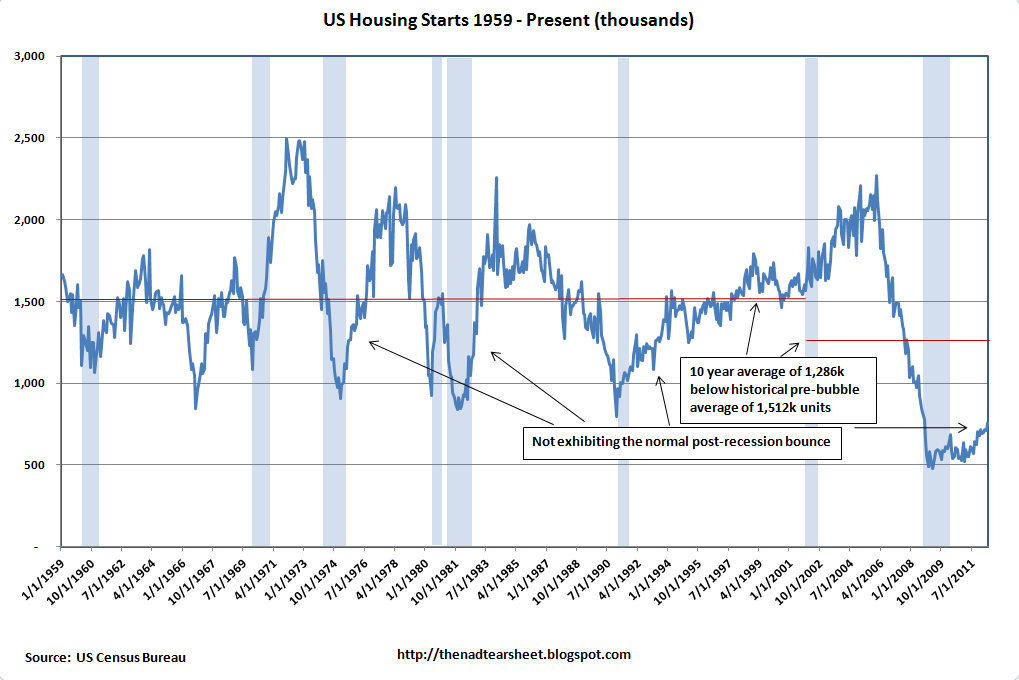
Housing starts came in at 760k in June, an increase from a revised 711k in May. While most other sectors in the economy are decelerating, the housing construction sector is accelerating. That said, housing starts are a long way from normalcy. Sentiment in the homebuilders has been improving as well, with the NAHB Builder Confidence Index rising smartly in July

Housing Starts:


NAHB Housing Index


On the heels of San Bernardino’s eminent domain proposal, Georgetown Professor of Law lays out another avenue to deal with underwater equity – “quasi-voluntary” principal reductions. In his paper Clearing the Mortgage Market Through Principal Reduction, he makes the case that negative equity is the reason why the housing market hasn’t bottomed and we need a policy response to it. The solution – make the banks an offer they can’t refuse:  Either reduce the principal on your underwater mortgages to home value or we’ll take away your ability to deal with the GSEs or FHA.  Since this more or less is a “reduce principal or get out of the business” it isn’t much of a choice.  While he mentions that there could be political consequences of these various actions (he looks at involuntary takings as well), he never mentions the possibility that lenders may in fact decide to adjust their risk calculations accordingly, thus drying up credit even more. What good is a new re-negotiated mortgage to the system if the existing homeowner can only sell to cash buyers or buyers that put up 40%?  Amazingly, he doesn’t consider the knock-on effects to lender behavior at all. He assumes that things will just continue as before and lenders will write off this intervention as a necessary “one-off” that is really good for them and good for the country. If that is an indication of how liberal policy makers in general think – that the private sector will not react to their policy changes – that explains a lot.

Morning Report 7/17/12

Vital Statistics:

  Last Change Percent
S&P Futures  1352.3 4.9 0.36%
Eurostoxx Index 2266.2 14.3 0.63%
Oil (WTI) 88.68 0.3 0.28%
LIBOR 0.455 0.000 0.00%
US Dollar Index (DXY) 83.12 0.021 0.03%
10 Year Govt Bond Yield 1.49% 0.02%  
RPX Composite Real Estate Index 184.2 0.1  

Markets are firmer this morning on an earnings “beat” out of Goldman. I put “beat” in quotation marks because the report was actually lousy as revenues are at a 7 year low. Expectations are way low going into this earnings season.  As we approach August, the European newsflow should grind to a halt. Bonds are down a half a point, and MBS are down a tick or two. The Bernank is testifying in front of Congress at 10:00 this am. Expect a lot of newly-minted LIBOR experts to opine on the subject.

The CPI came in flat for June on falling energy prices. That is about to be offset by increased food prices as corn approaches $8.00 a bushel due to drought conditions in the Midwest. Industrial Production rose, while capacity utilization fell.

Bill Gross is warning of a recession “when measured by employment, retail sales, investment, and corporate profits.” Investment banks are taking down their economic forecasts in a large steps – Jan Hatzius of Goldman took his 2Q estimate to 1.1% from 1.3%, while Deutsche Bank’s Joe LaVorgna took down his forecast to 1% from 1.4%. These estimates would put the economy firmly in the “stall speed” range.

The WSJ notes that asking prices are rising as supply decreases. Asking prices are up 2.7%, while the number of homes listed for sale is down 19.4% from a year ago. Banks are holding back foreclosures from the market, and are often times finding bids on the courthouse steps from professional investors looking for rental properties. Median age has been falling as well.

On LIBOR, finis

As I said in my original post, there are two distinct aspects to the LIBOR manipulation story.  My previous two posts have addressed the possibility that LIBOR was being routinely manipulated by traders to suit their positions.  But the alleged manipulation during the crisis of 2008 was of an entirely different nature, done (presumably) not to profit from existing trading positions but rather to obscure from the public the true depth of the on-going crisis by submitting too-low estimates of the cost of borrowing.  At first glance, this “manipulation” seems more troubling than that discussed previously, primarily because the intent seems to be precisely to deceive.   But I do think any judgment must ultimately take into account the context of the crisis itself and what was going on at the time.  It is not my intent here to pass my own judgment on the matter, but rather to present what I think are relevant issues for anyone wishing to consider the matter before they condemn Barclays (or anyone else) for their actions.

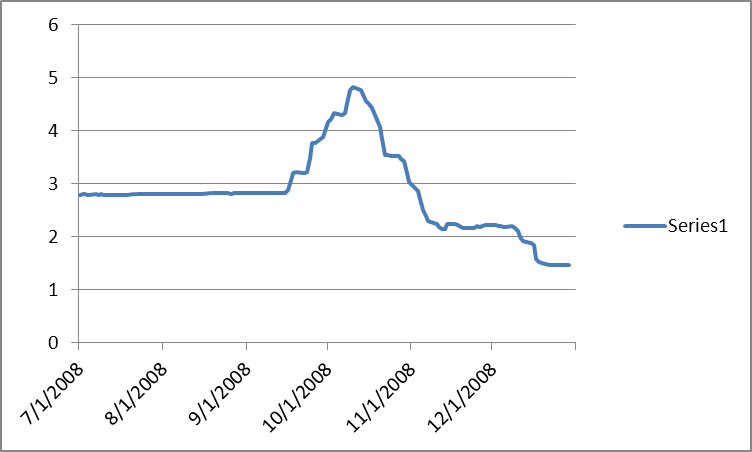
First, just as background, take a look at a graph of LIBOR rates throughout the worst of the crisis, starting in pre-crisis July and ending in December.


What was basically a flat-line through mid-September starts to spike on the day that Lehman failed, and continued to rise quite drastically every day, by about 200 basis points in the span of less than a month, until the Fed began in earnest its efforts to alleviate credit fears and get the capital markets functioning again.  That 200 basis point rise in the span of a few weeks really is quite extraordinary, and is testament to the degree to which fear had taken over the market, and the extent to which credit markets had seized up.   It is also testament to the fact that, whatever individual banks were submitting to the BBA as reported LIBOR contributions, LIBOR itself was clearly reflecting deep problems in the credit market.  As I said, a 200 bp move in such a short time really is quite extraordinary.

Should the spike have been even sharper, but for the “false” reporting of banks such as Barclays?  Perhaps.  But consider the possibility that at times Barclays (and others?) probably couldn’t borrow at all in the interbank markets.  Again, fear was rampant, and everyone was hoarding cash.  Many banks that had cash were holding it as reserves rather than lending it out regardless of the rate.  The credit markets had largely stopped functioning.  So what is a contributing member of the LIBOR panel supposed to report as its borrowing rate when it hasn’t been able to borrow at all?  Infinity?  It is possible that the whole process of establishing a LIBOR rate could/should have broken down entirely.

Consider also the fact that members of the BBA’s LIBOR panel were placed in a distinctly disadvantageous market position relative to non-members.  A non-member would have no obligation to post daily proclamations of their ability (or lack thereof) to borrow in the interbank market, and so would have less to fear from a negative feedback loop, whereby increasing credit fears lead to rising borrowing costs, which in turn would lead to even more increasing fears about one’s ability to pay it off, thus sparking even higher borrowing costs.  LIBOR panel members, on the other hand, were in a position of having to announce to the world every day at 11 am GMT just how much the rest of the interbank market feared their collapse.  Honesty, that is, had the potential to do even more damage to the company than was already occurring.

Finally the Fed, along with other central banks, was clearly spending much of its time trying to quell the contagion of credit fear.   They didn’t want LIBOR increasing by leaps and bounds every day either, and would certainly have been in daily contact with all of the major banks.  So I find it entirely plausible that either or both the Bank of England and the Fed  knew of any low-balling of the submissions and either explicitly or implicitly approved it.

Again, I am not necessarily trying to absolve Barclays or anyone else of any possible wrong-doing here.  Even given the points I’ve raised, I don’t know for sure what the right course of action was.  But I do think it is necessary to judge whatever was done in the context of the times.  We were in extraordinary circumstances and in some respects in entirely uncharted territory.  In such circumstances, it is not clear to me that the normal rules necessarily apply.

(I fear that my points above are not as clear or coherent as I would like them to be.  I am currently working on 3 hours of sleep in the last 2 days, and am falling asleep as I write, but I really wanted to get this up today, so I hope  it at least makes some sense and you can get the gist of what I am trying to say.)

Morning Report 7/16/12

Vital Statistics:

  Last Change Percent
S&P Futures  1346.3 -5.4 -0.40%
Eurostoxx Index 2246.9 -12.2 -0.54%
Oil (WTI) 86.57 -0.5 -0.61%
LIBOR 0.455 0.000 0.00%
US Dollar Index (DXY) 83.63 0.285 0.34%
10 Year Govt Bond Yield 1.46% -0.03%  
RPX Composite Real Estate Index 184.1 0.3  

RIP Barton Biggs.

Markets are weaker this morning on disappointing retail sales data. June retail sales fell 50 basis points in June while the Street was expecting a 20 basis point rise. The 10-year continues to grind higher,with the yield now at 1.46%.  Mortgage backed securities are up small. A lot of market heavyweights report earnings this week with Johnny John, Coca-Cola, Intel, Honeywell, Yum, Amex, Ebay, IBM, and Google, among others.

Citigroup beat analyst expectations with a $1.00 per share second quarter earnings report. Revenues were weaker than expected. Book Value increased to $62.21.  The stock is up about 2.5% pre-open.

The NY Fed’s Empire State Manufacturing Survey showed an uptick in July. Manufacturer Optimism remains on the positive side, but is lower than earlier this year. Input Prices fell.

Reuters has a dour outlook on the housing market, suggesting we may be in for a lost decade with house prices.  They cite the usual litany of problems with the housing market – immobile underwater homeowners, heavy debt burdens, a lousy job market – but they ignore how fundamentally cheap housing is right now. And that is why prices are stabilizing – eventually a market gets so cheap it cannot be ignored.  And that has happened in housing. 

Taxmageddon:  The game of chicken is on

On LIBOR, part 2

At the end of my last post, I posed the question of whether or not any possible attempts to manipulate the daily LIBOR quote had been successful.  To look at this question, I analyzed 3 years worth of  daily 3-month LIBOR data, from January 2005 thru December 2007, a time during which routine manipulation was allegedly being attempted.

Now, just to be clear, my analysis cannot be said to be definitive.  To determine if, on any given day, an attempted manipulation was successful, and to what degree, one would need to look at all of the individual submissions that comprised the average resulting in the published LIBOR rate that day,   determine which if any of those submissions should have been a different rate, establish what the submission should have been, and then recalculate the average using that new rate.  That is beyond the bounds of what I can do here.  Nor have I attempted to determine the effect of any possible collusion between two or more panel members, which would be even more complicated.  All I will attempt to do here is to look at daily LIBOR settings in the context of the rates before and after, and the longer term trends, both actual and expected given market conditions at the time, to determine if the published rate makes sense and seems reasonable or if it seems odd and counterintuitive.

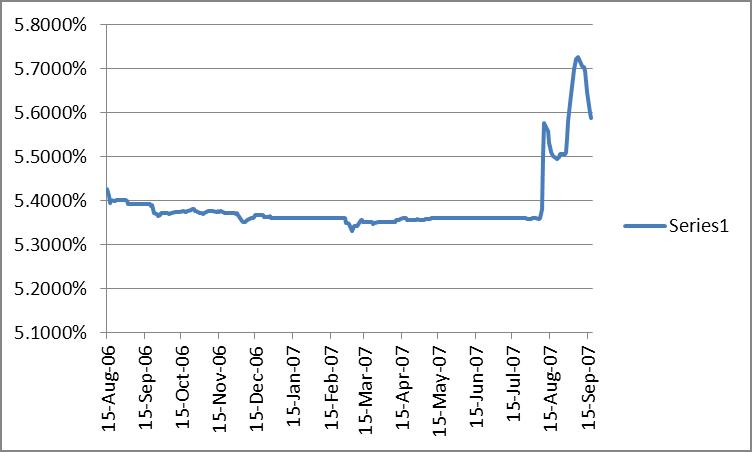
In looking at the data, one interesting thing appears immediately.   For almost an entire year, from mid-September 2006 until mid-August 2007, the daily LIBOR quote barely moved at all.
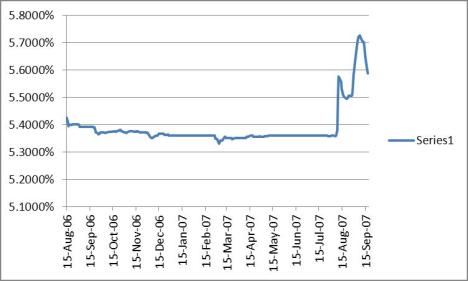
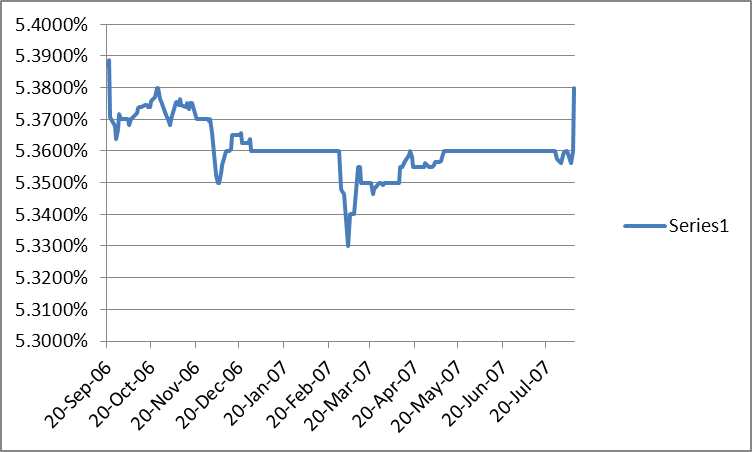
From September 20, 2006 until August 7, 2007 the high rate was 5.3875% (on September 20, 2006) and the low rate was 5.33% (on March 5, 2007).  Why were rates so steady during this time period?  Primarily because the Fed was maintaining a steady rates policy, and in the absence of any credit crisis, LIBOR will tend to mirror Fed policy.  So, with rate policy on hold for nearly a year, this would seem like an ideal time period to look for manipulation of LIBOR.  If it was going on during this time period, one would expect to see seemingly arbitrary daily moves both up and down in the otherwise steady published rate.

In fact what we see is remarkable consistency.  Indeed, for two extended periods, from Dec 26, 2006 until February 27, 2007, and then again from May 10, 2007 until July 26, 2007, we saw quite literally not a single change in the daily LIBOR rate of 5.36%.  For these two periods the graph is a perfectly flat line.

It seems highly unlikely that any manipulation could have been taking place during these two flat-line periods.   Overall, from Sep 20, ’06 until August 7, ’07, on days in which LIBOR did change from the previous day, the average change was .0029%, or less than one-third of a basis point.  And there were only 5 days over the course of this entire  222 day period in which the change in LIBOR from the previous day was even greater than 1 bp, with the biggest single change being 1.8 bps.

Now, perhaps it might be interesting to investigate further into why the rate changed by more than 1 bp on the 5 days in which it did, with an eye towards whether the change was the result of the same bank or banks altering their LIBOR submission on those days, and whether those days coincided with e-mails from traders requesting a higher or lower submission.  But regardless of the outcome of such an investigation, we can say, I think, that whatever attempted manipulation may have gone on during this period, it was neither all that regularly successful nor, if it was successful, did it alter the rate all that significantly, averaging barely a quarter of a basis point.

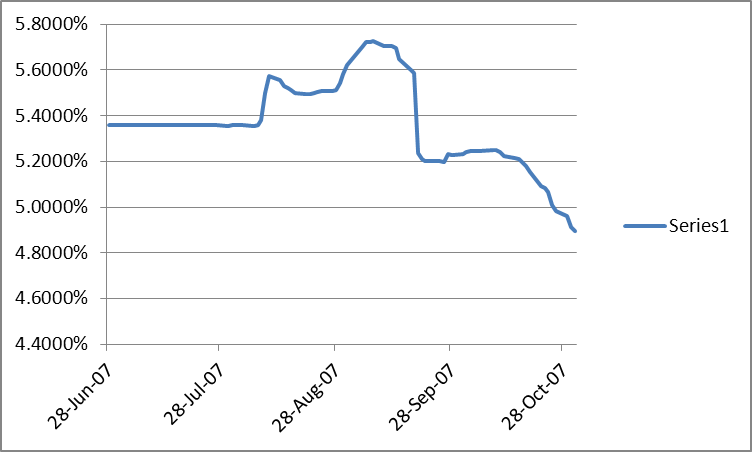
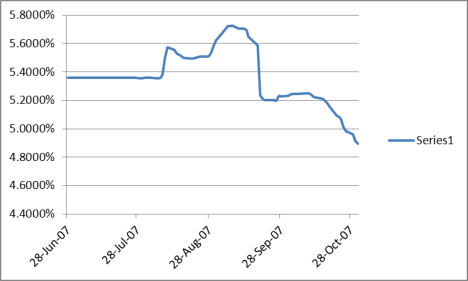
As an aside, some of you may be wondering why I chose September 20 and August 7 as a starting/stopping point for this particular analysis.  I chose September 20 because that was the date on which the Fed first announced that it was holding rates steady after over a year of rate hikes, and I chose August 7 because it was in early August that Bear Stearns’ impending meltdown began to really effect the market, with the collapse of two of its sub-prime funds and the requested resignation of its president Warren Specter.  This graph shows how rates began to react first to the news of Bear Stearns in early August by spiking from what had been essentially a flat-line, and then to the 50 bp rate cut by the Fed on Sep 18, the first of many cuts that would result in the zero rate policy that we still have today.
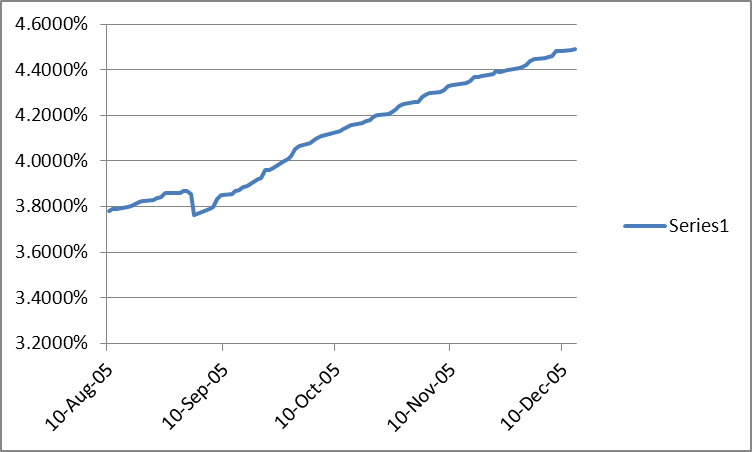
What about periods prior to September 2006?  Can evidence of successful manipulation be found there?  Well, it is somewhat more difficult to analyze this period because the Fed had an active rate-hiking policy prior to September 2006, and so the LIBOR rate was changing pretty much on a daily basis in response to this rate hiking policy.  For example, see this graph for the period between August 9, 2005 and December 13, 2005, a period in which the Fed hiked rates by 25 bps on September 20, November 1, and again on December 13.
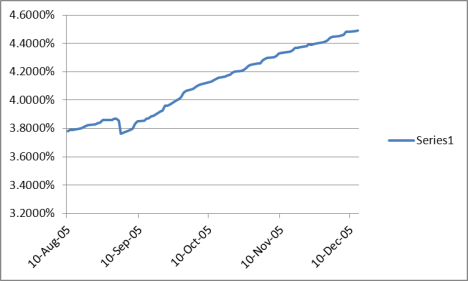
With the exception of two consecutive days, September 1 and 2 on which the rate oddly dropped first by 1.5 bps and then by 9.4 bps, the graph looks pretty much exactly as you would expect it to, slowly increasing incrementally every day to keep up with the anticipated (and ultimately realized) Fed actions of raising rates.  For example, between the November 1 and December 13 Fed announcement dates, on which the FED announced a 25 bp rate hike, the average daily change in LIBOR was .9 bp, with a max of 2 bps (both times over weekends, so accounting for 3 days worth of change) and the rate steadily moved from 4.2606% to 4.4913%, almost exactly the expected 25 bps.   This steady and consistent change is not indicative of any manipulation, or, if there was any, its effect was just fractions of a basis point.

That 9 bp drop on September 2 is certainly an interesting outlier.  What could have caused that?  Frankly I don’t know.   It is possible that it is the result of manipulation, although I doubt it because in order to get that much of a change, any manipulation would have to have been both coordinated with many other panel members and fairly egregious.  The absence of other equally odd outliers at other points suggests to me that something peculiar happened that particular day in the market causing the drop rather than being an example of regular manipulation.  But, again, I don’t really know the answer, so I could be wrong.

In any event, my look at the 3 years prior to 2008 does not suggest to me any obvious evidence of significant, successful alteration of LIBOR from what one would expect.  Which brings us to what I originally said needed to be the subject of a separate discussion:  possible manipulation of LIBOR during the crisis of 2008 in order to hide funding difficulties from the market.  That will be the subject of my next post.

On LIBOR, part 1

So I figured it was time to weigh in with a post about the LIBOR scandal.  I will say upfront that, while it is a scandal, I think that, because of the general bank-bashing atmosphere that prevails in certain media and political circles right now, it has been blown far out of all proportion.  Our own jnc has tended to focus, not unreasonably, on the implications that the scandal presents for the kind of culture that prevails in the finance industry.  While I don’t agree that it is nearly as indicative of a widespread culture of dishonesty and corruption as jnc seems to, I think it is at least a fair question.  I have no time, however, for the Taibbis and Simpsons of the world who are doing their utmost to portray this as some kind of huge and concerted rip-off of Main Street, municipalities, widows and orphans, or whoever else is their latest chosen victim. That is just a bunch of bunk.

There are actually two separate issues here, and they need to be discussed separately. The first is the claim that individual traders were routinely manipulating the daily LIBOR set, both higher and lower, to benefit their trading positions on any given day.  The second is that, during the crisis of ’08, some banks were reporting falsely low borrowing costs in order to keep their funding difficulties from becoming public information.  Let’s address the former first, and perhaps a little history would be useful.  

Prior to the advent of LIBOR swap contracts used many different floating rate indices such as Prime or T-Bills (which is of course manipulated by the Fed as a matter of course), and even at times an individual bank’s own lending rate, determined solely at it’s own discretion.   Then in the mid ’80’s the demon derivatives market invented LIBOR in order to standardize swap contracts by basing them all off of a single, reasonable and standard measure of a “premium” bank’s borrowing cost.   Banks liked this because, even if the published rate was not exactly their own borrowing cost, it was a fair enough approximation to make their contracts sensible. Spreads could be added to this standard for individual contracts to account for the varying credit quality of the contracting parties, but LIBOR would represent a baseline index. In the beginning there were actually competing publishers of daily LIBOR rates, each with their own methodology of calculating the rates.  There were different contributors as well as different averaging and rounding conventions, and so the “standard” wasn’t quite that.  But over time the British Bankers Association’s published BBA Libor became the dominant rate and eventually the market standard.

From the first, LIBOR was defined broadly and was never meant to be some exact rate that mirrored an already established market rate.    In the first place, it’s nature as an average of many different bank rates, with both high and low submissions being deliberately excluded, makes it nothing more than an approximation anyway.  Second, the rate that the BBA requested as submissions was always very subjective.  Originally the BBA simply asked each contributing bank’s opinion of  where an unnamed, generic “prime” bank might be able to borrow:  ““At what rate do you think interbank term deposits will be offered by one prime bank to another prime bank for a reasonable market size today at 11am?”. 

Later, in 1998, it changed it’s question to “At what rate could you borrow funds, were you to do so by asking for and then accepting inter-bank offers in a reasonable market size just prior to 11 am?” So now, rather than asking about a hypothetical bank’s borrowing costs, it was asking about the bank’s own borrowing costs.  But note the qualifying and indeterminate language.  What is “reasonable”?  What if you weren’t actually in the market “just prior” to 11 am?  What if you borrowed from three different banks at three slightly different rates? What if you borrowed at 10am, and then saw that the market sold off between then and 11 am? Do you submit your actual rate or what you guess it would have been an hour later? What if you weren’t a borrower at all, but were in fact lending to other banks on a given day?

The main point here is that, contrary to the perception being fostered by outraged pundits and opportunistic politicians, there is no single, objectively knowable “correct” rate to be submitted by any given bank.  Obviously there is not only room for a subjective interpretation and judgment on the part of the  individual submitters, such a judgement is often actually required.  There is some range of rates within which it is perfectly reasonable to have submitted, even of it is not an actual rate that you transacted.  

Now, if one is tasked with submitting the daily rate to the BBA, how does one make this judgement, and is it ethical to be influenced by the entreaties of traders who stand to benefit or lose from your judgement?  That is a fair question and perhaps a point worth debating.  But I actually think it is debatable.  If the nonexistent “correct” rate falls within a range of, say, 3 or 4 basis points, is it really wrong or unethical to take into consideration the financial well being of the company you work for when deciding whether to report the high or low end of the range?  I don’t think so, at least not necessarily.  And the fact that one rate within the band is chosen and not another does not mean that the rate has been criminally “manipulated” or that the rate has been “fraudulently” submitted. As long as the submitted rate is defensible on the merits, regardless of how the judgement was arrived at, I don’t see a problem.  Certainly, in any event, this is not some “criminal conspiracy” akin to the mob shaking people down.  

And in fact the whole process of calculating LIBOR takes all of this into account.  That is precisely one of the reasons that such a wide number of banks (18) are polled and averaged, and why the high and low submissions are excluded from the average. As the BBA itself says, “The decision to trim the bottom and top quartiles in the calculation was taken to exclude outliers from the final calculation. By doing this, it is out of the control of any individual panel contributor to influence the calculation and affect the bbalibor quote.” Which brings us to another, and I think more important question:  Regardless of whether routine attempts to influence the submissions are ethical, were they successful in changing the rate?

That will be the subject of a future post.

SPORTS

http://www.nowness.com/day/2011/9/1/1611/dewey-nicks-strong-is-beautiful