Posted on November 10, 2014 by Brent Nyitray
Markets are higher this morning on no real news. Bonds and MBS are flat.
The week after the jobs report is typically slow data-wise, and this week is no exception. Bonds will be closed tomorrow for Veteran’s Day. The most important data will probably be retail sales on Friday.
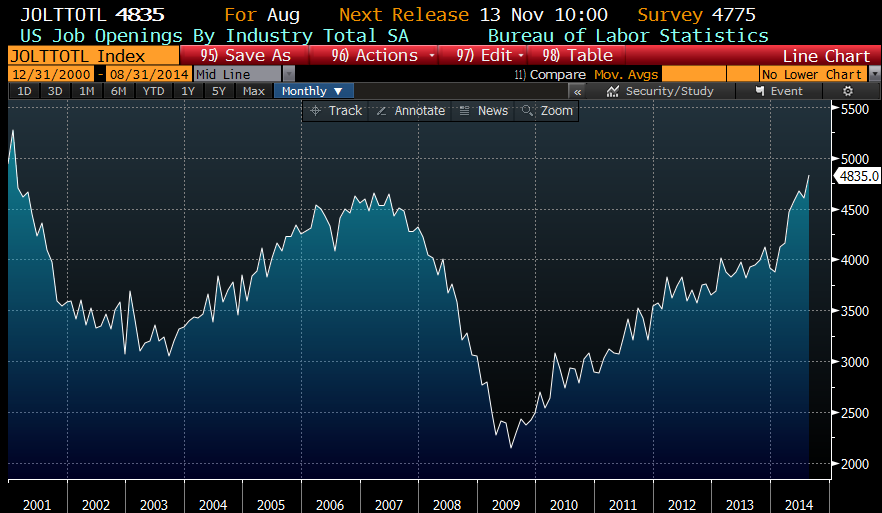
On Thursday, we will get the JOLTs job openings, numbers which are at boom-time levels. The labor market seems to be at an interesting place, with the leading indictators (initial jobless claims, job openings) signalling strength, while the lagging indicators (labor force participation rate, wage inflation) are still recessionary.

Luxury builder Toll Brothers pre-announced good numbers, as deliveries increased 22% in units and 29% in dollars. ASPs increased to $747,000 from $732,000 last quarter and $703,000 a year ago. Signed contracts rose 10% in units and 16% in dollars. Clearly things are still hitting on all cylinders at the luxury end of the market. Tomorrow, we will hear from D.R. Horton, who is increasing their focus on starter homes in anticipation of the return of the first-time homebuyer.
Obama has nominated Loretta Lynch to succeed Eric Holder as Attorney General. She will likely face questioning from two different directions. Republicans will want to press her on her support of “disparate impact” theory of discrimination, which says that if the numbers don’t reflect the population, the firm is guilty of discrimination, no questions asked. Even if they didn’t intend to discriminate. Note that this theory has been struck down by the courts and is probably headed to the Supreme Court. Democrats will press her on prosecuting actual bankers, not the banks themselves. The left is still seething that DOJ hasn’t gotten a scalp from the financial crisis. Angelo, call your lawyers…
The Black Knight Financial Services Mortgage Monitor is out. We saw a big jump in foreclosures starts, up to 91k, however delinquencies are down in a big way. Interestingly, the biggest jump in foreclosure starts are repeat foreclosure starts, which I take to mean loans that were modified under HAMP, which ended up going back into foreclosure. So much for the “avoidable foreclosure” theory.
Filed under: Morning Report | 16 Comments »
Posted on November 7, 2014 by Brent Nyitray
Markets are higher after a mixed jobs report. Bonds and MBS are flat.
- Nonfarm payrolls + 214k (down from 248k in Sep. 235k expected)
- Two month revision +31k
- Unemployment Rate 5.8% (down from 5.9% in Sep)
- Average Weekly hours 34.6 (flat with Sep)
- Average Hourly Earnings +.1% (Sep was flat)
- Labor Force Participation Rate 62.8% (up from 62.7% in Sep)
So overall, it shows the labor market continues to improve, however wages are still going nowhere.
The servicers are getting slammed this year, with Ocwen, Nationstar, and Walter leading the way. Nationstar reported numbers last night, and the stock was down 22% after hours. Walter Investment received an investigative subpeona from California, and we we are well aware of Ocwen’s issues. I have not seen this affect MSR valuations yet, but it will if these state AGs start forcing these companies to sell their portfolios.
Fannie Mae CEO Timothy Mayopoulos laid out further details on the new low downpayment program. Private Mortgage Insurance would have to cover the first 20% of loss, however which would limit the program. That said, he expects the cost of one of these mortgages to be less than the cost of a FHA loan.
Filed under: Morning Report | 23 Comments »
Posted on November 6, 2014 by Brent Nyitray
Markets are up this morning as initial jobless claims hit a new low. Bonds and MBS are down. ECB President Mario Draghi said policy makers were ready to implement further stimulus measures if economic conditions warrant, which pushed up stocks worldwide.
Initial Jobless Claims came in at 278k, the lowest since 2000. Consumer Comfort ticked up as well.
In other economic data, nonfarm productivity rose 2% in Q3, while unit labor costs only rose .3%. These two statistics explain both (a) the profitability of the S&P 500 and the lackluster economy. In all fairness, however raises aren’t usually negotiated in the summer months, so we’ll have to see if we get a big jump in Q1.
That said, the productivity and unit labor cost numbers perfectly reflect what Tuesday’s election was about – frustration that wages are going nowhere, even as productivity rises. Is the reason for this due to businesses being jerks, a lousy labor market, or technology? Depends on your politics.
Lenders got a break last Monday as a Federal district court in Washington DC ruled against HUD’s disparate impact claim, which says a lender is guilty of lending discrimination if the numbers don’t match the population, even if they had no intent to discriminate. This was a very left-wing take on discrimination, and was intended to create lending quotas. Next stop is the Supreme Court, which might be the end of the whole thing.
Filed under: Morning Report | 27 Comments »
Posted on November 5, 2014 by Brent Nyitray
Stocks are up in NY on the Republican win and a decline in gold. Bonds and MBS are down.
MBA mortgage applications fell 2.6% last week. Purchases rose 2.6% while refis fell 5.5%
The ADP Employment Change is predicting 230k jobs were created in October. The Street is forecasting Friday’s number will come in at 232k.
Republicans won convincingly last night, taking the Senate and building on gains in the House and at the State level. If you are a political junkie, here is a great backgrounder on how it happened. While it is premature to think about potential legislative initiatives, it is a good bet that financial regulation will be addressed at least in some form. Also, Republicans will have a much bigger hand in GSE reform and the infrastructure for the housing market going forward. At the margin, this means less subsidies, or in other words, higher priced MI and maybe slightly higher rates.
Democrats had been hoping that voters would also slap down Republican governors that they think went too far. This primarily means WI governor Scott Walker, who has survived in spite of unions throwing the kitchen sink at him, and KS governor Sam Brownback who cut taxes and services and lived to tell about it. Walker’s 2016 stock is rising.. Democrats made a big deal of putting these GOP policies on the ballot and they survived. The only bright spot for the left was seeing a few minimum wage increases get approved by voters.
Here is left wing economist Dean Baker’s take on GSE reform. He is afraid the government will be backstopping subprime mortgages, which I do not think is on the table. Also, he misunderstands the government is moving from an insurer role to a re-insurer role, with private capital taking the first 10% of losses. At any rate, I think he either does not understand or is misrepresenting what housing reform will do. And Dean Baker is a respected economist from the left, although he is an economist / ideologue in the mold of Paul Krugman. My point is that there will be a lot of partisan posturing and a lot of ideological collisions as the housing reform sausage gets made. The WH is most concerned with access to credit for underserved populations and probably imagines that its “disparate impact” theory on lending discrimination can take the place of hard quotas and targets.
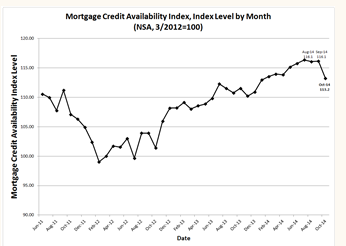
Speaking of mortgage credit, it declined in August, according to the MBA Mortgage Credit Availability Index. However the decline was driven by the removal of special loan programs which only pertain to REO sales.

Filed under: Morning Report | 15 Comments »
Posted on November 4, 2014 by Brent Nyitray
Markets are lower this morning along with European stocks. Bonds and MBS are higher.
In economic data, construction spending fell .4% in September, and August was revised upward to -.5%. Private residential construction fell and is up slightly on a year-over-year basis.
The ISM Manufacturing Survey came in at a very strong 59, as the manufacturing recovery continues. The ISM New York Survey fell by a lot, however, as did factory orders. IBD / TIPP Economic Optimism ticked up, however. Remember consumer sentiment surveys are influence by gas prices.
Oil is getting slammed as the Saudi Aramco cut the price of oil to the US in order to better compete with US domestic production. Lower oil and gas prices can provide a much-needed shot in the arm to domestic consumption. It could save the holiday shopping season for the retailers.
Today is election day, and pretty much everyone agrees Republicans will take the Senate. What does that mean legislatively? I think the big legislative priorities for Republicans are corporate tax reform, the Keystone pipeline, and fixing Dodd-Frank (read: rein in the CFPB). Corporate tax reform will hinge on revenue-neutrality. Obama will want to cut rates and close loopholes on a revenue-enhancing basis. Republicans don’t want to raise corporate taxes, so they will insist on revenue-neutrality. This may be too large an ideological bridge to cross. On the second issue, Keystone, lower oil prices are rendering that issue moot. Finally, there may be some possibilities on the CFPB, as the right wants to see it subject to some sort of accountability, and the affordable-housing advocates on the left are getting sick and tired of tight credit. Again, can Obama cross the ideological bridge that will subject him to scorn from the Elizabeth Warrens of the world?
The first time homebuyer is still MIA, and that is still the biggest issue facing the housing market. In fact the share of home purchases to first-timers is the lowest since 1987 when the stock market crashed. Only 33% of buyers purchased their first home this year, down from 38% a year ago. Blame a lousy job market and tight credit. The highlights of NAR’s survey can be found here.
Filed under: Morning Report | 38 Comments »
Posted on November 3, 2014 by Brent Nyitray
Feet, calves, and knees hurt
Recovering from the NY Marathon. Damn near got blown off the Verazanno Narrows bridge
Filed under: Morning Report | 23 Comments »
Posted on October 31, 2014 by Brent Nyitray
Stock markets are soaring globally after the Bank of Japan unexpectedly boosted its stimulus. It’s raining yen. Bonds and MBS are down.
Some economic data – Personal Incomes rose .2% in September, while Personal Spending fell .2%. It looks like dropping energy prices explain the drop in spending, which means the number isn’t really bearish. However, the gas savings used to pay down debt as the savings rate ticked up to 5.6% from 5.4%. This increase in the savings rate could be bullish.
The Fed’s preferred inflation measure – the Personal Consumption Expenditure Index came in at 1.4% (1.5% ex food and energy). Inflation continues to come in below the Fed’s target rate of 2%.
University of Michigan Consumer Confidence increased in October. As I have said before, the consumer confidence index is often a stealth gasoline price index.
Could the price increases in the new home market finally be coming to an end? It sounds like it. Meritage Homes reported margin pressure, and Standard Pacific’s margins are flatlining. The story for the builders has been tepid delivery growth with big increases in ASPs. Those days may be over, which means builders will have to increase volume to be able to show growth to the Street. This should be bullish for the economy.
Standard Pacific missed on the top and bottom line last night. The press release was pretty sparse on detail, and the conference call is later on today. The stock is more or less unch’d pre-open.
Filed under: Morning Report | 3 Comments »
Posted on October 30, 2014 by Brent Nyitray
Stocks are higher this morning after the strong GDP number. Bonds and MBS are up with worldwide bonds.
Initial Jobless Claims came in at 287k, and the Bloomberg Consumer Comfort Index came in at 37.2. Initial Jobless Claims remain exceptionally low, evidence that companies have done all the cutting they are going to do and are keeping who they have. Next step is to see wage growth and a drop in the long-term unemployed. Which way that breaks will have a huge influence in how the Fed reacts. If we see the long term unemployed enter the labor force first, that means wage growth will remain weak. That will give the Fed room to run on maintaining low rates and ultimately raise the potential growth rate of the economy. If instead, companies end up competing with each other for the employed, that means wages increase sooner, but the Fed moves sooner as well. Also, it means the long-term unemployed remain so, which reduces the potential growth rate of the economy. This is a subject of debate with the staff economists at the Fed, with the staff leaning more towards the latter scenario and the governors leaning more towards the first one. The minutes of yesterday’s meeting will be interesting.
Note that the Fed’s new labor market conditions index is probably going to drive some of the Fed’s policies going forward. The issue with it is that it lumps a whole slew of leading and lagging indicators together. Initial Jobless claims and Job Openings are leading indicators. The labor force participation rate and the unemployment rate are lagging indicators. I would posit that the leading indicators are strong, and the lagging indicators simply haven’t caught up yet. Which means the Fed could stay with low interest rates too long. You could argue that worldwide monetary easing has created a sovereign debt bubble. When Italy can tie up money for 10 years at under 2.5%, and the German government can do it for 84 basis points, investors are making a gargantuan deflationary bet. This is akin to buying Cisco Systems at $70 a share in 2000. Yes Virginia, you can lose money in sovereign debt on a mark-to-market basis and on a purchasing power basis. The entire world’s central bankers are on a mission to create inflation. Eventually they will succeed.
The advance estimate for third quarter GDP came in at 3.5%. This will be subject to two revisions later. The Street estimate was 3.0%. The personal consumption expenditure index (the preferred inflation measure for the Fed) came in at +1.3%, well below what they would like to see. It looks like we had a big jump in Federal government spending (+10% for Q3 vs -.9% for Q2). Defense spending drove the increase in government spending. Disposable personal income increased 4% in the third quarter, while the savings rate increased from 5.4% to 5.5%.
The FOMC statement was more or less a non-event. As expected, the Fed ended QE, but kept the “considerable time” language in the press release. Bonds sold off a bit on the announcement, but they have recouped those losses and then some this morning. With QE done and dusted, attention focuses to “policy normalization”, which is Fed-speak for raising interest rates off the zero bound. Interestingly, the Wall Street Journal headline this morning is “Fed Closes Chapter on Easy Money.” Um no. The Fed is closing the chapter on “really, really, really easy money,” and ushered in the new era of “really, really easy money.”
Completed foreclosures ticked up to 46,000 in September, according to CoreLogic. This is down 33% year-over-year but up 4.7% versus August. Approximately 607k homes are in some stage of foreclosure, which is down 34% from a year ago. While foreclosures are down markedly from peak levels, they are still running at a little over 2x normal levels. Delinquencies continue to fall.
Ocwen reported a loss last night, and reserved $100 million to settle with the NY AG for the backdating issue. They note they do not have a deal yet. They generated about 60bps operating profit on $1.1 billion in origination.
Filed under: Morning Report | 10 Comments »
Posted on October 29, 2014 by Brent Nyitray
Markets are flattish this morning as we await the Fed. Bonds and MBS are flat.
Mortgage Applications fell 6.6% last week as rates rose. Purchases fell 5% while refis fell 7.4%. The 30 year fixed rate mortgage rose to 4.13% from 4.1%.
The market’s reaction to today’s FOMC statement may well hinge on two words: “considerable time” – meaning the market wants to hear that the Fed will keep rates abnormally low for a considerable time after unemployment hits the Fed’s target. I doubt the Fed takes James Bullard’s advice and maintains QE – they have already said they intend to end it at this meeting, and I don’t think they want to risk their credibility. I also think they want to end QE in order to clear the decks for monetary policy normalization.
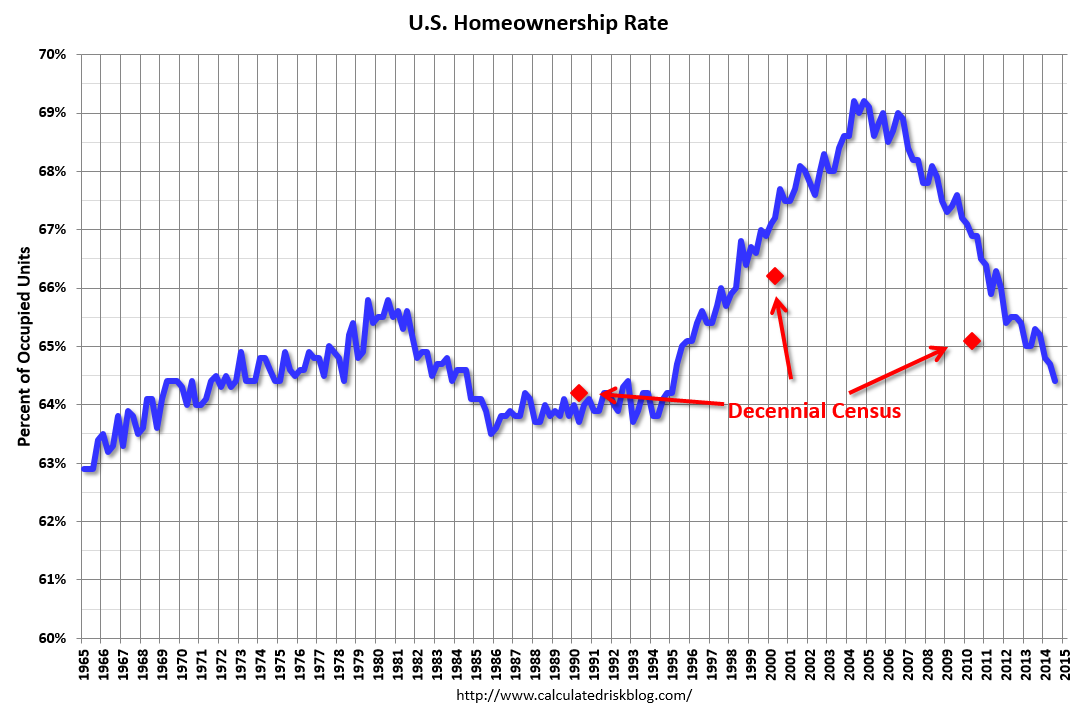
The homeownership rate ticked down in the third quarter from 64.7% to 64.4%. Household formation was roughly flat. We are pretty much back at levels not seen since the Clinton Administration began its big push to increase home ownership early in its administration.What is going on? Tight credit and a weak labor market is keeping the Millennial generation renting instead of buying. Median asking rents continue to rise and are now around $756. The P&I payment on the median house versus at the current 30 year fixed rate with 20% down is $796.

Ultimately, the number of 25-34 year olds is outpacing the growth in housing stock, as housing starts remain stubbornly around 1 million units per year. Median rents keep increasing due to tight housing supply – eventually the value proposition of buying versus renting becomes too big to ignore.
Filed under: Morning Report | 13 Comments »
Posted on October 28, 2014 by Brent Nyitray
US stocks are up on European strength. Bonds and MBS are flattish.
The FOMC meeting starts today. I think the action will be in the minutes, not so much the FOMC statement – the markets are looking for the words “considerable time” and will probably trade off that. In other words, they want to see a commitment to keep rates low for a “considerable time” after other indicators (unemployment) reach the Fed targets. I don’t think Yellen is holding a press conference for this one, and there won’t be any updates to the economic forecasts. Given the rebound in markets, I suspect they wrap up QE at this meeting to clear the decks for monetary policy normalization (Fed-speak for bringing the Fed Funds rate off the zero bound). Conducting monetary policy with a massive balance sheet is something new, and there are mechanical details that need to be worked out. I still think the Fed will do nothing more than a symbolic increases in the Fed Funds rate to get off the zero bound until they start seeing wage inflation. With the dollar rallying and commodities falling (see below regarding gasoline), the Fed has the room to let the economy run.
Durable Goods orders fell for the second straight month, with the headline number falling 1.3% after falling 18.3% (yes, 18.3%, not a typo) the month before. Capital Goods Orders ex defense / air (a proxy for business capital expenditures) fell 1.7%. Durable Goods orders are notoriously volatile and subject to big revisions after the fact, however two drops in a row is not a good sign. Manufacturing is not the driver of the economy it used to be, however it is important.
In other economic data, we had a big jump in consumer confidence, from 89 to 94.5 and an increase in the Richmond Fed Manufacturing Index.
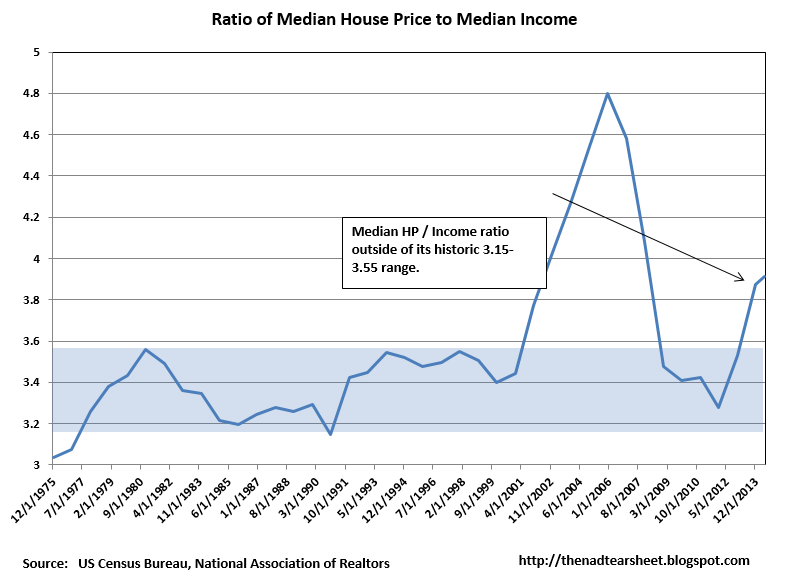
Home Prices fell .15% in August, according to Case-Shiller. The weakness was led by the previously hot California metros. On an annual basis, home prices are still up 5.6%. Home Price Appreciation is clearly decelerating, and it probably means that the rebound from the bottom is over. Further home price appreciation will be a function of wage growth. As you can see from the chart below, the median house price to median income ratio is back out of its historic range. Not predicting a big decline in home prices – just thinking that we go nowhere for a while until wages increase.

Gasoline prices continue to fall, and that means good things for consumption. Americans spend about $2,000 a year on gasoline, so lower prices can have a great stimulative effect. David Kotok of Cumberland Securities was on Bloomberg radio this morning, and he says that a $1.00 drop in the price of gasoline over the year puts about the same amount of money in an average American’s hands as the 2% payroll tax cut did. For what its worth, the annual drop in gas prices right now is around 70 cents or so. Retailers will certainly find this welcome news as we head into the all-important holiday shopping season. Note that the consumer confidence numbers are heavily influenced by gas prices and are hitting mid 2007 levels.
Filed under: Morning Report | 1 Comment »


 Brent Nyitray
 Fairlington Blade
 Let the mutherfuker burn!
 jnc4p
 Kevin S. Willis
 Michigoose
 lmsinca
 markinaustin
 Arcanaut
 novahockey
 quarterback
 ScottC
 yellojkt