Morning Report 5/18/12

Vital Statistics:


Last

Change

Percent

S&P Futures 

1307.5

6.2

0.48%

Eurostoxx Index

2155.6

8.7

0.40%

Oil (WTI)

92.68

0.1

0.13%

LIBOR

0.467

0.000

0.00%

US Dollar Index (DXY)

81.38

-0.004

0.00%

10 Year Govt Bond Yield

1.72%

0.02%


RPX Composite Real Estate Index

175.6

0.1


Markets are firmer this morning after enduring a bloody week which sent the S&P down 3.6% and the 10 year government bond yield down to 1.69%. Today is also the expiration of May options, so there is always the potential for funny closing prints. There is no economic data being released this morning.  Bonds and MBS are down slightly.

It’s Facebook Day! Facebook priced at the top end of the revised range last night and should begin trading around 11:00. There are a stocks that capture the attention of the populace and Facebook is one of them. Growth fund managers who have been starving for a good growth story besides Chipotle Mexican Grill and Lululemon just got a new one. With an IPO price at 28x revenue, the stock will have to almost collapse to get value and GARP guys interested. I’m sure if you are a good technical trader, you should be able to have a field day with this one. Treat it as a slip of paper with an alphanumeric code, not an investment, cause it isn’t.

Bloomberg has a column on why principal reductions won’t solve the housing crisis. The big problem is that something like 80% of all underwater homeowners with Fan and Fred mortgages are current on their mortgages. Any principal reduction program will encourage people to stop paying their mortgage. Second, of those seriously delinquent, most of them won’t be able to afford the lower payment anyway.

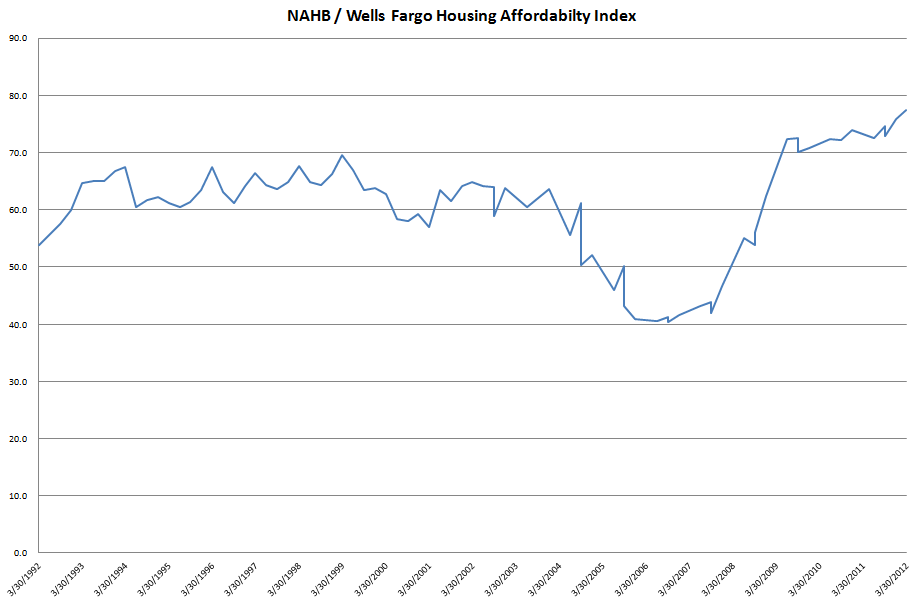
The National Association of Home Builders and Wells Fargo have constructed a housing affordability index, which is a measure of the percent of homes affordable by someone at the median income. The latest index is 77.5, which means 77.5 percent of all new and existing homes sold in Q1 were affordable for families earning the national median income. In a lot of ways, this chart is the inverse of my median house price to median income chart.

Chart: NAHB / Wells Fargo Housing Affordability Index:
 

Morning Report 5/17/12

Vital Statistics:


Last

Change

Percent

S&P Futures 

1319.6

-2.8

-0.21%

Eurostoxx Index

2140.4

-35.0

-1.61%

Oil (WTI)

93.04

0.2

0.25%

LIBOR

0.467

0.000

0.00%

US Dollar Index (DXY)

81.59

0.218

0.27%

10 Year Govt Bond Yield

1.76%

0.00%


RPX Composite Real Estate Index

175.6

0.1


Markets are lower this morning on a report in the Spanish press that Moody’s will downgrade the Spanish banks today and the continuing stand-off between the ECB and the Greek banks. The Spanish IBEX stock exchange is down 24% for the year and is at 9 year lows. Despite the headlines, Euro sovereign yields are flat / lower.

Initial Jobless claims came it at 370k, in line with expectations and we have good earnings from Wal-Mart and Sears. Later today, we will get Philly Fed. Bonds and MBS are up slightly.

Facebook prices tonight and should start trading tomorrow. Barry Ritholtz weighs in. David Einhorn took aim at AMZN at the Ira Sohn conference. His comments could have come from a Alan Abelson column in 1999. I expect to hear a lot of the same “you don’t get it” arguments on FB that we heard on AMZN back then.

The minutes of the April FOMC meeting were released yesterday afternoon. They note the possibility of “taxmageddon” – the expiration of the Bush tax cuts – as a sizeable risk to the economy. While they note the size of the shadow inventory and tight lending standards, they believe real estate prices have stabilized. Overall, there seem to be no major changes in this statement – the Fed remains open to QEIII should economic conditions warrant. 

Ellie Mae released their latest Origination Insight Report. Ellie Mae provides loan processing software and handles about 20% of US mortgage loan origination. Typical profile of a denied loan?  702 FICO / 87 LTV / DTI 28/43.  Talk about a tight mortgage market. 

The problem with having a London Whale is that you have thousands of Ahabs shooting harpoons at you once you disclose you are in trouble with an oversized position. Dealbook is estimating that JP Morgan’s trading losses have increased from $2 billion to $3 billion in the last 4 days as every wise-guy hedge fund manager that missed the initial trade puts it on.

Morning Report 5/16/12

Vital Statistics:


  Last Change Percent
S&P Futures  1334.7 6.5 0.49%
Eurostoxx Index 2186.7 8.0 0.37%
Oil (WTI) 92.98 -1.0 -1.06%
LIBOR 0.467 0.001 0.21%
US Dollar Index (DXY) 81.31 0.086 0.11%
10 Year Govt Bond Yield 1.80% 0.03%  
RPX Composite Real Estate Index 175.5 0.4  

S&P futures are firming this morning after hitting lows of 1321 overnight. Good earnings reports from Target and Deere seem to be overshadowing the bank run going on in Greece. Greek, Irish and Portuguese yields are higher this morning. US Treasuries are down half a point while MBS are flat. Everyone is waiting for the minutes of the last FOMC meeting which will be released this afternoon. 

Industrial Production increased 1.1% in April, a reasonably strong reading. Capacity Utilization ticked up to 79.2%, but the Fed revised down everything for the past year.

The recent drop in rates is triggering refi activity, as evidenced by a 9.2% jump in mortgage applications last week.

April Housing Starts came in at a 717k annualized rate, better than expectations, but still horribly depressed. To put that number in perspective, the in the 74-75 recession, starts bottomed at 904k.  In the 81-82 recession, they bottomed at 837k. In the 91-92 recession, they bottomed at 798k.  These bottoms were V-shaped and typically lasted 6 months or so before returning to normalcy of around 1500.  When was the last time we saw a 800k print?  September of 2008 – almost 4 years ago. Housing historically leads the economy out of a recession, and its absence has been a big part of why this recovery has been so anemic.

Is the summer of 2012 going to be a replay of the summer of 2011?  Certainly the pieces are being put in place – Europe’s sovereign debt crisis is again in the forefront, the economy is decelerating after a good Q4 / Q1, and the old saw “Sell in May and go away” was good advice again. We even have the prospect of major tax increases Jan 1 as the Bush tax cuts expire. The only thing we are missing is a debt ceiling fight. Oh, wait…

The Florida Supreme Court is hearing an foreclosure case that asks an interesting question – can the banks who filed foreclosures based on robo-signed documents voluntarily dismiss these cases and re-file them with better documents?

The good market reception to the Facebook IPO means that sellers are increasing the amount for sale. Existing holders like Goldman, Tiger, and Accel are blowing out of 241MM shares, much more than they originally planned.  Surprisingly, and perhaps no coincidentally,  GM has dropped paid advertising with Facebook because they “weren’t effective enough”. Apparently “likes” doesn’t necessarily translate into sales or dealer inquiries.

Morning Report 5/15/12

Vital Statistics


Last

Change

Percent

S&P Futures 

1336.0

1.9

0.14%

Eurostoxx Index

2179.7

-22.2

-1.01%

Oil (WTI)

94.71

-0.1

-0.07%

LIBOR

0.466

0.000

0.00%

US Dollar Index (DXY)

80.89

0.280

0.35%

10 Year Govt Bond Yield

1.78%

0.02%


RPX Composite Real Estate Index

175.5

0.4


Markets are up this morning on a lack of news out of Europe and some mixed economic data. The Consumer Price Index showed inflation remains benign, while retail sales data showed spending up slightly and below expectations. Bonds and MBS are down slightly. Greek bond yields are up 160 basis points. Portugal and Ireland are up as well 

The New York Fed released its Empire State Manufacturing Survey this morning, which came in better then expected on higher shipments. Six month optimism fell.

The National Association of Home Builders released its builder confidence survey this morning, which showed improving sentiment.

The Washington Post is starting to focus on the tax hikes that will take place in the beginning of 2013. They note the uncertainty that it is causing. So far, there seems to be no discussions in Washington about what to do about it. IMO this has been driving some of the recent deceleration in the economy.

Lots of institutional investors are clicking “Like” – Facebook raised the range of its IPO price from 28-35 to 34-38. At the top end of the range, FB would be valued at 26x sales – or about twice the valuation of the Google IPO.

Ally doesn’t plan on re-organizing the mortgage business and getting back in to the housing market. They are going to stick with car loans. Money Quote from Ally CEO Michael Carpenter: “You can live in your car if you don’t pay your mortgage.  I don’t mean to be cute, but the fact is people make their car payment before they pay their mortgage.”

Chart:  NAHB Index:

Morning Report 5/14/12

Vital Statistics:

Last Change Percent
S&P Futures 1340.2 -9.8 -0.73%
Eurostoxx Index 2199.2 -55.4 -2.46%
Oil (WTI) 94.47 -1.7 -1.73%
LIBOR 0.466 -0.001 -0.21%
US Dollar Index (DXY) 80.51 0.248 0.31%
10 Year Govt Bond Yield 1.78% -0.05%
RPX Composite Real Estate Index 175.3 0.0

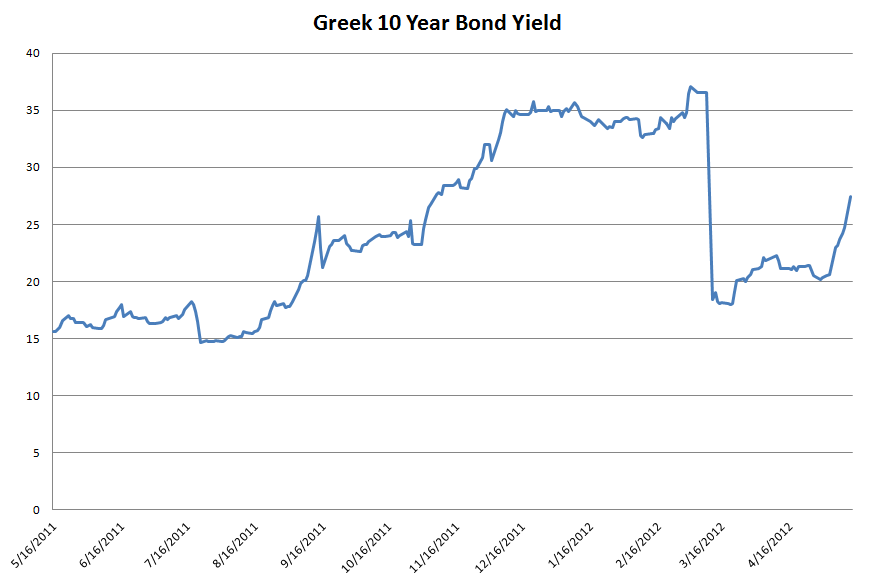
A sloppy start to the week as sovereign spreads widen in Europe. Greek sovereign debt is now trading at a 27.4% yield, which is the same level as last Nov. Don’t forget, this is the post-reorg debt – for those keeping score at home, Greek sovereigns were at 15% last year at this time, rose to over 40%, did a restructuring two months ago which pushed yields down to 17%, and now they are 27%. Spanish yields are rising, and it is time to start paying attention to the credit default swaps on the big European banks – Dexia is considered one of the worst cases, and is trading at the 17.75% level.

All of the stress in Europe is pushing down Treasury yields which sit about 10 basis points above September’s lows. MBS are higher as well, with the Fannie and Ginnie 3.5s up 6 ticks. This is putting pressure on oil and the Euro. The S&P futures are suggesting that the 200 day moving average is going to get broken on the open.

It is official – Ally’s Residential Capital has filed for bankruptcy protection. This move separates the auto loan and banking business, and should pave the way for the government to divest its 74% stake. Ally is providing the $150MM DIP and is kicking in $750MM.

It looks like 3 executives from JP Morgan will walk the plank over the $2 billion “hedging” loss in their Chief Investment Office unit. Jamie Dimon is not resigning, at least not yet. It is surprising that JP Morgan disclosed the loss before it fully exited the position – if disclosure rules forced his hand, that is a big unintended consequence. This episode will undoubtedly elicit calls for more regulation, and strengthens the view in Washington that there is no alpha in banking, just beta.

Chart: Greek 10 year bond yield:

Morning Report 5.11.12

Vital Statistics:


  Last Change Percent
S&P Futures  1349.3 -8.3 -0.61%
Eurostoxx Index 2231.1 -16.3 -0.72%
Oil (WTI) 96.03 -1.0 -1.08%
LIBOR 0.467 0.000 0.00%
US Dollar Index (DXY) 80.19 0.078 0.10%
10 Year Govt Bond Yield 1.85% -0.02%  
RPX Composite Real Estate Index 175.3 -0.1  

Markets are lower this morning after J.P. Morgan announced a $2 billion trading loss in its Chief Investment Office unit. April PPI showed inflation is behaving at the wholesale level. Bonds and MBS are higher.

The JP Morgan story is interesting. The position was supposed to be a hedge the bank’s credit exposure. However, if you read the Blooomberg story, it suggests the bank had sold protection on the Markit Series 9 CDX North American investment grade index. Which means it wasn’t hedging anything at all – selling protection and extending credit (which is what the bank does) are similar risks. The story goes on to speculate that it may have been some sort of spread bet, where the bank was short long-dated protection and long short-dated protection. Regardless, this position in no way hedges the bank’s overall business, at least as far as I can tell. Good luck getting out, guys. J.P. Morgan is going to get their eyes ripped out on the exit.

This incident will not cause a systemic risk in any way – if anything it will simply give ammo to the proponents of the Volcker Rule. A $2 billion loss for a bank that made $19 billion the year before and has $176 billion in equity is not fatal in any way. It also shows (again) the fundamental weakness in Value at Risk (VaR), which basically tells you the best case scenario when the fit hits the shan. JP Morgan stock is down 9.2% this morning. 

The CFPB has proposed rules for mortgage origination costs, which bans origination charges that vary by the size of the loan. Rob Christman summed it up perfectly:  “I’m sure that consumer groups are happy about it – just wait until they can’t find anyone who’s going to do a $100,000 loan.” The CFPB has also re-affirmed the anti-steering rules by the Fed.

The Facebook IPO is supposedly garnering lukewarm interest, at least at the price being discussed. It must be bad – I heard Mark Zuckerberg was seen this morning in a suit and tie, eschewing his traditional hoodie. The underwriters still have time to whip up excitement for the deal which should list on May 17 under they symbol FB.

Morning Report 5.10.12

Vital Statistics:

  Last Change Percent
S&P Futures  1359.1 8.1 0.60%
Eurostoxx Index 2248.8 23.2 1.04%
Oil (WTI) 96.89 0.1 0.08%
LIBOR 0.467 0.000 0.00%
US Dollar Index (DXY) 80.01 -0.075 -0.09%
10 Year Govt Bond Yield 1.89% 0.07%  
RPX Composite Real Estate Index 175.4 0.2  

Markets are higher this morning on no real news. Yesterday’s technical support at 1345 on the S&P 500 held, and perhaps we are just having an oversold bounce. Bonds and MBS are down as well. The Spanish government seized Bankia, the county’s largest real estate lender 

Initial Jobless claims for last week came in at 367k, more or less in line with estimates. 

Hey, Fannie Mae made some money! And they don’t need a check this quarter either.

The National Association of Realtors released their latest quarterly report yesterday, noting that improving sales and declining inventory are creating more balanced conditions. The inventory of homes for sale fell to 2.37MM existing homes from 3.03MM in Q111. The median home price fell slighlty to $158,100 from $158,700. This drops the median home price to median income ratio to 3.075, the lowest level since 1976, and below its historical range of 3.15 – 3.55. Prices after a bubble tend to overcorrect, and it certainly is possible that prices could go lower – however we are officially in “overcorrection” mode.

Chart:  Median House Price to Median Income:


Morning Report 5.9.12

Vital Statistics:

  Last Change Percent
S&P Futures  1345.8 -12.7 -0.93%
Eurostoxx Index 2215.7 -20.4 -0.91%
Oil (WTI) 95.84 -1.2 -1.21%
LIBOR 0.467 0.001 0.21%
US Dollar Index (DXY) 80.02 0.281 0.35%
10 Year Govt Bond Yield 1.80% -0.04%  
RPX Composite Real Estate Index 175.2 -0.1  

Another sloppy morning as people watch the Greeks try and form a governing coalition which may well reject the austerity measures agreed to with the EU. The Greek 10 year is yielding 23.3% and the Athens Stock Exchange Index is now touching 20-year lows. The turmoil in Greece has investors nervously eyeing Spain and Portugal.

This has put pressure on the S&P futures, and a bid under Treasuries. The 10-year traded below 1.8% this morning. I am watching the 1345 level in the S&P 500, which is the 200 day moving average and the low of early March. We came within a couple of points yesterday. Mortgages are rising, but not as much as Treasuries.

Corelogic released its March 2012 Home Price Index yesterday, which showed prices flat YOY. Excluding distressed sales, prices increased overall. The top markets were Wyoming, Virginia, Arizona, North Dakota, and Florida. The worst were Delaware, Illinois, Alabama, Georgia, and Nevada.

FHA foreclosures increased in March, and it released an interesting statistic – that half the mortgages it modified entered into foreclosure a year later. Speaking of mods, Bank of America is offering principal reductions to 200,000 homeowners as part of the State AG settlement.

University of Chicago economist Raghuram Rajan has an interesting paper discussing the best way forward to improve the economy. He points out that for the past 20 years, the US has attempted to address inequality through the credit mechanism. If we can’t do something directly for the middle class, we can allow them to do cash-out refis to spend as if they weren’t middle class. Ideologically, there will be something for everyone to love and something for everyone to hate. It provides an excellent historical background on how we got here in the first place. Good read.

Morning Report 5.8.12

Vital Statistics:


  Last Change Percent
S&P Futures  1361.3 -4.5 -0.33%
Eurostoxx Index 2280.4 -2.7 -0.12%
Oil (WTI) 96.95 -1.0 -1.01%
LIBOR 0.466 0.000 0.00%
US Dollar Index (DXY) 79.74 0.132 0.17%
10 Year Govt Bond Yield 1.85% -0.02%  
RPX Composite Real Estate Index 175.4 0.4  

Markets are generally lower this morning on follow-through from the weekend elections in Europe. German industrial output rose more than forecast, suggesting that Germany may avoid a recession. German GDP growth was negative in Q4, however as an exporter, they benefit form Euro weakness. Such is they symbiotic relationship between the North and South – the Southern European countries benefit from their ability to borrow at lower rates than they otherwise would, while the Northern European countries benefit from the currency weakness that results. Bonds and MBS continue to rally, and the 10-year yield has cracked 1.85% 

The National Federation of Independent Businesses released its Small Business Optimism Report this morning. The report contained an interesting statistic – nearly half of the respondents hired or tried to hire in the last three months, and 3/4 of them said they had “few” or “no” qualified applicants. Hard-to-fill job openings rose, and are typically a leading indicator to a drop in unemployment. Capital Expenditures have increased from the record lows of August 10, but are still below “normal” levels, indicating spending is in maintenance mode, not expansion mode.  Contrary to public perception, access to credit remains low on the list of concerns. Earnings are pushing to cyclical highs. Anyway, it is an interesting report. RTWT.

Wells Fargo made nearly 34% of the $385 billion of mortgages originated in the first quarter. Their next closest competitor was JP Morgan at 10.6%.  Should the Federal Trade Commission start preparing an antitrust lawsuit?  Probably not, as the reason for their increased market share was due to their competitors scaling back the business.

It is looking more like Ally will put its Residential Capital unit into bankruptcy and Treasury will support the decision if it happens. Treasury wants to put Ally on the block and recoup their money, but the liability stream from ResCap is making that impossible. The end result could be an acceleration of putback claims.

Morning Report 5.7.12

Vital Statistics:


Last

Change

Percent

S&P Futures 

1357.0

-5.5

-0.40%

Eurostoxx Index

2250.6

2.2

0.10%

Oil (WTI)

97.76

-0.7

-0.74%

LIBOR

0.466

0.000

0.00%

US Dollar Index (DXY)

79.69

0.190

0.24%

10 Year Govt Bond Yield

1.87%

-0.01%


RPX Composite Real Estate Index

175

0.4


Global markets are weaker this morning after the far left won elections in France, and Greece voters rejected austerity measures. Greek bond yields have blown out 240 basis points this morning. French yields have taken the election in stride. The CAC-40 (French stock market) is actually up. The S&P futures were initially down 20 points on the Asian open, but have largely recouped their losses. Bonds and MBS are flat / up.

Pundits will be trying to read the tea leaves in the European election. Needless to say, Paul Krugman is delighted. Mohamed El-Arian is cautious.

Robert Samuelson sums up the debate going on in the academic community over how to address the current recession. Paul Krugman has been urging the Fed to target increased inflation in order to decrease unemployment. Ben Bernake considers Krugman’s prescription to be reckless.  FWIW, I side with Bernake here. With so much slack in the labor force, we are seeing zero upward pressure on wages, and the Fed’s profligacy has created a bull market in commodities. Stagnant wages plus higher food and energy costs are a recipe for more consumer misery, not less.

The Obama administration has released its April Housing Scorecard. Punch Line: The housing market remains fragile and the administration remains committed to try and prevent avoidable foreclosures and to stabilize the housing market. It more or less reads like a campaign ad.

This week is Loanapalooza – the Mortgage Bankers Association Secondary Conference, which is being held in NYC. Certainly the top issues will be the CFPB, the return of the private label market, and the new regulatory environment.