Morning Report 5/30/12

Vital Statistics:

  Last Change Percent
S&P Futures  1323.7 -9.7 -0.73%
Eurostoxx Index 2162.6 2.3 0.10%
Oil (WTI) 89.51 -1.2 -1.38%
LIBOR 0.467 0.000 0.00%
US Dollar Index (DXY) 82.54 0.056 0.07%
10 Year Govt Bond Yield 1.69% -0.05%  
RPX Composite Real Estate Index 177.5 0.1  

A sloppy tape to start the day as Euro fears take center stage. Spanish credit default swaps are at 522 basis points, an all-time high. Troubled Spanish lender Bankia continues to fall. Greek sovereign debt is over 30%. The beneficiary of the risk-off trade is the US 10-year, where yields are down 6 basis points. Meanwhile, oil cannot get out of its own way, with WTI down 15% this month.

The 10-year yield is flirting with the Sep low of 1.673%.  MBS are unchd, and we are witnessing a similar phenomenon as last fall, where the 10 year rallied and MBS underperformed. The spread between the Freddie Mac generic 30 year fixed mortgage and the 10-year bond yield is 2.04%.  Here is a chart of the generic 30 year fixed rate mortgage, the 10-year bond, and the spread between the two. 


While mortgage rates are falling as the yield on the 10 year falls, they are falling much more slowly. So, if you are facing a lock decision, you have are faced with a bit of a conundrum:  If the 10 year yield continues to fall, mortgage rates might not participate. In other words, we may be reaching a floor in mortgage rates.  Which means you might as well lock.  On the other hand, if the 10 year yield starts backing up, mortgage rates should rise much slower since they really didn’t fall that much to begin with.  Which means you have some room to wait and see what happens, and you might want to float. So, lock or float?  IMO, when markets crack, they crack quickly. And the 10 year is at very lofty levels. It could go from 1.7% to 2.4% in a hurry. The risk is more skewed towards mortgage rates increasing quickly than falling quickly. I would lean short in mortgage rates, or in other words, lock.

Part of the reason why the recovery has been so halting has been that the job market for those in their prime earnings years has been horrendous. Instead of making the top salaries of their lives (which they need to pay for college for their kids and also retirement savings), many people in their prime earnings years are either unemployed or underemployed.  This is a huge drag on the economy. 

Morning Report 5/29/12

Vital Statistics:

  Last Change Percent
S&P Futures  1322.0 7.0 0.53%
Eurostoxx Index 2147.7 -0.3 -0.01%
Oil (WTI) 91.13 0.3 0.30%
LIBOR 0.467 0.000 0.00%
US Dollar Index (DXY) 82.27 -0.131 -0.16%
10 Year Govt Bond Yield 1.72% -0.02%  
RPX Composite Real Estate Index 177.4 0.3  

Markets are higher this morning on hopes of stimulus in China. Spain is working on a rescue plan for Bankia, its 3rd largest lender. Spanish banking woes have pushed their sovereign debt to around 6.5%, close to the highs of last November. While Greek and Spanish fears are pushing sovereign yields higher, we have not seen a corresponding rise in EURIBOR / OIS, which is a signal that the banking system in Europe is taking a sanguine view, at least for now.  Meanwhile, Treasuries and bonds are higher, with the 10 year bond now at 1.73%


The S&P Case-Schiller index posted a slight sequential gain in March, but was still down 3% YOY, and made a new post-crisis low. Nationwide, house prices on average are back at their mid-2002 levels. That said, the pace of the decline has definitely slowed.


Chart:  Case-Schiller

Morning Report 5/25/12

Vital Statistics:

  Last Change Percent
S&P Futures  1322.1 -0.5 -0.04%
Eurostoxx Index 2148.8 -7.7 -0.36%
Oil (WTI) 90.91 0.3 0.28%
LIBOR 0.467 0.000 0.00%
US Dollar Index (DXY) 82.16 -0.186 -0.23%
10 Year Govt Bond Yield 1.76% -0.02%  
RPX Composite Real Estate Index 177.1 0.4  

Markets are flat overall this morning, which makes sense.  Given the fact we have a 3 day weekend and we may have a resolution on the Greek situation, you would have to be certifiably insane to carry positions over the weekend.  Bonds close early today, and I suspect most of the Street will be on the L.I.E. by noon. 

No economic data with the exception of University of Michigan confidence at 9:55 this morning. University of Michigan consumer confidence really just tells you where gas prices were last month (h/t Ron at MCM). Consumer sentiment and the Triple A Gas Price index have a -.52 correlation with a 1 month lag.  

Are people who bought Facebook stock in the initial frenzy getting a do-over?  Sounds like it. The underwriters are claiming they made $100 million supporting the stock. I can see how they made money supporting the stock on the open.  I can’t see how they made money supporting it at the close since it opened down a couple of bucks the next day. Unless they were shorting it in the 40s.

I came across this testimony from a community banker regarding the unintended consequences of Dodd-Frank and the Volcker rule. The biggest one is that the regulators swung at Goldman and Morgan, they ducked, and the regulator ended up slugging all the small fry right in the jaw. When you have 15% of your staff handling regulatory matters and 12% of your operating budget is compliance there is a problem. He notes that regulatory costs as a percent of operating costs is 2.5x the costs for big banks. The Volcker rule alone will require the drafting of policies and procedures to ensure the East Podunk Savings and Loan doesn’t inadvertently set up a trading desk and start slinging around credit default swaps 

He also notes some major problems with the “ability to repay” test on mortgage origination and on the CFPB’s characterization of pricing risk as “predatory lending.”  The net result may be to drive community banks out of entire lines of business because of regulatory risk.  Will the powers that be listen?  I doubt they will do anything more than make perfunctory statements that these regulations were not meant to impact small banks. They will listen to this guy instead. 

Morning Report 5/24/12

Vital Statistics:

  Last Change Percent
S&P Futures  1317.8 2.1 0.16%
Eurostoxx Index 2154.3 20.3 0.95%
Oil (WTI) 90.56 0.7 0.73%
LIBOR 0.467 0.000 0.00%
US Dollar Index (DXY) 82.14 0.046 0.06%
10 Year Govt Bond Yield 1.75% 0.02%  
RPX Composite Real Estate Index 176.7 0.5  

Markets are giving up earlier gains on the back of some disappointing economic reports. Euro sovereigns are higher with the exception of Greece which now yields 30% and Portugal. Bonds are down a point and MBS are down a few ticks as well.

The Durable Goods headline number came in at +.2%, more or less in line with expectations, but DG ex transportation fell .6%. Cap Goods orders and shipments both fell. This metric tracks business investment and is an ominous sign for the economy.  This might explain why HP is laying off 27,000 workers.  

Initial Jobless claims came in at 370k, in line with expectations.

Freddie Mac released their Economic and Housing Outlook yesterday. It mainly re-hashes data we have already seen. They are of the view that housing is at or near bottom and that rental vacancies are at 9-year lows.

The housing market had another positive data point with the Toll Brother’s earnings announcement. Toll is in the McMansion business, so this report focuses more on the high end. Q2 revenues rose 14% YOY, but signed contracts increased 51%.  Backlog was up 49%. Granted, we are coming off of a low base, but you are starting to see some life in homebuilding. Doug Yearley, CEO said “It appears that the housing market has moved into a new and stronger phase of recovery as we have experienced broad-based improvement across most of our regions over the past six months. The spring selling season has been the most robust and sustained since the downturn began.”  Granted, he is talking his book, but still…

Morning Report 5/23/12

Vital Statistics

  Last Change Percent
S&P Futures  1305.2 -9.6 -0.73%
Eurostoxx Index 2148.5 -44.3 -2.02%
Oil (WTI) 91.15 -0.7 -0.76%
LIBOR 0.467 0.000 0.00%
US Dollar Index (DXY) 81.71 0.218 0.27%
10 Year Govt Bond Yield 1.74% -0.03%  
RPX Composite Real Estate Index 176.2 0.6  

Markets are lower this morning on GREXIT (Greek exit) fears and a lousy earnings report from Dell. Euro sovereign yields are generally lower, with the exception of Greece which is 22 basis points higher and approaching 30%. Remember, this is the post-reorg debt that is trading here. Their debt was trading around 35% before Greece did their restructuring about 10 weeks ago. The stress in Europe is pushing down bond yields here and MBS are up as well.

While the migration to tablets is hurting Dell, they also noted corporations are delaying spending.  Is it because IT spending is slowing in general, or is it that corporations have learned not to beta-test Microsoft operating systems (in this case Windows 8)? 

The Congressional Budget Office weighs in on Taxmageddon. Punch line: The budget deficit will drop by $560 billion, and real GDP growth will be .5%, with a contraction of 1.3% in 1H and an expansion of 2.3% in 2H. Remember the government operates on a Sep fiscal, so they are predicting recession in the Sep 12 – Mar 13 time period. If we cancel the tax increases and spending cuts, CBO estimates that real GDP growth would be about 4.4% in real (not nominal) terms in CY13. That is an aggressive (with a capital “A”) forecast. 

DealBook has an interesting article on the possible unintended consequences of breaking up the big banks.

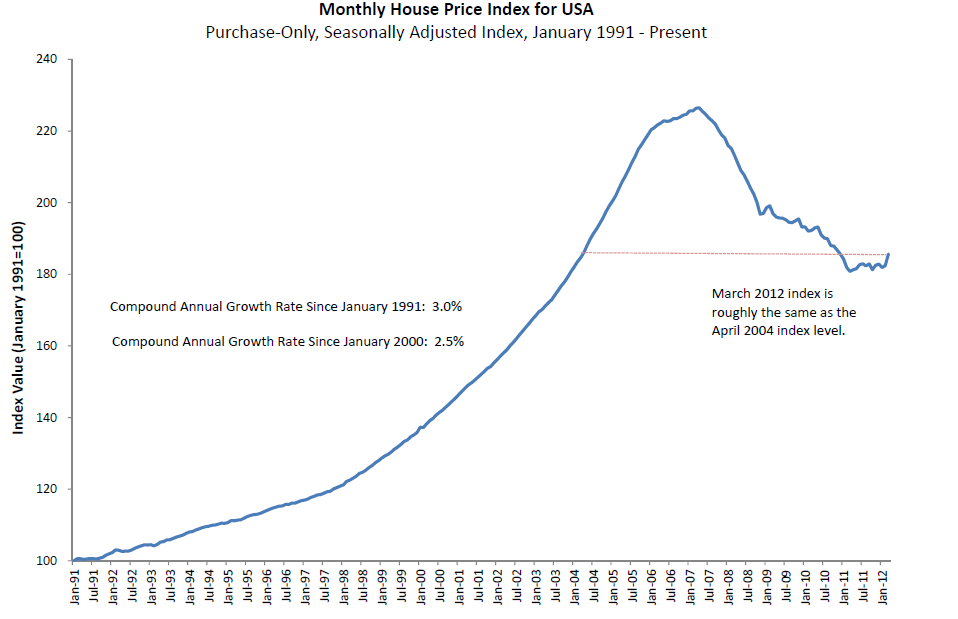
In other news, the NAR has declared the housing recovery to be underway. The MBA reported that mortgage applications increased 3.8% last week. New home sales in April were 343k, an increase of 3.3% MOM. The FHFA House Price index showed an increase of .55% QOQ and .5% YOY.  This is the first increase since early 2007.  Remember the FHFA index only looks at conforming loans, which is more of the “core” housing market.  It has proven to be a much less volatile index than Case-Schiller or RPX. 

Chart:  FHFA House Price Index:


Morning Report 5/22/12

Vital Statistics:

  Last Change Percent
S&P Futures  1319.1 3.4 0.26%
Eurostoxx Index 2181.4 31.3 1.45%
Oil (WTI) 92.34 -0.2 -0.25%
LIBOR 0.467 0.000 0.00%
US Dollar Index (DXY) 81.2 0.119 0.15%
10 Year Govt Bond Yield 1.78% 0.04%  
RPX Composite Real Estate Index 175.7 0.1  

Markets are generally firmer this morning on hopes of further stimulus out of China and Europe. Euro sovereign yields are lower. US bond futures are down a point and MBS are down slightly.  MBS underperformed bonds in the rally, so they should outperform as bonds retrace.

Richmond Fed came in below expectations. This survey looks at the service sector for Richmond, Baltimore and Charlotte. Revenues actually contracted in May. They note that service providers expect stronger customer demand over the next six months, while retailers do not. 

Existing Home Sales came in at 4.62MM annualized.  5.5 million is about “average.”  The number is up 10% YOY. The lack of distressed sales and the seasonal move towards bigger houses increased the median price 10% from 161,100 to 177,400. Overall, it notes that the headwinds in the real estate sector are abating.

Yesterday we had a number of sizeable mergers, with Eaton buying Cooper Industries for 12.8 billion, DaVita buying Healthcare Partners for 4.5B and Wanda Group buying AMC. Generally speaking, mergers are a good sign for the markets and the economy in general.

Andrew Ross Sorkin has a good column on why Glass Steagall wouldn’t have prevented the crisis. The Glass-Steagall issue has become a facile explanation of what went wrong. Elizabeth Warren even acknowledges this – one of the reasons she has been pushing reinstating GS – even if it wouldn’t have prevented the financial crisis – is that it is an easy issue for the public to understand and “you can build public attention behind.”  And there you have it. Never mind that nobody else in the world (the UK, Europe, Japan, Canada) separates commercial and investment banking, or even draws a distinction between the two. 

What was the rationale behind Glass-Steagall in the first place?  Poorly underwritten deals (for example, Facebook).  Facebook was the quintessential poorly underwritten deal.  An underwritten deal means that the investment banks (primarily Morgan Stanley) actually write a check to the company and buy 421MM shares at 38. It then places those shares with institutional investors.  If the deal is handled well, Morgan Stanley sells all the stock, collects its fee and moves on. This deal did not go well, obviously. Institutional investors sold into the market and FB was in danger of breaking price. Morgan Stanley stood in the market and bought everything that the market was willing to sell at the offer price. (If an IPO breaks price on the first day, that is a MAJOR embarrassment to the investment bank). So Morgan Stanley is now lugging millions of Facebook shares that it bought in the market at 38. The stock is trading at 32.65. Huge loss. Pre-Glass Steagall, what would they do?  Sell the stock to their captive commercial bank at 38. (Hey, we bumped up your allocation to 5 million shares)  Institutional investors will pull their money out quickly if they sense an investment bank is in trouble.  Depositors at a sleepy commercial bank?  Not so much.  Note:  This was done more with bond issues than stock issues, but the rationale remains the same. In the Great Depression, commercial banks were failing and it turned out their assets were not home mortgages or commercial loans – they were all the lousy deals their sister investment bank couldn’t unload. That is why we had Glass-Steagall – to prevent commercial banks from being repositories for losing positions. 

Fast forward to the financial crisis – commercial banks weren’t failing because they bought CDO-squared issues from their investment banking divisions. Or because Citi was stuffing its retail bank with LBO paper it couldn’t unload. The reason we had a financial crisis is because we had a residential real estate bubble.  Every bank in the US is exposed to residential real estate in some way, shape, or form. And it didn’t matter whether you were exposed to residential real estate through a mortgage backed security or through holding whole loans on your balance sheet.  The small community banks who wouldn’t know a CDO from a codfish blew up just the same as the big integrated banks 

Probably the single best thing regulators could do to prevent a re-occurrence would be to deal with the cascading counterparty risk from OTC derivatives. They should demand that OTC derivatives become standardized and exchange-traded with a central clearing party, position limits, and open interest disclosure. That would have prevented AIG from taking the positions it did and exposing all of its counterparties when it failed.

Morning Report 5/21/12

Vital Statistics:


Last

Change

Percent

S&P Futures 

1296.5

5.7

0.44%

Eurostoxx Index

2146.8

2.1

0.10%

Oil (WTI)

91.62

0.1

0.15%

LIBOR

0.467

0.000

0.00%

US Dollar Index (DXY)

81.26

-0.036

-0.04%

10 Year Govt Bond Yield

1.73%

0.01%


RPX Composite Real Estate Index

175.6

0.0


Markets are generally firmer this morning on comments from Chinese Premier Wen Jiabao supporting further measures to boost the economy. Euro sovereign sovereign spreads are a touch wider. Bonds and MBS are down.

The Chicago Fed National Activity Index rose .11 in April after falling .44 in March. This basically means that the economy is growing at its historical trend. Anything between -.7 and +.7 is considered on trend. Production was a positive factor, while consumption was negative. Employment was neutral.

Is the Fed more optimistic about future growth than Wall Street?  It appears to be the case. The average Wall Street growth forecast for 2012 is 2.3%, while the Fed is forecasting 2.4% – 2.9% growth. One explanation is that the Fed underestimates how much the credit-multiplier breaks down in the aftermath of asset bubbles. Meanwhile, the TIPS market is trimming its inflation forecast and giving Ben Bernake the room to maneuver.

Facebook has broken the IPO price in the pre-open and is trading at 36.51.  5.6 million shares have traded. Bob Griefeld, CEO of NASDAQ, blamed software glitches for the problems with trading FB on Friday where customer sell orders were delayed on the open.

Morning Report 5/18/12

Vital Statistics:


Last

Change

Percent

S&P Futures 

1307.5

6.2

0.48%

Eurostoxx Index

2155.6

8.7

0.40%

Oil (WTI)

92.68

0.1

0.13%

LIBOR

0.467

0.000

0.00%

US Dollar Index (DXY)

81.38

-0.004

0.00%

10 Year Govt Bond Yield

1.72%

0.02%


RPX Composite Real Estate Index

175.6

0.1


Markets are firmer this morning after enduring a bloody week which sent the S&P down 3.6% and the 10 year government bond yield down to 1.69%. Today is also the expiration of May options, so there is always the potential for funny closing prints. There is no economic data being released this morning.  Bonds and MBS are down slightly.

It’s Facebook Day! Facebook priced at the top end of the revised range last night and should begin trading around 11:00. There are a stocks that capture the attention of the populace and Facebook is one of them. Growth fund managers who have been starving for a good growth story besides Chipotle Mexican Grill and Lululemon just got a new one. With an IPO price at 28x revenue, the stock will have to almost collapse to get value and GARP guys interested. I’m sure if you are a good technical trader, you should be able to have a field day with this one. Treat it as a slip of paper with an alphanumeric code, not an investment, cause it isn’t.

Bloomberg has a column on why principal reductions won’t solve the housing crisis. The big problem is that something like 80% of all underwater homeowners with Fan and Fred mortgages are current on their mortgages. Any principal reduction program will encourage people to stop paying their mortgage. Second, of those seriously delinquent, most of them won’t be able to afford the lower payment anyway.

The National Association of Home Builders and Wells Fargo have constructed a housing affordability index, which is a measure of the percent of homes affordable by someone at the median income. The latest index is 77.5, which means 77.5 percent of all new and existing homes sold in Q1 were affordable for families earning the national median income. In a lot of ways, this chart is the inverse of my median house price to median income chart.

Chart: NAHB / Wells Fargo Housing Affordability Index:


Morning Report 5/17/12

Vital Statistics:


Last

Change

Percent

S&P Futures 

1319.6

-2.8

-0.21%

Eurostoxx Index

2140.4

-35.0

-1.61%

Oil (WTI)

93.04

0.2

0.25%

LIBOR

0.467

0.000

0.00%

US Dollar Index (DXY)

81.59

0.218

0.27%

10 Year Govt Bond Yield

1.76%

0.00%


RPX Composite Real Estate Index

175.6

0.1


Markets are lower this morning on a report in the Spanish press that Moody’s will downgrade the Spanish banks today and the continuing stand-off between the ECB and the Greek banks. The Spanish IBEX stock exchange is down 24% for the year and is at 9 year lows. Despite the headlines, Euro sovereign yields are flat / lower.

Initial Jobless claims came it at 370k, in line with expectations and we have good earnings from Wal-Mart and Sears. Later today, we will get Philly Fed. Bonds and MBS are up slightly.

Facebook prices tonight and should start trading tomorrow. Barry Ritholtz weighs in. David Einhorn took aim at AMZN at the Ira Sohn conference. His comments could have come from a Alan Abelson column in 1999. I expect to hear a lot of the same “you don’t get it” arguments on FB that we heard on AMZN back then.

The minutes of the April FOMC meeting were released yesterday afternoon. They note the possibility of “taxmageddon” – the expiration of the Bush tax cuts – as a sizeable risk to the economy. While they note the size of the shadow inventory and tight lending standards, they believe real estate prices have stabilized. Overall, there seem to be no major changes in this statement – the Fed remains open to QEIII should economic conditions warrant. 

Ellie Mae released their latest Origination Insight Report. Ellie Mae provides loan processing software and handles about 20% of US mortgage loan origination. Typical profile of a denied loan?  702 FICO / 87 LTV / DTI 28/43.  Talk about a tight mortgage market. 

The problem with having a London Whale is that you have thousands of Ahabs shooting harpoons at you once you disclose you are in trouble with an oversized position. Dealbook is estimating that JP Morgan’s trading losses have increased from $2 billion to $3 billion in the last 4 days as every wise-guy hedge fund manager that missed the initial trade puts it on.

Morning Report 5/16/12

Vital Statistics:


  Last Change Percent
S&P Futures  1334.7 6.5 0.49%
Eurostoxx Index 2186.7 8.0 0.37%
Oil (WTI) 92.98 -1.0 -1.06%
LIBOR 0.467 0.001 0.21%
US Dollar Index (DXY) 81.31 0.086 0.11%
10 Year Govt Bond Yield 1.80% 0.03%  
RPX Composite Real Estate Index 175.5 0.4  

S&P futures are firming this morning after hitting lows of 1321 overnight. Good earnings reports from Target and Deere seem to be overshadowing the bank run going on in Greece. Greek, Irish and Portuguese yields are higher this morning. US Treasuries are down half a point while MBS are flat. Everyone is waiting for the minutes of the last FOMC meeting which will be released this afternoon. 

Industrial Production increased 1.1% in April, a reasonably strong reading. Capacity Utilization ticked up to 79.2%, but the Fed revised down everything for the past year.

The recent drop in rates is triggering refi activity, as evidenced by a 9.2% jump in mortgage applications last week.

April Housing Starts came in at a 717k annualized rate, better than expectations, but still horribly depressed. To put that number in perspective, the in the 74-75 recession, starts bottomed at 904k.  In the 81-82 recession, they bottomed at 837k. In the 91-92 recession, they bottomed at 798k.  These bottoms were V-shaped and typically lasted 6 months or so before returning to normalcy of around 1500.  When was the last time we saw a 800k print?  September of 2008 – almost 4 years ago. Housing historically leads the economy out of a recession, and its absence has been a big part of why this recovery has been so anemic.

Is the summer of 2012 going to be a replay of the summer of 2011?  Certainly the pieces are being put in place – Europe’s sovereign debt crisis is again in the forefront, the economy is decelerating after a good Q4 / Q1, and the old saw “Sell in May and go away” was good advice again. We even have the prospect of major tax increases Jan 1 as the Bush tax cuts expire. The only thing we are missing is a debt ceiling fight. Oh, wait…

The Florida Supreme Court is hearing an foreclosure case that asks an interesting question – can the banks who filed foreclosures based on robo-signed documents voluntarily dismiss these cases and re-file them with better documents?

The good market reception to the Facebook IPO means that sellers are increasing the amount for sale. Existing holders like Goldman, Tiger, and Accel are blowing out of 241MM shares, much more than they originally planned.  Surprisingly, and perhaps no coincidentally,  GM has dropped paid advertising with Facebook because they “weren’t effective enough”. Apparently “likes” doesn’t necessarily translate into sales or dealer inquiries.