Morning Report

Vital Statistics:


Last

Change

Percent

S&P Futures

1395.1

-5.3

-0.38%

Eurostoxx Index

2289.35

-17.3

-0.76%

Oil (WTI)

105.05

-1.1

-1.04%

LIBOR

0.466

0.000

0.00%

US Dollar Index (DXY)

79.17

-.349

0.44%

10 Year Govt Bond Yield

1.92%

-0.02%


RPX Composite Real Estate  Index

173

-0.4


Apologies for the late report.  I am working in the San Diego office this morning and have been having technology issues.


Markets are generally weaker this morning on the back of weak unemployment numbers in Germany and a disappointing ADP report. Factory Orders were down 1.5%, a post-crisis low, and are showing a definite downward trend. Bonds and mortgage backed securities were stronger.


The New York ISM report showed that business conditions remain strong in the New York City area, although they slowed slightly from the March pace. The April index came in at 61.2 vs 67 in March. An ISM number above 50 indicates expansion, while below indicates contraction.


Beazer Homes reported a disappointing first quarter loss. That said, Beazer did report a marked improvement from Q111.  New orders were up 29%, closings were up 49%, backlog was up 39%, and average price was up 4%. They remain “hopeful, but cautious” about the prospects of a sustained market recovery. Beazer is concentrated in the South and Southeast.


The Treasury is considering issuing floating rate notes. Part of the rationale is that it would decrease borrowing costs today, plus it would help insulate the government from funding hiccups if it has to roll over a lot of debt at once. Still, it seems strange for the government to consider floaters with interest rates so low. It is akin to taking out an ARM to save a handful of basis points on your mortgage payment.

Morning Report

Vital Statistics:

  Last Change Percent
S&P Futures  1394.8 -3.7 -0.26%
Eurostoxx Index 2318.5 -25.6 -1.09%
Oil (WTI) 104.2 -0.8 -0.71%
LIBOR 0.466 0.000 0.00%
US Dollar Index (DXY) 78.91 0.199 0.25%
10 Year Govt Bond Yield 1.91% -0.02%  
RPX Composite Real Estate Index 173 -0.4  


World equity markets are down slightly this morning as Spain officially entered a recession, although the GDP report was better than expected. Merger Monday is back, with a deal in the energy space (Sunoco) and the healthcare space (Gen-Probe). Bonds and MBS are up small.


Personal income came in at +.4%, and personal consumption came in at +.3%.  The Personal Consumption Expenditure (PCE) indices indicate inflation is well under control. The National Association of Purchasing Managers – Milwaukee showed business conditions are improving slightly overall for companies in the Northern Midwest. 


No, they didn’t just do a reverse split. Barnes and Noble has doubled this morning on a strategic deal with Microsoft. The new company (NewCo – clever name) will involve the digital and College businesses of B&N and involve a Nook application for Windows 8. This looks like the culmination of B&N’s strategic alternative review announced earlier this year.


Tomorrow (May 1) is New Year’s Eve for the Left. Expect disruptions in the City and overseas.


No M.R. tomorrow as I will be traveling. Wed and Thurs MRs will be late.

Morning Report

Vital Statistics:


  Last Change Percent
S&P Futures  1397.6 0.8 0.06%
Eurostoxx Index 2339.0 16.3 0.70%
Oil (WTI) 104.3 -0.2 -0.20%
LIBOR 0.466 0.000 0.00%
US Dollar Index (DXY) 78.87 -0.046 -0.06%
10 Year Govt Bond Yield 1.92% -0.02%  
RPX Composite Real Estate Index 173.4 0.1  


Markets are generally flat this morning after the release of Q1 GDP, which came in light. The economy expanded at a 2.2% annual rate in Q1 vs expectations of 2.5% and lower than the 3% number in Q4. This more or less confirms the slowdown we have been seeing in other data as well. Yesterday, initial jobless claims came in at 388k.


Yesterday, the National Association of Realtors released their March Pending Home Sales Index, which is a forward-looking index of housing activity based on contract signings. The first quarter’s activity was the highest in five years. Supply and demand are becoming more balanced.  It will be interesting to see whether the banks start letting more REO go to meet the increased demand of if they continue to drip out inventory gradually.


Bill Gross continues to bet that Operation Twist continues as a mortgage play. Further, he believes that QEIII is a possibility, especially if the employment numbers weaken. Interestingly, he is also looking at this trade as a volatility bet – if you are long mortgages, you are short bond volatility – and is betting that the 10 year has more or less found its level for the next couple of years. 


A pet peeve of mine is this whole idea that the repeal of Glass-Steagall somehow caused the financial crisis. It turns out that Tim Geithner agrees with me that GS didn’t play a material role. No other country in the world (EU, Japan, UK, Canada) separates commercial and investment banking, or even draws a distinction between the two for that matter. Glass-Steagall was instituted because investment banks were stuffing their sister commercial banks with poorly underwritten bonds after the market crashed in 1929. If the investment bank couldn’t sell the paper to public at par (or close to it), they sold it to their captive banks who bought it at par and marked it there until bank runs exposed the fact that these bonds were worthless. The investment banks did the same thing with the insurance companies, which is why insurance companies were included. The point of G-S was to prevent this sort of thing and to ensure that these transactions would be arm’s length.


The financial crisis didn’t occur because JP Morgan was selling suspect bonds to Chase at the end of a gun barrel. Or Citi selling worthless paper to Travelers for that matter. The cause of the financial crisis was a deflating real estate bubble, which hit banks with large derivatives exposure (Bank of America and Citi) as well as small community banks that were in the very ordinary business of making mortgages, car loans, and business loans. It turns out that the smaller banks are the ones who can’t repay TARPIf we didn’t have a real estate bubble, we wouldn’t be having this conversation.Why did we have a real estate bubble?  There were a lot of contributing factors, but the biggest was the Fed and a psychological belief on the part of the public that real estate was a one-way bet.


People forget the reason why we repealed Glass-Steagall in the first place. The main reason was that the big international investment banks like UBS and Deutsche Bank were able to undercut the US investment banks because they were able to borrow at zero, while Goldman and Merrill had to fund their balance sheets at LIBOR. “Wall Street” was turning into Nomura, Barclay’s, Credit Suisse, and ING. Second, there were a couple of commercial banks who had become hybrids – JP Morgan and Bankers Trust – with Citi and Bank of America close behind. Glass-Steagall was becoming irrelevant anyway and the repeal was more or less an acknowledgment what had already happened.

Morning Report

Vital Statistics:

  Last Change Percent
S&P Futures  1378.8 8.7 0.63%
Eurostoxx Index 2319.8 35.8 1.57%
Oil (WTI) 104.4 0.8 0.77%
LIBOR 0.466 0.000 0.00%
US Dollar Index (DXY) 79.16 -0.068 -0.09%
10 Year Govt Bond Yield 1.99% 0.01%  
RPX Composite Real Estate Index 173.5 -0.3  


Markets are higher this morning on Apple’s earnings. Hard to believe a half-a-trillion dollar company could move up 10% in a day, but there you go. Bonds and MBS are lower as we await the FOMC decision this afternoon. No one anticipates a change in policy, but the market will focus on clues about QEIII. 


Speaking of the Fed, Krugman has some advice for Ben Bernake. Hint:  He’s not doing enough.


Durable Goods orders fell 4.2% YOY in March, the biggest drop in 3 years. Ex transportation, they fell 1.1%. This was far below expectations. There was also a marked buildup in inventories in the last 6 months, which portends a manufacturing slowdown. There has been nothing in the economic data in the last couple of months that indicates the economy is accelerating – everything points to a deceleration. This is mainly due to overseas weakness. The UK is officially in recession, while Europe and China are slowing.


Mortgage applications fell last week after a huge jump the week before. The 10-year spent all of last week below 2%, so maybe the refi activity is starting to dry up – meaning everyone who can refi at 3.75% has already done so.


Lender Processing Services has released its first look for March foreclosures and delinquencies. The total US loan delinquency rate is just over 7%, which is down almost 9% YOY. The number of properties in foreclosure totaled 2.06MM, the number 90D+ was 1.6MM and 30D+ was 3.5MM, for a total of 5.6MM delinquent. The full report will be released on May 1.


FWIW, Mark Zandi thinks the bottom in real estate is in. Bob Schiller isn’t so sure.

Morning Report

Vital Statistics:


Last

Change

Percent

S&P Futures 

1366.0

3.3

0.24%

Eurostoxx Index

2262.5

17.6

0.79%

Oil (WTI)

103.5

0.4

0.36%

LIBOR

0.466

0.000

0.04%

US Dollar Index (DXY)

79.32

-0.104

-0.13%

10 Year Govt Bond Yield

1.95%

0.02%


RPX Composite Real Estate Index

173.8

0.4


World equity markets are recovering slightly after yesterday’s sell-off on the back of a couple of good bond sales out of Spain and the Netherlands. The Netherlands is another potential worry spot, as Prime Minister Rutte’s ruling coalition collapsed over austerity disagreements. Bonds and MBS are down slightly.


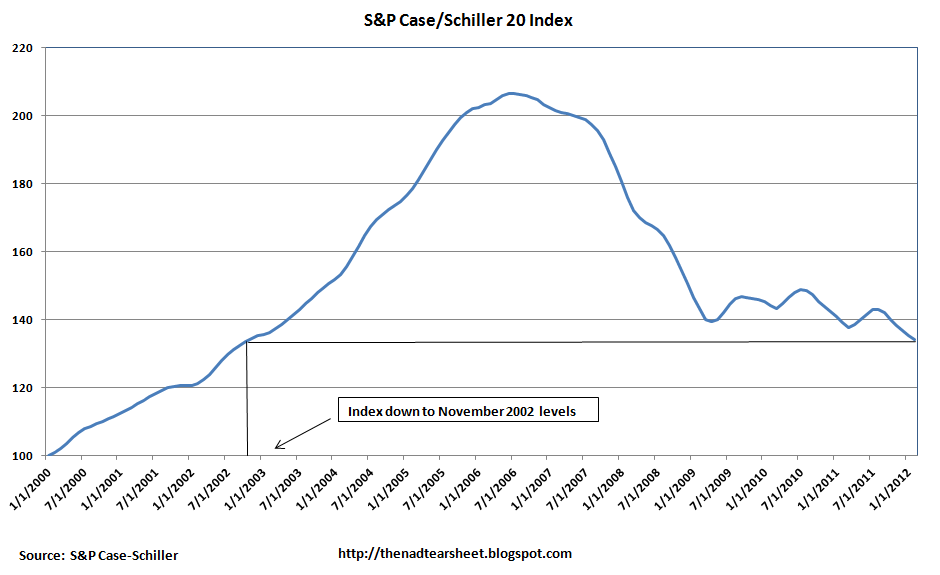
The S&P / Case-Schiller index fell to new post-bubble lows, with the index dropping 3.5% YOY. Five of the 20 MSAs showed increases – Detroit, Denver, Miami, Minneapolis, and Phoenix. Remember, Case-Schiller is a very lagged index, as the number reflects the market in December ’11 – February ’12. We are seeing the correlation between different MSAs break down, which should be good news for the homebuilders. Overall punch line of the report: Prices are still falling, albeit at a slower rate.


Shelia Bair warns of a bond bubble in the US. She raises an interesting question – Are we Europe?  Or Japan? She thinks we are Europe. I think we are Japan, personally.


United Technologies, 3M, and AT&T all reported better than expected earnings. Former highflyer Netflix is down 15% on future growth worries despite a better than expected quarter. Apple reports after the close.


Lawrence Yun of the National Association of Realtors weighs in on the future of Fan and Fred. Punch line:  Privatizing Fan and Fred in the 1970s created an untenable situation, where management took risks to maximize shareholder return with an implicit government backstop. This was an untenable situation, and almost guaranteed to end badly. It did. The question is what to do now. If you fully privatize Fan and Fred, you can expect volatility in mortgage rates and occasional market freezes. Say goodbye to the low-cost 30 year fixed rate mortgage, a uniquely American product that we almost consider our birthright. Pre-privatization, Fan and Fred performed a boring job very well. Perhaps it is time to make it official and fully nationalize them.


Chart:  S&P / Case-Schiller 20-city index:


Morning Report

Vital Statistics:

Last Change Percent
S&P Futures 1360.7 -14.5 -1.05%
Eurostoxx Index 2254.9 -56.4 -2.44%
Oil (WTI) 102.8 -1.1 -1.07%
LIBOR 0.466 0.000 0.00%
US Dollar Index (DXY) 79.52 0.321 0.41%
10 Year Govt Bond Yield 1.92% -0.04%
RPX Composite Real Estate Index 173.4 0.5

Kind of a soggy tape this morning to go along with our soggy weekend in the Northeast. Political woes in Europe seem to be the main culprit. A split in the Netherlands over austerity measures is causing Dutch credit default swaps to richen. Purchasing Manager Indices in France, Germany, and the Netherlands all came in below expectations. While there have been some worries over Spanish banks, EURIBOR / OIS (a measure of stress in the banking system) is still falling after peaking in early December. So at least one indicator is telling us these fears are overblown.

In the US, stock index futures are down about a percent and bonds are stronger. Bonds have had a remarkable turnaround in the last month, as the 10-year bond futures broke down and fell out of their range in mid-March, only to rally again on euro fears. The contract is now challenging resistance at 144. Incredible turnaround. MBS are up small.

In US earnings, Chevron and Kellogg both disappointed. So far, earnings have been strong overall. Homebuilder DR Horton reported better than expected sales, the question will be whether this was weather-related.

Merger Monday is back, with a couple big deals in the pharma space and a couple of old British titans – Vodafone and Cable and Wireless – are partying like it is 1999.

Speaking of Prince’s apocalyptic party song, a venerable investment bank from that era is re-launching. Smith Barney manager Frank Campanale is bringing back E.F. Hutton. Given that E.F. Hutton is a recognizable name and was not involved in the financial crisis, it makes some sense to resurrect it. One possible way to break up the big banks would be to have them spin out their non-commercial banking units – Citi could spin Smith Barney and Travelers, Chase and JP Morgan could split again, and you would basically re-establish the money center bank. Maybe the foreign banks could get involved, with Credit Suisse spinning out First Boston and DLJ, UBS spinning out PaineWebber, and Deutsche Bank spinning Bankers Trust.

Morning Report

Vital Statistics:
 
  Last Change Percent
S&P Futures 1374.5 -3.8 -0.28%
Eurostoxx Index 2312.0 -15.8 -0.68%
Oil (WTI) 102.1 -0.6 -0.58%
LIBOR 0.466 0.000 0.00%
US Dollar Index (DXY) 79.54 -0.002 0.00%
10 Year Govt Bond Yield 1.95% -0.03%  
RPX Composite Real Estate Index 172.8 0.6  
 
Markets are flattish after a successful Spanish bond auction and generally good earnings reports from a slew of companies. Bank of America and Ebay were standounts. Spanish bond yields are starting to increase and the Spanish equity market (The IBEX) is under pressure. US Treasuries and MBS are flat to up.
 
US Leading economic indicators fell. The Philly Fed Business Outlook Survey noted regional manufacturing activity expanded modestly in April, but fell slightly from the previous month. Both indicators seem to imply the economy is still expanding, but not as rapidly as a few months ago. Existing home sales fell to 4.48 million.
 
The press is pointing out the strong demand for the Spanish bond auction. As Bill Gross mentioned, banks are buying all of the excess supply in the Spanish bond auctions, which he views as artificial demand. The interesting question is that sovereign bonds are treated as riskless assets for bank capital requirements. If it turns out they are not riskless… Investors are noticing, and bidding up credit default swaps for Spanish banks.
 
Initial Jobless claims came in at 386k, ahead of the 370k expected. Last week was revised upwards. Interestingly, when I re-ran the data series, the government had revised virtually every week up from the beginning of the year. Not sure what is going on there..
 
A University of Chicago economist gives a theoretical explanation why principal reductions are better for borrowers than interest rate mods which merely lower the payment. In effect, mods which target a percent of income (usually 31%) end up penalizing workers as they earn more – in effect they can be hit (in theory) with a 100%+ marginal tax rate. Not sure I buy the idea that this is influencing behavior, but it is an interesting take on payment vs principal mods.
 
The National Association of Home Builders weighs in on tax policy, urging Congress to increase certainty (read: extend the Bush tax cuts) into the tax code. As the economy slows, Washington will come under increasing pressure to push the 2013 tax hikes further into the future.
 
Do the government’s inflation numbers seem to not jibe with your actual bills? One explanation is the change in methodology over the years. Someone went to the trouble of recalculating inflation using the older methodology, and unsurprisingly, it is higher. The government disagrees.
 
 
Chart: Initial Jobless Claims:
 

Morning Report

Vital Statistics:

Last Change Percent
S&P Futures 1381.5 -2.1 -0.15%
Eurostoxx Index 2331.1 -35.9 -1.52%
Oil (WTI) 104.3 0.1 0.06%
LIBOR 0.466 0.000 0.00%
US Dollar Index (DXY) 79.78 0.307 0.39%
10 Year Govt Bond Yield 1.99% -0.01%
RPX Composite Real Estate Index 172.2 -0.2
Equity markets are slightly weaker this morning on a disappointing earnings report from Intel. IBM and Yahoo also reported last night.  Abbott Labs and Halliburton beat estimates this morning. Spanish bond yields are lower. Bonds and MBS are slightly higher. No economic data this morning.
Part of the reason for the strong market rally yesterday was a strong Spanish bond auction. Many have noted that the Spanish banks have been large buyers of Spanish government debt. Bill Gross called the market “artificially controlled” on CNBC, and he doesn’t trust it. Bloombergnotes the bad debt exposure for Spanish banks, and the possibility for the government to take on contingent liabilities. Spain has the 12th largest GDP in the world (Greece is something like 35th), so don’t think a crisis would be a repeat of last fall.
Housing advocates are worried that a President Romney will take aim at HUD. Of course HUD could remain as the alphabet soup of government housing agencies get re-organized. For all intents and purposes, the US mortgage market is nationalized, and while the GSEs may go away in name, their function will be handled by some other entity. It would take roughly 500 billion to fully capitalize the GSEs and that kind of money can’t be raised in the private sector.
US Bancorp is noting that demand for credit is increasing. CEO Richard Davis told CNBC yesterday that mortgage demand was the highest in the bank’s history. The Minneapolis-based bank had reported better than expected numbers earlier that morning. So, this is one positive data point to throw in the mix of negative ones we have been seeing lately.
Ever done a quick fix on your home with the intention of doing a full repair later, but never got around to it? Here are some good ones (note the uses of hockey pucks)

Morning Report

Vital Statistics:

Last Change Percent
S&P Futures 1370.2 6.3 0.46%
Eurostoxx Index 2334.3 33.1 1.44%
Oil (WTI) 103.8 0.9 0.85%
LIBOR 0.466 0.000 0.00%
US Dollar Index (DXY) 79.54 -0.018 -0.02%
10 Year Govt Bond Yield 1.99% 0.01%
RPX Composite Real Estate Index 172.3 0.3
Markets are higher this morning on a better than expected German investor confidence data and a decline in Spanish bond yields. Bonds and MBS are lower. After falling out its narrow 140 -144 trading range, June 10 year bond futures are back in it again, driving mortgage rates back to February levels.
Johnny John reported better than expected numbers, as did Goldman, who also bumped up their dividend. Ex-highflyer First Solar is cutting 30% of its workforce.
Housing starts missed estimates by a wide margin, falling sharply from 694k in February to 654k in March. Remember, 1.5 million is more or less “normalcy,” and having starts heading downwards for two months in a row this late in an expansion is not a good sign. Optimists will point to the unexpected increase in permits. Nevertheless, forward-looking economic indicators are starting to turn down, indicating the economy is slowing. Remember, the Bush tax cuts expire Jan 1, and that will provide a large fiscal drag. Business (and the markets) are going to start handicapping the possibility of an early 2013 recession, which should mean a slowing economy this summer and into the fall.
Industrial Production was flat in March, vs a .3% increase.  Capacity utilization ticked up .1% to 78.6%, still below the historic 80% average. This shows there is still a lot of slack in the economy, which bodes well for the inflation numbers.
The rental market continues to outshine the purchase market, according to Zillow. The rent index increased 2% YOY in February, while the Zillow home value index dropped 4.5%. The huge backlog of foreclosures remains a wet blanket on the home value index, while ex-homeowners are driving rental prices higher. Localities like Chicago and Philadelphia showed huge divergences.
As if Spain didn’t have enough headaches, Argentina is expropriating Repsol’s 51% stake in YPF. Latin America has been one of the bright spots for Spanish banks, so if money starts fleeing the area, it will put further pressure on the Spanish economy. Granted, Brazil and commodity prices are going to be the main factor, but forced nationalization tends to make emerging markets investors nervous.
Are you trading gasoline futures?  If so, the Obama administration is taking aim at you. Worried that high prices at the pump may endanger his re-election campaign, the administration has announced a series of measures aimed at reducing speculation in the gasoline futures market. The most significant measure would allow the CFTC to increase margin requirements (never mind that the exchanges can do this already..)

Morning Report

Vital Statistics:

Last Change Percent
S&P Futures 1369.5 4.5 0.33%
Eurostoxx Index 2298.9 7.3 0.32%
Oil (WTI) 102.7 -0.1 -0.12%
LIBOR 0.466 -0.001 -0.11%
US Dollar Index (DXY) 80.09 0.206 0.26%
10 Year Govt Bond Yield 1.98% -0.01%
RPX Composite Real Estate Index 172 0.8
Equity futures are rising this morning on better than expected retail sales data. Citi missed earnings estimates and traded down a couple of bucks early, but has recovered as people digest the internals of the earnings report.
Empire Manufacturing came in lower than expected on weakness in China and Europe. While still positive, the pace of expansion has slowed. The forward-looking indicators continue to weaken, which is something to keep an eye on.
Spanish credit default swaps continue to increase in price, and have passed their high from last November during the Greek crisis. 10 year CDS for Spain are trading at 476 basis points. Spain’s GDP is the 12th largest in the world, so any default there will not be as tame as Greece. Their banks are much more household names – Banco Santander has the same market cap as Goldman. Paul Krugman is nonplussed.
11 state AGs sent a letter to Acting FHFA Ed DeMarco urging him to allow principal reductions on Fannie and Fred loans.
Earnings season gets in full swing this week.