Posted on December 8, 2014 by Brent Nyitray
Markets are lower this morning on no real news. Bonds and MBS are up.
The week after the jobs report is typically data-light, and this week is no exception. The highlights from a bond market perspective will probably be the JOLTS job openings on Tuesday and retail sales on Thursday. We will also hear from luxury home builder Toll Brothers on Wed morning.
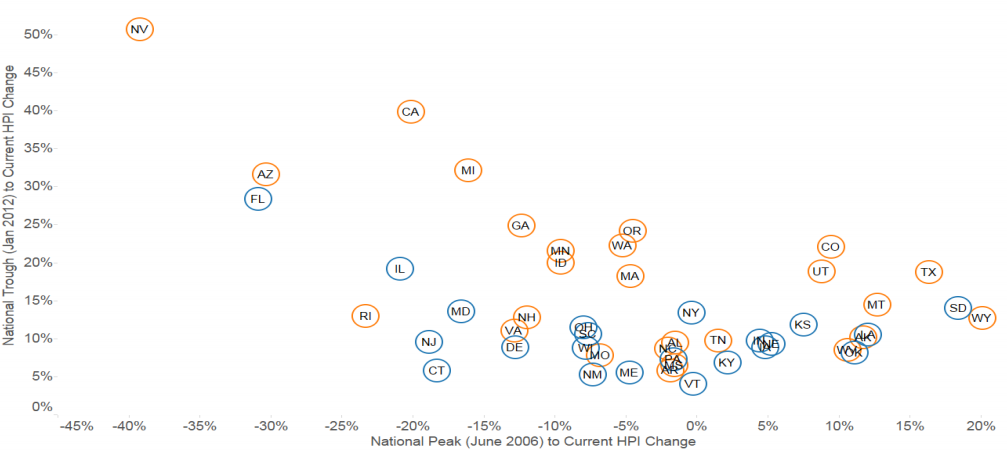
The latest Black Knight Mortgage Monitor is out. Foreclosure starts dropped by 10.5% to 81,400 and the foreclosure inventory dropped to 3.6MM homes, which is down 18% year-over-year. They have a cool chart that illustrates the difference between the judicial and non-judicial states in terms of home price appreciation, both in terms of decline and rebound. You can see how the judicial states have experienced much lower rebounds off the bottom than the non-judicial states. It would be interesting to see compare the peak to trough price declines of judicial vs. non-judicial states. I suspect we would find that having tougher foreclosure requirements did not help support house prices.

S&P lowered the ratings on Italy’s sovereign debt to BBB- from BBB, which is one level above junk status. Yet, Italian sovereigns are trading at 1.97%, 33 basis points lower than AA+ rated US Treasuries. This is all about the ECB and QE, but it shows again that all of this central bank manipulation of global sovereign bond markets has created some major dislocations. Of the 5 PIIGS, only Portugal and Greece have higher yields than the US 10-year. Strange times.
There were no changes in the federal limits on conforming loans for 2015.
San Francisco is looking at using eminent domain to steal from bondholders help people in who are in foreclosure keep their homes. The city is also trying to issue about $400 million in GO munis, and something like this cannot help.
Filed under: Morning Report | 22 Comments »
Posted on December 5, 2014 by Brent Nyitray
Markets are higher after a good jobs report. Bonds and MBS are getting slammed.
A not-too-shabby jobs report today. Payrolls increased by 321k, much better than the 230k estimate and the 208k ADP number. The two month revision was +44k. The unemployment rate held steady at 5.8% as did the labor force participation rate at 62.8%. We had a nice month-over-month increase in wages: up 0.4%, however on an annual basis, it was steady at 2.1%.
One strange anomaly: the household survey and the establishment survey differed in a big way – the household survey (which is conducted by sending questionnaires to individual houses) showed no employment growth, while the establishment survey (which is conducted by sending questionnaires to businesses) showed strong payroll growth. The market is clearly choosing to focus on the establishment data.
We could finally be hitting the point where the lagging employment indicators are catching up with the leading indicators. Recoveries after asset bubbles tend to be bathtub-shaped. We could finally be at the inflection point. Lower energy prices are going to be a big help as well.
Of course lower energy prices are not great for everyone – especially those companies in the energy patch. The big new distressed trade is energy debt as many over-leveraged and now cannot borrow. Shades of the mid / late 1980s.
It is an old cliche that all real estate is local. When I talk to people in San Diego, they describe a completely different housing market than the one I see up here in the Northeast. Interestingly, on the way to work today, I saw the first single family home being built since probably 2007. So maybe the Northeast is getting better at long last..
Filed under: Morning Report | 52 Comments »
Posted on December 4, 2014 by Brent Nyitray
Markets are lower as ECB President Mario Draghi addresses further action the ECB might take to boost growth. Bonds and MBS are flat.
It looks like Mario Draghi is kicking the QE can down the road a little more, and will address further stimulus measures in the first quarter. The Euro is rallying.
Initial Jobless Claims came in at 297k during the holiday shortened week. Announced job cuts fell 21% in November, according to outplacement firm Challenger, Gray and Christmas.
The ISM Non-Manufacturing Index rose to 59.9% in November as business activity and new orders surged. The employment index decreased however.
Completed Foreclosures fell to 41,000 in October, according to CoreLogic. This is a 26.4% decline from a year ago, and a 34% drop from September. The 12 month sum of foreclosures is at its lowest point since October 2000. Approximately 605,000 homes are in some stage of foreclosure compared to 875,000 a year ago. This represents about 1.6% of all homes with a mortgage. Unsurprisingly, the judicial states contain the highest inventory, with New Jersey at 5.5%, and New York and Florida at 4.1%.
The latest Beige Book shows that conditions improved overall during the months of October and November. The only disappointing news was that wage inflation remains “subdued.” Separately, Obama met with the Business Roundtable yesterday to push for wage increases. The Administration is also pushing for businesses to consider hiring the long-term unemployed. This is pretty much going to be an “either / or” type of situation.
Filed under: Morning Report | 10 Comments »
Posted on December 3, 2014 by Brent Nyitray
Markets are flattish on no real news. Bonds and MBS are flat as well.
Mortgage Applications fell 7.3% last week, which isn’t a surprise given the holidays. Purchases rose 2.5% while refis fell 13.4%.
ADP is forecasting the payroll number will come in at 208k this Friday. The Street is forecasting 230k.
Speaking of bond bullish, Amazon.com just did a $6 billion (!) bond issue, which contained a $1.5 billion tranche of 30 year bonds yielding 4.95%. The funds will be used for general corporate purposes. If you look at their balance sheet, they already have $7 billion in cash vs. $3 billion in debt outstanding, so it isn’t like they need the money. 30 years at under 5%. 7 years ago, the 30 year yielded more than that.
The latest kerfuffle in Washington doesn’t involve immigration – it involves a bunch of expiring tax breaks. Many of them are for individuals – tax breaks for teachers, tuition, mortgage debt forgiveness, mortgage PMI, and mortgage forgiveness. There are a number of business breaks in there as well. The Senate came up with a two year extension, but Obama promised to veto it because it doesn’t address the earned income tax credit and child tax credits that expire in 2017. He wants them to be made permanent. It looks like a 1 year extension bill is in the works. If this doesn’t get resolved, it could make for an interesting start to the tax year.
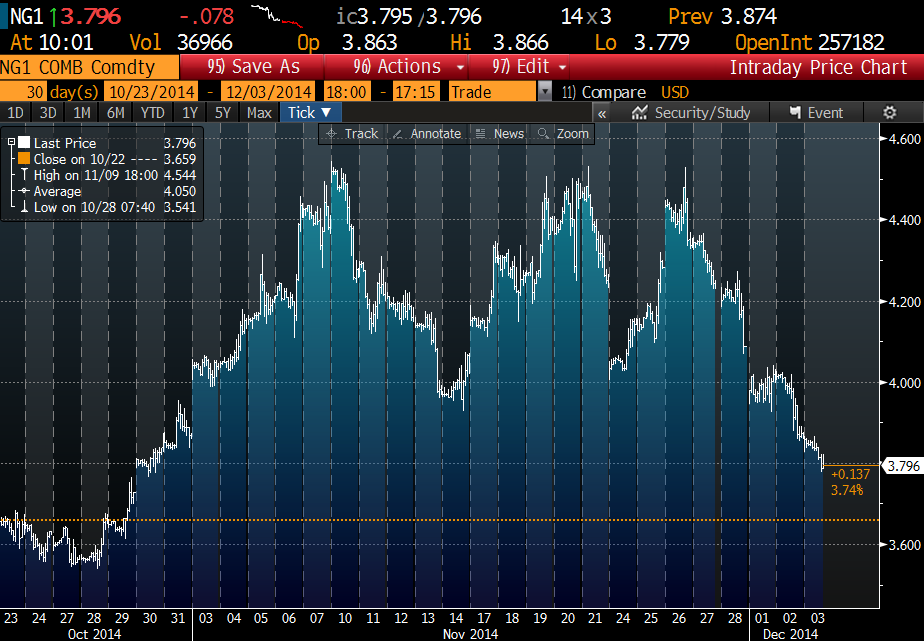
From the polar vortex making November the coldest in decades to El Nino ushering in a mild December, natural gas investors have been taken for a ride over the past six weeks or so. Fun fact – on the NYSE, they have Bloomberg or CNBC on the big TV monitors. In the commodity pits, they have on the Weather Channel. This is why. Look at the volatility of nat gas over the past month. roughly $3.50 to $4.50 and back to $3.80. Pretty amazing.

Filed under: Morning Report | 24 Comments »
Posted on December 2, 2014 by Brent Nyitray
Stocks are higher this morning on no real news. Bonds and MBS are giving back some of Friday’s big gain.
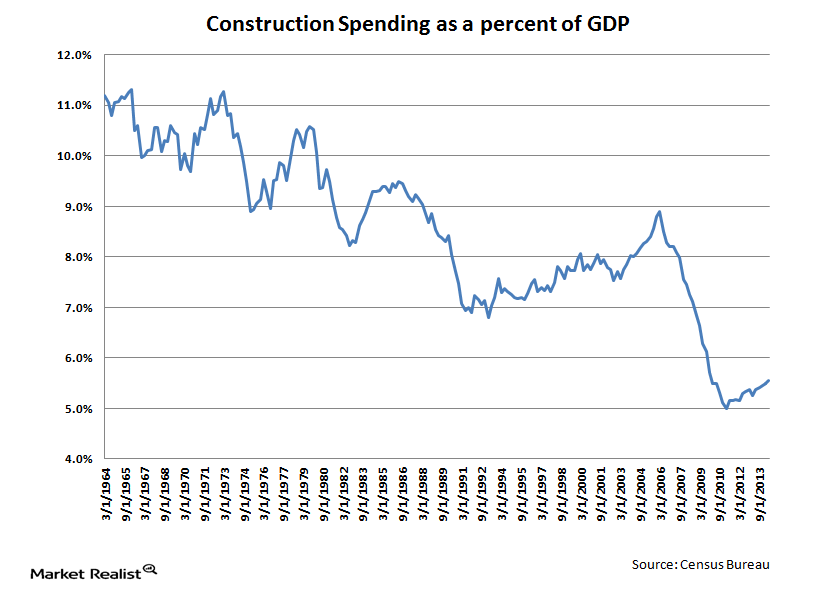
Construction Spending rose 1.1% in October, and September’s number was revised upward from – .4% to – .1%. Private residential construction rose 1.3%. Federal construction spending rose 19.3% and overall public construction increased 2.3%. Construction spending is still 20% off its peak level in 2006. 3Q GDP was boosted by a 9.9% increase in government spending, and we see that the Federal Government increased construction spending by 19%. Perhaps someone was trying to influence the midterms by throwing a little money around…
Chart: Construction Spending 2000 – Present

Construction Spending as a percent of GDP:

As you can see from the two charts above, we construction spending has been heavily depressed since the bubble burst 8 years ago. This represents pent-up demand which will drive the economy going forward. If oil prices remain low, 2015 could be a good year and the economy might be able to weather higher interest rates, although I don’t think the Fed raises rates by more than a symbolic amount until wage inflation starts. Given the bid that is underneath worldwide bonds, the Fed could raise short term interest rates and longer-term rates might not even move all that much.
Home Prices increased 6.1% year-over-year in October, according to CoreLogic. They remain 12.4% below their April 2006 peak.
Zillow is predicting Millennials will be the biggest home buying group in 2015 and rent inflation will outstrip home price appreciation. We are already seeing the home price indices reflect higher growth at the lower price points than the higher price points.
While Black Friday sales were tepid for the most part, Cyber Monday sales were brisk, up 8.5%. Consumer confidence indices are pushing through post-bubble highs, and lower gas prices should help improve consumer spending.
Filed under: Morning Report | 6 Comments »
Posted on December 1, 2014 by Brent Nyitray
Markets are lower this morning on overseas weakness as the Chinese PMI came in weaker than expected. Bonds and MBS are flat.
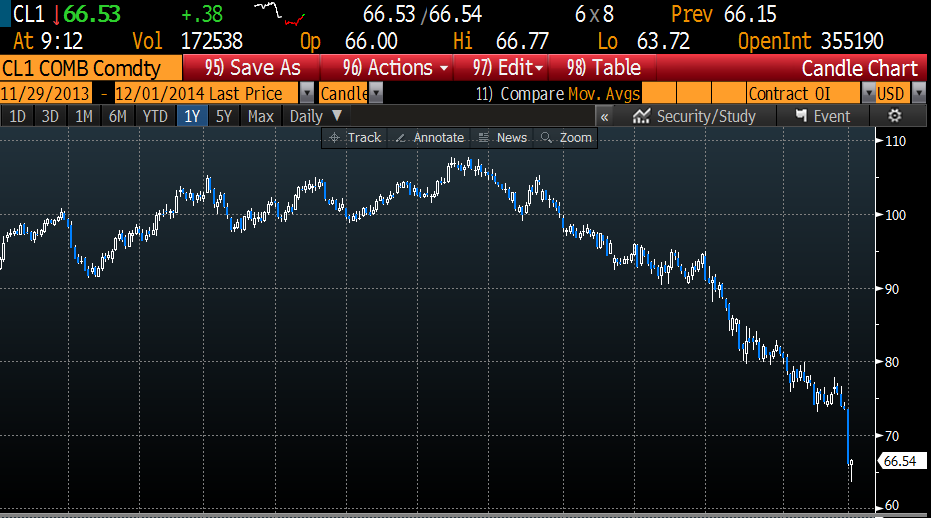
The story of the last few days has been the precipitous decline in the price of oil, which is collapsing at a faster rate than it did in the 2008 crisis. The fracking boom in the US is playing a big role here, along with OPEC’s decision to to maintain output. This is going to have major implications for the US economy and also foreign policy (mainly good).
Chart: WTI Crude 2007 – Present:

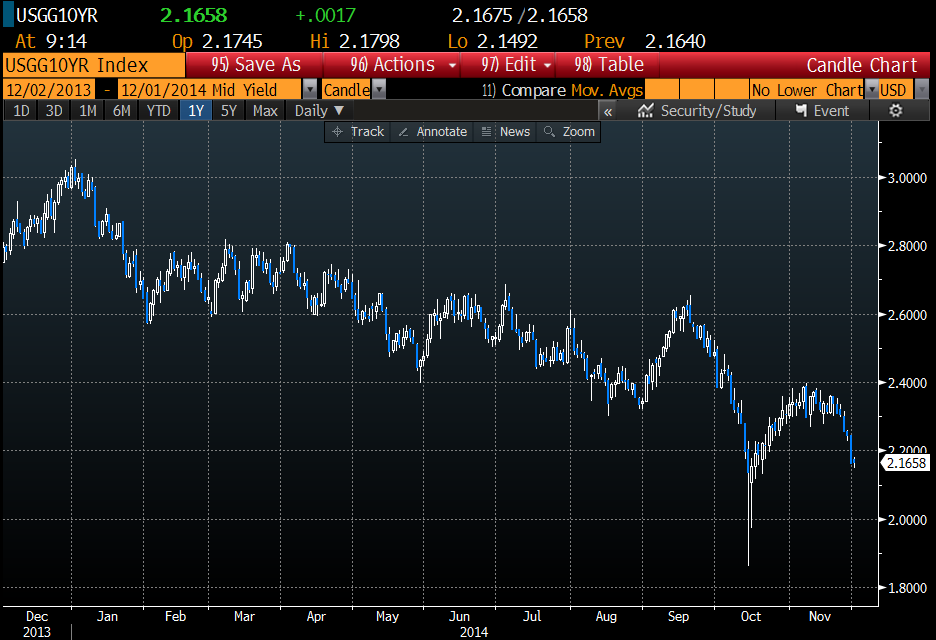
As oil falls, so do bond yields. Last week, the 10 year dropped 15 basis points to close out at 2.164%. There are lots of reasons to be skeptical of Friday’s closing print – namely (a) low volume as many desks were staffed with skeleton crews and (b) end-of-month position squaring and window-dressing. That said, bonds are holding onto gains first thing this morning. LOs, if you had some borrowers that wanted to refi and missed their chance, wake them up. Due to the holidays, they probably don’t know what has been happening in bonds..
Chart: 10 year bond yield.

Note that while bond yields fell 15 basis points, mortgage rates fell by only 6 basis points or so. We saw this the last time yields fell quickly – mortgage rates didn’t follow the move down all that much until it became obvious that the move wasn’t a fluke. Note TBAs picked up about half a point last week.
We have some important economic data this week, with the ISM, Construction Spending, and the Employment Situation Report. We will also get same store sales from the retailers, which should provide some insight into Black Friday. Retailers should benefit from the gift of low gas prices, however it looks like Black Friday was a disappointment this year.
The WSJ is reporting that some of the bigger lenders (like Wells and SunTrust) are preparing to ease lending standards in response to the new R&W guidelines out of the GSEs.
Filed under: Morning Report | 8 Comments »
Posted on November 25, 2014 by Brent Nyitray
Stocks are higher after a strong GDP report. Bonds and MBS are flat
The second revision to Q3 GDP came in at +3.9%, an increase from the initial estimate of +3.5%. Personal consumption rose 2.2%. The core PCE index (which is the inflation measure the Fed prefers to use) came in at 1.4%, so inflation is still well below what the Fed would like to see. The big contributing factor to GDP was government spending, which increased 9.9%.
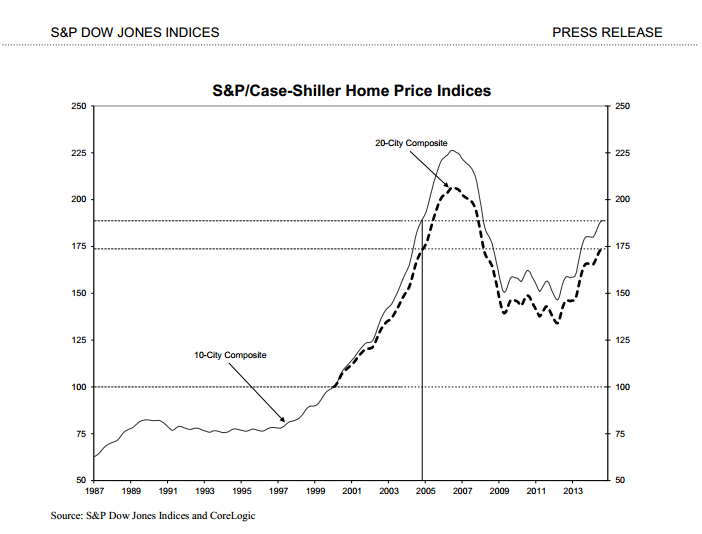
Home price appreciation seems to be flattening, however, as the FHFA home price index was flat on a month-over-month basis. Case-Shiller rose .34%, however. The CoreLogic home price index noted that price appreciation was slowing at the high end, however prices were still rising pretty quickly at the low end (9.4% vs. 4.5%).
Chart: Case-Shiller Home Price Index

The big institutional investors are slowing down their purchases of distressed properties, as they have yet to show the huge profits they promised to their own investors. They have a big backlog of homes to renovate and rent, and skilled construction labor is hard to come by these days. I always suspected that the execution of this trade was going to be more difficult and expensive than people were figuring it would be.
The Supreme Court will hear oral arguments on the FHA disparate impact case on Jan 21. This is an important fair lending issue, as the Obama Administration moved to make proving lending discrimination as strictly a numbers game – in other words, the CFPB does not have to prove intent to discriminate. If your numbers don’t line up with the population, you are guilty, no questions asked. This one has wended its ways through the lower courts and has made it to the Supreme Court.
Filed under: Morning Report | 29 Comments »
Posted on November 24, 2014 by Brent Nyitray
Stocks are higher this morning on speculation that the ECB will take further measures to boost growth. Bonds and MBS are down.
This is a short week with the Thanksgiving holiday. Friday will be an early close in the bond market. We have a lot of data on Tuesday and Wednesday.
Economic growth moderated in October, according to the Chicago Fed. Production-related indicators were negative, while employment-related indicators were positive.
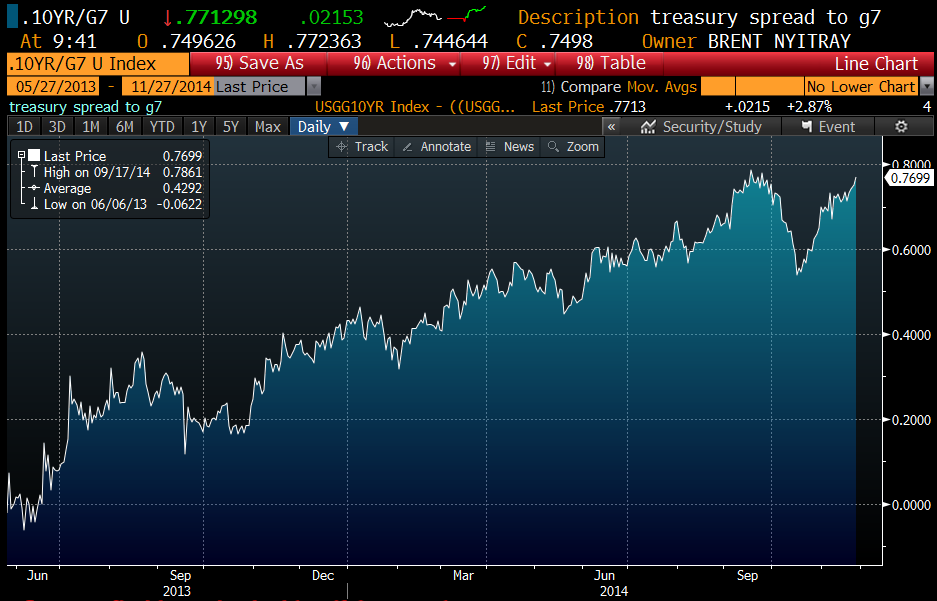
Even as the Fed ends QE, the demand for sovereign debt remains insatiable. J.P Morgan is forecasting demand for sovereign debt will exceed supply by $400 billion in 2015 as worldwide business confidence drops and inflation remains nowhere to be seen. This has been largely a European phenomenon, however the laws of relative value will affect US bonds as well. Note that US Treasuries yield more than the G7 average, by a lot. In fact, it has risen from flat to 77 basis points since the Fed announced it would end QE in mid-2013. We are approaching levels not seen since 2006. The upshot? Demand for European debt will keep a bid under Treasuries. In other words, the environment remains suitable for continuing low rates. Interesting that pretty much every strategist on the Street has gotten this one wrong.
Fun fact: Of the PIIGS, Italy, Ireland, and Spain yield less than the US. Only Portugal and Greece yield more. It makes you wonder if the Fed and the ECB have created a monster – a sovereign debt bubble.
Chart: Treasury spread to G7 debt. (in other words, the 10-year yield minus the average 10 year bond yield for the G7 countries).

Obama says that “Americans will want that new car smell and someone that doesn’t have as much mileage as me.” FWIW, Hillary will have quite the amount of mileage on her, as she will be pushing 70 in 2016. But she smells nice, I guess.
Filed under: Morning Report | 14 Comments »
Posted on November 21, 2014 by Brent Nyitray
Markets are higher this morning after China cut interest rates. Bonds and MBS are flat.
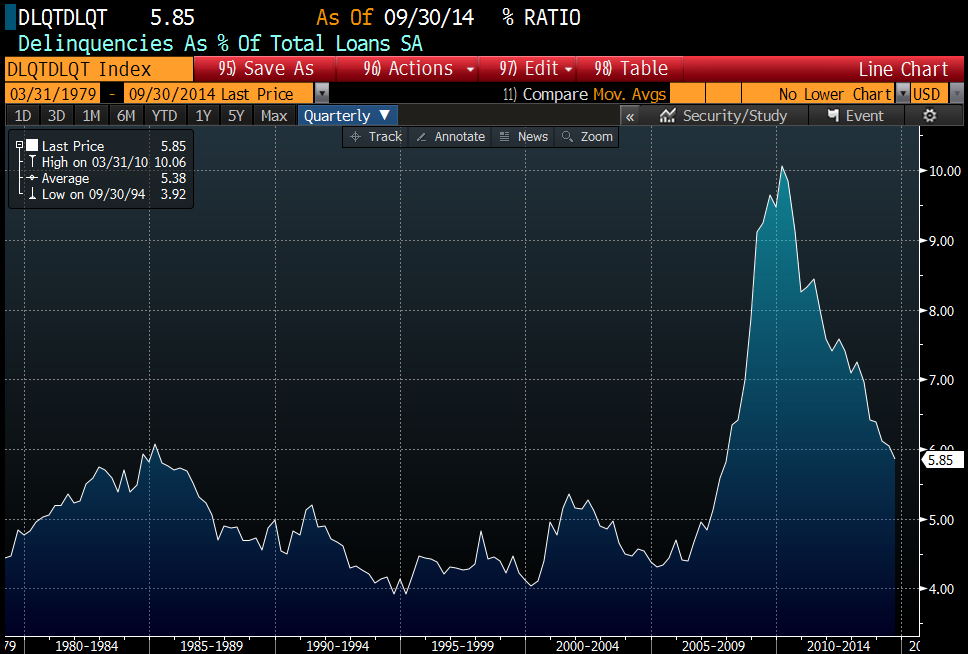
Delinquencies dropped again to 5.44% of all loans, according to Black Knight Financial Services. They are still elevated, but have quite a bit from their high of around 10%. Prior to the the bust, a typical delinquency number was about 4.5%.

Foreclosure starts declined 10% in October, and are down 31% year-over-year. Foreclosure inventory is down 33% YOY and is at the lowest level since February 2008.
The CFPB is coming down on lenders who ask too many questions about disability income in the verification process.
Filed under: Morning Report | 25 Comments »
Posted on November 20, 2014 by Brent Nyitray
Stocks are down on overseas economic weakness. Bonds and MBS are up.
Economic data dump: Initial Jobless claims came in below 300k for the 10th time this year. Lower energy prices are keeping a lid on inflation at the consumer level as the CPI came in flat. Philly Fed made a huge move upward – from 20.7 to 40.8. This is the highest reading in over 20 years. The Bloomberg Consumer Comfort Index rose to 38.5, while the Index of Leading Economic Indicators rose to 0.9%. All in all, some pretty good data this morning – surprising that bonds have taken all this in stride and are up so much.
Existing Home Sales rose to 5.26 million in October from an upward revised 5.18 million in September. They are up 2.5% on a year-over-year basis. The median home price was 208,300, which is up 5.5% from a year ago. All-cash sales increased to 27% from 24% in the prior month, but are down from 31% a year ago. Normalcy is around 20% cash sales. The first time homebuyer represented 29% of all sales. Normalcy is closer to 40%.
There was nothing earth-shattering in the FOMC minutes yesterday. Everyone agreed that QE had done its job and it was time to end it. They agreed to continue to re-invest maturing proceeds back into the market, and did not discuss suspending that or selling some of their portfolio. The staff economists tweaked their 2015 GDP estimates downward a bit. Since the October FOMC meetings don’t have a press conference of projection materials, they tend not to announce big changes. Bonds rallied on the minutes initially, but sold off to more or less end the day unch’d.
Mel Watt testified in front of the Senate Banking Committee yesterday. Elizabeth Warren laid into him about principal reductions on Fannie and Freddie loans. Mel said that reductions are still under consideration. Of course the FHFA Home Price Index (which represents homes with a conforming loan) is within 6% of the high, so if Mel continues to slow-walk principal mods, the problem eventually goes away on its own. They sound like they are bringing back the 3% down conforming loan for “targeted” borrowers.
Filed under: Morning Report | 33 Comments »


 Brent Nyitray
 Fairlington Blade
 Let the mutherfuker burn!
 jnc4p
jnc4p Kevin S. Willis
 Michigoose
 lmsinca
 markinaustin
 Arcanaut
 novahockey
 quarterback
 ScottC
 yellojkt