Posted on December 22, 2014 by Brent Nyitray
This week is for all intents and purposes a two day week. Markets will close early on Christmas Eve and many will take off Friday.
The big deluge of data is tomorrow, with GDP, personal income, personal spending and a host of other indicators.
The risk-on trade continues this morning, with stocks up small and bonds down a tad. Oil continues to fall.
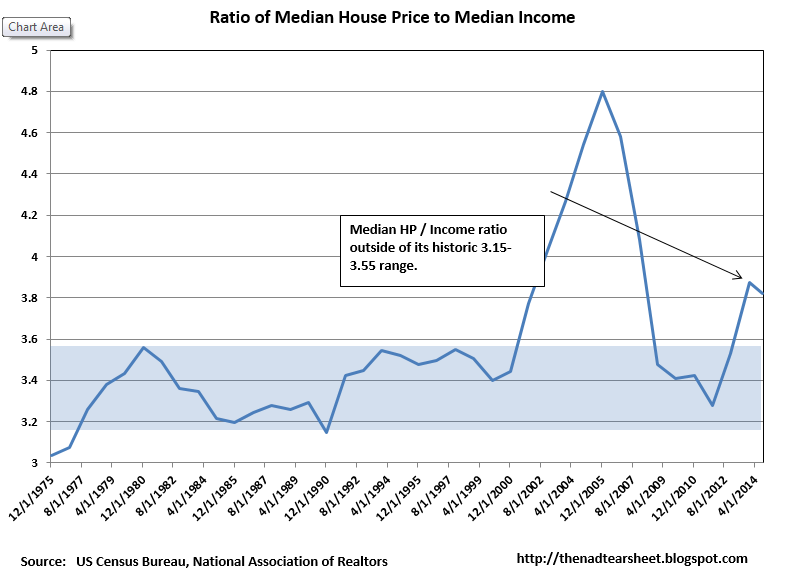
Existing Home Sales fell 6.1% to a seasonally adjusted annual rate of 4.93 million, according to NAR. Housing inventory was tight and bad weather didn’t help things either. The median existing home price was 205,300, which is 5% above November 2013. According to Sentier Research, the median income in the US was $53,700 as of the end of October. This makes the median home price to median income ratio just over 3.8, which is above its historical range of 3.15x – 3.55x. This means home price appreciation is probably going to be hard to come by until wage inflation begins to pick up.

One other thing to keep in mind: a flattening yield curve is a classic “tell” that the economy is slowing down, and by all accounts, it looks like the economy is accelerating. This will be another situation where the classic investing playbook isn’t going to help you all that much. In other words, if the Fed starts hiking rates and mortgage rates stay where they are, don’t all of a sudden dump your portfolio and pile into defensives like Proctor and Gamble or General Mills.
Filed under: Morning Report | 16 Comments »
Posted on December 19, 2014 by Brent Nyitray
Markets are flattish this morning after a torrid 2 day run courtesy of Santa Yellen. Bonds and MBS are up small.
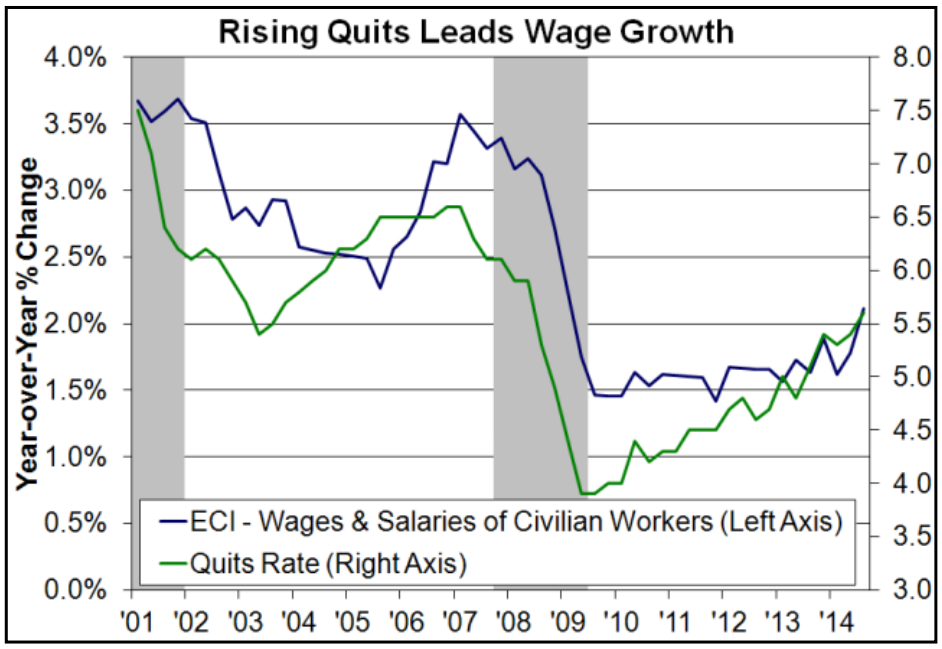
Fannie Mae is forecasting that wage growth is just around the corner and focuses on an interesting indicator out of the JOLTS job report – the quit rate. The quit rate is a leading indicator for job growth, and it has has been moving up for quite some time while wages have been flat. Another reason to be somewhat optimistic about 2015.

Are the high premiums for FHA loans creating an adverse-selection problem? The MBA thinks so. Creditworthy borrowers are going for the cheaper Fannie and Freddie loans, leaving only the borrowers with poor credit in the FHA risk pool. The new 3.5% down Fannie Mae loans will undoubtedly exacerbate this trend.
The drop in oil prices is causing pain in economies that rely on oil revenues, particularly Russia and Venezuela. It looks like Russian banks are going to need some sort of bailout. This could have impacts on the US real estate market, particularly at the high end. On one hand, Russian billionaires will want to move assets out of Russia ahead of the capital controls that are probably coming, On the other hand, in a crisis, you sell what you can, not necessarily what you want to. Not sure how this will shake out, but it bears watching. It will probably be a preview of what happens when China’s real estate bubble bursts as well. The Asian Crisis of the late 90s did have some reverberations in US credit markets, so we may feel a bit of credit tightening as banks back away from each other.
Filed under: Morning Report | 13 Comments »
Posted on December 18, 2014 by Brent Nyitray
Stocks are continuing yesterday’s Fed-driven melt-up. Bonds and MBS are down hard. That window where rates were around 2.05% did not last long.
As advertised, the FOMC statement basically substituted “patience” for “a considerable time.” That said, it still contained the “considerable time” language, but referred to it in the past tense. Probably the biggest surprise was their downward forecast for 2015 inflation to a range of 1% – 1.6%. Their September forecast was 1.6% to 1.9%. They also took down their 2015 unemployment forecast to 5.25% from 5.5% in September. The Street seems comfortable that rates are going up in the second half of 2015.
Initial Jobless Claims fell to 289k last week, and we have been solidly below 300k for quite some time. The leading indicators have been strong for a while, however we have not been seeing the wage growth. That said, I am seeing anecdotal evidence that wage inflation might be be around the corner. At lunch I noticed the “help wanted” placard had taped over the starting salaries and increased them by a buck an hour. Sample size of 1, of course, but still…
The Markit US PMI came in weaker than expectations. The Bloomberg Consumer Comfort Index ticked up to 41.7 from 41.3 last week. The Philly Fed Index fell from 40.8 to 24.5 and the Index of Leading Economic Indicators was flat at .6%.
Mortgage lenders are worrying more about lackluster demand impacting margins, according to the latest Fannie Mae Lender Sentiment Survey. The biggest headache remains regulatory, of course. Lenders anticipate a modest housing expansion in 2015. It seems like the homebuilders agree. It is all going to hinge on the return of the first time homebuyer.
Filed under: Morning Report | 12 Comments »
Posted on December 17, 2014 by Brent Nyitray
Markets are higher this morning on no real news. Bonds and MBS are down.
Oil continues to fall, with a barrel of West Texas Intermediate now down below $55 a barrel. This is putting pressure on prices. The Consumer Price Index fell .3% in November. Ex food and energy, it rose .1%. Will be interesting to see how the Fed addresses (if at all) falling energy prices in the FOMC statement.
Mortgage Applications fell 3.3% last week. Purchases were down 6.9% while refis were flat.
The FOMC will announce their decision at 2:00 pm. Expect volatility around that time and after as the press conference starts.
“A considerable time.” Sounds like a novel. Anyway, that is the phrase that will be the focus of the Fed statement. Will the Fed drop the language that states that rates will remain near zero for a “considerable time?” The new expected buzzword? Patience. Given how far bonds have moved to the upside already I don’t know how much a dovish statement will move them further. If anything the risks are on the downside.
Filed under: Morning Report | 4 Comments »
Posted on December 16, 2014 by Brent Nyitray
Stocks are lower as oil continues to fall. Bonds and MBS are rallying hard.
Euro yields are continuing to move lower. The German Bund is currently trading at 57.6 basis points. It began the year at close to 2%. Think about that for a moment. FWIW, the trader in me is starting to think about a capitulation low in rates. Which means we are ripe for a snap-back in yields. LOs, I know this is a dead period of the year, but there might be some refis to be had with the us 10 year yield falling towards 2%. I don’t know how long this gift lasts.
Another observation is that we are getting close (40 basis points or so) to the lows set before the the Fed hinted that QE was ending. If we are getting this sort of movement in rates without QE, it does beg the question of whether QE was effective in the first place.
The Russian Ruble fell to a record low as the Russian Central Bank raised interest rates to 17%. The ruble has been slammed by a combination of low oil prices and international sanctions over Ukraine. The last stop is capital controls. The swoon in oil prices has hit Russia and Venezuela particularly hard.
Housing starts fell to 1028k in November from an upward revised 1045k. Building Permits fell from 1092k to 1035k. For once it was single fam that accounted for most of the decline – multi-fam actually rose. Note that weather may have affected the numbers as winter storms arrived early this year for the upper Midwest and New England.
The FOMC meeting begins today. The decision will be released tomorrow at 2:00 pm.
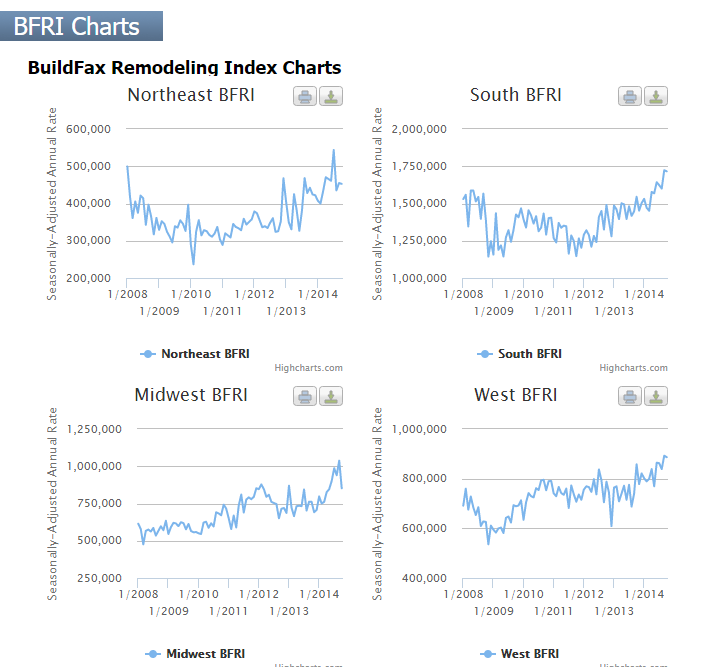
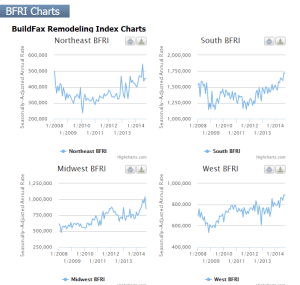
The Buildfax remodeling rate came in at just under 4 million, which is 4% below September and is 10% higher than a year ago. Activity continues to be strongest in the South and West, with the Midwest and Northeast lagging.
Filed under: Morning Report | 22 Comments »
Posted on December 15, 2014 by Brent Nyitray
Markets are higher this morning after stocks got slammed in Asia last night. Bonds and MBS are down.
The NAHB Homebuilder Sentiment Index fell to 57 in December. Sentiment is still on the strong side, although the Street was clearly spooked by Toll’s numbers last week.
Wall Street is betting that inflation will remain dead for a long time. Treasury Strips are back (which basically slices and dices a long term Treasury into a bunch of zero coupon bullet bonds). This strategy has been a winner this year, rallying almost 50%. Foreign bond investors have had a great year with the the currency and bond markets posting big gains. The thing to remember is that US investors aren’t the only ones who play the Treasury market – and foreign bond investors are often looking at their domestic bond markets and finding more value in the US. To put this in perspective – the US 10 year yields 2.12%. The German Bund (10 year) yields 64 basis points. The Japanese JGB (another 10 year) yields under 38 basis points. The Spanish 10 year yields 1.79%. There is a global relative value trade happening here.
Strategists have gotten the bond market wrong all year. This is a case where the textbook response – sell Treasuries as the economy improves – has been dead wrong, overwhelmed by events overseas. Keep this in mind when thinking about rates in the US – strong data might not be enough to push bonds lower and originators might be getting a gift here. It won’t last, and the snap-back could be vicious. Second, anyone buying a 30 year zero at 43 which yields 2.86% should have their head examined. This is bubble behavior, and is the bond market equivalent of buying Cisco Systems at 70 (or 132x earnings) in 2000. Bonds will crack at some point, but keep in mind that bond market cycles are long.

Speaking of strong economic data, Industrial Production rose 1.3% in November and capacity utilization topped 80% for the first time since March of 2008. This production number was the highest since 2010. On the other side of the coin, the December Empire Manufacturing Index fell in December.
The FOMC meets this week, and the decision will be released Wednesday at 2:00 pm EST. This one should have a press conference, along with updated economic projections and a press conference. The focus is on the timing of rate hikes, and investors will key in on language regarding the labor market.
In the budget deal last week, some regulations were relaxed for the big Wall Street banks, particularly the provision requiring derivatives to be housed in an entity without recourse to the parent FDIC – insured bank. This sparked a big rebellion on the left, but it ended up going nowhere. FDIC insured banks may now use credit default swaps as hedging instruments for their own books. To hear the left tell the story, this basically returns us back to the bad old days of 2005. To the industry, this is a common-sense relaxation of a rule that went too far in the first place. That said, banks were always allowed to use these products, but had to post more collateral than they wanted to. This is a knotty question, as many “hedges” are really speculative bets when you delve into the details. I suspect JP Morgan’s 2012 London Whale trading loss was intended to act as a hedge in the first place.
Finally, there was a bit of dishing on this place in PL yesterday…
Filed under: Morning Report | 30 Comments »
Posted on December 12, 2014 by Brent Nyitray
Markets are lower this morning as oil continues to fall. Bonds and MBS are up, with the 10 year hitting lows not seen since June of 2013.
Lower energy prices means that inflation at the wholesale level is pretty much non-existent. The producer price index fell .2% in November. Ex food and energy, it was flat.
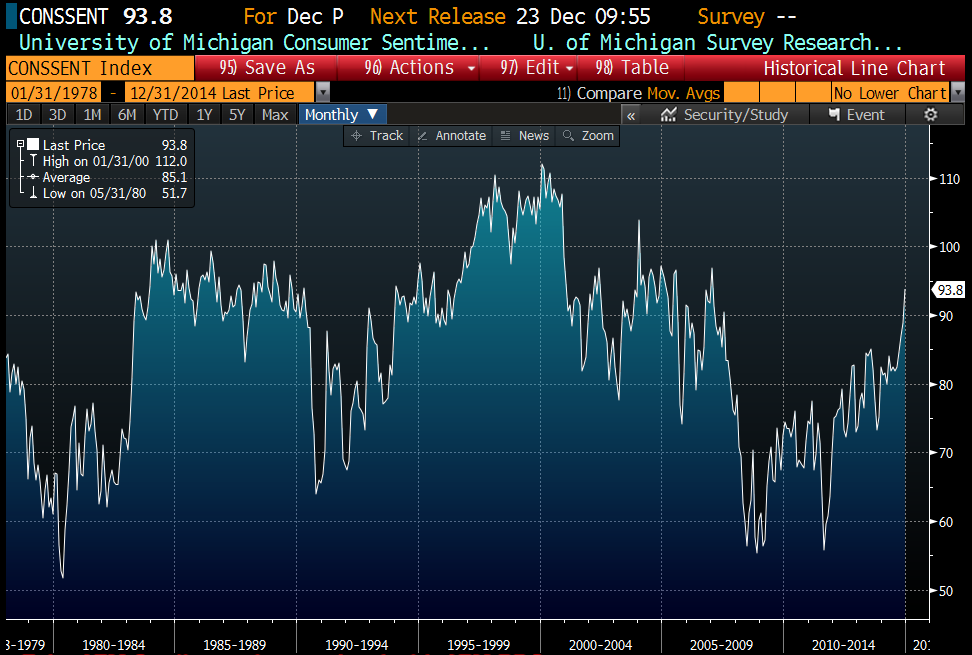
Declining gas prices pushed the University of Michigan Consumer Confidence level to 93.8 from 88.8 last month. We appear to be back to normalcy.

The left is still up in arms over the language in the CROmnibus (continuing resolution + omnibus spending bill) that allows banks to trade derivatives in their FDIC insured entity. I haven’t seen the specific language, but I think it allows the banks to use derivatives for hedging purposes. But there is so much posturing going on here that it is hard to tell exactly what it does. The spending bill did make it through the House, and it looks like a done deal in the Senate.

Filed under: Morning Report | 22 Comments »
Posted on December 11, 2014 by Brent Nyitray
Stocks are higher this morning after initial jobless claims and retail sales surprised tot he upside. Bonds and MBS are flat.
Initial Jobless Claims fell slightly to 294k last week. We have been consistently hitting under 300k for a while, which is a very bullish sign. Companies may not be raising wages yet, but they are holding on to the people they have.
Retail Sales increased .7% in November, well above the .4% Street estimate. October was revised upward Ex autos and gas, sales rose .7%. Lower gasoline prices are providing a bit of an economic dividend.
Congress looks like they have circled around a spending bill to keep the government open for the near term. The left (led by Elizabeth Warren) is complaining about the bill. The Department of Homeland Security is funded only through February, which will give Republicans a chance to wrangle with Obama on the issue of his immigration executive order. There are also some relaxations to Dodd-Frank, and the left is apopleptic about that. The changes would allow FDIC institutions to use derivatives to hedge their own currency and f/x risk and would relax margin requirements for non-banks that use derivatives to hedge (like airlines hedging their fuel costs, for example). That said, it looks like the left will lose this battle.
Filed under: Morning Report | 13 Comments »
Posted on December 10, 2014 by Brent Nyitray
Markets are weaker this morning as oil (and oil stocks) continue to fall. WTI is trading at $62.20 after OPEC revised its 2015 forecast. Bonds and MBS are flat.
Mortgage Applications rose 7.3% last week. Purchases were up 1.3% while refis were up 13.2%. Don’t bust out the champagne quite yet, we are still basically bumping along the bottom.

Luxury builder Toll Brothers reported 4th quarter and full year results this morning. Deliveries rose 29% in dollars and 22% in units, but it looks like the torrid increase in average selling prices has passed and they are beginning to moderate. ASPs rose 6% YOY to $747k. Price appreciation for signed contracts was even less – around 3.6%. Backlog was up 3% in dollars and flat in units.
Robert Toll, CEO of Toll Brothers made a point I have been making for a long time – housing starts are still way below historical averages: “We believe the housing recovery has many years to run. Housing starts, through ups and downs from 1970-2007, have averaged about 1.6 million annually. According to Harvard University’s Joint Center for Housing Studies, ‘Despite the rebound in the last two years, home sales and starts are still nowhere near normal levels. This was the sixth consecutive year that starts failed to hit the one million mark, [which was] unprecedented before 2008 in records dating back to 1959.”
Obviously the recovery to normalcy depends on the first time homebuyer. Consistent rental inflation is pushing them to consider home ownership as an alternative. The NAHB is praising Fannie and Freddie for re-introducing the 3% downpayment loans.
Filed under: Morning Report | 88 Comments »
Posted on December 9, 2014 by Brent Nyitray
Markets are lower worldwide after a big sell-off in China. Bonds and MBS are rallying.
The Chinese government instituted new regulations for local debt last night, which sent the markets reeling. Chinese stocks have been on a tear recently (up something like 30% since Nov 1) so the news was an excuse for some major profit-taking, which sent the indices down something like 5%.
Small business optimism picked up a bit in December, as the NFIB Small Business Optimism approached the historical average before the Great Recession began. A big increase in economic optimism drove the increase. Earnings trends are heading higher, and some are planning to increase employment, which is good news for the economy.
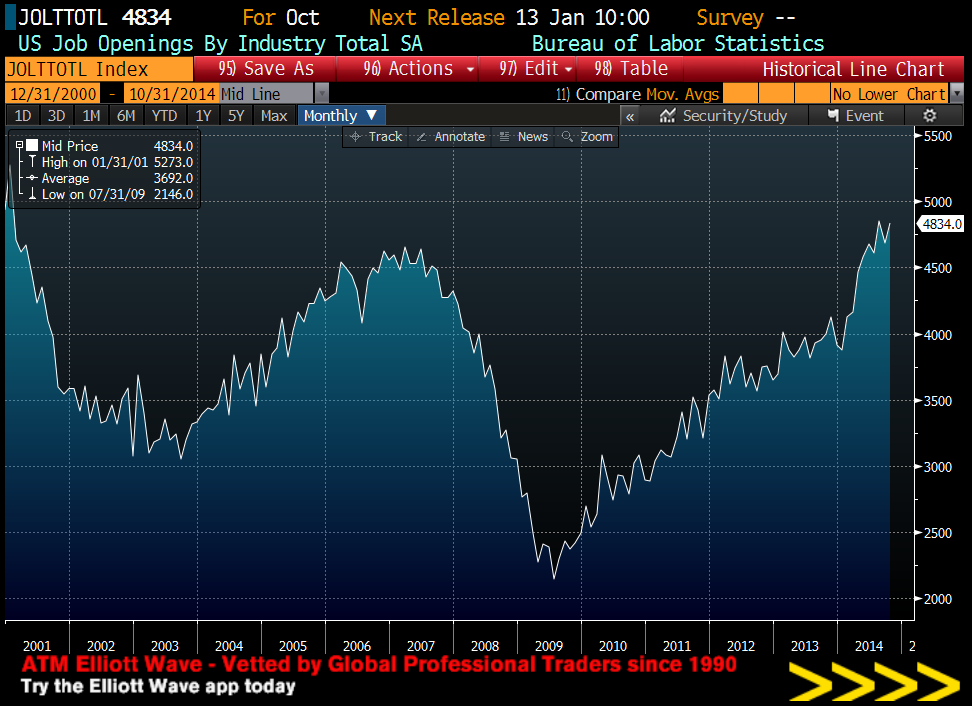
Another good data point for the market: Job openings rose to 4.834MM in October from 4.685MM in September. This almost matches August’s number, which was the highest since early 2001. Combine that with a steady diet of sub 300k initial jobless claims prints and the leading indicators of the labor market are looking strong. Now about that wage growth…

New 3% down loans are expected to have only a marginal effect on increasing credit availability. Separately, This is all part of an attempt to get the first time homebuyer back into the market, which has been the Achilles Heel of this housing recovery. The problem is that while a 3% downpayment isn’t necessarily daunting, the credit score the banks require is – something like 755. For young adults with student loan debt, that sort of score probably just isn’t in the cards. Here are the FAQs for the 3% down loans from Freddie Mac.
Obamacare Architect Jonathon Gruber heads to Capitol Hill today to discuss the obfuscation and white lies involved in the selling of Obamacare. In an unfortunate (for him and Obama) minute of candor, he discussed how the the plan relied on the “stupidity of the American voters” to get it through, and how the “Cadillac Tax” was a brilliant piece of wordsmithing that set in motion the eventual taxability of employer-provided health care benefits. Don’t expect much out of Gruber – he will probably apologize for the language he used and spend the rest of the time lawyered up and will simply relay previously prepared talking points. Note that the Medicaid subsidy issue is going to be taken up by the Supreme Court as well, which could throw the whole thing in peril.
Filed under: Morning Report | 10 Comments »


 Brent Nyitray
 Fairlington Blade
 Let the mutherfuker burn!
 jnc4p
jnc4p Kevin S. Willis
 Michigoose
 lmsinca
 markinaustin
 Arcanaut
 novahockey
 quarterback
 ScottC
 yellojkt