Morning Report: A historical examination of the last 3 tightening cycles 10/14/15

Markets are flattish as earnings season begins in earnest. Bonds and MBS are up.

Last night JP Morgan reported weaker than expected earnings. Mortgage originations are up 41% year-over-year and up 2% on a quarter-on-quarter basis. Charge-offs fell dramaticallyl.

Bank of America reported better than expected earnings. Originations for them were up 17%.

Mortgage Applications fell 27.6% last week as the “beat the TRID deadline” effect was unwound. Purchases were down 34% and refis were down 22.5%.

Retail Sales rose 0.1% in September, while the control group, which ignores gasoline, autos, and building supplies, fell 0.1%. Where are consumers spending their money? Cars, furniture, apparel, and entertainment.

The Producer Price Index fell 0.5% in September as the strong dollar depressed commodity prices. Ex- food, energy and trade the index is up 0.5% year-over-year. We have yet to see any sort of meaningful inflation at the producer level.

Business inventories were flat in August. Commodity prices could be playing a role in this number.

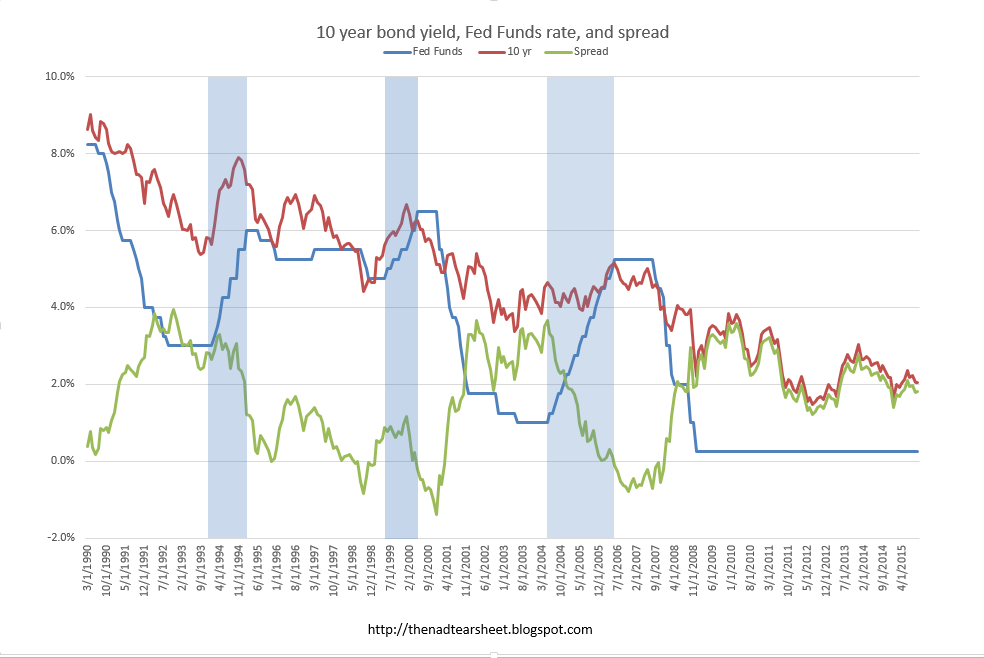
We know the Fed is going to start hiking rates soon. But does that necessarily mean that mortgage rates are going up? If you look at the historical record, at least over the past 3 tightening cycles. the Fed Funds rate increased, but the long term rate moved up much less, or not at all. If you look at the spread between long term and short term rates, the yield curve flattened dramatically and ended up inverting. The vertical blue lines are the 1994, 1999, and 2004 tightening cycles. The red line is the yield on the 10 year, which will most approximate mortgage rates, while the blue line is the Fed Funds rate. The green line is the difference between the two. The lower the green line, the more flatter the yield curve.

What are the takeaways from this? 1) Don’t necessarily fear a tightening in December – it might not affect mortgage rates at all, and 2) When the Fed starts tightening, that is the time to get people out of ARMS and into a 30 year fixed rate mortgage. LIBOR will increase with the Fed funds rate, resetting ARM rates, but if the 30 year fixed doesn’t move (or barely moves), then that switch is a great trade for the borrower.

Morning Report: Main Street is hiring 10/13/15

Markets are lower this morning after weak economic data out of China. Bonds and MBS are up.

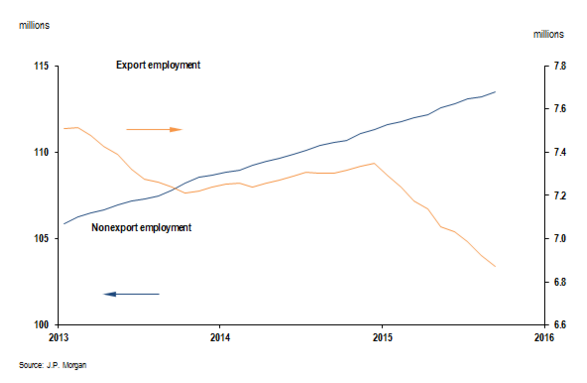
The NFIB Small Business Optimism index rose to 96.1 from 95.9 the prior week. Good news on the labor front – small businesses are hiring or trying to hire despite the volatility in the markets. This actually points to a bit of dichotomy we have seen since the financial crisis – a bifurcation of the “S&P 500 economy” and the “main street economy.” The S&P 500 economy has a lot of international exposure and this acted as a tailwind for the stock markets as the US economy began recovering. Many people were perplexed that the economy could feel so tepid yet the stock market was hitting new highs. Now the phenomenon seems to be reversing. Companies with big international exposure are feeling the effects of the commodity sell-off and emerging markets pain, while the small manufacturer who serves the local area is thinking about expanding and hiring.

Low oil prices are here to stay, at least through 2016, according to the IEA. You have a combination of decreasing demand as China slows combined with an additional million barrels of oil a day coming out of Iran. Rig count has already fallen and is at 5 year lows.

There were 36,000 completed foreclosures in August, according to CoreLogic. This is up 0.8% versus July, but down 20% year-over-year. The foreclosure rate of 1.2% is back to January 2008 levels. The non-judicial states have largely worked through their inventory, however the judicial states (especially in the Northeast) still have some wood to chop.

UBS has a piece out on hybrid funds – funds that hold stocks and high yield debt. If we continue to see a sell-off in junk bonds, these funds will face redemptions, and that meant that the stocks will get sold as well. This is an issue in particular for the energy patch.

Morning Report: Slow news day 10/12/15

Markets are flattish on no real news. Bonds and MBS are closed for the Columbus Day holiday.

No economic data this morning, but we will get a slew of data this week. We will get retail sales on Wednesday, which promises to be a big number as well as inflation data. On Friday we get some big manufacturing data.

Earnings season kicks off in earnest this week with many of the big banks reporting. We will hear from JP Morgan after the close.

The CFPB is going after mandatory arbitration clauses in banking and credit cards. This will make it easier for consumers to sue. Separately, the SEC is reducing its use of in-house administrative law judges, which critics have said gives it a “home court” advantage.

The rental market has been on fire, and has been doing much better than the single family construction market. Is that about to change? As the Millennials age, they will become house buyers. The demographics are changing, and 2015 may be the known as “peak rentals” The one thing our economy needs more than anything right now is more housing construction. We have a shortage, and housing construction employs a lot of people with jobs that pay good wages. The difference between 1.2 million housing starts and 2 million in terms of growth is very meaningful.

Last week the House passed a bill that would extend a hold-harmless period for TRID until February. Its fate in the Senate is unclear. The CFPB has said it will take into account whether a company is making a good faith effort to comply but does not support a hold harmless period.

Shortest honeymoon ever. After agreeing to a deal to stop developing nuclear weapons in exchange for the lifting of sanctions, Iran tested a long range ballistic missile with a range of around 800 miles, potentially violating the agreement signed in July.

Morning Report: FOMC minutes show the Fed is worried about the global economy 10/9/15

Markets are higher this morning as commodities continue to rebound. Bonds and MBS are down.

Import Prices fell 0.1% in September and are down almost 11% on a year-over-year basis.

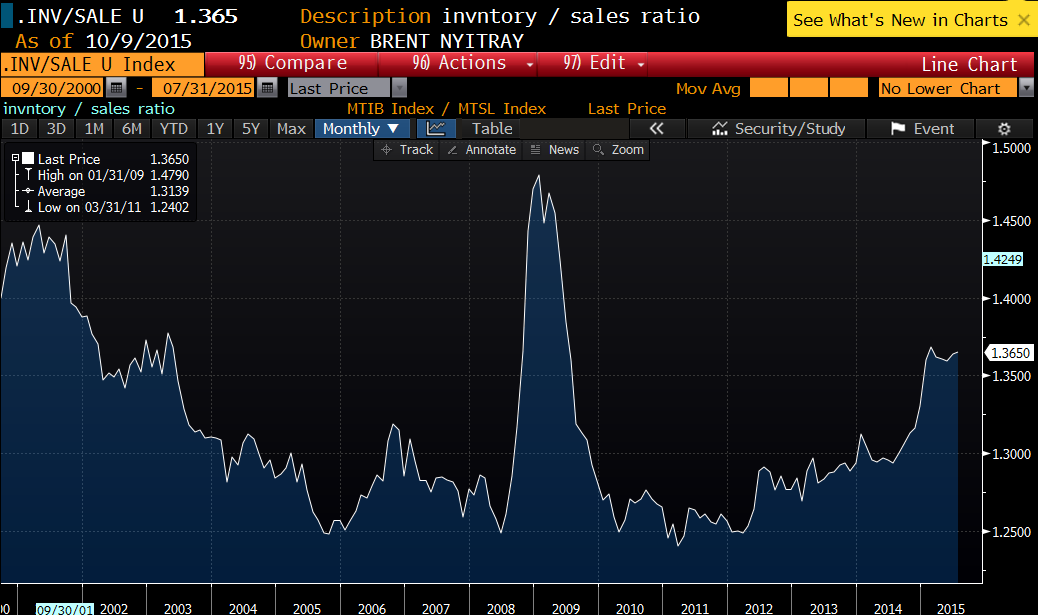
Wholesale inventories rose 0.1% in August, while wholesale sales fell 1%. Both numbers were worse than expectations. The increase in the inventory to sales ratio is a worrisome sign., You typically see the ratio build ahead of a cyclical recession.

The FOMC minutes confirmed what everyone suspected – that international worries prompted the Fed to hold interest rates steady at the September FOMC meeting. Overall, the Committee seemed rather constructive on the US economy in general. The Fed Funds futures are currently handicapping a 10% probability of a hike at the October meeting and something like 40% in December.

Note that while the Fed is sanguine on the US economy, economists are generally more cautious. A survey of strategists and economists puts the chance of a US recession at 15% over the next 12 months. It is important to note that the Fed’s forecasts for economic growth have been consistently high since the Great Recession.

Representative Kevin McCarthy withdrew his name from consideration for the next House speaker after allegations of an affair ended up on a Wikipedia page. This leaves current speaker John Boehner in charge for the time being. Interestingly, the Wikipedia edit emanated from the US government itself – someone in the Department of Homeland Security. After the Secret Service started distributing confidential information on Representative Chaffetz, it looks like the worker bees in the government are going directly after Republican politicians. It will be interesting to see if anyone in the Obama administration actually cares.

Hillary’s plan for the financial system. A surtax on banks with over $50 billion in assets, an increase in the statute of limitations for financial crimes, and toughening the Volcker rule regarding proprietary trading.

Note that margin debt is falling on the stock exchanges. This could be a reaction to the turmoil in overseas markets. Generally speaking margin selling tends to exacerbate downward moves, so having less margin debt is actually a good thing.

Morning Report: Awaiting the FOMC minutes 10/8/15

Markets are lower this morning on overseas weakness. Bonds and MBS are up.

Third quarter earnings season starts tonight with the traditional report out of Alcoa.

Initial Jobless Claims fell to 263k last week, the lowest since July.

The minutes from the September FOMC meeting will be out at 2:00 pm EST. Be aware of possible bond market volatility as the market digests it.

The Bloomberg Consumer Comfort Index rose to 44.8 from 43 last week.

Fannie Mae is announcing further reps and warranties guidance for loans starting Jan 1. It will include new alternatives to repurchase if the loan has a defect. The government is sick and tired of tight credit, especially at the lower end of the credit spectrum. These are intended to ease credit by giving lenders more certainty. The government is clearly worried given that the big banks like JP Morgan are backing away from FHA originations.

A case for allowing student loan debt to be discharged in bankruptcy is winding its way through the courts. There is about $1.2 trillion in student loan debt outstanding.

It looks like a strike at Fiat-Chrysler has been avoided. It sounds like the union got some of what they wanted so we could start seeing the beginnings of increasing wages.

Larry Summers makes the case for going big on expansionary fiscal policy. His argument is that China’s slowdown threatens to drag the global economy into a secular stagnation similar to what Japan has been going through. He argues that monetary policy is pretty much played out: rates are at zero, and the stimulative effect of additional QE with the 10 year at 2% would be de minimus. He argues for a new “New Deal” where the government deficit spends on infrastructure spending. Of course this isn’t a new idea in the modern age: Japan has been doing precisely that for 25 years and has nothing to show for it except for a debt to GDP ratio of 2.3x. That would be like the US spending $40 trillion over 25 years. Before we advocate spending that kind of money, we should figure out  why it hasn’t worked in Japan.. And if over 1 quadrillion yen is not enough, then what is? We need a better answer than the un-falsifiable “More Cowbell.” If the Rx only works in theory, then maybe the answer is to just slug it out until the economy corrects on its own.

Morning Report: No we aren’t in another real estate bubble 10/7/15

Mortgage applications rose 25% last week as purchases rose 27%% and refis rose 24%. That is a surprising result given the Bankrate 30 year fixed rate mortgage rose 5 basis points last week. Some think that it was partly TRID-driven.

Janet Yellen’s intention to let the labor market run hot for a few years has some Fed watchers worried. The criticisms range from fears about creating another 1970s – style inflationary environment to worries about the Fed’s credibility. We are in uncharted territory with the amount of control central banks worldwide are exercising over the economy. FWIW, I do not see much in the way of similarities between the 1970s and today: capacity utilization is low, and the chance of an oil shock is pretty remote. In fact we have the exact opposite situation. The inflation hawks make the case that monetary policy acts with such a lag that the die may already be cast for higher inflation (a similar argument that some of the global warming alarmists make with respect to CO2 in the atmosphere) The other point is more valid: the evidence that the Fed can influence wages and labor force participation is weak and the Fed is setting up unrealistic expectations that could damage its credibility down the road.

Of course the other unintended consequence of ZIRP is the pressure it puts on pension funds. That probably is going to be the next crisis. We saw this movie before, in the 1950s.

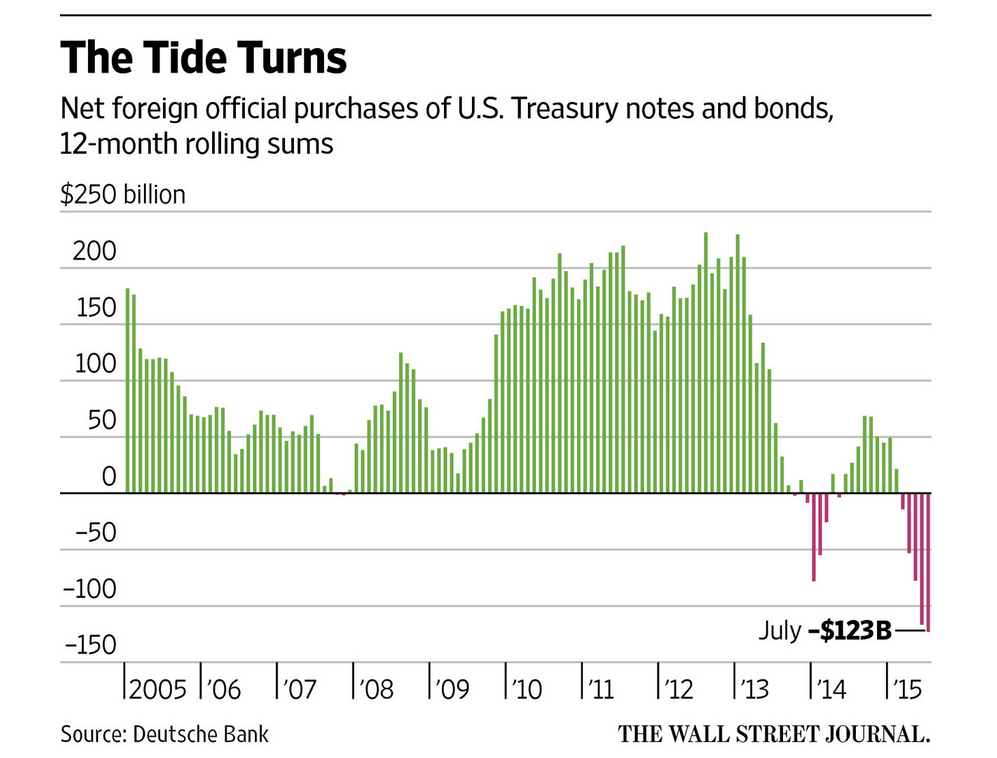
As we contemplate higher interest rates, foreigners are selling US Treasuries. While economic fundamentals will ultimately matter more than foreign fund flows, but it looks like foreign investors are cutting exposure ahead of higher rates. It probably will affect volatility, as primary dealers have pulled back market-making activity and Treasury markets have become less liquid in general.

Now that house prices are approaching the 2006 peaks, some are arguing that we are in another bubble. Affordability is down as wages have gone nowhere, and scarcity is driving up prices. FWIW, bubbles are psychological phenomenons – the occur when buyers (and lenders) believe an asset is special and cannot go anywhere but up. We won’t see another housing bubble in the US, but our grandkids might.

Morning Report: TRID to delay closings 10/6/15

Stocks are unchanged this morning as there is very little in the way of economic data / earnings to move markets. Bonds and MBS are down small.

The trade deficit widened to 48 billion in August as the strong dollar cuts exports and increases imports.

The IMF cut is global growth estimate to 3.1% from 3.3%. Blame weak commodity prices.

Economic Optimism improved markedly according to Investors Business Daily and TIPP Online. Many of these consumer confidence indices are merely inverse gasoline price indices. Falling gasoline prices makes people happy.

Home prices rose almost 7% in August on a year-over-year basis, according to CoreLogic. They are forecasting home price appreciation around 4.3% over the next year.

Bill Gross sees another 10% downside in stocks and is recommending sitting in cash for a while. His point is that corporate profits are flatlining as commodity prices hurt earnings in the energy patch and the strong dollar hurts manufacturers. Expect more layoffs in the energy sector. Bill Gross called the Chinese sell-off earlier this year as well as the German Bund sell off.

TRID is expected to delay closings as people get adjusted to the new rules.  CFPB Chairman Richard Cordray says the agency will give lenders who are making good-faith efforts to comply with the new rules a break: “Nobody believes that market participants are going to be trying to abuse consumers here; they’re trying to change their systems. So we’ll be diagnostic and corrective, not punitive, and there will be time for them to work to get it right and not be perfect on the first day,” said Cordray. We’ll see if that actually happens.

What to the French do well? Food, lifestyle, and labor strife. Propose job cuts and you are likely to get the shirt ripped off your back by an angry mob.

Morning Report: The markets and the Fed are on different pages 10/5/15

Markets are higher this morning on overseas strength. Bonds and MBS are down.

The Labor Market Conditions Index fell from a downward-revised 1.2 to zero. This has been the average since 2000.

The Markit US Composite PMI came in at 55, while the services PMI came in at 55.1. The ISM Non-Manufacturing Composite fell from 59 to 56.9.

Aftermath of the weak jobs report on Friday: Fed fund futures assign a 10% probability of an Oct hike, 30% probability of a December hike and 50% probability of a March hike. The markets are increasingly out of sync with what the Fed members are actually saying in the press. Note we get the FOMC minutes this Thursday. That will be the highlight of the week.

The Bernank weighs in on raising rates. His Rx: don’t. Separately, DoubleLine’s Jeffrey Gundlach thinks we have further downside in risk assets like junk bonds, US equities and emerging markets stocks and bonds. His point: people are holding and hoping these assets rebound. That isn’t the psychology of a bottoming process. That happens when people throw in the towel and sell.

It is looking like the Trans-Pacific Partnership free trade deal is pretty much done. It still has to get through Congress, although he did get fast-track approval. I suspect it won’t move the needle that much for the US economically. It is mainly about intellectual property protection for US firms.

Sometimes bad ideas get implemented, fail, become forgotten, and then come back, like Freddy Kreuger. One such idea is the financial transactions tax, also known as the Robin Hood tax. It is back in vogue in Europe, and Bernie Sander wants a 50 basis point tax on all stock trades, a 11 basis points on bonds and 5 on derivatives will be able to fund a slew of new government benefits. Don’t believe it. While leftist politicians love to promote ideas like this as new, they aren’t. They have been tried and discarded. Sweden implemented on in the 1980s, only to see most stock trading in Swedish stocks flee to London. The UK in fact did implement one for stock trades, and all it did was drive institutional investors to use swaps to sidestep it and retail investors to go to betting parlors like City Index. They will sell it as raising a lot of revenue – it won’t simply because it will kill high frequency trading, and volume will dry up. They will sell it as reducing volatility – some (not all, but some) of HFT is actually market-making which is stabilizing. We don’t really have market-makers or specialists on the floor of the New York Stock Exchange like we used to. You could make the argument that it will increase, not decrease volatility. Anyway, #FeelTheBern is big on this idea – he should take a look at how it has (not) worked in the past.

Morning Report: Terrible jobs report 10/2/15

Stocks are lower after the jobs report disappointed. Bonds and MBS are up big

Jobs report data dump:

  • Change in nonfarm payrolls +142k vs. +201k expected
  • Two month revision -59k
  • Unemployment rate 5.1% (in line with expectations)
  • Average Hourly earnings 0% month over month +2.2% YOY
  • Labor force participation rate falls to 62.4%

Very disappointing jobs report. No wage growth, and the labor force participation rate has fallen all the way back to Oct 1977 levels, which was the time when Reggie Jackson earned his nickname Mr October.

Stock index futures reversed a strong rally on the news. The 10 year bond yield dropped 12 basis points as well. It certainly looks like the decision to stand pat in September was the right one. For all the Fed’s discussion of October being a “live” FOMC meeting, consider it dead.

In other economic news, factory orders fell 1.7% in August and the ISM New York index fell to 44.5 from 51.1.

Yesterday, the House Financial Services Committee passed a bill to bring a bit of accountability and control to the CFPB. The director will be replaced with a 5 member commission, and there will be an inspector general. The CFPB is currently under the Fed, and gets its funding there. Congress has no say over their operations. This was intentional, to prevent a more conservative Congress from de-fanging the agency.

Finally, it looks like Hurricane Joaquin is going to miss the East Coast.

Morning Report: Slew of economic data this morning 10/1/15

Stocks are higher after yesterday’s rally. Given that yesterday was the end of a pretty lousy month (and quarter) it looked like people gunned the market a little to make their quarterly returns look a little better. Bond yields continue to grind lower.

The next two days are going to have a lot of economic data.

The ISM Manufacturing Index fell to 50.2 in September from 51.1 in August. 7 industries reported expansion, while 11 reported contraction. The slowdown in China and the strong US dollar are weighing on business confidence. A 50.2 reading would correspond to about a 2.2% GDP growth rate.

Construction spending rose 0.7% in August, which was better than the 0.5% Street estimate. Residential construction is up 1.3% for the month and 16% for the year.

Initial Jobless Claims rose to 277k last week. We continue to bounce around the lows with this number. That said….

Jobless Claims may be increasing in the future, as Challenger and Gray announced job cuts increased 93%. This indicator combs the newswires for companies making announcements for job cuts. Something like 58,000 job cut announcements were made in September, with the 30,000 cuts at HP accounting for most of it.

The Bloomberg Consumer Comfort index rose to 43 from 41.9 last week.

Auto sales numbers are looking strong. Fiat Chrysler jeep sales are up 40%. Amazing what cheap gasoline can do.