Posted on October 5, 2015 by Brent Nyitray
Markets are higher this morning on overseas strength. Bonds and MBS are down.
The Labor Market Conditions Index fell from a downward-revised 1.2 to zero. This has been the average since 2000.
The Markit US Composite PMI came in at 55, while the services PMI came in at 55.1. The ISM Non-Manufacturing Composite fell from 59 to 56.9.
The Bernank weighs in on raising rates. His Rx: don’t. Separately, DoubleLine’s Jeffrey Gundlach thinks we have further downside in risk assets like junk bonds, US equities and emerging markets stocks and bonds. His point: people are holding and hoping these assets rebound. That isn’t the psychology of a bottoming process. That happens when people throw in the towel and sell.
It is looking like the Trans-Pacific Partnership free trade deal is pretty much done. It still has to get through Congress, although he did get fast-track approval. I suspect it won’t move the needle that much for the US economically. It is mainly about intellectual property protection for US firms.
Sometimes bad ideas get implemented, fail, become forgotten, and then come back, like Freddy Kreuger. One such idea is the financial transactions tax, also known as the Robin Hood tax. It is back in vogue in Europe, and Bernie Sander wants a 50 basis point tax on all stock trades, a 11 basis points on bonds and 5 on derivatives will be able to fund a slew of new government benefits. Don’t believe it. While leftist politicians love to promote ideas like this as new, they aren’t. They have been tried and discarded. Sweden implemented on in the 1980s, only to see most stock trading in Swedish stocks flee to London. The UK in fact did implement one for stock trades, and all it did was drive institutional investors to use swaps to sidestep it and retail investors to go to betting parlors like City Index. They will sell it as raising a lot of revenue – it won’t simply because it will kill high frequency trading, and volume will dry up. They will sell it as reducing volatility – some (not all, but some) of HFT is actually market-making which is stabilizing. We don’t really have market-makers or specialists on the floor of the New York Stock Exchange like we used to. You could make the argument that it will increase, not decrease volatility. Anyway, #FeelTheBern is big on this idea – he should take a look at how it has (not) worked in the past.
Filed under: Morning Report | 15 Comments »
Posted on October 2, 2015 by Brent Nyitray
Stocks are lower after the jobs report disappointed. Bonds and MBS are up big
- Change in nonfarm payrolls +142k vs. +201k expected
- Two month revision -59k
- Unemployment rate 5.1% (in line with expectations)
- Average Hourly earnings 0% month over month +2.2% YOY
- Labor force participation rate falls to 62.4%
Very disappointing jobs report. No wage growth, and the labor force participation rate has fallen all the way back to Oct 1977 levels, which was the time when Reggie Jackson earned his nickname Mr October.
Stock index futures reversed a strong rally on the news. The 10 year bond yield dropped 12 basis points as well. It certainly looks like the decision to stand pat in September was the right one. For all the Fed’s discussion of October being a “live” FOMC meeting, consider it dead.
In other economic news, factory orders fell 1.7% in August and the ISM New York index fell to 44.5 from 51.1.
Yesterday, the House Financial Services Committee passed a bill to bring a bit of accountability and control to the CFPB. The director will be replaced with a 5 member commission, and there will be an inspector general. The CFPB is currently under the Fed, and gets its funding there. Congress has no say over their operations. This was intentional, to prevent a more conservative Congress from de-fanging the agency.
Finally, it looks like Hurricane Joaquin is going to miss the East Coast.
Filed under: Morning Report | 28 Comments »
Posted on October 1, 2015 by Brent Nyitray
Stocks are higher after yesterday’s rally. Given that yesterday was the end of a pretty lousy month (and quarter) it looked like people gunned the market a little to make their quarterly returns look a little better. Bond yields continue to grind lower.
The next two days are going to have a lot of economic data.
The ISM Manufacturing Index fell to 50.2 in September from 51.1 in August. 7 industries reported expansion, while 11 reported contraction. The slowdown in China and the strong US dollar are weighing on business confidence. A 50.2 reading would correspond to about a 2.2% GDP growth rate.
Initial Jobless Claims rose to 277k last week. We continue to bounce around the lows with this number. That said….
Jobless Claims may be increasing in the future, as Challenger and Gray announced job cuts increased 93%. This indicator combs the newswires for companies making announcements for job cuts. Something like 58,000 job cut announcements were made in September, with the 30,000 cuts at HP accounting for most of it.
The Bloomberg Consumer Comfort index rose to 43 from 41.9 last week.
Filed under: Morning Report | 26 Comments »
Posted on September 30, 2015 by Brent Nyitray
Stocks are up this morning on no real news. Feels like end of month / quarter window dressing. Bonds and MBS are down small
Mortgage Applications fell 6.7% last week as purchases fell 5.6% and refis fell 7.5%.
The ISM Milwaukee index fell to 39.44 from 47.7 last month. The Chicago Purchasing Manager Index fell to 48.7 from 54.4. The strong dollar is taking its toll on manufacturers.
All cash sales dropped to 31% in June, according to Corelogic. The historical, pre-bubble average is close to 25%. This speaks to the lack of first time homebuyers. It also speaks to an increase in gettable loans as that number reverts to the mean, even if home sales remain flat.
One of the big questions facing the Fed concerns falling unemployment and a falling labor force participation rate. Intuitively, you would think that as unemployment falls, people who are not currently in the labor force but want to be would find jobs, which would push up the participation rate. If the labor force participation rate remains low, that means the potential growth of the economy remains low, which means a slow, plodding recovery that won’t feel like any sort of economic boom. It also means inflation should, at least in theory, come back as companies bid up the wages of the fewer workers that are left. So far we aren’t seeing that. Millennials should be picking up the slack of retiring boomers but so far it hasn’t happened. And if Millennials don’t do it, then you need to pick up immigration.
Filed under: Morning Report | 15 Comments »
Posted on September 29, 2015 by Brent Nyitray
Markets are up this morning on good economic news overseas. Bonds and MBS are up small.
Consumer Confidence increased to 103 in September from 101.3.
NAR is saying they expect TRID to delay closings by up to 15 days. There will undoubtedly be a learning curve for the industry. TRID is the biggest change to the industry since the implementation of Dodd-Frank. CFPB claims they will use discretion in not going after lenders who make mistakes but are making a good-faith effort to work within the rules.
NAR put out the list of the 20 hottest real estate markets. While some at the top are not surprising (San Francisco) some of the other names are more associated with the economic dumpster fires we saw as the collapse began. Cities like Stockton CA and Detroit MI are included in the 20 hottest markets.
Glencore (which used to be called Xstrata) is a Swiss commodity trader who has been subject to solvency rumors. The stock has gotten hammered over the past year (down over 80%) but is up big today after addressing market rumors about solvency problems. While real estate types don’t typically have to worry about what happens in the area of precious metals, energy, and ag, stress in these markets can spill over to the rest of the financial sector. What does this mean for LOs? Stress = lower interest rates.
Speaking of stress, mutual funds that mimic hedge fund strategies may find themselves wrapped around the axle if we have a period of stress. Hedge fund arbitrage strategies typically require leverage and often invest in illiquid assets. Hedge funds at least have quarterly redemptions, which makes it easier to exit positions if need be. Mutual funds have no wiggle room – they have to accept redemptions daily. This could get ugly if markets turn south.
Filed under: Morning Report | 13 Comments »
Posted on September 28, 2015 by Brent Nyitray
Stocks are lower this morning on no real news. Bonds and MBS are up.
We have some important data this week, with construction spending, the ISM data and the jobs report on Friday. The market is forecasting a jump in wage inflation and that will be the number everyone is going to focus on.
Personal Spending rose 0.4% and Personal Income rose 0.3% in August. Inflation came in at 0.1% month-over-month and up 1.3% year-over-year.
Pending Home Sales fell 1.4% in August, but are up 6.7% year-over-year.
The Dallas Fed Manufacturing Index came in less negative than forecast.
On Friday, Speaker of the House John Boehner announced he was resigning. At the margin, it probably means a clean continuing resolution (in other words, no government shutdown). This isn’t going to matter to the markets one way or another – they recognize government shutdowns and debt ceiling fights as what they are: a chance for politicians to posture, and otherwise something to ignore.
The favorite to replace Boehner is Kevin McCarthy from California.
Speaking of government shutdowns and the debt ceiling, it does have an effect on the bond markets. The debt ceiling’s proximity means the government has to issue less T-bills than it ordinarily would, which makes them scarce and therefore they have ultra-low interest rates. This is bad news for money market funds and other savers. That said, ZIRP is the primary reason the issue.
Filed under: Morning Report | 31 Comments »
Posted on September 25, 2015 by Brent Nyitray
Markets are higher this morning after Janet Yellen soothed concerns over global growth and said the Fed is probably still going to raise rates this year. Bonds and MBS are down.
I see a headline coming across the tape that House Speaker John Boehner is going to resign from Congress, according to the New York Times. Don’t see anything on the NYT site, but if so, this is big news.
The third revision to second quarter GDP came in at +3.9%. Personal consumption was revised upward to 3.6% from 3.1%. Inflation remains more or less at the Fed’s target rate of 2%. 3Q GDP forecasts are much lower, in the 1% – 2% range.
Consumer sentiment slipped in September, according to the University of Michigan. This is the lowest reading in a year.
Janet Yellen spoke yesterday, and said the Fed will probably still raise rates this year, however they were willing to let the labor market run hot for a while. The markets were cheered by these statements. She mentioned getting discouraged workers back into the workforce, and that is somewhat new – historically, they have focused on unemployment and wage inflation. Here is a deeper dive into what she was talking about. Interestingly, the Fed thinks that early on ZIRP had little to no effect on the economy, and that only now, are we starting to see the economic benefits of ZIRP. IMO, it has always been about real estate prices. Once real estate bottomed in 2011 / 2012 the economy began a more robust recovery.
Filed under: Morning Report | 26 Comments »
Posted on September 24, 2015 by Brent Nyitray
Markets are lower this morning after Caterpillar warned and announced it will cut 5,000 jobs. Bonds and MBS are up.
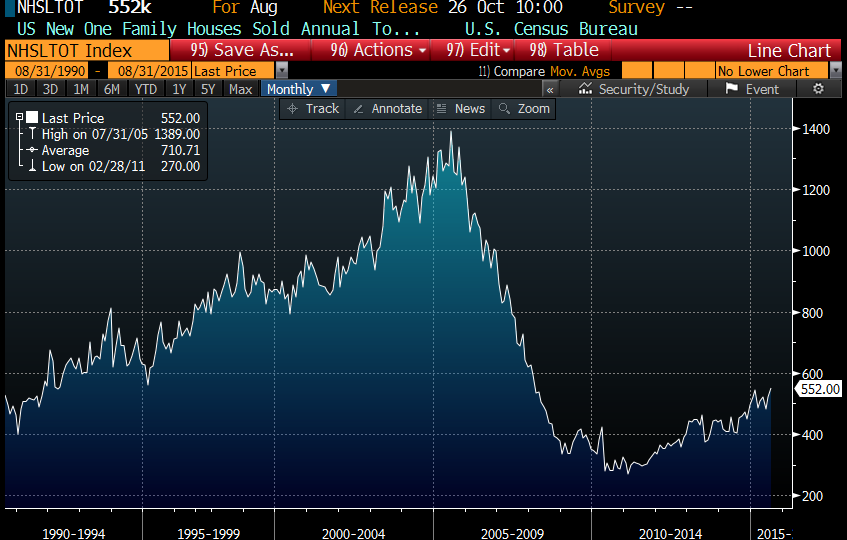
New Home Sales rose to an annualized 552k in August, which easily beat expectations. While new home sales have more than doubled from their early 2011 lows, we are still well below what could be considered “normalcy.”
Durable Goods orders fell 2% in August, coming in better than estimates. Capital Goods Orders (a proxy for business capital expenditures) fell 0.2% versus expectations of 0.5%.
The Chicago Fed National Activity Index slipped in August from 0.51 to -.41. This index has had one positive reading all year.
Initial Jobless Claims came in at 267k. The Bloomberg Consumer Comfort Index fell to 41.9.
Builder KB Home reported better than expected earnings this morning but disappointed on orders. Orders were up 19% to 2,167 units. Backlog increased 36%. Average selling prices rose 9% to $357.2k from $327k. The stock is down about half a buck on the open.
Filed under: Morning Report | 21 Comments »
Posted on September 23, 2015 by Brent Nyitray
Markets are flattish this morning on no real news. Bonds and MBS are down small.
Mortgage Applications rose 13.9% last week, with purchases rising 9.1% and refis rising 17.7%. Refis increased to 58.4% of all loans. This was the first full week after the Labor Day holiday, so don’t break out the champagne quite yet – the increase was due to a holiday-shortened week before.
Mario Draghi (European Central Bank President) said more time is needed to assess whether more stimulus is needed.
Bill Gross wrote about financial repression (essentially having rates pegged at the zero bound) and the risks it poses to the financial system. He makes the point that pension funds are getting hammered because they cannot generate the required return on assets with safe assets so they are taking more and more risk, citing municipalities like Chicago, Detroit, etc. He argues that we should be willing to take some short-term financial pain for longer term financial stability. Of course Dr. Cowbell has a different take, which is that bankers want higher rates because they hate poor people and want them to suffer. Or something.
Has ATR and HMDA restricted mortgage credit? Not according to the Fed. Probably because credit has been highly restrictive since 2008. It couldn’t have gotten any tighter to begin with. Note that QM was intended to make lender more likely to lend. Given what we have seen with the big banks exiting FHA (Wells and Chase), the CFPB’s new rules aren’t having the desired effect.
Filed under: Morning Report | 24 Comments »
Posted on September 22, 2015 by Brent Nyitray
Stocks are lower this morning on overseas weakness and slumping commodity prices. Bonds and MBS are up.
The Richmond Fed Manufacturing Index fell in September. The strong dollar is hurting manufacturing.
Scott Walker dropped out of the Republican presidential campaign yesterday. His staffers went to the Rubio campaign, which tells you how the pros are reading the tea leaves with respect to the Republican presidential nomination.
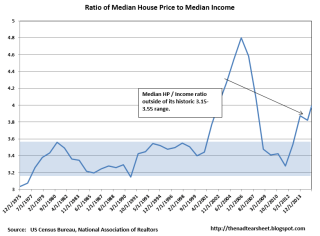
Housing affordability is the lowest since 2008, as the median house price to median income ratio becomes stretched again. Affordability peaked between 2011 and 2013, however professional investors were the ones in a position to take advantage of it. Credit conditions continue to improve, but are still a fraction of what they were pre-crisis.
The big banks are backing away from the FHA market, citing regulation and worries about giving loans to 520 FICO borrowers who only put 3.5% down. Separately, Ginnie Mae is worried about the fact that small independent mortgage bankers are filling the void left by the big banks. The industry is concerned that the big bank withdrawal is hurting the housing recovery.
Filed under: Morning Report | 22 Comments »


 Brent Nyitray
 Fairlington Blade
 Let the mutherfuker burn!
 jnc4p
jnc4p Kevin S. Willis
 Michigoose
 lmsinca
 markinaustin
 Arcanaut
 novahockey
 quarterback
 ScottC
 yellojkt