Morning Report: PCE Inflation comes in as expected

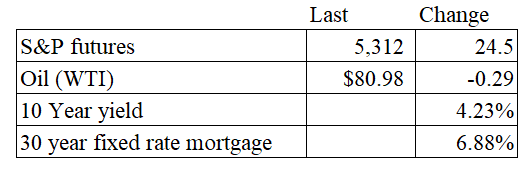
Markets are closed for the Good Friday Holiday.

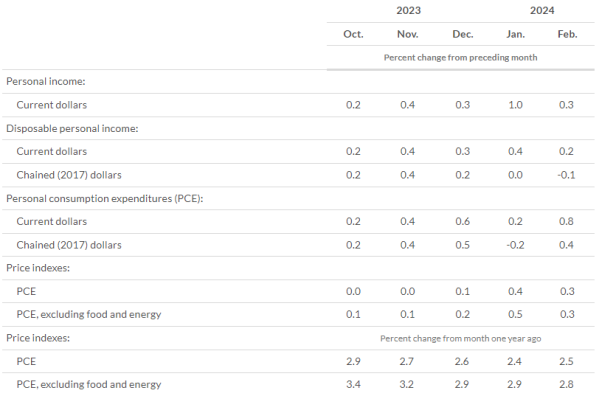
Personal Incomes rose 0.3% in February, while spending rose 0.8%. The all-important PCE Price Index rose 0.3% MOM, which was a deceleration from the 0.4% increase in January, but higher than the numbers were were seeing in the fourth quarter of 2023. Excluding food and energy, the index rose 0.3%. The annual rates continued their general downward trend, with the annual headline number falling to 2.5% and the core rate falling to 2.8%.
Pending Home Sales grew 1.6 month-over-month in February, according to NAR. Pending Home Sales fell 7% on a year-over-year basis however. NAR expects to see more inventory hit the market, however which should boost sales. “While modest sales growth might not stir excitement, it shows slow and steady progress from the lows of late last year,” said NAR Chief Economist Lawrence Yun. “Ongoing job gains are clearly increasing demand along with more inventory. The high-cost regions in the Northeast and West experienced pullbacks due to affordability challenges,” added Yun. “Home prices rising faster than income growth is not healthy and adds challenges for first-time buyers.”

Yun further noted, “There will be a steady rise in inventory from recent growth in home building. Additionally, many sellers, who delayed listing in the past two years, will begin to put their homes on the market to move to a different home that better fits their new life circumstances – such as changes in family composition, jobs, commuting patterns and retirees wanting to be closer to their grandkids.”   

Consumer sentiment improved in March, according to the University of Michigan Consumer Sentiment Survey. “Consumer sentiment recorded an incremental increase of less than three index points from February, well within the margin of error and stable since January. Critically, consumers exhibited confidence that inflation will continue to soften. Assessments and expectations of personal finances improved modestly from last month, as the perceived negative effects of high prices and expenses on living standards eased. Strong stock market performance this month supported sentiment gains only for those with the largest holdings, with little impact on the index. Overall, sentiment is essentially unchanged throughout the first quarter of 2024, remaining just shy of the midpoint between the pre-pandemic level of sentiment and the historic trough from June 2022.”

Importantly, consumers’ forecasts for inflation continued to improve. Year-ahead expectations fell from 3.0% to 2.9%, while long-term expectations fell from 2.9% to 2.8%. The Fed pays attention to UMich and has mentioned it in its minutes.

Morning Report: Slightly dovish Fed meeting

Vital Statistics:

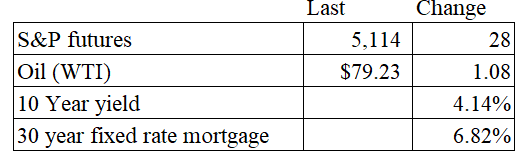
Stocks are higher this morning after the Fed’s statement kicked off another rally. Bonds and MBS are up.

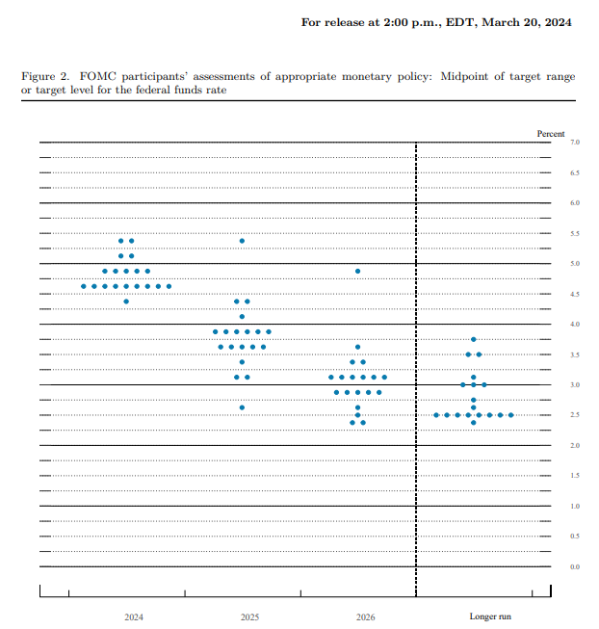
The Fed maintained the Fed Funds rate at current levels as expected and signaled that it would begin cutting this year. The dot plot was pretty similar to December, which signaled three rate cuts this year. The fear going into the meeting was that the majority of voters might move from 3 cuts to 2, but that didn’t happen. That said, there were more votes for 2 cuts than there were in December.

In the economic projections, the Fed raised their estimate for this year’s GDP growth from 1.4% to 2%, pushed down their estimate for unemployment from 4.1% to 4% and increased their estimate for core inflation growth from 2.4% to 2.6%.

During the press conference, Jerome Powell said that the recent disappointing inflation numbers might be due to seasonality, and he also said that the Fed might begin to taper its balance sheet runoff. I think the comments on tapering QT were a surprise to the market. Theoretically this should be a positive for MBS spreads, although the Fed’s MBS portfolio is way out of the money, and the only runoff will be from people who are moving.

When asked about shelter inflation, he mentioned that rents seem to be cooling off and he was convinced that overall inflation would move lower.

Overall, the stock market liked the decision and the bond market seemed to take comfort in the fact that quantitative tightening might decrease going forward. The yield curve became slightly less inverted, with the 2s-10s spread going from -36 basis points to -32 basis points. Given the strength of the overall economy, it is surprising to see an inverted yield curve.

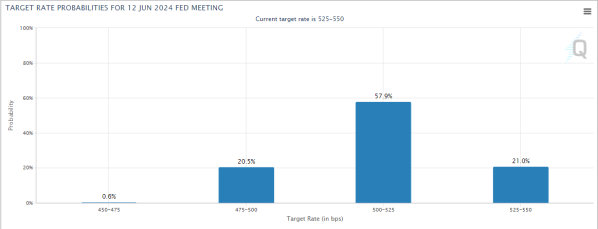
The Fed Funds futures didn’t make any dramatic changes, although the June chances of a rate cut increased from about 60% to 75%, while the December futures remained at three cuts. The December futures are handicapping a bigger chance of 100 basis points than 50 this year.

Overall, the Fed statement and press conference was mildly bullish, and the big takeaways are that (a) the Fed seems unconcerned about the recent hot inflation prints and (b) the Fed wants to slow its balance sheet reduction which should be supportive to the 10 year bond and MBS spreads.

Redfin was out with their take on the meeting and its impact on mortgage rates: “Mortgage rates are still expected to fall gradually this year as the Fed solidifies its plans to cut rates this year. When enough economic data accumulates to set the stage for that, rates will start to drop. However, we don’t expect rates to drop precipitously. We should end the year in the low 6% range. That means the housing market won’t shift dramatically this year, but we do expect more supply and transactions this year amidst weakening price growth.”

Deutsche Bank strategist Jim Reid had this to say: “Last night saw a remarkably relaxed Fed as Powell indicated that January’s higher inflation could have been seasonal, and February’s print had already seen improvements,” said Deutsche Bank’s Jim Reid, adding that Powell’s dovish-leaning press conference drove equities higher and yields lower. “Our economists continue to expect the first rate cut to come in June with 100 bps of cuts in total this year, but with risks skewed to a more hawkish outcome,” Reid added.

Morning Report: Wholesale inflation comes in hot

Vital Statistics:

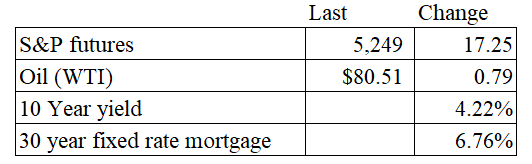
Stocks are higher this morning on no real news. Bonds and MBS are down.

Retail sales rose 0.6% in February, which was a touch below expectations. On a year-over-year basis retail sales were up 1.5%. These numbers are not adjusted for inflation, so it is an indication that spending is on the weaker side. January’s numbers were revised downward, which is typical these days.

Inflation at the wholesale level increased 0.6% in February, which was an acceleration from January and December. About 70% of the increase was due to energy prices, particularly gasoline. Excluding food and energy, wholesale prices rose 0.3%.

Initial Jobless Claims fell to 209,000 last week.

Biden is proposing a $10,000 tax credit for first-time homebuyers and people who sell their starter home. The admin is also directing FHFA to waive title insurance fees and telling CFPB to go after fees at closing. Ultimately the problem is supply and interest rates, so the going after closing costs and goosing demand probably isn’t going to do much.

Since the inflation numbers aren’t going to allow the Fed to cut as much as necessary to lower mortgage rates, one way to attack the problem is to target MBS spreads. FHFA can tell Fannie Mae and Freddie Mac buy MBS again which was part of their job prior to the financial crisis.

Homebuilder Lennar reported first quarter earnings yesterday. Revenues rose 13%, which was driven by a 23% increase in units and a 8% decline in average selling prices. Gross margins expanded to 21.8% compared to 21.3% a year ago. The increase in gross margins were driven by decreased construction costs which was offset by a decline in average selling prices and higher land costs. Lennar is holding much less land in inventory than it has in the past.

Earnings were $719 million and the company spent $506 million buying back stock.

Morning Report: Decent jobs report

Vital Statistics:

Stocks are higher this morning after the jobs report. Bonds and MBS are up small.

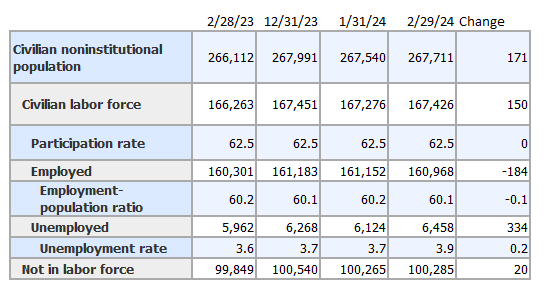
The economy added 275,000 jobs in February, which was way more than expected. The unemployment rate ticked up from 3.7% to 3.9%, while average hourly earnings rose 0.1%. The headline numbers are indicative of a strong labor market.

January’s payroll number was revised downward substantially, from a gain of 353,000 to a gain of 229,000. The February payroll number was another case of statistical adjustments accounting for the increase, as the number of people with jobs actually fell by 184,000. The number of unemployed people rose by 334k.

The Fed will be happy with the decline in wage growth, and the overall message that the labor market is coming more into balance.

Jerome Powell said yesterday that the Fed is close to cutting rates. “I think we are in the right place,” Powell said of the current stance of monetary policy in a hearing before the Senate Banking Committee. “We are waiting to become more confident that inflation is moving sustainably down to 2%. When we do get that confidence, and we’re not far from it, it will be appropriate to begin to dial back the level of restriction so that we don’t drive the economy into recession.”

When asked about concerns over workers losing their jobs, Powell said: “We’re well aware of that risk, of course, and very conscious of avoiding it,” Powell said. “If what we expect and what we’re seeing – continued strong growth, strong labor market and continuing progress in bringing inflation down – if that happens, if the economy evolves over that path, then we do think that the process of carefully removing the restrictive stance of policy can and will begin over the course of this year.”

These comments helped push the 10 year bond yield to the lowest level in over a month. The Fed Funds futures for March didn’t change, but the June futures are showing a roughly 80% chance of a rate cut.

Morning Report: Jerome Powell signals no imminent rate cuts

Vital Statistics:

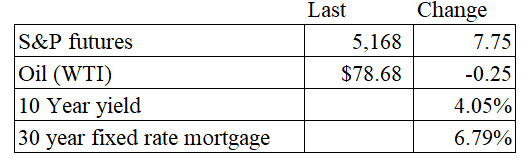
Stocks are higher after Super Tuesday gave unsurprising results. Bonds and MBS are up small.

Jerome Powell heads to the Hill today for his semiannual Humphrey-Hawkins testimony. Here are his prepared remarks. Punch line: Rate cuts are coming, but not imminent:

We believe that our policy rate is likely at its peak for this tightening cycle. If the economy evolves broadly as expected, it will likely be appropriate to begin dialing back policy restraint at some point this year. But the economic outlook is uncertain, and ongoing progress toward our 2 percent inflation objective is not assured. Reducing policy restraint too soon or too much could result in a reversal of progress we have seen in inflation and ultimately require even tighter policy to get inflation back to 2 percent. At the same time, reducing policy restraint too late or too little could unduly weaken economic activity and employment. In considering any adjustments to the target range for the policy rate, we will carefully assess the incoming data, the evolving outlook, and the balance of risks. The Committee does not expect that it will be appropriate to reduce the target range until it has gained greater confidence that inflation is moving sustainably toward 2 percent.

The questions from Congress will be interesting. I am sure that many in Congress are getting itchy for rate cuts, especially since consumers are rather down on the economy overall, which tends to lead to a bad election season for incumbents.

The private sector added 140k jobs in February, according to the ADP Employment Report. Wage gains for job changers accelerated from 7.2% to 7.6%. Overall wage inflation was 5.1%. “Job gains remain solid. Pay gains are trending lower but are still above inflation,” said Nela Richardson, chief economist, ADP. “In short, the labor market is dynamic, but doesn’t tip the scales in terms of a Fed rate decision this year.

Leisure / hospitality added 41,000 jobs in February, followed by construction. The Street was looking for 150,000 jobs, so this was a bit lower than expected. The Street is looking for 190,000 jobs in Friday’s jobs report.

Mortgage applications rose 9.7% last week as purchases rose 12% and refis rose 8%. “The latest data on inflation was not markedly better nor worse than expected, which was enough to bring mortgage rates down a bit, with the 30-year fixed mortgage rate declining slightly last week to 7.02 percent,” said Mike Fratantoni, MBA’s SVP and Chief Economist. “Mortgage applications were up considerably relative to the prior week, which included the President’s Day holiday. Of note, purchase volume – particularly for FHA loans – was up strongly, again showing how sensitive the first-time homebuyer segment is to relatively small changes in the direction of rates. Other sources of housing data are showing increases in new listings, which is a real positive for the spring buying season given the lack of for-sale inventory.”

Home prices rose 5.8% in January, according to CoreLogic. “U.S. annual home price growth strengthened to 5.8% in January 2024,” said Dr. Selma Hepp, chief economist for CoreLogic. “And while the acceleration continues to reflect the residual impact of strong appreciation in early 2023, the annual rate of growth is expected to taper off in coming months.”

“Home prices further increased in late 2023 despite high mortgage rates, which surged to the highest level since the beginning of the millennium,” Hepp continued. “But metro areas that have struggled with the impact of higher rates continue to see downward movement on home prices. Generally, pressures from higher mortgage rates tend to occur in markets where the higher cost of homeownership pushes against the affordability ceiling.”