Morning Report: FedEx profit warnings spooks the markets

Vital Statistics:

 LastChange
S&P futures3,870-40.50
Oil (WTI)86.201.16
10 year government bond yield 3.48%
30 year fixed rate mortgage 6.17%

Stocks are lower this morning after economic bellwether FedEx withdrew its guidance based on a deteriorating economy. Bonds and MBS are down.

FedEx stock is down some 23% this morning after it issued a profit warning. Note that Fed Ex is on a May fiscal year. “Global volumes declined as macroeconomic trends significantly worsened later in the quarter, both internationally and in the U.S. We are swiftly addressing these headwinds, but given the speed at which conditions shifted, first quarter results are below our expectations,” said Raj Subramaniam, FedEx Corporation president and chief executive officer. “While this performance is disappointing, we are aggressively accelerating cost reduction efforts and evaluating additional measures to enhance productivity, reduce variable costs, and implement structural cost-reduction initiatives. These efforts are aligned with the strategy we outlined in June, and I remain confident in achieving our fiscal year 2025 financial targets.”

It looks like the rate increases are beginning to be felt, and we will be seeing more of this. FedEx is kind of an economic canary in the coal mine. It looks like the Fed’s rate hikes are gaining some traction.

Consumer sentiment improved in September, according to the University of Michigan Consumer Sentiment Survey. Most notably, the median expected inflation rate declined to 4.6%, the lowest reading in a year. The Fed pays close attention to this number because inflationary expectations are a critical input into inflation. Inflation uncertainty is the highest it has been since 1982 however, which is a concern.

The rise in interest rates this year has caused MBS spreads to widen considerably. MBS spreads describe the difference between the mortgage rate and a Treasury of similar maturity. When MBS spreads are large (aka “wide” in trader parlance) it means that mortgage rates are high relative to underlying interest rates. This describes the current state of affairs, as MBS spreads have widened considerably this year. We are at 10 year highs (setting aside the short spike in the initial days of COVID).

Morning Report: Retail sales rise

Vital Statistics:

 LastChange
S&P futures3,950-16.50
Oil (WTI)86.85-1.56
10 year government bond yield 3.44%
30 year fixed rate mortgage 6.12%

Stocks are lower this morning on no real news. Bonds and MBS are down.

Retail sales rose 0.3% MOM in August, which was above expectations. Ex-vehicles they fell 0.3%. Ex-vehicles and gas, they increased 0.3%. Miscellaneous store retailers rose 1.6% MOM and 15.3% YOY. Departments stores rose 0.9%. Food and drinking places rose 1.1% MOM and 10.9% YOY.

The miscellaneous and department store numbers bode well for the back-to-school shopping season which is a good harbinger for the holiday shopping season.

We received a couple Fed reports this morning – the Empire State and Philly Fed regional reports. These reports discuss business conditions generally for the Northeast and Mid-Atlantic. These reports are generally not market moving however the Fed does pay attention to them. Business conditions are slowing overall, but more importantly we are seeing declines in the prices paid and prices received indices. These are more anecdotal measures of inflation, but are encouraging data points for the Fed.

Industrial production fell 0.2% in August, according to the Fed. Manufacturing production rose 0.1%. Capacity Utilization fell to 80%. So far, it doesn’t look like the Fed’s tightening has affected the manufacturing sector yet.

The labor market remains tight as well, with initial jobless claims falling to 213k. Historically, this is an extremely low number. The Fed wants to see the unemployment number tick up in order to slow down wage growth. I know that seems counter-intuitive but it will keep pressure on the Fed to keep hiking rates.

The yield curve continues to invert as the 2 year yield has been rocketing upward. 2s 10s are out to 40 basis points, and 2s 30s are out to 36 basis points. This is a recessionary indicator, and it shows the long end of the curve hanging in there while the short end rises. Note mortgage rates are still rising as mortgage backed security spreads widen. This means the difference between the market mortgage rate and a Treasury of comparable maturity is increasing.

It appears the government has averted a rail strike, which should help prevent even more supply chain issues. That would have been disastrous for the economy if it lasted for any length of time.

Morning Report: Wholesale inflation falls

Vital Statistics:

 LastChange
S&P futures3,9599.50
Oil (WTI)88.431.16
10 year government bond yield 3.43%
30 year fixed rate mortgage 5.97%

Stocks are higher this morning after yesterday’s bloodbath. Bonds and MBS are down small.

Inflation at the wholesale level fell 0.1% MOM and rose 8.7% YOY. The decline was driven primarily by a big decrease in energy prices. Ex-food and energy, the monthly index rose 0.2% MOM and 8.1% YOY. The report was more or less in line with Street expectations, so we aren’t seeing any sort of major reaction in the markets.

The encouraging thing is that the monthly core numbers (ex food, energy and trade services) is on a general downtrend over the past year. Will this have an effect on the Fed’s plans next week? Nope.

The Fed Funds futures now see a 70% chance of a 75 basis point hike and a 30% chance of a 100 basis point hike.

The effect on the yield curve is much more pronounced at the short end. The 2 year bond yield has picked up 23 basis points in yield over the past two days, while the 10 year is up about 8 basis points. The yield curve continues to invert, and the spread between the 2 year and the 10 year is now negative 36 basis points. The amount of tightening that has yet to hit the market is piling up. IMO, this is going to increase the chance for a hard landing.

Luckily since mortgage rates are more influenced by longer-term rates we aren’t seeing much of an impact on mortgages, at least not yet.

Mortgage applications fell 1.2% last week as purchases increased 0.2% and refis fell by 4%. Last week was short with the Labor Day holiday. “The 30-year fixed mortgage rate hit the six percent mark for the first time since 2008 – rising to 6.01 percent – which is essentially double what it was a year ago,” said Joel Kan, MBA Associate Vice President of Economic and Industry Forecasting. “Higher mortgage rates have pushed refinance activity down more than 80 percent from last year and have contributed to more homebuyers staying on the sidelines. Government loans, which tend to be favored by first-time buyers, bucked this trend and increased over the week, driven mainly by VA and USDA lending activity.”

Median incomes fell about 2.9% to $67,251 in 2020, according to the Census Bureau. I’m sure the pandemic wreaked havoc on the numbers, so I would put an asterisk next to this one.

Morning Report: No relief on the inflation front

Stocks are lower this morning after the consumer price index (a measure of inflation) came in higher than expected. Bonds and MBS are down.

The consumer price index rose 0.1% in August, which was higher than expected. The Street was looking for 0.1% decrease as energy prices have been falling. On a year-over-year basis, prices rose 8.3%.

If you strip out food and energy, prices rose 0.6% MOM and 6.3% YOY. These were both higher than expected. Energy prices fell 5% MOM while food increased 0.8%. Higher prices for motor vehicles put upward pressure on the index.

The reaction in the markets was swift and severe. The S&P 500 futures went from a 0.75% increase for the day to a 2% decrease. In the bond market, the reaction was even more dramatic with the 10 year yield rising from 3.29% to 3.45%. The two-year spiked from 3.51% to 3.75%.

The Fed Funds futures were already predicting a 75 basis point increase at next week’s Fed meeting, and are now pricing in a 18% chance of a 100 basis point hike. The November futures are now pricing in a 75 basis point hike as well. The December futures now see a better-than-70% chance for a 4 handle on the Fed funds rate at the end of the year.

Needless to say, this report is highly bearish and raises the chance of a hard landing in the US economy. We are conceivably talking about 400 basis points in hikes over the course of 9 months, which is comparable to the rate hikes in the early 1980s in terms of magnitude.

Given that we started the year with negative GDP growth, and we haven’t begun to feel the effects of the summer rate hikes, I think a recession is inevitable, though the NBER will pull out all the stops trying to prevent itself from declaring one.

Notwithstanding the CPI print, the National Federation of Independent Businesses sees inflation beginning to moderate. The NFIB Small Business Optimism index improved in August as the outlook brightened. That said, we are coming from pretty depressed levels.

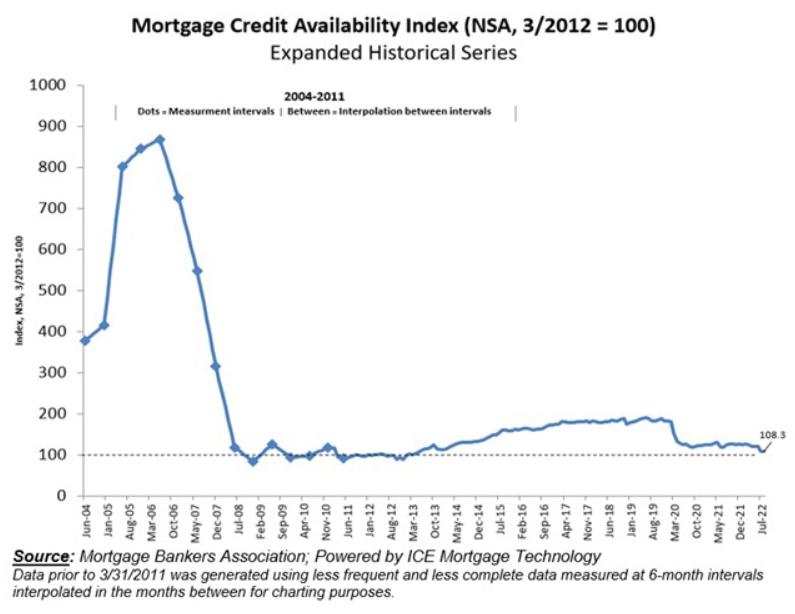
Mortgage credit availability declined for the sixth straight month in August, according to the MBA. “Mortgage credit availability declined slightly in August, as investors reduced their offerings of ARM and non-QM loan programs,” said Joel Kan, MBA Associate Vice President of Economic and Industry Forecasting. “As overall origination volume is expected to shrink in 2022, some lenders continue to streamline their operations by dropping certain loan programs to simplify their offerings. Additionally, with a worsening economic outlook and signs of cooling in home-price growth, the appetite for riskier loan programs has been reduced.”

As you can see from the chart below, mortgage credit is almost back to the bad old days in the aftermath of the bubble.

Morning Report: Inflation data looms large this week

Vital Statistics:

 LastChange
S&P futures4,10821.5
Oil (WTI)88.481.72
10 year government bond yield 3.29%
30 year fixed rate mortgage 5.96%

Stocks are higher this morning on no real news. Bonds and MBS are flat.

The upcoming week will be dominated by the consumer price index report tomorrow and the producer price index on Wednesday. On Friday, we will get the University of Michigan consumer sentiment survey which should include inflation expectations. There will be no Fed-speak this week as we are in the quiet period ahead of the FOMC meeting next week.

The Fed Funds futures see a 88% chance of a 75 basis point hike next week. The impact of 225 basis points in rate hikes (75 in June, July and September) hasn’t even begun to be felt. We could be looking at a major slowdown at the end of the year.

The Atlanta Fed GDP Now index now sees 1.3% growth in the third quarter.

Note that we will get retail sales this week, which should contain the back-to-school spending numbers. BTS is generally a good predictor of the holiday shopping season.

Morning Report: Home Purchase sentiment is dour

Vital Statistics:

 LastChange
S&P futures4,03428.75
Oil (WTI)86.242.69
10 year government bond yield 3.26%
30 year fixed rate mortgage 5.94%

Stocks are higher this morning on no real news. Bonds and MBS are up small.

The Fannie Mae Home Purchase Sentiment Index fell in August as rising home prices and mortgage rates combined to make buyers reluctant to purchase. “The share of consumers expecting home prices to go down over the next year increased substantially in August. Accompanying this, HPSI respondents reported a significant decrease in home-selling sentiment,” said Doug Duncan, Fannie Mae Senior Vice President and Chief Economist.  “We also observed a large decline in consumers reporting high home prices as the primary reason for it being a good time to sell a home, suggesting that expectations of slowing or declining home prices have begun to negatively affect selling sentiment. Conversely, lower home prices would obviously be welcome news for potential first-time homebuyers, who are likely feeling the combined affordability constraints of the high home price and high mortgage rate environment. In fact, the survey’s ‘ease of getting a mortgage’ component dropped to an all-time low among this typically younger demographic (i.e., 18- to 34-year-olds). With home prices expected to moderate over the forecast horizon and economic uncertainty heightened, both homebuyers and home-sellers may be incentivized to remain on the sidelines – homebuyers anticipating home price declines and potential home-sellers not keen to give up their lower, fixed mortgage rate – contributing to a further cooling in home sales through the end of the year.”

Foreclosure starts are back at pre-pandemic levels, according to data from ATTOM. Foreclosure starts hit 34,501, which was up 118% compared to a year ago. Lenders started the process on 23,592 properties which was up 187% YOY. “Two years after the onset of the COVID-19 pandemic, and after massive government intervention and mortgage industry efforts to prevent defaults, foreclosure starts have almost returned to 2019 levels,” said Rick Sharga, executive vice president of market intelligence at ATTOM. “August foreclosure starts were at 86 percent of the number of foreclosure starts in August 2019, but it’s important to remember that even then, foreclosure activity was relatively low compared to historical averages.”

In September, the Fed is upping the number of mortgage backed securities it will allow to run off, from $17.5 billion to $35 billion. This should (at least in theory) reduce the demand from the Fed and theoretically cause mortgage backed security spreads to widen. However, because prepayment speeds are slowing at a rapid clip it looks like the Fed won’t even get to $35 billion in maturing MBS. In other words, the Fed won’t be re-investing any maturing principal, and the runoff will be slower than permitted (since the Fed can’t control who pays their mortgage off).

It will be more important to watch what happens in Treasury re-investments. The last time the Fed tried to reduce its Treasury holdings, repo rates spiked, which forced them to suspend roll-offs. We’ll see if they have fixed the issue this time around.

Morning Report: More hawkish comments out of the Fed.

Vital Statistics:

 LastChange
S&P futures3,957-22.25
Oil (WTI)83.321.36
10 year government bond yield 3.26%
30 year fixed rate mortgage 5.95%

Stocks are lower after the European Central Bank raised rates by 75 basis points. Bonds and MBS are down small.

Jerome Powell is speaking this morning. The prepared remarks don’t seem to be on the Fed’s site yet.

Cleveland Fed President Loretta Mester made hawkish comments yesterday.

We will need to move policy into a restrictive stance in order to put inflation on a sustained downward trajectory to 2 percent. That means that short-term interest rates adjusted for expected inflation, that is, real interest rates, will need to move into positive territory and remain there for some time. Right now, nominal short-term interest rates are lower than expected inflation, so short-term real interest rates are still negative and monetary policy is still accommodative. My current view is that it will be necessary to move the nominal fed funds rate up to somewhat above 4 percent by early next year and hold it there; I do not anticipate the Fed cutting the fed funds rate target next year. But let me emphasize that this is based on my current reading of the economy and outlook. While it is clear that the fed funds rate needs to move up from its current level, the size of rate increases at any particular FOMC meeting and the peak fed funds rate will depend on the inflation outlook, which depends on the assessment of how rapidly aggregate demand and supply are coming back into better balance and price pressures are being reduced.

The Fed funds futures still see an end-of-year Fed funds rate of 3.75% – 4.0% and project that rate holding steady through July of 2023.

Freedom just did another round of layoffs and it looks like they are pushing their ops largely overseas. The wholesale division took the brunt of the layoffs. The company has a contract with an offshoring company that has loans processed and underwritten in either India or the Philippines.

Home prices declined in July, according to Black Knight’s Mortgage Monitor. The median home price fell 0.77% in July, which was the worst single-month decline in prices since 2011. The declines should continue as housing affordability remains awful.

Black Knight thinks tappable equity probably peaked in May of this year. Note that prices generally follow a seasonal pattern, so some decline during the late summer / fall is normal.

Morning Report: Putting the Fed’s rate hikes into historical perspective.

Vital Statistics:

 LastChange
S&P futures3,940-5.0
Oil (WTI)85.25-1.74
10 year government bond yield 3.30%
30 year fixed rate mortgage 5.97%

Stocks are flattish this morning on no real news. Bonds and MBS are up small.

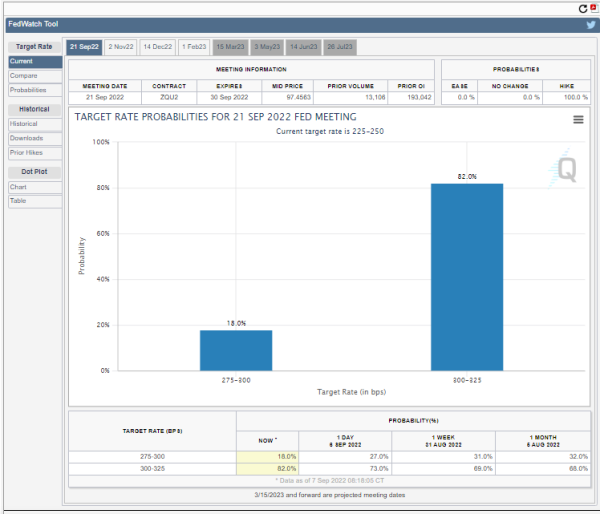
The markets are forming a consensus that the Fed will hike rates another 75 basis points at the September 20 – 21 FOMC meeting. The Fed funds futures see a 82% chance of 75 and a 18% chance of 50.

Jerome Powell’s speech at Jackson Hole was taken as hawkish, and so far the Fed has not pushed back on that interpretation, which is partially what has driven the change in sentiment.

If the Fed does indeed hike by 75 basis points, this will work out to be 300 basis points of rate hikes over a six month period, which is the most dramatic increase in recent history. The most comparable period is 1994 when Alan Greenspan hiked the Fed Funds rate from 3.25% to 6% over the course of a year. Old-timers might remember that this crashed the mortgage backed securities market. Orange County, CA went bankrupt after massive MBS investments went sour.

We are doing more this time over the course of six months. If the December futures are correct, we will see 375 basis points over the course of a year. In 1981, Paul Volcker raised the Fed Funds rate from 16% to 20% and caused the deepest recession since the Great Depression.

The point is that the Fed is acting almost as aggressively against inflation as it did in the early 1980s. This certainly explains the stock market’s reaction.

Home prices declined 0.3% in July, according to CoreLogic. They rose 15.8% YOY. “Following June’s surge in mortgage rates and the resulting dampening effect on housing demand, price growth is taking a decisive turn. And even though annual price growth remains in double digits, the month-over-month decline suggests further deceleration on the horizon. The higher cost of homeownership has clearly eroded affordability, as inflation-adjusted monthly mortgage expenses are now even higher than they were at their former peak in 2006.”

Mortgage Applications fell 0.8% last week as purchases and refis fell by about the same amount. “Mortgage rates moved higher over the course of last week as markets continued to re-assess the prospects for the economy and the path of monetary policy, with expectations for short-term rates to move and stay higher for longer,” said Mike Fratantoni, MBA Senior Vice President and Chief Economist. “With the 30-year fixed rate rising to the highest level since mid-June, application volumes for both purchase and refinance loans dropped. Recent economic data will likely prevent any significant decline in mortgage rates in the near term, but the strong job market depicted in the August data should support housing demand. There is no sign of a rebound in purchase applications yet, but the robust job market and an increase in housing inventories should lead to an eventual increase in purchase activity.”

Morning Report: Data-light week ahead

Vital Statistics:

 LastChange
S&P futures3,94520.50
Oil (WTI)87.720.84
10 year government bond yield 3.26%
30 year fixed rate mortgage 5.87%

Stocks are up this morning as investors become more comfortable with risk assets after the jobs report. Bonds and MBS are down.

The upcoming week is relatively data-light, but we will have a lot of Fed-speak including Jerome Powell on Thursday. We won’t have any market-moving economic reports this week.

The housing market is “losing momentum” according to Wells Fargo. “There’s no question that the housing market has long lost momentum and continued to lose momentum in July,” Vitner told the Times in an article published Wednesday. “When we get the June, July, and August data, I think we’ll see substantially more weakness in the West, and probably more weakness across the country. It’s worse than it looks,” he added. “A lot of folks have underestimated how much of a shift we’ve seen in the housing market.”

The sale to list ratio fell below 100% for the first time since since March of 2021, as affordability constraints limit what buyers can pay. “While the cooldown appears to be tapering off, there are signs that there is more room for the market to ease,” said Redfin Chief Economist Daryl Fairweather. “The post-Labor Day slowdown will likely be a little more intense this year than in previous years when the market was super tight. Expect homes to linger on the market, which may lead to another small uptick in the share of sellers lowering their prices. Homebuyers’ budgets are increasingly stretched thin by rising rates and ongoing inflation, so sellers need to make their homes and their prices attractive to get buyers’ attention during this busy time of year.”

You can see that prices are beginning to moderate.

The service economy improved in August, according to the ISM Services Index. Most notably, we saw an improvement in supplier deliveries and a deceleration in prices. “The Prices Index decreased for the fourth consecutive month in August, down 0.8 percentage point to 71.5 percent. Despite an improvement in inventory levels, services businesses still continue to struggle to replenish their stocks, as the Inventories Index contracted for the third consecutive month; the reading of 46.2 percent is up 1.2 percentage points from July’s figure of 45 percent. The Inventory Sentiment Index (47.1 percent, down 3 percentage points from July’s reading of 50.1 percent) moved back into contraction territory in August.” We aren’t out of the woods by any stretch, but we are starting to see anecdotal indications that inflation is subsiding.

Morning Report: The labor market begins to weaken

Vital Statistics:

 LastChange
S&P futures4,00140.50
Oil (WTI)89.102.51
10 year government bond yield 3.22%
30 year fixed rate mortgage 5.91%

Stocks are higher this morning after the jobs report showed a deterioration in the labor market. Bonds and MBS are up.

The economy added 315,000 jobs in August, according to the BLS. This was a touch above the 293,000 consensus number, but a big decrease from the 526,000 that were reported in July. The unemployment rate ticked up 0.2% to 3.7%. The labor force participation rate increased to 61.4% from 61.1%, so this uptick in unemployment was driven by both an increase in the unemployed and an increase in the labor force. Average hourly earnings rose 5.1% YOY.

Overall, this report shows the Fed is finally getting some traction in slowing down the economy. Bonds took the report with a sigh of relief and stock have rallied as well.

The Fed Funds futures got a little more dovish after the report, with the Sep futures seeing a 62% chance of 75 basis points and a 38% chance of 50. The December futures are now handicapping a 40% chance of an end-of-year rate of 3.5%-3.75% and a 56% chance of 3.75%-4.0%.

It bears repeating that monetary policy acts with about a 6-9 month lag, so the big increases of the past couple of months have yet to impact the economy.

Home Prices rose 7.4% QOQ and 16.7% YOY according to the Clear Capital Home Data Index. The Northeast had the biggest quarterly growth at 11.6%. The Northeast and the Midwest have been laggards since the housing recovery began. The West looks like it is beginning to decelerate after torrid growth.

Note the Clear Capital index is about a month ahead of Case-Shiller and FHFA.

Construction spending fell 0.4% MOM and rose 8.4% YOY, according to Census. Residential construction fell 1.5% MOM and but is still up 14% YOY.

The median mortgage payment is approaching 150% of the typical rent payment, which is the biggest differential since 2009. In early 2020, the payments were roughly equal. This differential is a huge driver of the rent versus buy decision and is one of the reasons why purchase activity is slowing.

That said, it appears that home price appreciation is at least decelerating and the apartment REITs are all reporting mid-teens increases in rents for new tenants. So as rents rise and (hopefully) rates work back downwards that differential should close.

The combination of rising rates and rising prices have simply priced a lot of people out of the market.