Morning Report: Competition for Zillow’s Z-estimate 12/10/15

Markets are rebounding this morning after several days of losses. Bonds and MBS are flat.

Initial Jobless Claims rose 13k to 282,000 last week. The story remains the same: companies are reluctant to let go of employees.

Import prices fell 0.4% in November and are down 9.4% year over year. Blame low commodity prices. Note that some strategists are starting to say the downside in oil is limited at these prices.

The Bloomberg Consumer Comfort Index rose to 40.1 from 39.6 the prior week.

Everyone knows to treat Zillow’s Z-estimates with a grain of salt. Pre-crisis, they generally overstated property values and post-crisis, they have generally been low. Their median error rate is something like 8% (which is calculated by measuring the difference between the modeled value of a house and what it actually sells for). Now Redfin is rolling out their own model, which they claim has an error rate closer to 2%.

Rental prices in Manhattan have risen so much that potential renters are balking at the asking prices. Rental vacancies are at the highest level since 2006. In November, the median monthly rent in Manhattan rose to $3661, up 4% YOY.

Morning Report: Mortgage credit tightening slightly 12/9/15

Stocks are lower this morning on no real market-moving news. Bonds and MBS are down.

Mortgage Applications rose 1.2% as refis rose 3.5% and purchases were flat.

Wholesale inventories fell by 0.1% as sales were flat.

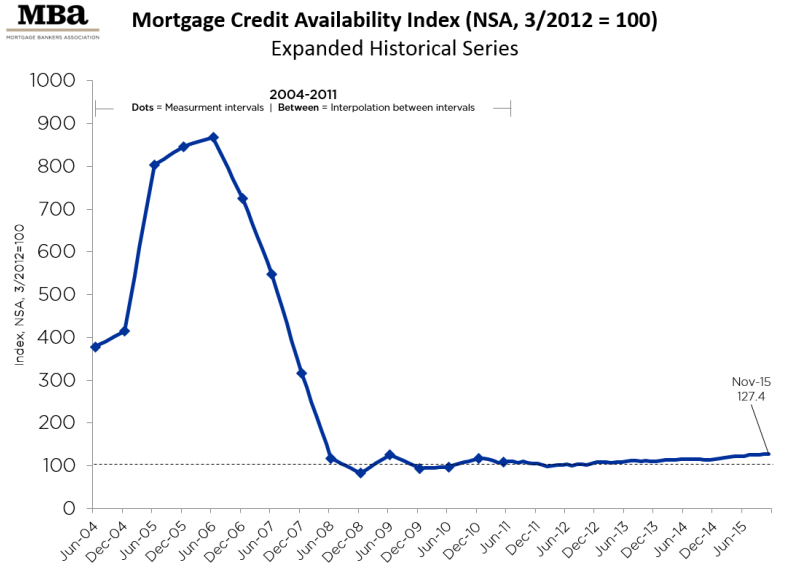
Mortgage credit availability fell in November, according to the MBA. This means credit standards increased. Conventional loans tightened while government loans loosened slightly. While mortgage credit availability has increased steadily since the US residential real estate market bottomed in 2012, it is still a shadow of its former self.

The MBA has its latest survey on mortgage bank profitability and volume. Last quarter, the average gain on a mortgage for independent mortgage bankers and the mortgage subsidiaries of banks fell from $1,522 to $1,238 (or about 55 basis points). On a year-over-year basis, it was an increase from $897 (or 42 bps) in the third quarter of 2014. Average volume in the third quarter was $614 million (or 2,609 units), which was the second highest print since 2008. Lots of useful stats in this survey.

While home prices have been appreciating at a mid single digit clip, rental prices have been increasing even faster. Last year, nearly half of all renters spent at least 30% of their in rent, which qualifies as cost-burdened. A quarter paid 50%. This is creating an affordable housing problem, especially in urban areas.

The Fannie Mae Home Purchase Sentiment Index fell a couple of points as increasing prices and limited inventory are making things difficult for potential buyers. Second, consumers are becoming a touch more pessimistic about their future incomes.

Not Radicalized

I’m tired of hearing about how someone became radicalized. It’s a completely backwards way of viewing this problem.

From NBC:

“Counterterrorism officials also told NBC News that Farook and Malik were making preparations for some time to “take care of both grandma and the baby.” The couple lived in a Redlands, California residence with their 6-month-old daughter and Farook’s 62-year-old mother, Rafia Farook. They left their daughter with Rafia Farook on the morning of the attack.

Nobody radicalized them. They had a choice. And they choose to be evil. That’s all there is to it. Nobody twisted their arm or filled their head with nonsense. They went looking for an excuse and found one ready made.

Also, the press lies on mass shootings. And the only reasons this even matters, is we can’t even decided what rights are.

From Popehat:

I hear “my right not to be shot outweighs your right to own a gun.” This strikes me as perfectly idiotic. But it’s no more idiotic than an imagined right not to be criticized or offended, which is far more popular in modern America.

We’ve lost the plot. We don’t know where rights come from, we don’t know or care from whom they protect us, we don’t know how to analyze proposed restrictions to them, and brick by brick we’ve built a culture that scorns rights in the face of real or imagined risks. It is therefore inevitable that talk about Second Amendment rights will be met with scorn or shrugs, and that discussions of what restrictions on rights are permissible will be mushy and unprincipled.

So here’s how this places out ..
Two people who looked for a justification to kill are stripped of their agency by Western liberals (aka paternalistic racists), who then lie about the extent of a different problem so they can preen in front of their credentialed but ignorant peers and post pithy, yet asinine things on Facebook about how we need to curtail rights they do not understand and would happily surrender because they reject the idea that evil exists and think that things would be great if we just gave peace a chance.

Morning Report: Commodities continue to fall 12/8/15

Stocks are lower this morning as commodity prices continue their downward spiral off of weak economic news out of China. Bonds and MBS are up.

Job openings fell in October to 5.4 million from 5.5 million. Note that payrolls increased by a lot in October (almost 300k), so that drop makes some sense.

The NFIB Small Business Optimism Index fell to 94.8 from 96.1 last month. Small business wants to hire and expand, but is finding it difficult to hire qualified workers. Small business also intends to increase capital expenditures, which have been deferred since the Great Recession.

The IBD/TIPP Economic Optimism index increased in December to 47.2 from 45.5. As a general rule, the indices tend to inverse gasoline price indices. When gas prices fall, people are generally more upbeat.

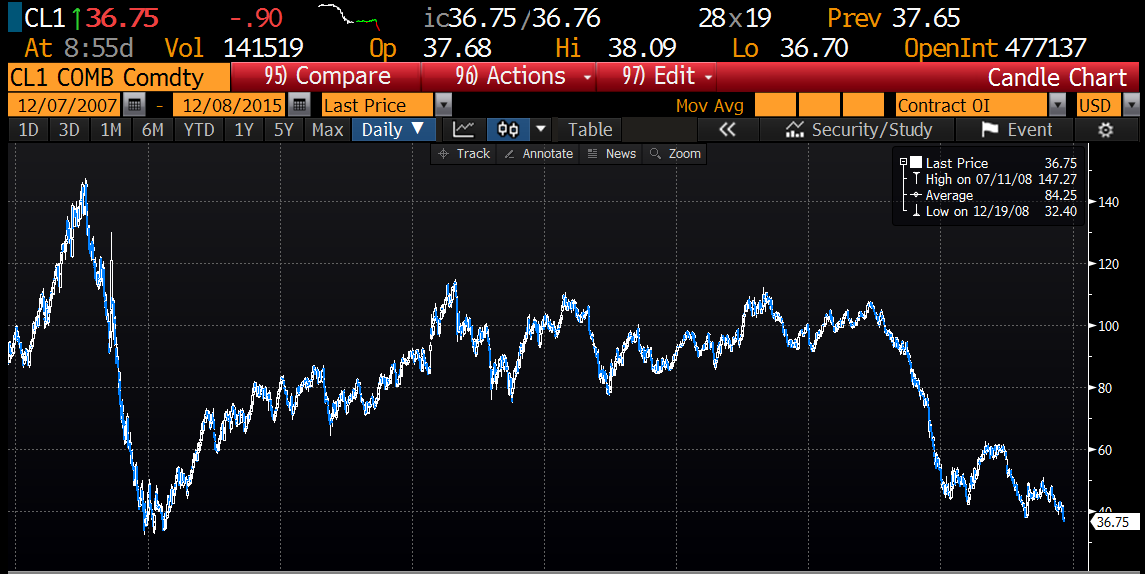
Oil continues its downward spiral. If you look at the chart below, you can see how oil has traded since 2007. We are approaching the 2008 lows in oil right now. Note that oil has its own dynamic, particularly with Iran, who will be adding about 3.8 million barrels of oil per day. The problems in the oil patch are creating problems for the banks, as oil is trading at 37 bucks a barrel and it costs something like $40 – $45 to get it out of the ground.

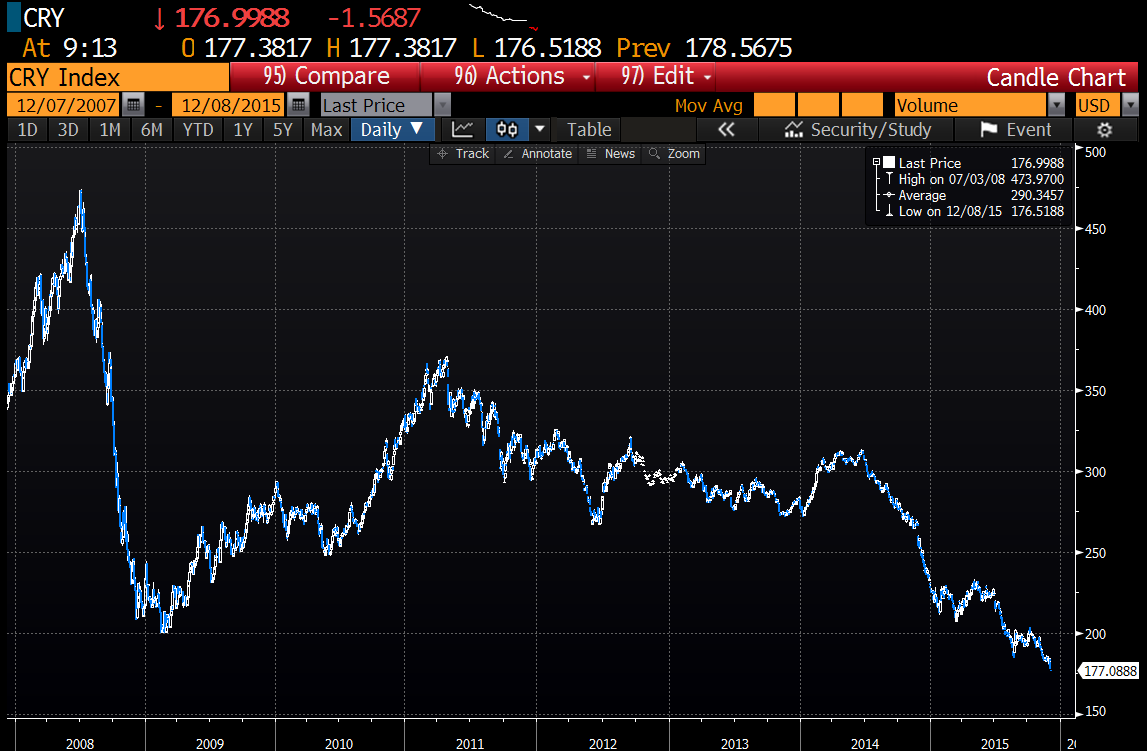
The story is more than oil, however. Commodities are down across the board, from the softs like coffee to the industrial metals like copper. This is the canary in the coal mine for global demand. The ISM data indicates manufacturing is going through a soft spot, if not a recession. If you look at the Commodity Research Bureau commodity index, you can see we are well below the lows of 2008 and are approaching the lows of 2002.

So if global demand is falling, and inflation is nonexistent, why is the Fed going to raise rates next week? At the end of the day, the Fed has more or less painted itself in a corner, and will have to move for credibility’s sake. They have telegraphed this move so much that they have to follow through. The punch line is that the Fed may hike the Fed Funds rate next week and mortgage rates might not move much, if at all.

In spite of all the carnage in the commodity markets, there is one that is holding up better than most: lumber. And that speaks to future demand for construction. Note that in last Friday’s jobs report, construction employment increased again. Next year could be the beginning of the return of housing construction, hopefully.

Speaking of homebuilders, McMansion builder Toll Brothers reported earnings this morning, and beat on the top line while missing on the bottom line. Net signed contracts increased 29% in dollars and 12% in units. ASPs increased 4.4% to $790k.

Foreclosures continue to fall, according to CoreLogic. Completed foreclosures fell 27% YOY to 27k in October. There are 463,000 homes in some state of foreclosure, which is the lowest level since November 2007.

Morning Report: Larry Summers urges the Fed to go slow in hiking rates 12/7/15

Stocks are lower as oil continues to drop. Bonds and MBS are down small.

The week after the jobs report tends to be data-light and this week is no exception. The highlight will be retail sales on Friday. Other than that, expect markets to be dull as traders position for the FOMC meeting next week.

The Labor Market Conditions Index fell to 0.5 from 2.2 in November, according to the Fed. This index is a meta-index of 19 different variables.

The latest Black Knight Mortgage Monitor is out, and they take a look at the high LTV loan universe. FHA has become the go-to high LTV loan product, and they high LTV loans account for 77% of FHA / VA origination. Fannie and Freddie did about 1% in high LTV loans. Home Price appreciation continued in September, with their proprietary home price index up 5.5% on a year-over-year basis.

Larry Summers makes the case that the Fed should go slow with raising interest rates. His main point: that the “neutral interest rate” has been declining and will continue to decline due to the changing allocation of savings versus consumption tilts more towards savings. (More savings = more demand for bonds, which pushes bond yields lower). Of course this argument focuses primarily on the baby boomers, who are retiring and ignores the millennials, which are bigger and will enter the workforce (and spend) over the next decade or so. He makes another point: some of the economic indicators are pointing towards a slowdown, and we don’t want to have monetary policy acting as a drag on an economy that is already weakening. FWIW, I think the body language out of the Fed is that they will take it slow, and I cannot see how an extra 25 or 50 basis points on the Fed Funds rate is going to be that material of a drag on the US economy. In reality, a sub-1% Fed Fund rate is still incredibly accomodative.

College Football Playoffs and the remaining good bowl games

Such interesting possibilities.  Stoopes and the Land Thieves are 3-0 against ‘Bama, and Austin native Baker Mayfield is lighting it up at QB for the Sooners.  However, Brent Venables, who for a decade under Stoopes was the defensive guru of the Big 12, is now at Clemson.  Stoopes dumped Venables so that he could hire his brother, Mike Stoopes, who had been fired from his HC job.  Mike is a downgrade from Venables.

Michigan State was consistently the best coached defense in the nation under Dantonio and Narduzzi, but Narduzzi is now deservedly a HC on his own.  Nevertheless, MSU has not forgotten how to defend.  Twist for the ‘Bama – MSU game is that Saban used to coach at MSU.

Could ‘Bama grind out a victory against any of the other three?  All of the other three are better than every team that ‘Bama faced, but there are many truly NFL capable studs in the Tide’s lineup. Crucially, I would rate all three of the other starting QBs in the playoffs well ahead of ‘Bama’s Jake Coker.

Could MSU score enough to beat OU or Clemson?  Could either Clemson or OU  score four TDs against the MSU or ‘Bama defenses?

The Playoff Schedule:

No. 1 Clemson faces No. 4 Oklahoma on Dec. 31 in the Orange Bowl.

No. 2 Alabama will face No. 3 Michigan State on Dec. 31 in Jerry World, the Cowboys’ stadium, mislabeled the something Cotton Bowl.

For OU, Arlington TX would have been a home game, so it was a sure thing that OU would be ranked #4, although that ranking is certainly “reasonable”, regardless.

While I would not predict the results of a game between 19 YOs without inside information on injuries, grades, drinking habits, and girl friends, I will guess that styles will produce more TDs in the Arlington game, and that the final will provide a true contrast.  Here is a statistical model, taken without benefit of the “model information” I consider crucial:

Each Team’s Chances Of Winning The College Football Playoff

In the other Bowl games of note, the truly outstanding teams that fell short of the Playoffs will be butting heads.  TCU and ND had so many injuries that they were not the same teams by midseason as they were in early September.  They remained very tough squads, and if they heal before their bowl games, they will be as good to watch as the playoff teams.

Stanford, Ohio State, Iowa, Florida State, UNC, Okie Lite, and Baylor (if it has its first or second string QB back), are all highly competitive teams.  In fact, there was no single dominant team this year, and I am not inclined to believe that Clemson’s record set it apart.   I find ACC competition suspect, below the top three teams.  By contrast, the very competitive PAC has some good multi-loss teams, as does the western half of the SEC.

Only one non-power conference team is worth a mention: Houston.  Not having played even a fruit blender schedule there is no comparable way to measure them.  They do have talent and are very well coached by Herman, however, who was previously OC at tOSU.

So these are the best of the remaining bowl games, but remember when there is nothing on the line, either team may show up or not, depending in part on how much they want to party over Winter Break:

Dec 29
Citrus Bowl NKA as something else
UNC v. Baylor (but one of BU’s two best QBs must return for this or it will not be worth watching)

Dec 31
Peach Bowl
FSU vs UH (classic who wants to be there game)

Jan. 1 –

Fiesta Bowl
Notre Dame vs. Ohio State (injuries for ND and no incentive for tOSU?)
Rose Bowl Game
Stanford v. Iowa (Stanford has a great RB who will set many records)
Sugar Bowl
Oklahoma State vs. Ole Miss

Jan 2 –
Alamo Bowl
Oregon vs. TCU (another injury bowl – but these are exciting teams)

Jan 11 – National Title Game from Glendale, AZ

FWIW, do not bet on these games.  19 YOs, girlfriends, drinking, injuries, passing finals, arrests in New Orleans…you cannot know the outcome.  That is why we watch.

And – GOOD LUCK to Michigan State!


Jobs report in line; December tightening a go 12/4/15

Stocks are lower after the jobs report came in as expected, which puts the Fed on track for their first tightening in 9 years in a couple of weeks. Bonds and MBS are up small.

Jobs report data dump:

  • Nonfarm payrolls + 211k vs. 200k expected
  • Unemployment rate 5%, in line with expectations
  • Average Hourly Earnings +0.2% MOM / +2.3% YOY in line
  • Underemployment rate 9.9% vs 9.7% expectations
  • Labor Force Participation rate 62.5% vs. 62.4% expected

The general take on the jobs report is that it is good enough to give the Fed comfort to raise rates in two weeks. Digging in deeper, the increase in jobs were in construction (+46k), professional services (+28k), health care (+24k), restaurants (+23k) and retail (+31k). Mining and IT lost jobs.

Homebuilder Hovnanian reported numbers this morning, Revenues were flat compared to last year, while margins fell as deliveries fell 2% in units. The dollar value of net contracts increased 29%, which bodes well for next year. Backlog is up 30%.

Uber is now valued at $65 billion, which makes it about the 80th biggest company in the S&P 500, and gives it about the same market cap as Danaher. The bubble of the day is in these pre-IPO companies. By the time they actually go public, they are typically overvalued.

Negative equity fell from 16.9% a year ago to 13.4% last quarter, according to Zillow. A normal number is closer to 5%. They have a cool interactive map where you can search by county to see what percentage is underwater.

We are beginning to see some softness at the super-high end of the US residential real estate market. Some of this is undoubtedly driven by foreign demand.

Morning Report: ECB disappoints, sending bond yields higher 12/3/15

Stocks are flat after the ECB cut rates again and promised more stimulus. Bonds and MBS are down.

ECB President Mario Draghi announced more quantitative easing and a cut in rates. They maintained their main rate at 0.05% and cut the deposit rate to -.3%. Apparently it wasn’t enough as bond yields are up worldwide.

Janet Yellen will be speaking in front of Congress starting at 10:00 am.

The ISM Non-Manufacturing Index fell from 59.1 to 55.9 in November, coming in well below expectations. Note the ISM Manufacturing Index also missed estimates and came in below 50, which indicates deceleration in the manufacturing sector. The employment sub-index fell, and some business owners are blaming Obamacare for higher costs.

Factory Orders rose 1.5%, a bit better than expectations, while durable goods orders were revised downward to 2.9%. Capital Goods Orders ex-defense and aircraft (a proxy for business capital expenditures) rose 1.3%.

Job cut announcements fell 13.9% to 31,000, according to outplacement firm Challenger, Gray and Christmas. This is the lowest level in over a year.

Initial Jobless Claims rose 9k to 269k. Initial Jobless Claims are still at multi-decade lows, which is amazing when you take into account population growth.

The Bloomberg Consumer Comfort index fell again last week to the lowest level in a year. Consumers are becoming more pessimistic about the economy, with 31% having a positive view and 69% having a negative view. FWIW, November same store sales are coming in this morning from the retailers, and they look to be disappointing.

Bill Gross’s latest investment outlook is out. He is advising clients to gradually de-risk their portfolios during 2016. His thesis is that years of QE have essentially hollowed out real economies as it allows zombie corporations to continue to exist and it punishes savers and insurance companies / pension funds. Of course he is talking his own book to some extent. There is no doubt that the fear of the unintended long-term consequences of ZIRP and QE are coming into play with the Fed’s plan to raise interest rates in the US.

Morning Report: ADP jobs report comes in stronger than expected 12/2/15

Markets are flat this morning as labor costs rise. Bonds and MBS are down.

Janet Yellen will be speaking at noon today.

Mortgage applications fell 0.2% last week as purchases rose 7.7% and refis fell 6%. Not bad considering last week had the Thanksgiving holiday.

The ADP employment change came in at 217k, beating Street expectations of 190k. The prior month was revised upward. The forecast for Friday’s payroll number is 200k. If we get a similar payroll number on Friday, a rate hike in two weeks will be looking like a sure thing.

Productivity increased 2.2% in the third quarter and unit labor costs rose to 1.8%. Productivity growth has been slow, and employers are having to add people. We saw something similar in the ISM report yesterday. Employment was the bright spot in an otherwise disappointing report.

The ISM New York Index fell to 60.7 from 65.8.

While auto sales didn’t meet their lofty targets yesterday, they were the best in 14 years. Volkswagen’s US sales dropped 25% however in the wake of the emissions scandal. It looked like sales accelerated through the month as well.

Home prices rose 1.0% month-over-month in October and are up 6.8% year-over-year, according to CoreLogic. They are forecasting prices to rise 5.2% next year.

Morning Report: Construction rises, manufacturing contracts 12/1/15

Stocks are higher this morning on economic strength out of Asia. Bonds and MBS are down.
Construction spending rose 1.0% in October. This is up 13% year over year. Residential construction rose 16.8% year over year, however the growth appears to be in multi-family construction, not SFR.
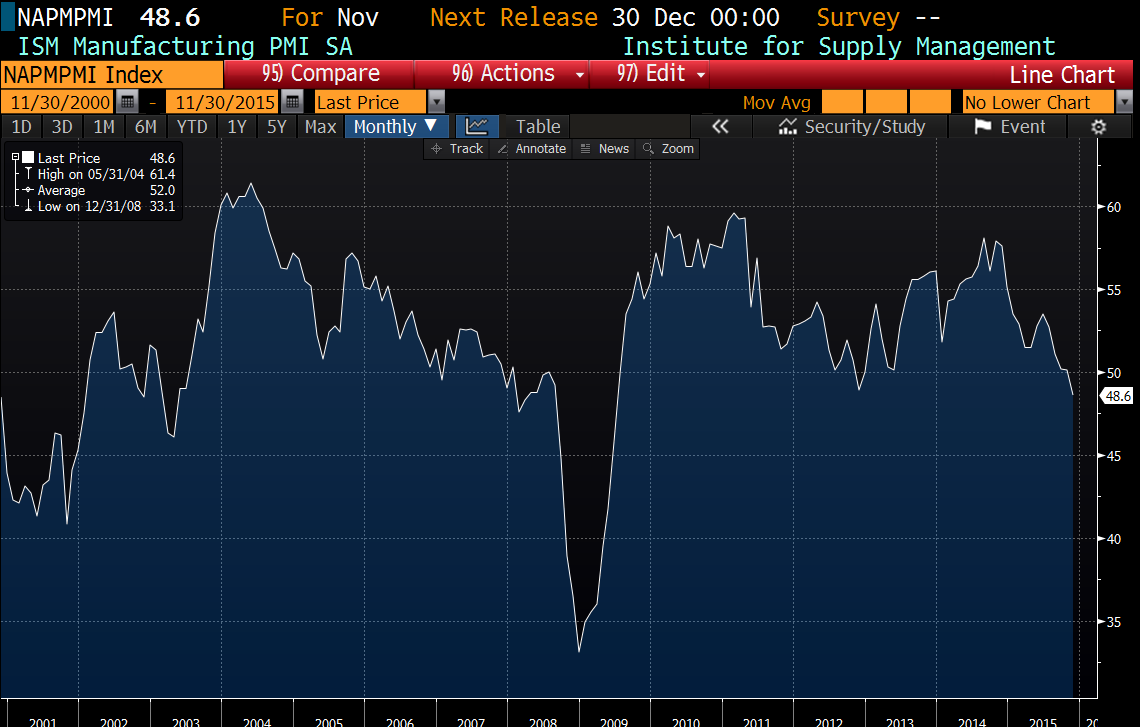
The ISM Manufacturing Index fell to 48.6 from 50.1 last month. A reading below 50 indicates that the manufacturing economy is generally contracting. This is the biggest decline since June of 2009. Inventory build is a problem, which has also been confirmed in the inventory to sales ratio. In fact, third quarter GDP was revised upward based on inventory build, however that inventory build essentially “borrows” growth from the following quarter. A reading of 48.6 would generally correspond to a GDP growth rate of about 1.7%.
Chart: ISM Manufacturing:

The weakness in manufacturing is a dollar issue, as commodity based companies and exporters are feeling the pinch. Since the US is the only economy contemplating tightening (while everyone else is deciding how much additional stimulus to put out), the dollar strength looks to continue.
Chart: US dollar index:

Vehicle sales are coming in this morning, and it looks like GM, Fiat-Chrysler, and Ford have missed their market forecasts. Most were reporting growth of about 3%. Auto loans are the new subprime.
Loews CEO and famed investor James Tisch said the Fed is “woefully behind the curve in waiting to raise rates. It should have been done years ago.” He is one of the people that is making the argument that raising rates could be positive for the economy as it will eliminate some of the misallocated capital (especially in the energy patch) and remove the penalty on savers.
Silicon Valley is attempting to disrupt the mortgage industry with a new model of non-QM, stated income loans where human interaction with the borrower is kept to a minimum. The Millennial generation generally prefers to interact with technology instead of a human. These firms are making huge investments in technology (in fact at one firm 7 or the 12 employees are IT people). They are also taking regulatory risks that many in the industry are unwilling to take. One CEO said: “There isn’t a banker out there that doesn’t look at me and shake his head and say, ‘You don’t know what you’re doing…But we’re doing it.”  They are also making a bet that the private label market will return at some point early next year. Interestingly, LOs are compensated on “customer satisfaction” and not commission.
Speaking of disruption, Morgan Stanley is laying off about a quarter of its fixed income trading team. Last year was a lousy year for fixed income trading in general, and the fee income just hasn’t been there. While the Fed has basically spoon fed rate expectations to the market, the exit of market makers will probably make the markets more volatile. Don’t forget, traders are generally young, and the majority of the ones who are left have never seen a tightening cycle before.
While Black Friday looks to have been a disappointment, initial indications suggest Cyber Monday went a little better.