Morning Report: The Fed looms large this week 6/15/15

Stocks are lower after talks between Greece and its creditors broke down over the weekend. Bonds and MBS are up.

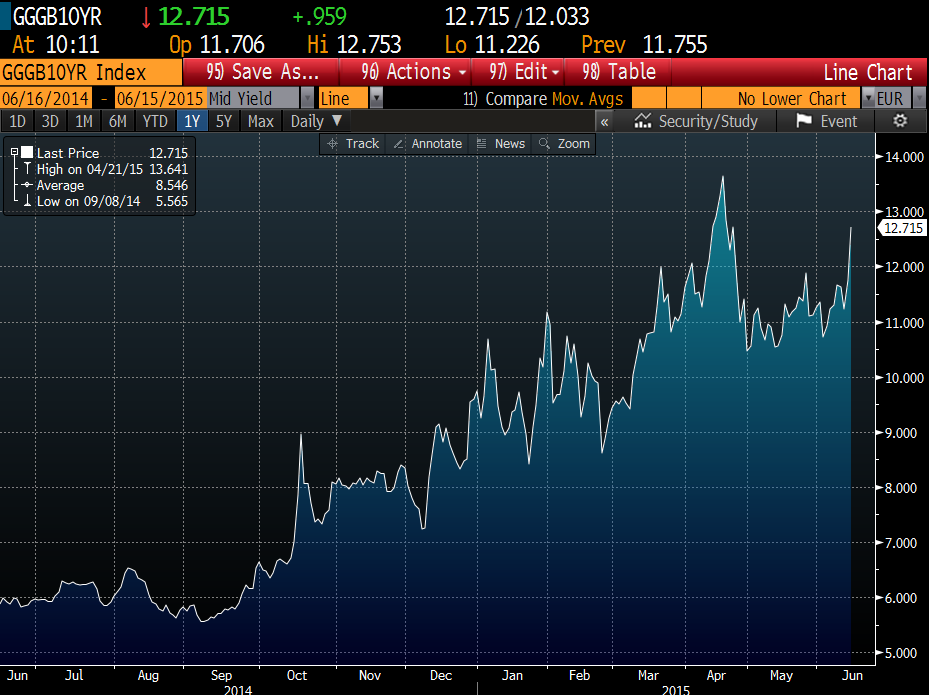
This is supposedly “deal week” for Greece. They owe the IMF $1.7 billion. If they don’t pay (and they have already missed one payment), then it makes it hard for the ECB to continue providing emergency liquidity. The current program with the ECB expires at the end of the month. Rhetoric is getting more and more heated between Germany and Greece at this point. At issue are the pensions. Greece is steadfastly resisting restructuring the country’s pension system. And the Germans are getting sick of it: ‘We will not let the German workers and their families pay for the overblown election promises of a partially communist government,’’ Vice-Chancellor Sigmar Gabriel wrote in a Bild opinion column on Monday. If they can’t get a deal, then the ECB will probably stop supporting the Greek banks and the county will have to impose capital controls to keep hard assets from fleeing the country. It sounds like the Europe will consider allowing Tsipras some sort of face-saving change to the deal, but nothing really meaningful. The bond markets are getting nervous, as the Greek 10 year bond yield is up almost one full percentage point this morning at 12.723%. For us in the the US markets, any sort of Greek exit will probably cause a flight to quality, which means it would be bullish for US bonds.

Chart: Greek 10 year bond yield:
In other “bullish for US bonds” news, the manufacturing sector had a rough go of it in May. Industrial Production fell 0.2%, manufacturing production fell 0.2% and capacity utilization fell to 78.1%. Separately the New York State Empire Manufacturing Index fell to -1.98. While manufacturing is no longer the economic driver it used to be, these are still lousy numbers, and reinforces the idea that the Fed will stand pat this week.

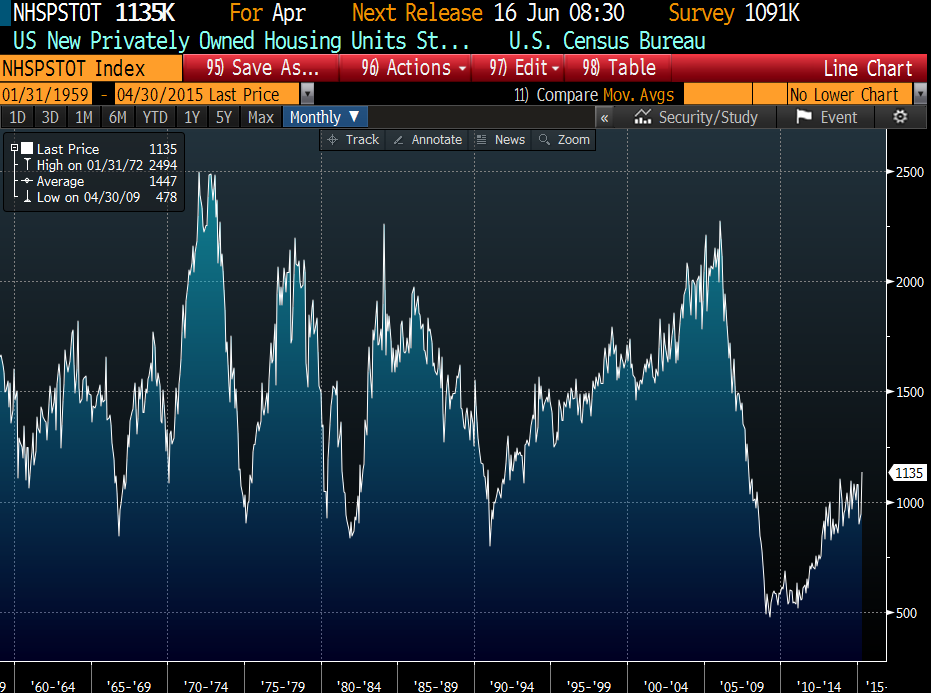
The NAHB Homebuilder index rebounded to 59 in June, topping its post-crisis highs. Builder confidence is more or less back at “normalcy.” While homebuilder sentiment is back to normalcy, housing starts most certainly are not. The Street is forecasting housing starts to come in at 1.09 million tomorrow, which is still 27% below the normal, pre-bubble level of 1.5 million starts a year. Starts are only now approaching the recessionary lows of the past. So while builders may have positive sentiment, they aren’t putting their money where their mouth is, at least not yet.

Chart: housing starts, long term:
The FOMC meets on Tuesday and Wednesday this week. This will be the first FOMC meeting where a rate hike is in play. Given some of the weak economic data and persistent low inflation, it is unlikely the Fed will hike rates this week, however the language of the statement will certainly be important. Expect to see some volatility this week in bonds, between the FOMC and the Greek situation. LOs, be sure to tell your borrowers about the risks of floating.

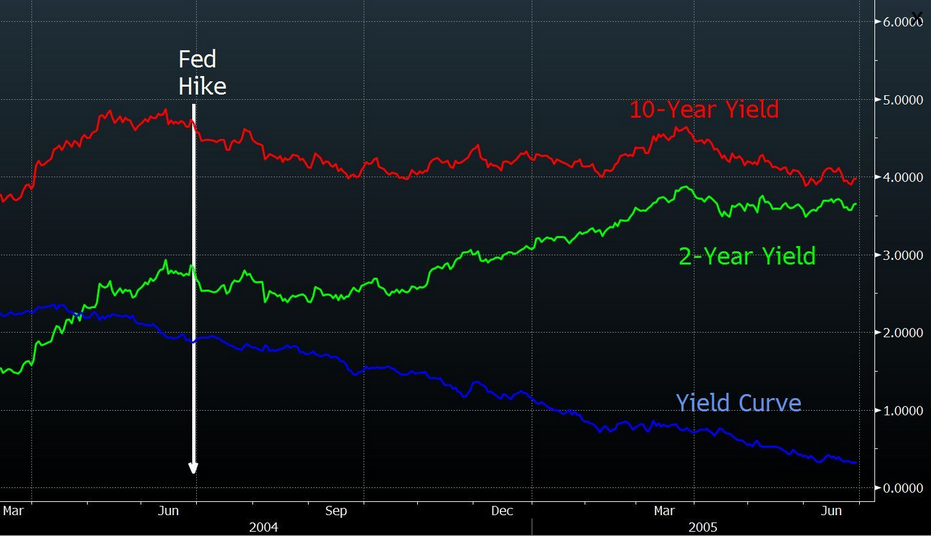
If the Fed does in fact hike rates, it doesn’t necessarily follow that the 10 year bond yield (and by extension mortgage rates) will spike. When you look at the tightenings in the past, the yield curve flattened, which means the short end of the curve (overnight rates etc) moved higher, but the longer end of the curve largely ignored the increase. The 2004 tightening cycle is probably the most relevant, as we were still in the aftermath of the collapse of the stock market bubble. The Fed increased the Fed Funds target rate from 1% to 5.25% over the course of 2 years. The US 10 year basically went nowhere.

Chart: aftermath of 2004 rate hikes:
For a contrarian view on the Fed and long-term interest rates, listen to Bill Gross, who thinks the world’s central banks want higher long-term rates because they are worried about insurance companies and pension funds. These entities are not able to earn the returns they need in this low interest rate environment (the actuarial tables couldn’t care less that rates are zero), and they have been forced to take a lot of credit risk. The most painless way to avoid a crisis is to let long-term rates slowly creep up. It just goes to show how small the eye is in the needle the world’s central banks need to thread.

Elizabeth Warren and the left are not fans of share buybacks And there are legitimate questions about companies levering up to fund buybacks. And yes, buybacks are more tax efficient than dividend hikes because investors can defer taxes on capital gains by not selling. . However they are trying to conflate stock buybacks with “market manipulation,” which is fraud and illegal. I think the gameplan is twofold here: The first is to weaken the presumption that management’s first priority is to maximize shareholder value. The second is to shame companies into raising wages for workers.

Morning Report: Bond Market Bubble talk 6/12/15

Stocks are lower as both the EU and Greece dig in their heels over a rescue package. Bonds and MBS are up small.

Inflation remains muted at the wholesale level. The Producer Price Index rose 0.5% in May, however that is energy driven. Ex food and energy, it was up 0.1%, or 0.6% year-over-year. The PPI is not that critical of an inflation index – the Fed uses the PCE deflator – but it shows that inflationary pressures remain contained. IMO we won’t see any sort of inflation until we see wage gains, and we are only just starting to see that.

Higher energy prices are not denting consumer sentiment according to the University of Michigan. June Consumer sentiment rose to 94.6 from 90.7 in May.

A couple Fed researchers have crunched the numbers and believe that the natural rate of unemployment is about 4.3%, versus the 5.2% number the Fed currently uses. They focus on labor’s share of income, which has fallen from 72.2% in 2001 to 62.9% now. If correct, that means the Fed has room to let the economy run. The bigger question is why the number has fallen so much. Is it weak bargaining power? Is it the fact that the emerging companies in the US need less employees? (For example, GE has a market cap of $276B and has 305,000 employees. Facebook has a market cap of $228B and has only 10,000 employees). IMO, it will come down to the labor force participation rate. Are the people who have involuntarily exited the labor force coming back?

Cash sales make up 35% of all home sales, according to CoreLogic. That is down from the peak of 46.5% in Jan of 2011, but still well above the pre-crisis level of 25%. So for originators, this means more “gettable” business even if existing home sales don’t improve all that much. I guess you can use cash sales as a proxy for distressed sales, and the places with the biggest foreclosure inventory and lowest price appreciation have the highest cash sales percent.

The raging debate in bond circles is whether we are in a bond bubble. Certainly sovereign debt yields are telling you that inflation is never, ever, ever coming back. However the bigger issue is corporate debt, which is being issued at a record pace as companies lock in low borrowing costs. If they were using that cash to build out capacity and invest in the business then there would be less concern. However, they are levering up to fund buybacks and M&A activity. That is a bigger issue. The biggest issue is that the holdings of corporate debt are now very, very concentrated in bond mutual funds, foreign investors and insurance companies. When there are bond fund redemptions, they have to sell. And new regulations regarding proprietary trading and bank capital mean that trading desks at the big investment banks are not going to absorb all that selling pressure. In addition, hedge funds are getting fewer and bigger as well. Corporate debt could get slammed hard if everyone heads for the exit all at once. Right now, the stock market is anticipating no problems when the Fed starts raising rates. That may end up being a bad bet.

Morning Report: Jamie vs Lizzie 6/11/15

Stocks are higher this morning after retail sales came in better than expected. Bonds and MBS are up.

Retail Sales rose 1.2% in May, matching estimates. The control group, which strips out some of the more volatile components rose 0.7%, higher than the 0.5% estimate. The big gainers were building supplies, autos and gasoline. 

Import prices rose 1.3% on a month-over-month basis. Business Inventories picked up 0.4% as well.

Initial Jobless Claims came in at 279,000, a strong number. This is the 14th consecutive week below 300k.

The Bloomberg Consumer Comfort index slipped to 40.1 from 40.5. These sorts of consumer confidence / sentiment indices are really inverse gasoline price indices.

2015 could be the best year in housing since 2006, according to the NAR. Rising rates are not discouraging buyers – in fact the opposite is happening. Buyers are worried that affordability is going down and that is motivating them to buy now.

Separately, consumers are getting more bullish on housing, according to the Fannie Mae National Housing Survey. They are not getting more bullish on the economy however, even though their incomes are rising. Pessimism about the economy is at a six month high.

The left is all up in arms after Jamie Dimon said that Elizabeth Warren doesn’t understand the business of banking. I have seen stories where she confuses lending and servicing, so Jamie has a point. She has found her niche as the Ted Cruz of the Left – happy to play to the base and annoy her adversaries with overheated rhetoric. It is okay, Liz, even the really smart people don’t understand it all that well.

Morning Report – Tough times for East Coast builder Hovnanian 6/10/15

Stocks are flattish after Greece submitted a plan to creditors which was rejected. Bonds and MBS are down

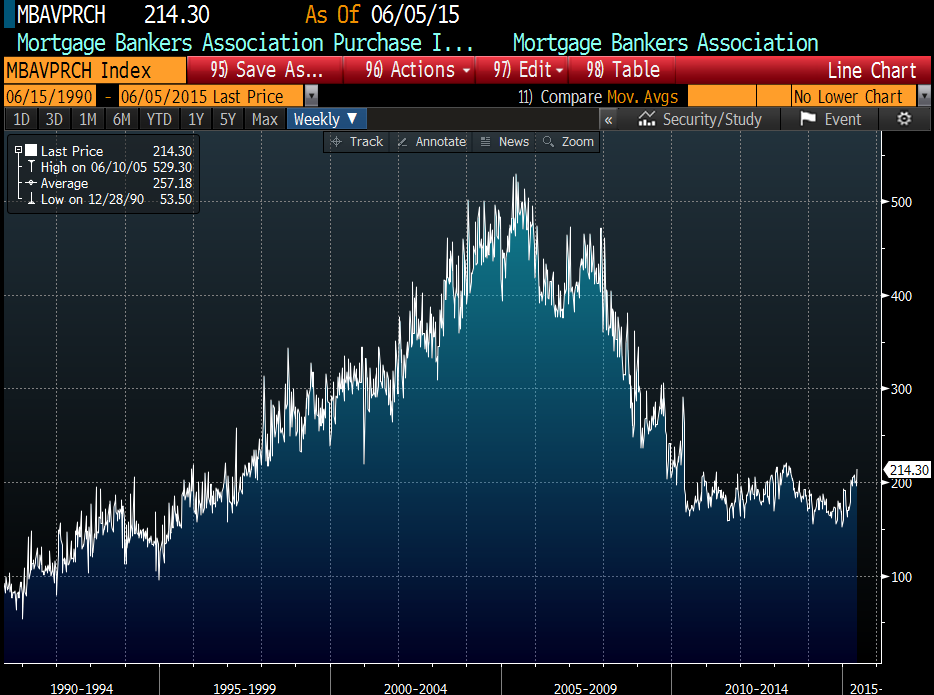
Mortgage Applications rose 8.4% last week in spite of a massive sell-off in bonds, which took the 30 year fixed rate mortgage from 4.02% to 4.17%. Purchases were up 9.7% while refis increased 7%. Note that this bump is following the shortened Memorial Day week, so that accounts for some of the increase. The purchase index is approaching 2 year highs, although we are a long way from normalcy.

How much have the banks been fined / spent on legal for the financial crisis? About $300 billion. And the governments aren’t done yet. They still are scratching their collective heads wondering why credit is so tight, though.

For all the talk about how tough the Millennials have it, Generation X has it even worse. The financial crisis hit them during their peak earnings years. Want to know why consumer spending is down so much? The elderly boomers already bought their last TVs, while Gen-Xers are struggling with the 50% hit to their net worth they took in the bust. Millennials are just trying to find a job. I do think that the next big political schism will fall along generational lines, with the baby boomers trying to extract more resources from their broke offspring who want to means test the benefits their parents get.

Hovnanian, the New Jersey based homebuilder, fell 13% yesterday after they disappointed the Street with earnings. Margins fell as they company had to offer more incentives to move their inventory. Gross margins fell from 20% to 16%. The company characterized the housing market as “a  bit tentative.” Hovnanian operates in New Jersey, North Carolina, Pennsylvania, Virginia, Maryland, California, Texas, Tennessee, Alabama, and Mississippi. Not surprising since the Northeast / Mid Atlantic / Deep South housing markets have been lagging the red-hot West Coast markets.

More gloomy prognostications from JP Morgan: The US is entering a period of slower growth due to low productivity (which fell 3.1% last quarter). They anticipate job creation to average around 75,000 a month, unless some new productivity-enhancing technological development comes around. The last time we went through that was the 1970s, productivity stagnated and the oil shocks along with automatic wage increases in union contracts ignited a wage-price spiral. FWIW, I am not sure I buy that argument – cheap energy is not going away, and solar keeps getting cheaper and better.

Morning Report: the labor market remains tight 6/9/15

Stocks are lower this morning on concern that Chinese growth is slowing. Bonds and MBS are lower.

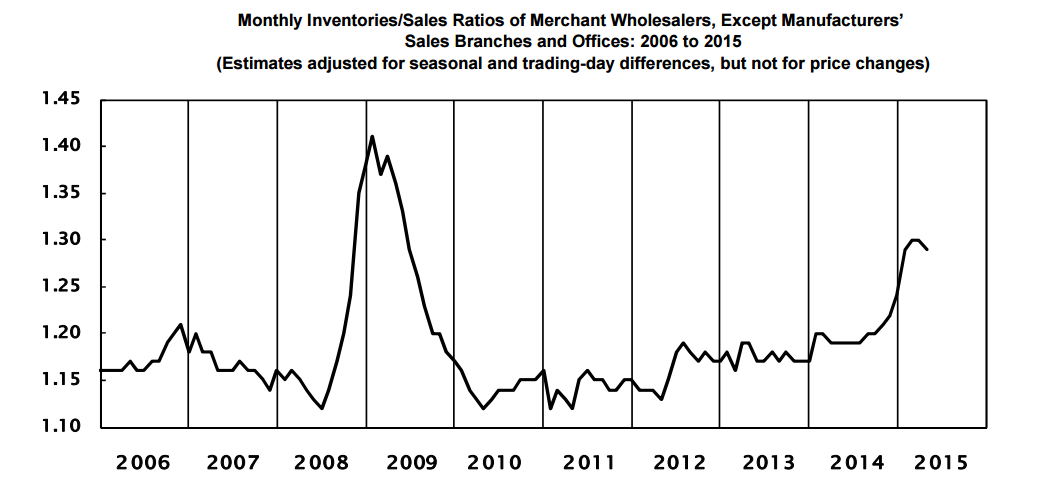
Wholesale Inventories increased 0.4% in April, while wholesale sales rose 1.6%. The inventory to sales ratio was 1.29x, which is on the high side. This means that unless sales increase markedly, manufacturers will have to slow down production to work down the excess inventory. This would dampen GDP growth going forward.

Job openings hit 5.4 million in April, the highest number since the survey began in late 2000. The “quits rate,” which is an important data point for the Fed is inching up to 1.9% from 1.7% a year ago.

The NFIB Small Business Optimism index rose to 98.3 in May, finally approaching “normalcy.” Money quote regarding the labor market: “Owners report that the labor market is, from an historical perspective, getting very tight. Owner complaints about “finding qualified workers” are rising, job openings are near 42 year record high levels, and job creation plans remain solid. Over 80 percent of those hiring or trying to hire in May reported few nor no qualified applicants. This is inconsistent with current Fed policy, which has no impact on the supply of qualified workers.” In terms of biggest concerns for small business, quality of labor (not cost) remains the #3 biggest concern, behind taxes and government regulation. Quality of labor has now displaced “poor sales” on the top 3 list.

The Chinese stock market bubble continues to inflate despite a weakening economy. The Chinese government is basically endorsing the rally, and is changing the rules regarding margin selling to ease the problem of forced selling. China is undoubtedly having an episode similar to the US in the 20s and Japan in the 80s. It may (and probably will) go on for a lot longer than people think it will. But with each passing day, the “investments” get more marginal and more speculative, and the whole edifice is built on borrowed funds, which always seems to end badly when the music stops.

Completed foreclosures fell to 40,000 in April, down from 50,000 a year ago, according to CoreLogic. The seriously delinquent rate fell to 3.6%, the lowest since Feb 2008. About 521,000 homes are in some stage of foreclosure, down from 694,000 a year ago. Foreclosure inventory remains the highest in the judicial states of New Jersey and New York. Note, New York is going to do something about zombie foreclosures: vacant homes which are taking their time to get through the process. Lest anyone think they are doing this to give investors a chance to limit their losses, the real reason is so they can sue if they are unhappy with the way the property is being maintained.

Morning Report – Jobs report data dump 6/8/15

Stocks are lower after Greece officially missed its payment to the IMF. Bonds and MBS are up small.

The week after the jobs report is usually data-light and this week is no exception. The only data that should matter is retail sales on Thursday. While the labor market seems to be improving, consumer spending is still lagging. Part of that is demographic, where you have a bunch of old rich people who probably bought their last TVs, toasters, etc and a bunch of young broke people.

Bonds got rocked on Friday after the stronger than expected jobs report. 280,000 jobs were created in May, and the two prior months were revised upward from “dismal” to “not hideous.” Average hourly earnings rose to $24.96, up 2.3% from last year. The unemployment rate ticked up to 5.5% as the labor force participation rate improved to 62.9%. It is looking like the first quarter weakness was indeed transitory, and weather-driven. It probably doesn’t mean the Fed is moving in June, but September is definitely in play.

The big question the Fed is grappling with is the ceiling on the labor force participation rate. If it is high, say 66% – 67%, then returning workers will keep a lid on wages, and the Fed will be able to let the economy run a bit longer. It also means the overall growth potential for the economy is higher. If the ceiling is low, say 64% – 65%, it means wage inflation will force the Fed’s hand earlier, which means the “speed limit” of the economy is lower. Of course demographics explain some of the long term changes in the labor force participation rate, however many of the long-term unemployed want to (and need to) have a full-time job. Whether they can get meaningful jobs after being on the sidelines for multiple years is an open question.

In spite of the huge sell-off in bonds over the past two months, the street is forecasting  a 2.5% 10 year yield for 2015. The Fed has been consistently over-optimistic on the economy in general, and the simple fact that the Fed funds rate is increasing does not necessarily mean long term rates are going to go up big. Take a look at the chart below: it is the 10 year bond yield minus the Fed Funds target rate. In the last tightening cycle (early 2004 to early 2006), the Fed Funds rate increased from 1% to 5.25% over the course of two years. During that same period, the 10 year bond yield increased from about 4.8% to 5.2%. The yield curve actually inverted towards the end of the cycle (which more or less broke the real estate bubble). In other words, the Fed could start hiking rates this year and we could see the 10 year go basically nowhere.

Morning Report – Bond Market Volatility 6/4/15

Stocks are lower this morning as talks in Greece stall. They have a big payment due to the IMF tomorrow.

Some labor market numbers this morning. Initial Jobless Claims fell to 276,000, a great number. That said, the final revision to productivity for the first quarter is in, and it fell to -3.1%. Unit Labor Costs rose 6.7%.

The IMF is urging the Fed to hold off raising rates until the first half of 2016. They also cut their forecast for US GDP growth from 3.1% to 2.5%, more or less matching what the Fed was forecasting at its March meeting. Given the weak Q1, that forecast is probably coming down in the June FOMC meeting.

If you have been caught by surprise with the big moves in the bond market, you aren’t alone. The volatility in the bond market has been stunning over the past several months. The mood of the markets seems to go from fear of deflation in Europe to fears of inflation in the US. Jim Bianco characterized the bond market like this: “You want to shove rates down to zero, people are going to make big bets because they don’t think it can last,” Bianco said. “Every move becomes a massive short squeeze or an epic collapse — which is what we seem to be in the middle of right now.” IMO, the action in the markets is also a function of the fact that the major players in the markets right now are central banks, and they are taking positions based on social policy considerations, not economic ones. In other words, the ECB isn’t buying bonds because it thinks they are cheap – it is buying them in an attempt to create inflation. When you have non-economic players (players that are not concerned about their p/l) dominating the market, the ones that do care about their p/l (everyone else) are bound to get whipsawed.

Another issue is the fact that new regulations against proprietary trading has diminished the historical market stabilization role of trading desks. In the old days, when a big buyer or seller (say someone like a PIMCO) had an big order, they would find an investment bank to take the other side of the trade. The bank would bid (or offer) a little bit above or below the market and gradually work out of the trade over the course of the day or days. This had the effect of dampening volatility as it kept the market from getting whipsawed by big orders. Ironically, the regulatory push to “make banking boring again” has had the effect of making the government bond market anything but boring.

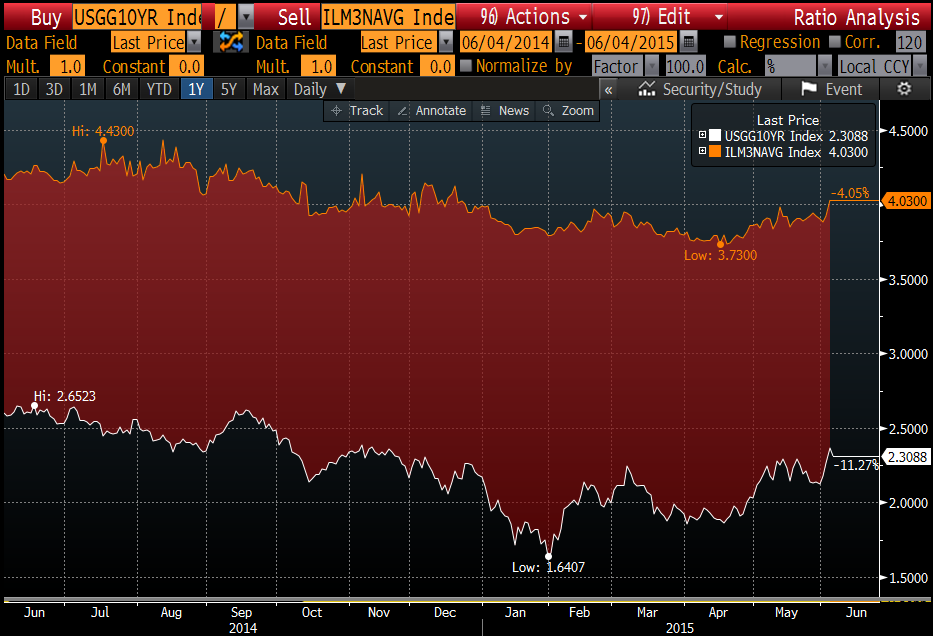
For mortgage bankers, the thing to keep in mind is that mortgage rates have been “fading” this volatility. In other words, they have been reluctant to follow big outsized moves. You can see it in the graph below, where the upper line is the Bankrate 30 year mortgage rate and the lower line is the US 10 year bond yield. Note how mortgage rates ignored the big dip in yields at the end of Janurary and have lagged the moves upward lately. Think about this when you are locking. If rates stop going up, mortgage rates will still probably keep rising to “catch up” with Treasuries. Even if rates fall, mortgage rates will probably stay up here for a while.  In a volatile market like this it doesn’t make a lot of sense to be floating. Rates are still at historical lows, and can move up in a hurry. It would be shame to end up paying an extra 30 basis points on your mortgage because you were waiting to catch a rally that never came.

Morning Report: Bonds getting beat up by Mario Draghi comments 6/3/15

There is a definite “risk on” feel to the market this morning after Mario Draghi committed to keep QE until at least September 2016. He also warned bond investors to expect more volatility, which is also depressing bonds worldwide. Peripheral European bonds (the nice term for the PIIGS) are rallying, while the Northern European bonds sell off. The German Bund yield is 80 basis points – hard to believe it was at 7 basis points a couple months ago. The sell-off in G7 debt is spilling over to US Treasuries which are trading at 2.32%, a six month high.

The trade deficit narrowed in May as the West Coast port strike ended. This could add a small boost to Q2 GDP, although no one expects a Q2 / Q3 rebound of 4%-5% like we had last year.

The ISM Non-Manufacturing Index fell to 55.7 from 57.8 in May. This index level would typically be associated with GDP growth around 3%.

Mortgage applications fell last week by 7.6% as purchases fell 3% and refis fell 11.5%. Last week was shortened by the Memorial Day holiday, so don’t read too much into that number.

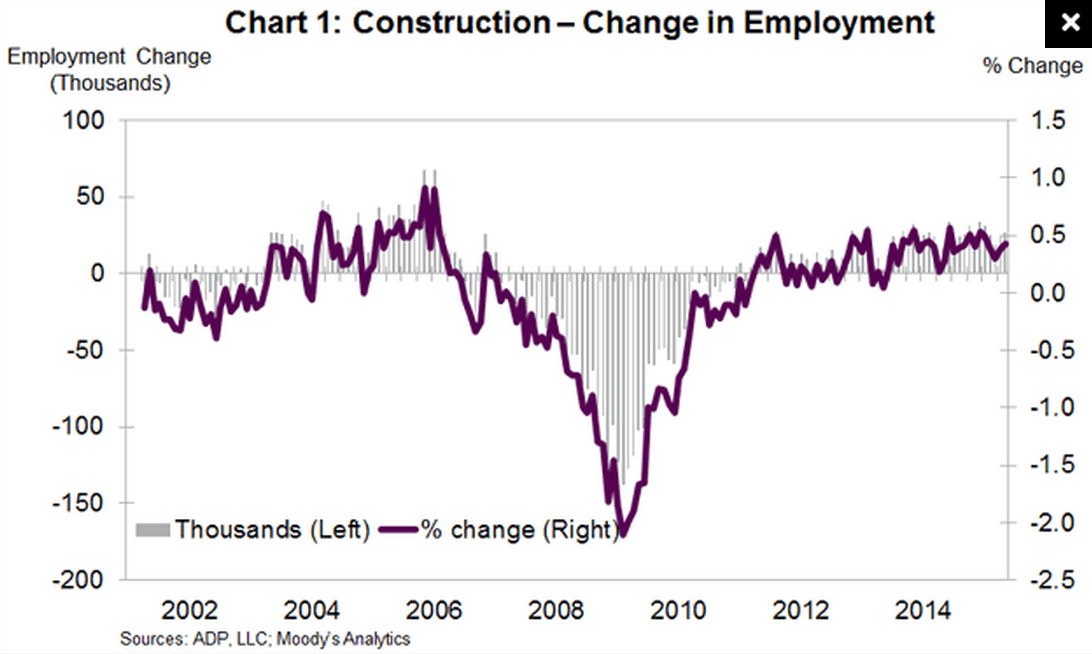
The ADP Employment Change index showed 201,000 jobs were created in May. We will get the official jobs report on Friday. The Street is forecasting 227,000 jobs were created in May. I can’t see Friday’s jobs report being market-moving unless it is unusually strong. That said, we have the first Greek deadline on Friday as well, so bonds could be in for a bumpy ride regardless. Manufacturing jobs contracted for the third month in a row, while construction jobs (a sort of proxy for housing) increased by 27,000. Construction employment levels haven’t returned to pre-crisis levels yet, but they are slowly getting back.

Home prices rose 6.8% year-over-year in April, according to CoreLogic. They remain 9% below their April 2006 peak. Some states are back to pre-crisis levels: Texas, Tennessee, New York (?!). Nevada, Florida, and Rhode Island are still around 30% below peak levels. The New York number doesn’t make a lot of sense, unless Manhattan real estate is really influencing the numbers. CT and NJ are 25% and 22% below peak levels, respectively. California is down 10.6% from the peak levels.

Morning Report – The dearth of starter homes 6/2/15

Stocks are lower this morning as European stocks and bond fall on some strong inflationary numbers. US Treasuries and MBS are lower as well.

Looks like we have dueling proposals to address the Greek situation. The parties are still a ways away from agreeing to anything.

The ISM New York fell to 54 from 58 last month. Factory orders fell 0.4% in April.

Economic Optimism fell to 48.1 from 49.7, according to IBD / TIPP. A reading of 50 is considered neutral, so consumers still feel slightly depressed about the state of the economy. If you dig into the data, the mood about the economy in general is somewhat negative, people’s personal financial situation are slightly positive, and their view of government economic policy is highly negative.

May auto sales are coming better than expected. Ford is still negative, while Chrysler Fiat is up small. GM was up 3%. Surprisingly, this is the best May in 8 years. That said, with the average age of a US car at 11.4 years, I guess the comps are pretty easy.

An interesting stat demonstrates the lack of starter homes on the market. 10 years ago, about a quarter of new homes had 3 or more bathrooms. Today, that number is 36%. The average size of a new home has increased by something like 140 square feet since the crisis. If you look at the homebuilders, Toll Brothers has been seeing all the action, while the more diversified builders like D.R. Horton and Pulte are only recently beginning to focus on the first time homebuyer. Here are all sorts of fun facts about new construction, courtesy of the Census Bureau. This speaks to both sides of the income inequality debate that has been raging in Washington. If you are an aging baby boomer with assets, QE has been very good to you. If you are a Millennial, the results are mixed at best. You had a very narrow window to pick up a bargain in the real estate market and it closed very quickly. Now house prices are again over their skis relative to incomes. In fact, Bank of America is expecting slightly negative house price growth in 2017-2019 as income growth fails to materialize. What is a Millennial with a bunch of student loan debt to do? Go to Atlanta, Dallas, or Houston.

Morning Report – Bonds could have a bumpy ride this week 6/1/15

Stocks are higher this morning as Europe and Greece work towards a deal. Bonds and MBS are flat.

Personal Income rose 0.4% in April, ahead of the 0.3% estimate, but personal spending was flat as people used income gains to pay down debt. The year-over-year growth rate is the lowest in 5 years.

The core PCE index (the Fed’s preferred measure of inflation) rose 0.1% in April and is up 1.2% year over year. Low inflation remains a persistent thorn in the Fed’s side and will provide a ready excuse to postpone rate normalization.

Construction spending rose 2.2% in April, which came in well above expectations. March was revised upward from -0.6% to +0.5%. These are month-over-month numbers – on a year over year basis, construction is up 4.8%. Residential construction continues to lag.

The ISM Manufacturing Index rose to 52.8 from 51.5 in April. The manufacturing economy continues to perform relatively well.

Greece owes the IMF 300 million this Friday, and as of now they have no way to pay for it. Greece is demanding that the ECB and IMF recognize that Greece has shifted to the left, however so far Europe isn’t budging. Between the Greek saga and the jobs report on Friday, bonds could exhibit some real volatility this week.