

 Brent Nyitray
 Fairlington Blade
 Let the mutherfuker burn!
 jnc4p
jnc4p Kevin S. Willis
 Michigoose
 lmsinca
 markinaustin
 Arcanaut
 novahockey
 quarterback
 ScottC
 yellojkt
Vital Statistics:
| Last | Change | Percent | |
| S&P Futures | 1457.1 | -1.9 | -0.13% |
| Eurostoxx Index | 2583.8 | -10.7 | -0.41% |
| Oil (WTI) | 99.07 | 0.1 | 0.07% |
| LIBOR | 0.381 | -0.005 | -1.17% |
| US Dollar Index (DXY) | 78.91 | 0.063 | 0.08% |
| 10 Year Govt Bond Yield | 1.85% | -0.01% | |
| RPX Composite Real Estate Index | 193.6 | -0.1 |
Expect a quiet market today and tomorrow for the Jewish holidays. S&P futures are down a couple of points and bonds / MBS are up a few ticks. There is not much on the economic calendar this week.
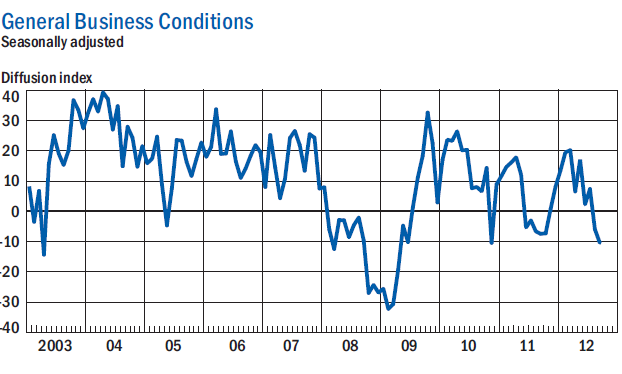
The Empire State Manufacturing Survey showed manufacturing in the New York region contracted more than expected. Just more evidence that the economy is losing steam going into the election. The diffusion index is now at the lows of late 2010. FWIW, I am hearing initial forecasts for 3Q GDP growth coming in around 1%. Meanwhile, several business owners testified last week that regulatory uncertainty is driving a lot of the inaction.
Paul Krugman has yet another editorial ridiculing anyone who disagrees with ZIRP and QE. Nobody attacks a strawman with more savagery than Dr. Cowbell, who imagines he is debating with someone who honestly fears Zimbabwean style inflation (yes, he actually did say that). Right now, commodities are soaring along with the stock market. Wages are flat to falling. So, a combination of flat wages and increased food and energy prices equals lower disposable income. I suspect a lot of middle class people would prefer not to have this “help.” Or seniors, for that matter, who receive meager interest income from Treasuries and high quality corporate bonds.
Rick Santelli (kind of the anti-Krugman) raises some good points about why QE might not end up influencing mortgage rates to the consumer. Why? Because we are raising the guarantee fee on conforming mortgages, and the banks will respond to the GSE’s round of put-backs by increasing borrowing costs. His view on ZIRP – the government needs to borrow a lot of money and needs interest rates as low as possible. He also notes that a lot of the floor traders have become mortgage bankers.
Investors in foreclosed properties now have a new source of funds – banks! Waypoint Real Estate Group got $65 million from Citi to buy foreclosed properties. Citi is also working on a way to issue securities backed by rental income streams. This is very good news for the housing market.
Filed under: Morning Report |
 All Things in Moderation
“So, a combination of flat wages and increased food and energy prices equals lower disposable income. ”
I’m confident that if we try hard enough, we can recreate stagflation.
LikeLike
“Citi is also working on a way to issue securities backed by rental income streams.”
Come see the new bubble… Same as the old bubble.
LikeLike
Depressing
LikeLike
Everybody I talk to who does real estate for a living says that investor pools of single family housing are a sure money loser, and the bigger the capital, the more you are likely to lose.
I tend to agree, with the caveat that I have only done my own remodeling and flipped one house. I think a corporate structure would be a severe impediment in residential real estate where deals are put together quickly and fluidly.
LikeLike
“The Obama Administration is also escalating another trade enforcement action, begun in July, against what it says are unfair anti-dumping and countervailing duties on some $3.3 billion in U.S. automobile exports to China.
The United States will ask the WTO to set up a dispute settlement panel to consider its case against those duties, which Beijing imposed in December 2011. China acted in response to the auto bailout Obama championed, arguing the rescue amounted to unfair government support for the industry.
“The key principle at stake is that China must play by the rules of the global trading system,” an administration official said on condition of anonymity. “When it does not, the Obama Administration will take action to ensure that American businesses and workers are competing on a level playing field.”
I might suggest that as we are the largest shareholder in GM, scratching plans to build the new 1.1 billion dollar plant in China would be far more effective.
LikeLike
“Everybody I talk to who does real estate for a living says that investor pools of single family housing are a sure money loser, and the bigger the capital, the more you are likely to lose.”
Lots of private equity money is going into this, attracted by the supposed high single digit rental yields.
These pools are designed to hold and rent for several years before selling the properties. That said, the more capital you commit, the more geographically spread out your portfolio will be. And if you don’t have most of your properties clustered together, the maintenance and management expenses can eat up your positive carry in a hurry.
LikeLike
The traditional approach to real estate investing has been through limited partnerships or similar LLC entities. It has concentrated on commercial real estate and the only residential ventures have been whole subdivisions from scratch or multi-family housing. I have been involved with these from both directions for many years. I also do not understand how scattered purchases of single family housing would work for a pool. I could see buying a failed and incomplete subdivision at a bargain price and gradually building it out, if the pool was into long term return.
LikeLike
This may be my oversight, but I don’t know of any large fortunes that have ever been made in single family rentals or flipping as opposed to being a developer of course.
Since there is no new angle on this, chances are pretty good that if you could make big money this way, somebody would have already done it.
LikeLike
Oh and it goes without saying that the more you have the ability to geographically concentrates your holdings, the greater the chance that it’s because the you’re in a lousy market. It’s kind of like noticing there aren’t any snow ski shops in Hawaii, and thinking oh boy, there’s an opportunity for me to make a kiling.
LikeLike
The only way it works is if you can buy them right and get real estate price appreciation without having to sink too much into rehabilitating the properties. Don’t forget that private equity funds can borrow at much more attractive rates and terms than the rest of us can. But people are paying up (like that Florida transaction that went at 96% of property value).
LikeLike
“I’m confident that if we try hard enough, we can recreate stagflation.”
It turns out a return to the Carter administration is a Best Case scenario.
http://www.shadowstats.com/alternate_data/inflation-charts
LikeLike
As a landlord who just began eviction proceedings for the second time in a year……….I wish all landlords across the country better success than we’re having. Job losses increase risk and evictions take time.
LikeLike
brent I’m not sure that’s true. Most flippers, don’t pay market rates for their property, and of course they don’t want to actually make many payments at all on the mortgage anyway, so even if they get a market mortgage, it’s less of an issue.
Rental real estate in NYC of course is a gold mine, but I don’t know if resindential rental in Las Vegas would justify the spread. I guess if they are VERY selective in location they can make it work. BUT as discussed in your example above if the location is a good one in Florida, how great a deal on price are they likley to get?
LikeLike
lms
MD I am told is a comparatively poor place to be a landlord just for that reason, renter’s rights.
LikeLike
John, I am talking about the big 9 digit pools that are being offered by HUD and FDIC. Completely different animal from the smaller guys.
LikeLike
oh yes, in terms of rates of finance, correct?
LikeLike
or are these outright buys from their pool, with no financing involved?
LikeLike
or are these outright buys from their pool, with no financing involved?
Depends on the deal. The government does not offer financing for that.
The Florida deal at 96 was based on the way FDIC used to do pools where the government would provide the leverage in return for equity and a cut of the returns. I believe in that case the government financed something like 80% of the deal and takes 90% of the rental income until most of the leverage is paid back and then they take 50%. Capital gains / losses go to the manager. They also pay a management fee of 1.5% to the buyer as well. So it was a complicated deal.
LikeLike
Yes, more so than I thought we were orignally discussing. So this is really only based on creating securitized paper from the rental income then?
LikeLike
I don’t think so. I think it is looked at as just another private equity type investment where you have a 5 year time horizon and can use leverage to juice the returns.
LikeLike
I wonder if they will create residential versions of REITs out of them? I guess it would depend on the tax treatment.
LikeLike
“Shrinking Household Debt Is Good Sign for 2013 Economy”
http://www.cnbc.com/id/49060039
typical, paying off loans when the rates are low and borrowing when rates are high
spending on things that decrease in value, when they should be borrwoing to purchase things that increase in value
LikeLike
banned:
typical, paying off loans when the rates are low and borrowing when rates are high
You are assuming that the loans that are getting paid off have low interest rates. That seems unlikely to me, or at least not obvious. Someone who is paying off a mortgage taken out in 2005 is not not paying off a low interest rate loan.
LikeLike
“I wonder if they will create residential versions of REITs out of them? I guess it would depend on the tax treatment.”
It is tough – there are limitations on the amount of the portfolio that can be REO (for starters) which may make it difficult.
For that matter, I would imagine most of the types that find this product attractive is ERISA money which already lives in its own tax universe.
LikeLike
Someone who is paying off a mortgage taken out in 2005 is not not paying off a low interest rate loan.
Or paying off credit card debt.
LikeLike
Or paying off credit card debt.
It should be possible to find those numbers. Hope this is the case.
LikeLike
OT: This may have come up before, but I can’t remember. But one of the stories making the rounds today is about IRS guidance on employer responsibility to provide coverage under the ACA.
ACA requires employers with 50 or more FTEs to provide coverage that meet the standards, etc. But that’s hard. So, you look into the regs to see what counts as an FTE, which is defined as someone who works an average of 30+ hours a week. So, instead of going through the hassle of covering employees, just limit their hours to an average of 30. So, if you know people are going to be way over 30 during the holiday season, restrict them to less than 15 in other months. problem solved.
Employment attorney quote: “I have found that employers do what they need to do for business purposes and then figure out how to comply with the rules, whatever they are.”
LikeLike
Limiting hours to 30 becomes the Walmart approach – or the French answer to full employment policy. I suspect that it will not be a driver of employment decision making except at some margins for very low profit industries that avoid health care costs and ERISA generally even now. Think “day care”.
LikeLike
right — expect those are the people that the law was intended to cover. So while nobody might lose coverage, the uninsured (or some group of them) will remain so. Or they get subsidized coverage on the exchanges.
LikeLike
lms:
AGAIN??!!?!!!!!
My sympathies to you! What happened this time?
LikeLike
Hi Michi
I know…….he lost his job and she’s supposedly out on disability. I may have to go out and get a second job at this rate. 2012 will go down in infamy around here.
LikeLike
scott:
i dont’ think that the people who have sub-prime rates and 25% credit card interest are the ones they’re talking about, though I could be mistaken.
LikeLike
banned:
i dont’ think that the people who have sub-prime rates and 25% credit card interest are the ones they’re talking about
Your assumption that only (or predominantly) sub-prime borrowers have have been unable to re-fi at these low rates doesn’t seem like a good assumption.
If you bought a house in 2005 as a reasonable credit and with 30% down, and your house value has dropped by 20%, you pretty much have to pay down your debt in some amount in order to re-fi at today’s low rates. The implication that, by paying down your debt in order to do so (and thus contributing to lower national household debt) you are doing a dumb thing doesn’t make a lot of sense to me.
LikeLike
my point, perhaps badly made, is that the last several years and even now would have been bad times to pay off debt. refinancing it at lower rates, if that were possible, would have made much more sense
it’s like being underwater on your mortgage, if you couldln’t refinance then it makes much more sense to walk away than to keep paying on a house which is worth 25% less than you owe.
LikeLike
banned:
my point, perhaps badly made, is that the last several years and even now would have been bad times to pay off debt. refinancing it at lower rates, if that were possible, would have made much more sense
It’s a bad time to pay off debt incurred or rolled over since 2008. But for debt incurred prior to 2008, it is very smart to pay it off, particularly if doing so frees up credit lines to borrow now at lower rates, even if those new credit lines are actually smaller than the old one’s, contributing to shrinking national household debt.
I agree that now is a good time to incur new debt. I just disagree with your assumption that shrinking household debt means people are behaving stupidly.
it’s like being underwater on your mortgage, if you couldln’t refinance then it makes much more sense to walk away than to keep paying on a house which is worth 25% less than you owe.
It may make strictly short term economic sense, but not necessarily long term economic sense, much less sense in the broader, ethical/moral world, which of course is important to many people, and not without reason.
LikeLike
FWIW, i was unable to refi b/c of the appraisal. wanted to consolidate some debt and get into a 15 year. No go on what i think was a woefully off-base appraisal.
Bought in 2009. 5% at 30 years with a second interest only.
Refi 2010 into 4.5% with a second, appraises with modest appreciation of about 4%.
this summer. tried to get to a 3.5% and consolidate. can’t consolidate, b/c it’s a cash-out and the LTV doesn’t work. okay. just the first. appraisal comes back less than 2009. And that 2010 refi is a disqualification for any of the underwater refi programs.
LikeLike
scott
for an individual of course, that’s case by case.
However in a macro sense, the Fed and the Federal government are doing everything possible to make it unwise for us to pay down debt with current cash (as opposed to borrowing more at lower rates of course) and I never fight the Fed.
these are in all liklihood the lowest rates of our lifetime absent a drop into absolute Depression (the real kind, not the Paul Krugman kind)
LikeLike
oil fell 3% today which means that the WH is almost certainly going to do the SPR release that they are currently denying or that Netanyahu has been exposed as being not willing to conduct an airstrike against Iran without US help, no matter what his bluster otherwise
LikeLike
scott
there is no ethical or moral consdieration involved in walking away from a mortage. It’s a business decision
anybody who believes otherwise is probably a mortgagee themselves
LikeLike
DJ – I’ll go with you on no moral obligation. But there most definitely is an ethical one. However, it may be outweighed by other ethical considerations.
The contract itself is based on an ethical framework. The breach of it is a violation of that framework.
However, the debtor/mortgagor could have any number of competing ethical considerations. She may, for example, have children dependent upon her. Her ethical responsibility to them may conflict, if she must move to get a job and cannot afford to carry two homes.
The person who has no competing ethical consideration who justifies walking away because it is cheaper has only to weigh the possibility of a deficiency judgment, a bad credit rating, or a bankruptcy. This is how his ethical obligation is enforced in our law.
LikeLike
banned:
there is no ethical or moral consdieration involved in walking away from a mortage. It’s a business decision.
Of course there is. Business decisions are not, by their nature, devoid of ethical/moral considerations.
LikeLike
agreed except that there is no ethical violation involved as long as the mortgagor is willing to accept the penalties laid out in the contract.
no mortgagee gets to put any “higher” obligation on a mortgagor than is on paper
LikeLike
Eugene Robinson decides we need more over the top hyperbole:
“Teachers are heroes, not villains, and it’s time to stop demonizing them.”
If teachers are heroes, try doing without the guys who keep the water and electricity running to your house. Maybe we are all heroes, like giving everyone on the team a trophy.
LikeLike
“lmsinca, on September 17, 2012 at 9:33 am said: Edit Comment
As a landlord who just began eviction proceedings for the second time in a year………”
It’s enough to make one a Romney voter.
Sorry, had to go there. 🙂
Speaking of which, I actually think that Romney makes a better case for himself in the “Super Secret Romney Fundraiser Video” than he has in his public statements, mainly because he actually appears to be giving an honest assessment of how he views things:
http://www.motherjones.com/politics/2012/09/secret-video-romney-private-fundraiser
LikeLike
“ScottC, on September 17, 2012 at 3:50 pm said:
I just disagree with your assumption that shrinking household debt means people are behaving stupidly.”
I agree with Scott. Among other things, the willingness to carry debt depends on how you view your future income level and job stability.
I’m sure Banned will slam me for this as being financially unsophisticated., but as I’ve gotten older I’ve found that being as close to debt free as possible (except for my mortgage) provides me with a freedom of action and peace of mind that I don’t have otherwise.
LikeLike
jnc
It’s enough to make one a Romney voter.
Why? Does Obama believe I should let them live there rent free indefinitely? Besides, both of the last two freeloaders were either Republicans or their bumper stickers lied.
Speaking of which, I actually think that Romney makes a better case for himself in the “Super Secret Romney Fundraiser Video” than he has in his public statements, mainly because he actually appears to be giving an honest assessment of how he views things:
I agree. I always knew there was something I didn’t like about the guy. Now he’s confirmed it.
LikeLike
lms:
Does Obama believe I should let them live there rent free indefinitely?
The notion isn’t exactly beyond the pale. You know, spread the wealth around, and all that.
I always knew there was something I didn’t like about the guy. Now he’s confirmed it.
What is it that you don’t like about him that he has confirmed?
LikeLike
Scott
You know, spread the wealth around, and all that.
Yes, I’m sure you’re right. Every liberal I know believes we shouldn’t be individually rewarded for hard work.
What is it that you don’t like about him that he has confirmed?
His characterization of 47% of the population as being lazy and not paying their way. You know…………….the “moochers”, apparently the only segment of the population that Obama can count on. However, at least he was honest like jnc said. I don’t think much of his philosophy or his insults though. It shouldn’t matter much to anyone here as I wasn’t going to vote for him anyway.
It’s ironic because lots of Presidents, Republicans and Democrats, are responsible for all the tax cuts the lower end (and upper end) of the income spectrum has received over the last few decades. Romney is the first presidential candidate I’ve heard blame all them for being dependent on government and believing they are victims. As he said though, it’s not his job to worry about them.
LikeLike
His characterization of 47% of the population as being lazy and not paying their way.
As I recall, a while back there was a pretty prolonged discussion about Warren Buffett, and the Democrats in general, injecting morality into the tax debate. Isn’t Romney doing that here? You’re greedy, lazy and a moocher if you are part of that 47% who purportedly vote for Obama. Are there other characteristics that can be measured based on the amount you pay in federal income taxes (democrats obviously think there are)? It appears that both sides have waded into the tax morality morass. I’m guessing the “rich should pay their fair share” message of the Democrats will poll better than “47% of Americans are lazy moochers” message of the Republicans. To be clear, I think both messages are stupid.
LikeLike
ashot:
Isn’t Romney doing that here?
No. As I pointed out, those were lms’ words, not Romney’s. Despite the fact that lms put the word “moocher” in quotation marks, the word was not uttered by Romney as far as I can see from what has been reported.
LikeLike
Of course, it was the GWB tax cuts that created most of the victims who will not take responsibility for themselves, as measured by the scale of income tax not owed or paid. That was the trade-off for lowering the top rates that got the two cuts passed, during wartime, no less.
Neither party approaches deficit reduction honestly or tax reform honorably. It is now merely “Whose ox” politics. As I have pointed out before, when Bill Bradley and Jack Kemp were working on it and debating it the tax reform questions were met on the policy plane.
I agree with Ashot – the WMR formulation is far less palatable than the BHO formulation, which is also wrong.
LikeLike
lms:
His characterization of 47% of the population as being lazy and not paying their way. You know…………….the “moochers”, apparently the only segment of the population that Obama can count on.
He did not use any of those characterizations. Not one. Those are your words, not his.
That being said, however, it is a simple fact that those who do not pay income taxes are not “paying their way” with regard to services provided by the government. It may be an uncomfortable fact for those who want those of us who do pay income taxes to pay even more, but it is a fact nonetheless.
As he said though, it’s not his job to worry about them.
Of course you know that, in context, you are misrepresenting what he said, don’t you?
LikeLike
Here’s David Brooks saying it waaaaaaay better than I can.
You could say that the entitlement state is growing at an unsustainable rate and will bankrupt the country. You could also say that America is spending way too much on health care for the elderly and way too little on young families and investments in the future.
But these are not the sensible arguments that Mitt Romney made at a fund-raiser earlier this year. Romney, who criticizes President Obama for dividing the nation, divided the nation into two groups: the makers and the moochers. Forty-seven percent of the country, he said, are people “who are dependent upon government, who believe they are victims, who believe the government has a responsibility to take care of them, who believe they are entitled to health care, to food, to housing, to you name it.”
This comment suggests a few things. First, it suggests that he really doesn’t know much about the country he inhabits. Who are these freeloaders? Is it the Iraq war veteran who goes to the V.A.? Is it the student getting a loan to go to college? Is it the retiree on Social Security or Medicare?
It suggests that Romney doesn’t know much about the culture of America. Yes, the entitlement state has expanded, but America remains one of the hardest-working nations on earth. Americans work longer hours than just about anyone else. Americans believe in work more than almost any other people. Ninety-two percent say that hard work is the key to success, according to a 2009 Pew Research Survey.
It says that Romney doesn’t know much about the political culture. Americans haven’t become childlike worshipers of big government. On the contrary, trust in government has declined. The number of people who think government spending promotes social mobility has fallen.
The people who receive the disproportionate share of government spending are not big-government lovers. They are Republicans. They are senior citizens. They are white men with high school degrees. As Bill Galston of the Brookings Institution has noted, the people who have benefited from the entitlements explosion are middle-class workers, more so than the dependent poor.
Anyway, have a great day everyone.
LikeLike
Oh there’s this too from the same piece. But go ahead and blame liberals for our country’s woes and entitlement spending. I said once that the best chance of cutting back on entitlement spending was voting for Obama but I didn’t get much of a response.
Even after adjusting for inflation, entitlement transfers to individuals have grown by more than 700 percent over the last 50 years. This spending surge, Eberstadt notes, has increased faster under Republican administrations than Democratic ones.
LikeLike
lms (from Brooks):
This spending surge, Eberstadt notes, has increased faster under Republican administrations than Democratic ones.
And as I have noted previously, this deceptive statistic ignores which party controlled Congress.
LikeLike
Scott
Those are your words, not his.
Very true, his comments were much more nuanced than mine.
Forty-seven percent of the country, he said, are people “who are dependent upon government [lazy], who believe they are victims [lazy], who believe the government has a responsibility to take care of them [not paying their way], who believe they are entitled to health care, to food, to housing, to you name it. [moochers]”
Of course you know that, in context, you are misrepresenting what he said, don’t you?
Not really, considering it’s the second or third time he’s said something similar. Remember when he said he wasn’t worried about the poor? Go ahead and supply the context if you want.
Anyway, I’m back to work and have a lot of catching up to do and bills to pay so have a good one.
LikeLike
OT to LMS — if you’re interested, remind me later and I’ll send you a new report on Pre-Existing condition plan.
LikeLike
lms:
Go ahead and supply the context if you want.
OK. He was asked about his campaign strategy in terms of getting elected in November, and he was explaining his focus on attracting votes from the small slice of voters who are up for grabs. He was pointing out that, in terms of seeking out votes, it was “not his job” to worry about those people who are already committed to Obama and who he will never convince to vote for him. In this he is absolutely correct, although it certainly provides his political foes with an opportunity to dowdify his words, as you have done.
BTW, I agree with jnc. Romney should embrace the attitude he showed here more publicly. Obviously in that one snippet he is painting all Obama supporters with too broad a brush. No doubt many Obama supporters do pay income taxes. But that they do embrace an entitlement/welfare state supported primarily by a small demographic of “rich” people seems obvious to me. Romney should make a principled, public stance against this notion.
LikeLike
No. As I pointed out, those were lms’ words, not Romney’s.
You really don’t think there are some rather obvious and unflattering implications to Romney’s description of 47% of our citizens? His words are still a moral statement regarding the tax code aren’t they? Maybe they aren’t quite as stark as I put them, but they are not a defense of the tax code on economic grounds.
although it certainly provides his political foes with an opportunity to dowdify his words
You didn’t build that.
LikeLike
ashot:
You really don’t think there are some rather obvious and unflattering implications to Romney’s description of 47% of our citizens?
Sure there are unflattering implications, but I don’t think Romney was actually trying to make a point of those implications. He was pointing out that as an electoral strategy, there is a certain demographic of people that he cannot attract to vote for him, and so he needs to concentrate his efforts elsewhere.
You didn’t build that.
I agree, there are similarities.
LikeLike
He was pointing out that as an electoral strategy, there is a certain demographic of people that he cannot attract to vote for him,
I agree. I also agree with the argument that Romney should not run from this. And I’m guessing you would say Obama should not run from his “spreading the wealth around” comment of 4 years ago. Don’t we want honesty from our candidates? Don’t we want to know what they actually believe? If so, why do we kill candidates when they are honest? Of course there is a question as to whether Romney believes what he said or if he was just pandering to a group of wealthy donors.
I agree, there are similarities.
Sadly, I see no future where campaigns refrain from such acts. Ugghhh.
LikeLike
Scott, I can’t let this one go unanswered even though I really need to get to work. I’m only good for a few hours a day right now.
OK. He was asked about his campaign strategy in terms of getting elected in November, and he was explaining his focus on attracting votes from the small slice of voters who are up for grabs. He was pointing out that, in terms of seeking out votes, it was “not his job” to worry about those people who are already committed to Obama and who he will never convince to vote for him.
His meeting with donors was intended to highlight how to attract the voters not already committed to Obama but the full quote below as well as the one above clearly defines his attitude toward those voters. I think the elephant in this room is that you agree with him. Just say so.
“[M]y job is not to worry about those people. I’ll never convince them they should take personal responsibility and care for their lives [lazy, moochers],” Romney also said in the video
LikeLike
lms:
I think the elephant in this room is that you agree with him. Just say so.
I thought I did, but if I need to be I can be more clear. I agree with him.
I have said this many times, but if the way in which we fund our government is through income taxes, then everyone should pay income taxes, and the tax rate should be flat with no exemptions.
LikeLike
BTW, thanks nova, I’ll look for it. I have another interesting story about a friend of my daughters who finally got on the PCIP out here but I’ll save it for when I have more time. It’s really essential these people have access to medical insurance.
LikeLike
“lmsinca, on September 18, 2012 at 5:51 am said:
jnc
It’s enough to make one a Romney voter.
Why? Does Obama believe I should let them live there rent free indefinitely?”
To the best of my knowledge, President Obama hasn’t taken a position on rent controls or the right to inherit a lease, but historically those initiatives seem to arise from the Democratic/Progressive side of the fence. See the past conversations on rent control in New York and whether tenants have a property right due to the length of time they have lived in a space and their contributions to the community in San Francisco.
LikeLike
“lmsinca, on September 18, 2012 at 7:40 am said:
…
I think the elephant in this room is that you agree with him. Just say so.”
I’ll own this. I definitely agree with him. I mean it when I say I’m a libertarian. It’s the most persuasive argument he’s made in my view thus far in the campaign. Note also that the 53% vs 47% meme isn’t original to Romney. The first I saw of it was from Erik at Red State in the Facebook posts in response to the “We are the 99%” meme as part of Occupy Wall Street. The “divide the country” approach didn’t start with Romney, he just draws the line differently than OWS.
I also agree with Brent in something that he posted on PL yesterday, namely that the entire “Life of Julia” meme shows that this is the active policy goal of the administration.
My solution, as repeated ad nauseum, is the flat tax with no deductions or exemptions, that rolls in all the FICA payroll taxes into one rate with the traditional income tax and treats capital gains the same as earned income. It resolves the whole “freeloader” issue nicely. If Romney was making an argument for a real flat tax straight up, I’d wager he would be doing better. However, traditional Republican upper bracket cutting and proposals for eliminating the tax on capital gains will never gain traction with the vast majority of the electorate.
LikeLike
“markinaustin, on September 18, 2012 at 7:14 am said:
Of course, it was the GWB tax cuts that created most of the victims who will not take responsibility for themselves, as measured by the scale of income tax not owed or paid.”
Completely agree. Ezra makes the same point.
LikeLike
If the 47% who do not pay net federal income tax are all BHO voters and cannot be swayed, then the corollary is that 90% of those who pay net federal income tax will vote GOP, given WMR’s estimate of 5-7% persuadables in the middle.
But, of course, that is not what we’re seeing in the polls. I thought WMR was a data/numbers guy.
LikeLike
“lmsinca, on September 18, 2012 at 6:50 am said:
Oh there’s this too from the same piece. But go ahead and blame liberals for our country’s woes and entitlement spending. I said once that the best chance of cutting back on entitlement spending was voting for Obama but I didn’t get much of a response.
Even after adjusting for inflation, entitlement transfers to individuals have grown by more than 700 percent over the last 50 years. This spending surge, Eberstadt notes, has increased faster under Republican administrations than Democratic ones.”
Last I checked, Social Security, Medicare, Medicaid and the PPACA were Democratic/Progressive/Liberal policies and proposals so I think it’s pretty fair to “blame” them for the spending associated with the entitlements that they enacted, especially to the extent that it exceeds the original cost projections that were done at the time of enactment.
However, you can definitely blame Republicans for two key drivers of entitlement spending:
1. Automatic COLA’s under Richard Nixon
2. Medicare Part D under George W. Bush.
Even with that though, on entitlement spending Republicans are still junior league compared to Democrats.
With regards to President Obama, I’d agree with that provided that he is dealing with a Republican Congress. With a Democratic Congress, I’d expect a repeat of 2009-2010 in terms of spending growth.
LikeLike
This touches on what I think it a big problem with the progressive income tax. The idea that someone is more or less responsible to the government based on income just leads to this. One side can’t say “they’re not paying their fair share” and not expect the response to be “yeah, let’s talk about what’s fair.”
LikeLike
Also — I’ve heard on the news about the Marines killed in Afghanistan. But the coverage made it seem like a “blue-on-greed” attack where the locals turned their guns on us. Apparently, this is not the case. they took out 6 USMC Harrier jets and the squadron’s CO.
http://www.utsandiego.com/news/2012/sep/15/yuma-harrier-jets-marine-felled-afghanistan/
“Raible, 40, died early Saturday during an unprecedented breach of the sprawling base in Helmand province that also resulted in the destruction of six AV-8B Harriers and significant damage to two more jets from the unit he commanded, Marine Attack Squadron (VMA) 211.”
LikeLike
LMS: Report on PCIP plan
http://www.commonwealthfund.org/Publications/Issue-Briefs/2012/Sep/Preexisting-Condition-Insurance-Plan.aspx
LikeLike
Mark asked about this on PL, so I’m reposting it here:
http://www.barackobama.com/life-of-julia/
Critiques by William Bennett:
& Ross Douthat:
See also:
http://douthat.blogs.nytimes.com/2012/05/11/why-julia-is-dangerous-for-obama/
LikeLike
“ashot, on September 18, 2012 at 10:54 am said:
He was pointing out that as an electoral strategy, there is a certain demographic of people that he cannot attract to vote for him,
I agree. I also agree with the argument that Romney should not run from this. And I’m guessing you would say Obama should not run from his “spreading the wealth around” comment of 4 years ago. Don’t we want honesty from our candidates? Don’t we want to know what they actually believe? If so, why do we kill candidates when they are honest? Of course there is a question as to whether Romney believes what he said or if he was just pandering to a group of wealthy donors. “
The people who want honesty are the 47% on either side who are committed. The candidates eschew honesty as they are targeting the 6% in the middle.
LikeLike
“If so, why do we kill candidates when they are honest?”
It’s easy. look how much copy was churned out in less than 24 hours over this statement. and you didn’t have a make a single phone call to do it. probably opened email, checked talking points from the usual suspects, and started writing. done by kickoff.
LikeLike