Bits & Pieces (Monday Evening Slog)

Ugh. What a day. One of those days where nothing gets resolved but I can continue to see all the things that are unresolved hovering over my head. Although they are mostly 3rd world problems, most of them stem from a mistake or decision I made previously, and I hate that. I always have that sense that somehow I have an obligation to do things differently in the past, but I can’t do it.It’s like those dreams where you’re running through molasses. Nothing a big, fat check from the government wouldn’t solve. I’m just saying, NoVA. 😉 
 …
  
As you may know, I’m a Disney fan. And I always hope they hit it out of the park, and create another classic, each time they make another movie. There are a few movies I felt were classics from the first time I saw them, like Beauty and the Beast. But I had good feelings about that one from the minute I first saw the poster art and theater standees. I think I got that vibe from The Little Mermaid, as well. I knew when I saw it, or shortly after, that it was a very good movie. I believe we had rented it on VHS and I was watching it with a little group of college friends when one of them said: “It’s like an instant Disney classic!”, and I realized that I agreed.

I think Tangled belongs in that group of Disney classics. After films that I enjoyed but didn’t feel weren’t classics in the manner of Beauty and the Beast, such as The Frog Princess, and one’s that were good but weren’t really classic Disney, like Bolt, my expectations were tempered. I came out of my first viewing, thinking they had pulled it off, but not really considering it an instant classic.

After having watched it several times now, and seeing both my daughters (one 6 and one 13) watch it several more times, I’m convinced it’s a classic, and one that will build an even bigger following over time. It’s a great re-telling of the Rapunzel tale, has some great set pieces, great performances, and classic Disney musical numbers.

Another indicator for me: Tangled is the first Disney Soundtrack I’ve purchased since The Nightmare Before Christmas. Before that, it was The Little Mermaid.

I had originally planned to discuss my deep love of certain movies, and my ability to watch them over and over again, such as It’s a Wonderful Life. It’s been a crazy day, so some other time.

My favorite scene:

Some days I feel a whole lot like George Bailey at 0:56.

— KW

This is not lobbying

Taking advantage of the pension system

I’m quoting liberally here from the story:

Two lobbyists with no prior teaching experience were allowed to count their years as union employees toward a state teacher pension once they served a single day of subbing in 2007, a Tribune/WGN-TV investigation has found ….. The legislation enabled union officials to get into the state teachers pension fund and count their previous years as union employees after quickly obtaining teaching certificates and working in a classroom. They just had to do it before the bill was signed into law.

… His pay for one day as a substitute was $93, according to records of the Illinois Teachers Retirement System … based on his salary history so far, he could earn a pension of about $108,000 a year, more than double what the average teacher receives …. stand to receive more than a million dollars each from a state pension fund …. A spokesman for the Illinois Federation of Teachers emphasized that the lobbyists’ actions were legal and that they made “individual decisions.”

End quote.

Here are two guys who clearly took advantage of a situation. What I don’t get is the defense from the union. The tone-deafness of that quote is astounding to me.

Morning Report

Vital Statistics:

Last Change Percent
S&P Futures 1238 2.8 0.23%
Eurostoxx Index 2337.8 0.280 0.01%
Oil (WTI) 88.04 0.640 0.73%
US Dollar Index (DXY) 76.438 0.043 0.06%
10 Year Govt Bond Yield 2.21% -0.01%

Futures are flat this morning as the market waits to see what comes out of Europe. The WSJ has a story this morning about the brightening outlook for Corporate America. It raises an interesting point regarding consumers – what they actually do can be different from what they say. Consumers can feel tapped out and miserable, but when the 10-year old car has had it, they buy a new one. Consumption can only be deferred for so long, and we have had a retrenching consumer for 3 years now.

The Obama administration is working on a new housing plan – one which eases the requirements for refinancing. Credit is so tight right now that borrowers who are current but have little or no equity are unable to refinance. This move is intended to break that dynamic. Will it prevent home prices from dropping? Probably not, as the first-time homebuyer is not really in a position to buy a house, and prices aren’t cheap enough to entice professional investors to take the liquidity risk and step into the market.

Merger Monday is back upon us with a bear hug in the pipeline space and a deal in the cloud computing space. CAT reported better than expected earnings.

No major economic data today – Case-Schiller comes out tomorrow.

Sunday Funnies and Asset Bubbles


I have several bloggers on the left that I regularly follow. Sometimes they’re a little over the partisan top but I am generally able to separate the nuggets of truth from the red meat. Here’s David Atkins discussing the difference between an asset economy and a wage economy. He’s not placing blame only on Republicans but policy makers in general since before Reagan. Both Atkins and David Dayen over at FDL work hard, I think, to understand what’s going on without blinders to their own side’s shortcomings and both do a good job of analyzing policy and the repercussions. Of course in the interest of moderation I’ll say they don’t always get it right but I think they do a lot of research and thought before throwing up any “ole thang”.

It would be comforting in a way to think that most every public official in Washington were eating luxurious dinners while rubbing their hands in glee at how best to destroy American families to benefit corporate contributors, so that those same public officials could buy houses in the Hamptons and eat filet mignon every night. Then it would just be a question of rooting them all out and putting “good” people into office. But that’s not really how most people, including elected officials, operate. Some are overtly corrupt to be sure, but a large number of them think they’re doing what they do for the right reasons.

I think this is true in the same way I believe my opponents on the right, you know who you are, believe in both their support of our heavily subsidized capitalist system and their prescription to bring us back from the economic precipice we’ve been on for three years now. Sure there are men and women in government and private markets who are only interested in their own bottom line but I’m hoping that most Americans would want to see a prospering economy and citizenry.

The real bipartisan agenda can be neatly summed up in this much overlooked but central Ronald Reagan quote from 1975:

“Roughly 94 percent of the people in capitalist America make their living from wage or salary. Only 6 percent are true capitalists in the sense of deriving income from ownership of the means of production…We can win the argument once and for all by simply making more of our people Capitalists.”

Understanding this idea is the key to understanding what is happening in America today, without resorting to Snidely Whiplash caricatures of elected officials.

Obviously policy makers thought by expanding home ownership, access to easy credit and inexpensive imported goods, and investing retirement funds in the market would lift us all. Unfortunately, it didn’t work out all that well for most of the middle class, regardless of how many refrigerators or tech gadgets they own.

The bipartisan idea from a public policy standpoint was not simply to enrich the wealthy at the expense of the middle class. The idea was to make the American middle class dependent on assets rather than wages.

On its face, the idea is insane. In a capitalist system, assets do often rise in value. But they also decline, and often sharply. Without significant wage growth and redundancies in the economy that provide stability at the expense of efficiency for asset growth, the popping of economic bubbles produces Great-Depression-style economic pain. The only way an asset-based economy can work is if assets grow reliably forever into the future. Not even the most “pro-growth” policies can promise that. In fact, those policies usually inflate bubbles that ensure just the opposite.

When policymakers attempt to privatize Social Security and Medicare, they aren’t necessarily supervillains hoping to turn America into a nation of nobles and peasants. Some are, but not all. The objective is to convert what they see as “useless” money sitting in the financial equivalent of a freezer, and put it to “productive” use in asset investments.

I think this is an important point and when I or others say that asset captitalists such as Pete Peterson are anxiously waiting to invest SS taxes paid by Americans into private investment opportunities this is what we mean. Many of us don’t believe this will work out very well for the little guy.

The recklessness and stupidity of this sort of approach to public policy should have been proven by the 2008 financial crisis that saw the rapid destruction of asset values in stocks, bonds, and housing. Predicating economic health on asset growth is a pipe dream: most people will never have enough assets to make it work, and asset growth is far too unstable to serve as the basis for a functional economy.

I think his conclusion is something to think about but I don’t see any real change in direction on the horizon so in the meantime, I’ll just try to protect our assets and push for a change in policy makers.

America will only return to real economic health when the asset-crazed insanity of the last 30 years is brought to heel, and America returns to a public policy that is far more interested in wage growth and economic stability than it is in asset inflation. Until then, we can expect continued political and economic shocks from an angry electorate and an economy that has run off the rails due to 30 years of deeply misguided anti-inflation, pro-asset-growth ideology.

ATiM Can Be Proud

The other day lms pointed out that an unknown person named “Kite” had become a “Follower” of our little blog here (see the list of avatars in the sidebar). I was curious, so I chased him down to ask how he had discovered us. Apparently there is some application out there called Stumbleupon which somehow tracks your own interests and recommends sites that you may find interesting. One of our own blog posts turned up in Kite’s stumbleupon, and he thought it interesting enough to start to follow us. But what I really wanted to pass on about his response to me was this:

Not really much intent to post with anything resembling consistency, but your blog is an interesting read. One of the few times I’ve ever read a political blog that wasn’t a shouting matching within five posts.

Hey…that’s what we were trying to do! Nice to have an outside observer confirm that we have achieved some measure of success. Well done, all.

Is a Rise in Income Inequality a Myth?

Here’s an interesting article by Jim Pethokoukis (formerly of Reuters, now with AEI) in which he states that there really is no increase in income inequality.
I’ve clipped this portion in honor of Kevin,
“4. A 2010 study by the University of Chicago’s Bruce Meyer and Notre Dame’s James Sullivan notes that official income inequality statistics indicate a sharp rise in inequality over the past four decades: “The ratio of the 90th to the 10th percentile of income, for example, grew by 23 percent between 1970 and 2008.” But Meyer and Sullivan point out that income statistics miss a lot, such as the value of government programs and the impact of taxes. The latter, especially, is a biggie. The researchers find that “accounting for taxes considerably reduces the rise in income inequality” over the past 45 years. In addition, “consumption inequality is less pronounced than income inequality.””
Food for thought in the current OWS environment.
—Troll

Bits & Pieces (TGIF Edition)

Can’t embed it, but I do recommend Full Metal Disney. Very strange, but well-executed.

If you’re not listening to the My History Can Beat up Your Politics by Bruce Carlson, you’re making a profound error. Here, he discusses the effectiveness of stimulus spending in a historical context.

He quotes Herbert Hoover as saying: “No one is starving. The hobo eats better than ever before.”

That Herbert Hoover was a man after my own heart. If you’ve never read it, you should consult John Hodgman’s Compleat List of Hobo Names. Myself, I am partial to Chicken Nugget Will and Persuasive Fredrick. And Cthulhu Carl. Then, you too, will be an expert on hobos.

Steve Jobs new biography includes a bit on warning Obama that he was going to be a one-term president. It also included the interesting observation that it’s too damned hard to build factories in America, while it’s easy to do in China.

Louisiana law bans cash transactions for second hand goods. Holy crap, why does every politician want to make me a frothing-at-the-mouth libertarian?

According to The Transom, David Frum is not a serious person. You have to scroll down to read it. But it’s there.

 — KW


It’s all gonna be OK

A sure sign that home prices have stopped falling:

A San Francisco insurer will roll out coverage against falling housing values in Ohio, the first state where it is selling policies for owners of single-family houses and condos.

Home Value Insurance Co. will use calculations by the Case-Shiller Home Price Index to decide payouts if homeowner policyholders sell their houses below the insured values. The company, founded in 2009 and headed by former investment banker Scott Ryles, will sell its Home Value Protection policies through independent agents.

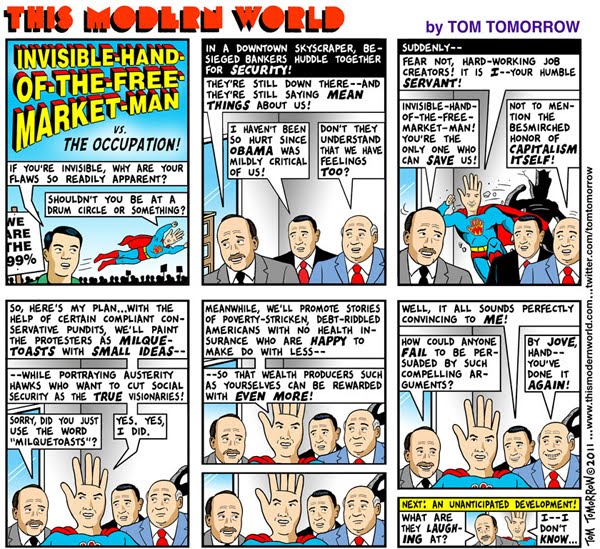
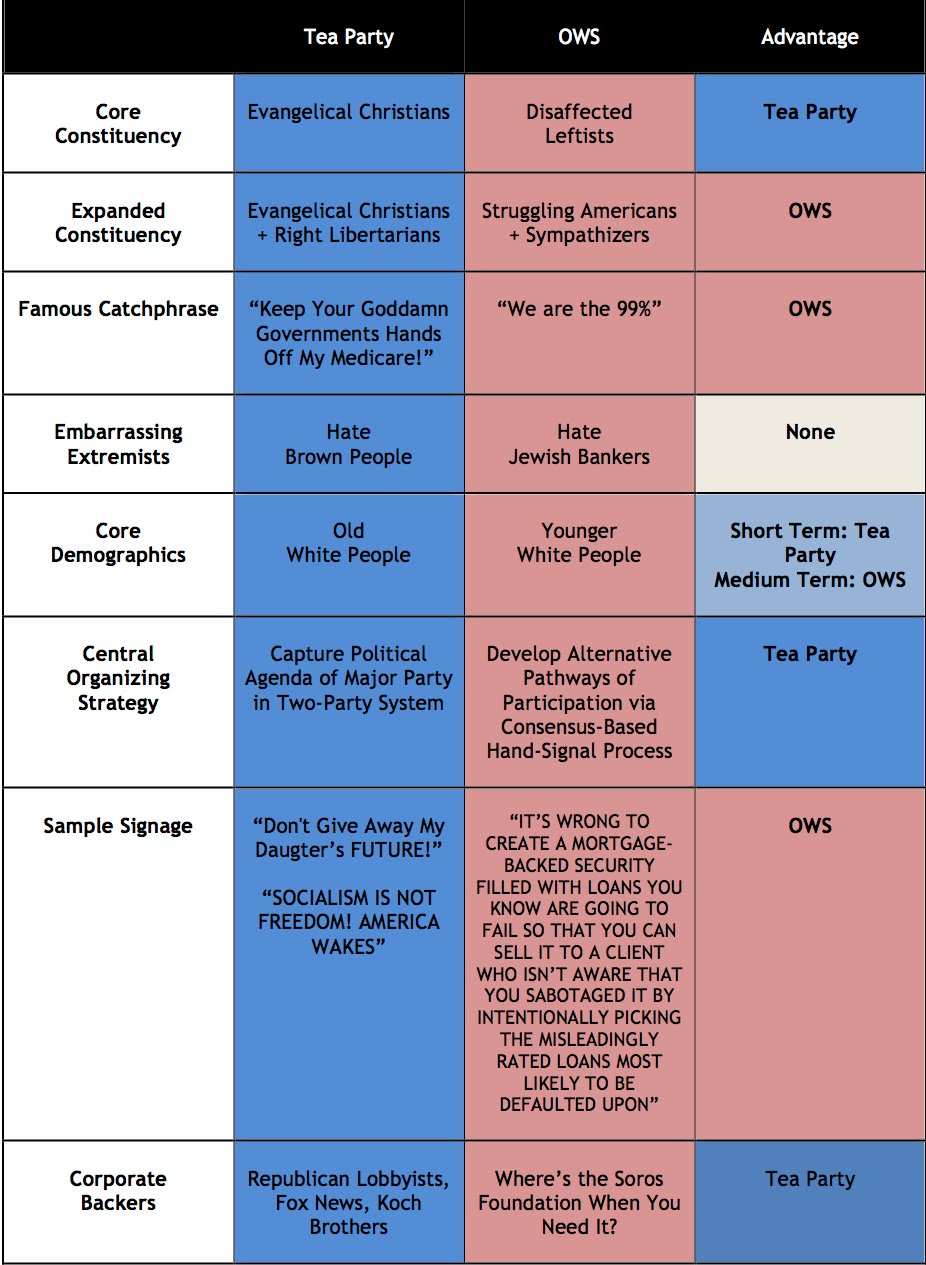
The Tea Party vs Occupy Wall Street by The Duck of Minerva

All credit and thanks to The Duck of Minerva for this.

OWS Update

Man arrested in Toronto for crawling into tents and sniffing some young lady’s feet. The poor foot-sniffer, just looking for olfactory justice for foot fetishists, was promptly oppressed by The Man™.

Reports of sexual harassment and assault at OWS events continue.

Protesters in L.A. have cost local government $45,000 so far. Redistributing wealth from other city services to protecting (and cleaning up after) the Noble Protestor.

Enthusiasm has apparently waned for some:

Rachel Goldie, 20, decided to leave the protest Wednesday because she felt it had been corrupted by people who didn’t care about economic justice. “Everybody is pretty much just partying it up,” she said.

Harassing people randomly is probably not the best way to sell your message. Occupy Baltimore distributes pamphlet urging victims of sexual assault not to report it to the police. Yay, enlightenment!

Lee Stranahan makes some ironic comments on OWS declaration via the medium of pictures. I especially like this one.

Lee also makes an argument for the fundamental differences between OWS and the Tea Party. Myself, I like Arun Gupta’s reflection upon the similarities of their root causes, while acknowledging various differences.

In NYC, residents are protesting the protestors. Noise pollution and garbage being two major issues.

The WSJ on OWS. Observations, some digs at Obama and MoveOn.org, but . . . I dunno, I expect more from you, WSJ. James Picht blames a sense of entitlement on the behalf of Wall Street bankers and welfare queens as the problem.

And that’s that, for now.