A Not So Modest Proposal

I was thinking today about our discussion regarding what method the Feds should use to fund federal spending, and it suddenly occurred to me that we don’t actually need a single method.  This is the beauty of a federal system.  If we think of the nation as it was originally conceived, a collection of semi-sovereign states bound together through the Constitution and governed by a federal government, then it is easy to imagine a system in which the federal government simply tells member states how much they owe, and the states themselves figure out how to come up with the money.  So if Californians like a a progressive income tax, they can have one, and if Texans prefer a consumption tax, they can have that too, and New York can have a transaction tax on all the evil Wall Street transactions , if that is how they prefer to raise the funds owed to the Feds.

The issue then becomes how to determine what the burden should be for each state.  If a balanced budget is desirable, the states, combined, need to be charged whatever the Feds are going to spend.   Since federal spending is generally measured as a percent of GDP, and since GDP is basically the sum total of either all income or all expenditures in the economy (depending on how you set out to measure it), making an individual state’s contributions a function of GDP makes sense and can be viewed as either a tax on income or consumption, depending on your preference.  And, interestingly enough, we can and do measure each state’s share of GDP, called GSP (Gross State Product).  So we have a ready and easy metric to determine what a given state’s share of the federal tax burden should be. If, say, federal spending is going to be set at roughly 20% of GDP annually, why not make each state’s contribution to the federal coffers be 20% of each individual state’s GSP?  Again, individual states can determine for themselves how to actually raise the amount owed from its citizens.  This would put an end to divisive national discussions about tax rate disparities, different “kinds” of income, and who is paying their  “fair share”, and would create a system of competition among states for the most efficient and “fair” method of raising funds.

Thinking about this, I decided to check to see how such a methodology would compare to what individual states have actually been contributing to the federal coffers.  The most recent year for which I could easily find both GSP figures and federal taxes paid broken out by state was 2007.  Note that the federal taxes broken out by state include both income taxes and corporate taxes.  It turns out that 2007 is actually a good year to use, because total revenues that year amounted to 19.5% of the sum of all state GSP’s, and the last time we actually had a balanced budget, federal spending was roughly 20% of GDP, so if we use that as a baseline for what spending “should” be, 2007 would have produced a balanced budget.  The results were interesting.

In 2007, the top 5 states in terms of GSP were also the top 5 states in terms of taxes paid to the federal government (see chart below).  Note that the positions of New York and Texas flip depending on whether the order is GSP or taxes paid, but otherwise the top 5 is in order either way.  The rest of the states are also roughly in the same order, which is not that surprising since GSP is a measure of all income received in that state, and federal taxes are currently based on income.  There were a couple of outliers, however, for example, Minnesota is number 9 in terms of taxes paid, but drops to 16 in terms of GSP, and Connecticut, which is 16 in taxes paid drops to 23 in GSP.  But for the most part the order of states is pretty close.

Next I compared what states actually paid with what they would have paid had their “bill” to the federal government been determined by a “flat” tax of 19.5 percent of GSP which would result in total revenue equal to that which was actually collected.  There were some interesting disparities.  For example, California, which had the highest GSP and paid the highest taxes still only paid 17.42% of its GSP in taxes, more than 2% less than it would have paid under a “flat tax” of 19.5% on GSP.   Another way of saying this:  Californian’s share of GDP was 13.14% but it’s share of the federal tax burden was only 11.76%.  On the other hand, Connecticut paid more than 22.5% of its GSP in taxes, 3% more than it would have paid with a flat 19.5%, and while it’s share of GDP was 1.55%, it paid over 2% of all tax revenue.    See below for a list of all states (numbers in millions of $).

State

Gross collections

GSP

% of GDP

collection as % of GSP

Collection at 19.5%

California

$313,999

$1,801,762

13.14%

17.43%

$350,804

Texas

$225,391

$1,148,531

8.37%

19.62%

$223,619

New York

$244,673

$1,105,020

8.06%

22.14%

$215,148

Florida

$136,476

$741,861

5.41%

18.40%

$144,441

Illinois

$135,458

$617,409

4.50%

21.94%

$120,210

Pennsylvania

$112,368

$533,212

3.89%

21.07%

$103,817

Ohio

$105,773

$462,506

3.37%

22.87%

$90,050

New Jersey

$121,678

$461,295

3.36%

26.38%

$89,814

Georgia

$75,218

$391,241

2.85%

19.23%

$76,175

North Carolina

$75,904

$390,467

2.85%

19.44%

$76,024

Virginia

$61,990

$384,132

2.80%

16.14%

$74,791

Michigan

$69,924

$379,934

2.77%

18.40%

$73,973

Massachusetts

$74,782

$352,178

2.57%

21.23%

$68,569

Washington

$57,450

$310,279

2.26%

18.52%

$60,411

Maryland

$53,705

$264,426

1.93%

20.31%

$51,484

Minnesota

$78,697

$252,472

1.84%

31.17%

$49,156

Indiana

$42,668

$249,229

1.82%

17.12%

$48,525

Arizona

$35,485

$245,952

1.79%

14.43%

$47,887

Tennessee

$47,747

$245,162

1.79%

19.48%

$47,733

Colorado

$45,404

$235,848

1.72%

19.25%

$45,920

Wisconsin

$43,778

$233,406

1.70%

18.76%

$45,444

Missouri

$48,568

$229,027

1.67%

21.21%

$44,592

Connecticut

$54,236

$212,252

1.55%

25.55%

$41,326

Louisiana

$33,677

$207,407

1.51%

16.24%

$40,382

Alabama

$24,149

$164,524

1.20%

14.68%

$32,033

Oregon

$23,467

$158,268

1.15%

14.83%

$30,815

Kentucky

$23,151

$152,099

1.11%

15.22%

$29,614

South Carolina

$20,499

$151,703

1.11%

13.51%

$29,537

Oklahoma

$29,325

$136,374

0.99%

21.50%

$26,552

Iowa

$18,437

$129,911

0.95%

14.19%

$25,294

Nevada

$19,619

$129,314

0.94%

15.17%

$25,177

Kansas

$22,311

$116,986

0.85%

19.07%

$22,777

Utah

$15,064

$105,574

0.77%

14.27%

$20,555

Arkansas

$27,340

$95,116

0.69%

28.74%

$18,519

DC

$20,394

$92,516

0.67%

22.04%

$18,013

Mississippi

$10,869

$87,652

0.64%

12.40%

$17,066

Nebraska

$19,043

$80,360

0.59%

23.70%

$15,646

New Mexico

$8,346

$75,192

0.55%

11.10%

$14,640

Hawaii

$7,666

$62,019

0.45%

12.36%

$12,075

Delaware

$16,858

$61,545

0.45%

27.39%

$11,983

West Virginia

$6,522

$57,877

0.42%

11.27%

$11,269

New Hampshire

$9,304

$57,820

0.42%

16.09%

$11,258

Idaho

$9,025

$52,110

0.38%

17.32%

$10,146

Maine

$6,289

$48,021

0.35%

13.10%

$9,350

Rhode Island

$11,967

$46,699

0.34%

25.63%

$9,092

Alaska

$4,287

$44,887

0.33%

9.55%

$8,740

South Dakota

$4,766

$35,211

0.26%

13.53%

$6,856

Montana

$4,523

$34,266

0.25%

13.20%

$6,672

Wyoming

$4,725

$31,544

0.23%

14.98%

$6,142

North Dakota

$3,660

$28,518

0.21%

12.83%

$5,552

Vermont

$3,806

$24,627

0.18%

15.46%

$4,795

Then, just for fun, I decided to see what would happen if the Feds allocated a state’s share of the tax burden in the same way it currently allocates an individual’s share of the burden, ie progressively.  So, for example, since the share of taxes paid by the top 1% of income earners is 36.7%, I looked at what it would take to make the share of the top 1% of GSP states be an equivalent 36.7%.  And so on for the next 4% (22% share of taxes), 5-10% (11.8% share), 10-25% (16.8% share), 25-50% (10.4% share), and finally the bottom 50% (2.3% share).

It turns out that under a progressive tax on GSP, the top 10% of states are all paying less than their “fair share”, while the bottom 90% are all over paying more.  Far and away the most egregious under-payer is California which, being the top 1% in terms of GSP, should be paying more than 3 times what it is currently paying.  The biggest over-payer is Arkansas, which is paying almost 10 times what it would be paying under a “fairer”, progressive system.  See chart below for what all states would pay, and their share of all taxes paid.

State

Gross collections

Collection at 19.5% of GSP

progressive share

Share of all taxes

California

$313,999

$350,804

$980,059

36.70%

Texas

$225,391

$223,619

$299,422

11.21%

New York

$244,673

$215,148

$288,079

10.79%

Florida

$136,476

$144,441

$171,983

6.44%

Illinois

$135,458

$120,210

$143,131

5.36%

Pennsylvania

$112,368

$103,817

$71,303

2.67%

Ohio

$105,773

$90,050

$61,848

2.32%

New Jersey

$121,678

$89,814

$61,686

2.31%

Georgia

$75,218

$76,175

$52,318

1.96%

North Carolina

$75,904

$76,024

$52,215

1.96%

Virginia

$61,990

$74,791

$51,367

1.92%

Michigan

$69,924

$73,973

$50,806

1.90%

Massachusetts

$74,782

$68,569

$47,094

1.76%

Washington

$57,450

$60,411

$30,236

1.13%

Maryland

$53,705

$51,484

$25,768

0.96%

Minnesota

$78,697

$49,156

$24,603

0.92%

Indiana

$42,668

$48,525

$24,287

0.91%

Arizona

$35,485

$47,887

$23,968

0.90%

Tennessee

$47,747

$47,733

$23,891

0.89%

Colorado

$45,404

$45,920

$22,983

0.86%

Wisconsin

$43,778

$45,444

$22,745

0.85%

Missouri

$48,568

$44,592

$22,318

0.84%

Connecticut

$54,236

$41,326

$20,684

0.77%

Louisiana

$33,677

$40,382

$20,212

0.76%

Alabama

$24,149

$32,033

$16,033

0.60%

Oregon

$23,467

$30,815

$4,637

0.17%

Kentucky

$23,151

$29,614

$4,457

0.17%

South Carolina

$20,499

$29,537

$4,445

0.17%

Oklahoma

$29,325

$26,552

$3,996

0.15%

Iowa

$18,437

$25,294

$3,806

0.14%

Nevada

$19,619

$25,177

$3,789

0.14%

Kansas

$22,311

$22,777

$3,428

0.13%

Utah

$15,064

$20,555

$3,093

0.12%

Arkansas

$27,340

$18,519

$2,787

0.10%

District of Columbia[1]

$20,394

$18,013

$2,711

0.10%

Mississippi

$10,869

$17,066

$2,568

0.10%

Nebraska

$19,043

$15,646

$2,355

0.09%

New Mexico

$8,346

$14,640

$2,203

0.08%

Hawaii

$7,666

$12,075

$1,817

0.07%

Delaware

$16,858

$11,983

$1,803

0.07%

West Virginia

$6,522

$11,269

$1,696

0.06%

New Hampshire

$9,304

$11,258

$1,694

0.06%

Idaho

$9,025

$10,146

$1,527

0.06%

Maine

$6,289

$9,350

$1,407

0.05%

Rhode Island

$11,967

$9,092

$1,368

0.05%

Alaska

$4,287

$8,740

$1,315

0.05%

South Dakota

$4,766

$6,856

$1,032

0.04%

Montana

$4,523

$6,672

$1,004

0.04%

Wyoming

$4,725

$6,142

$924

0.03%

North Dakota

$3,660

$5,552

$836

0.03%

Vermont

$3,806

$4,795

$722

0.03%

Come on California and Texas…start pulling your weight!!!!

Reason’s “Worst” Op-Eds of 2012 01/04/2013

Reason recently published a list of the Top 5 Worst Op-Eds of 2012. I’m pleased that I actually recall all off them.

5. Eric Posner, “The World Doesn’t Love the First Amendment,” Slate.com (Sept. 25). Free speech is too dangerous.
4. L.Z. Granderson, “Don’t Be Nosy about Fast and Furious,” CNN.com (June 27) Some things are better unknown
3. David Brooks, “The Follower Problem,” The New York Times (June 11) Don’t you know your place? Genuflect before your betters and STFU.
2. Maureen Dowd, “The Loin King,” The New York Times (Nov. 3) Honestly, I really don’t know what Down is talking about.
1. Tom Friedman, “Obama’s Nightmare,” The New York Times (Nov. 13). America needs fall to on the grenade in Syria, like it did in Iraq.

I actually found the Slate article to be the worst of the bunch. Or maybe Brooks. That one really chapped my ass too. Hmmm, let’s go with Brooks.

Morning Report – Jobs Day 01/04/13

Vital Statistics: 

  Last Change Percent
S&P Futures  1453.4 -0.2 -0.01%
Eurostoxx Index 2696.4 -4.8 -0.18%
Oil (WTI) 92.08 -0.8 -0.90%
LIBOR 0.305 0.000 0.00%
US Dollar Index (DXY) 80.84 0.460 0.57%
10 Year Govt Bond Yield 1.92% 0.01%  
RPX Composite Real Estate Index 192.1 0.1  

Markets are slightly higher after the economy added 155k jobs in December.  The unemployment rate came in at 7.8%, flat vs the revised upward Nov number.  The labor force participation rate was flat at 63.6%. Bonds and commodities have been getting hit since the release of the FOMC minutes yesterday, which indicated QE’s days are numbered.  The 10-year yield has broken out of its 6 month trading range, and MBS are down about 1/4 of a point. 

The minutes of the FOMC meeting revealed that the Fed will probably end QE some time this year. This has put pressure on Treasuries, as well as commodities like gold.  The Fed is predicting 2.3% – 3% GDP growth this year, which is above most other forecasts.  They debated whether to purchase Treasuries or MBS, noting that they haven’t been getting the “spill-over effect” in MBS that they had hoped for by buying Treasuries.  They also said that they do not want to give the impression that they are setting monetary policy solely on two variables – the unemployment rate and the inflation rate. 

The minutes explain why Treasuries refused to rally on the debt ceiling brinkmanship last year – the market knew the Fed was planning to end QE some time this year.  And the differing reactions of the stock and bond market is explained because stocks were paying attention to the machinations in Washington, while bonds were watching the Fed. So this was not the typical “bonds are right, stocks are wrong” dynamic you usually see.

Tim Geithner plans to leave the Administration by the end of the month, and won’t stick around for the debt ceiling debate.  White House Chief of Staff Lack Lew is the favorite to replace him. Lew worked for Citi from ’06-’08, but other than that has spent his career in government.  This will be the first non Wall Street / Fed Treasury secretary in a while, since the disastrous reigns of industry guys like the Paul (The Tin Man) O’Neill and John Snow in the Bush Administration.

The Fed examines why lending rates have not fallen in lockstep with QE in a new paper which asks why isn’t the 30 year fixed rate mortgage at 2.6%.  It does try and provide some reasonable explanations, for example, it does cite the increase in G-fees.  It also cites (a) increased put-back risk, (b) the declining value of MSR’s, and (c) higher origination costs due to increased regulatory scrutiny. That said, the academics tested the hypothesis that each of these individual items were driving the increased margins for lenders, but nothing was significant by itself. So they reject that hypothesis.  Since the t-stat is below 2, it doesn’t count, I guess, so price-gouging must be the explanation, and not these other reasons, which are 100% controlled by the government.  Sigh.

Morning Report – Money for Nothing. 01/03/13

Vital Statistics:

  Last Change Percent
S&P Futures  1455.0 -2.1 -0.14%
Eurostoxx Index 2690.8 -20.4 -0.75%
Oil (WTI) 92.82 -0.3 -0.32%
LIBOR 0.305 0.000 0.00%
US Dollar Index (DXY) 80.16 0.317 0.40%
10 Year Govt Bond Yield 1.84% 0.01%  
RPX Composite Real Estate Index 192 0.2  

Stock markets are giving back a little after yesterday’s relief rally on the fiscal cliff deal.  Mortgage Applications fell 10.4% last week.  2013 forecasts are starting to trickle in from strategists – suffice it to say 1H13 looks rough, with the economy basically at stall speed. 

There is quite a bit of economic data this morning.  ADP forecast that 215k private sector jobs were created in December.  Challenger and Gray reported that announced job cuts fell in December to 32,556. Initial Jobless Claims came in at 215k. The NY ISM came in at 54.3, indicating the outlook is barely positive.  Later this afternoon, we will get the minutes from the Dec FOMC meeting.

Corelogic reported that shadow inventory – properties that are seriously delinquent, in foreclosure, or are REO that are not listed for sale – fell 12% in October to 2.3 million units, representing 7 month’s supply.  Almost half of the properties are delinquent and not foreclosed.  The real question is how much this inventory will depress prices.  Given that many of these units are in judicial states, the supply will be dripped out slowly. Also, if a home has been vacant for several years, it develops problems that make the repairs more than the property is worth.  So, while it is in inventory, it is probably worth very little and isn’t competing with the homes that most normal homebuyers are focused on. 

So now that we have the fiscal cliff uncertainty out of the way, the markets should continue to rally, right?  We, according to business leaders, no.  And since the deal does not reduce debt, we are in danger of a downgrade, according to Moody’s. The debt ceiling also was a taste of what is to come, with 3 gating items in the near future – the debt ceiling, the continuing resolution, and the sequestration.  Obama has already laid a marker down saying that it can’t be “all spending cuts.”  Given that Republicans have already made the tax hike concession, they are likely to take a tough negotiating stance on these items. So it could get ugly.

How did Obama get Boehner on board for tax increases?  A simple warning.  Stop opposing higher taxes for top earners or I will dedicate my second term to blaming Republicans for the global recession. And, blame is one of Obama’s many talents.

Latest investment outlook from Bill Gross – Money for Nothin’ Writing Checks for Free.  The basic idea is that right now, the government is financing its deficit more or less for free.  Why?  Because the Fed is buying the treasuries (or at least 80%) through QE, and by statute, it gives its profit or losses back to the government.  So the government is basically (in a roundabout way) paying interest to itself. Bill goes on to point out that this has been done before, and it has always ended badly. In the long run, inflation will rear its ugly head.  Of course Paul Krugman would echo Keynes and say “in the long run, we are all dead.”  Bill also makes the good Austrian point – that Krugman has no answer for – that the unintended consequences of QE include mal-investments that will sow the seeds for the next bust.  You can view this debate here.

Morning Report: Happy New Year 01/02/13

Vital Statistics:

  Last Change Percent
S&P Futures  1445.5 25.4 1.79%
Eurostoxx Index 2705.2 69.3 2.63%
Oil (WTI) 93.3 1.5 1.61%
LIBOR 0.305 -0.001 -0.33%
US Dollar Index (DXY) 79.45 -0.282 -0.35%
10 Year Govt Bond Yield 1.84% 0.09%  
RPX Composite Real Estate Index 191.8 -0.5  

Markets are higher this morning after the government reached a compromise on the fiscal cliff.  It turned out the bond market (which was refusing to rally in spite of the setbacks along the way) was correct in its forecast.  When stocks and bonds are telling you different things, listen to the bond market –  it is usually right.  The 10-year is at the top of its recent 1.55 – 1.85 trading range.  MBS are down.

The House passed the Senate compromise on the fiscal cliff late last night, taking income tax hikes for most people off the table (although taxes are going up for everyone with a job).  Here are the main effects:

  • Tax rates will increase to the Clinton level rates for incomes over 450k
  • Limits on itemized deductions kick in at incomes > 300k
  • Capital Gains and Dividends rise to 20% for incomes over that threshold
  • Estate tax set at 40%, with a $5 million threshold that will be indexed to inflation
  • The sequester will be delayed for 2 months
  • the AMT will be permanently patched and indexed for inflation.
  • Extended unemployment benefits continue
The debt ceiling was not addressed in this deal.  The end deal is more or less a tax hike with no spending cuts. It looks like they extended the tax relief for principal mods / short sales as well.  So, unless you make over $300k, you are fine, right?  Nope.  77% of all households will see their taxes increase because the payroll tax holiday expired.
 
On to the debt ceiling, where Obama has already said he won’t accept spending cuts without further tax increases. That will be a contentious debate, since Republicans already walked the plank with their base and voted for tax hikes without Democrats giving up a thing.  Given that Republicans have voted for tax hikes already, the “Republicans are unreasonable” arguments will lose some of their sting.  They will be emboldened to push for more spending cuts, which the White House will refuse. While the WH had the benefit of circumstance in the fiscal cliff negotiations, where the default outcome was a big tax hike, now Republicans have the benefit of circumstance where the default outcome is where spending gets cut (as the sequester was merely delayed, not eliminated).  Punch line, things will get ugly again in Washington, so look to fade this rally.
 
Bob Schiller is not convinced we are off to the races in the housing recovery.  Basically, he believes housing has hit “fair value” and isn’t going anywhere for a while. He may be correct, and that house price inflation will go back to its old relationship with incomes.


New Years Open Thread

Just an open thread…that is all.

¡Hot Tamales!

It’s been awhile since we’ve had a bites and pieces post, so I thought I’d offer up our annual party for making tamales. The singular is tamal, but even my Costa Rica born wife calls it a tamale. I think I’ve corrupted her.

Tamales are traditionally made in Latin America over Christmas. There’s a lot of work involved, so a family will make an enormous batch, many of which are given to neighbors and friends. My wife’s parents owned a small bakery in Heredia, a suburb of San José. Tamales brought to them were often dinner at that time of year as they were swamped with seasonal work at the bakery. I’ve continued that tradition by bringing tamales to my neighborhood wine shop. They too are swamped this time of year and the tamales are gratefully received.

Making tamales is quite an undertaking. It helps to have some like minded friends and a general to take charge. I’ve done a lot more cooking over the last ten years than my wife, but I’d say she has more the makings of a chef than I. This year, she largely demonstrated how to make the tamales for our crew and kept the process going. I worked as a prep cook for most of the day.

The recipe for our tamales derives from one of Keen’s aunts, Lijia. At the heart of tamales is the masa–liquid thickened with corn flour. We use Maseca, which is corn flour with lime (calcium hydroxide, not fruit juice). The twist for Lijia’s tamales is to use boiled and mashed potatoes in the masa. You get a somewhat softer texture than using just corn flour. One cooks chicken breasts in a lot of water, add the mashed potatoes, some condimento and cilantro. Condimento is a spice blend that generally has garlic powder, cumin, and a few other spices. We make our own as it’s fresher and has less salt (or MSG) than that from the store. Plus, you can’t find Costa Rican style condimento here.

My sole contribution was to upgrade the chicken and the stock. The original version called for boiling the chicken breasts for a long time to create the broth, then add everything else. There’s two problems with that approach. First off, chicken breasts don’t have a lot of flavor to add to the broth. Second, what little flavor they have is long gone once you’re done making the broth. I poach the chicken breasts and then make a stock.

We start with a dozen skinless, boneless chicken breasts and four whole chickens. Remove the breasts from the whole chickens and add to the others. Rinse, pat dry, and set aside. Remove the dark meat from the bones and set aside. I freeze it and use it for other recipes, especially curries. Use a cleaver to break up the bones and expose that lovely marrow. Roast the bones along with the back and wings (also cut up into 3” chunks with a cleaver). Roast the bones for about an hour at 350 degrees.

While the bones are roasting, bring a stockpot with two gallons of water up to a boil. Poach whole chicken breasts in a couple of gallons of water and set aside when nearly done. They’ll be cut up and sautéed later, so you needn’t worry about undercooking. Add the roasted bones to the poaching liquid and bring up to a simmer. Add a couple of quarts of chopped onions, celery, and carrots along with spices. This stock is a bit different from normal, so you’ll be using cilantro, cumin, and coriander. Simmer for 2 – 4 hours, strain, and set aside. As the great outdoors is an extended cooler in December, I strain everything into a big bowl, put back into the stock pot, and set outside for the night.

We’re only getting started. Peel a couple pounds of carrots and slice into match sticks. Do the same for some bell peppers. These will be sautéed later and added to the tamales.

Back to the chicken. Cut the chicken into half-inch pieces. Finely chop some carrots and the tops of the bell peppers. Finely mince a few cups worth of yellow onions. Heat up some oil in a frying pan, add one third of the minced veggies and onions, a couple of tablespoons and some achiote (used to color dishes in Latin America). Add the chicken breast pieces and stir fry until colored and fully cooked. Set aside and repeat. Do the same for the bell pepper and carrot match sticks.

The banana leaves will need to be prepared. Slice them into roughly 9” squares. Two are needed for each tamal. Avoid Goya brand (they were surprisingly bad). We went through 20 packages of prepared banana leaves. You might guess from the scale that we make a lot of tamales. We wound up using about a gallon of homemade turkey stock to supplement the broth (making 3 gallons in total) and wound up with over 150 tamales by the time we were done.

Now we make the masa. Take the chicken stock back from the porch and heat to a simmer. Add the riced potatoes and mix. Gradually add the corn flour (Maseca), and stir. You’ll want folks with some muscles and it’s going to get thick. Once it’s completely thickened (you’ll need a Latina to tell you when), take out to the table as you’re ready to make tamales.

At this point, you should have a honking big stock pot full of masa. There’s a big bowl of sautéed chicken breast chunks. There’s also a couple bowls of sautéed bell pepper and carrot match sticks. You’ll also have bowls of olives, capers, and raisins (we use craisins). Think Costco sized portions.

Now we’re ready to assemble the tamales. Put one banana leaf section on top of another, the smaller on top. Plop about a half cup of masa on them. Add two chunks of chicken, one on each end. Add a few match sticks of carrot and bell pepper. Put a few capers on one end, an olive or two, and some craisins. Wrap it up (you’ll need guidance) and set aside. Each pack has two tamales, set back to back and wrapped in twine. Hemp twine is in-effing-credible. Best stuff I’ve ever used.

Once the tamales are wrapped and tied, they need to be cooked. Fill as many pots as you have room for with tamales on their ends. Pour water into the pot until about halfway up the tamales. If you have a pot that’s taller than the tamales, you can stack a few on top and cover them. Boil/steam for about 45 minutes.

When it comes to eating the tamales, we microwave them and serve them with Salsa Lizano, a Costa Rican savory sauce. It’s the same type of sauce as Heinz 51.

MEET PUPPA, MY CHRISTMAS MIRACLE

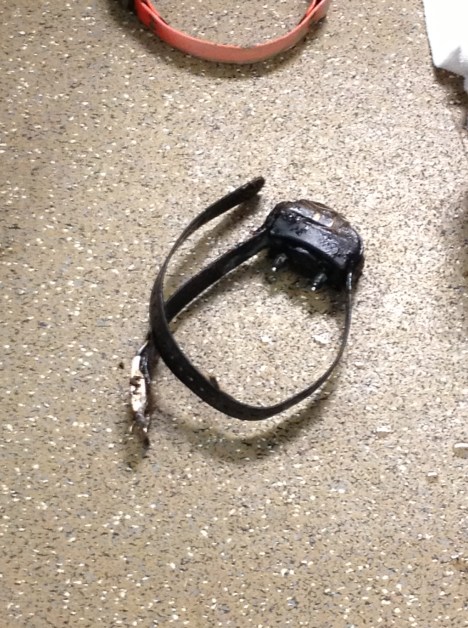
I hope everyone’s holidays are going well. I wanted to show you some pictures of a dog my wife and I rescued, we call him Puppa. About 6 months ago he showed up in my neighborhood, starving and looking forlorn. Whoever had him had put a shock collar on him:puppa starving

Puppa was very scared of people, yet wanted companionship. If you walked a dog, he’d follow you, but at a distance of no less than 10 feet. We took to feeding him, he loves hot dogs, and leaving out water. It took us two months to lure him over to my street and in front of my house. We couldn’t catch him however. No matter what we did, he’d never come any nearer than 10 feet. we even got some tranquilizers from my vet, with no luck. On Christmas morning I went out to feed him his holiday hot dogs when a SUV approached me, a woman inside asked me if Puppa was my dog. I told her it was a stray that I’d been trying to catch. It turns out she lives in an adjoining subdivision, works for a private animal rescue, and had noticed Puppa on a walk with her dog. She agreed to set up a trap that day, and if we caught him, to get him to the vet. Well, sure enough it worked! That afternoon, Puppa was in the trap!puppa trapped

The vet cut off the shock collar:photo (94) though I wont torture you with pictures of the horrible wound it left.

I take Puppa home on Wednesday and have visited him everyday. Yesterday he put his paw on my hand: Puppa

I haven’t had all that great a year, but it sure is ending well.

I miss commenting here, so I am going to resume

Merry Christmas and a Happy New Year!

George

Morning Report – On the Waterfront Edition 12-28-12

Vital Statistics:

  Last Change Percent
S&P Futures  1401.8 -8.9 -0.63%
Eurostoxx Index 2633.2 -26.8 -1.01%
Oil (WTI) 91.01 0.1 0.15%
LIBOR 0.308 -0.003 -0.96%
US Dollar Index (DXY) 79.81 0.188 0.24%
10 Year Govt Bond Yield 1.70% -0.03%  
RPX Composite Real Estate Index 192.3 0.0  

Stock index futures are lower on pessimism about a budget deal. Obama will meet with Congressional leaders today to see if they can hammer out a deal. The House will meet on Sunday night. The same story remains – stocks are worried about going over the cliff, while the bond market seems skeptical.  For a laugh, check out Rick Santelli’s rant about the way the markets are handicapping it. 

One other possible headwind for the economy in Q1 – a longshoreman’s strike that would close cargo ports on the Eastern Seaboard and the Gulf Coast. This would not only limit raw material supplies to US factories, it would also push many logistics workers, truck drivers, etc on to the unemployment rolls. Some economists estimate that a strike could cost the US economy $1 billion a day. Will Obama risk alienating his labor base to intervene?  Fun fact:  the average compensation for a longshoreman in $124k.

Yesterday’s consumer confidence numbers took a step downward, and seem to back up reports that this year’s holiday sales were weak.The outlook for business conditions and labor markets fell. 

Chart:  Conference Board Consumer Confidence:

 In spite of the pessimism over the fiscal cliff, luxury homes priced over $1 million are making a comeback. Sales have risen by 9% for the first 9 months of 2012.  Strong foreign demand has been driving up prices in Manhattan and the Hamptons. In terms of foreclosures over $1 million, the NYC suburbs hold 4 out of the top 10 zip codes, with New Canaan taking the lead.  This is still the wreckage from the bust, where lots of $1 million a year guys lost their jobs in 2007 and haven’t worked since.

Morning Report – the Mod Squad 12-27-12

Vital Statistics:

Last Change Percent
S&P Futures 1416.2 2.7 0.19%
Eurostoxx Index 2665.1 16.6 0.62%
Oil (WTI) 91.18 0.2 0.22%
LIBOR 0.311 0.001 0.32%
US Dollar Index (DXY) 79.44 -0.182 -0.23%
10 Year Govt Bond Yield 1.77% 0.01%
RPX Composite Real Estate Index 192.3 0.5

Markets are quiet again as desks are understaffed both in Europe and the US. Initial Jobless Claims fell to 350k, back to the bottom end of our 350k – 390k range. Bonds and MBS are down small and continue to dismiss the possibility of a cliff-induced recession.

President Obama heads back to Washington to try and craft a deal to avert the fiscal cliff. The WH seems to have backed off its proposal to increase taxes at 400k and has moved back to 250k. It is looking more and more like we will go over the cliff on Jan 1 and then pass some sort of tax cut package soon thereafter.  Treasury informed Congress that we will hit the debt limit on Monday, but they can play some games to keep the government funded through Feb.

Of course, once we climb the fiscal cliff, we will go right into the battle of the debt ceiling. Moody’s has already fired a shot across the bow, saying that they expect the government to raise the limit, but they may downgrade the U.S.’s credit rating unless we get a decrease in the debt / GDP ratio.

Yesterday’s WSJ report on possible new initiatives to mitigate the effects of the housing bust have already been met with skepticism. The first plan involved allowing deeply underwater non-agency loans to refi into Fan and Fred loans.  James Pethokousis of the American Enterprise Institute points out that allowing the GSEs to refi underwater non-agency mortgages is a non-starter with virtually all Republicans and many Democrats as it shifts risk from the private sector to the public sector.  Plus, you have to get the originators on board, and they won’t make 125%+ LTV loans without some sort of safe harbor against buyback risk.

A second plan would further expand HAMP, by changing the definition of “in danger of imminent default” to include anyone who is has a LTV over 125%, even if they are current on their mortgage. Such a move would not require Congressional approval. The American Securitization Forum is against the idea, given that these loans are worth their weight in gold.  They are current, have above-market coupons, and have virtually no chance of being prepaid for years. If enacted, investors would take an income hit (although Treasury would pay them the coupon difference for 5 years), and would see a capital loss as well. My sense is that ASF’s argument will be met with very little sympathy in the Administration, although state and federal pension funds will be quietly making the same argument as well. Still another hurdle would be servicers, who would have to buy off on the idea that modding a current loan is somehow good for the investor.