Morning Report – John Williams confirms QE could end this year 6/3/13

Vital Statistics:

  Last Change Percent
S&P Futures  1634.2 5.2 0.32%
Eurostoxx Index 2772.8 3.1 0.11%
Oil (WTI) 92.68 0.7 0.77%
LIBOR 0.273 -0.002 -0.73%
US Dollar Index (DXY) 83.15 -0.228 -0.27%
10 Year Govt Bond Yield 2.16% 0.03%  
Current Coupon Ginnie Mae TBA 101.8 -0.1  
Current Coupon Fannie Mae TBA 100.4 -0.3  
RPX Composite Real Estate Index 200.8 0.3  
BankRate 30 Year Fixed Rate Mortgage 4.1    


Markets are higher on no real news. We will get an important manufacturing report at 10:00 am est with the ISM Manufacturing Report. Bonds and MBS are down small.
 
Lots of data this week, with the ISM Manufacturing Survey later this morning, Unit labor costs and productivity on Wed and the jobs report on Friday. The jobs report will obviously be the biggest report of the week. The Street is expecting an increase of 177 jobs and a 7.5% unemployment rate. 177,000 jobs is on the low side of recent history. 
 
Federal Reserve Bank of San Francisco President John Williams confirmed the conventional wisdom in the bond market – that the Fed may start reducing asset purchases with an eye towards ending QE by year end. “With continued good signs on jobs and confidence in a substantial improvement, I could see as early as this summer, some adjustment, maybe modest adjustment downward in our bond purchase program.” The program is doing this great job of helping the economy gain momentum and I would want to see that continue well into the second half of the year, but if things, again iff they go well, you could imagine ending the program by the end of the year.”
 
The sell-off in bonds has been painful for PIMCO: Bill Gross’s Total Return Fund lost 2.2% last month.
 
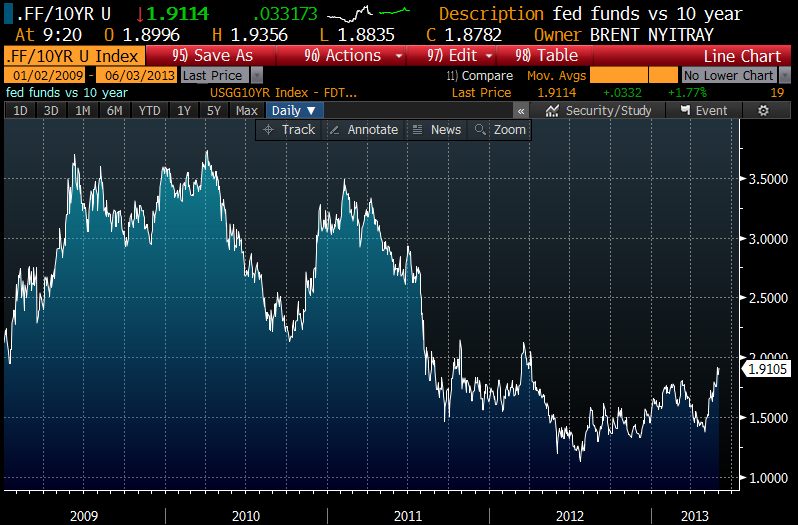
If the Fed ends QE, how high can we expect 10 year yields to go? Actually, a lot higher. The following chart shows the difference between the 10 year bond and the Fed Funds rate since it was set at 25 basis points in early 2009. Since we know the Fed is probably going to wait until unemployment gets closer to 6% before making any moves with the Fed Funds rate, we can assume that stays constant for the near term. But this chart shows we have gotten used to a flat yield curve over the past year. And that may be about to change.
 
Chart: 10 year bond yield minus the Fed Funds Rate
 

Not Your Ordinary Marketplace

http://tinyurl.com/m4qjapm

Some takeaways:

Whether directly from their wallets or through insurance policies, Americans pay much more for almost every interaction with the medical system.

High prices mostly result not from top-notch patient care, but from business plans seeking to maximize revenue; haggling between hospitals and insurers that have no relation to the actual costs of performing the procedure; and lobbying, marketing and turf battles among specialists that increase patient fees.

The United States spends about 18 percent of its gross domestic product on health care, nearly twice as much as most other developed countries. The Congressional Budget Office has said that if medical costs continue to grow unabated, “total spending on health care would eventually account for all of the country’s economic output.”

Consumers, the patients, do not see prices until after a service is provided, if they see them at all.

Patients with insurance pay a tiny fraction of the bill, providing scant disincentive for spending (NoVA has told us this, of course).

Even doctors often do not know the costs of the tests and procedures they prescribe.

Insurers have limited incentive to bargain forcefully, since they can raise premiums to cover costs.

The article focuses on colonoscopies as a case study of an ordinary procedure run amok. If the American health care system were a true market, the increased volume of colonoscopies — numbers rose 50 percent from 2003 to 2009 for those with commercial insurance — might have brought down the costs because of economies of scale and more competition. Instead, it became a new business opportunity, and moved out of the office and into the hospital.

The cost of a colonoscopy in the United States varies staggeringly, from place to place, and even within a city. Austin averages four times Baltimore, for example. New York is even higher, of course.

It is the pricing of these ordinary medical procedures that surprises me as a major contributor to our inflated health care costs.

I recommend the linked article.

Bites & Pieces…Weekend Edition

I learned something this week; Brent enjoys the Bites & Pieces posts.  Well, in that case here we go.

Oooops, he and I don’t have much in common except that he’s a Democrat when it comes to social issues, and I’m pretty sure our food tastes will be as out of sync as our belief in the free market.

I’ve described myself as a grazer and I wasn’t kidding.  I offered up my kale and pine nut salad and he didn’t jump at the offer so I think I’ll offer up my prime rib, Yorkshire pudding and spinach soufflé instead.  I’d throw in my blueberry cheese cake but he’d probably have a heart attack and you guys would blame me for the loss of our Morning Report.

I only serve this meal once a year……… maybe, and I generally make a big salad to go with it so I can keep from starving to death while I watch everyone else inhale their dinner.

Prime Rib

Minimum 3 rib standing roast of quality, we buy prime.  The weight doesn’t matter and I’ve actually purchased a roast of only 2 ribs before and the recipe works.  You can have the butcher cut the bones away and reattach with string if you want.

Generously season the entire surface of roast.  We like a Monterey seasoning but you can use anything you want as long as it includes some salt.  Be creative.

Bring roast to room temperature and pre-heat oven to 375.  Place roast in roasting pan with a rack under it.  Put roast in oven, uncovered, and roast for 1 hour.  Turn oven off.

Leave roast in oven, with door closed until guests arrive or about 45 minutes before you want to serve dinner.  Do Not Open Oven Door and the roast must be in the oven for at least 2 hours after first roasting before you turn the oven on to finish.  It can stay in longer though.

Turn oven on to 375 and continue roasting; 35 minutes for rare, 45 minutes for medium or 55 minutes for well done.

I leave it in for 45 minutes and the outside pieces are medium and inside is medium rare.  Everyone around here says that’s perfect.

Serve with creamed horse radish sauce.  I used packaged au jus mix or brown/onion gravy for the meat and the Yorkshire pudding.  There won’t be enough drippings in the pan to make au jus or gravy generally.

Yorkshire Pudding (makes 12 muffins)

Ingredients:

1 cup milk

1 cup flour

6 eggs

1 tsp salt

Vegetable shortening

Directions:

Mix milk, flour, eggs and salt until well blended.  Refrigerate for at least two hours.

Spray muffin pan with Pam and put ¼ tsp of Crisco into each muffin tin.  Place pan in oven and heat in oven at 400 until Crisco is melted and quite hot.  Ladle cold liquid evenly between 12 muffins, quickly while pan is hot.  Bake at 400 for about 25-30 minutes until the Yorkshire is puffed up and brown.

Let muffins sit in the pan for about 5 minutes before removing as it’s easier to get them out.  Don’t skip the Crisco or spraying the pan.  They will fall as they cool but that’s normal.  There will still be little hollow places inside.

Spinach Souffle

Ingredients:

1 cube butter or margarine

6 eggs

6 tbs flour

2 boxes chopped frozen spinach (defrosted and drained well)

2 lbs. cottage cheese

½ lb. American cheese (cubed)

Combine all ingredients in a round and deep baking dish and bake for one hour at 350.

If you only have one oven (I actually have two) you can cook the spinach with the roast at 375 for a little less time.  While the roast and spinach sit put the Yorkshire in.

As I mentioned, this is not a light or diet friendly dinner so be warned, but our family and friends look forward to it every time I say “that’s what’s for dinner”.  It’s generally a holiday or special occasion meal.  If you want to cut back on the fat content, save the spinach for another meal and have green beans instead….hahaha

Let’s do something strange and use science!

It is an article of faith among those on the political left and in the media (but I repeat myself) that the Republican party has moved significantly to the right in recent years. Depending on who you are talking to and what purpose they have at the moment, the alleged radicalism of the right either began with GWB (Bush shunned the UN on Iraq!) or has actually occurred in reaction to Obama’s rise to power (those insane Tea Partiers, don’t you know). As I have mentioned, I think this alleged movement is largely a myth, and that by any objective measure both the Republican party and the politics of the nation have actually been trending to the left for pretty much nearly a century.

But that discussion got me to thinking just what kind of objective measure might there be for such a thing, and how can we go about measuring it? It is actually quite a difficult question, kind of like objectively defining pornography. What is right and left can mean all kinds of different things, and is ultimately determined relative to the point of view of the determiner himself. To someone like Noam Chomsky, Bill Clinton was probably a rightwing fascist, while to Jonah Goldberg actual fascists were in fact members of the left. So you can see how this might be a problem.

But after thinking about it, the first measure that I came up with was government spending. We can easily see what kind of things the federal government has spent money on throughout history, and so if we can allocate various federal programs as favorites of the political left or right, and see how spending priorities have changed over time, that might give us some clue as to the direction in which the government itself, if not the political parties individually, have been trending.

This site is somewhat useful for this purpose. We can look at government spending broken down into various categories like defense, education, welfare, pensions, and interest, for various years going back all the way to 1792. Further breakdowns are possible as well.

Defense spending has, of course, long been a sacred cow for Republicans. This is not to say that D’s have no interest in defense, but trying to get R’s to agree to defense cuts has been virtually an impossible task. So it seems reasonable to me to categorize defense spending as a right wing priority. How has defense spending fared since, say, 1950 to pick a year somewhat randomly? Well, in 1950 defense spending comprised 54% of the federal budget. By 1970 that had dropped slightly to 48%. By 1990 it had dropped to only half of what it was in 1950, to 27% of the total federal budget. And by 2010 it had dropped further, albeit slightly, to 25%.

Welfare spending, on the other hand, has long been a priority of Democrats. Again, this is not to say that R’s have no interest in supporting welfare spending, but I think it is fair to say that it is a higher priority for the left than the right. So how has spending on welfare programs changed over the last 60 years? In 1950 spending on welfare programs made up 3.6% of all federal spending. By 1970 it had risen to 5.2%. By 1990, it had risen to 8%, and by 2010, it had nearly doubled again to 15%. (Go here for a more detailed view of what constitutes “welfare” on this site.)

So we see that since the middle of the last century, spending on a right-wing sacred cow, defense, has steadily decreased by roughly 50%, while spending on a left-wing sacred cow, welfare, has increased by more than 400%. So is this indicative of a national politics that has moved to the left, or the right? To me the data speaks for itself.

Of course defense and welfare spending are not the only possible spending measures, and spending itself is just one possible measure of political trends. Which gets me to the real point of this post. If we were to attempt to devise a scientific (who doesn’t like science?) and objective analysis of political trends, left or right, in the nation over the last 50 to 100 years, what type of measure would you all suggest?

Morning Report – the beginning of a secular bear market in bonds? 5/31/13

Vital Statistics:

  Last Change Percent
S&P Futures  1645.7 -7.9 -0.48%
Eurostoxx Index 2781.4 -17.8 -0.64%
Oil (WTI) 92.79 -0.8 -0.88%
LIBOR 0.275 0.001 0.22%
US Dollar Index (DXY) 83.15 0.108 0.13%
10 Year Govt Bond Yield 2.10% -0.01%  
Current Coupon Ginnie Mae TBA 102.6 0.4  
Current Coupon Fannie Mae TBA 101.1 0.1  
RPX Composite Real Estate Index 200.6 0.4  
BankRate 30 Year Fixed Rate Mortgage 3.9    


Markets are weaker this morning after personal income and personal spending came in weaker than expected. Bonds and MBS are up small.
 
University of Michigan Consumer Confidence increased to 84.5 from 83.7 the week before.  
 
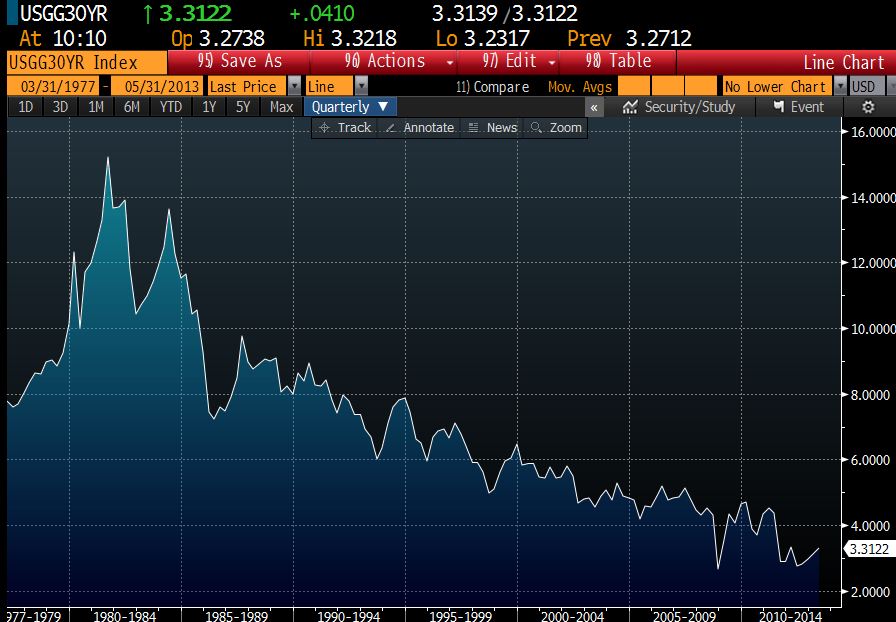
Goldman believes the bond market sell-off is for real. They are forecasting a 2.5% 10 year by the end of the year. The sell-off has been global, as Japanese Government Bonds, UK Gilts, German Bunds have also been hit. FWIW, Bill Gross of PIMCO called it 3 weeks ago when he tweeted “The secular 30-yr bull market in bonds likely ended 4/29/13” 


What the Hell is a Moderate Anyway?

I enjoy reading political writers who have both a sense of humor and ask thought provoking questions.  When I read this brief piece by booman, it resonated with me.

What constitutes moderation in Democratic politics? Which policies of mainstream Democrats are simply unacceptable to South Dakotans, for example? I think these are questions that need to be empirically tested. South Dakota clearly preferred Mitt Romney to Barack Obama, but it isn’t entirely clear why they felt that way. While Republicans absolutely dominate on the local level, the Democrats have done very well in recent years on the federal Senate/House level. Why is that?

These same dynamics have played out in North Dakota and Montana, where Democrats have over performed in Senate contests. Senators like Max Baucus, Jon Tester, Byron Dorgan, Kent Conrad, Tim Johnson, and Tom Daschle have certainly been frustrating at times, but it’s hard to find all that much commonality between them in terms of their apostasy from the party platform. I suppose they have probably been less environmentally friendly than your average Democrat. They’ve been cozy with the banking and credit card industries. They’ve been a bit more socially conservative than their peers.

If I had to name something really out of whack, it’s been their obsession with the deficit. Because the other stuff is easily explainable by the fact that they represent sparsely-populated states with a lot of mining and financial services activity and not much religious or ethnic diversity, their love of austerity sticks out.

Opposition to big spending seems to be a requirement in these northern plains states. Is that the key ingredient for success? Or is it possible to use a different playbook? How much of a role does personality play? Jon Tester and Max Baucus don’t seem much alike but they both have success. Kent Conrad struck me as quite a bit more conservative than Byron Dorgan, who could be quite openly partisan at times.

I understand the urge to find a candidate who is seen as moderate, but I can’t pinpoint what moderate really means.

I’m working with a group trying to find a congressional candidate to support who will run against our very conservative congressman here.  The last time we came close to beating him was in 2008 and we had a pretty progressive candidate who barely lost.  In 2010 the same candidate lost by a larger percentage.  And 2012 was awful.  We lost by 25 or 30 percentage points I think, but we’re not sure if it was from redistricting or because of a new and relatively unknown candidate.   Both worked against us of course, but which played the larger part?

We’re a very conservative district, perhaps even more so now, and so I’ve been arguing for a more moderate candidate but I think I’m being out voted.  It’s a pretty liberal group so they want the most progressive candidate we can find.

One of the aspects of politics today that I’ve been fascinated watching is the apparent growing split in the Republican Party between the more ideologically driven members of the base or Tea Party and more traditional or moderate conservatives.  As I’m sure everyone has already heard Bob Dole had a few things to say about today’s Republican Party.

“Reagan couldn’t have made it. Certainly, Nixon couldn’t have made it because he had ideas,” he pointed out. “I just consider myself a Republican, none of this hyphenated stuff. I was a mainstream conservative Republican. It seems to be almost unreal that we can’t get together on a budget or legislation,” Dole said, comparing today’s Congress unfavorably with the institution in which he served for decades. “We weren’t perfect by a long shot, but at least we got our work done.”

Another example, of course, would be John McCain’s criticism of the small group of Senators who appear to be blocking budget negotiations.

I consider myself a moderate on some issues and a progressive on others but I’d still rather be represented by a Democrat than a Republican so I’m willing to compromise a bit.

It’s funny, when Kevin picked the name for this blog, I told him I wasn’t a moderate but now I’m not so sure what that even means or if it matters.

I’m also wondering if any of the conservatives here worry about the same things I do.   Are they being too driven by the base, or political purity, when they might have a better chance at winning more elections if the moderates, or more traditional members of the party had a little more influence?  Or is winning with moderates some sort of cop out?

Morning Report – Fannie Mae comes back to earth 5/30/13

Vital Statistics

  Last Change Percent
S&P Futures  1652.6 5.6 0.34%
Eurostoxx Index 2807.2 20.6 0.74%
Oil (WTI) 92.59 -0.5 -0.58%
LIBOR 0.275 -0.001 -0.40%
US Dollar Index (DXY) 83.7 0.037 0.04%
10 Year Govt Bond Yield 2.14% 0.02%  
Current Coupon Ginnie Mae TBA 101.8 0.4  
Current Coupon Fannie Mae TBA 100.8 -0.2  
RPX Composite Real Estate Index 200.6 0.4  
BankRate 30 Year Fixed Rate Mortgage 3.94    


Markets are higher this morning in spite of a 5.2% sell-off in the Nikkei 225 last night. Q1 GDP was revised downward to 2.4% from 2.5%. Initial Jobless Claims rose to 354,000. Bonds and MBS are down small.
 
Yesterday was the first relatively stable day in the Treasury markets in quite some time, notwithstanding the major sell-off in early Asian trading yesterday morning. Today we are more or less in the same place. 
 
The CFPB has tweaked the Ability to Repay rule a tad, with new guidance for mortgage broker compensation and exempting small lenders that focus on low-income lending. These amendments will take effect Jan 1, 2014.
 
It is tempting to think the the U.S. Treasury yield is being driven by differing interpretations of Bernake’s words. And maybe some of it is. But we are seeing a global sell-off in G7 sovereign debt that started at about the same time.  The US Treasury yield is up 54 basis points since May 1. UK Bonds are up 26 basis points. Japanese Government bond yields are up 31 basis points. That is in spite of a new quantitative easing program by the Bank of Japan – think about that! German Bund yields are up 30 basis points. Everyone started selling off more or less on May 1. My point is that there seems to be more going on in US Treasuries than a simple question over when the Fed is going to start tapering QE. Given the move in world stock markets, it feels like a very big investor (probably a sovereign wealth fund) is doing an asset allocation trade out of G7 debt and into stocks. 
 
Remember Fannie Mae, which was more or less given up for dead? Well, it has rallied about fourteenfold since mid March. It sold off had yesterday, but you can’t deny the move. 30 cents to an intraday high of $5.44. This has been one big speculative toy for the past couple of months, while the big hedge funds are in the prefs. If Fannie Mae survives in some way, shape, or form those bets could pay off. However Fannie Mae is simply sending all of its profits to the government, which is not counting them against money it owes. (They changed the rule last Fall, right before Fannie Mae started turning a profit – what a coincidence). Oh, and before you dismiss it as just another “penny stock” – it sports a market cap of $16.7 billion. Anyway, play in this sandbox at your own risk.
 
Chart:  Fannie Mae (FNMA)


Tuesday Bits and Pieces

This post is for Brent.

Classic commercials of the 60’s and 70’s. Talk about nostalgia and bringing back memories. Remember that crying Indian?

I don’t know what made me think of this, but I remember seeing this game live on WPIX when I was a kid. I’d never seen anyone so crazed before.

Duke beat Syracuse for the NCAA lacrosse national championship yesterday. This a more palatable memory, from 2009 (OK…this is more for me than Brent):

For all you Star Wars and Star Trek geeks, the physics of space battles.

This one really is for Brent…America’s coolest houses. BTW, number 2 is actually in New Canaan, so Brent you can easily visit. (I don’t get why it is such a big tourist attraction, but then again I don’t get a lot of things.)

And finally, an old KW favorite…bad lip reading:

ATiM: Dead or Alive?

ATiM has been extremely quiet for some time now. Brent keeps up his morning post, and both jnc and McWing continue to post daily links, but apart from that there doesn’t seem to be a whole lot of commentary. A lot of people seem to have checked out for good. At the moment ATiM is, at best, on life support, if not dead altogether. Can it be revived? Should it be? What needs to be done in order to revive it, or should it be put out of its misery altogether?

Anyone out there lurking who would care to offer up an opinion? Consider it an exit interview…brutal honesty is welcome.

Morning Report – Foreclosures drop again 5/29/13

Vital Statistics:

  Last Change Percent
S&P Futures  1646.2 -8.4 -0.51%
Eurostoxx Index 2794.0 -41.9 -1.48%
Oil (WTI) 94.43 -0.6 -0.61%
LIBOR 0.276 0.003 1.10%
US Dollar Index (DXY) 83.58 -0.516 -0.61%
10 Year Govt Bond Yield 2.14% -0.03%  
Current Coupon Ginnie Mae TBA 101.7 0.3  
Current Coupon Fannie Mae TBA 100.6 0.3  
RPX Composite Real Estate Index 200.2 0.0  
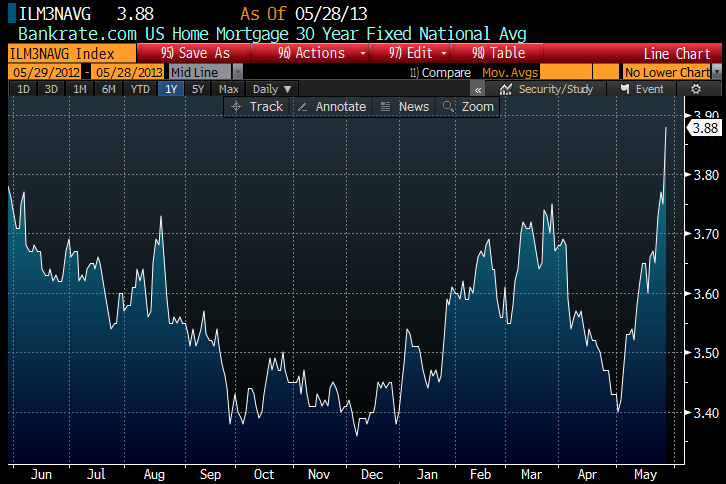
BankRate 30 Year Fixed Rate Mortgage 3.88    


Bond market volatility is the theme of the day (yet again). The 10-year bond yield jumped to 2.23% this morning in late Asian hours. No real news drove the decline, just the general fear that the Fed will start paring back QE sometime this fall.
 
Lender Processing Services reported that home prices are up 1.4% month-over-month and 7.6% year over year. It does appear that the rally is becoming more broad, as states other than the usual suspects are showing the biggest gains. This time around, Georgia leads the way as Atlanta prices increased 2.6% MOM. Arizona was actually in the bottom 10, indicating that perhaps the big professional-driven rally off the bottom has been played out.
 
CoreLogic reported that foreclosures are down 16% YOY and 1% MOM. 52,000 foreclosures were completed in April 2013. In states like Arizona and California, the year-over-year decline is over 50%. The shadow inventory of homes in some state of foreclosure is 1.1 million, compared to 1.5 million a year ago. The judicial states of FL, IL, NJ, NY, and CT still have some work to do, but the rest of the states have largely completed their foreclosures.
 
The sell-off in bonds has created a massive jump in mortgage rates. Now, as the mortgage REITs hedge their books, we are approaching another wave of selling in TBAs as MBS investors hedge their convexity and REITs de-lever. This is going to push mortgage rates even higher. If rates stay here, we should be best-exing into a 3.5% coupon pretty soon.