Morning Report – The margin clerk approacheth… 6/12/13

Vital Statistics:

  Last Change Percent
S&P Futures  1637.7 10.6 0.65%
Eurostoxx Index 2697.5 14.3 0.53%
Oil (WTI) 96.07 0.7 0.72%
LIBOR 0.273 0.001 0.37%
US Dollar Index (DXY) 81.15 0.037 0.05%
10 Year Govt Bond Yield 2.23% 0.04%  
Current Coupon Ginnie Mae TBA 101.6 -0.3  
Current Coupon Fannie Mae TBA 99.92 -0.2  
RPX Composite Real Estate Index 202.8 -0.2  
BankRate 30 Year Fixed Rate Mortgage 4.04    


Markets are higher this morning after yesterday’s decline. This week is relatively data-light until Friday. Bonds ad MBS are down small.
 
Mortgage Applications rose 5% last week as the Bankrate 30 year fixed rate average fell from 4.1% to 4.03%. Refis were up 5%.
 
The sell-off in bonds and MBS has not only hit mortgage REITs like Annaly and American Capital, who are down 25% + in the last month, it has also hit some hedge funds as well. $1.5 billion Metacapital is down 6.5% this year. The REITs are levered something like 6:1 and the hedge funds are undoubtedly levered as well. Margin calls could start soon, and when they happen, look out below. MBS are one of those investments that pretty much everyone is long, and there are few buyers when they get hit. The point of this: watch your locks. It is a dangerous environment to float in.
 
Corelogic has put out its latest equity report. Just under 20% of all homes are underwater and negative equity fell by 8.7% in the first quarter.

What Kind of Whistleblower Would You Be?

I’m not sure what to think about this Snowden guy.  I tend to think the government certainly has an obligation to hold secrets when it comes to national security and yet obviously the American people deserve to know, and I think participate in, the process by which we give up so many of our legal rights in order to acquire that sense of security.

Diane Feinstein thinks he should be tried for treason and John Boehner calls him a traitor.

Political opinion in the US was split with some members of Congress calling for the immediate extradition from Hong Kong of the whistleblower, Edward Snowden. But other senior politicians in both main parties questioned whether US surveillance practices had gone too far.

Dianne Feinstein, chairman of the national intelligence committee, has ordered the NSA to review how it limits the exposure of Americans to government surveillance. But she made clear her disapproval of Snowden. “What he did was an act of treason,” she said.

House Speaker John Boehner defended the NSA programs and their congressional oversight, saying he had been briefed on the programs and that Americans were not “snooped on” unless they communicated with a terrorist in another country.

“He’s a traitor,” Boehner said of Snowden in an interview with ABC News. “The disclosure of this information puts Americans at risk, it shows our adversaries what our capabilities are, and it’s a giant violation of the law.”

Daniel Ellsberg believes Snowden’s leak is the most important example of whistleblowing in history.

In my estimation, there has not been in American history a more important leak than  Edward Snowden’s release of NSA material – and that definitely includes  the Pentagon Papers 40 years ago. Snowden’s whistleblowing gives us the possibility to roll back a key part of what has amounted to an “executive coup” against the US constitution.

For the president then to say that there is judicial oversight is nonsense – as is the alleged oversight function of the intelligence committees in Congress. Not for the first time – as with issues of torture, kidnapping, detention, assassination by drones and death squads –they have shown themselves to be thoroughly co-opted by the agencies they supposedly monitor. They are also black holes for information that the public needs to know.

Ellsberg seems to think this event will give Americans both the incentive and proof  we need to rise up against this “surveillance state”.   Ha, based on the polling I’ve seen this week and comments from both government officials and public forums I’ve been reading, most people don’t really care that much or simply accept it’s the trade off  for being safe.

And it seems to me we have two different kinds of justice being handed out for whistleblowers.  Thanks to Dodd/Frank (don’t get me wrong, I know it’s a crappy bill) the SEC has newly enacted protections for financial whistleblowers and the government has reaped the benefits to the tune of   millions of dollars.

In just its first year, the whistle­blower program already has proven to be a valuable tool in helping us ferret out financial fraud,” then-SEC Chairman Mary L. Schapiro said in November 2012. “When insiders provide us with high-quality road maps of fraudulent wrongdoing, it reduces the length of time we spend investigating and saves the agency substantial resources.”

The SEC’s Investor Protection Fund awarded the Commission’s first Whistleblower Award Program recipient in 2012, but the case and individual haven’t been made public. The Fund represents monetary sanctions received from settlements of SEC cases, including penalties, disgorgement, and interest. The balance at the end of fiscal 2012 was $453 million.

And on the opposite end of the spectrum Obama appears to undermine his own support of protections for whistleblowers, at least in the area of National Security.

The federal appeals court granted another hearing on May 24, and the Obama administration rushed out a memo asking the Director of National Intelligence and the Office of Personnel Management to quickly come up with a litmus test for deciding which federal positions can be classified as being “sensitive,” citing a 2010 OPM proposal that aimed to dramatically expand the number of national security employees.

Whistleblower advocates say the court ruling and the president’s memo spell a major rewiring of the Whistleblower Protection Enhancement Act. “It’s not that OPM and DOJ are arguing that whistleblowers in sensitive positions shouldn’t have access to protections. It’s an unintended consequence that they have not tried to prevent,” says Angela Canterbury, public policy director at the Project on Government Oversight, where I used to work. “The Obama administration is undermining the same protections they [formerly] supported.

There are at least five whistleblowers who’ve come up against the heavy hand of the Obama Administration via the DOJ recently.

The Obama administration has waged a war on government whistleblowers. So here are 5 whistleblowers who have been under attack by a president who once said that official whistleblowers were “often the best source of information about waste, fraud, and abuse in government.

Check out the Thomas Drake case:

4. Thomas Drake

A former executive at the National Security Agency, Thomas Drake exposed details about the agency’s Trailblazer Project. For this, he was charged under the Espionage Act, though the government’s case against him spectacularly failed.

Drake became concerned about the Trailblazer Project’s cost–at $1 billion, it was way more than the NSA should have been paying for a program they could have instituted in-house. He was also concerned it would violate the privacy of Americans. But Trailblazer, which was supposed to analyze intercepted communications, was chosen to be the NSA’s vehicle for surveillance anyway. Drake disclosed details about the NSA’s wastefulness to a Baltimore Sun reporter.

The government initially threw the book at him, but their case collapsed. As Marcy Wheeler explained in The Nation: “The Department of Justice had been pursuing Drake for alleged violations of the Espionage Act that might have sent him to prison for up to 35 years. But the government withdrew the evidence supporting several of the central charges after a judge ruled Drake would not be able to defend himself unless the government revealed details about one of the National Security Agency’s telecommunications collection programs.” Drake was eventually convicted on the misdemeanor charge of exceeding authorized use of a computer.

I’m really curious what all of you think of the whistleblower issue in particular, but of course I’m also wondering if anyone thinks there’s a reverse of the surveillance state possible.  Is surveillance state too strong of a descriptive?  Do you think Obama is really to blame or is it just the result of an overzealous government at all levels since 9/11?

Morning Report – NFIB Small Business “confidence” 6/11/13

Vital Statistics:


Last

Change

Percent

S&P Futures 

1625.6

-16.5

-1.00%

Eurostoxx Index

2661.6

-57.8

-2.13%

Oil (WTI)

94.47

-1.3

-1.36%

LIBOR

0.272

-0.002

-0.69%

US Dollar Index (DXY)

81.46

-0.186

-0.23%

10 Year Govt Bond Yield

2.26%

0.05%


Current Coupon Ginnie Mae TBA

101.2

-0.2


Current Coupon Fannie Mae TBA

99.55

-0.5


RPX Composite Real Estate Index

203

0.6


BankRate 30 Year Fixed Rate Mortgage

4.06


Thought I had posted this earlier, but it looks like it didn’t take

Markets are lower after the Bank of Japan left policy unchanged. Bonds and MBS are heavy again, with the 10 year yielding 2.26%

Part of the issue with the weakness in the bond and MBS market is convexity-related hedging. Convexity hedging is coming out of the mortgage REITs primarily, but also anyone who holds mortgages as an investment and hedges the interest rate risk. The “inside baseball” explanation of what is going on: Mortgage REITs are finding that as rates increase, the duration of their mortgage backed securities increases. This means they have to either sell MBS or Treasuries to rebalance their hedge.” The punch line: selling begets more selling. And that is partly why the 10 year and MBS cannot get out of their own way.

The NFIB Small Business Optimism report ticked up to 94.4 in June, the highest level in a year, and the second highest reading since the recession started in 2007. That is the good news. The bad news? The number is still very weak, and only slightly higher than the post-recession average.  The biggest headaches for small business?  Taxes, Government regulations / red tape, and poor sales. In that order. The elephant in the room is obamacare. The report highlights one of the big disconnects happening right now, with the S&P 500 near record levels. The big multinationals are doing fine, but small business is barely growing with population. Since small business is half of the economy, it explains why we can have record levels in the S&P 500 and “meh” economic growth.If multinational profits correspond to 4% GDP growth, and the small business sector profits correspond to 0% GDP growth, you get 2% growth as an average number. 

Traders are well aware of the “fat finger” phenomenon. This happens when you are entering an order and accidentally hit two keys at once, turning an order to buy 100,000 shares into an order to buy 1,200,000 shares. Well, we have a fat head error. And no, I am not talking about the one where a guy ordered a Tom Brady Fathead poster for his office and got Tebow instead. 

Remember eminent domain? It’s baaaack. Or at least advocates have some new ammunition – a paper by Cornell law professor Robert Hockett. He argues that municipalities should, in partnership with investors, “condemn” underwater mortgage notes, pay mortgagees “fair value” and systematically write down principal. Of course any municipality that pursues this will effectively be cutting their citizens off from Fannie Mae / Freddie Mac / Ginnie Mae loans.

Morning Report – a consensus forming on QE? 6/10/13

Vital Statistics:


  Last Change Percent
S&P Futures  1644.8 6.2 0.38%
Eurostoxx Index 2716.5 -7.6 -0.28%
Oil (WTI) 95.33 -0.7 -0.73%
LIBOR 0.274 -0.001 -0.36%
US Dollar Index (DXY) 81.82 0.146 0.18%
10 Year Govt Bond Yield 2.18% 0.01%  
Current Coupon Ginnie Mae TBA 101.5 0.1  
Current Coupon Fannie Mae TBA 100.1 -0.2  
RPX Composite Real Estate Index 202.4 0.2  
BankRate 30 Year Fixed Rate Mortgage 4.03    


Markets are higher this morning on no real news.  There is no economic data this morning. Bonds are weaker, with the 10 year yield at a 16 month high of 2.18%. MBS are down small.
 
Pretty light week, data wise. We will get NFIB Small business Optimism on Tuesday, retail sales on Thursday, and industrial production / capacity utilization on Friday. None of these should be market moving. 
 
Compass Research is out saying the death of NJ Senator Frank Lautenberg pretty much makes Mel Watt an unlikely confirmation. It drops his “yes” votes from 56 to 55. Separately, KBW is out saying that Fannie Mae common stock is worthless. Of course is still sports a $11.4 billion market cap
 
Home equity increased by $816 billion in Q1, according to the housing scorecard, put out by HUD. Delinquencies are down 7% in the month of May. In spite of the back up in mortgage rates, housing still remains highly affordable.
 
US bond fund redemptions are the highest since 1992. Bill Gross, who’s fund lost 1.9% in May predicted that April of 2013 will go down as the end of the three decade bull market in bonds that began in the early 1980s. A poll by Bloomberg predicts that the Fed will cut its quantitative easing program from $85 billion a month to $65 billion a month at the October 29-30 FOMC meeting.

Immigration Reform-ATiM Style

I’ve been thinking about this post all week and trying to come up with a clever angle to get a discussion going.  After a few brief exchanges with some of you I realized that most of us probably support some variety of reform that leads to citizenship, so what’s there to discuss right?  One thing I’d like to understand more clearly is why some of you support open borders or how you think that would actually work in reality.   I’m also curious about what everyone thinks the chances are of the Senate bill passing first the Senate and eventually the House.  I’m not really expecting it to pass the House at this point but think it might squeak past in the Senate.  And also, at 844 pages with 300 amendments already offered isn’t it just another boondoggle anyway?

The first thing I had trouble finding was a good summary of the bill, I love you guys but I’m not willing to read that many pages of gobbledegook to come up with the gist of the bill.  I’m reading a book I’m really enthralled with right now and am not giving that up for ATiM.  The best summary I could find was Marco Rubio’s…………..funny huh?

Here are a few highlights:

This legislation contains the toughest border immigration enforcement measures in U.S. history. It is based on six required security triggers that must be achieved before the newly legalized are allowed to apply for green cards. These six triggers include:

1. Border Security Plan: DHS must create, fund and initiate a border security plan (within 6 months of bill’s enactment).

2. Border Fence Plan: DHS must create, fund & initiate a border fence plan (within 6 months of bill’s enactment).

3. Border Security Metrics: DHS must achieve 100 percent border awareness and at least 90 percent apprehension rates in high-risk sectors of the U.S.-Mexico border (within 5 years of bill’s enactment).

4. Border Commission: If DHS fails to achieve #3, a Border Commission of border state officials and stakeholders is required to create & implement a plan to achieve 100 percent border awareness and at least 90 percent apprehension rates in high-risk sectors of the U.S.-Mexico border (within 10 years of bill’s enactment).

5. Employment Verification: Universal E-verify must be implemented (within 10 years of bill’s enactment).

6. Exit System To Stop Visa Overstays: Visa exit system must be implemented at all international airports & seaports (within 10 years of bill’s enactment).
Modernizing

Conservative Economists Say Modernizing Our System Will Grow Our Economy And Create Jobs: The modernization of our legal immigration system will be a net benefit for America as we make historic reforms towards a more merit-based immigration system that will help us attract entrepreneurs, innovators, investors, skilled workers and people driven by the desire to build a better life for themselves and, in turn, create jobs for American workers.

Protecting American Workers: This bill protects American workers from unwarranted immigration for jobs that Americans are willing and able to do. For example, the proposal would not allow any work visas to be issued if the unemployment rate in a certain area is above 8.5 percent, which is the norm in many cities.

Highly Skilled Workers: After educating the world’s brightest and most innovative minds, we will no longer send them home to benefit competing economies like China and India; we will instead staple green cards to their diplomas. We will also expand the highly skilled H1-B visa program from 65,000 to 110,000 to fill jobs Americans can’t do. To accomplish the move to a more merit-based immigration system, we eliminate certain categories of family preferences that have allowed for chain migration and completely eliminate the diversity visa lottery, among other reforms.

Guest Worker Program: The bill establishes a guest worker program for lower-skilled workers that ensures our future flow of workers is manageable, traceable, fair to American workers, and in line with our economy’s needs. The modernization of our visa programs will ensure people who want to come legally – and who our economy needs to come legally – can do so.

Agricultural Worker Program: A new agricultural guest worker visa program would be established to ensure an adequate agricultural workforce to safeguard our food supply. This program will also allow current undocumented farm workers who have made a substantial prior commitment to agricultural work in the United States to obtain legal status.

And then it goes on to detail how the bill deals with the illegal immigrants here now.  It explains why it’s not amnesty, how they’re going to deny Federal benefits until certain criteria are met, what to do about children (dreamers) brought here unwittingly by their parents and how the path for  immigrants who came her illegally will be longer and more difficult than it is for those who chose the legal path.  There’s a lot in there, and you can tell where the compromises are.

Here are a few comments from various people here that I would love to hear more about and am also wondering what everyone thinks of the bill the gang of eight crafted.

Mark:  I am for need based immigration. I think we should permit immigrants with talent and skill to come here and apply for citizenship after five years. I think we should allow many more immigrants in toto than we do now. But I want them to actually learn American history and become acculturated and be fluent in English before they take their oath of citizenship. I want their knowing and proud allegiance to our country. And I don’t want extended family reunification – I want it limited to spouse and minor children.

I agree with George that immigrants are our lifeblood. But without selectivity, I believe we can get blood poisoning.

Brent:  On immigration, I am to the left of both parties. Our economy’s biggest growth came during periods of greatest immigration. While there is a correlation / causation issue there (were immigrants flocking to the US because the economy was great or were immigrants making the economy great?) I think we need an influx of young people to balance out the aging baby boom generation. Since we can’t go back and change fertility rates, well that leaves immigration.

McWing:  I’d give citizenship on day one, also, I wouldn’t have any language requirement though I would not publish anything official in anything other than English. A common language is important, IMO. And since I think the welfare state will collapse anyway, sure, let them have at it, though I dont think that is why the overwhelming number of immigrants come here, for welfare. I, perhaps naively, think they come here to live and work in a society who’s governent interferes in their lives less than where they came from. Also, they’ll be paying taxes, so the schools will be funded adequately. I hope the parents demand English only/immersion for their kids, to give them a fighting chance once they hit the working world. I don’t think the border states will be swamped, people move to where there are jobs, immigrants are no different.

Scott:  I am instinctively in favor of open borders and easy immigration. But that cannot coexist with the kind of welfare state that we now have. I suppose if you assume the welfare state as it exists must eventually collapse anyway, then accelerating it and getting on with the recovery process sooner rather than later makes sense. In which case open borders and immigration is even more attractive.

Perhaps more of you have weighed in and I missed it so I’m curious what the rest of you think and is there any chance that the Senate bill is a launching pad for the kind of reform each of you wants?  As a Californian with a keen interest in Mexico and it’s people I probably wouldn’t go as far as McWing, although I might be persuaded, but the bill looks a little constipated with stumbling blocks to me.

There’s been all sorts of coverage lately and I’ve read a lot of it but one of the most interesting to me was this email exchange Greg Sargent had a couple of days ago on Cornyn’s suggested compromise and perhaps thwarting Presidential aspirations:

This has put Marco Rubio in a box, and it needs to be acknowledged that Cornyn’s move really does threaten the prospects for reform. Frank Sharry, of the pro-immigration America’s Voice, explains why in an email to me:

“Cornyn is trying to box Rubio in, and if he does, we’ve got a problem.  Cornyn is taking dead aim at hardening the triggers – threatens the path to citizenship in a big way – in hopes of dragging Rubio to the right. The problem is that Rubio going right loses many Dems. Dicey moment. Cornyn stepped out in front with a proposal for more border security in way that undermines the path to citizenship. Rubio either goes with Cornyn — to look more conservative — and threatens the bipartisan core support for reform, or says no to Cornyn and looks weak, damaging the chance to get 15 Republicans to come in board.”

In other words, Cornyn has undercut Rubio by staking out a position much further to the right of the Gang of Eight compromise that Rubio had been taking.

I’ve read, in a variety of opinions, that the only way immigration reform will pass is if Republican leadership and the big donors want it to pass and they’ll have to pressure Boehner to put it up for a vote and hope the Democrats will get it across the finish line.  I can’t help but wonder if that would finally be the end of Boehner’s Speakership though.

Morning Report – Jobs report in line with expectations 6/7/13

Vital Statistics:

  Last Change Percent
S&P Futures  1631.1 8.4 0.52%
Eurostoxx Index 2695.6 19.4 0.72%
Oil (WTI) 94.28 -0.5 -0.51%
LIBOR 0.275 0.001 0.33%
US Dollar Index (DXY) 81.47 -0.067 -0.08%
10 Year Govt Bond Yield 2.11% 0.03%  
Current Coupon Ginnie Mae TBA 102.2 0.1  
Current Coupon Fannie Mae TBA 100.6 -0.1  
RPX Composite Real Estate Index 202.2 0.3  
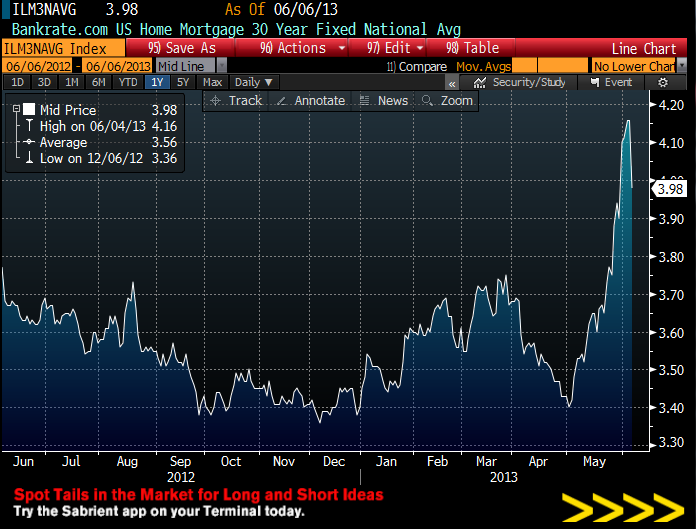
BankRate 30 Year Fixed Rate Mortgage 3.98    


Markets are higher after the jobs report came in pretty much in line. Bonds and MBS are flat / down small.
 
The jobs report showed that nonfarm payrolls increased by 175,000 in the month of May, slightly higher than Street estimates (which were lowered after the ADP report). April was revised downward from 165k to 149k. The unemployment rate ticked up from 7.5% to 7.6% as the labor force participation rate ticked up from 63.3% to 63.4%. Earnings and workweek were flat. Since the report was pretty much in line with expectations,we aren’t seeing any big reaction in the markets.
 
Remember my question about mortgage rates on Wednesday? Basically how did the Bankrate average 30 year mortgage rate jump from 3.9% to 4.1% when the bond market was flat and we had a weak day in Fannie TBAs? Well, whatever it was, it has been reversed, as the Bankrate average 30 year mortgage rate fell 18 bps back to 3.98%. Strange.


Morning Report – Modest, Moderate, and Measured 6/6/13

Vital Statistics:

  Last Change Percent
S&P Futures  1611.6 3.6 0.22%
Eurostoxx Index 2725.5 16.2 0.60%
Oil (WTI) 94.24 0.5 0.53%
LIBOR 0.274 0.000 -0.07%
US Dollar Index (DXY) 82.35 -0.248 -0.30%
10 Year Govt Bond Yield 2.11% 0.03%  
Current Coupon Ginnie Mae TBA 101.8 -0.2  
Current Coupon Fannie Mae TBA 100.2 -0.2  
RPX Composite Real Estate Index 201.9 0.1  
BankRate 30 Year Fixed Rate Mortgage 4.16    
Markets are flattish after initial jobless claims came in as expected. Challenger and Gray reported that announced layoffs are 41% below last year’s pace.  Bonds and MBS are flat.
 
Moderate. Modest. Measured. That is the summary of the Fed’s Beige Book Survey of economic growth. The bright spot of the report was residential real estate construction. The Dallas District noted the strongest growth, while growth elsewhere was modest to moderate. Since this report is basically as amalgam of the various Federal Reserve District reports which have been previously released, it isn’t a market-mover. 
 
The Senate plan to wind down the GSE’s (Corker / Warner) would liquidate Fannie and Fred, transfer all of their liabilities to Treasury. The liquidation preference would be to the US Government first, then the junior prefs, and then the common shares. Note that Fannie Mae and Freddie Mac’s recent record profits have not gone to paying down their debt to the government – those funds have been simply revenues to the government. A new entity – The Federal Mortgage Insurance Commission would have a re-insurance role and backstop private insurance. Ginnie Mae would not be affected.

Morning Report – What is going on with mortgage rates? 6/5/13

Vital Statistics:

  Last Change Percent
S&P Futures  1625.1 -6.1 -0.37%
Eurostoxx Index 2723.4 -32.3 -1.17%
Oil (WTI) 93.76 0.5 0.48%
LIBOR 0.274 0.001 0.18%
US Dollar Index (DXY) 82.58 -0.192 -0.23%
10 Year Govt Bond Yield 2.12% -0.02%  
Current Coupon Ginnie Mae TBA 101.8 0.0  
Current Coupon Fannie Mae TBA 100.3 -0.8  
RPX Composite Real Estate Index 201.8 0.4  
BankRate 30 Year Fixed Rate Mortgage 4.16    


Markets are weaker after a disappointing ADP report. Nonfarm productivity was revised downward to .5% while unit labor costs fell. The Fed will release its Beige Book later on this afternoon. Mortgage applications fell 11.5% last week. Bonds and MBS are up small on the data.
 
The ADP report is supposed to foreshadow Friday’s all-important jobs report, albeit only the private sector portion. Basically take the jobs report, subtract out public sector workers, and you have ADP. The ADP employment change report came in at 135,000 vs expectations of 165,000. Friday’s payroll report is expected to be 178,000, with an unchanged unemployment rate of 7.5%. Bonds spiked on the ADP number and have pretty much given it all back. I am struggling to come up with a scenario where bonds rally big on Friday. My guess is that it will take an increase in the unemployment rate (like 7.7%) and a lousy payroll number, like 50k. The bond market increases so grudgingly, it feels like it won’t take much of an upside surprise to send it lower.
 
I first thought it was a data error, or a misprint. On Friday, the Bankrate US Home Mortgage 30 year Fixed National Average spiked from 3.9% to 4.1%. But it increased again on Monday and Tuesday and now is sitting at 4.16%. Over that period, the 10 year is unchanged, but the FNCL 3.5 TBA is down a point, which corresponds to a 22 bp increase in yield. The GNSF 3.5 is down 14 ticks, which corresponds to a 10 basis point increase in yield. So how do we get a 26 basis point increase in mortgage rates when Fannies are up 22bps and Ginnies are up 10?  And no, its not jumbos, which only increased 4 basis points. Strange things are afoot at the Circle K. 


Morning Report – Progress on the GSEs 6/4/13

Vital Statistics:


Last

Change

Percent

S&P Futures 

1638.5

2.3

0.14%

Eurostoxx Index

2765.3

17.5

0.64%

Oil (WTI)

93.19

-0.3

-0.28%

LIBOR

0.274

0.001

0.26%

US Dollar Index (DXY)

82.81

0.149

0.18%

10 Year Govt Bond Yield

2.13%

0.01%


Current Coupon Ginnie Mae TBA

101.9

-0.2


Current Coupon Fannie Mae TBA

100.4

-0.1


RPX Composite Real Estate Index

201.5

0.6


BankRate 30 Year Fixed Rate Mortgage

4.11


Markets are up small after a 2% rally in Japan’s Nikkei 225 index last night. Bonds and MBS are down small.

Yesterday’s ISM report showed the manufacturing sector contracted slightly in May. New Orders and Production fell, while inventories rose. Employment was flat. The index level of 49 corresponds to a GDP growth rate of just about 2%.

The Senate is close to establishing a plan to abolish Fannie Mae and Freddie Mac and replace them with a government re-insurer that would backstop private mortgage insurance. F&F would be wound down and the US Treasury would assume responsibility for existing conforming loans. A new entity – the Federal Mortgage Insurance Corporation (FMIC) would provide re-insurance, which means they would only step in if the private mortgage insurer was unable to cover the losses. For holders of the junior preferreds, which includes a lot of big hedge funds, this doesn’t look like anything good for them.

And for those keeping track at home, here is Fannie Mae’s recent chart:

Image

In the News Now

Grand Old Party for a Brand New Generation

There was a lot of internet chatter about the above “GOP for a New Generation” report today.  Out of curiosity I decided to read it.  It was really interesting and while it doesn’t have much to do with our recent discussion of whether the Republican Party has moved right or not, I think it’s indicative of where they could use some improvement.

I happen to be the mother of young voters just outside of this under 30 age group, and because I’ve enjoyed watching their political views form so much, I thought this was a great study.

To be clear, in addition to the parts I’ve excerpted, they also polled economic matters, the size of government (interesting results there), the environment, and also discussed the use of social media and other sources of political news.

The following report assesses the findings from a variety of studies on young voters, including a new March 2013 survey conducted for the College Republican National Committee (CRNC), and makes recommendations about how Republicans can begin this work today.

We believe that Republicans can win young voters but that it will require a significantly different approach than has been used in recent elections.

Health Care

Health care remains a second-tier issue behind the economy and the national debt. In the August 2012 XG survey, only 8% of young voters said it was their top issue, and just 27% named “lowering health care costs and improving care” as one of their top two or three priorities in the March 2013 CRNC survey.

Nonetheless, the issue is at the top of the second tier in both surveys and came up frequently in our focus group research. In the August XG survey, young voters handed Democrats a heavy advantage on the issue, preferring their handling of health care to Republicans by a 63-37 margin. Some 41% thought things overall would be better as a result of Obama’s health care reform plan (versus to 32% who said things would be worse).

Many of the young people in our focus groups noted that they thought everyone in America should have access to health coverage. In the Spring 2012Harvard Institute of Politics survey of young voters, 44% said that “basic health insurance is a right for all people, and if someone has no means of paying for it, the government should provide it”; 23% disagreed.

Admittedly, there were concerns about the cost and quality of health care under the ACA but in general the young people gave Obama credit for trying.

Immigration

While immigration wasn’t a major issue it appeared it might be an issue that could turn a voter against a conservative candidate who they agreed with on taxes or other economic issues but disagreed with on immigration reform.

The position taken most frequently by young voters was that “illegal immigrants should have a path to earn citizenship,” chosen by35% of respondents. Closely behind this were the 30% who preferred the “enforcement first” strategy of securing the border and enforcing existing immigration laws. Some 19% chose “illegal immigrants should be deported or put in jail for breaking the law,” while another 17% took the position that “illegal immigrants should have a path to legal status but not citizenship.”On the issue of laws that “would allow illegal immigrants brought to the U.S. as children to gain legal resident status if they join the military or go to college,” three out of four (75.3%) young adults agreed in an October 2012 poll conducted by CIRCLE. And young voters for the most part knew how the candidates in the election stood on that issue; in that same survey, 63% of respondents said that Barack Obama was the candidate who supported “allowing many illegal or undocumented immigrants who were brought to the United States as children to remain in the country,” while only 3% said that was Mitt Romney’s position.

Abortion

This really surprised me; I knew it was pretty close but not quite this close.  In this case I wish Dems would alter their position a little to make room for a more tolerant culture of life position, but I repeat myself.

The results debunk the conventional wisdom on the issue and establish that not all “social issues” are viewed the same. Indeed, only 16% of young voters preferred that abortion be legal in all cases, while 32% said abortion should be legal “up to a certain point.” Combined, that comprises 48% who take a position leaning toward legality. On the other side, 37% felt abortion should be illegal with exceptions, and 14% thought abortion should always be illegal, making a combined 51% who lean toward prohibiting abortion. On this issue, there is small gender divide, with men in the survey actually tending to lean more pro-choice than women.

Where the Republican Party runs into trouble with young voters on the abortion issue is not necessarily in being pro-life. On the contrary, the Democratic Party’s position of pushing for abortion to be legal in all cases and at all times, including some recent laws around how to handle medical care for babies born alive during abortion procedures, is what is outside the norm of where young voters stand. Unfortunately for the GOP, the Republican Party has been painted – both by Democrats and by unhelpful voices in our own ranks – as holding the most extreme anti-abortion position (that it should be prohibited in all cases). Furthermore, the issue of protecting life has been conflated with issues around the definition of rape, funding for Planned Parenthood, and even contraception.

In the words of one pro-life respondent, “The Planned Parenthood thing for me is not so much about abortion; it’s about counseling before you can get to that point, and I feel that that’s a big part of what they do, is contraception counseling and about being safe.”

Bingo

Gay Marriage

Perhaps no topic has gotten more attention with regards to the youth vote than the issue of gay marriage. And on this issue, the conventional wisdom is right: young people are unlikely to view homosexuality as morally wrong, and they lean toward legal recognition of same-sex relationships. Only 21% of young voters in the Spring 2012 Harvard Institute of Politics survey felt that religious values should play a more important role in government, and only 25% felt homosexual relationships were wrong. Young people nowadays are more likely than ever to know someone who is openly gay or lesbian, and that factor is correlated with attitudes supporting same-sex marriage.

Surveys have consistently shown that gay marriage is not as important an issue as jobs and the economy to young voters. Yet it was unmistakable in the focus groups that gay marriage was a reason many of these young voters disliked the GOP.

The conclusion of the report discusses five areas where they think the GOP can improve their chances to win over a larger percentage of the youth vote and they explain their methodology and whatnot.

I’m still working on an immigration post, just thought this was interesting and current considering all the references I read about it today on both sides of the political divide.