Championship Saturday

This is all about getting to the Mythical National Championship, or the other four BCS Bowls for consolation.  First, we say goodbye to Louisville, NIU, and Fresno.  Byebye.

 
Then we look at what ought to be the premier matchup: MSU [10] against tOSU osu (they don’t deserve capitals, Mark!)[2], tonight around 7:15 CST.
Kelley and my sis are Spartans for life.  They are underdogs here.  While I will back MSU and Narduzzi’s creative defense in this game, it is not without fear that ESPN will engineer an SEC team into the MNC Game if tOSU osu loses.  ESPN controls college sports now and it is hopelessly in bed with the SEC.

 
First game is at 11CST.   Okie Lite[6] hosts the Land Thieves[17] in Stillwater in unseemly cold weather for the southwest.


At 2:30 CST, my ‘Horns [25] are in Waco ready to be drubbed by Baylor [9].  Should be Mack Brown’s last regular season game.  Because of the unseemly weather and the popular nickname for our noodle armed QB, we shall call the game “Derp on ice”.

 
At 3 CST, MO [5] plays Auburn [3].  It doesn’t occur to ESPN that MO and aTm have done far better in the SEC than they did in the entire history of the Big 12.  I pick MO.  I think Malzahn may be UT’s next coach despite the extension he just signed at Auburn.


At 6:45 CST Stanford [7] plays ASU [11].  Top to bottom, the PAC has been really strong this year, but this game is only for the Rose Bowl, thanks to the possibility of two unbeaten teams and the certainty that ESPN will force us to watch SEC football if either unbeaten goes down.


At 7 CST FSU [1] plays a BASKETBALL SCHOOL [20] for the ACC title.  Since Jameis has been cleared of rape charges and not indicted, there is no hope whatsoever for the BASKETBALL SCHOOL.


With Fresno and NIU gone from the unbeatens, the five BCS bowls will have ten BCS teams from six BCS conferences.  The four extras should go to the PAC, the 12, the BiG, and the SEC, but not to the ACC or the little east or whatever that abomination is.

 
Finally, ‘Goose may have some interest in Utah State v. Fresno [23] at 9 CST.

 
‘Goose, edits are welcome!

Morning Report – Goldilocks jobs report 12/6/13

Vital Statistics:


  Last Change Percent
S&P Futures  1802.1 18.1 1.01%
Eurostoxx Index 2977.9 24.7 0.84%
Oil (WTI) 97.63 0.3 0.26%
LIBOR 0.241 -0.001 -0.31%
US Dollar Index (DXY) 80.45 0.210 0.26%
10 Year Govt Bond Yield 2.85% -0.02%  
Current Coupon Ginnie Mae TBA 104.2 -0.1  
Current Coupon Fannie Mae TBA 103.5 0.1  
RPX Composite Real Estate Index 200.7 -0.2  
BankRate 30 Year Fixed Rate Mortgage 4.52    


Markets are stronger this morning on a better-than-expected jobs report. Bonds and MBS are up small, in a classic case of “buy the rumor, sell the fact.”
 
Nonfarm payrolls increased by 203,000 in November, which beat the 185,000 street estimate. The unemployment rate fell to 7% as the labor force participation rate rose from 62.8% to 63%. Personal income fell, while personal spending rose .3%. All in all, consider this a “Goldilocks” jobs report from the stock market’s perspective: strong enough to make people think about a better economy ahead, but weak enough to keep the Fed on your side. At the margin, it does make a tapering move more likely at the Fed this month.
 
It is looking like Janet Yellen and Mel Watt will be confirmed next week. 
 
Newark, NJ is moving forward with an eminent domain plan. As the cities that go this route get bigger and bigger, eventually Obama and Watt will have to take a position on this tactic. They will only be able to get away with the “it’s a local issue” dodge so long. 
 
It looks like we are close to a budget deal, which takes another government shutdown off the table. No major spending cuts, no tax increases, however some additional revenue will be raised through increasing airport security fees and PBGC premiums.

Morning Report – stronger-than-expected revision to 3Q GDP

Vital Statistics:

Last Change Percent
S&P Futures 1790.1 -1.7 -0.09%
Eurostoxx Index 2989.6 -2.2 -0.07%
Oil (WTI) 97.44 0.2 0.25%
LIBOR 0.242 0.000 -0.10%
US Dollar Index (DXY) 80.76 0.140 0.17%
10 Year Govt Bond Yield 2.86% 0.03%
Current Coupon Ginnie Mae TBA 104.3 -0.1
Current Coupon Fannie Mae TBA 103.4 -0.1
RPX Composite Real Estate Index 200.7 -0.2
BankRate 30 Year Fixed Rate Mortgage 4.52
Markets are slightly lower after a stronger-than-expected GDP report and some other good labor-market data. Bonds and MBS are selling off, and the market is setting itself up for a strong jobs report tomorrow.
The second revision to third quarter GDP came in at 3.6%, much higher than the 3.1% estimate. Consumption was a little lower than expected at 1.4%, and the inflation was at 2%. Inventory build drove the increase, and consumer spending was somewhat low, so unless spending picks up, Q3 will end up “borrowing” growth from Q4. The main takeaway from the report? Higher interest rates aren’t acting like a drag on the economy, at least not yet, which has to be a relief to the Fed.
Initial Jobless Claims printed below 300k, although that number should be taken with a grain of salt due to the Thanksgiving holiday. Challenger and Gray reported announced job cuts dropped 20% as well. The Challenger Survey looks at company press releases of restructurings and job cuts. Many of these cuts never end up materializing, but they do weigh heavily on consumer confidence.
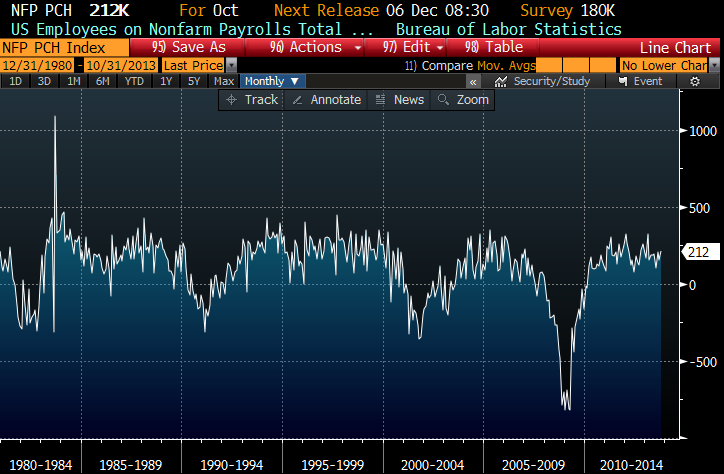
The Street expectation for payroll growth is 185k, and a print like 220k would be considered a “blowout” number. However, historically, is that a “good” number? Actually it is. Since 1980, monthly payroll growth has averaged around 100k. During the boom years of the 95-99, payrolls averaged 224k a month. So something like 220k would be considered a “normal” expansionary number, with all the caveats about population growth, etc..

In an effort to change the subject from the growing pains of obamacare, the President gave a speech about income inequality and the need to hike the minimum wage. Politically, this is going absolutely nowhere, and all he is really doing is rallying his base. Separately, fast food workers in 100 cities today are going on strike to protest low wages. It will be interesting to see if they get any traction. The reason why inflation has been so low has been the lack of wage growth – you cannot get a wage / price spiral if the “wage” side doesn’t cooperate. The Fed wants to see a modest amount of inflation – for the average American, 3% inflation and 3% wage growth is a lot more comfortable than 0% inflation and 0% wage growth. Plus, the biggest problem for Americans is debt, and inflation is a debtor’s best friend.

Morning Report – Bonds sell off on stronger-than-expected ADP report 12/4/13

Vital Statistics:

Last Change Percent
S&P Futures 1788.0 -3.4 -0.19%
Eurostoxx Index 2988.7 -25.2 -0.84%
Oil (WTI) 97.06 1.0 1.06%
LIBOR 0.242 0.001 0.23%
US Dollar Index (DXY) 80.77 0.180 0.22%
10 Year Govt Bond Yield 2.84% 0.06%
Current Coupon Ginnie Mae TBA 104.7 -0.1
Current Coupon Fannie Mae TBA 103.4 -0.4
RPX Composite Real Estate Index 200.7 -0.2
BankRate 30 Year Fixed Rate Mortgage 4.43
Markets are lower this morning after a strong ADP employment report. Bonds and MBS are down. Later on today, we will get the ISM services index and new home sales.
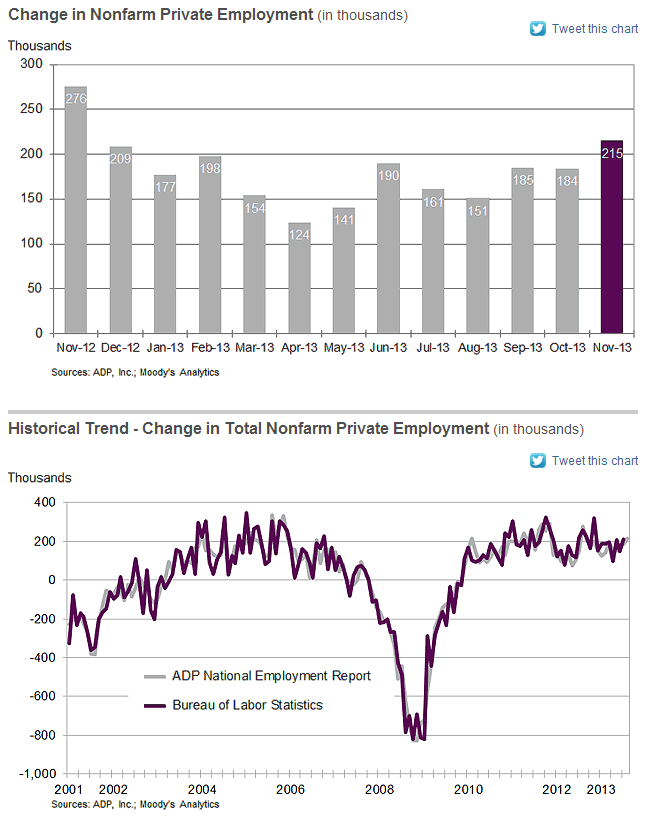
The ADP employment report showed 215k jobs added in November, above the 170k estimate. October was revised upward from 130k to 184k. The forecast for Friday’s payroll number is 175k. Lately, ADP has not been a great predictor of the upcoming jobs report, so bear that in mind. According to JP Morgan, the street is leaning heavily short going into the number, so the reaction to a strong report could be muted. Conversely a weak report could send bonds flying. A classic case of “buy the rumor, sell the fact.”

Mortgage applications fell 12.8% last week, which isn’t surprising given the holiday. Purchases dropped 4.1% while refis dipped 17.5%. Mel Watt is supposedly going to be confirmed next week and the rumor is that he wants a HARP extension for loans through 2010. So we could see some sort of refi wave, although it won’t be anything like 2012 was.
Smaller mortgage lenders have been picking up market share, according to Inside Mortgage Finance. As of Q3, they had a 60% market share vs 39% share in 2009. One reason – the big banks have tightened credit standards and are taking longer to process loans than smaller lenders. LOs, this is a good selling point to bring up with your realtor contacts – what realtor wants to get paid later rather than sooner?
Detroit has filed for bankruptcy, and it looks like pensions and creditors will likely take a hit. Detroit owes more than $18 billion and cannot perform even basic services. Half of that debt is retiree benefits. If Detroit was a company, they would be filing Chapter 7, not Chapter 11. Given the crime rate in the city, I don’t know what brings business back into Detroit. Almost on cue, Fitch, which recently cut Chicago’s rating, is predicting there will be more muni downgrades than upgrades in 2014.
Here is what the CFPB is going to be up to over the next few months.
Bill Gross’s Investment Outlook is pretty good:  If you look at asset prices, there is an implied growth rate built in. But that implied growth rate is based in part on risk-free asset prices that are being manipulated by the Fed. That implied growth hasn’t happened yet, and it may never materialize. Then what?

In England, Poor White Kids are far Behind Poor Black Kids

Morning Report – Bonds sell off on strong ISM report 12/3/13

Vital Statistics:

Last Change Percent
S&P Futures 1794.3 -5.4 -0.30%
Eurostoxx Index 3033.9 -43.3 -1.41%
Oil (WTI) 93.81 0.0 -0.01%
LIBOR 0.241 0.002 1.03%
US Dollar Index (DXY) 80.62 -0.302 -0.37%
10 Year Govt Bond Yield 2.77% -0.03%
Current Coupon Ginnie Mae TBA 105 0.1
Current Coupon Fannie Mae TBA 104.1 0.1
RPX Composite Real Estate Index 200.7 -0.2
BankRate 30 Year Fixed Rate Mortgage 4.43
Weaker overseas markets mean US stocks are soggy this morning. Bonds and MBS are rallying small. Later on this morning, we will get the ISM New York and IBD / TIPP economic optimism.
Corelogic reported that home prices were up 12.5% year over year and up .2% in October. Home prices remain 17.3% below their April 2006 peak. The .2% month-over-month gain shows that real estate price growth is moderating, which was more or less to be expected. Almost half the states in the US are within 10% of their respective historical price peaks.
Yesterday’s bond sell-off was triggered by a better-than-expected ISM report, which showed that manufacturing is improving in the US and is approaching two year highs. If you look at the historical relationship between the ISM and GDP growth, the November number of 57.3 corresponds to a 4.7% increase in real GDP. The 2013 average corresponds to a 3.6% increase. Manufacturing isn’t as large of a component of the US economy as it used to be, but it does show that at least one major sector in the US is picking up steam.
The other sector that really matters is housing / construction, and there we still have relatively moribund numbers, although they are steadily building back off the lows. Construction spending increased .8% month over month in October after falling .3% in September. We still have yet to get housing starts data since August, but building permits topped a 1 million pace in October. Part of the reason why this recovery has been so weak is that housing is usually the first industry to rebound after a recession and we are still at very depressed levels historically. Part of that has to do with the excesses of the bubble and low household formation numbers due to the lousy job market. The excesses of the bubble are more or less reversed and if anything, we have a deficit. The low household formation numbers have been driven by a lousy job market, not fertility rates 25 years ago, and therefore represents pent-up demand. This state of affairs cannot last (and won’t).
So maybe the holidays won’t be so bad after all. It looks like Cyber Monday sales were record-breaking after Black Friday sales were disappointing. Even still, it looks like the retailers are being highly promotional, which doesn’t exactly speak to a healthy consumer environment. Many noted that using a deal as “bait” fell flat on its face as customers got in line to purchase one specific item, and bought it without buying anything else. Back-to-School was lousy, so it is hard to get over-optimistic about the holiday shopping season. One other thing to note – we can now look forward to the FAA regulating internet sales.

Morning Report – Black Friday disappoints 12/2/13

Vital Statistics:

Last Change Percent
S&P Futures 1804.7 0.6 0.03%
Eurostoxx Index 3080.2 -6.4 -0.21%
Oil (WTI) 93.09 0.4 0.40%
LIBOR 0.239 0.000 -0.10%
US Dollar Index (DXY) 80.9 0.220 0.27%
10 Year Govt Bond Yield 2.78% 0.03%
Current Coupon Ginnie Mae TBA 105.3 0.0
Current Coupon Fannie Mae TBA 104.1 -0.2
RPX Composite Real Estate Index 200.7 -0.2
BankRate 30 Year Fixed Rate Mortgage 4.38
Markets are flattish as traders return from a long weekend. Bonds and MBS are down. At 10:00 we will get the ISM manufacturing report and construction spending.
There is a lot of data this week, starting with the ISM report today, GDP on Thursday, and the all-important jobs report on Friday. Given the October surprise and the fact that the bar is set pretty low for Friday’s report (180k jobs / 7.2% unemployment) bonds could be vulnerable as any upside surprise will re-ignite December taper talk.
Black Friday was disappointing according to the National Retail Federation, as retailers were highly promotional early into the holiday shopping season. We have seen Wal Mart and Target already cut profit forecasts for the year. On Thursday, we will get the comp store data dump from all the retailers as they report November same store sales. We might see some profit warnings as well. It is hard to see how the Fed sees growth accelerating into 2014 with a consumer that is still cautious.
The White House is saying that the healthcare.gov website is operating fine, therefore it made its self-imposed Dec 1 deadline. The Administration is hoping that this will mollify Democrats in red districts with cold feet about the whole thing. We’ll see if it actually “works for the vast majority of users” as HHS claims it does.

FYI – a chance to comment on a proposed regulation

The U.S. Department of the Treasury and the Internal Revenue Service (IRS) today will issue initial guidance regarding qualification requirements for tax-exemption as a social welfare organization under section 501(c)(4) of the Internal Revenue Code.  This proposed guidance defines the term “candidate-related political activity,” and would amend current regulations by indicating that the promotion of social welfare does not include this type of activity.  The proposed guidance also seeks initial comments on other aspects of the qualification requirements, including what proportion of a 501(c)(4) organization’s activities must promote social welfare.

The initial guidance is expected to be posted on the Federal Register later today.

There are a number of steps in the regulatory process that must be taken before any final guidance can be issued.  Given the significant public interest in these and related issues, Treasury and the IRS expect to receive a large number of comments.  Treasury and the IRS are committed to carefully and comprehensively considering all of the comments received before issuing additional proposed guidance or final rules.

“This proposed guidance is a first critical step toward creating clear-cut definitions of political activity by tax-exempt social welfare organizations,” said Treasury Assistant Secretary for Tax Policy Mark J. Mazur.  “We are committed to getting this right before issuing final guidance that may affect a broad group of organizations.  It will take time to work through the regulatory process and carefully consider all public feedback as we strive to ensure that the standards for tax-exemption are clear and can be applied consistently.”

“This is part of ongoing efforts within the IRS that are improving our work in the tax-exempt area,” said IRS Acting Commissioner Danny Werfel.  “Once final, this proposed guidance will continue moving us forward and provide clarity for this important segment of exempt organizations.”

Organizations may apply for tax-exempt status under section 501(c)(4) of the tax code if they operate to promote social welfare.  The IRS currently applies a “facts and circumstances” test to determine whether an organization is engaged in political campaign activities that do not promote social welfare.  Today’s proposed guidance would reduce the need to conduct fact-intensive inquiries by replacing this test with more definitive rules.

In defining the new term, “candidate-related political activity,” Treasury and the IRS drew upon existing definitions of political activity under federal and state campaign finance laws, other IRS provisions, as well as suggestions made in unsolicited public comments.

Under the proposed guidelines, candidate-related political activity includes:

1.      Communications

  • Communications that expressly advocate for a clearly identified political candidate or candidates of a political party.
  • Communications that are made within 60 days of a general election (or within 30 days of a primary election) and clearly identify a candidate or political party.
  • Communications expenditures that must be reported to the Federal Election Commission.

2.      Grants and Contributions

  • Any contribution that is recognized under campaign finance law as a reportable contribution.
  • Grants to section 527 political organizations and other tax-exempt organizations that conduct candidate-related political activities (note that a grantor can rely on a written certification from a grantee stating that it does not engage in, and will not use grant funds for, candidate-related political activity).

3.      Activities Closely Related to Elections or Candidates

  • Voter registration drives and “get-out-the-vote” drives.
  • Distribution of any material prepared by or on behalf of a candidate or by a section 527 political organization.
  • Preparation or distribution of voter guides that refer to candidates (or, in a general election, to political parties).
  • Holding an event within 60 days of a general election (or within 30 days of a primary election) at which a candidate appears as part of the program.

These proposed rules reduce the need to conduct fact-intensive inquiries, including inquiries into whether activities or communications are neutral and unbiased.

Treasury and the IRS are planning to issue additional guidance that will address other issues relating to the standards for tax exemption under section 501(c)(4).  In particular, there has been considerable public focus regarding the proportion of a section 501(c)(4) organization’s activities that must promote social welfare.  Due to the importance of this aspect of the regulation, the proposed guidance requests initial comments on this issue.  The proposed guidance also seeks comments regarding whether standards similar to those proposed today should be adopted to define the political activities that do not further the tax-exempt purposes of other tax-exempt organizations and to promote consistent definitions across the tax-exempt sector.

Morning Report – NAR forecasting home prices to moderate in 2014 11/27/13

Last Change Percent
S&P Futures 1805.0 3.0 0.17%
Eurostoxx Index 3084.1 21.5 0.70%
Oil (WTI) 92.22 -1.5 -1.56%
LIBOR 0.2376 0.001 0.42%
US Dollar Index (DXY) 80.67 0.059 0.07%
10 Year Govt Bond Yield 2.73% 0.02%
Current Coupon Ginnie Mae TBA 105.234 -0.2
Current Coupon Fannie Mae TBA 104.344 -0.2
RPX Composite Real Estate Index 200.67 -0.2
BankRate 30 Year Fixed Rate Mortgage 4.33
Markets are higher this morning after a mixed bag of economic reports. Due to the Thanksgiving Day holiday, this morning included reports scheduled for tomorrow. Bonds and MBS are down small.
Initial Jobless Claims came in at 316k, the lowest level in 2 months. Durable Goods orders fell 2%, which was more or less in line with Street expectations. Consumer Confidence came in higher than expected. Chicago Purchasing Managers dropped, but not as much as expected. Finally leading economic indicators rose .2%. Bottom line: so much for the theory that the government shutdown affected the economy outside of the luxury car dealerships around Tyson’s Corner.
Mortgage Applications fell slightly as rates ticked up a couple of basis points. Surprisingly, refis rose while purchases fell.
FHFA decided not to change the conforming loan limits, which really isn’t much of a surprise. Incoming FHFA Chairman Mel Watt does not have an appetite for reducing the government’s footprint in the mortgage market. Whether that means anything for FNMA shareholders (and pref holders) is an open question. Ralph Nader (yes) is agitating in defense of shareholders.
Again, I think the under-appreciated story is that Mel Watt will in fact be the new FHFA Chairman. This means principal reductions on loans held by F&F, a probable extension (and loosening) of the HARP plan, and definitely more focus on low-income lending. Watt is a CRA guy to the bone. The reason why the MBA has supported his candidacy was because he would presumably usher in a wave of refis.
Pending Home Sales dropped .6%, according to the National Association of Realtors. This is unsurprising given the government shutdown and the inability of mortgage bankers to get tax returns out of the IRS. The NAR is warning that the new QM rules may depress sales in early 2014. They also forecast home price growth to slow from 11% in 2013 to 5% in 2014. It is an interesting dynamic with tight inventory on one hand, and decreasing affordability on the other. If the job market improves, especially for the Millenials, there will be a wave of pent-up demand that is going to enter the market. Household formation has been severely depressed over the past 6 years, not due to demographics, but due to a lousy economy. Homebuilders have underbuilt for ten years, and foreclosures remain tied up in the courts in the judicial states. And while affordability may have decreased, anyone with gray hair remembers the days when a 4.5% mortgage was considered unheard-of, something that your dad might have been able to get in the 1960s, but a relic of a bygone era.

Morning Report – Harry goes nuclear, Watt does that mean? 11/26/13

Vital Statistics:

Last Change Percent
S&P Futures 1802.7 0.3 0.02%
Eurostoxx Index 3068.0 -4.8 -0.16%
Oil (WTI) 94.1 0.0 0.01%
LIBOR 0.2366 0.001 0.32%
US Dollar Index (DXY) 80.865 -0.055 -0.07%
10 Year Govt Bond Yield 2.71% -0.01%
Current Coupon Ginnie Mae TBA 105.365 0.0
Current Coupon Fannie Mae TBA 104.477 0.1
RPX Composite Real Estate Index 200.67 -0.2
BankRate 30 Year Fixed Rate Mortgage 4.34
Sorry I haven’t put one of these out in the last couple of days – been traveling for the holidays.
Markets are flattish on no major news. This week should be relatively dull, with no major economic reports. Bonds and MBS are flat as well.
We have had some economic data over the past couple of days. Pending Home Sales came in at -.6%, which is evidence the housing recovery may be slowing down a bit. That said, prices are still rising at a rapid clip, with the Case-Shiller index up 13.3% on a year-over-year basis and the FHFA House Price Index up 2% for the third quarter.
Building Permits came in at 974k, higher than the Street estimate. We didn’t get housing starts today due to the government shutdown.
One piece of news from last week – Harry Reid “went nuclear” and changed the rules regarding Presidential nominations. Now, nominees cannot be filibustered. Watt does that mean? It means Mel Watt will be the next FHFA Chairman. Mel Watt is basically a CRA guy, so expect a lot of fair-lending scrutiny. Also, he will do everything he can to expand HARP and HAMP. Watt does that mean for originators? Maybe one more refi wave.
Mel Watt wouldn’t take a position on the use of eminent domain to handle underwater mortgages, which is pretty much tacit approval of the strategy. Expect a lot of consumer friendly / investor unfriendly stuff to come down the pike. Principal mods are almost a given, although there will be push-back from investors. Not that the government is going to care about hurting hedge funds or mortgage REITs, but there are investors they do care about, namely pension funds. Pension funds have been begging the government not to do this, and this will certainly lead to interesting political dynamics.