Morning Report – Fed Day! 12/18/13

Vital Statistics:

Last Change Percent
S&P Futures 1776.3 3.3 0.19%
Eurostoxx Index 2973.2 31.4 1.07%
Oil (WTI) 97.34 0.1 0.12%
LIBOR 0.245 0.001 0.31%
US Dollar Index (DXY) 80.14 0.082 0.10%
10 Year Govt Bond Yield 2.87% 0.03%
Current Coupon Ginnie Mae TBA 104.3 -0.3
Current Coupon Fannie Mae TBA 103.4 -0.2
RPX Composite Real Estate Index 200.7 -0.2
BankRate 30 Year Fixed Rate Mortgage 4.45

Markets are up small on a good housing starts number. Bonds and MBS are down.

Today is the last FOMC announcement under The Bernank. Starting next year we will have the “dream team” of Yellen and Fischer. The consensus seems to be no tapering, but only by a nose. I am more interested to see the forecast for 2014 GDP growth and whether it went up or down. The Fed has been revising down its estimates all year, but I am wondering if the stronger data we have been seeing lately will change the trend.

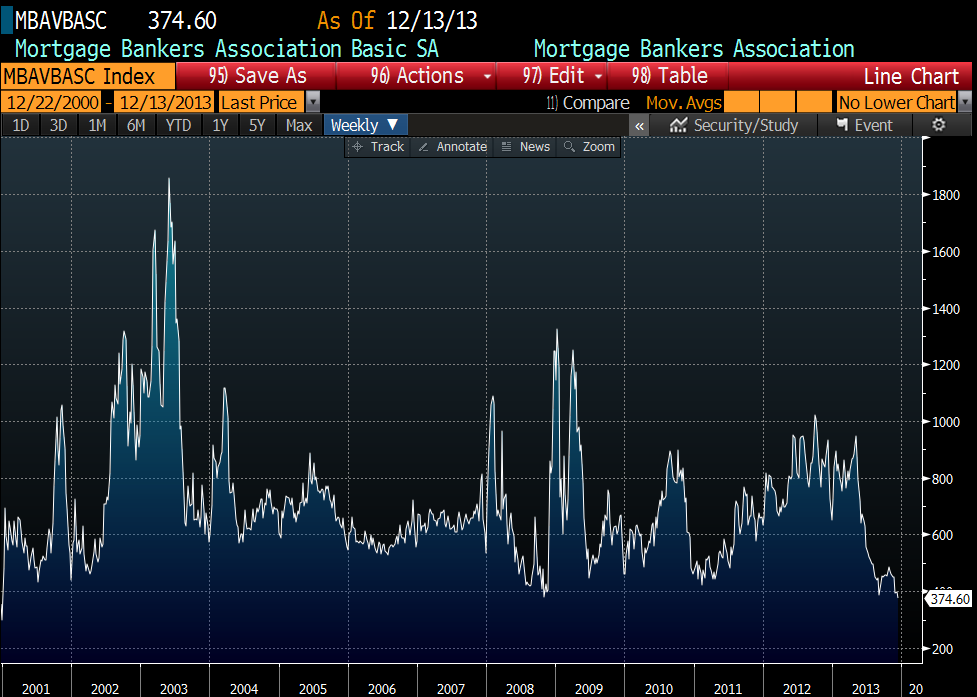
The bad news: Mortgage Applications hit the lowest level since 2001 last week as the MBA index dropped 5.5% to 374.60, the lowest level since 2001.

Here is the purchase index going back to 1991: We remain mired in this situation where cash buyers are almost half of all sales on purchase transactions and refis remain depressed. Will it turn around? Of course, once the first time homebuyer gets back on his or her feet.

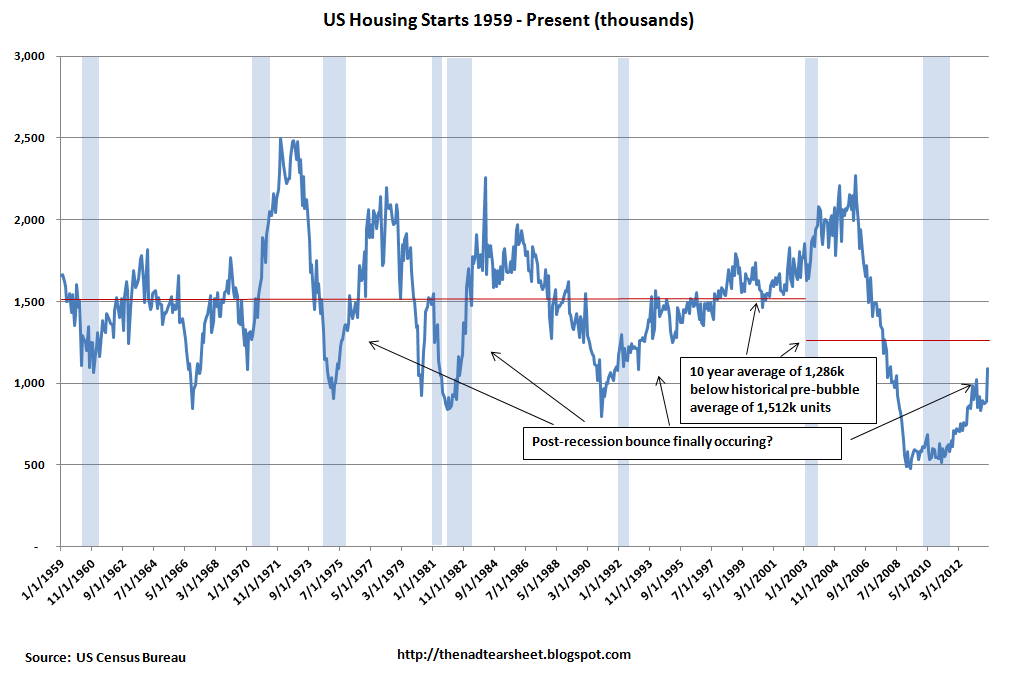
The good news:  In the “been down so long everything looks up” category, housing starts leaped to the highest level since early 2008, with a print of almost 1.1 million units. While it is historically a very depressed number, (we averaged about 1.5 million units a year prior to the bubble years), it looks great compared to our average of 727k over the past 5 years. Housing construction has been the Achilles Heel of this recovery – it is a huge economic engine and employs a lot of people. The builders have been reporting massive gross margins, and I think will want to start ringing the register.

Lennar reported 4Q earnings this morning which beat analyst expectations. Homebuilding revenue was up 50%, and gross margins were an eye-popping 26.8% as average selling prices increased 18% year over year. Orders and backlog are up as well. The builders are undoubtedly going to take advantage of these numbers by boosting production, which will be good for the economy in general.

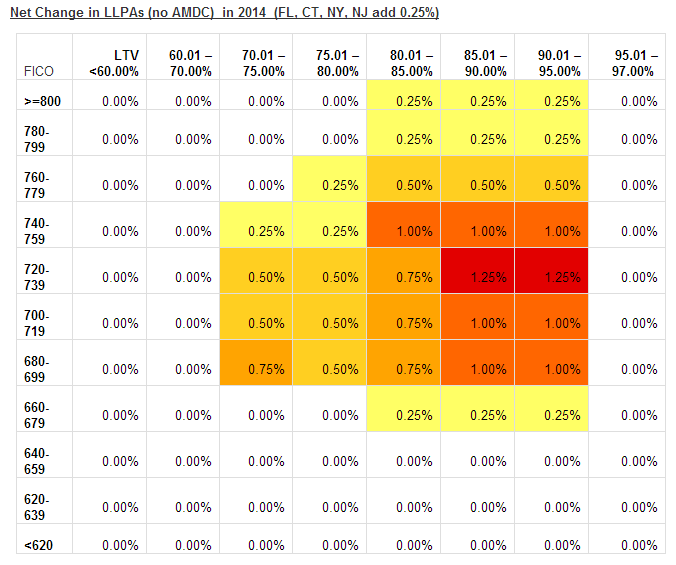
The WSJ has a write-up on the new LLPA hitting conforming buyers next year. FHFA has been hiking fees for years now, and the guarantee fee has been used as a cookie jar to pay for other spending. Jumbos lately have been offered at lower rates than conforming loans. This won’t help to get the MBA applications index up.

Rudely Copied from the NYT; USDC distinguishes a clear precedent

December 16, 2013

Judge Questions Legality of N.S.A.

Phone Records

By

WASHINGTON — A federal district judge ruled on Monday that the National Security Agency program that is systematically keeping records of all Americans’ phone calls most likely violates the Constitution, describing its technology as “almost Orwellian” and suggesting that James Madison would be “aghast” to learn that the government was encroaching on liberty in such a way.

The judge, Richard J. Leon of Federal District Court for the District of Columbia, ordered the government to stop collecting data on the personal calls of the two plaintiffs in the case and to destroy the records of their calling history. But Judge Leon, appointed to the bench in 2002 by President George W. Bush, stayed his injunction “in light of the significant national security interests at stake in this case and the novelty of the constitutional issues,” allowing the government time to appeal it, which he said could take at least six months.

“I cannot imagine a more ‘indiscriminate’ and ‘arbitrary’ invasion than this systematic and high-tech collection and retention of personal data on virtually every single citizen for purposes of querying and analyzing it without prior judicial approval,” Judge Leon wrote in a 68-page ruling. “Surely, such a program infringes on ‘that degree of privacy’ that the founders enshrined in the Fourth Amendment,” which prohibits unreasonable searches and seizures.

Andrew Ames, a Justice Department spokesman, said government lawyers were studying the decision, but he added: “We believe the program is constitutional as previous judges have found.”

The case is the first in which a federal judge who is not on the Foreign Intelligence Surveillance Court, which authorized the once-secret program, has examined the bulk data collection on behalf of someone who is not a criminal defendant. The Justice Department has said that 15 separate judges on the surveillance court have held on 35 occasions that the calling data program is legal.

It also marks the first successful legal challenge brought against the program since it was revealed in June after leaks by the former N.S.A. contractor Edward J. Snowden.

In a statement from Moscow, where he has obtained temporary asylum, Mr. Snowden praised the ruling.

“I acted on my belief that the N.S.A.’s mass surveillance programs would not withstand a constitutional challenge, and that the American public deserved a chance to see these issues determined by open courts,” Mr. Snowden said in his statement. It was distributed by Glenn Greenwald, a journalist who received leaked documents from Mr. Snowden and wrote the first article about the bulk data collection. “Today, a secret program authorized by a secret court was, when exposed to the light of day, found to violate Americans’ rights,” the statement said. “It is the first of many.”

The case was brought by several plaintiffs led by Larry Klayman, a conservative legal activist. Mr. Klayman, who represented himself and the other plaintiffs, said in an interview on Monday that he was seeking to turn the case into a class action on behalf of all Americans. “I’m extremely gratified that Judge Leon had the courage to make this ruling,” he said. “He is an American hero.”

Mr. Klayman argued that he had legal standing to challenge the program in part because, he contended, the government had sent inexplicable text messages to his clients on his behalf; at a hearing, he told the judge, “I think they are messing with me.”

The judge portrayed that claim as “unusual” but looked past it, saying Mr. Klayman and his co-plaintiff instead had standing because it was highly likely, based on the government’s own description of the program as a “comprehensive metadata database,” that the N.S.A. collected data about their phone calls along with everyone else’s.

Similar legal challenges to the N.S.A. program, including by the American Civil Liberties Union and the advocacy group Electronic Frontier Foundation, are at earlier stages in the courts. Last month, the Supreme Court declined to hear an unusual challenge to the program by the Electronic Privacy Information Center, which had sought to bypass lower courts.

The ruling on Monday comes as several government panels are developing recommendations on whether to keep, restructure or scrap the bulk data collection program, and as Congress debates competing bills over the program’s future.

Though long and detailed, Judge Leon’s ruling is not a final judgment on the program, but rather a preliminary injunction to stop the collection of data about the plaintiffs while they pursued their case.

He also wrote that he had “serious doubts about the efficacy” of the program, saying that the government had failed to cite “a single instance in which analysis of the N.S.A.’s bulk metadata collection actually stopped an imminent attack, or otherwise aided the government in achieving any objective that was time-sensitive.”

Judge Leon rejected the Obama administration’s argument that a 1979 case, Smith v. Maryland, had established there are no Fourth Amendment protections for call metadata — information like the numbers dialed and the date, time and duration of calls, but not their content. The 1979 case, which involved collecting information about a criminal defendant’s calls, helped establish the principle that people do not have a reasonable expectation of privacy for information they have exposed to a third party, like the phone company, which knows about their calls.

The surveillance court, which issues secret rulings after hearing arguments from only the Justice Department and without opposing lawyers, has maintained that the 1979 decision is a controlling precedent that shields the N.S.A. call data program from Fourth Amendment review. But Judge Leon, citing the scope of the program and the evolving role of phones and technology, distinguished the bulk collection from the 34-year-old case.

Last month, a federal judge declined to grant a new trial to several San Diego men convicted of sending money to a terrorist group in Somalia. Government officials have since acknowledged that investigators became interested in them because of the call records program. Citing Smith v. Maryland, the judge said the defendants had “no legitimate expectation of privacy” over their call data.

David Rivkin, a White House lawyer in the administration of the elder President George Bush, criticized Judge Leon’s reasoning.

“Smith v. Maryland is the law of the land,” Mr. Rivkin said. “It is not for a District Court judge to question the continuing validity of a Supreme Court precedent that is exactly on point.”

Judge Leon also pointed to a landmark privacy case decided by the Supreme Court in 2012 that held it was unconstitutional for the police to use a GPS tracking device to monitor a suspect’s public movements without a warrant.

Although the court decided the case on narrow grounds, five of the nine justices separately questioned whether the 1979 precedent was still valid in an era of modern technology, which enables long-term, automated collection of information.

***

Leon, a lifelong R for those who want to know, has shown sensitivity to the civil liberties issues that drive JNC and me to distraction.  He is operating within the confines of a Supreme Court that is very deferential in this area to national security concerns.

Morning Report – Hey my rate went up and bonds didn’t move, what gives? 12/17/13

Vital Statistics:

Last Change Percent
S&P Futures 1782.3 2.0 0.11%
Eurostoxx Index 2961.3 -17.4 -0.59%
Oil (WTI) 97.44 0.0 -0.04%
LIBOR 0.244 0.002 0.62%
US Dollar Index (DXY) 80.13 0.059 0.07%
10 Year Govt Bond Yield 2.87% -0.01%
Current Coupon Ginnie Mae TBA 104.7 0.0
Current Coupon Fannie Mae TBA 103.4 0.1
RPX Composite Real Estate Index 200.7 -0.2
BankRate 30 Year Fixed Rate Mortgage 4.48
Markets are little changed this morning ahead of the start of the FOMC meeting. Consumer Prices were unch’d.
The GSEs are planning on reducing the upper limits sometime next fall.  They are thinking of dropping the high cost ceiling from 625k to 600k and the overall ceiling from 417k to 400k. They are inviting public comment. Setting new purchase limits “furthers the goal of contracting the market presence of Fannie Mae and Freddie Mac gradually over time, one of the key objectives of FHFA’s strategic plan.”
Fannnie Mae and Freddie Mac also released their new pricing adjustments today, (Fannie is hereFreddie is here) which increases costs for borrowers in 2014. The first part is a g-fee increase of 10bp. The second is a series of LLPAs to better reflect credit risk. Note the Adverse Charge goes away for all states except CT, FL, NY, and NJ. However, when you include the new LLPAs, conforming loan rates are going up. Mortgage News Daily put out this handy chart showing the new adjustments. Note that these are not the actual adjustments – they are the change in adjustments. Note that higher LTV loans with FICOs over 680 are getting socked.

Toss in the potential effects of QE tapering and conforming loans just got a lot more expensive. LOs get ready for this new pricing regime.

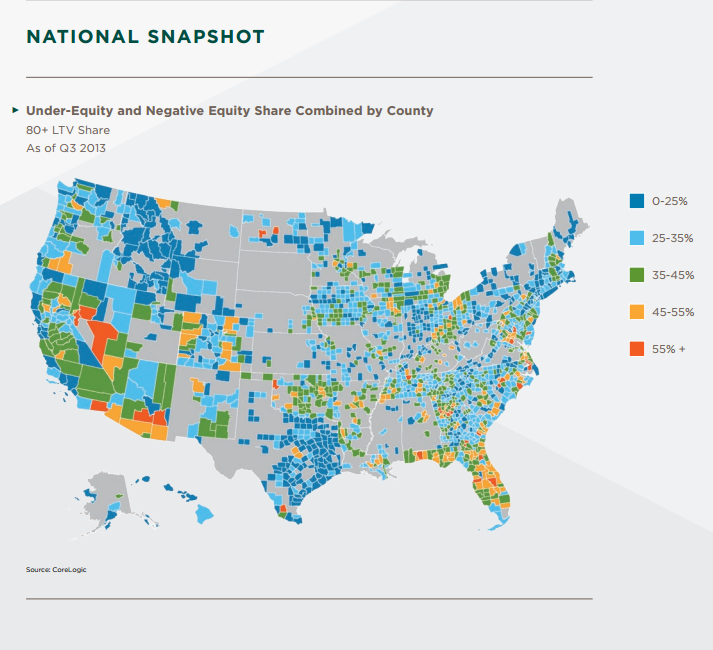
A total of 791,000 homes returned to positive equity in the third quarter, according to CoreLogic. This leaves a total of 6.4 million homes (or about 13% of all mortgaged homes) with negative equity. This compares to 7.2 million homes (or 14.7%) a year ago. You can see the distribution of negative equity MSAs in the chart below:

The budget deal is looking more and more likely to pass the Senate. That doesn’t necessarily mean smooth sailing ahead – Republican lawmakers who are angry about the budget deal are spoiling for a fight over the debt ceiling. CNBC also has a lay of the land. The big strategic question for the GOP remains obamacare – if it continues to flail and have issues, do Republicans go along with a debt ceiling increase for fear of changing the subject, or would they view this as an opportunity to slay the unpopular ACA dragon once and for all?

When people think of Detroit, they often think of the hapless Lions, but also the Packard Plant, which went dormant in 1956 and is ruins remain a testament to urban decay and is a symbol of Rust Belt miseryIt just got bought for $405,000. He plans to revitalize Detroit’s East Side. Good luck with that…

Morning Report – all about the Fed 12/16/13

Vital Statistics:

Last Change Percent
S&P Futures 1778.2 9.7 0.55%
Eurostoxx Index 2973.3 51.4 1.76%
Oil (WTI) 97.04 0.4 0.46%
LIBOR 0.243 -0.001 -0.41%
US Dollar Index (DXY) 80.05 -0.162 -0.20%
10 Year Govt Bond Yield 2.85% -0.01%
Current Coupon Ginnie Mae TBA 104.6 0.0
Current Coupon Fannie Mae TBA 103.4 0.1
RPX Composite Real Estate Index 200.7 -0.2
BankRate 30 Year Fixed Rate Mortgage 4.49
Markets are up this morning on no real news. Bonds and MBS are up small. We had a few minor economic reports this morning which were generally mixed.
This week is all about the FOMC meeting starting this Tuesday. It feels like we are at a 50 / 50 bet on tapering at this meeting. We will also get the Fed’s economic forecasts. The Fed has been consistently high in its forecast for economic growth, but it will be interesting to see the direction the forecasts point. Once we get the FOMC data, bond traders might as well go home for the rest of the year, with Christmas and New Years eve both middle-of-the-week events, the end of December promises to be slow.
We will also get our first housing starts number since the government shutdown. It should include September, October, and November data. We will also get existing home sales later on.
Bloomberg has a good story on what went wrong with HAMP. If Bank of America wasn’t forced to buy Countrywide, then the purchase goes down as one of the worst business decisions ever, up there with New Coke and Time Warner’s aol purchase.

Saturday Football Open Thread (Wrap-up and Bowl Preview)

The annual Army-Navy game, played in Philadelphia, is the only game on the schedule for today (line: Navy, spread: 10)(3:00 pm EST/CBS). Since I don’t think any of us have a dog in this hunt, I hope it’s simply a great game. The weather will be problematic, with the forecast being for rain/snow at kickoff turning to snow around the end of the first quarter or so. Bundle up!  UPDATE: Navy wins 34 – 7.  

Bowl games start next Saturday; here is the complete bowl lineup:

Saturday, December 21, 2013

Gildan New Mexico Bowl: Washington State (6 – 6) vs Colorado State (7 – 6).  ESPN/2:00 EST

Royal Purple Las Vegas Bowl: Fresno State (11 – 1) vs USC ( 9 – 4).  ABC/3:30 EST

Famous Idaho Potato Bowl: Buffalo (8 – 4) vs San Diego State (7 – 5).  ESPN/5:30 EST

R&L Carriers New Orleans Bowl: Tulane (7 -5) vs LA-Lafayette (8 – 4).  ESPN/9:00 EST

Christmas week

Monday, 12/23: Beef ‘o’ Brady’s Bowl, East Carolina (9 – 3) vs Ohio (7 – 5). ESPN/2:00 EST

Tuesday, 12/24: Sheraton Hawai’i Bowl, Boise State (8 – 4) vs Oregon State (6 – 6). ESPN/8:00.  Wear sunglasses–the combination of those two uniforms is likely to be blinding!

Thursday, 12/26: Little Caesar’s Bowl, Pitt (6 – 6) vs Bowling Green (10 – 2). ESPN/6:00 EST.

San Diego County Credit Union Poinsettia Bowl, Utah State (8 – 5) vs Northern Illinois (12 – 1). ESPN/9:30 EST.

Friday, 12/27: Military Bowl Presented by Northrup Grumman, Marshall (9 – 4) vs Maryland (7 – 5).  ESPN/2:30 EST.  Another game that may require sunglasses.

Texas Bowl, Syracuse (6 – 6) vs Minnesota (8 – 4).  ESPN/6:00 EST.  May the best ATiM team win! (I notice Texas doesn’t need any stinkin’ help hosting a bowl game)

Fight Hunger Bowl, BYU (8 – 4) vs Washington (8 – 4).  ESPN/9:30 EST.

Saturday, 12/28: New Era Pinstripe Bowl, Rutgers (6 – 6) vs Notre Dame (8 – 4). ESPN/12:00 noon EST.

Belk Bowl, Cincinnatti (9 – 3) vs North Carolina (6 – 6).  ESPN/3:20 EST.  Am I the only one who knows what “Belk” is, or are they outside North Carolina as well as inside?

Russell Athletic Bowl, Miami (FL) (9 – 3) vs Louisville (11 – 1).  ESPN/6:45 EST.

Buffalo Wild Wings Bowl, Michigan (7 – 5) vs Kansas State (7 – 5).  ESPN/10:15 EST.

New Years Week

Monday, 12/30: Bell Helicopter Armed Forces Bowl, Middle Tennessee (8 – 4) vs Navy (?7 – 4?).  ESPN/11:43 EST.

Franklin American Mortgage Music City Bowl, Ole Miss (7 – 5) vs Georgia Tech (7 – 5). ESPN/3:15 EST.

Valero Alamo Bowl, Oregon (10 – 2) vs Texas (8 – 4). ESPN/6:45 EST.

National University Holiday Bowl, Arizona State (10 – 3) vs Texas Tech (7 – 5). ESPN/10:15 EST.

Tuesday, 12/31: AdvoCare V100 Bowl, Arizona (7 – 5) vs Boston College (7 – 5).  ESPN/12:30 EST.  Scott and “Carl” get to fight it out!  May the best ATiM team win.

Hyundai Sun Bowl, Virginia Tech (8 – 4) vs UCLA (9 – 3).  CBS/2:00 EST.

AutoZone Liberty Bowl, Rice (10 – 3) vs Mississippi State (6 – 6).  ESPN/4:00 EST.

Chik-fil-A Bowl, Duke (10 – 3) vs Texas A&M (8 – 4).  ESPN/8:00 EST.

Wednesday, 1/1:  Happy New Year!

Taxslayer.com Gator Bowl, Nebraska (8 – 4) vs Georgia (8 – 4).  ESPN2/12:00 EST.

Heart of Dallas Bowl Presented by Plainscapital Bank, UNLV (7 – 5) vs North Texas (8 – 4).  ESPNU/12:00 EST.

Outback Bowl, Iowa (8 – 4) vs LSU (9 – 3).  ESPN/1:00 EST.

Capitol One Bowl, Wisconsin (9 – 3) vs South Carolina (10 – 2).  ABC/1:00 EST.

Rose Bowl Game Presented by Vizio, Stanford (11 – 2) vs MSU (12 – 1).  ESPN/5:00 EST.

Tostitos Fiesta Bowl, UCF (11 – 1) vs Baylor (11 – 1).  ESPN/8:30 EST.

Thursday, 1/2: Allstate Sugar Bowl, Oklahoma (10 – 2) vs Alabama (11 – 1).  ESPN/8:30 EST.

Friday, 1/3: AT&T Cotton Bowl, Oklahoma State (10 – 2) vs Missouri (11 – 2).  FOX/7:30 EST.

Discover Orange Bowl, Clemson (10 – 2) vs osu (12 – 1).  ESPN/8:30 EST.

Saturday, 1/4: BBVA Compass Bowl, Vanderbilt (8 – 4) vs Houston (8 – 4).  ESPN/1:00 EST.

Sunday, 1/5: GoDaddy Bowl, Arkansas State (7 – 5) vs Ball State (10 – 2).  ESPN/9:00 EST.

National Championship, Monday, 1/6/2014:

Vizio BCS National Championship Bowl, Florida State (13 – 0) vs Auburn (12 – 1). ESPN/8:30 EST.

Morning Report – 2013 worse than 1994 12/13/13

Vital Statistics

Last Change Percent
S&P Futures 1772.1 3.5 0.20%
Eurostoxx Index 2932.1 4.0 0.13%
Oil (WTI) 96.4 -1.1 -1.13%
LIBOR 0.244 0.001 0.41%
US Dollar Index (DXY) 80.17 -0.039 -0.05%
10 Year Govt Bond Yield 2.86% -0.02%
Current Coupon Ginnie Mae TBA 104.7 0.1
Current Coupon Fannie Mae TBA 103.4 0.2
RPX Composite Real Estate Index 200.7 -0.2
BankRate 30 Year Fixed Rate Mortgage 4.48
Markets are higher this morning after wholesale inflation came in lower than expected. Bonds and MBS are up.
Slow news day. Bonds are going to mark time until the FOMC meeting next week. Then that will probably be it for activity until the new year. The stronger economic data certainly gives the Fed enough reason to trim purchases slightly.
It is looking like 2013 will be a worse year for bond funds than 1994, when Askin Capital Management and Orange County blew up as mortgages tanked.
It looks like extended unemployment benefits are scheduled to lapse at the end of the year. Another provision that matters to us is the tax relief on short sales. When a person discharges their mortgage for less than the amount they owe, the IRS treats that as income. Starting Jan 1, people who have a short sale will also get a bill from the IRS. So far no word on whether that will continue.

Morning Report – Meet Stanley Fischer 12/12/13

Vital Statistics:

Last Change Percent
S&P Futures 1781.7 0.9 0.05%
Eurostoxx Index 2925.8 -21.6 -0.73%
Oil (WTI) 97.77 0.3 0.34%
LIBOR 0.243 -0.001 -0.41%
US Dollar Index (DXY) 79.98 0.089 0.11%
10 Year Govt Bond Yield 2.87% 0.01%
Current Coupon Ginnie Mae TBA 104.4 -0.1
Current Coupon Fannie Mae TBA 103.3 -0.1
RPX Composite Real Estate Index 200.7 -0.2
BankRate 30 Year Fixed Rate Mortgage 4.45
Markets are higher this morning after a good retail sales report. Initial Jobless Claims rose to 368k from 320k the week before. Import prices fell. Bonds and MBS are lower.
Stanley Fischer is mooted to be the next Vice Chairman of the Fed. He ran the Bank of Israel through the 2008 financial crisis, and his international experience is supposedly one of the reasons why Obama is interested in him. He has a experience teaching at free-market leaning University of Chicago, and left-leaning MIT. Supposedly he is skeptical of the new Fed communications strategy, which could put him in conflict with Janet Yellen. He has called QE “dangerous, but necessary.”
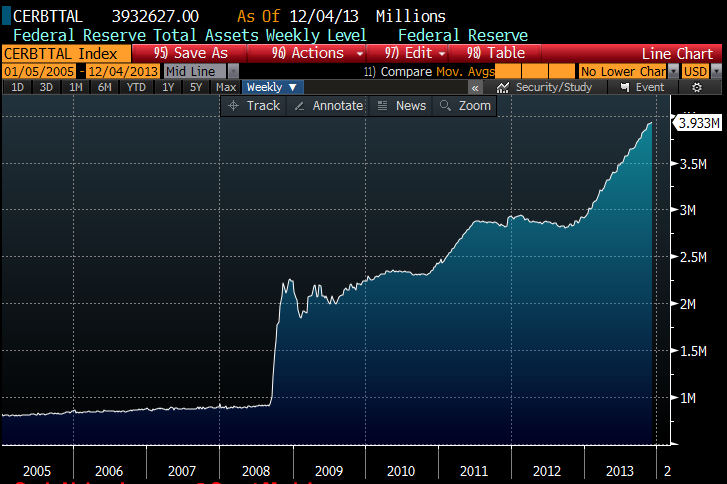
In the “now they tell us” category, QE has made the traditional method of tightening ineffective. When the Fed wants to tighten monetary policy, it would meter out the amount of money flowing into and out of the banking system on a daily basis. The Federal Funds rate was essentially the gauge they would use. Since the Fed has injected multiple trillions of liquidity into the system, the old methodology won’t work, unless they significantly drain the system, which would be disruptive to say the least. Instead it plans to repo its vast security portfolio in order to pull liquidity out of the system. Of course this won’t matter for a couple of years, but it just goes to show how much QE has changed the landscape. You can see just how much the Fed’s balance sheet has ballooned below:

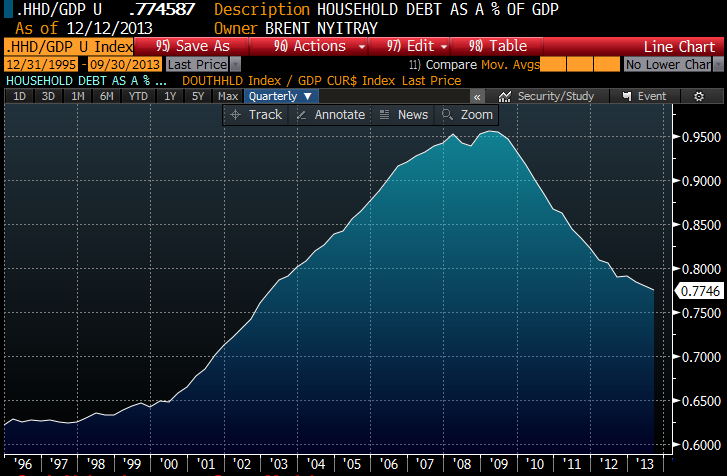
A Reuters poll of 60 economists shows they expect growth to accelerate in 2014, with GDP hitting 2.5% in Q1 and reaching 3% by year end. Continued recovery in housing, along with a pick up in capital expenditures are the keys. The consumer de-leveraging continues. You can see that household debt has fallen to 77% of GDP and is back at 2003 levels.

Morning Report – Mel is now guarding the henhouse 12/11/13

Vital Statistics:

Last Change Percent
S&P Futures 1803.5 0.4 0.02%
Eurostoxx Index 2973.6 12.7 0.43%
Oil (WTI) 98.27 -0.2 -0.24%
LIBOR 0.244 0.002 0.83%
US Dollar Index (DXY) 79.98 0.014 0.02%
10 Year Govt Bond Yield 2.82% 0.02%
Current Coupon Ginnie Mae TBA 104.8 -0.2
Current Coupon Fannie Mae TBA 103.7 -0.2
RPX Composite Real Estate Index 200.7 -0.2
BankRate 30 Year Fixed Rate Mortgage 4.42
Markets are flattish on no real news. Bonds and MBS are down small. In spite of rising rates, mortgage applications rose 1% last week as refis rose 2% and purchases rose 1%
Mel Watt was confirmed by the Senate yesterday to lead FHFA. Ed DeMarco slipped in one last G-fee increase before he left – it will be interesting to see if Watt maintains it. Exhibiting his droll sense of humor, President Obama said that Mel Watt is “just the type of regulator to make sure the kind of crisis we just went through never happens again.” Regardless of anyone’s free-market inclinations, a Mel Watt FHFA is probably better for originators than Ed DeMarco was. He wants credit loosened, he wants more mortgage activity. Watt is a CRA guy to the bone.
The other possible effect (and I’m not thoroughly convinced it will happen) is that higher coupon MBS get hit as the market factors in new prepayment assumptions. Of course that isn’t relevant for new issues, but there is a relative value trade between TBAs and existing MBS. If existing MBS get hit, TBAs probably will as well. To a LO, what this means is that your borrower won’t be able to gain as much benefit going higher up in rate as before. Again, may not happen, but is something to watch over the next few months.
The new Volcker rule is out, and it is not as harsh as the banks had feared. Principal trading in a market-making context is still allowed, although the devil is in the details and it will depend on how the regulators enforce it. The main point is that liquidity in the MBS markets should remain the way it is and not contract, which would have had the effect of raising interest rates.
It is looking like a budget confrontation isn’t happening in the new year. Paul Ryan and Patty Murray came up with a deal that weakens the sequester, and cuts the deficit by raising fees in other places. Extended unemployment benefits were not part of the deal, which means that unemployment checks will stop for millions of Americans at the beginning of the year. Also, I don’t know if the debt ceiling was addressed. So we have a couple big issues still aren’t resolved.

Morning Report – Toll Brothers reports the luxury end of the market is doing well 12/10/13

Vital Statistics:

Last Change Percent
S&P Futures 1803.5 -5.5 -0.30%
Eurostoxx Index 2964.6 -24.1 -0.81%
Oil (WTI) 98.47 1.1 1.16%
LIBOR 0.242 -0.001 -0.31%
US Dollar Index (DXY) 79.98 -0.154 -0.19%
10 Year Govt Bond Yield 2.80% -0.04%
Current Coupon Ginnie Mae TBA 104.9 0.3
Current Coupon Fannie Mae TBA 103.9 0.1
RPX Composite Real Estate Index 200.7 -0.2
BankRate 30 Year Fixed Rate Mortgage 4.44
Markets are lower this morning on no real news. Bonds and MBS are higher
Toll Brothers announced better-than expected earnings of 54 cents a share. The luxury end of the market continues to do well. Average Selling Prices increased to $703,000. Contracts were flat in the first 5 weeks of this quarter, as higher prices and interest rates tamp down demand. That said, they believe “this leveling of demand will prove temporary based on still-significant pent-up demand, the gradual strengthening of the economy and the improving prospects of our affluent customers.”
The National Federation of Independent Business Optimism Index rose to 92.5 from 91.6. This is still a relatively depressed level historically, and speaks to the great divide in American business. The S&P 500 is at record highs, while small business is still stuck in the post-bubble morass. The difference: QE is driving money into stocks, and the big US companies that make up the index have a lot of international exposure. That is why the economy feels “meh” even though the stock market is at record highs.
The Obama Administration’s latest housing scorecard is out. As of October, 1.2 million homeowners have had their principal cut through HAMP. Housing remains affordable as the NAR Housing Affordability index stands at 164.3, (lower than its peak of 213.6 in January, but well above its historical average of 135).

Morning Report – FHA lowers the upper limit on mortgages 12/9/13

Vital Statistics:


  Last Change Percent
S&P Futures  1807.0 2.0 0.11%
Eurostoxx Index 2981.6 1.6 0.05%
Oil (WTI) 97.71 0.1 0.06%
LIBOR 0.243 0.002 0.73%
US Dollar Index (DXY) 80.22 -0.098 -0.12%
10 Year Govt Bond Yield 2.85% -0.01%  
Current Coupon Ginnie Mae TBA 104.6 0.3  
Current Coupon Fannie Mae TBA 103.8 0.4  
RPX Composite Real Estate Index 200.7 -0.2  
BankRate 30 Year Fixed Rate Mortgage 4.48    


World markets are higher this morning after Friday’s stronger-than-expected jobs report. Bonds and MBS are up small as well.
 
The upcoming week is relatively data-light, so the markets will be left to fret about the FOMC meeting next week. The Street seems to be handicapping a December tapering at 50/50. Don’t forget, even if the Fed does begin to reduce asset purchases, it doesn’t necessarily follow that MBS purchases will drop. In fact, most observers think that the Fed will only reduce Treasury purchases and maintain their current rate of MBS purchases. The only reason why the Fed may want to reduce MBS purchases would be to reflect that the Fed’s current purchase rate of $40 billion a month is much higher as a percentage of total MBS issuance than it was a year ago. This is because overall issuance has fallen since the refi boom ended.
 
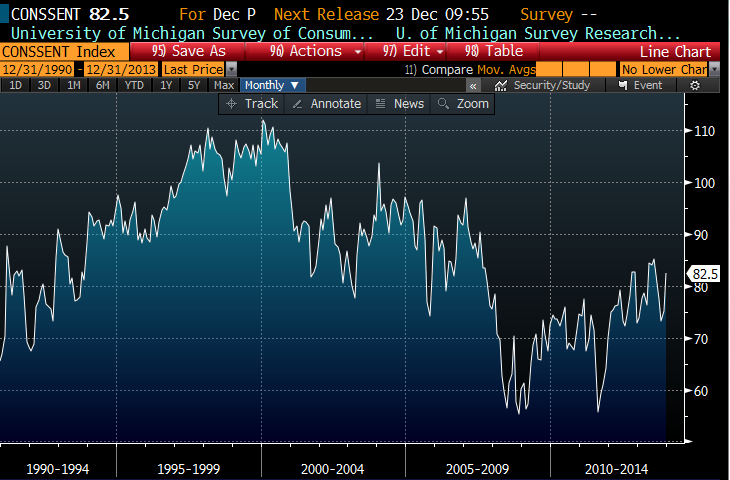
Consumer sentiment is on the rebound, but is still below what one would call “normalcy.” The chart below is of the University of Michigan Consumer Sentiment Index. You can see that we are close to post-bubble highs, but are still mired in that early 90s malaise. Consumer sentiment is a big driver of real estate activity – in fact the CEO of KB Home said that consumer sentiment matters more than interest rates, at least to the homebuilders. Things are improving, albeit slowly.


It looks like we have some sort of budget deal in Washington, which should at least take the possibility of another government shutdown off the table. It looks like some of the sharper edges of the sequester will be sanded down, and it will be paid for by increased pension contributions from Federal workers and increased airport security fees. It is a “kick the can down the road” agreement that will at least prevent some fireworks beginning next year. 


The FHA reduced the upper limit on FHA mortgages in high cost areas from $729,750 to $625,500. The jumbo market has been back for quite some time, and FHA is happy to let upper income borrowers access private capital. 

 
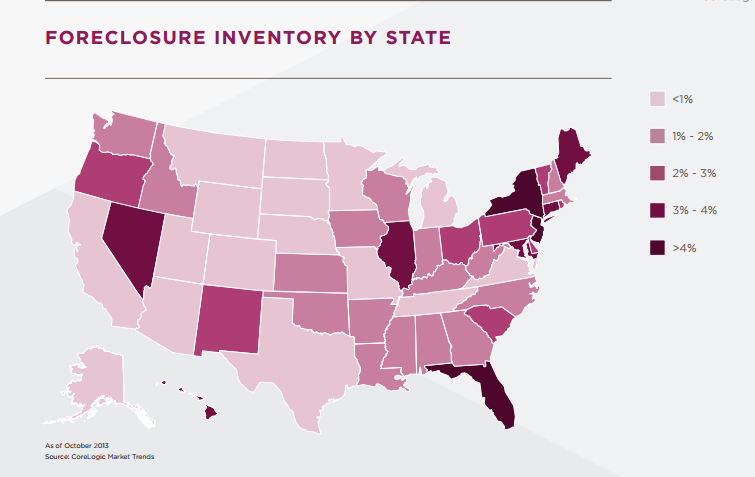
Completed foreclosures dropped 30% from a year ago, and 26% from last month, according to CoreLogic. The foreclosure pipeline is 900k homes, which is a big drop, however we are still far from “normalcy,” which would be about a quarter of that number. The judicial states still have the highest level of foreclosure inventory, as you can see from this foreclosure heat map.