Morning Report – Subprime is back 1/28/15

Markets are higher after yesterday’s sharp sell-off. Bonds and MBS are flat.

Mortgage Applications fell 3.2% last week as purchases fell .1% and refis fell 5.1%.

There is anecdotal evidence (Redfin and also D.R. Horton) of buyer demand for homes, which bodes well for business this year. The wrinkle is that buyers are highly price sensitive and are not chasing homes, even though rates are lower. Existing home inventory is at 4.4 months, which is well below the mid 5s we have been seeing for years and the mid 6s, which indicates a balanced market.

Mel Watt testified before the House Financial Services Committee yesterday. Here are the prepared remarks. He more or less defended an activist government role in the housing market. On the subject of principal mods for Fannie and Freddie loans, he told the left that the check is in the mail, saying that they are still looking at the best way to serve both homeowners and the government. As the FHFA home price index is within 5% of peak levels already, this problem is melting away over time.

We will have the FOMC decision today around 2:00 pm. Nothing major is expected, as there is no press conference. I suspect any action will be in the minutes, not the statement.

Is the non-QM securitization market finally coming back? Maybe. As if now, non-QM loans are portfolio’d. However some hedge funds are thinking of selling MBS backed by these loans. Of course the big question will be how much overcollateralization the Street will require. High quality jumbos have been having something like a 50% equity tranche. That said, financial repression leads to investors reaching for yield, so this may work.

Morning Report – Juno Edition 1/26/15

Markets are down small as a historic snowstorm bears down on the Northeast. Bonds and MBS are up small.

The Northeast is bracing for a historic snowstorm to start today and go through Tuesday night. NYC is expected to get up to 2 feet, while Boston could get close to 3 feet. The evening commute will probably start around noon today, as the National Weather Service has a blizzard warning for the tri state area beginning at 1:00 pm today. Expect to see a touch more volatility in the markets as desks will be understaffed for the next couple of days.

Aside from the snowstorm, we have some important data this week, with the FOMC meeting and also Q4 GDP on Friday. The January FOMC meeting should not have any economic projections and I don’t anticipate anything market moving to come out of the press release, but you never know. The Street is forecasting +3.0% on the advance estimate for Q4 GDP.

Homebuilder D.R. Horton announced better-than-expected earnings this morning. Sales, orders, and backlog are up smartly. Analysts will be most concerned about the Texas housing market. The stock is up a buck as of now. The conference call begins at 10:00 am. Note that both Lennar and KB waited until the conference call to disclose poor Q1 forecasts, so don’t feel the need to lift any Horton quite yet.

Morning Report – Global Bond Yields plummet 1/23/15

Global stocks and bonds are continuing their post ECB rally. It is truly stunning to see bond yields where they are. If you think the US 1.83% bond yield is rock bottom, consider this: It is higher than 3 out of the 5 PIIGS (only Greece and Portugal are higher) and is multiples higher than many G7 yields.

Some global 10 year yields:

France 10 Year Govt Bond Yield 0.54%
Germany 10 Year Govt Bond Yield 0.38%
Swiss 10 Year Govt Bond Yield -0.22%
UK 10 Year Govt Bond Yield 1.49%
Japan 10 Year Govt Bond Yield 0.23%
Canada 10 Year Govt Bond Yield 1.52%

We live in truly extraordinary times. Yes, the German Bund is pushing towards Japanese yields. Rates are negative through 7 years in Germany right now, and you’ll pay 22 basis points per year to lend to the Swiss government for 10 years.That’s not an interest rate – it is a storage fee.

With the ECB out of the way, attention turns to the Greek elections and the possibility (again) of Grexit.

King Abdullah of Saudi Arabia passed away last night. Oil markets are taking the news in stride, as it probably will not affect OPEC policy.

Existing Home Sales rose to a seasonally adjusted 5.04 million in December, from a downward revised 4.92 million in November. The median home price rose 5.3% year-over-year to $208,500.

In economic news, the Chicago Fed National Activity Index fell by a lot in December to -,05 from .73 in November. Production indicators drove the decline, however employment is still positive. It is looking more and more like we took a bit of a swoon in December economically, given what we have seen with the ISM numbers and the Industrial Production numbers.

The Index of Leading Economic Indicators rose from a downward-revised +0.4% to +0.5% in December.

Morning Report – Super Mario Pleases the markets 1/22/15

Markets are higher this morning after the European Central Bank announced a 1.1 trilllion euro quantitative easing program. Bonds and MBS have been all over the map this morning, but are rallying at the moment.

The ECB QE program will consist of 60 billion euros a month, ending in September 2016. Draghi is walking a fine line here, trying to increase inflation and growth while at the same time mollify German voters that he is coming to the rescue of their Southern brethren. FWIW, I think Germany doth protest too much – their manufacturers have to love seeing the Euro get whacked. Such is the symbiotic relationship of the European monetary union – the profligate Southern European countries get to borrow at lower rates than they otherwise would, and the Northern European exporters get a depressed Euro which makes them more competitive.

The formal announcement was very similar to what was leaked yesterday in terms of amount – 50 billion for 2 years vs 60 billion for 18 months. The markets were looking for something like 500 billion euros in QE, so it is an upside surprise. Bonds are rallying in Europe, with the German Bund challenging its lows of 42 basis points. US Treasuries are being taken along for the ride.

Initial Jobless Claims fell to 307k, but are still the second week above 300k. Good numbers nonetheless. The Bloomberg Consumer Comfort Index slipped to 44.7 from 45.4 last week.

Home Prices rose .8% in November, higher than expected according to the FHFA. On a year-over-year basis, prices are up 5.3% and are within 4.5% of their April 2007 peak. On a seasonally adjusted basis, New England was negative while the West Coast was highly positive. Note that the FHFA Home Price Index only looks at houses with conforming mortgages, which makes it a subset of the overall real estate market.

Morning Report – Housing Starts rebound 1/21/15

Markets are lower this morning on no real news. Bonds and MBS are flat.

The ECB decision is tomorrow. The market has priced in a lot of optimism for QE, so if they disappoint, rates could reverse hard. Keep in mind that US rates have been pulled down by Europe. The fundamentals of the US economy mean rates should be higher.

A headline just crossed the tape saying the ECB is set to propose QE of 50 billion euros a month through 2016. Assuming they start next month, that works out to be $1.1 trillion – I believe the expectations were for the mid $500s billion. Bonds are not reacting to the news. Again, this is just a leak or speculation, not the actual decision.

Housing Starts rose to 1.09 million in December, an increase from the upward-revised 1.04 million in November. Building Permits fell however.

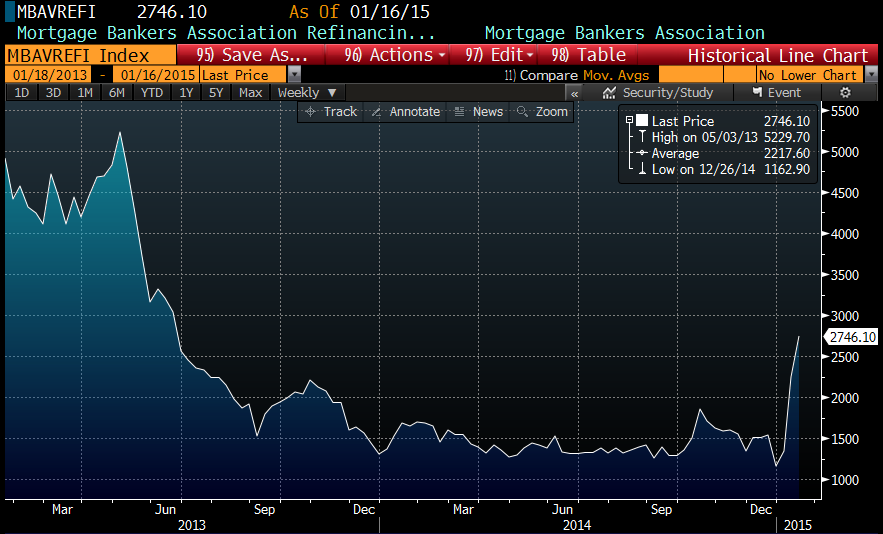
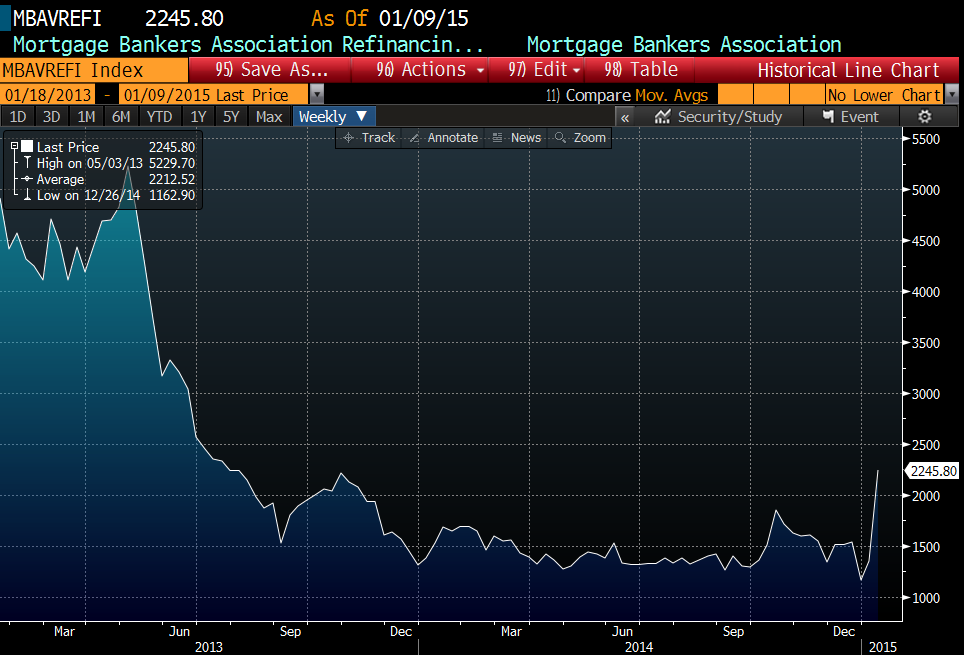
Mortgage Applications rose 14.2% last week following up on an increase of 49% the week before. Purchases fell 2.2% while refis rose 22.3%. Refis are now 74% of all applications, a 10% increase from the beginning of the year. The MBA refi index is the highest it has been June of 2013, when the taper tantrum was beginning.

Obama gave the State of the Union speech last night. If you are interested, here is the take on it. I don’t think he had anything to say affecting housing although he wants to increase the capital gains tax and he vowed not to roll back banking regulations.

The Supreme Court is hearing arguments today challenging the Administration’s novel theory called “disparate impact” to prove discrimination.  Basically, the Administration wants to be able to declare a lender guilty of lending discrimination if the numbers don’t comport with the demographic make-up of their market, even if the lender did not intend to discriminate. The Court is expected to rule in June.

The rise in the dollar has been giving foreign real estate investors sticker shock. Foreign investment demand is behind a lot of the buying in big cities like NY, DC, SF, etc. The woes in Russia are having a big impact as well.

Morning Report – This week is all about the ECB 1/20/15

Markets are higher this morning after better-than-expected growth out of China. Bonds and MBS are up.

We will have some important housing related data this week with the NAHB Homebuilder Sentiment Index today, housing starts & building permits tomorrow, the FHFA Home Price Index on Thursday, and existing home sales on Friday.

The ECB will announce further QE measures this week, so be aware we could see some volatility in the bond market. Investors have been repricing aggressively, so let borrowers know that bond markets are volatile and rate quotes can change in a hurry.

The NAHB Housing Market Index fell to 57 from an upward-revised 58 in December. Traffic was a drag on the index. We are seeing increases in traffic in the Midwest, and declines in the Northeast, South, and West. The index is still close to post-recession highs.

The big takeaway from homebuilder earnings so far has been that price increases are going to be hard to come by and builders are going to become more promotional. They are also going to start shifting production to lower price points – starter homes may be lower margin projects, but you can build a lot of them. Note that in the December Industrial Production indices, construction materials were a big standout. This could portend a stronger building year.

Tonight we will have the State of the Union. Basically, Obama is going to announce a laundry list of liberal priorities that have no chance of being enacted with Republicans in control of Congress. In other words, don’t worry too much about what he has to say. He is going to agitate for higher capital gains taxes , however his centerpiece will be to provide free community college (to help the middle class), and his way to pay for it is to eliminate the 529 College Savings Plan. Of course middle class families have to save for college – they can’t just write a check like the rich, and they don’t qualify for need-based financial aid – so it is kind of ironic that Obama wants to torpedo the way the middle class saves for college in the name of helping the middle class. Of course the cognitive dissonance is irrelevant since this is strictly for show and has absolutely no chance of ever seeing a vote in either chamber. Markets should not react to what he has to say (in fact I suspect only the obama faithful will watch in the first place).

Another proposal slated to come out tonight is some sort of bank tax. SIFMA has already weighed in on it. Again, relax. It is red meat for the base and has zero chance of becoming law.

Morning Report – Buy the Rumor, sell the fact 1/16/15

Markets are flattish as global currency markets continue to digest the move by the Swiss National Bank to remove the cap on the franc. While that isn’t of great importance to US investors, it is important to Euro bond investors, and they are the ones leading the parade these days. Bonds and MBS are down small.

Consumer Price inflation fell in December by .4% due to lower energy prices. Ex food and energy, the index was flat.

More evidence the economy slowed in December: Industrial Production fell .1% and Capacity Utilization fell to 79.7% from a downward-revised 80%.

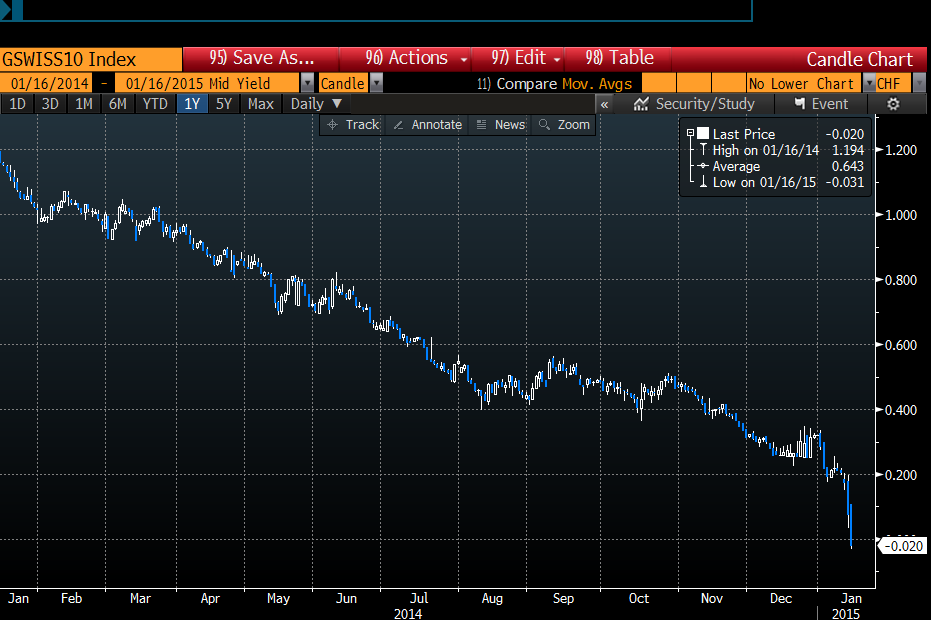
The surprise move by the SNB to eliminate the cap on the franc has caused issues at some broker-dealers that specialize in foreign exchange. People have gotten absolutely blown up in the swiss / euro pair, and some firms (heard FXCM is one) are having capital issues. This is the sort of thing that could snowball, and begin to affect credit markets in the US, but I don’t really anticipate it. Just something to keep an eye on. Fun fact: The yield on the Swiss 10 year bond is negative 2 basis points. For the low, low price of only 2 basis points per year, you get the privilege of letting the Swiss Government borrow your money for 10 years. Don’t believe me? Look:

The ECB is scheduled to meet next Thursday morning and the market are expecting a big announcement regarding QE. Bond markets have priced in A LOT of optimism regarding this event, and if it disappoints, or even comes in as expected, we could see a reversal in interest rates. LOs, this is one thing you should tell any borrowers that are on the fence. These low rates could disappear as quickly as they appeared. There is an old saw in the markets that says “Buy the rumor, sell the fact.” In this case, it means that the move in interest rates may have preceded the event, and the move could reverse afterward. Not necessarily forecasting this is going to happen, but the setup for it looks good.

Lennar reported good earnings yesterday, but the stock was slammed 7% on future margin guidance. We have heard the same thing from Toll and KB Home as well – it is getting hard to raise prices and incentives are increasing. The big price appreciation in new home construction appears to be over. This will probably spill over into existing homes as well. Part of this isn’t all bad news – it also reflects a shift to the lower price points (read starter homes). They may have lower margins, but you can sell a lot more starter homes than you can sell McMansions. The builders are setting themselves up for the return of the first time homebuyer. Given the behavior of the XHB lately, the seasonal “hope springs eternal” trade that lasts from Thanksgiving to New Years appears to be unwinding.

Morning Report – MI and TBAs 1/15/15

Markets are higher this morning as oil rebounds. Bonds and MBS are down.

Initial Jobless Claims came in at 316k, higher than expected, while the producer price index fell .3% in December. The Empire Manufacturing Survey rebounded back into positive territory.

I wanted to talk a little about TBAs this morning given some questions I have had from LOs. (Those of you not in the origination business can skip it). Someone had priced a VA loan last week and found that pricing was worse a week later (not by a little, but by a point), even though the bond market rallied. How was that possible given that the 10 year fell 17 basis points in yield? I will explain. It is a function of the new FHA mortgage insurance premiums.

Some background: The TBA (stands for To Be Announced) is the basic input to a rate sheet. If I was to sell a pool of FHA or VA loans today, the price I would get would be the TBA price plus some carry (interest for a few days). So, when we put out our rate sheets, we start with the TBA prices and then add on our costs to originate, margins, etc.

Look what happened last week. When the government announced lower mortgage insurance premiums for FHA loans, the Ginnie Mae TBAs underperformed versus the Fannie Mae TBAs, which set pricing for conforming loans. The reason for this was the market re-assessed prepayment speeds. By lowing the MI going forward, it made refinancing more attractive. This means that prepayment speeds are increasing and that makes the existing TBAs worth less. Think about it: If you bought a Ginnie 4% TBA for 106, and it prepays in a year, what to you get? Par, or a loss of 6%. The higher up the coupon, the bigger the incentive to prepay is.

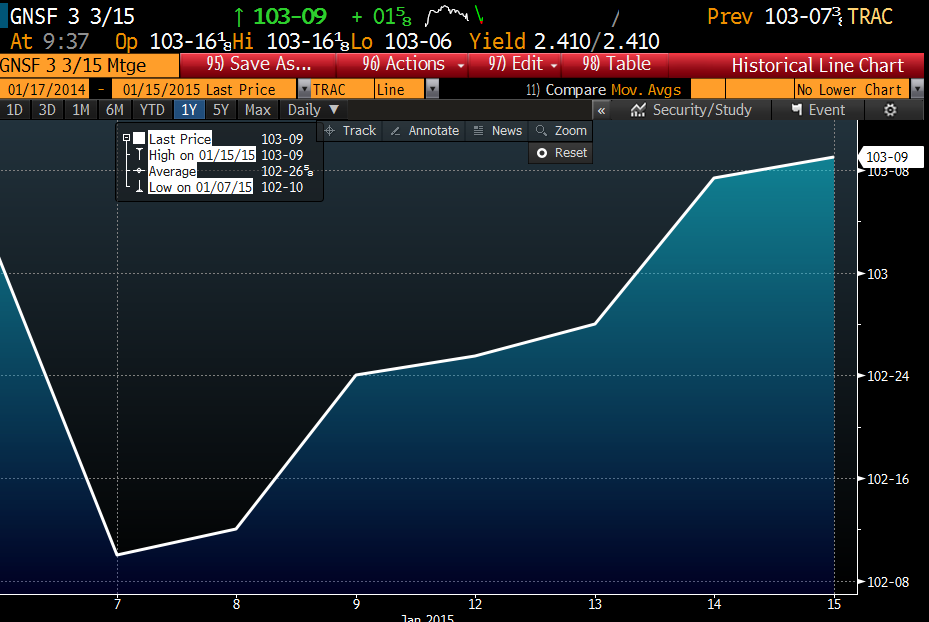
Here are a couple charts of Ginnie Mae TBAs from last week. The first is the March Ginnie Mae 3% TBA. It rose about 9 ticks, following an initial sell-off on the MI news. This underperformed the Fannie Mae 3% TBA by about 9 ticks. Remember, as bond prices rise, yields fall. The falling yield meant that if you quoted a customer a 3.5% FHA or VA loan last week, and locked it this week, the customer would probably have some points coming to them. This was to be expected, since rates fell:

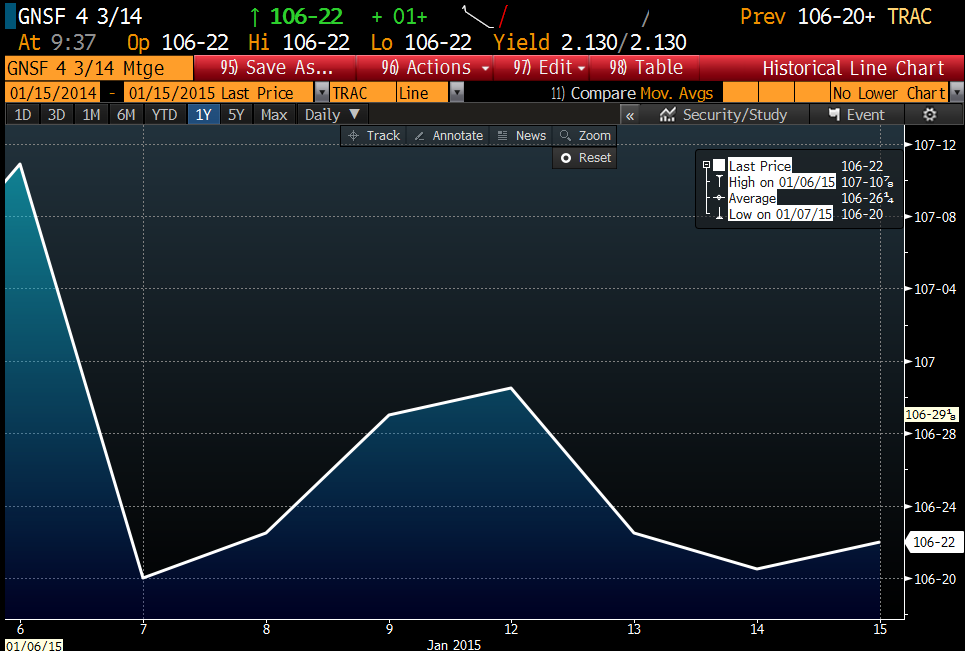
Now, let’s look at what happened to the Ginnie Mae 4% TBAs. This would include loans with rates between 4.25% and 4.625%. The 4% TBA actually fell. By a lot. This means if you quoted a borrower a 4.5% VA loan last week and tried to lock it today, the borrower would have to pay more points. Why? Prepayment speeds. The 4% Ginnie security is much more likely to prepay than a 3% security. Therefore, investors have to price in the new information, and that meant the 4% security was worth less, and that means borrowers are going to be treated as if rates rose, even though they didn’t in the bond market.

Note that the government may have inadvertently increased the risk to the taxpayer on the FHFA insurance fund and gotten nothing out of it. If they cut the MI, but rates increase, they have accomplished nothing except for further subsidizing MI and increasing the risk of a future taxpayer-funded bailout. The law of unintended consequences rears its ugly head once again…

This is real “inside baseball” stuff, but if you wondered about the mechanics of loan pricing and interest rates, hopefully this helped. And if you have a borrower who is asking why there hasn’t been this massive move in FHA and VA pricing since rates fell so much last week, you can explain why.

Morning Report – Weak retail sales 1/14/15

Markets are lower this morning after a lousy retail sales number. Bonds and MBS are up big on the retail sales number and strength in Eurobonds following a court ruling on QE.

Eurobonds are flying as one more hurdle for QE was cleared. The German Bund now yields 42.8 basis points.

Lousy. No other way to put it. Retail Sales fell .9% in December. Ex autos and gas, they were down .3%. The Street was expecting +.5%. To put that number in perspective, the setup for holiday sales was good: falling gas prices gave consumers an unexpected gift, the weather cooperated, and we had an extra shopping day in the season. And in spite of all of that, we put up a lousy number. I am wondering if analysts will start pushing back their estimates of the first rate hike.

Import prices fell 2.5% month-over-month as commodity prices continue to fall.

Mortgage Applications rose 49% last week, the biggest gain since 2008. Rates are the lowest since May 2006, and refis soared. Of course we are coming off of a holiday shortened week, but the moral of the story is that we might be setting up for another refi wave, this time driven by home price appreciation as well as rates. That said, we have a way’s to go to get back to the salad days of early 2013, but this is an encouraging number nonetheless.

KB Home gave the markets a head-fake yesterday, with the stock rallying on the earnings release, only to get slammed on the conference call. After rising a few percent pre-open, KB warned that margins would be under pressure and Q1 would be break-even versus Street expectations of 17 cents. Traffic in Texas remains unaffected by the drop in oil prices, at least so far. The entire sector got taken to the woodshed however. It appears that the builders have chewed through a lot of their inventory of cheap land they bought in the aftermath of the crisis, and are now building on lots bought more recently at higher prices. In spite of all of that, ASPs rose 17% to 351k.

Morning Report – Good numbers out of KB Home 1/13/15

Markets are higher this morning in sympathy with markets around the world. Bonds and MBS are down.

Alcoa kicked off earnings season with a better than expected result, however the stock is unch’d this morning…

Goldman decreased their price target for oil this quarter to $39 a barrel. Speculators are betting that supply will increase even more.

Homebuilder KB Home reported earnings this morning… Orders were up 10%, and earnings beat on a massive tax benefit. Revenues rose 29%, and average selling prices rose 17%. That big jump was due mainly to a greater emphasis on Northern California and away from the Southwest. Gross margins contracted 60 basis points. The stock is up a few percent this morning. The conference call is at 11:30 am (877-269-7756 / 13596999) if you are interested in listening in. We will hear from Lennar later this week.

The NFIB Small Business Optimism survey came in above par for December. This was the highest reading since October 2006. 100 is more or less “normalcy” since the index was created about 20 years ago. Employment was a pleasant surprise, with 54% of firms reporting hiring (or attempts to hire) however the pool of available candidates appears to be a poor fit, as 43% reported few or no qualified candidates for the position:  (“Qualified candidate” –  a candidate with the wisdom of someone in their fifties, the efficiency of someone in their forties, the drive of someone in their thirties and the paycheck of someone in their twenties)

Job Openings were more or less unchanged at 4.8 million in November, according to the JOLTS survey. This is a boom-time level, and is a leading indicator for the labor market.

The IBD / TIPP Economic Optimism Index came in at 51.5 from 48.4.

Good background article on Bill Gross’s exit from PIMCO.