Morning Report: Consensus shifting rapidly on a rate hike 8/26/15

Green on the screen again this morning as stocks try to rebound. Yesterday, stocks traded up early only to give it all back late in the day and close with big losses. Bonds and MBS are falling again.

Durable Goods orders were strong at 2%, and June’s number was revised upward. Capital Goods Orders Non-defense, ex-air (a proxy for business capital investment) rose 2.2% versus a 0.3% expectation, while June was revised upward from 0.9% to 1.4%. These were the highest readings in a year.

Mortgage Applications rose 0.2% last week as purchases rose 1,7% and refis fell 1%. Surprising that refis fell given the 17 basis point drop in the 10 year, but it looked like TBAs (which set mortgage rates) largely ignored the move in the bond market.

Not sure what caused yesterday’s late day sell-off, but the S&P 500 made a 60 point swoon in the last hour of trading to close down 26 points.

The other interesting thing about this sell-off has been the fact that bonds have not reacted much to the sell-off. The flight to safety trade has been almost non-existent in Treasuries. Odd, since the sell-off has taken down the probability of a rate hike in September. In fact, many strategists are moving out their estimate for the first hike to 2016.

Larry Summers was arguing over the weekend that financial conditions are acting like a tightening, and therefore the Fed doesn’t really need to raise rates right now. Hotlanta Fed President Dennis Lockhart said that conditions in the financial markets have complicated the Fed’s decision. By any measure, inflation is nowhere to be found. Given the fear of replicating the 1937 mistake, the Fed is probably going to err on the side of caution. Aside from the psychological discomfort of having rates at 0%, what reason is there to raise rates?

The carnage in the stock markets in Asia have created some bargains. HTC (the cellphone maker) is trading at a discount to cash. Market cap of $39.7B, no debt, $47.2 billion of cash. Like buying dollar bills for 84 cents. In crisis, opportunity.

Morning Report: Green on the Screen as China cuts rates 8/25/15

Markets are higher this morning after the People’s Bank of China cut interest rates and required reserves. Bonds and MBS are down.

The Chinese Government is going back to the big levers to try and support asset prices – using rate cuts and reserve requirement cuts. They are also using pension fund money to buy stocks and have prohibited insiders and large investors from selling. John Hilsenrath from the Wall Street Journal described China this way: China is like a CDO. You don’t know what’s inside, how well it performs or where the leverage is until it’s under stress. I think that is a very apt description.

The FHFA House Price Index rose 0.2% in June, lower than expectations. The S&P Case-Shiller index of real estate prices fell 0.12% in June but is up 5% year-over-year.

New Home sales rose to an annualized pace of 507k in July, slightly lower than expectations. Surprisingly, consumer confidence rose in a big way to 101.5 from 91.

McMansion builder Toll Brothers reported numbers this morning which missed analyst estimates. Revenues and deliveries both declined. Average selling prices actually declined – first time we have seen that out of the builders. That said, signed contracts were up 30% in dollars and 12% in units as ASPs rise to $834k from $717k last year at this time. The stock is up half a buck pre-open, but then again pretty much everything is green this morning.

During the big sell-off in the markets, Treasuries only moved grudgingly higher. I had been reading that the Middle East (which is getting crushed by low oil prices) was selling the 10 year in a big way. Interestingly, TBAs and mortgage rates have been fading the move in the bond markets. People have been moving back their timing estimates for the first rate hike and bonds are not reacting much to it.

For those that are market history buffs, here is a cool chart showing the economy from the American Revolution through WWII.

Morning Report: Shades of 1937?

The #1 trending topic on Twitter is #BlackMonday.

The global stock market sell-off continues this morning, with S&P futures down 64 handles. Bonds and MBS are up small.

Markets sold off hard overnight, with Japan down 4.6%, China down 8.5%, and Europe generally down 4.5%. Commodities are getting clocked, with oil down to $39 a barrel. Emerging markets are getting crushed.

The Chicago Fed National Activity Index rebounded from -0.07 in June to 0.34 in July.

The sell-off in risky assets over the past week has pushed out the market’s forecast for the first rate hike out of the Fed. Futures are pricing in a first hike in the Dec – March timeframe. Over the weekend, Larry Summers penned an editorial in the Financial Times encouraging the Fed to stand pat for a while. He makes the point that the sell-off in assets has a tightening effect all by itself, and hiking rates in this disinflationary environment risks another 1937.

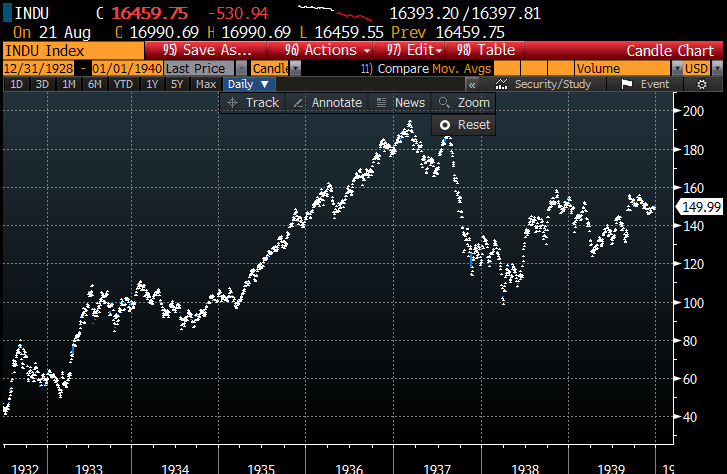
After stocks bottomed in 1932, the Dow Jones Industrial Average went on a tear, increasing almost fivefold in 5 years. In 1937, however they started a brutal 1 year bear market, where stocks got cut in half. The most common explanation for the sell-off was the Fed’s tightening in late 1936 and early 1937. Now, there are a lot of reasons for the sell-off in the 1930s (markets sensing something afoot in Europe, FDR’s undistributed profits tax, etc), but the Fed is very cognizant of their role in the “recession in the depression” and this will certainly guide their decision-making.

With stocks hitting air pockets on the downside, you would expect to see Treasuries flying. Yes, they are up, but not by as much as you would expect. Supposedly there has been massive supply of Treasuries coming out of the Middle East, which is keeping a lid on prices.

Morning Report: Is the Midwest making a comeback? 8/21/15

Stocks are lower this morning again after yesterday’s bloodbath. Bonds and MBS are up small.

Some people think the bond market’s strength is telling the Fed not to hike rates. I agree that bonds are pricing in the view that inflation is never, ever, ever going to come back. However, the US interest rate market is so manipulated by central banks (indeed all bond markets are these days) that I don’t think bond prices are the reliable signal they typically are.

Foreclosure inventory is down 24% year over year, according to Black Knight Financial Services. The delinquency rate has fallen to 2.2%, pretty much a post-crisis low.

Is the rust belt making a comeback? House prices are rising again in the Midwest as the auto industry recovers and the place becomes simply too cheap for business to ignore. Of course parts of the Midwest were ground zero for CRA lending, especially places like Detroit, which is filled with abandoned homes worth $10,000 with $100,000 mortgages on them. If you want to see what economic collapse looks like, check out this video of Toledo Ohio, my hometown. Most of these houses are worthless, and this is why I have always thought the fears of the big foreclosure inventory were overblown. These houses may count for the foreclosure numbers, but they certainly are not competing with anything and are probably never going to sell.

Morning Report: Not much clarity from the FOMC minutes 8/20/15

Stocks are lower this morning after Asian markets got roughed up overnight. Bonds and MBS are up.

Initial Jobless Claims came in at 277k, a bit higher than expected but still at or close to 4 decade lows. The Bloomberg Consumer Comfort Index rose to 41.1.

Existing Home Sales rose to 5.59 million in July from 5,48 million. The median home price rose 5.6% YOY to $234,000. This puts the median house price to median income ratio around 4.3x, which is higher than historical averages. Distressed sales fell 2 percentage points YOY to 7%. First time homebuyers fell slightly to 28% from 29% a year ago. Investor purchases fell from 16% to 13% and days on market fell from 48 to 42. Unsold inventory is about 4.9 months’ worth, which indicates a tight market.

In other economic news, the Index of Leading Economic Indicators unexpectedly fell, while the Philthy Fed Index rose.

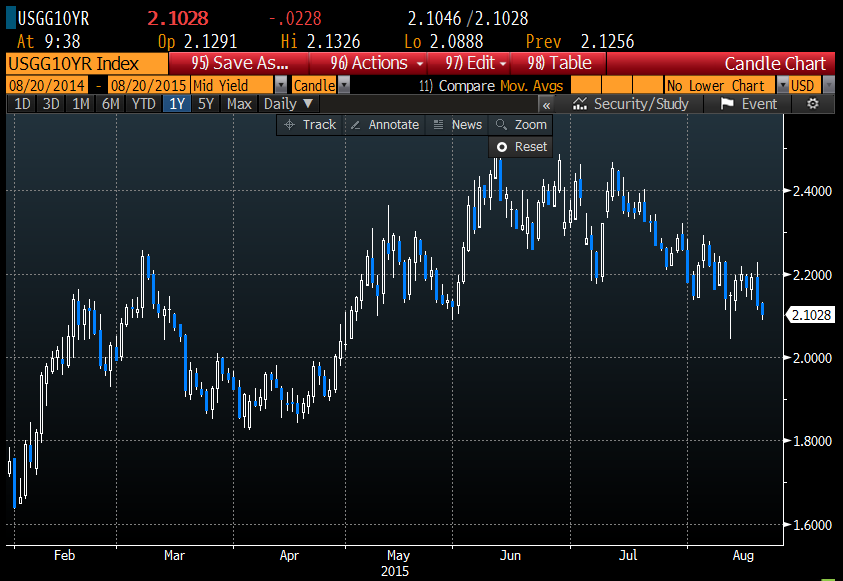
With the 10 year bond trading around 2.1%, we are at 3 – 4 month lows. Loan officers, you might want to ping any of your borrowers that are floating or who were on the fence for a refi.

The FOMC minutes didn’t really add any certainty to the September vs. December debate, however it did change the market’s perception of the probability of a rate hike from 50% to 36%. The key statement: “Most judged that the conditions for policy firming had not yet been achieved, but they noted that conditions were approaching that point.” The minutes address the labor market this way: (I bolded the interesting parts for emphasis)

“Participants agreed that labor market conditions had improved further, citing increases in payroll employment and job openings, the decrease in the unemployment rate, and some further reduction in broader measures of labor market underutilization. Although the labor force participation rate declined in June and the national hiring and quits rates were little changed in May, several participants noted that reports from business contacts in their Districts pointed to continued job gains and relatively strong labor markets. They cited anecdotal reports of firms having concerns about retaining workers and facing difficulties in filling even medium- and lower-skilled jobs. However, several participants contended that, despite the progress over the past few years, some noticeable margins of slack remained, citing as evidence the high number of workers not actively searching for jobs but available and interested in work as well as the high share of employees working part time for economic reasons compared with pre-recession levels.

The ongoing rise in labor demand still appeared not to have led to a broad-based firming of wage increases. While business contacts in a number of Districts continued to report that the pace of wage increases had picked up, recent national readings on hourly compensation and average hourly earnings of employees had remained subdued. The most recent employment cost index, released in April, had suggested an increase in wage gains. However, questions were raised about how to interpret this reading because the pickup was concentrated in the Northeast and might have resulted from particular factors that were not associated solely with a general tightening of labor market conditions, such as minimum wage adjustments and market conditions in certain occupations. In addition, it was noted that considerable uncertainty remained about when wages might begin to accelerate and whether that development might translate into increased price inflation.”

I found it interesting that filling lower-skilled jobs is difficult. If that is the case, then wages at the low end of the scale are going up, whether or not the government passes a new minimum wage law. (Of course the left is going to try and claim the minimum wage law did it, if wages do in fact rise). This would push the Fed to start hiking sooner rather than later. On the other hand, conditions in China and the fall in commodities (which they also mentioned) are going to naturally pull us towards a disinflationary scenario. The Fed does not foresee any sort of contagion from China, however they thought the same thing about the end of the subprime bubble. Punch line – not many people changed their forecasts after the minutes, and it is going to probably hinge on the August jobs report in a few weeks.

Zerohedge had an interesting oberservation: The Fed last hiked rates 110 months ago. Since then there have been 697 rate cuts around the world.

Did the Bernank get himself a new boat?

Morning Report: Awaiting the FOMC minutes 8/19/15

Markets are lower this morning on overseas weakness. Bonds and MBS are down.

The consumer price index rose 0.1% in July, less than forecast. Ex-food and energy, it was up 1.8% on a year-over-year basis. Shelter and medical care rose the most.

We will get the Fed minutes later on today. Investors will be looking for two things: the Fed’s view on potential wage inflation and the meltdown in China. For those worried about the effect of increasing interest rates, asset prices will undoubtedly be vulnerable to higher rates, however at least this time around, consumption hasn’t been driven by asset price inflation the way it was in the late 90s and the mid aughts.

That said, stocks are predicting a 100% probability that the Fed can hike rates without anyone blowing up.  St. Louis Federal Reserve Bank President James Bullard was warning about asset bubbles yesterday and the need to hike rates to prevent them from blowing up. The only asset bubble I see right now is in sovereign debt, and the Fed is up to their eyeballs in it.

Real average weekly earnings rose 2.2% last week.

Mortgage Applications rose 3.6% last week. Purchases fell 1.1%, while refis rose 7.2%.

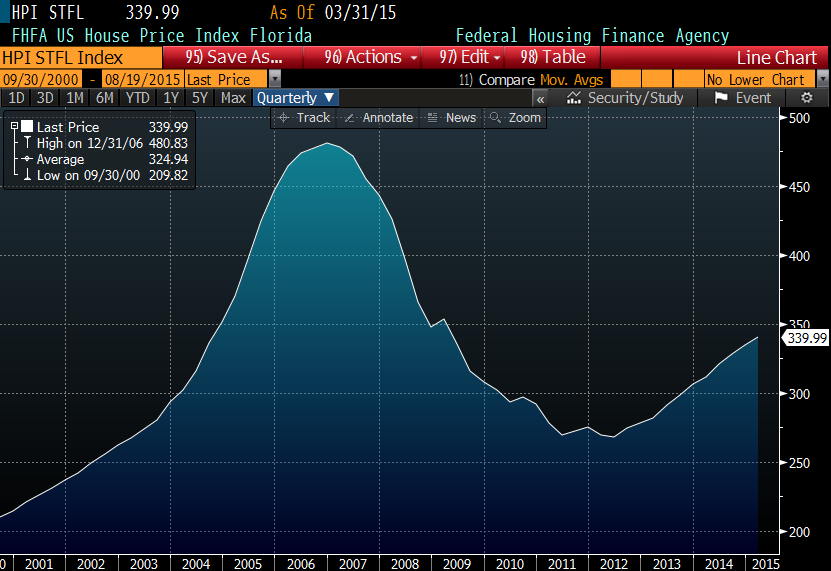
Florida real estate is getting back to the go-go days of the mid aughts. Some are worried about another bubble, but if you look at the Florida FHFA House price index, it is still 29% off of peak levels. One other difference this time: the buyers this time around are not dominated by regular people – they are dominated by institutional investors looking to earn rental income and by foreign investors looking to move money out of their home countries. In other words, if prices collapse (and I don’t know what the catalyst would be), the economic effect will be much less.

Zillow has a good article on the first time homebuyer. They note how the median home price to median income ratio for the first time homebuyer has risen from 1.7 in the 1970s to 2.6 today.  That said, interest rates are much lower today than the 1970s. Note that the average years of renting has increased from 2.6 years to 6 years now. This probably represents the fact that people are waiting until they are older to get married and have kids.

Morning Report: Housing Starts top 1.2 million 8/18/15

Stocks are lower this morning after WalMart earnings disappoint. Bonds and MBS are down small

Housing Starts were more or less flat in July at just over 1.2 million. June was revised higher. Multi-fam starts dropped while single family rose. Building Permits fell however from 1.33 million to 1.12 million. Multi-family permits accounted for almost all of the drop. Goldman took up their Q3 GDP tracking estimate from 2.2% to 2.4% on the number.

Speaking of housing, the Home Despot reported better than expected earnings this morning as well. An improving housing market is encouraging people to spend on renovations.

PIMCO expects housing to grow at 10% for the next 2 – 3 years. Household formation is picking up, and we have simply underbuilt for a long time.

Morning Report: Empire State Manufacturing Report disappoints 8/17/15

Markets are lower after a bad reading on the Empire State Manufacturing Survey. Bonds and MBS are up.

The Empire State Manufacturing Survey hit a 6 year low, as it tumbled from 3.9 to -15. This is generally not a market-moving index and it can be volatile, but given the dearth of things to trade on this morning, this is what people are focusing on.

Homebuilder sentiment rose from 60 to 61 in July, according to the NAHB.

The highlight of the week will be the FOMC minutes on Wednesday. Bloomberg has a helpful primer on how to read them.

Oil has dropped below $42 a barrel and is back at 6 year lows. Interestingly, the consumer sentiment indices seem to have decoupled from oil prices. We saw that in the falling University of Michigan Consumer Sentiment survey last week. Oil’s drop may appear to be a momentum trade, although speccies are still net long.

Meanwhile in politics, Donald Trump remains the Republican headache that won’t go away, and the email crisis remains the Democratic headache that won’t go away. Bill and Obama went golfing over the weekend, so the fix is presumably in. That said, the Administration has thrown the book at every low-level type who mishandled classified info.

Morning Report: Retail Sales rise 8/13/15

Markets are flattish on no real news. Bonds and MBS are down.

Retail Sales rose 0.6% in July, in line with expectations. The control group, which strips out volatile items like autos, gasoline and building products rose 0.3%, below expectations. It looks like people are spending shifting spending from goods to services (ie restaurants). August’s sales will be important – it signifies back-to-school shopping, which is a good predictor of holiday sales.

Mortgage foreclosures fell to 2.09% in the second quarter from 2.22% in the first. Delinquencies fell from 5.54% to 5.3%.

Import prices fell 0.9% in July, a little less than expectations. Inflation remains nowhere to be found.

Initial Jobless Claims continue to hang around 4 decade lows. They rose slightly to 274k.

The Bloomberg Consumer Comfort index ticked up slightly to 40.7 from 40.3. Sentiment remains soggy.

As we head into the September FOMC meeting, here is a dovish take on why the Fed should maintain ZIRP. His point is that the withdrawal of QE has already softened the economy and interest rates reflect the new normal of weak global growth and no inflation. Increasing rates risks tipping the economy back into a recession. While I am somewhat sympathetic to his argument, I doubt that 25 basis points on the Fed Funds rate is going to have that big of an impact, and the Fed will go slow. Janet’s Addiction dies hard.

The rent versus buy decision is getting easier. While home prices continue to rise, rents are rising faster as vacancy rates fall. In expensive places like LA, people are spending half their income on rent. Something to point out to first time buyers who are on the fence: Buy a home and get a 30 year fixed rate mortgage, and your principal and interest payment won’t increase, ever. Beats the heck out the annual negotiation with the landlord.

Morning Report: How will China affect bond yields? 8/12/15

Stocks are lower in the US on overseas weakness. Bonds and MBS are up

Mortgage Applications rose 0.1% last week as purchases fell 3.5% and refis rose 3.1%.

Job openings fell in June, according to the JOLTS job openings report. The quits rate was steady at 1.9% and hires was steady as well. The quits rate is an important labor market indicator to the Fed.

Chinese weakness has been driving the sell-off in stocks and the rally in bonds. Does it have staying power? Can it affect the Fed’s thinking with interest rates? IMO, the answers are yes and no. The Chinese real estate bubble is deflating – the only question is whether it will be a disorderly mess or whether the government can let the air out slowly. Given the amount of state control over the economy they may be able to engineer a soft landing, but no one else has been able to do it  – Japan came close, however they took their debt to GDP ratio to 2.2x and have had to endure 25 years of no growth (and counting) to do it.

The punch line however is that China’s economy will slow, and that will depress commodity prices and increase deflationary pressure worldwide. This probably is Treasury bullish at the margin, but it isn’t going to be the driver of Treasury prices – the US recovery and the Fed are. If anything, turmoil in China is going to be a secondary effect. I still think the Fed hikes rates 25 basis points in September and then waits to see what happens. If the economy accelerates, maybe they hike another 25 in December. If the economy flatlines, maybe they wait. Note the Fed has historically been reticent to make big changes in an election year, for fear of being accused of being political.

Everyone knows that Dodd-Frank’s limits on market-making has affected liquidity in asset markets. Stocks are already susceptible to air pockets as tight spreads and low commissions have made the market-making business unprofitable. However we are seeing it in other markets as well – gold, currencies, etc.. Citi makes an interesting observation: performance-chasing by professional investors is also exaggerating market moves. They call this a “fundamental change” in the markets. I wonder how much of it is due to ZIRP. If professional investors cannot make a return in buy and hold strategies because interest rates are too low, they have to chase performance. I suspect as rates go up, this dynamic will reverse as professional investors return to classic buy and hold strategies that work. That said, the market-making aspect is a new normal that we need to get used to.

For all the sturm and drang about volatility, the VIX (a measure of fear in the market) is remarkably sanguine at 16.

Hillary Clinton gave her server and a thumb drive to the FBI last night under subpoena. Supposedly the IG found top secret messages on her server, so this could (or at least should) potentially be serious, if Obama decides to make it serious. Supposedly the admin was the one who initially leaked the story to the press, so they may treat it seriously. As a former Naval Officer who handled classified material, I know if I had taken home top secret material, I would have been thrown in jail. Also, regardless of what the Obama Administration decides to do, someone has everything that is on that server. If it is someone’s interest to not have Hillary as president, it will get leaked to the press.