Morning Report: Payrolls disappoint 1/5/17

Vital Statistics:

Last Change
S&P Futures 2732.8 9.0
Eurostoxx Index 396.3 2.6
Oil (WTI) 61.3 -0.7
US dollar index 85.6 0.0
10 Year Govt Bond Yield 2.44%
Current Coupon Fannie Mae TBA 102.375
Current Coupon Ginnie Mae TBA 103.25
30 Year Fixed Rate Mortgage 3.91

Stocks are up despite surprisingly weak nonfarm payroll number. Bonds and MBS are up.

Jobs report data dump:

  • Nonfarm payrolls up 148,000 vs 191,000 expected
  • Unemployment rate 4.1%, in line with expectations
  • Labor force participation rate 62.7% in line with expectations
  • Average hourly earnings up 0/3% MOM / 2.5% YOY in line with expectations

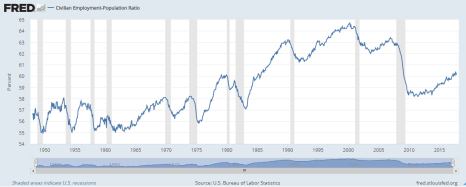
The NFP number was a surprise given that the ADP was over 100,000 higher. I suspect the NFP number will get revised upward in coming months given all of the other data we have been seeing. Wage growth remains slightly above inflation, and the labor force participation rate is still well below what would be considered a healthy job market. The employment-population ratio, which is one of the preferred metrics for the Fed was 60.1%, unchanged MOM, but up 0.3% YOY.  While some of the drop in the EP ratio is demographics-driven, it shows we still have a long way to go to recover from the Great Recession and return to the last great labor market, which was the 90s.

Chart: Employment to population ratio:
employment to population ratio

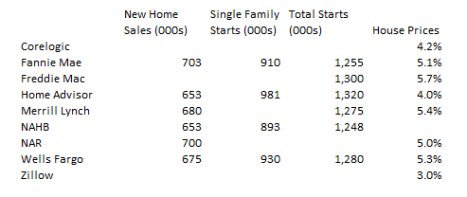
Bill McBride of Calculated Risk summarizes the housing market forecasts for 2018:
2018 housing summary

In other words, not much of a change from last year. FWIW, I think either the total housing starts or the house price inflation numbers are too low. There is so much pent-up demand for housing that starts around 1.3 million are not going to come close to satisfying it, which would imply much faster home price appreciation (especially if inflation and wages rise). On the other hand, given the increases in input prices (labor, framing lumber, etc), if prices are only rising in the mid single digits, margins for builders are going to fall, which means they will have to compensate by increasing volume. This would make the housing starts estimates too low. Remember, historically (even ignoring the bubble / bust years) housing starts have averaged 1.5 million per year, and have typically hit 2 million per year coming out of recessions.

NAR weighed in the jobs report: “The job market continues to improve, but at a decelerating pace. The year 2017 ended with 2.1 million net new job additions, a very solid rate. However, the gains had been 2.6 million, 2.9 million, and 2.5 million in the three preceding years. More jobs and more income for households definitely attest to the rising housing demand.

As to the supply of homes, construction workers are needed. In 2017, a net 190,000 new workers were employed in the construction industry, and that also marks a decelerating trend, as the prior three years averaged 284,000 annual additions. With the unemployment rate in the construction industry having fallen from over 20% in 2010 to 5.9% at the year-end of 2017, there could be a little growth to home construction despite the on-going housing shortage. There needs to be serious consideration in allowing temporary work visas until American trade schools can adequately crank out much needed, domestic skilled construction workers.”

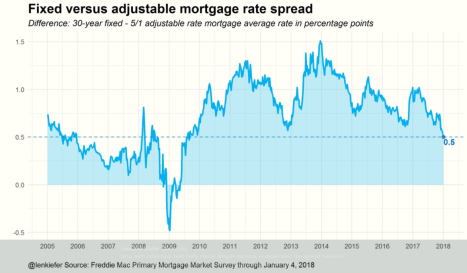
As home prices get more expensive, people tend to turn to adjustable rate mortgages in order to lower their monthly payment, at least initially. For the past few years, the spread (or the yield pickup) has been shrinking. The current difference between the two is the lowest since 2009:
fixed vs variable spread

In fact, the Wall Street Journal’s numbers show that the 30 year fixed rate mortgage is currently 3.92% and the 5/1 ARM is 4.07%. When ARMs are higher than a 30 year fixed rate mortgage, it makes no sense to go for an adjustable, unless you think long term rates are headed way lower. In this current economic environment, with an accelerating economy and a Fed raising rates, that is a long shot bet.

Morning Report: Dissecting the FOMC minutes 1/4/18

Vital Statistics:

Last Change
S&P Futures 2718.8 7.8
Eurostoxx Index 389.3 0.9
Oil (WTI) 60.8 0.4
US dollar index 85.7 -0.2
10 Year Govt Bond Yield 2.48%
Current Coupon Fannie Mae TBA 102.375
Current Coupon Ginnie Mae TBA 103.25
30 Year Fixed Rate Mortgage 3.91

Stocks are higher this morning on no real news. Bonds and MBS are down.

There is some labor data this morning. Initial Jobless Claims came in at 250k last week, while job cuts in December were 32,423 in December, according to outplacement firm Challenger, Gray and Christmas. This is the lowest year for job cuts since 1990. Finally, the ADP employment report showed 250,000 jobs created in December, which came in well above the consensus number of 188,000. Tomorrow’s jobs report is looking for 190,000. Mark Zandi, chief economist of Moody’s Analytics, said, “The job market ended the year strongly. Robust Christmas sales prompted retailers and delivery services to add to their payrolls. The tight labor market will get even tighter, raising the specter that it will overheat.”

Regarding Zandi’s comment about overheating: there are certainly labor shortages, and perhaps the slew of year end bonuses given out by employers are signaling wage growth ahead. So far, wage growth has been faster than the official inflation estimates, but not by much.

There was nothing earth-shattering in the FOMC minutes, (the bond market didn’t move at all on the release) however the prospect of tax reform did cause some members to take up their estimates for interest rates going forward. The FOMC did expect tax reform to boost growth this year, which accounts for the increase in their GDP forecast for 2019 to 2.5% from 2.1%. They consider the labor market to be generally strong, especially for unskilled entry-level workers, where we are seeing some wage growth. Some firms are coping with a tight labor market by raising wages, while others are using more flexible working arrangements. Some are spending money on productivity-improving technology in lieu of raising compensation.

Regarding the Fed Funds rate, we are seeing a wider dispersion in terms of opinion:  While most members were comfortable with the projected path of rates, both hawks and doves expressed concern: “A few participants indicated that they were not comfortable with the degree of additional policy tightening through the end of 2018 implied by the median projections for the federal funds rate in the December SEP. They expressed concern that such a path of increases in the policy rate, while gradual, might prove inconsistent with a sustained return of inflation to 2 percent, or that the level of the federal funds rate might already be near its current neutral value. A few other participants mentioned that they saw as appropriate a pace of additional policy tightening through the end of 2018 that was somewhat faster than that implied by the December SEP median forecast. They noted that financial conditions had not materially tightened since the removal of monetary policy accommodation began, that continued low interest rates risked financial instability in the future, or that the labor market was increasingly tight.”

The wider dispersion of opinion on the part of the FOMC is new and will be something to monitor, especially since we have a new FOMC Chairman.

We tend to take FICO scores for granted. They have been around forever, everyone pretty much understands them, and we have all sorts of data from which to backtest loan performance versus FICO. Now, some lenders are pushing FHFA to allow scores from Experian, Equifax, and Transunion for conforming loans. These alternative scoring methods tend to be a little more forgiving than FICO (which comes from Fair Issac). The FHFA is considering the suggestion, however there is always the fear that credit scoring companies could create a “race to the bottom” by becoming more lenient. The non-FICO companies launched VantageScore, which supposedly can grade 30 million more people than FICO can. Of course having competing credit score companies can open up lenders to charges of discrimination, particularly if they use different scores for different borrowers.

Morning Report: Manufacturing strong 1/3/18

Vital Statistics:

Last Change
S&P Futures 2697.8 3.8
Eurostoxx Index 389.3 0.9
Oil (WTI) 60.8 0.4
US dollar index 85.7 -0.2
10 Year Govt Bond Yield 2.46%
Current Coupon Fannie Mae TBA 102.375
Current Coupon Ginnie Mae TBA 103.25
30 Year Fixed Rate Mortgage 3.91

Stocks are higher this morning on no real news. Bonds and MBS are up small.

We will get the FOMC minutes this afternoon at 2:00 pm. We might see some volatility if they contain any surprises, so just be aware if you are locking around then.

Mortgage applications fell 3% last week as purchases rose 1% and refis fell 7%.

Manufacturing improved in December, according to the ISM Manufacturing Report. New Orders and Production drove the increase, while employment fell. This was the second highest reading for 2017. Manufacturing firms reported difficulties finding qualified workers, and 44% reported increasing starting pay to attract workers. The 2017 average of 57.6 in the index historically corresponds with a 4.5% increase in GDP. The December reading would be associated with over 5% growth. That said, manufacturing doesn’t have the impact on the economy it used to have, but that is still impressive growth.

Despite Twitter tensions with North Korea (which rattled the chattering classes), North Korea and South Korea improved communications. While the tiff between Kim Jong Un and Trump make for bit of a sideshow, the markets (stocks, bonds, currencies) do not take it as any sort of serious threat or possibility.

Construction spending increased in November by 0.8% MOM and 2.4% YOY. Private residential construction rose 1.1% MOM and over 7% YOY.

Framing lumber prices are up 43% YOY, in the CME futures. Traders are looking for prices to eclipse their bubble highs this Spring. This should bump up prices for new construction in 2018. For all of the handwringing over tax reform’s effect on house prices, simple supply and demand will keep them supported, at least for 90% of the market. If the growth in the economy ever translates into faster wage growth, expect that supply and demand imbalance to increase even further.

Economic confidence was positive in 2017, according to Gallup’s economic confidence index. Note the index began in 2008, so the only track record we have is of the crisis / post-crisis days.

Congress is working to come up with some sort of long-term spending solution to keep the lights on. Republicans want increased defense spending, while Democrats want non-defense spending to have the same increases that defense does. Surprisingly, both parties seem to want to increase defense spending. Republicans are going to need Democrats to reach a deal, as some on the right will balk at the higher spending levels. While there has been talk that Democrats might demand some sort of immigration measure in exchange for a vote, so far they haven’t drawn that line in the sand. At least as of now, nobody is talking about a government shutdown. Remember the last time government shut down, originators couldn’t get tax transcripts out of the IRS which delayed some closings. It is something to stay ahead of.

Morning Report: Housing is still highly affordable 1/2/18

Vital Statistics:

Last Change
S&P Futures 2686.3 10.6
Eurostoxx Index 389.2 -0.4
Oil (WTI) 60.1 0.2
US dollar index 86.0 -0.3
10 Year Govt Bond Yield 2.44%
Current Coupon Fannie Mae TBA 102.375
Current Coupon Ginnie Mae TBA 103.25
30 Year Fixed Rate Mortgage 3.92

Stocks are higher to start the year. Bonds and MBS are down.

We will get the FOMC minutes this Wednesday and also the jobs report on Friday. Both have the potential to be market-moving. Other than that, we will get the ISM reports and construction spending.

Home prices continue to increase at a torrid pace, as the CoreLogic House Price Indicator has had its fourth straight month of 6% annual increases.

Given the size of the rebound in the home price indices, we are seeing all sorts of questions about affordability. In the latest issue of the Scotsman Guide, I discuss home prices and affordability questions. The article was written last fall before it looked like we would get any action on tax reform. The mortgage interest deduction will now become irrelevant for most homeowners, but that doesn’t necessarily mean that housing has become less affordable – at least not at the median home price and median income. Regardless, the biggest driver of housing affordability is the mortgage rate, not the house price. Affordability was the worst in the early 80s, when mortgage rates were double digits. The chart below looks at the mortgage payment as a percent of income over time. Note that the mortgage interest deduction moves the curve downward in a more or less linear fashion, and does not make much of a difference in terms of relative affordability.

Morning Report: Home values more than 1.5x GDP 12/29/17

Vital Statistics:

Last Change
S&P Futures 2694.8 9.0
Eurostoxx Index 389.7 0.2
Oil (WTI) 60.1 0.2
US dollar index 86.0 -0.3
10 Year Govt Bond Yield 2.43%
Current Coupon Fannie Mae TBA 102.375
Current Coupon Ginnie Mae TBA 103.25
30 Year Fixed Rate Mortgage 3.97

Stocks are up on the last trading day of the year. Bonds and MBS are flat.

Yet another slow news day.

Should be a dull day for bonds as the market closes at 2:00 pm EST. There is no economic data or Fed-speak either.

Oil has topped $60 a barrel, which is higher than it has been for the past 3 years, but is pretty low in the grand scheme of things. It is something to watch, however as oil prices are a drag on the economy when they get too high. The US has so much capacity however that whenever prices rise, additional supply can come on line in a hurry. The US is pretty much insulated from OPEC any more.

What is the value of all US homes in the US? Almost $32 trillion, or more than 1.5x US GDP.  Over the past year, they have increased in value by almost $2 trillion. This increase is more than 3x the rate of inflation.

As inflation rises, we should expect to see US bond yields rise. That said, global sovereign bond markets do influence each other, and the spread between US Treasuries and German Bunds has risen to more than 2%. Relative value trading (i.e. investors swapping out of more expensive German bonds into cheaper US Treasuries) should act as a bit of a drag on US interest rates. The bigger question will be whether global growth pulls up Euro yields or whether the US yield curve continues to flatten.

See you all in the new year!

Morning Report: Strong Chicago PMI 12/28/17

Vital Statistics:

Last Change
S&P Futures 2687.5 2.0
Eurostoxx Index 390.3 -0.2
Oil (WTI) 59.7 0.0
US dollar index 86.3 -0.3
10 Year Govt Bond Yield 2.43%
Current Coupon Fannie Mae TBA 102.375
Current Coupon Ginnie Mae TBA 103.25
30 Year Fixed Rate Mortgage 3.97

Stocks are modestly higher this morning on no real news. Bonds and MBS are flat.

Very slow news day.

The Chicago PMI came in at a very strong 67.6 as production and new orders hit multi-year highs. Employment was disappointing however as businesses struggle to find qualified employees.

Initial Jobless Claims came in at 245k last week ahead of the Christmas holiday. Surprised it is that high.

Some the biggest fixed income managers lay out their trades for 2018. Blackrock says to move up in credit quality. Note that they are neutral on everything. U.S. municipal bonds, U.S. credit, emerging markets and Asian fixed income, and an underweight position on Treasuries, European sovereign debt and European corporate bonds. They don’t like anything, really. Fidelity says global growth is going to become inflationary, so buy TIPS (Treasury inflation protected securities) and emerging market debt. Goldman is betting against the crowd, favoring yield curve steepeners as opposed to the biggest trade on the Street, which is betting on a flatter yield curve. The theme seems to be inflation will return, and that means higher rates next year. The elephant in the room is the Fed, and the fear that increasing short term rates will torpedo the recovery.

Easy come, easy go. Bitcoin continues to give back gains after it hit a record last week. It is down 28% from its highs on fears that South Korea might close one of its exchanges. Here is the fundamental issue with Bitcoin: governments despise it, and while they might not be able to kill it directly, they can attack everything that supports it. While there are a few retailers that accept Bitcoin, understand that they don’t hold it. They immediately exchange it into dollars.

Tax reform has some people in high tax jurisdictions rushing to pre-pay their property taxes ahead of the change in 2018. Note the IRS will only allow this if they are assessed and paid in 2017. So if your local government can’t get the assessments out in time, it doesn’t matter if you prepay.

Morning Report: Home prices rise 12/27/17

Vital Statistics:

Last Change
S&P Futures 2689.8 2.8
Eurostoxx Index 390.1 -0.1
Oil (WTI) 59.5 -0.4
US dollar index 86.6 -0.2
10 Year Govt Bond Yield 2.46%
Current Coupon Fannie Mae TBA 102.375
Current Coupon Ginnie Mae TBA 103.25
30 Year Fixed Rate Mortgage 3.97

Stocks are higher this morning on no real news. Bonds and MBS are up as well.

Home prices rose 0.7% MOM in October and are up 6.4% YOY, according to the Case-Shiller Home Price Index. Seattle, Las Vegas, and San Diego led the charge with 12.7%, 10.2%, and 8.1% gains respectively. Inventory fell to 3.4 month’s worth of supply, although some of that is probably seasonal. With home prices accelerating so fast out West, renting could be more attractive than buying in some MSAs.

Manufacturing continued to be strong in in December according to the Richmond and Dallas Fed.

Pending home sales rebounded in November, according to NAR.  This is the first YOY gain since June, and is being driven by a strong economy. There might have been some hurricane elements at play however.

What trade worked in 2017 (aside from Bitcoin and the stock market?) Credit risk transfer securities issued by Fannie and Fred. These are meant to offload some of the credit risk that the GSEs hold on their balance sheets. They take the first losses when borrowers default. The subordinate tranches of these securities made over 11% last year. outstripping high yield bonds and MBS by a wide margin. If there is more of an appetite for these securities, it will go a long way in helping establish the framework for competition to Fannie and Fred.

The current state of affairs over who runs the CFPB: Mick Mulvaney (appointed by Trump) or Leandra English (appointed by outgoing director Richard Cordray).

Tax reform will probably cause more migration from the high-cost states like NY, NJ, CT, IL, and CA to cheaper states like NC and TX. These states are hit with the double-whammy of high housing costs and high state taxes. The difference probably isn’t going to be enough to cause a massive migration, however it could nudge those who are on the fence.

Bond funds have been seeing outflows since tax reform has passed and investors are making changes to their asset allocations. Bond funds saw a withdrawal of $3.3 billion in the week ending Dec 20, which may account for the big increase in the 10 year’s yield that week. It isn’t just US Treasuries – the German Bund yield is up big this year as well. As investors become more constructive on the economy, they are shifting to emerging market sovereign bonds, which pay more and are more levered to global economic growth and out of Treasuries and Bunds, which are largely looked at as safe haven assets. Developed market stock funds also saw outflows as investors rang the register after a great year.

Merry Christmas everyone

Morning Report: Incomes and spending rise 12/22/17

Vital Statistics:

Last Change
S&P Futures 2689.8 2.0
Eurostoxx Index 390.0 -0.7
Oil (WTI) 58.0 -0.4
US dollar index 86.8 0.0
10 Year Govt Bond Yield 2.49%
Current Coupon Fannie Mae TBA 102.531
Current Coupon Ginnie Mae TBA 103.375
30 Year Fixed Rate Mortgage 3.88

Stocks are up this morning on no real news. Bonds and MBS are flat.

This should be a relatively quiet day as bonds close early heading into the long holiday weekend.

Durable Goods orders increase 1.3% MOM / 8.2% YOY in November, coming in below analyst estimates. A surge in aircraft orders drove the increase. Core capital goods orders (a good proxy for business capital expenditures) rose 8.1% YOY.

Personal incomes rose 0.3% in October, slightly below the Street estimate of 0.4%. Consumer spending was better than expected, rising smartly at 0.6%. Inflation remains nowhere to be found, with the core PCE up 0.1% MOM and 1.5% YOY. The low inflation numbers certainly give the Fed some breathing room, although tax reform will probably push them to be more aggressive. Especially since 9 companies so far have announced wage increases based on tax reform.

The Fed Funds futures are currently handicapping a 5% probability of no hikes in 2018, a 21% probability of a single 25 basis point hike, a 35% chance of 50, a 27% chance of 75, and a 10% chance of 100.

Bitcoin is crashing right now, down 25% from yesterday. I was asked how Bitcoin would affect the real estate market.  My view was that Bitcoin is simply so volatile that I cannot imagine both a buyer and seller being comfortable quoting a house in bitcoin. I just don’t see someone trying to sell their house for 25 bitcoin. Second, the financing has to be in dollars as no banks lend in bitcoin yet, and I cannot imagine what the interest rate for a bitcoin loan would be. So no, it may be accepted by your local store, however it is more of a novelty at this point. Will that change? Who knows? Will Bitcoin be dominant cryptocurrency or will it be like Classmates.com or MySpace – early adopters that got crushed later on by Facebook?

Bloomberg takes a look at the state of housing entering 2018. Tight inventory, builder confidence, and a growing economy point to a strong housing market next year. On the other side of the coin, the drop in the mortgage interest deduction could hurt homes at the top end, while the larger standard deduction may lower the incentive to buy versus rent for many at the lower end of the income scale. IMO, the negatives are marginal compared to the positives.

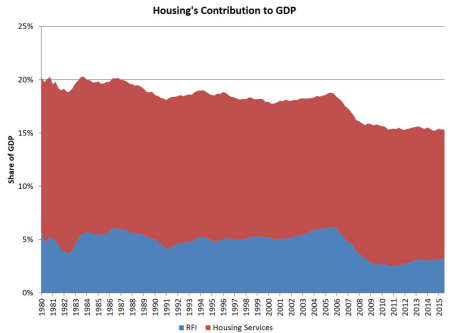
Don’t forget, housing’s contribution to GDP is way, way below historical levels. If 2018 is the year homebuilding finally breaks out, it will have an ousized effect on GDP growth. Labor shortages might be the bottleneck, but as wages rise, they attract new workers so that state of affairs doesn’t last long. Swinging a hammer pays a lot more than slinging burgers.

housing contribution to GDP

90 day delinquencies spiked in November, according to Black Knight Financial Services. 85% of the spike is attributed to the hurricanes, so it doesn’t really tell us anything about the state of the economy.

Finally, happy holidays to all!

Morning Report: Home Prices rise 6.6% YOY 12/21/17

Vital Statistics:

Last Change
S&P Futures 2687.0 5.5
Eurostoxx Index 388.8 0.4
Oil (WTI) 57.5 0.3
US dollar index 86.8 0.0
10 Year Govt Bond Yield 2.49%
Current Coupon Fannie Mae TBA 102.531
Current Coupon Ginnie Mae TBA 103.375
30 Year Fixed Rate Mortgage 3.88

Stocks are up this morning after tax reform is passed. Bonds and MBS are flat.

Hot on the heels of tax reform is legislation to keep the lights on. The House is set to vote on a stopgap measure to keep the government open for another month. This will prevent the Senate from attaching too many things to the bill. It also gives the government some breathing room after the new year to hash out a longer-term funding deal.

In response to the tax cuts, 5 big corporations (Comcast, AT&T, Boeing, Fifth Third, and Wells Fargo) all announced they were either raising pay or paying bonuses to workers. Could this be the start of broader wage growth?

House prices rose 0.5% in October, according to the FHFA House Price Index. September’s 0.3% increase was revised upward to 0.5%. On a YOY basis, prices rose 6.6% nationally. The East South Central region (TN, KY, MI, and AL) rose 8.2%, which was a particular strong showing. As usual, the West and Mountain states led the charge, while the Upper Midwest and the East Coast brought up the rear.

The final revision for third quarter GDP came in at 3.2%. The prior estimate was 3.3% as consumer spending was revised down a tenth of a percent to 2.2%. The GDP price deflator was unchanged at 2.1%.

In other economic data, Initial Jobless Claims rose to 245k last week, while the Philly Fed Manufacturing Index rose. The Chicago Fed National Activity Index gave back some of October’s hurricane-related gains. The Index of Leading Economic Indicators rose 0.3%. Overall, all of these reports were strong readings and show the economy with some momentum heading into 2018.

The chickens are coming home to roost for subprime auto lending. Some big private equity firms got into the business, hoping to generate huge returns from auto loans paying in the high single digits. Unfortunately, the default rates have soared for these loans, and auto sales have cooled off and they can’t exit the business. No, it isn’t a canary in the coal mine for the US economy as a whole.

Realtor.com weighs in on the hottest and coldest real estate markets of 2017. In the top 20, the hottest are unsurprising – the Bay Area. However there are a few surprises, like Detroit, Fort Wayne, and Stockton.

This reminds me of the late 90s, when companies discovered you could get a multiple by adding .com to your corporate moniker. Long Island Iced Tea company jumps fivefold after renaming itself Long Blockchain and committing to looking for a way to make money in blockchain and fintech. Not that they have any business in it, or expertise, but they will look into the idea.