Job Creation Ideas

I’m late on a bunch of stuff, but wanted to post this for the good of the order.

“‘Jobs’ are deals between workers and employers, and so ‘creating’ them out of unwilling parties is impossible. The state, though, can outlaw deals, and has,” Deirdre McCloskey is a professor of economics, history, English, and communication at the University of Illinois at Chicago

This, and other job improvement suggestions, available here for your review and discussion.

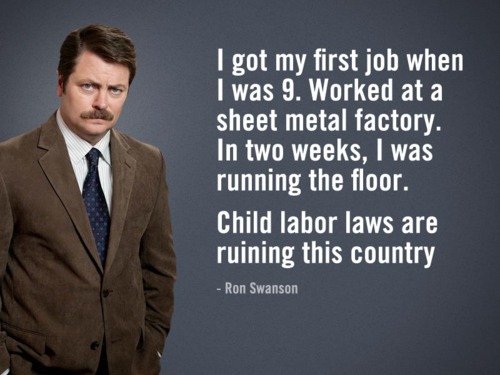
And for a little Friday fun, everyone’s favorite sit-com libertarian Ron Swanson:

Morning Report

Vital Statistics:

Last Change Percent
S&P Futures 1210.4 12.5 1.04%
Eurostoxx Index 2352.5 20.01 0.86%
Oil (WTI) 85.83 1.6 1.90%
US Dollar Index (DXY) 76.869 -0.18901 -0.25%
10 Year Govt Bond Yield 2.24% 0.05%

Economic data this morning: Import Price Index up 13.4% YOY. Advance retail sales up 1.1% for the month of September. August sales were revised higher from flat to +.3%. September’s numbers have generally been much stronger than August. The WSJ has a story this morning discussing economic volatility, and shows that economic volatility has indeed been higher than historical averages. Certainly the stock market has been more volatile, with the VIX index over 30 (even after a gigantic rally). Link: Economy in Full Swing (Watch Your Head) – WSJ

Google reported last night better than expected numbers. The stock is up over 8% premarket. So far, Alcoa and JP Morgan have sold off after their numbers (in spite of “beating” the “analyst estimate”). The initial take from JPM and AA is that Europe is going to be a problem. Last quarter, CEOs were generally constructive on 2H; it will be interesting to hear their views going forward this time around.

Today’s Washington Post discusses the prospect of a double dip recession, (link) and makes the point that the typical drivers of a recession – construction and auto inventories – are already flat on their back, so there isn’t any excess to work off. That is a fair-enough observation, although I would point out that this isn’t the typical inventory-driven recession. This is a recession in the aftermath of an asset bubble, and those recoveries are slower, more fickle, and a lot of the levers that government has to fix things (monetary and fiscal policy) don’t work very well. To give you an idea of how depressed housing is (and why this recession is different), look at the chart below regarding housing starts.

Housing and construction typically leads the economy out of a recession. This time, it is not because there is a massive inventory of unsold homes. In addition, household formation has been depressed as a) immigration has been slowing, and b) unemployed college graduates move back in with their parents. A bottom in housing is a necessary, but not sufficient, condition for an economic rebound.

The WSJ has a depressing piece on how median incomes have fallen during the 2000s. Again, this is typical post-bubble behavior. The equity bubble burst in 2000, and the only thing that provided the economy any real energy was the housing bubble. Although people have the perception that the housing bubble inflated in 05-06, if you look at housing’s historical relationship with incomes, the bubble actually started in 2000, when the equity bubble burst. Guys like Krugman have been advocating inflation as a way out of this mess; so far, the Fed has only succeeded in commodity price inflation. If the “wage” side of the wage / price spiral don’t cooperate, the Fed only succeeds in crimping disposable incomes further, which is a recipe for the dreaded misery index.

Bits & Pieces (Thursday Night Open Mic)

Real-life superhero Phoenix Jones arrested for being over-enthusiastic with pepper spray.

In the mid-80s, Mick Fleetwood of Fleetwood Mac came up with a solo album. I loved the one video released from it, and the song, but it’s almost impossible to find. But, here it is.

For the video shoot, Mick Fleetwood shaved his beard. Probably shouldn’t have done that. Fans of Lindsey Buckingham will note that the video sounds very much like Lindsey Buckingham, both in terms of the singing and the writing.

I had a friend who was a musician during the 80s (he’s still a musician, but the story is from the 80s). He wrote a song called “Wrestling with Girls” that got picked up by local wrestler, Jerry “The King” Lawler. Amazingly, I was able to find it (or a segment featuring it, done on Jerry “The King” Lawler’s 80s talkshow) on YouTube. YouTube, is there anything you can’t do? The song starts at 5:56 . . .

What does this have to do with Mick Fleetwood’s “I Want You Back” sounding more like Lindsey Buckingham than Mick Fleetwood? Well, I had a copy of this song before Lawler decided he wanted to release it as a single. With the exception of the announcer segment, which is clearly Jerry Lawler, the song sounds identical. So imagine my youthful surprise when I heard the version with Jerry Lawler . . . and it was still Steve Cox. I think Jerry Lawler can be heard, off-tune, far in the background, if you listen closely.

A wrestler faking singing a song. Can you imagine it?

If you watch any of the leading in video (I did, for the first time since 1986), you’ll notice Steve was a uber-geek. I don’t remember him being such a big geek. Interesting how our perspectives change over time.

Anyway, for evidence that folks move in different directions as time passes, take a look at some of the traditional native American flute playing Steve was doing about 7 years ago as Voice of Golden Eagle. Same guy, extremely different vibe.

It’s really solid. “That was sunset song.”

— KW

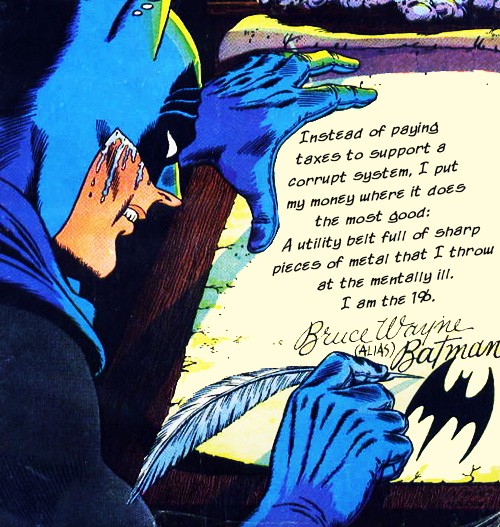
The Cowled One Percent

Morning Report

FYI, I do one of these on my other blog. It is easy enough to just copy it over here. Let me know if you find this worthwhile or not. Sold2u.

Vital Statistics: S&P futures -4, Eurostoxx – 1.5%, 10 year bond yield 2.18%, US dollar +21bp, Oil down 1.10 to 84.48, EURIBOR / OIS + 1.7bp.

JP Morgan reported earnings this morning. EPS and revenues were better than estimates, but the stock is down slightly based on earnings quality issues. They expect the Durbin rule to reduce consumer banking net by $600MM. They are very cautious about 2012 investment banking revenue, and headcount continues to fall. Euro exposure is about $15 billion, of which 65% is sovereigns. Tier 1 (Basel III) was 9.9%. Mortgage origination was $37B. Refis will drive business for the near future.

Harrisburg, PA filed for bankruptcy yesterday, mainly due to an ill-advised incinerator project that dwarfs the city’s budget. Harrisburg’s munis have been in the doghouse for a while, and this is not a surprise. Most are insured at any rate. The state will probably end up taking over the city’s finances. While the downturn has caused fiscal issues for many localities, we have not seen the mass bankruptcies / muni bloodbath that Meredith Whitney has been predicting.

Martin Feldstein has an editorial in today’s NYT link: How to Stop the Drop in Home Values discussing yet another plan to halt the decline in house prices by intervening in the market. This one involves reducing principal to 110% of the value of the house, and making the new mortgage full recourse – in other words, the bank can go after the other assets of the homeowner. The government and the banks would split the costs of the principal reduction. Washington seems fixated on this idea that foreclosures are reason why house prices are falling, and if we just stop the foreclosures, prices will stop falling. As I have argued in another post Robert Samuelson: The only thing we have to fear is fear itself this is premised on the idea that house prices are too low at the moment. Which is nonsense. If anything prices are sort of back in their historical relationship with incomes, but since incomes are falling, so should housing.

The magical thinking is on full display here: “

Without a program to stop mortgage defaults, there is no way to know how much further house prices might fall. Although house prices in some areas are already very low, potential buyers continue to wait because they anticipate even lower prices in the future.

Before the housing bubble burst in 2006, the level of house prices had risen nearly 60 percent above the long-term price path. So there is no knowing how far prices may fall below the long-term path before they begin to recover.”

Martin’s underlying assumption is that buyers are stupid. They aren’t. They won’t believe the government has the ability to support the housing market. And they aren’t going to start paying up for “fairly priced” property. For that matter, underwater homeowners need buyers to bid property back into “overvalued” territory. Anyone who has spent any time in the financial markets as a professional understands that markets don’t work that way, especially ones where underwater sellers dominate.

The low lending standards of the bubble years allowed first time homebuyers to purchase property without a downpayment. Essentially, the housing market “borrowed” first time homebuyers form the future. The only buyers left in this market are pros and the very young first time homebuyer. The very young first time homebuyer is lucky to have a job and is saddled with student loan debt. They are years away from amassing the downpayment that is needed in this tight credit environment. That leaves the pros. And they aren’t going to pay up for a fairly priced (at best) asset. Though some are moving into the MBS market, they are more or less front-running the Fed.

"Free Trade" ?

I don’t see how anyone on the right or the left can deny the influence of money in politics. I don’t think it’s a partisan issue. The middle class keeps slipping further and further behind and last time I checked they weren’t all Democrats.

On Wednesday afternoon, the House was steamrolling toward passage of a trio of free-trade agreements without a whisper of objection from the Republican side. Finally, hours into the debate, Rep. Walter Jones (R-N.C.) rose to appeal to his fellow Tea Partyers to heed the people who elected them.

“Here we have roughly 9.1 percent unemployment in this country, due in no small part to the Washington elite jamming these job-destroying trade agreements down our throats,” Jones pleaded on the House floor. “It’s time we started listening to the will of the American people, doing what’s in the best interest of the American people, not in the best interest of the foreign nationals who desperately want to take our jobs.”

It was a passionate speech but useless. Lawmakers, including the overwhelming majority of Tea Party Republicans, voted in support of the three trade deals, which had been at the top of corporate America’s wish list.

For all the talk of populist foment – the Tea Party on the right and the new Occupy Wall Street movement on the left – business interests remain firmly in control. Forced to choose between their voters and their donors, lawmakers don’t hesitate before choosing the latter.

There is little doubt about where the Tea Party faithful stands on free trade. A year ago, a Wall Street Journal-NBC News poll found that 61 percent of Tea Party supporters thought free-trade agreements had hurt the country, compared to 53 percent of Americans overall who held that view. Shortly after that, a Pew Research Center poll found that only 24 percent of Tea Party supporters thought free-trade agreements were good for America.

Bits & Pieces (Hump Day Edition)

Anyone who didn’t follow Tao’s link to Critical Massachusetts blog documenting the protests, apparently, of parental injustices by his children (and dog) must do so now.

Finally, the true story of the founding of our country can be told:

I’d totally go see that movie.

Corporate Zombies are a bigger problem than perhaps some believe. Re: Your Brains:

And, speaking of work ethics (as we were earlier), this is pretty much the story of my life:

— KW


Odd State of the Law, Rx Drug Edition

It is currently the state of the law that if you think you were injured by a brand name Rx you can sue, claiming failure to warn of the consequences absent a label warning, but if you think you were injured by a generic Rx you cannot sue, claiming failure to warn absent a label warning.

In 2009, the Supremes decided Wyeth v. Levine, 6-3.  It held that the approval of the label by the FDA does not immunize the drug company from failure to warn, basically because drug companies can provide more info than FDA approves.

In June, the Supremes decided Pliva v. Mensing, 5-4.  The Hatch-Waxman Amendments allow generics to gain FDA approval if they are equal to brand named drugs.  FDA regs state that because the generic’s approval is based on the listed drug’s approval, its “labeling must be the same”.  The majority said that therefore, unlike brand name drugs, generics can not change their warnings.  Thus “failure to warn” cases against generics are precluded by the generics’ duty to a fixed label, under federal law.

The opinion recognizes the oddity.  It says that this makes no sense to the plaintiff, who would have had a lawsuit if she had been prescribed the named brand. It also says it is up to Congress not to make unusual and bizarre laws.

On its face, it is an odd result dictated by judicial restraint, in both cases.  However, legal critics say the majority overlooked the fact that the generic maker can ask FDA for permission to upgrade the warning label.  Sotomayor seized on this in her dissent calling it a “dilution of the impossibility standard.”  Another criticism is that if Congress intended for brand name drugs to be liable for failure to warn, then Congress would have had to affirmatively state that this rule did not apply to generics in H-W.  A final criticism is that the whole case relies on pre-emption of state tort law by the federal regulation.  Sotomayor addressed that in her dissent, saying that H-W did nothing to address preemption and thus the 2009 case should be seen as controlling on that issue.

Kennedy voted with the majority both times but did not write.

These cases are in QB’s area, not mine, and I look forward to his comments.  I also want to know from NoVaH if there is an effort to get Congress to clarify.  You would think the industry had an interest here, but the interest is obviously divided between the brand names and the generics.

I know Mike and ‘goose probably have some good points to offer.  But all are welcome to fill my insight gaps, here.

Weak Tea

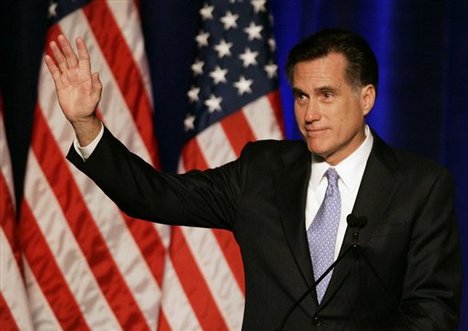
The success Mitt Romney has thus far enjoyed seems, as far as I can see, to raise serious questions about the effectiveness of The Tea Party. Amidst all the attention paid to The Tea Party (understandable given the last national election) it’s difficult not to notice that The Tea Party does not, at the moment at least, seem poised to deliver the Republican nomination to a Tea Party Candidate.
Worse still, The Tea Party hasn’t even given us a credible candidate for the nomination.
One could, I think, be forgiven for not being willing to take The Tea Party all that seriously.

My 2008 Defense of Glass-Steagall

I originally posted this in 2008. I meander a little bit. Re-reading it, it sounds like I’m suggesting a lot of things were the result of the Glass-Steagall repeal that were largely unrelated . . . so this argument is flawed. But, I post it as an anchor point for others to advocate a return to Glass-Steagall or to object to any such foolishness. That being said, here it is:


Each time we repeal the Depression era legislation meant to prevent the sorts of collapses we saw in the late 20s/early 30s financial markets, we end up with a financial crisis. Has it ever occurred to those folks that those rules were there for a reason?

In 1933, the Glass-Steagall Act established the Federal Deposit Insurance Corporation, and one very important thing that it did was prevent large private banks–i.e., investment banks–from receiving deposits–i.e., servicing the little guy, and thus end up putting the little guy’s money at risk in speculative corporate and real-estate investments. The idea being to keep investment banks from becoming flush with the savings of middle- and lower-class folks and playing with that money in the marketplace–in no small part to allow for the creation of the FDIC, and keep the government from having to bail out the big investment banks if they ended up losing all their customers’ deposits in the stock market or in real estate speculation.

Between 1933 and 1999–that’s 66 years–we never saw a banking crisis like the one we face now. The closest would be the S&L collapse, and that was in no small part because of a 1982 law letting S&Ls do with their money the sorts of things Glass-Steagall forbade large investment banking firms to do. In 1999, Glass-Steagall was repealed. 8 years later, the financial industry in America is in a mess.

And fixing it doesn’t require a lot of new regulation, or new oversight. There was some corruption here, but most of the mess was made the old-fashioned, completely legal way. The quick fix is pretty simple: Bring Back Glass-Steagall.

Of course, the important issue right now is not how to fix this, but who to blame: Democrats or Republicans? While in the political class they are both blaming each other, the correct people to blame–as it almost always is in this sort of circumstance–is pretty much everybody.

This is a bi-partisan mess. And, certainly, providing incentives to lend to folks with bad credit–out of a misplaced sense of compassion or feeling that too few loans to minorities with poor credit was a sign of racism–was a bad idea. That’s what conservatives are pointing to, and they have a point, but that’s hardly the whole cause of the problem.

Repealing Glass-Steagal was also a very bad idea (and lobbied for by both Democrats and Republicans, and signed by Clinton), because it allows too much intermixing of financial service entities, putting them all in the same leaky boat. Just as the S&Ls failed because they could legally invest in all sorts of crappy investments in order to book short term profits and attract customers with unrealistically high interest rates, allowing investment banks to buy bundled mortgages put both sectors at risk–if the mortgage industry had a crisis, then mortgage companies and investment banks could fail. If the investment banking industry had a crisis, it could mean real problems for the mortgage industry, and so on.

Now, there are lots of other reasons we’re in the subprime crisis. But turning mortgages into vehicles for investment profit that could be sold to investment banks in order to “realize” as-yet-non-existent profits did more to provide incentives to banks and fly-by-night mortgage firms to make risky loans than any requirement that banks serve communities that were poor credit risks. Although that certainly played a part.

There’s a limit to what regulation can do, but requiring consumer loans to be fixed-interest with 10% down, no exceptions, and no “interest free” or balloon mortgages would be one thing that would probably help in the future. The other thing would be to reinstate Glass-Steagall, and make it illegal to sell bundled mortages to investment banks (and book, and award bonuses, on the supposed future profits of these risky loans). Split the lending and investment banking and insurance industries again. Sandbox them, so the crisis in one are much less likely to spill out into all the others.

While they (the banks and insurance companies) lobbied hard to be able to merge all the financial services under one roof (investment banking, consumer banking, insurance), it doesn’t look like that was a very good idea. Additionally, the laws were changed without even a casual glance back at history. When regulations are in place, and the free market has had no need to “correct” for poor performance in the free market, once those regulations are removed, the free market will naturally start building towards a massive “correction”. Which is what happened. Again!

What casual glance back at history could they have made? How about the Saving’s and Loan Crisis? Tightly regulated, with low caps on the interest rates they could offer customers and unable to legally offer credit cards, take ownership positions in real estate, and so on (mostly depression era limitations imposed on them because of the inherent risks), they were low-profit affairs. Then, as high interest rates drove customers away from the S&Ls and into more profitable investments and accounts, the S&Ls suffered–but, at the time, in such a way that put their businesses at risk of failure, but not in a way that would ever have cost the tax payers billions of dollars.

To help the S&Ls remain solvent in face of sky-rocketing interest rates, the Jimmy Carter administration raised the caps that the S&Ls could offer their customers. Not so bad. Then, in 1982, the Garn-St. Germain Depository Institutions Act that apparently helped propel the S&Ls into insolvency while intending to make them more solvent. It was co-sponsored by a Democrat and a Republican, and enjoyed wide house and senate support at the time. Deregulation of this sort always seems to enjoy broad, bi-partisan support. Yet, when the crisis inevitably come, each party points their fingers at the other party and says: “This is your fault!”

What’s odd to me is how hard the financial indsutries lobbied for the repeal of the regulations that, in many ways, protected them, even while preventing them from making money in markets they felt they could serve. S&Ls lobbied for Garn-St. Germain, and the same investment banks and insurance companies that are imploding are some of the ones that lobbied from the repeal of Glass-Steagall. From 1933 (passage of Glass-Steagall) to 1999 (repeal), we never had the sort of the banking and financial problems that cropped up in the space of 8 years. It was almost like they couldn’t wait to commit corporate suicide, and just wanted those pesky regulations that had kept them from doing it out of their way.

Accountability and transparency are important. But firewalls between sectors of the capital markets may not be such a bad idea. While it may limit the profits of banks and insurance companies, it also insulates them against problems that will happen in those markets. And it would be best that if the housing market ever bubbles and collapses again, it doesn’t start taking down investment banks and insurance companies simultaneously. If an insurance company insures a number of banks that hold mortgages, while at the same time investing in bundled mortgages, what’s going to happen when the housing market swings into a down period and foreclosures start happening? That company is going to be hit from both sides. It would be much easier for that company to remain solvent if it insured banks against losses in the mortgage industry, while having the money it draws from to pay out someplace completely out of real estate.

But what’s going to come out of Washington, especially in an election year? Two things. First, lots of pointing fingers and indignant blame from the same people who cooperated in making all this happen in the first place. Second, new regulations (instead of re-instating old one’s that worked) that are designed to protect and prop-up the political class in Washington, rather than being designed to protect the consumer and the small individual with a few bucks in the bank.

Yay, Washington.