

 Brent Nyitray
 Fairlington Blade
 Let the mutherfuker burn!
 jnc4p
jnc4p Kevin S. Willis
 Michigoose
 lmsinca
 markinaustin
 Arcanaut
 novahockey
 quarterback
 ScottC
 yellojkt
Speaking of Calvin and Hobbes:

Other than that, I got nothing. Floor’s yours. — KW

Filed under: Uncategorized | 15 Comments »
Other than that, I got nothing. Floor’s yours. — KW
Filed under: Uncategorized | 15 Comments »
Vital Statistics:
| S&P Futures | 1196.9 | 3 | 0.25% |
| Eurostoxx Index | 2295 | -20.890 | -0.90% |
| Oil (WTI) | 86.71 | 0.330 | 0.38% |
| US Dollar Index (DXY) | 77.271 | 0.073 | 0.09% |
| 10 Year Govt Bond Yield | 2.15% | -0.01% |
The earnings parade continues. Bank of America (BAC) posted 3Q income of 56 cents a share, mainly on one-time items and accounting gains. They continue to deleverage – they shrunk the balance sheet $42B QOQ and have increased Tier 1 capital to 8.65%. I don’t see any mention of Durbin and the dreaded $5.00 debit card fee in the press releases. Maybe they will talk about it on the conference call. The stock is up a couple of percent pre-market.
Goldman reported a loss for the quarter. Writedowns on investments drove a lot of the losses. Sales and Trading revenues were lower as well as investment banking. Given that the stock market rolled over early in the quarter, these numbers should not have been a surprise. GS is up a buck pre-open.
Other companies reporting today: JNJ, KO, MRO, UNH, EMC, CROX
In economic data, the Producer Price Index came in higher than expected. China’s GDP came in slightly lower than estimates.
The WSJ has a story this morning talking about the lack of liquidity in the equity and bond markets. Decreased liquidity is a bear-market phenomenon, as lower prices beget lower activity. Hedge funds are sitting on their hands waiting for redemption notices at the end of the month. The overall decrease in sales and trading commissions means that banks aren’t going to take risk to facilitate customer orders for all but their best customers. Perhaps we are seeing the downside of the changes made in the late 90s – the balkanization of stock exchanges, the reduction of bid/ask spreads to pennies, and the decrease in commissions. In bull markets, people can move in and out of the market with ease, and these liquidity providers (market makers, the NYSE specialist) are viewed as unnecessary costs of trading. However, in a bear market people start to miss them. IMO, the flash crash would have been an unlikely phenomenon under the old regime. Is there any chance that we go back to the days of 1/16 bid – ask spreads, 3 cent commissions, and the NYSE specialist? Probably not. But it is becoming clearer that we gave up something in order to get penny spreads and sub-penny commissions.
What is the new battleground stock these days? Green Mountain Coffee Roasters. David Einhorn (who got it right about Lehman Brothers) was at the Value Investing Congress with a 110 page presentation ripping GMCR. This is one of those classic big battles in the markets – the value-driven hedge fund manager vs mutual fund managers starved for a growth story. We have seen this battle before in major flame-outs like Krispy Kreme and Enron. I don’t have the slides, but here is the WSJ story.
Further to yesterday’s energy discussion: WSJ It’s Official: ‘Age of Shale’ Has Arrived Money quote:
“You certainly have to record the discovery and the exploitation of resources from both oil and gas shales as one of the great wealth creators in American history,” said Ralph Eads, vice-chairman of investment bank Jefferies & Co., which has advised on more than $75 billion worth of shale deals over the last three years. “It looks to be the economic equivalent to any of the big technology innovations.”
Could be. And as more and more countries eschew coal and nuclear for electricity generation, the US could be shipping LNG all over the world and not only become energy independent, but a net energy exporter. Middle East geopolitics are going to change in a big way.

Filed under: Uncategorized | 3 Comments »
Turns out that Spock is gay. This news cannot surprise longtime fans of Star Trek, who frequently noticed the homosexual tensions between Kirk and Spock.

Filed under: Uncategorized | 26 Comments »
The Post this weekend looked at the light bulb issue and the phase out of incandescent bulbs. What was interesting to me was the marketing campaign that is going to be deployed: convincing Americans that light bulbs are durable goods and not disposable items:
Philips is hoping to persuade consumers to view the LED bulbs as a durable good like an iPad, a TV or a car rather than a disposable good such as Kleenex, pencils or toilet paper. That way, people might be more inclined to pay $300 for 10 to 15 LED bulbs for a house energy and lighting upgrade, instead of just grabbing incandescents at $2 a box as needed.
“We’re used to thinking of light bulbs as a replacement business,” Crawford said. “Transitioning our mind-set is absolutely a business challenge.”
Or, you can do what I’m planning on doing. Stockpiling. And then, when the time is right, profiteering.

KW, the first one will be free of course. I know you’re already hooked.
See more at The Washington Post

Filed under: Uncategorized | 13 Comments »
I heartily admit that I am not the equal of most of you when it comes to posting. While I enjoy the back-and-forth, I often get lost in the weeds. So, I’ve pulled out the income inequality argument from the Sun. night comments and am posting the following IMF study entitled “Equality and Efficiency.”
An excerpt:
Do societies inevitably face an invidious choice between efficient production and equitable wealth and income distribution? Are social justice and social product at war with one another?
In a word, no.
In recent work (Berg, Ostry, and Zettelmeyer, 2011; and Berg and Ostry, 2011), we discovered that when growth is looked at over the long term, the trade-off between efficiency and equality may not exist. In fact equality appears to be an important ingredient in promoting and sustaining growth. The difference between countries that can sustain rapid growth for many years or even decades and the many others that see growth spurts fade quickly may be the level of inequality. Countries may find that improving equality may also improve efficiency, understood as more sustainable long-run growth.
Inequality matters for growth and other macroeconomic outcomes, in all corners of the globe. One need look no further than the role inequality is thought to have played in creating the disaffection that underlies much of the recent unrest in the Middle East. And, taking a historical perspective, the increase in U.S. income inequality in recent decades is strikingly similar to the increase that occurred in the 1920s. In both cases there was a boom in the financial sector, poor people borrowed a lot, and a huge financial crisis ensued (see “Leveraging Inequality,” F&D, December 2010 and “Inequality = Indebted” in this issue of F&D). The recent global economic crisis, with its roots in U.S. financial markets, may have resulted, in part at least, from the increase in inequality. With inequality growing in the United States and other important economies, the relationship between inequality and growth takes on more significance.

Filed under: Uncategorized | 14 Comments »
Vital Statistics:
| Last | Change | Percent | |
| S&P Futures | 1208.3 | -10.9 | -0.89% |
| Eurostoxx Index | 2328.2 | -27.3 | -1.16% |
| Oil (WTI) | 86.21 | -0.59 | -0.68% |
| US Dollar Index (DXY) | 77.005 | 0.398 | 0.52% |
| 10 Year Govt Bond Yield | 2.18% | -0.07% |
After a lull in activity, Merger Monday is back upon us. Today’s activity is in the energy space as Kinder Morgan is buying El Paso for $38 billion in cash and stock, and Norwegian Oil company Statoil is buying E&P independent Brigham Exploration. The KMI / EP deal is a bet that natural gas will continue to grow its market share of energy in the US. Barclay’s will provide $11.5 billion in financing, which is a good sign for the credit markets.
Germany poured cold water on the idea of a complete sovereign debt crisis fix at the Oct 23 summit. G20 finance ministers met over the weekend. This has all the feelings of a negotiation, not a Lehman-esque crisis.
Citigroup posted better than expected earnings this morning, while Wells Fargo missed. Citi announced they have $32.4 billion in European exposure. Lowe’s announced they will close 20 stores and lay off 2000 workers.
Robert Sameulson has a piece in this morning’s Washington Post which discusses why our children’s future doesn’t look so bright. IMO, this sort of thinking is part and parcel of recessions. If anything, I think the national mood was worse during the late 70s / early 80s, where people thought that the US would be devoured by the two headed monster of OPEC and the Japanese. It turned out that oil demand was a lot more elastic than we thought, and the Japanese were in a bubble of their own. US manufacturing rebounded smartly as US companies adopted just-in-time and adopted Deming’s quality concepts.
I remember during the early 90s recession, we were supposedly heading for a generational war as the baby boom generation took all the job opportunities from Gen X-ers. Unemployed Gen X-ers would supposedly toil away forever at temp jobs while highly paid baby boomers bid up real estate prices to unreachable levels. Instead, we got the dot-com boom, which made many Gen X-ers extremely rich.
The point is that conventional wisdom, especially in the area of economics, is usually wrong because it overreacts to what is going on at the moment and extrapolates that forever. It accounts for the Business Week “Death of Equities” cover story in August 1979 as well as Dow 36,000 which was released in Oct 1999.
While I do believe that this recession is indeed different that past Fed-driven recessions, it isn’t a permanent state of affairs. This too shall pass. Booms don’t last forever, and neither do busts. My view has been that we are on a cusp of a revolution in energy which will collapse prices and turn the US from a net importer of energy to a net exporter. And that revolution will be a true elixir – it will go a long way towards fixing our budget problems and our trade deficit. It will also directly benefit the middle class the most by increasing disposable incomes and providing jobs.
We do have some more wood to chop economically – housing has to bottom, and the imbalances that stemmed from the real estate bubble have to be corrected. The debt that accrued during the last decade has to be worked off. Fortunately, while debt levels are quite high according to historical levels, debt service levels (principal and interest payments) are on the low side because interest rates are so low. Which means the debt will be worked off faster.
In economic data, Empire Manufacturing came in lower than expected. Industrial production was .2% and Capacity Utilization is slightly lower than expected at 77.4%. Below is a chart of capacity utilization. It shows that there still is a tremendous amount of slack in the economy, which bodes well for inflationary fears.

Filed under: Uncategorized | 11 Comments »
Admin note: the Link Dump, despite being unsorted, still puts your new addition in alphabetical order. So, if you add something, think about pressing the little teeny arrow buttons to bump it up in the link rotation. Otherwise, over time, any link that doesn’t start with the number “1” won’t get displayed. Just a suggestion.
The Daily (despite being a Rupert Murdoch publication) seems to have pretty good coverage of the OWS. Not in depth, perhaps, but seems pretty fair to me. Worth a look.
More than a dozen protesters were arrested at a downtown Citibank branch near New York University — including a suit-clad woman who exited the bank and insisted to an apparent police officer dressed in civilian clothes that she was a customer.
As she was thrown up against a wall and handcuffed, she screamed, “I’m not doing anything wrong! This is wrong!” The incident was caught on video and quickly went viral on Twitter.
Some Daily editorial opinionating on Occupy Wall Street to be found here.
Barack Obama may have an uphill climb when it comes to winning re-election in November, 2012—but he’s going to have a lot of cash, and a lot of deep-pocketed celebrity donors, to help me make that climb.
An odd but important indicator of a potentially rebounding economy: more people are quitting their jobs in search of greener pastures.

Do millionaires really pay a lower effective rate than us regular folks? The Daily (thus, Rupert Murdoch) says it’s so!
As Sunday’s often are, this is pretty much an all The Daily share-fest. And this link is no different, but comes with a question for all: any particular reason Rupert Murdoch or NewsCorp would have it in for Raj Rajartnam? Because I’d never heard of him before The Daily began to constantly pummel him with critical coverage from trial to punishment.
Women’s Museum closes in Dallas, Texas. Not enough coverage of feminism, or an inability to control costs?
Finally: Sure, Single Payer healthcare might help keep healthcare costs down. But would it protect our senior citizens from robot attacks? I don’t think so.
— KW

Filed under: Uncategorized | 15 Comments »
Fall is my favorite time of year. Don’t get me wrong. Lazy summer evenings are nice, but DC is too warm for my taste. Fresh tomatoes almost make it worthwhile. Wintertime has its own pleasures, particularly snuggling under the comforter. Spring is a wonderful awakening and I love the arrival of fresh greens and strawberries.
Ah, but fall. It’s relief from that long, hot summer. I can enjoy the clear warm days and love the cool rainy ones. And comfort food comes back on the menu along with those fruits and vegetables that have been growing all year, just waiting for me to happen by.
We went apple picking out in Front Royal last year. It’s a long trip, so we’ll see if we can find something closer this year. One of my favorites is homemade apple sauce. It’s so easy. Good apples, a bit of sugar and spice, heat and plenty of time. This stuff is to the jarred as a summer tomato is to the ones you see in the supermarket. I bought a food mill specifically for the aim of making apple sauce. I used a potato ricer last year. It works, but it’s messy.
I’m looking forward to our annual Thanksgiving bash. That’s a post in and of itself. I tried my first organic turkey last year. It was pretty good, though I think my favorite of the meal was the beets I picked up a MoM’s (My Organic Market) in Del Ray.
Perhaps the purest fall food for me is the pumpkin. I remember that I used to make an occasional pumpkin pie and have it for breakfast for the better part of a weak. There are other things you can do with it, though. My favorite of these is to stuff it. Here is an absurdly simple recipe a former Post food writer (Kim O’Donnell) clued me into three years ago.
The first time I ever made this, Primo and Secondo were sick and so I had to leave the pumpkin in a warm oven. An interesting thing happened. The skin began to fall away from the pumpkin, so I peeled it and served it all mixed. It’s cheesy, pumpkin goodness. Here are a few of source links:
http://voices.washingtonpost.com/mighty-appetite/2008/11/the_great_sugar_pumpkin.html
http://www.thekitchn.com/thekitchn/fall/autumn-supper-savory-stuffed-pumpkin-099843
http://blog.streaminggourmet.com/2009/10/25/ruth-reichls-cheesy-bread-in-a-pumpkin/
BB
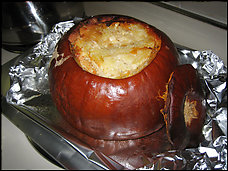
Stuffed Pumpkin

Filed under: Uncategorized | 7 Comments »

Filed under: Uncategorized | 75 Comments »
If you’ve followed Pigford at all, you might want to read this article by Lee Stranahan reiterating his belief that the Pgiford settlement was mostly a fraud and black farmers with legitimate claims pretty much got screwed by folks exploiting the controversy for their own gain.
Of course, Lee Stranahan works with Andrew Breitbart, so if you may draw whatever conclusions, based on context, that you please.

Filed under: Uncategorized | 32 Comments »


