Morning Report 6/8/12

Vital Statistics:


Last

Change

Percent

S&P Futures 

1302.7

-7.3

-0.56%

Eurostoxx Index

2143.7

0.6

0.03%

Oil (WTI)

82.22

-2.6

-3.07%

LIBOR

0.468

0.000

0.00%

US Dollar Index (DXY)

82.72

0.666

0.81%

10 Year Govt Bond Yield

1.56%

-0.08%


RPX Composite Real Estate Index

178.7

0.4


Markets are weaker this morning after some disappointing economic data out of Europe. I guess people were hoping for a little bit more out of the Bernank regarding further stimulus when he testified in front of Congress yesterday. The trade deficit narrowed as imports and exports fell by 1.7% and .8% respectively. Bonds and MBS are both up a little. Overall, it feels like a typical Summer Friday and I would expect most of the Street to be on the L.I.E. by noon.

The Fed voted yesterday to accept the Basel III framework. Rob Chrisman has a good piece on how Basel III will impact mortgage pricing. Essentially the new treatment of mortgage servicing rights will force big lenders like Wells to lower the price they are willing to pay for servicing released premiums. In plain English, this means that Basel III has imposed a higher cost on the banks that will be passed on to borrowers. The Fed estimates that the 19 largest US banks are about $50 billion short of meeting new capital requirements, but they also note that these rules will become fully implemented by 2019 and that most banks should be able to meet the new capital requirements through retained earnings and won’t need to raise more capital.

Fannie Mae notes in its National Housing Survey that consumer sentiment seems to be plateauing as we head into the summer selling season. Roughly 1/3 of the respondents expect home prices to rise in the next 12 months and 72% believe now is a good time to buy.

The FHA is planning to announce a bulk sale program today. However, they want to deter “vulture investors” by requiring that the loan buyer to wait 6 months to foreclose and to agree to keep at least half the REO for 3 years.

Morning Report 6/7/12

Vital Statistics:

  Last Change Percent
S&P Futures  1325.5 10.0 0.76%
Eurostoxx Index 2161.6 23.9 1.12%
Oil (WTI) 86.19 1.2 1.38%
LIBOR 0.468 0.000 0.00%
US Dollar Index (DXY) 82.02 -0.306 -0.37%
10 Year Govt Bond Yield 1.66% 0.00%  
RPX Composite Real Estate Index 178.3 0.2  

Markets are higher this morning after China cut interest rates to boost their economy. The benchmark lending rate will drop from 6.56% to 6.31%, effective tomorrow (such precision!). The allowed discount from the benchmark was widened from 10% to 20%.  Initial Jobless Claims in the US came in at 377k, more or less in line with expectations. Bonds and MBS are flat.

Given last Friday’s dismal jobs report, the market was definitely concerned about the Fed’s Beige Book survey which was released yesterday afternoon. Overall, the tone of the report did not confirm fears of an imminent slowdown. The Fed reported that “overall economic activity expanded at a moderate pace” and that “Economic outlooks remain positive, but contacts were slightly more guarded in their optimism.”

In another positive datapoint for the real estate industry, homebuilder Hovnanian reported better than expected earnings yesterday, with a 50% increase in backlog and a 52% increase in contracts. Perhaps this portends the rise in housing starts and construction we have been waiting for since 2008.

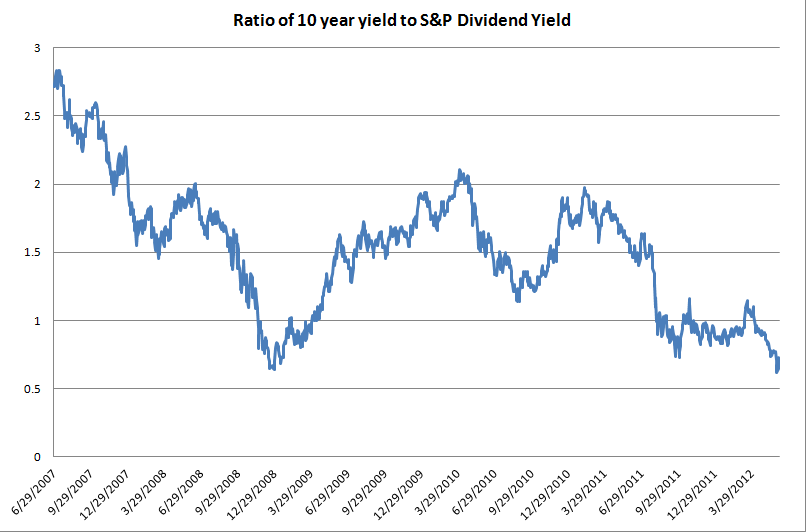
To get an idea how cheap stocks are compared to bonds right now, consider the fact that the 10 year yields about 1.65%, while the dividend yield on the S&P 500 is 2.2%. A dividend yield (let alone earnings yield) higher than the 10-year is a rare event. If you look at the ratio of the 10 year to the dividend yield, it reached  just over 60% last week, and the last couple times it reached that level (2008 and fall of 2011), it portended a huge stock market rally. At any rate, it seems to trigger asset allocation decisions and may account for some of the velocity of the moves in the S&P futures and the bond futures. It also means buy stocks and sell bonds.  Or borrow money long term.

Chart:  Ratio of the 10-year bond yield to the S&P 500 dividend yield:


Morning Report 6/6/12

Vital Statistics:

  Last Change Percent
S&P Futures  1295.7 10.6 0.82%
Eurostoxx Index 2128.5 41.2 1.97%
Oil (WTI) 85.15 0.9 1.02%
LIBOR 0.468 0.000 0.00%
US Dollar Index (DXY) 82.56 -0.265 -0.32%
10 Year Govt Bond Yield 1.59% 0.01%  
RPX Composite Real Estate Index 178.1 0.6  

S&P futures are higher this morning on hopes of further stimulus in Europe.  The ECB left interest rates unchanged. The world seems to be backing away from the ledge a little, selling government bonds and taking more risk. Mortgage rates moved lower only grudgingly last week, so we should expect them to stay more or less stable as the 10-year yield backs up. Nonfarm productivity came in lower than expected, as did unit labor costs. The Fed’s Beige Book will be released mid-afternoon.

CoreLogic’s April Home Price Index showed a year-over-year gain of about 1%.  Excluding distressed sales, they rose almost 2%. They also introduced a new metric – the Pending Home Price Index – which indicates the trend in prices. This month, the Pending HPI predicts another 2% from April to May. Month-on-month increases are normal seasonal behavior, but year on year increases are more a sign that prices are bottoming.

Clear Capital is reporting more or less the same thing in its June Home Data Index Market Report. It notes that national home prices grew on both a quarterly and yearly basis for the first time since August 2010. Dr Alex Villacorta, Director of Research said:  “While gains in national home prices over the quarter and year were minimal in May, there are encouraging trends continuing to play out and gaining momentum beneath the surface.  Strength in REO-only price trends as well as some early indications of price gains spreading from low tier sections to the mid, and higher priced homes is helping confirm that the country continues to make progress on its recovery, and we are expecting to see improvements extend of the next several months.” RTWT.

Given that the mortgage market more or less IS Fannie, Fred, and Ginnie the question now is what to do with them. The Community Mortgage Lenders Association has sent a white paper to the government recommending that we reduce the GSE’s involvement in the secondary market to around 33% and that there be an explicit backstop fee paid to the government. 

Morning Report 6/5/12

Vital Statistics:

  Last Change Percent
S&P Futures  1271.0 -2.0 -0.16%
Eurostoxx Index 2076.6 -2.4 -0.11%
Oil (WTI) 83.63 -0.4 -0.42%
LIBOR 0.468 0.001 0.21%
US Dollar Index (DXY) 82.89 0.328 0.40%
10 Year Govt Bond Yield 1.54% 0.02%  
RPX Composite Real Estate Index 177.6 -0.1  

Markets are flat after some disappointing economic data out of Europe. The Eurozone ISM survey came in at 46 and has been below 50 for the past 4 months, indicating a contraction in the manufacturing sector. The  US Non-Manufacturing ISM will be released at 10:00 am, with economists predicting a reading of 53.5. Equity markets seem to be stabilizing, so we are seeing Treasury investors back away from the ledge. MBS are lower as well.

Germany is becoming more amenable to some sort of pan-European banking coordination. Angela Merkel said: “So we will also talk about to what degree one has to bring the systemic banks under specific European supervision to keep national interests from playing too large a role.” This will be easier said than done, as countries tend to get very nationalistic when talking about banks. Good luck getting the French on board.

CSFB is predicting the Fed will continue monetary stimulus, with a continuation of Operation Twist and buying mortgages. I am not sure why Operation Twist needs to be continued – Europe has done more to lower long-term interest rates than the Fed could engineer. There has been speculation that the Fed could do a hybrid of sorts, where it sells short term paper and buys mortgage backed securities directly.

NPR has an article on the future of the American Dream – homeownership. While most of the article discusses the psychological differences between homebuyers during the bubble and homebuyers before the bubble, they have an interesting chart from showing how much cheaper it is to buy than rent. The chart shows ratio of the cost of homeownership vs the cost of renting since 1986.  The costs are now equal, even if you ignore the interest deduction.

Chart:  Rent vs Buy 


Morning Report 6/4/12

Vital Statistics:


Last

Change

Percent

S&P Futures 

1277.0

3.1

0.24%

Eurostoxx Index

2088.7

20.0

0.97%

Oil (WTI)

82.46

-0.8

-0.93%

LIBOR

0.468

0.001

0.21%

US Dollar Index (DXY)

82.74

-0.152

-0.18%

10 Year Govt Bond Yield

1.50%

0.05%


RPX Composite Real Estate Index

177.6

0.3


S&P futures are up 3 points after having been down 12 points in the overnight session. A drop in Euro sovereign yields seems to account for the better tone. China’s non-manufacturing PMI dropped to 55.2 in May from 56.1 in April, indicating that their economy is decelerating. The 10-year yield has increased to 1.5% and mortgage backed securities are down a tick.

This week will be a relatively data-light week, in contrast to last week (especially Friday). However, there will be lots of Fed-speak all week and investors will be parsing each statement for further clues regarding QE.  It may turn out that the Fed conducts Operation Twist by purchasing MBS instead of Treasuries.

One of the reasons why this recovery has proven to be so unsatisfying has been the lack of construction activity, which usually leads the economy out of a recession. The Atlantic has a chart that shows construction jobs as a percent of total jobs is at levels not seen since 1946.

Laurie Goodman of Amherst Securities weighs in on how regulators are creating a credit crunch.

Chart:  Construction jobs as a percent of total jobs:


Morning Report 6/1/12

Vital Statistics:


  Last Change Percent
S&P Futures  1282.1 -27.1 -2.07%
Eurostoxx Index 2076.9 -42.0 -1.98%
Oil (WTI) 83 -3.5 -4.08%
LIBOR 0.468 0.001 0.21%
US Dollar Index (DXY) 83.31 0.266 0.32%
10 Year Govt Bond Yield 1.46% -0.10%  
RPX Composite Real Estate Index 177.4 -0.1  

Ugly.  That is all you can say this morning.  Equity markets are reeling after a slew of disappointing economic reports this morning.  The 10-year is trading at 1.46%. MBS are trading higher as well. The German 2-year bund actually has a negative yield. 

The unemployment rate ticked up to 8.2% and the economy added just 69,000 jobs last month. The labor force participation rate rose to 63.8%, reversing April’s decline. The average workweek declined, which bodes ill for future hiring. 

With the massive rally in the 10-year, you would think Operation Twist would be put on the back burner. You would be wrong. Federal Reserve Bank of Boston head Eric Rosengren is advocating continuing Operation Twist (where the Fed buys long-dated bonds and sells short-dated paper in an attempt to lower long-term rates). Given the massive rally we have experienced in the 10 year, May’s jobs report should have been great. Anyone think June’s report is going to be great?

Facebook’s IPO is instructive in that it shows how the relationship between issuer and bank has become more important than the relationship between investor and investment bank. Many moons ago, when I was in business school, we used to ask why IPOs popped so much on day 1. A pop in the stock meant that issuers were leaving money on the table. One explanation was that while an investment bank would get a deal from an issuer maybe once every few years, they had to deal with their buy-side clients every day. So they were more interested in keeping Fidelity happy than they were in keeping XYZ.com happy. Which meant IPOs were usually under-priced. 

Fast forward to today:  Facebook was a disaster if you were an investor. But the investor’s loss was Facebook’s gain. The banks managed to sell as many shares as possible at as high a price as possible. What has changed?  IMO commissions and spreads. When I started in the business, institutions paid a nickle a share to trade a stock. Bid/Ask spreads were 1/8. Sales and trading was a lucrative business that was conducted over the phone.  Nowadays, you can trade inside the penny spread, and commissions are 1/4 of a cent a share. Everything is automated. Sales and trading is a loss-leader business, which means banks are more interested in keeping issuers happy than they are keeping investors happy. If Fidelity is mad, who cares?  Morgan Stanley isn’t making anything from them anyway…

Morning Report 5/31/12

Vital Statistics:

  Last Change Percent
S&P Futures  1309.6 1.0 0.08%
Eurostoxx Index 2124.7 8.5 0.40%
Oil (WTI) 87.6 -0.2 -0.25%
LIBOR 0.467 0.000 0.00%
US Dollar Index (DXY) 82.81 -0.212 -0.26%
10 Year Govt Bond Yield 1.59% -0.03%  
RPX Composite Real Estate Index 177.5 0.0  

Equity markets are flat after yesterday’s bloodbath, while bonds continue to rally.  The 10 year is trading at 1.59%. MBS are up as well. Lest anyone think this is strictly a US phenomenon, yields in the “safe” European countries like Switzerland, Denmark, Germany are even lower. On the other hand, Greek debt now yields 30.6%, which is pretty much the same level it was before default. 

Today is Jobs Day with a slew of labor-related economic releases at 8:30. Challenger has already said that announced job cuts were up 67% YOY in May.  This is a notoriously volatile index because one large employer (in this case HP) can dominate the month, so you have to focus on the trends and here 10 out of the last months showed increases. On the other hand, announced job cuts don’t always happen so take it with a grain of salt.  That said, there aren’t a lot of forward-looking labor measures out there.

Initial Jobless Claims came in at 383k, higher than the 370k estimate. The ADP Employment change report predicts 133k jobs were added in May.  1Q GDP was revised downward to 1.9%, in line with expectations. Consumption, exports, and residential fixed investment (finally!) drove Q1 GDP growth.

Delays in foreclosures and recent incentives by the Obama administration are making short sales more attractive to lenders than foreclosures.  Short sales were up 25% from a year ago as opposed to bank-owned sales which dropped 15%.  More aggressive pricing on the part of lenders is driving the increase.

Given the outsized rally in Treasuries yesterday, you would have expected a commensurate drop in mortgage rates.  But that didn’t happen. Mortgage rates are moving lower only grudgingly as rates fall, indicating that we may be reaching a floor, or at least further drops will be very hard to come by.

Morning Report 5/30/12

Vital Statistics:

  Last Change Percent
S&P Futures  1323.7 -9.7 -0.73%
Eurostoxx Index 2162.6 2.3 0.10%
Oil (WTI) 89.51 -1.2 -1.38%
LIBOR 0.467 0.000 0.00%
US Dollar Index (DXY) 82.54 0.056 0.07%
10 Year Govt Bond Yield 1.69% -0.05%  
RPX Composite Real Estate Index 177.5 0.1  

A sloppy tape to start the day as Euro fears take center stage. Spanish credit default swaps are at 522 basis points, an all-time high. Troubled Spanish lender Bankia continues to fall. Greek sovereign debt is over 30%. The beneficiary of the risk-off trade is the US 10-year, where yields are down 6 basis points. Meanwhile, oil cannot get out of its own way, with WTI down 15% this month.

The 10-year yield is flirting with the Sep low of 1.673%.  MBS are unchd, and we are witnessing a similar phenomenon as last fall, where the 10 year rallied and MBS underperformed. The spread between the Freddie Mac generic 30 year fixed mortgage and the 10-year bond yield is 2.04%.  Here is a chart of the generic 30 year fixed rate mortgage, the 10-year bond, and the spread between the two. 


While mortgage rates are falling as the yield on the 10 year falls, they are falling much more slowly. So, if you are facing a lock decision, you have are faced with a bit of a conundrum:  If the 10 year yield continues to fall, mortgage rates might not participate. In other words, we may be reaching a floor in mortgage rates.  Which means you might as well lock.  On the other hand, if the 10 year yield starts backing up, mortgage rates should rise much slower since they really didn’t fall that much to begin with.  Which means you have some room to wait and see what happens, and you might want to float. So, lock or float?  IMO, when markets crack, they crack quickly. And the 10 year is at very lofty levels. It could go from 1.7% to 2.4% in a hurry. The risk is more skewed towards mortgage rates increasing quickly than falling quickly. I would lean short in mortgage rates, or in other words, lock.

Part of the reason why the recovery has been so halting has been that the job market for those in their prime earnings years has been horrendous. Instead of making the top salaries of their lives (which they need to pay for college for their kids and also retirement savings), many people in their prime earnings years are either unemployed or underemployed.  This is a huge drag on the economy. 

Morning Report 5/29/12

Vital Statistics:

  Last Change Percent
S&P Futures  1322.0 7.0 0.53%
Eurostoxx Index 2147.7 -0.3 -0.01%
Oil (WTI) 91.13 0.3 0.30%
LIBOR 0.467 0.000 0.00%
US Dollar Index (DXY) 82.27 -0.131 -0.16%
10 Year Govt Bond Yield 1.72% -0.02%  
RPX Composite Real Estate Index 177.4 0.3  

Markets are higher this morning on hopes of stimulus in China. Spain is working on a rescue plan for Bankia, its 3rd largest lender. Spanish banking woes have pushed their sovereign debt to around 6.5%, close to the highs of last November. While Greek and Spanish fears are pushing sovereign yields higher, we have not seen a corresponding rise in EURIBOR / OIS, which is a signal that the banking system in Europe is taking a sanguine view, at least for now.  Meanwhile, Treasuries and bonds are higher, with the 10 year bond now at 1.73%


The S&P Case-Schiller index posted a slight sequential gain in March, but was still down 3% YOY, and made a new post-crisis low. Nationwide, house prices on average are back at their mid-2002 levels. That said, the pace of the decline has definitely slowed.


Chart:  Case-Schiller

Morning Report 5/25/12

Vital Statistics:

  Last Change Percent
S&P Futures  1322.1 -0.5 -0.04%
Eurostoxx Index 2148.8 -7.7 -0.36%
Oil (WTI) 90.91 0.3 0.28%
LIBOR 0.467 0.000 0.00%
US Dollar Index (DXY) 82.16 -0.186 -0.23%
10 Year Govt Bond Yield 1.76% -0.02%  
RPX Composite Real Estate Index 177.1 0.4  

Markets are flat overall this morning, which makes sense.  Given the fact we have a 3 day weekend and we may have a resolution on the Greek situation, you would have to be certifiably insane to carry positions over the weekend.  Bonds close early today, and I suspect most of the Street will be on the L.I.E. by noon. 

No economic data with the exception of University of Michigan confidence at 9:55 this morning. University of Michigan consumer confidence really just tells you where gas prices were last month (h/t Ron at MCM). Consumer sentiment and the Triple A Gas Price index have a -.52 correlation with a 1 month lag.  

Are people who bought Facebook stock in the initial frenzy getting a do-over?  Sounds like it. The underwriters are claiming they made $100 million supporting the stock. I can see how they made money supporting the stock on the open.  I can’t see how they made money supporting it at the close since it opened down a couple of bucks the next day. Unless they were shorting it in the 40s.

I came across this testimony from a community banker regarding the unintended consequences of Dodd-Frank and the Volcker rule. The biggest one is that the regulators swung at Goldman and Morgan, they ducked, and the regulator ended up slugging all the small fry right in the jaw. When you have 15% of your staff handling regulatory matters and 12% of your operating budget is compliance there is a problem. He notes that regulatory costs as a percent of operating costs is 2.5x the costs for big banks. The Volcker rule alone will require the drafting of policies and procedures to ensure the East Podunk Savings and Loan doesn’t inadvertently set up a trading desk and start slinging around credit default swaps 

He also notes some major problems with the “ability to repay” test on mortgage origination and on the CFPB’s characterization of pricing risk as “predatory lending.”  The net result may be to drive community banks out of entire lines of business because of regulatory risk.  Will the powers that be listen?  I doubt they will do anything more than make perfunctory statements that these regulations were not meant to impact small banks. They will listen to this guy instead.