Posted on December 22, 2015 by Brent Nyitray
Stocks are higher this morning on hopes of more stimulus for the Chinese economy. Bonds and MBS are down small.
The third revision to Q3 GDP came in at 2%, a slight downward revision from the 2.1% second estimate. A lower inventory estimate drove the revision. Personal consumption was 3%, while the core PCE index (the Fed’s preferred measure of inflation) rose at an annualized rate of 1.3%. Consumption has been depressed for so long that eventually consumers are forced to replace worn out clothes and cars. The average age of a car in the US recently hit a record at 11.5 years, and this is behind the stronger auto sales (along with cheap and easy financing).
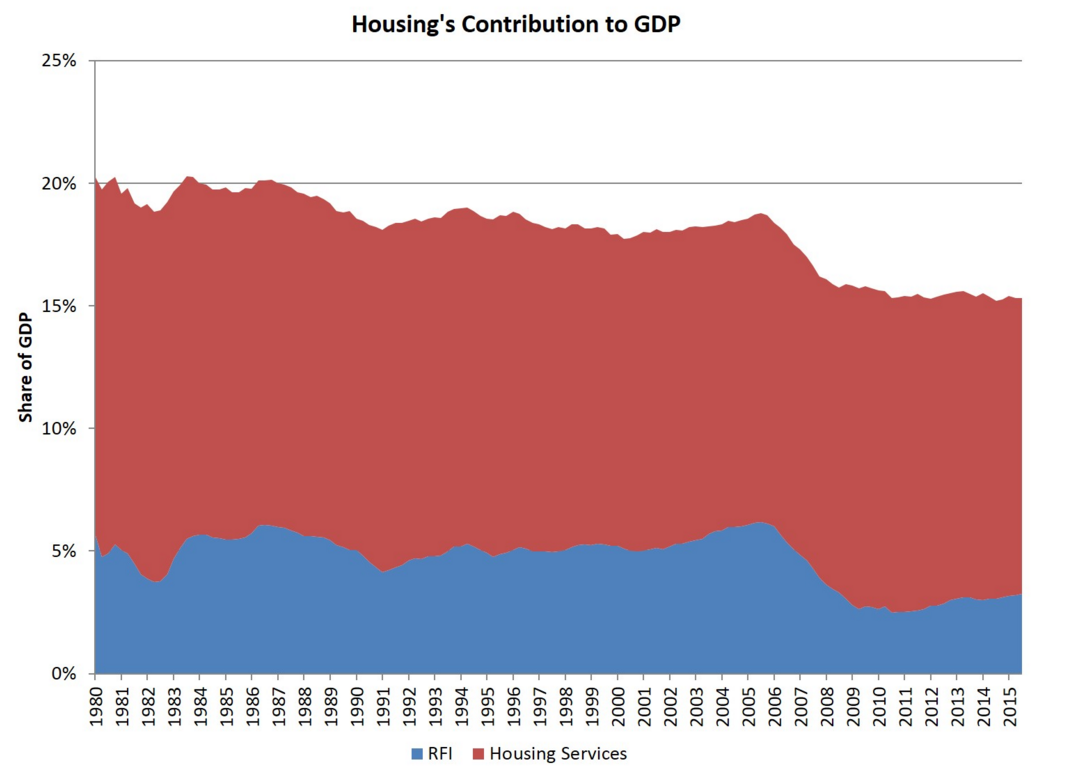
Housing contributed 15.3% of GDP in the third quarter, about where it was in the fourth quarter. This is well below the historical levels and is explained by the drop in homebuilding. Given that the excesses of the bubble were worked off years ago, inventories are tight, and the Millennial generation is even bigger than the Boomers we will see a pick-up at some point, which should last years. Remember, housing starts averaged 1.5 million a year from the 1960s to 2002 (pre-bubble years). Since 2002, we have averaged under 1.2 million. When you take into account population growth, the deficit grows even larger.

House prices rose 0.5% in October, according to the FHFA. On a year over year basis, they rose 6.1%. Looking at the chart, it seems like we are back at the heights of the index set in 2007 or so.The Mountain states led the charge, while the Northeast fell a little.
Cash sales as a percentage of home sales fell to 32.5% of all sales from 35.9% a year ago, according to CoreLogic. REO sales tend to be most likely to be cash sales. You can see on the map below the range of percentages based on the state. It looks to correlate most closely with the foreclosure pipelines.

More TRID horror stories. Borrowers are having to pay for longer lock periods, and lenders are scrambling to meet closing deadlines. Hopefully this will be a memory in a few months. Non-agency remains an even bigger problem as investors are taking a zero defects stance on TRID and not buying loans.
Filed under: Morning Report | 3 Comments »
Posted on December 21, 2015 by Brent Nyitray
Stocks are up this morning on no real news. Bonds and MBS are up small.
We have a holiday shortened week, with markets closing early on Thursday. We do get some important data with the final revision to Q3 GDP, Existing Home Sales, New Home Sales, the FHFA House Price Index, personal spending and income, and inflation. Basically a week’s worth of data crammed into 3 days.
Oil continues to fall, hitting $34.23 a barrel for WTI.
The Chicago Fed National Activity Index fell to -.3 from – .17.
Goldman is predicting a March rate hike – a “fairly easy path.” They anticipate growth will remain above trend and employment growth to be well above breakeven. Inflation will pick up as the the big swoon in oil from $100 to $50 will be a year old and won’t be pushing down the inflation numbers.
Filed under: Morning Report | 38 Comments »
Posted on December 18, 2015 by Brent Nyitray
Markets are lower this morning on no real news. Bonds and MBS are up small.
Homebuilder Lennar reported better than expected earnings this morning with average sales prices up 6%, a decrease in gross margins and an increase in new orders of 10%. CEO Stuart Miller sees a “slow and steady” housing market improvement. He said the Fed rate hike was a sign of confidence in the economy.
Rob Chrisman discussed how TRID is impacting the non-agency markets. quotes one lender: “I see in your commentaries lots of feedback about TRID. Something else is happening and it appears, absent some quick changes in philosophy, the effect could be both a complete seizure of non-agency lending and possibly some firm’s very existence could be put in jeopardy. My firm has had 100% of the jumbo loans that we’ve sent for delivery rejected by our buyers. Yes – 100% – and we’re talking nearly 50 loans so far. Why? Every one had a TRID violation. Does that mean my firm screwed up and is alone on this? No. Two of the firms we sell to say they have purchased ZERO loans so far in December. ZERO. Why? Same reason. None of them were TRID compliant. The TRID rule is so severe, and so open for interpretation, and because the buyers are taking a zero defect approach – it is near impossible to manufacture a perfect loan from a TRID perspective. It’s clear to anyone in our business what could happen next. If I were a warehouse lender – I’d immediately cease funding non-agency loans. Same goes for any correspondent lender who doesn’t want a giant pipeline of unsaleable production. We’re large enough to be able to fund our unsaleable pipeline with cash. But many firms are not. What happens to a firm that has $5 million of cash on hand when its warehouse lender asks them to buy $6 million of jumbos (literally only 5 to 8 loans) off of the line? Game, set, match. Because TRID only affected new applications after 10/3 – the fundings are now only starting to be affected. This crisis is about to get real…”
Of course the reaction from the CFPB lawyers will undoubtedly be that these stooges in the mortgage banking industry just can’t get their act together. And they better start expanding credit in our targeted areas, or else!
The latest CoreLogic Market Pulse is out: They expect home prices to reach their previous peaks in mid 2017. Note that the FHFA House Price Index (which covers a subset of homes) is pretty much already there.
Filed under: Morning Report | Leave a comment »
Posted on December 17, 2015 by Brent Nyitray
Stocks are lower this morning, reversing the post FOMC rally. Bonds and MBS are up.
As expected, the Fed rose the Fed Funds target rate by 25 basis points. The statement generally focused on how the economy has improved. The biggest surprise in the statement and the projection materials was the forecast for rates going forward. The Fed lowered their expected Fed Funds range going forward. You can see the September versus December dot graphs below:

In the projection materials, they took up their forecast for 2016 GDP up a hair and took down their estimate for 2016 unemployment by a tick.
In response to the rate hike, banks hiked their prime rate to 3.5% from 3.25%. A lot of consumer debt, especially credit cards, are tied to the prime rate, which means consumers will feel the pinch.
The Philthy Fed Manufacturing Index fell to-5.9 from 1.9. while initial jobless claims fell from 282,000 to 271,000.
The Bloomberg Consumer Comfort Index rose to 40.9 from 40.1.
The Index of Leading Economic indicators fell from 0.6% to 0.4%.
The nail that sticks up gets hammered down.
The FHFA is taking more steps to push lenders to provide financing to more multi-fam properties.
Filed under: Morning Report | 72 Comments »
Posted on December 16, 2015 by Brent Nyitray
Stocks are up this morning ahead of the FOMC meeting. The decision should be released around 2:00 EST. Given that this was the most telegraphed rate hike in history, I don’t necessarily expect a lot of volatility around the decision, however the language in the statement could always spook the markets. The consensus seems to be a hike of 25 basis points and very dovish language.
Mortgage Applications fell 1.1% last week as purchases fell 2,8% and refis rose 1.4%.
The strong dollar is still wreaking havoc on the manufacturing sector. Industrial Production fell 0.6% last month and capacity utilization fell to 77% from 77.5%. Manufacturing Production was flat.
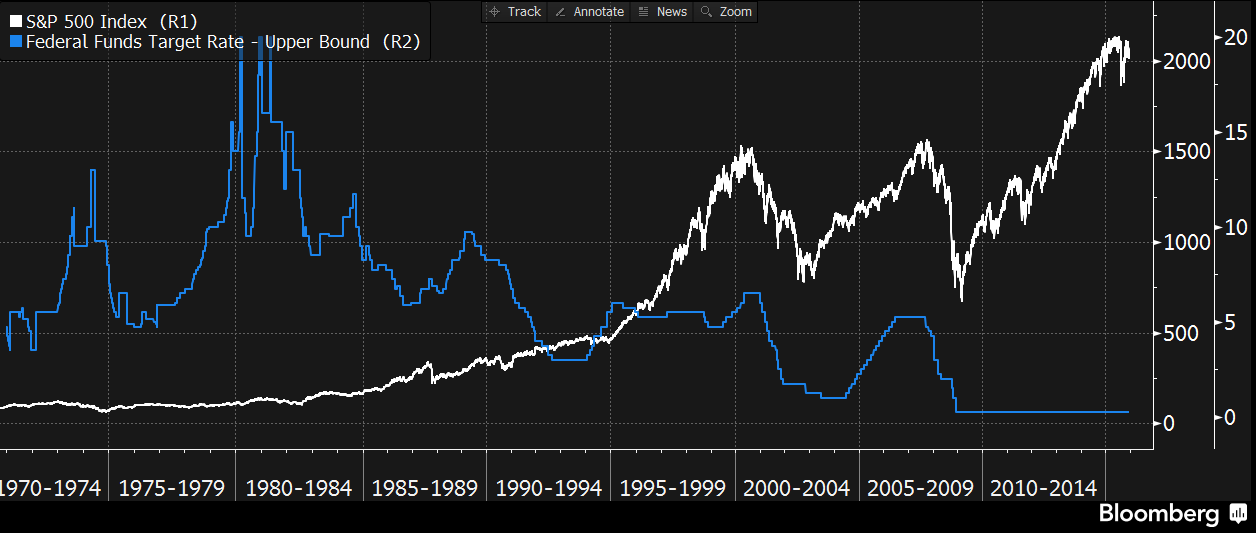
As the Fed begins to remove support from the market, stock market strategists are wondering what will happen to the stock market. Are current market levels a function of the Fed’s stimulus programs or are they supported by earnings and economic fundamentals? I can’t see a gradual tightening cycle collapsing the market, but it will mean that further increases in the market will have to be driven by earnings and economics and you can’t expect to see further multiple expansion. Dividends will become much more important. Here is a chart of the S&P 500 versus the Fed Funds rate over the past 45 years:

Interest rate cycles are long. The bull market in Treasuries started in 1982 or so is probably over, unless the economy rolls over again. The previous bear market in Treasuries ran from the mid-50s through the early 80s.
Note that the other central banks (especially Japan and Sweden) have tried to get off the zero bound, only to see rates fall back to 0% again. If that happens, then what? The Fed would have to raise its inflation target.
The story of Marty Whitman’s Third Avenue downfall. A value investor who simply didn’t fit with the current momentum-investor world. The current liquidity crunch in junk bonds is being attributed to Third Avenue’s Focused Credit Fund, which just put up gates preventing investor withdrawals. Daily liquidity, they promised.
Filed under: Morning Report | 20 Comments »
Posted on December 15, 2015 by Brent Nyitray
Markets are higher this morning as oil and credit markets have an up day. Bonds and MBS are getting whacked.
There is no news in particular driving the rally in oil and other financial assets. Markets don’t go up in a straight line and they don’t go down in one either. Another possibility is that market participants are positioning themselves ahead of the Fed rate hike.
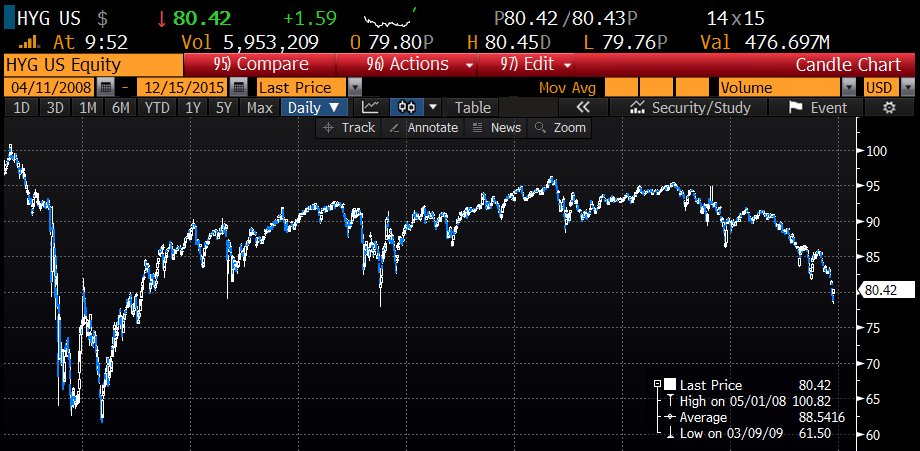
The problems in the credit markets are centered in distressed credits. The carnage is concentrated in the energy sector. For those keeping score at home, if you want to track how things are going, check out the Ishares high yield ETF HYG. The chart is below. You can see how it has been rolling over. I included the financial crisis years for perspective.

Blackrock believes the problems in the distressed markets are not systemic – in other words, don’t look for a repeat of 2008.
In economic data this morning, the consumer price index was flat on a month-over-month basis. Ex-food and energy, it increased 0.2%. On a year-over-year basis, it increased 2% ex- food and energy, which is right in line with the Fed’s target. The Bloomberg Real Average Hourly Earnings index increased to 1.6% annualized, up from an upward-revised 2.4% last week. Maybe, just maybe, wage inflation is upon us.
The Empire Manufacturing Index improved to -4.6, indicating that things are still tough in the manufacturing sector. Blame the dollar.
Homebuilder sentiment fell in December to 61 from 62. The index hit a 10 year high in October, so the sentiment is still pretty positive. The builders all reported pretty strong increases in orders and backlog, so it looks like 2016 could be a better year for the builders. The Spring Selling Season is about 2 months away. Note we will get numbers out of Lennar on Friday.
A survey of economists says that mortgage rates are going up. Probably a no-brainer, given the Fed is hiking rates. Does that mean a bad year for the housing sector? Not necessarily. Certainly an increase in rates is going to make lives tough for the refi shops. However if rates are rising because of a strengthening economy, that is probably great news for the purchase business as Millennials leave expensive rentals and buy property.
Filed under: Morning Report | 22 Comments »
Posted on December 14, 2015 by Brent Nyitray
Markets are lower this morning as oil continues to fall and problems at a high yield mutual fund begin to spill over.
No economic data today. The markets will be focused on the Fed and the evolving situation in distressed debt markets.
Marty Whitman’s Third Avenue Focused Credit Fund has suffered losses as the rout in high yield has reduced liquidity. Dodd-Frank has severely curtailed market-making operations at investment banks, and right now there are very few buyers of distressed credit as hedge funds face redemptions and investment banks cannot step in because of capital requirement. In fact, the regulators are considering additional steps to ensure a bank failure doesn’t bring down the entire financial system, which means that investment banks will probably de-risk further, making them even less likely to act as market-makers. This will be an interesting first test of a financial crisis in the new Dodd-Frank world.
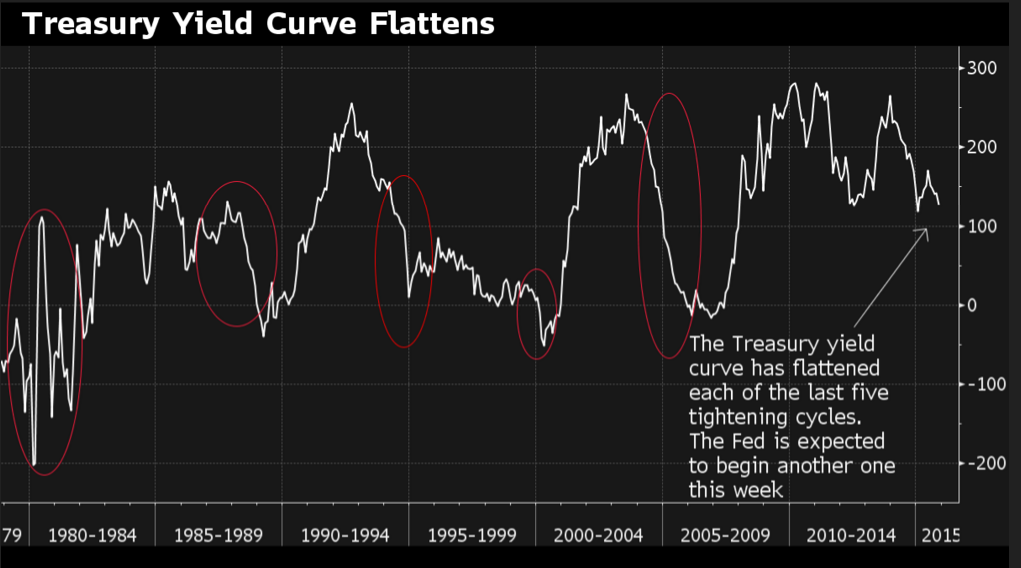
As a general rule, in credit crunches, the long bond rallies. You saw that on Friday, where the 10 year yield fell 10 basis points in spite of strong retail sales data. This week will be interesting between the evolving Third Avenue situation and the FOMC decision on Wednesday. LOs, expect bond market volatility this week. As a general rule, tightenings have not had a dramatic effect on mortgage rates. In fact, the yield curve has flattened during all the tightening cycles since 1979. Granted, these tightenings have taken place in context of a secular bull market in bonds, so take this analysis with a grain of salt. That said, unless the economy really starts taking off (and you start seeing wage inflation), chances are that the 10 year yield increases less than the amount of the rate hike. Note that CoreLogic is forecasting a 4.5% 30 year fixed rate mortgage by the end of 2016.

Mortgage loan performance has been improving, according to the OCC. Performing loans increased to 93.9% from 93% a year earlier. New foreclosures are down 22% YOY.
Ex GMAC Ally Financial is getting back in the mortgage business. Ally CEO said this about the move: “Don’t think of this as Ally going down the road of the old GMAC,” Brown said, referring to the home lending unit that brought Ally to the brink of collapse. The ironic thing is that the “new subprime” is auto loans, and that is Ally’s bread and butter these days. They are offering 8 year loans for new cars at rates at rates substantially below the 30-year fixed rate mortgage (think 3.5% range). Given that new cars depreciate like sushi, this is a very, very mispriced loan. If you are wondering why the Fed wants to get off the zero bound even in the face of zero inflation, there you go. Those sort of rates are a function of ZIRP and the impossibility of earning a decent rate of return. It would be ironic if the ne-er do well of mortgages had simply morphed into the ne-er to well of auto lending and we see a collapse in asset backed security liquidity.
Filed under: Morning Report | 13 Comments »
Posted on December 11, 2015 by Brent Nyitray
Stocks are lower this morning on emerging market weakness and oil. Bonds and MBS are up.
Retail Sales rose 0.2% in November, lower than expectations. Ex food, energy and building materials, they rose 0.6%, better than expectations.
Inflation at the wholesale level remains under control as the producer price index rose 0.3% in November. Ex food and energy and trade services it was up 0.1%.
Morgan Stanley is warning investors that the world’s central banks could succeed in creating inflation. Markets are definitely priced right now as if inflation is never ever coming back. We could see another bond sell-off like the “taper tantrum” of 2013. IMO, until we start seeing wage inflation we don’t have anything to worry about on that front.
The MR will be spotty next week as I will be on the Left Coast
Filed under: Morning Report | 9 Comments »
Posted on December 10, 2015 by Brent Nyitray
Markets are rebounding this morning after several days of losses. Bonds and MBS are flat.
Initial Jobless Claims rose 13k to 282,000 last week. The story remains the same: companies are reluctant to let go of employees.
The Bloomberg Consumer Comfort Index rose to 40.1 from 39.6 the prior week.
Filed under: Morning Report | 17 Comments »
Posted on December 9, 2015 by Brent Nyitray
Stocks are lower this morning on no real market-moving news. Bonds and MBS are down.
Mortgage Applications rose 1.2% as refis rose 3.5% and purchases were flat.
Wholesale inventories fell by 0.1% as sales were flat.
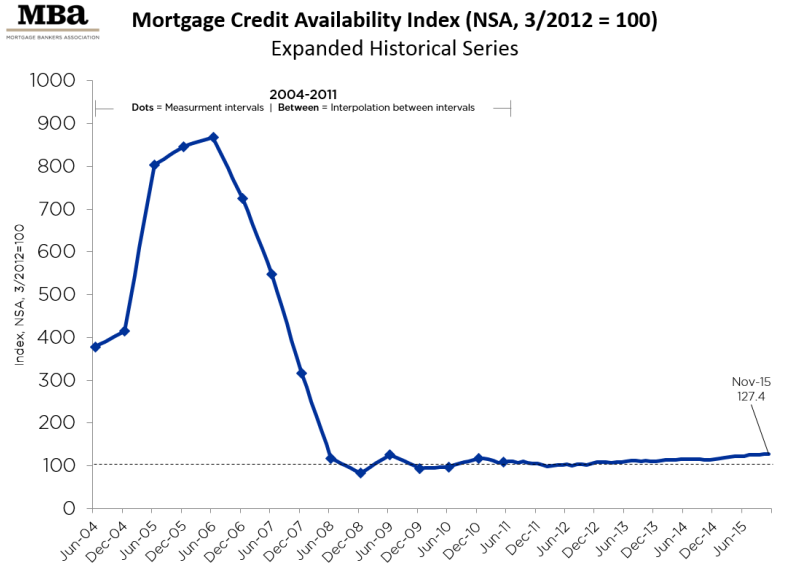
Mortgage credit availability fell in November, according to the MBA. This means credit standards increased. Conventional loans tightened while government loans loosened slightly. While mortgage credit availability has increased steadily since the US residential real estate market bottomed in 2012, it is still a shadow of its former self.

The MBA has its latest survey on mortgage bank profitability and volume. Last quarter, the average gain on a mortgage for independent mortgage bankers and the mortgage subsidiaries of banks fell from $1,522 to $1,238 (or about 55 basis points). On a year-over-year basis, it was an increase from $897 (or 42 bps) in the third quarter of 2014. Average volume in the third quarter was $614 million (or 2,609 units), which was the second highest print since 2008. Lots of useful stats in this survey.
While home prices have been appreciating at a mid single digit clip, rental prices have been increasing even faster. Last year, nearly half of all renters spent at least 30% of their in rent, which qualifies as cost-burdened. A quarter paid 50%. This is creating an affordable housing problem, especially in urban areas.
The Fannie Mae Home Purchase Sentiment Index fell a couple of points as increasing prices and limited inventory are making things difficult for potential buyers. Second, consumers are becoming a touch more pessimistic about their future incomes.
Filed under: Morning Report | 27 Comments »