Morning Report: Neel Kashkari wants to get tougher on the banks 2/17/16

Stocks are higher this morning as yesterday’s rally has follow-through on overseas markets. Bonds and MBS are down.

Mortgage Applications rose 8.2% last week as purchases fell 3.7% and refis rose 16%.

Housing starts came in 1.1 million, missing the 1.17 million estimate. Building Permits were flat at 1.2 million.

The Producer Price Index rose 0.1% in January. The core index (ex food and energy) rose 0.4%. The headline number was up 0.6% YOY and the core number was up 0.8%.

Industrial Production jumped in January by 0.9%, however the preior month was revised lower from -0.4% to -0.7%. Manufacturing Production rose 0.5%. Capacity Utilization improved markedly from 76.4% to 77.1%.

At 2:00 pm, we will get the FOMC minutes. Given the uncertainty around the Fed’s future plans, we could see the market more sensitive to these than usual.

Neel Kashkari of the Minneapolis Fed gave a speech to Brookings yesterday, calling for even more regulation for the banks and to turn them into public utilities. Of course any examination over whether the Fed had a hand in creating the real estate bubble in the first place is nowhere to be found.

The new enemy for consumer direct is not the government – it is a new robot designed to waste a telemarketer’s time.

Morning Report: Markets rebound after a long weekend 2/16/16

Green on the screen as investors return after a long weekend. Bonds and MBS are down small.

The Empire Manufacturing Index improved slightly to -16.64 versus -19.37 in the prior month.

The NAHB Homebuilder Sentiment Index fell to 58 from 61 in February.

Saudi Arabia, Russia, Venezuela and Qatar agreed to freeze production at January levels provided the other members of OPEC agree to go along. Apparently this has been in the works for a while, so oil isn’t having much of a reaction.

Household debt increased 0.4% in the fourth quarter, according to the NY Fed. Student Loan and Auto loan financing are growing the most, while mortgage and HELOC is steady or falling. Credit quality for mortgage debt remains strong, however you can see the increase in low-FICO auto loans (the new subprime). Debt levels below:

As the Spring Selling Season begins, inventory remains tight, especially close to urban areas. The supply of homes is the lowest since 2005.

Morning Report: Rates back to pre-taper tantrum levels 2/11/16

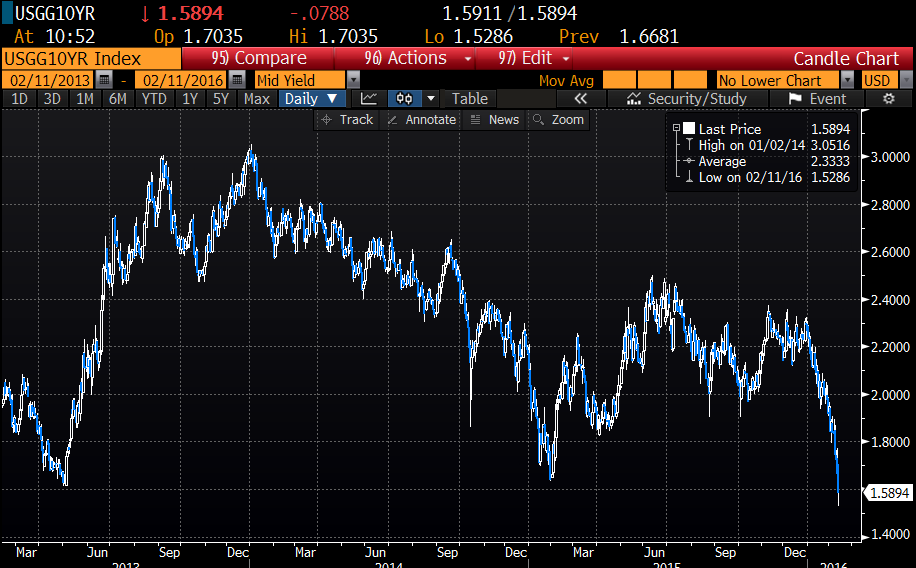
Global stock markets are down again on no real news. Whatever comfort markets took in Janet Yellen’s remarks yesterday are over. Bonds and MBS are up, with the 10 year bond yield pushing a 1.5% handle.

Speaking of Janet Yellen’s plan to continue to increase the Fed Funds rate, the markets are not buying. The Fed Funds Futures contracts are forecasting no rate hikes until 2018.

Loan officers, you have been given an unexpected gift with the 10 year. Rates are now at the pre “taper tantrum” level when the Fed started bracing the markets for the end of QE. So I guess the Fed didn’t need to purchase $4 trillion worth of assets to get rates down?

Initial Jobless Claims fell to 269k from 285k last week. It bears repeating that these numbers are exceptionally good and are associated with boom times. The tape doesn’t care, but still…

The Bloomberg Consumer Comfort Index rose slightly to 44.5 from 44.2 last week. Lower gasoline prices are helping improve the mood.

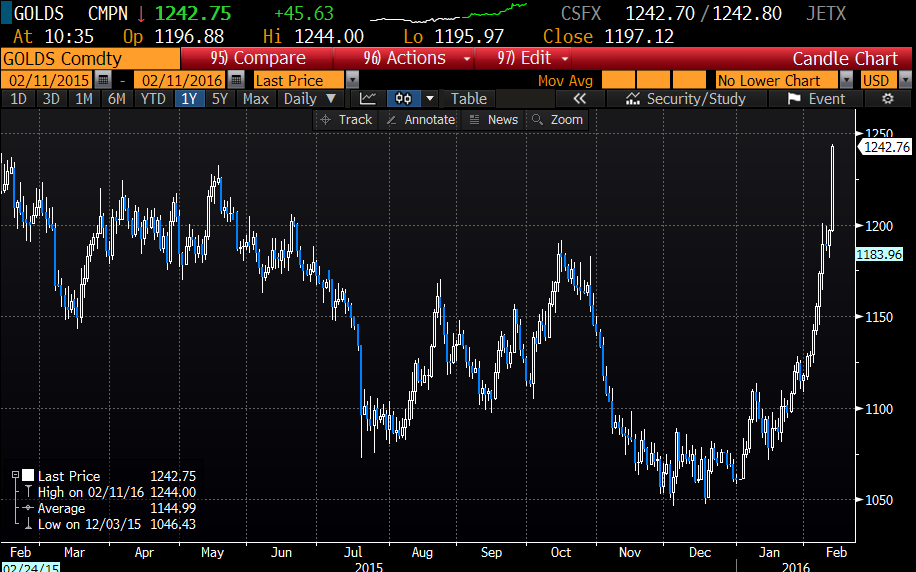
Most commodities have been getting crushed lately, however one has been on a tear: Gold. Gold is a strange animal, in that it is one of the few financial assets that isn’t some else’s liability. The price of gold can be considered to be the (inverse) confidence indicator in the world’s central banks. Gold up, confidence down.

Continuing on the central bank thread, one of the bright spots in the US markets has been auto sales. This has been driven by a couple things: The biggest was that people deferred replacing cars until they absolutely had to due to the lousy economy. However another reason is cheap credit, and some hedge funds think they have found the new “big short” in subprime auto. When you can get an 8 year loan for a new car at a rate below the 30 year fixed rate mortgage, something is awry.

So, yet another pillar holding up the economy was based on cheap credit. Janet Yellen must feel like Michael Corleone: “Just when I thought I was out, they pull me back in.”

The House Financial Services Committee is having a hearing today on FHA MIP. Expect Democrats to push for another cut and Republicans to be against it. The Democrats are in a strange position with the base continuing to push for even tougher regulations for the industry and the affordable housing types getting sick and tired of the tight credit that results.

Russia

Russia

A wounded economy

It is closer to crisis than the West or Vladimir Putin realise

Nov 22nd 2014 | From the print edition The Economist

VLADIMIR PUTIN is not short of problems, many of his own creation. There is the carnage in eastern Ukraine, where he is continuing to stir things up. There are his fraught relations with the West, with even Germany turning against him now.  There is an Islamist insurgency on his borders and at home there is grumbling among the growing numbers who doubt the wisdom of his Ukraine policy. But one problem could yet eclipse all these: Russia’s wounded economy could fall into a crisis.

Some of Russia’s ailments are well known. Its oil-fired economy surged upward on rising energy prices; now that oil has tumbled, from an average of almost $110 a barrel in the first half of the year to below $80, Russia is hurting. More than two-thirds of exports come from energy. The rouble has fallen by 23% in three months. Western sanctions have also caused pain, as bankers have applied the restrictions not just to Mr Putin’s cronies, but to a much longer tally of Russian businesses. More generally, years of kleptocracy have had a corrosive effect on the place. Much of the country’s wealth has been divided among Mr. Putin’s friends.

Everybody expects continued stagnation, but the conventional wisdom is that Mr. Putin is strong enough to withstand this. The falling rouble has made some export industries like farming more competitive. These exports combined with Mr. Putin’s import-blocking counter-sanctions mean Russia still has a small trade surplus. It has a stash of foreign-exchange reserves, some $370 billion according to the central bank’s figures. Add in the resilience of the Russian people, who are also inclined to blame deprivation on foreigners, and the view from Moscow is that Mr Putin has time to manoeuvre. People talk loosely about two years or so.

In fact, a crisis could happen a lot sooner. Russia’s defences are weaker than they first appear and they could be tested by any one of a succession of possibilities—another dip in the oil price, a bungled debt rescheduling by Russian firms, further Western sanctions. When economies are on an unsustainable course, international finance often acts as a fast-forward button, pushing countries over the edge more quickly than politicians or investors expect.

Putin a good man down

The immediate worry is the oil price. Mr Putin is confident it will recover. But supply seems set to increase, with OPEC keen to defend its market share.  American government agencies predict oil prices could average $83 a barrel in 2015, well below the $90 level Russia needs to avoid recession (and to keep its budget in balance). If global demand weakens—Japan has slipped into recession since the latest round of forecasts—the oil price could fall further. That would immediately prompt investors to reassess Russia’s prospects.  Then there are the debt repayments. Russia’s firms have over $500 billion in external debt outstanding, with $130 billion of it payable before the end of 2015, at a time when few Western banks want to increase their exposure to Russia.  Even firms that earn dollar revenues may struggle to pay their debts. Rosneft, an oil giant, recently asked the Kremlin to lend it $44 billion. Mr Putin has so far resisted, but he cannot let a company that is 70% state-owned and employs 160,000 people fail. There is a lengthening queue of troubled Russian firms.

Non-performing loans were rising even before interest rates were raised to 9.5% to defend the rouble. Meanwhile Russian banks are reliant on the central bank to replace deposits that their customers are understandably spiriting into dollars.  Directly or indirectly, many of these bills will end up with the Kremlin, which is why its reserves will be vital. They are evaporating: down $100 billion in the past year, following failed attempts to defend the rouble. And the book-keeping is dodgy. Of the reported $370 billion reserve pile, more than $170 billion sits in the country’s two wealth funds. Some of their assets are iffy, including various stakes in Russia’s state-owned banks and debt issued by Ukraine that Mr Putin’s own aggression is fast rendering worthless. One of the funds is earmarked for pensions. In reality, Russia’s government has perhaps $270 billion of hard cash that is accessible and usable without massive cuts elsewhere—less than its external obligations due over the next two years.

All this spells trouble for Russia, but Mr Putin’s marauding foreign policy could accelerate things. This after all is a man who has invaded other countries and lied about it. A deeper foray into Ukraine would lead to stronger sanctions by Western countries. Some of them, such as barring Russia’s banks from the SWIFT international payments system, could halt Russian trade altogether. A partial block on oil exports would fell the economy, as it did Iran’s. And the more trouble he faces, the more likely Mr Putin is to play the nationalist card—and that means more foreign forays, and yet more sanctions.

From Russia to Rio, without much love

Russia’s biggest recent economic crisis, in 1998, led to a government default.  This time a string of bank failures, corporate defaults and a deep recession look likelier. Even so the pain from these could spread abroad quickly, both to countries that rely on Russian trade (exports to Russia account for fully 5% of GDP in the Baltics and Belarus) and through financial ripple effects. Banks in both Austria and Sweden are exposed. And if firms in one badly run commodity-driven country start to default on their dollar debts, then investors will worry about others—such as Brazil.

If Russia’s economy looks likely to collapse, there will be inevitable calls in the West for sanctions to be cut back. This week Mr Putin pointed out that 300,000 German jobs depend on trade with his country. But Angela Merkel rightly stood firm. Actions, Mr Putin must finally learn, have consequences. Invade another country, and the world will act against you. And the same goes for the economy, too. Had Mr Putin spent more of his time strengthening Russia’s economy than enriching his friends, he would not find himself so vulnerable now.

Latest interview on Blog Talk Radio. 7/1/13

I talk about the Fed, interest rates, and real estate.

http://www.blogtalkradio.com/capitalmarketstoday/2013/07/01/special-edition-market-turmoil-bond-market-interest-rates

Shameless Plug

I started writing for this site as well – http://marketrealist.com/

Free professional investment research for individual investors.  Check it out.

The Straw Krugman

Dr. Cowbell (to steal just one of his nicknames) is both flattered and amused by how he has become the favorite boogeyman of the right:

Funny: Angry Bear finds some of the usual suspects explaining How to Debate Paul Krugman, and the answer appears to be this: invent a straw man who bears no resemblance at all to the economist/columnist of the same name, and ridicule that imaginary person.

I have to say, never in my wildest dreams did I imagine that I could play the role of History’s Greatest Monster to so many people. Thank you for the honor!

Aside from the silliness of the exercise, this little exchange is another illustration of a point I’ve noticed before: the way hard-right commentators assume that the other side must be their mirror image. They insist that no government intervention is ever justified; so liberals must support any and all government interventions. They want smaller government, as a principle; liberals must want bigger government, never mind what for. They believe that deficits and printing money are always evil; liberals must be for deficits and money-printing under all circumstances.

I’m sympathetic to this argument because I’ve seen it in action. It seems that expressing an opinion that the legitimate of role of government is slightly more than what Friedrich Hayek (or Ron Paul) would allow makes one an advocate of Politburo-style central planning.

The column Krugman links too has a deeper link to this item where Krugman’s Articles of Faith are enumerated. I’ve conveniently bolded the portions which do seem like legitimate strawman statements.

1) Recessions, depressions and crises are the result of the unhampered market. We actually do not have to investigate if markets were really free when recessions occurred or what really were the specific causes of whatever threw the economy off track. When there is a recession, depression or crisis, there must have been too much of an uncontrolled market.

2) The Great Depression was caused by uncontrolled markets.

3) Recessions, depressions and crises are practically the result of one problem: a lack of aggregate demand. People, for whatever reason (and who cares about the reason; let’s not get hung up on those details) don’t spend enough. If everybody were to spend more, people would sell more. Problem solved. It is the role of government to get people spending again. This is done by printing money and causing inflation so that people spend the money rather than save it. Or by the government running up deficits and spending it on behalf of the stupid savers.

4) The Great Depression was solved by the government spending lots of money and the central bank printing lots of money.

5) This explains ALL economic problems.

6) If there are recessions, depressions and crises, they can all be solved by printing money and by deficit spending.

7) If after many rounds of money printing and deficit spending, there is still a recession, then only one conclusion is permissible: There was obviously not enough money printing and deficit spending. We need more of it.

8) If after another round of money printing and deficit spending we still have a recession, then….well, do you not get it? We obviously have NOT PRINTED ENOUGH MONEY and we are NOT ACCUMULATING ENOUGH DEBT! And, by the way, remember 7) above.

Krugman is practicing Keynesianism as a religion. The 8 commandments above are not to be questioned. Whoever questions them is not worthy of debate.

Now, this attack is not completely unfair since Krugman is easily the most visible and vocal advocate of classical Keynesian stimulus. But also in the article is a video of noted libertarian Hans-Hermann Hoppe, a stereotypical Austrian Economist in both accent and philosophy, who says this is the way to engage Krugman:

Ask some questions almost like a child. Explain to me how increases in paper pieces can possibly make a society richer. If that were the case, explain to me why is there still poverty in the world? Isn’t every central bank in the world capable of printing as much paper as they want?

Now here is a debating style I have come to be familiar with recently. Just pepper someone with a litany of seemingly simple questions which belie the fundamental assumptions and premises beneath them.

If we were to pick a Most Ridiculed Pundit on ATiM, Krugman would probably be in the top three. And I am no fan of his tendency to insult the basic education of his opponents, particularly ones with credentials approaching his own. But to engage in my own logical fallacy of Arguing From Authority, they don’t give out Nobel Prizes for collecting box tops. Krugman is both fun to read and fun to ridicule but he rarely makes the arguments people claim he has made. Or when he has, he is far more likely to be right than the people just tearing him down on an ad hominem basis.

Capital Markets Today

Interview I did with Capital Markets Today where I discuss the fiscal cliff, the economy, and real estate.

Edit:  Updated link

Article I wrote for the Scotsman Guide Dec issue.

http://www.scotsmanguide.com/default.asp?ID=5341

Last Call for Twinkies

“Hostess Brands Says It Will Liquidate”

By MICHAEL J. DE LA MERCED