Morning Report: Mixed jobs report 3/4/16

Stocks are flattish after the jobs report. Bonds and MBS are down.

Jobs report data dump:

  • Nonfarm payrolls +242k
  • Unemployment rate 4.9%
  • Average hourly earnings -0.1%
  • Labor force participation rate 62.9%
  • Average weekly hours 34.4

Overall, an okay report: payrolls were better than expected, but hourly earnings disappoint. The increase in the labor force participation rate is a good thing to see. While it will depress wage growth at least initially, it will make for a stronger economy down the road. FWIW, there may be measurement issues regarding the wage measure that will supposedly be unwound in the next report.

Bonds sold off on the jobs report, with the 10 year and the 2 year bond yields up 3 basis points. I doubt this report will change any minds with regard to the March FOMC meeting, which most people seem to think will have no move in rates and hawkish language.

More evidence of wage inflation: Costco is upping the lower end of their wage scale from $11.50 to $13.00. They announced it on their earnings conference call last night. This will hit their earnings per share by about 1.3% over the next year. Competition for workers is becoming more intense as unemployment stays below 5%.

Morning Report: Lots of economic data this morning 3/3/16

Stocks are slightly lower as a slew of economic data comes in this morning. Bonds and MBS are flattish.

Outplacement firm Challenger, Gray and Christmas reported that announced job cuts rose 21.8% in February to 61.6k. The energy sector accounted for 25k of the losses, followed by chemicals, computer, and industrial goods. The West and the Midwest bore the brunt of the cuts. Remember these are announced job cuts and often never actually happen. Overall, the employment picture is looking decent, however we’ll get a better look tomorrow.

Here is a table of the industries hit. Note that aside from energy, job cuts are pretty low. Note that these are not net numbers either – they don’t take into account any sort of hiring.

Initial Jobless Claims rose to 278k last week. Anything below 300k is a good number.

The ISM Non-manufacturing composite fell slightly to 53.4 in February from 53.5 in January. Business continues to be decent in the services sector.

Factory Orders fell 1.6% in January, while durable goods orders rose 4.7%. Capital Goods Orders rose 3.4%.

Why is wage growth so difficult to find? Productivity growth has been weak since peaking around 1999 – 2000. This was the tail end of the big boost from the Internet and the decade-long transformation of the PC into a tool on everyone’s desk. Last quarter it came in at -2.2%. Productivity has been negative for 3 out of the past 4 years, and that is not a recipe for wage inflation.

Unit Labor costs rose 3.3% in the fourth quarter, which drove the drop in productivity as output only increased 1%.

The Markit US Services PMI fell slightly in February to 49.7 while the composite PMI was flat at 50.

The Bloomberg Consumer Comfort Index fell to 43.6 from 44.2 last week. Falling perceptions of the economy drove the decline.

2012 Presidential Nominee Mitt Romney is going to try and push back the Trumpmentum with a speech tonight.

Nothing too earth-shattering in the Fed’s Beige Book which was released yesterday. Overall, manufacturing is flattish compared to last month, however labor markets improved overall, and “wage growth varied considerably, from flat to strong, across all districts.”

Morning Report: Global yields continue to fall 3/2/16

Stocks are lower this morning after yesterday’s strong rally. Bonds and MBS are down.

Mortgage Applications fell 4.8% last week as purchases fell 0.6% and refis fell 7.2%.

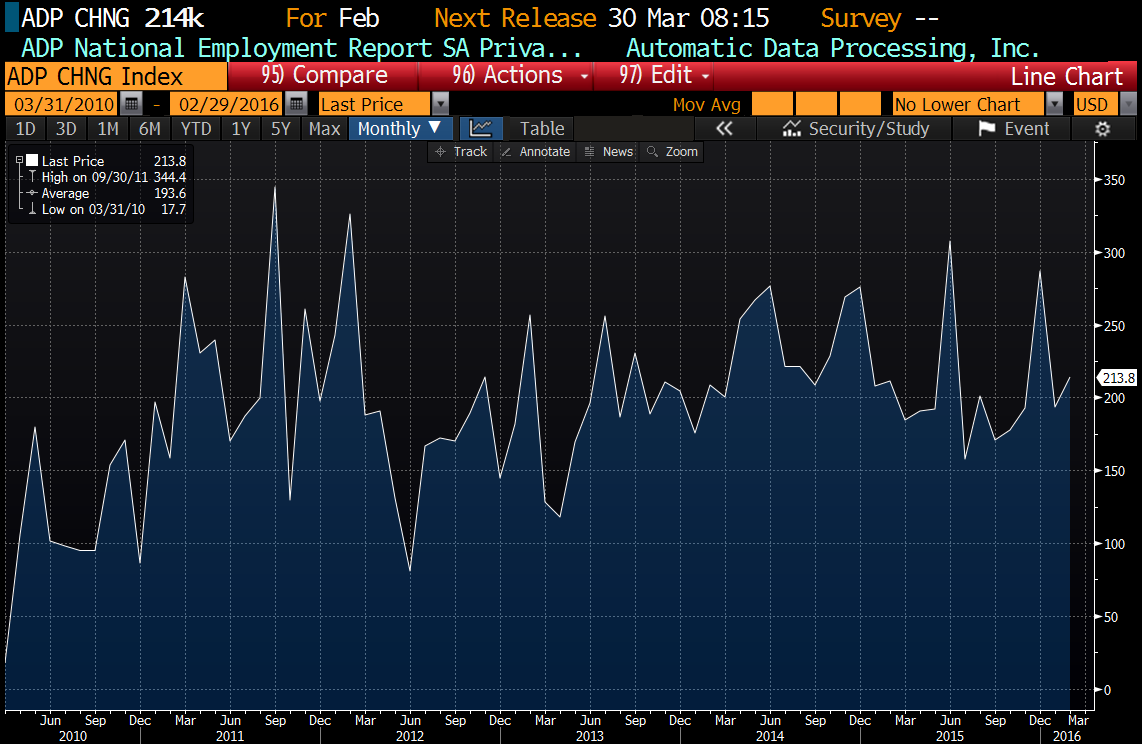
The ADP Employment change came in stronger than expected at 214k jobs. The Street is forecasting an increase of 195k payrolls for Friday’s jobs report. All of the activity was in the services sector, as the manufacturing sector lost about 9,000 jobs and the financial sector added only 8,000.

Chart: ADP jobs

The ISM New York Index fell slightly to 53.6

Donald Trump and Hillary Clinton were the big winners on Super Tuesday. You can probably stick a fork in Sanders at this point. For the GOP, the question is whether Donald Trump is a plurality winner or a majority winner. The establishment is hoping that once they coalesce around a single candidate, the numbers will swing to that candidate. If they go the brokered convention route, Trump will almost certainly run as an independent, which guarantees a Clinton landslide.

Yesterday was a bloodbath in Treasuries, with the 10 year yield increasing about 9 basis points to 1.82%. The 2 year yield increased 7 basis points. If we see strong wage growth on Friday’s jobs report, we could see further weakness in Treasuries.

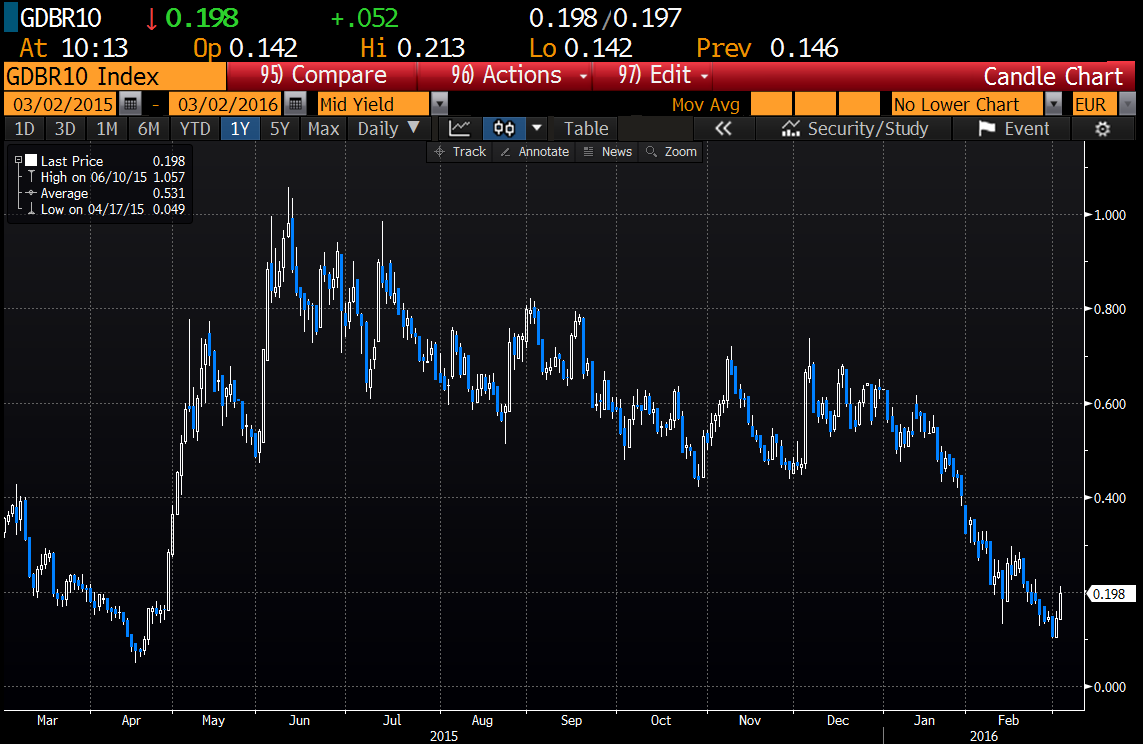
To put the current 1.85% 10 year yield in perspective: when the Fed hiked rates last December, the yield was 2.3%. That said, the fact that interest rates are falling globally will prevent Treasuries from falling too much. Note the German 10 year Bund is close to the sub 10 basis point lows of last spring, and currently yields 18 basis points. The Japanese Government 10 year bond yield is negative 5 basis points. Global investors look at Treasuries yielding more than Italian, Spanish, and Irish bonds and see relative attractiveness, especially since the US is about the only country not trying to devalue its currency. That should help keep a lid on rates.

Chart: German Bund Yield

The collapse in global bond yields is sending a signal that the Fed isn’t going to ignore – that deflation remains a threat. Janet Yellen has pledged to let the labor market “run hot” for a while and that means letting wage growth run. The big question is what happens to the labor force participation rate. If these workers come back, that will prevent too much wage inflation and will be ultimately better for the economy in the longer term. If they don’t, then look for wage inflation to begin and the Fed to move earlier.

Morning Report: Markets at odds with Fed forecasts 3/1/16

Green on the screen this morning as oil and emerging markets rally and the Chinese act to boost lending. Bondsd and MBS are flat.

The ISM manufacturing Index improved to 49.5 from 48.2 last month. Still below 50, which indicates a slowdown, but better than expected. The Markit US Manufacturing PMI came in at 51.3, better than expected.

Construction Spending rose 1.5% in January, much higher than the 0.3% forecast. Public construction drove the increase. Private residential construction was flat for the month.

The turmoil in the financial markets and the global economy have cooled the market’s forecast for further rate hikes. The Fed Funds futures contracts are now forecasting only a 10% chance of a rate hike at the upcoming March meeting and a coin toss for one by December. This is at odds with the last dot graph from the December FOMC meeting, where the median forecast was 1.25% by the end of 2016.

Vehicle sales are coming in strong this morning. Ford Feb sales were up 20%, while Fiat Chrysler sales were up 12% on strong Jeep sales. SUVs were the big gainer overall, as lower gasoline prices entice drivers to switch to bigger cars. Much of this growth is being fueled by cheap credit, however there is so much pent-up demand for new cars (the average age of a car in the US is 11.4 years) that this growth is probably sustainable for the near term and isn’t just a cheap credit story.

Today is Super Tuesday, where 12 states are holding primaries. So far, it looks like Hillary Clinton and Donald Trump will emerge as the winners.

Elmer Fudd warns of “distortions to savings and investment” due to negative interest rates. As the primary architect of the Great United States Housing Bubble, it would have been nice if he had worried about monetary policy-driven distortions to savings and investment say, 15 year ago.

Home prices continue to rise according to CoreLogic. Prices rose 1.3% MOM and are up 6.9% YOY. According to Corelogic, prices remain about 7% below their April 2006 peak. Overvalued markets include many in Texas, Washington DC, and Florida. You can see in the map below, which areas are cheap and expensive (green=cheap, red=expensive).

NAR is predicting existing home sales of 5.38 million in 2016, with average home price appreciation of 4% to 5%. It looks like the Northeast is finally starting to pick up a bit, with contracts up 11% in January.

Morning Report: Walter and Ocwen miss 2/29/16

Markets are higher this morning after the Chinese cut reserve requirements in an effort to stimulate their economy. Bonds and MBS are flattish.

The ISM Milwaukee Index improved to 55.2 from 50.4, while the Chicago Purchasing Manager index fell to 47.6 from 55.6.

Pending Home Sales fell 2.5% in January, according to NAR. A dearth of inventory continues to weigh on the market.

The corporate bond market is having difficulty digesting new issuance. Over the past 12 months, there have been 75 “no go” days, where the primary market was essentially shut. This is higher than the bad old days of 2008-2009. High Yield is even worse, with issuance down 75% year-over-year.

When the stock and bond markets disagree, go with what bonds say. Unsurprisingly, asset managers continue to rotate out of stocks and into bonds.

Warren says don’t worry, be happy. Also the annotated version of the annual letter.

What are the characteristics of houses that sell quickly? Spanish architecture and 1,500-2,000 square feet.

Originator and servicer Walter Investment reported lower than expected earnings this morning and the stock is down about 10%. for 2015, originations were up 36% and the servicing portfolio increased by 4%. In the fourth quarter, origination volume was up 8% YOY.

Walter wasn’t the only company to miss this morning: Ocwen also is down about 11% after missing its quarter. Delinquencies rose to 13.7% from 13.1%.

Morning Report: Home Prices Continue to rise 2/25/16

Stocks are flat this morning on no real news. Bonds and MBS are up.

Initial Jobless Claims came in at 272k, an increase of 10k from last week.

Durable Goods orders rebounded smartly after a terrible December. They were up 4.9%, way better than the Street expectations.

Capital Goods orders rose 3.9% as well. Capital Goods orders are a proxy for business capital investment, so whatever turmoil is happening in the financial markets doesn’t seem to be affecting Main Street, at least not yet.

House prices rose 1.4% in the fourth quarter, according to the FHFA House Price Index. Home prices have now surpassed their bubble peaks and are making new highs. Note that this index is a sub-index of the real estate market – it only looks at homes with conforming mortgages, so it excludes all cash distressed sales and the jumbo market.

In other economic data, the Bloomberg Consumer Comfort Index fell slightly last week to 44.2. Consumer comfort is crawling back to the bubble days, but still is lower than the Big 90s when the stock market bubble was raging.

One thing that is apparent in this election cycle is that it is hip to bash big business. Why won’t they fight back and tell their side of it? In essence, they dismiss the current populism as so much heated campaign rhetoric and believe that when the election is over, it is back to business as usual. FWIW, they have scored some big victories with the Ex-Im bank and the TPP trade deal. Wall Street, for some inexplicable reason, continues to be content with being a punching bag.

Realtor.com lays out the 20 hottest real estate markets in February. Cliff Note version: mainly California. The Northeast is deader than Elvis.

The Atlanta Fed lowered their Q1 GDP estimate to 2.5% from 2.6%.

Morning Report: New Home Sales fall 2/24/16

Markets are getting pounded on the new worry du jour: Brexit. Bonds and MBS are rallying..

Brexit is the threat of the UK leaving the EU. It has implications mainly in the foreign exchange markets, but if the markets need something to worry about, well there you go.

Mortgage Applications fell 4.3% last week as purchases rose 2.2% and refis fell 7.7%. The spike in rates last week killed the refis.

New Home Sales continue to disappoint. Sales fell in January to 494k from 544k in December. For whatever reason, homebuilders continue to hold back production and rely in price hikes to move the top line.

Regardless, people are still optimistic about the housing sector going forward. Toll Brothers mentioned that a dearth of skilled labor is an issue. Interestingly, average selling prices on signed contracts are falling for them in some areas of the country (the Mid-Atlantic and the South) and are flat in the West. Their urban luxury apartment sector was where all the ASP growth was. Perhaps the builders have pushed price hikes about as far as they can and now buyers are beginning to balk.

Morning Report: Home Prices continue to rise 2/23/16

Stocks are lower this morning on fears of another yuan devaluation. Bonds and MBS are down.

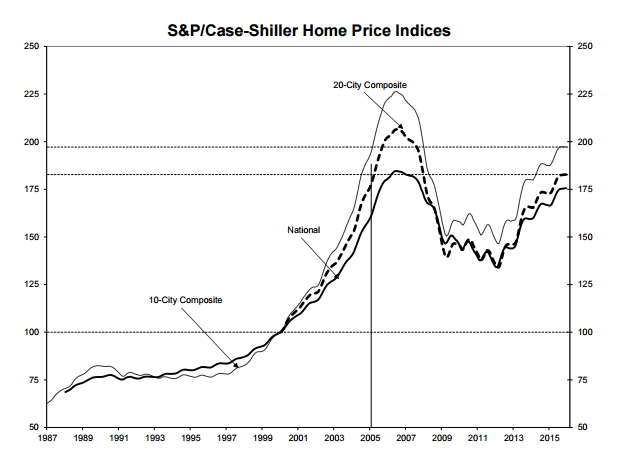
Home Prices continued to rally in December, according to the Case-Shiller Home Price Index. They were up 0.8% on a month-over-month basis and up 5.7% on a year-over-year basis. Prices remain about 11.5% below their July 2006 peak. Note the FHFA House Price index which we will get on Thursday is already at new highs.


Existing Home Sales were up 0.4% at 5.47 million units in January, according to the National Association of Realtors. On a year-over-year basis, they are up 11%, the biggest gain in 3 years. The median home price rose 8.2% year-over-year to $213,800 as supply constraints continue to drive up prices. Housing inventory is 1.82 million units, which represents a 4 month supply. A balanced market is more like 6 – 6.5 month’s worth. Ultimately, the big price increases are unhealthy because incomes have yet to really exhibit growth (although that may be changing). The median house price to median income ratio is roughly 3.8x, using the median income data from Sentier. 3.3 – 3.7x which is about normal.

Speaking of home supply, McMansion builder Toll Brothers reported earnings this morning. Revenues were driven again by an 11.7% increase in average selling prices and not by unit growth. Gross margins fell, which speaks to increasing costs. So far this February, deposits and contracts are flat with last year. The decline in stocks probably has a lot to do with it as the luxury buyer is going to be more sensitive to asset prices than the first time homebuyer.

Interesting to see this dynamic with the builders – a reluctance to build more units despite higher prices. Interestingly, CalAtlantic (the new name for Standard Pacific and Ryland after their merger) is bringing back the buydown loan.

In other economic news, consumer confidence slipped in in February, and the Richmond Fed Manufacturing Index both fell.

Blackrock is warning clients that the Fed is not likely to sit out the rest of 2016, the way the Fed Funds futures markets are predicting. Efficient market theorists might scoff at that notion, however the interest rate markets are so manipulated by central banks at the moment it makes sense to look at market signals with a jaundiced eye. What does that mean to mortgage types? Make hay now, because no one knows how long these low rates are going to stick around.

Speaking of credit markets, the new subprime – auto loans – are beginning to exhibit signs of trouble. Auto loans are being priced like mortgages, however a mortgage is secured by a generally appreciating asset, while an auto loan is secured by a depreciating asset. This is the result of financial repression, which is the act of pushing interest rates to the floor. Investors who have to earn a return (like pension funds and insurance companies) are forced to move further and further out on the risk curve to earn their required return. The actuarial tables really couldn’t care less that interest rates are zero.

Donald Trump looks to be cruising to a third consecutive victory in Nevada. The big question for the D is whether he is a plurality winner or a majority winner. Once the establishment coalesces around one candidate will he continue to lead? One other interesting tidbit: Democratic turnout for the primaries is pretty depressed. Republican turnout is huge. Kind of pokes a hole in the media’s attempt to create a Bernie Sanders movement, doesn’t it?

Morning Report: Inflation returns to the Fed’s target 2/19/16

Markets are lower this morning on no real news. Bonds and MBS are down.

Real Average weekly earnings increased 1.2% in January.

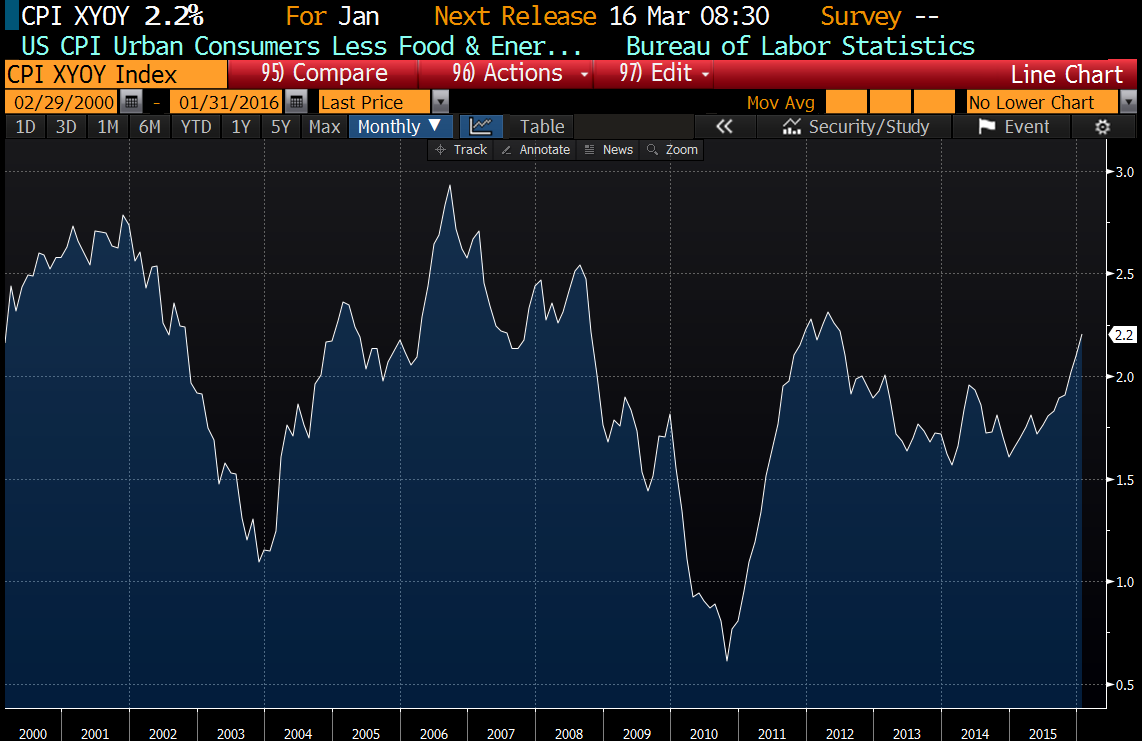
Inflation at the consumer level was flat month-over-month and up 0.3% YOY. Ex food and energy, it was up 2.2%, which is the highest level since June of 2012. This would indicate the Fed is actually getting there as far as its inflation target. That said, the Fed prefers to use the Personal Consumption Expenditure index, which is still below their target.

Chart: YOY inflation, ex-food and energy:

Good explanation of why the markets and the price of oil have become positively correlated. Old timers might remember back when an increasing oil price was a bad thing. Punch line: the banks have a lot of exposure to the energy patch and are lugging debt that made sense at $60 a barrel, but not at $30. That said, energy companies have issued $5 billion in equity secondary offerings this year, which is a surprise. The appetite is there, at least for some investors.

The thinking behind negative interest rates, explained. European economists give their take on it. Basically they work well in smaller. open economies as a lever to manipulate foreign exchange rates, but they aren’t all that effective for larger economies which are trying to boost inflation and growth. In other words, they might work for Denmark, but probably won’t do much good here. Japan recently went negative, so that will be a good test of that theory.

Housing affordability is getting a little better as rates fall. Unsurprisingly, the Rust Belt and the Northeast are the most affordable, while California remains the worst. Note San Francisco is proposing transfer taxes for luxury properties in order to address affordability. Between rich tech workers and Chinese investors, property prices in San Francisco are sky-high.

There is legislation afoot to eliminate the caps on VA loans, which will make them much more popular in high cost areas. Basically it will become a no money down jumbo. It has passed the House, and the prospects are good in the Senate and the WH.

Morning Report: FOMC minutes show Fed is preparing to back off on tightening 2/18/16

Stocks are higher this morning after oil continues its rally. Bonds and MBS are flat

Initial Jobless Claims fell from 269k to 262k., while the Philly Fed improved to -2.8.

The Bloomberg Consumer Comfort Index fell slightly to 44.3 from 44.5 the prior week. The Economic Expectations index fell markedly from 47 to 42.5.

The Index of Leading Economic Indicators improved slightly in January from -0.3% to -0.2%.

Mortgage Delinquencies fell from 4.99% to 4.77% and foreclosures fell from 1.88% to 1.77% in the fourth quarter, according to the MBA.

The FOMC minutes were released yesterday, and for the most part they were a non-event as far as the markets were concerned. The Fed did spend some time talking about the slowdown in China, and the reverberations in the markets. A number of officials are beginning to think the inflation forecasts are too high. In addition, the stresses in the financial system act as a tightening even if rates go nowhere. The Fed seems to be setting the stage for a cut in the GDP and inflation forecasts at the March meeting, as well as a pause in tightening. Separately, the OECD took down its forecast for global growth to 3.0% from 3.3%.

Mortgage REIT MFA Financial reported earnings this morning. They continue to position their portfolio of MBS more towards credit risk and less towards interest rate risk. When the private label securitization market comes back, REITs like MFA will be the big buyers of non-QM paper. Their appetite for non-agency MBS will be the key driver bringing back the widespread use of products that don’t fit in the agency box.

FHFA Chairman Mel Watt says that the GSE’s lack of capital is the most serious risk to the mortgage market right now. He says that guarantee fees have increased 25 basis points since 2009 and they are now “appropriate.” He also said that the current state of conservatorship is “not a desirable end state” and said that the GSE’s protection from market forces “presents itself in multiple decisions, including pricing.”