Morning Report: 7% of all mortgages are in forbearance.

Vital Statistics:


Last Change
S&P futures 2912 42.1
Oil (WTI) 12.71 -0.29
10 year government bond yield 0.64%
30 year fixed rate mortgage 3.43%


Stocks are higher this morning as earnings continue to come in. Bonds and MBS are flattish.


7% of all mortgages are in forbearance, according to the MBA. Ginnie Mae loans (FHA and VA) are now at 10%. Fannie loans are 4.6% and Freddie are 5.5%. Private label increased to 7.5%. The FHFA has also released a press release saying that lump sum payments at the end of the forbearance period are not required.


The Economic Policy Institute (a lefty think tank) estimates from a poll that initial jobless claims are understated by 9 – 14 million due to system problems, in other words people who can’t register because the state unemployment sites are overwhelmed with traffic. If they are right, then the actual number of people who lost their jobs due to COVID is about 37.5 million. In other words, about 662 livelihoods per person who has died from the virus.


The COVID lockdown is beginning to affect the food supply as well. At some point the cure is worse than the disease.


The Fed begins the two-day FOMC meeting this week. They can’t do much more monetary policy wise, but it sure would be nice if they announced a facility to allow mortgage bankers to repo servicing advances.


Home prices rose 0.4% MOM and 3.5% YOY in February, according to the Case-Shiller Home Price Index. It will be interesting to see if the COVID crisis affects home prices nationally. FWIW, Pulte said on its conference call that it hasn’t cut prices at all. In some markets where there is excess spec inventory, builders are adding financing incentives, but not breaking price.


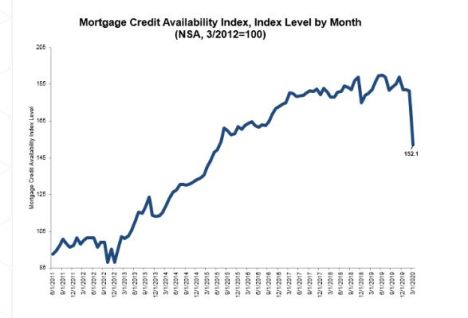
We are starting to see warehouse banks curtail high balance loans. Cash-out refis are also getting harder to do. I heard a rumor that Ginnie Mae may also introduce some sort of vehicle to pass some of the forbearance costs onto lenders (perhaps a special pool for forbearance loans). While the government’s forbearance policies may provide relief to homeowners, the unintended consequence is a severe restriction in credit.


One of the big trends in the aftermath of the financial crisis was the Millennial Generation preferring to live in urban walkable areas. COVID-19 might have stuck a fork in that trend. Good news for suburban SFR property owners.

Morning Report: Shelter in place orders are being relaxed

Vital Statistics:


Last Change
S&P futures 2856 28.1
Oil (WTI) 12.71 -4.29
10 year government bond yield 0.63%
30 year fixed rate mortgage 3.43%


Stocks are higher this morning on optimism that we have turned the corner on the COVID-19 crisis. Bonds and MBS are down.


In terms of economic data, the big number will be the first pass at Q1 GDP will be released on Wednesday. The consensus is that GDP contracted 3.8% as consumer spending falls 1.5%. Trump Administration Advisor Kevin Hassett thinks the economy could contract 30% in Q2.


The Fed will have the April FOMC meeting this week, and with rates already at zero, it probably won’t have the impact it normally has. Speaking of the Fed, they are ratcheting back MBS purchases again this week, with only $8 billion a day.


It looks like some states are beginning to relax the shelter-in-place orders, and even New York is looking to ease things in mid-May. If these states end up seeing no big uptick in cases, I expect the rest of the country to follow pretty quickly. Especially if the number of deaths settles in under 100k. FWIW, I think if most of the country is back to normal by Memorial Day, we can take the Great Depression II economic forecasts off the table.


Ex MBA President wrote a scathing editorial in Housing Wire regarding Mark Calabria and how he is the worst person for the job right now. In Mark’s defense, his job is to protect the GSEs and (and therefore the taxpayer), however Dave is correct that taking a cavalier attitude with non-bank servicers is not the best look right now when (a) the government imposed this forbearance period on everyone and (a) the GSEs are part of the government. If the government goes forward and imposes all of these costs on the industry, the least it can do is help mitigate those as much as it can. Perhaps the aid doesn’t need to come from Fannie and Freddie, but the government should provide it from somewhere.


Home price appreciation is slowing, but not dropping yet, according to Realtor.com. Inventory is tight, largely driven by sellers who are pulling their homes off the market. This could be due to fears of not getting the best price, or it could be due to people wanting to keep potentially sick strangers from entering their home.


Pulte noted on its Q1 conference call that pricing is holding up, and cancellations are unexpectedly small – about 2% and only due to job losses. Orders on the other hand are weak. In the first week of March, they got over 800 orders. By the last week of March it was 140.


Rent strikes are beginning to pop up in NYC. This one is not the usual tenant versus landlord situation where there is a dispute over fixing things. This is meant to be a political statement to goad lawmakers into doing something for renters. Bold strategy, Cotton…

Morning Report: Second round of stimulus passes

Vital Statistics:


Last Change
S&P futures 2806 14.1
Oil (WTI) 17.21 0.69
10 year government bond yield 0.61%
30 year fixed rate mortgage 3.43%


Stocks are higher this morning on no real news. Bonds and MBS are flat.


The second round of stimulus passed the House yesterday and is scheduled to be signed by the President at noon today.


Durable goods orders fell 14% in March, driven by lower transportation orders. Ex-transports, they were down 0.2%. Core Capital Goods (a proxy for capital expenditures) rose 0.1%.


New Home Sales fell to 627k in March from an annualized pace of 741k in February.


Homebuilder Pulte reported good earnings yesterday, however this was mainly before the COVID-19 pandemic hit.  “The U.S. housing industry carried tremendous momentum into 2020, until the devastating effects of the COVID-19 pandemic began impacting the country,” said Ryan Marshall, PulteGroup President and CEO. “As the coronavirus spread and state and local governments implemented various restrictions and stay-in-place orders, we experienced a material slowdown in consumer traffic and sales activity beginning in mid-March.” Despite the COVID issues, closings and orders were up 16% and gross margins increased. Before COVID, 2020 was expected to be the year when homebuilding finally broke out of the post-bubble vortex. It looks like it will have to wait another year. As an aside, Redfin reported that 1 in 7 offers were signed by buyers who saw the home virtually.


About 3.4 million homeowners have requested mortgage forbearance, according to Black Knight Financial Services. This is 6.4% of all mortgages. With 26 million new unemployment claims since the shelter-in-place orders, that number is probably going up. At this level, servicers in aggregate are on the hook to advance $2.8 billion per month for Ginnie securities. So far, Treasury is refusing to create an advance facility for non-bank servicers.


Some states are relaxing shelter-in-place restrictions and allowing non-essential businesses to re-open. Needless to say, public health types are aghast, however it will be interesting to see how well it works, especially Texas. Speaking of Texas, the amount of newly unemployed in the US, about 26 million, is just shy of the population of the US’s second most populous state at 29 million. That puts the economic carnage of this shelter-in-place order in perspective. Even New York is beginning to look at relaxing restrictions, at least upstate.


Morning Report: Unemployed top 26 million

Vital Statistics:


Last Change
S&P futures 2802 14.1
Oil (WTI) 16.51 2.59
10 year government bond yield 0.61%
30 year fixed rate mortgage 3.43%


Stocks are higher this morning on no real news. Bonds and MBS are up.


4.4 million people filed for unemployment last week. That takes the COVID-19 tally up to 26.4 million.


Fannie Mae and Freddie Mac will now purchase loans in forbearance, provided they funded between March and May. They will incorporate a 500 basis point LLPA for first time homebuyers and 700 for everyone else. They will only buy purchase and rate / term refis, no cash outs. After 5/31 any loan in forbearance is ineligible for purchase from Fannie Mae.


Mark Calabria is getting beaten up  regarding the reluctance for Fannie and Freddie to provide advance lines to servicers. Ex-MBA President Dave Stevens wrote a scathing article regarding FHFA.

The CARES Act is clear about forbearance: “If a furnisher makes an accommodation with respect to one or more payments on a credit obligation or account of a consumer, and the consumer makes the payments or is not required to make one or more payments pursuant to the accommodation, the furnisher shall (I) report the credit obligation or account as current.

In this morning’s Federal Housing Finance Agency announcement – they are limiting otherwise saleable loans that are performing, “current” according to the law just passed, or charging exorbitant delivery fees.

This is unacceptable. These are GSE-eligible loans as they are performing/current according to the law just passed, unless they were delinquent at time of going into forbearance. The GSEs need to buy these loans and either hold them on balance sheet, or pool them in TBAs if that is an option (likely not).

Good point about the loan being current. If the law says a loan in forbearance is current, then the GSEs should treat it as such.


Meanwhile, borrowers in forbearance will get asked to repay the entire forbearance period as a lump sum, which will be pretty much impossible for anyone who had a legitimate hardship. It is looking like the CARES act forbearance will please absolutely no one.


The House looks set to pass an additional stimulus bill after Democrats agreed to table the idea of mandatory vote by mail. It has already passed the Senate.

Morning Report: Existing home sales fall YOY

Vital Statistics:


Last Change
S&P futures 2779 40.1
Oil (WTI) 14.11 2.59
10 year government bond yield 0.60%
30 year fixed rate mortgage 3.43%


Stocks are higher this morning after the Senate passed a stimulus bill to increase aid to small business, and oil rallies. Bonds and MBS are down.


Existing home sales fell 8.5% month over month in March, but are still up modestly on a YOY basis. “Unfortunately, we knew home sales would wane in March due to the coronavirus outbreak,” said Lawrence Yun, NAR’s chief economist. “More temporary interruptions to home sales should be expected in the next couple of months, though home prices will still likely rise.” Pricing was strong, with the median home price up 8% YOY. Inventory is still tight, down 10% YOY and is about 3.4 months worth. First time homebuyers increased to 34% of all buyers and investors fell to 13%.


Meanwhile, some are fretting about another housing crash. When demand outstrips supply as much as it does right now, you generally don’t see crashes. Residential real estate bubbles like we saw from 2004-2006 are rare (like once or twice a century). The conditions required for one simply aren’t in place right now.


Mortgage applications fell 0.3% last week as purchases rose 2% and refis fell 1%. Meanwhile, house prices rose 0.7% MOM in February and were up 5.7% YOY, according to the FHFA House Price Index.


JP Morgan is preparing to bring back workers in phases, according to an internal memo. Meanwhile, New York State will re-open in phases, based on how many COVID-19 cases are out there.

Morning Report: Oil goes negative

Vital Statistics:


Last Change
S&P futures 2751 -50.1
Oil (WTI) 14.23 -7.29
10 year government bond yield 0.55%
30 year fixed rate mortgage 3.38%


Stocks are lower as oil continues to weaken. Bonds and MBS are up.


The front month oil contract went negative yesterday, which was probably a first. I think at one point it traded at -$40 a barrel. Why? Nowhere to put it. Storage is pretty much full, and any incremental capacity out there is expensive. The May contract still trades, but June is really the active one.


Forbearance requests are now up to 6% of all mortgages.  8.26% of Ginnie loans are in forbearance and 4.6% of Fannie / Freddie loans are in forbearance. “With over 22 million Americans filing for unemployment over the past month, homeowners are contacting their mortgage servicers seeking relief, leading to a sharp increase in the share of loans in forbearance across all loan types,” said Mike Fratantoni, MBA’s senior vice president and chief economist. “Mortgage servicers continue to receive a very high level of forbearance requests, but volumes were down somewhat compared to the prior week.”


Most economists think the eventual recovery will be U-shaped, in other words and extended downturn before things get back to normal. The other predictions are a V-shaped recovery or a W-shaped one. Obviously it depends on how long the lockdown lasts, and whether people get back to work wearing gloves and masks. Interestingly this has begun to fall down partisan lines, with red-staters wanting to get back to work, and blue-staters hectoring them about it. Note that Texas supposedly opens this week, and Georgia and Tennessee are looking to re-open May 1.


Retailers are looking for bailout as well. While many small retailers will be able to access the Main Street Program, many larger ones like Macy’s or Needless Markup cannot. The government’s fear is that it would be propping up companies that have larger problems than just the COVID-19 virus and were probably heading for bankruptcy to begin with.


The Senate may be close to a deal for further funding of small business. Apparently one of the issues with the previous deal was that larger companies with existing relationships with the banks got there first, before the the smaller businesses did. This would set aside something like $125 billion for the smaller guys with no relationships. “We insisted that a chunk of the money be separate from the competition with the bigger companies, you know the ones that have two, three, 400 people and a relationship with the banks, and we got $125 billion that will go exclusively to the unbanked,” [Chuck Schumer] said. “To the minorities, to the rural areas and to all of those little mom and pop stores that don’t have a good banking connection and need the help.”

Morning Report: Oil goes negative

Vital Statistics:


Last Change
S&P futures 2751 -50.1
Oil (WTI) 14.23 -7.29
10 year government bond yield 0.55%
30 year fixed rate mortgage 3.38%


Stocks are lower as oil continues to weaken. Bonds and MBS are up.


The front month oil contract went negative yesterday, which was probably a first. I think at one point it traded at -$40 a barrel. Why? Nowhere to put it. Storage is pretty much full, and any incremental capacity out there is expensive. The May contract still trades, but June is really the active one.


Forbearance requests are now up to 6% of all mortgages.  8.26% of Ginnie loans are in forbearance and 4.6% of Fannie / Freddie loans are in forbearance. “With over 22 million Americans filing for unemployment over the past month, homeowners are contacting their mortgage servicers seeking relief, leading to a sharp increase in the share of loans in forbearance across all loan types,” said Mike Fratantoni, MBA’s senior vice president and chief economist. “Mortgage servicers continue to receive a very high level of forbearance requests, but volumes were down somewhat compared to the prior week.”


Most economists think the eventual recovery will be U-shaped, in other words and extended downturn before things get back to normal. The other predictions are a V-shaped recovery or a W-shaped one. Obviously it depends on how long the lockdown lasts, and whether people get back to work wearing gloves and masks. Interestingly this has begun to fall down partisan lines, with red-staters wanting to get back to work, and blue-staters hectoring them about it. Note that Texas supposedly opens this week, and Georgia and Tennessee are looking to re-open May 1.


Retailers are looking for bailout as well. While many small retailers will be able to access the Main Street Program, many larger ones like Macy’s or Needless Markup cannot. The government’s fear is that it would be propping up companies that have larger problems than just the COVID-19 virus and were probably heading for bankruptcy to begin with.


The Senate may be close to a deal for further funding of small business. Apparently one of the issues with the previous deal was that larger companies with existing relationships with the banks got there first, before the the smaller businesses did. This would set aside something like $125 billion for the smaller guys with no relationships. “We insisted that a chunk of the money be separate from the competition with the bigger companies, you know the ones that have two, three, 400 people and a relationship with the banks, and we got $125 billion that will go exclusively to the unbanked,” [Chuck Schumer] said. “To the minorities, to the rural areas and to all of those little mom and pop stores that don’t have a good banking connection and need the help.”

Morning Report: Almost 3 million people request forbearance

Vital Statistics:


Last Change
S&P futures 2815 -50.1
Oil (WTI) 11.23 -7.29
10 year government bond yield 0.63%
30 year fixed rate mortgage 3.38%


Stocks are lower this morning as people watch the price of oil collapse. Bonds and MBS are up small.


Oil is down huge this morning. Why? Nowhere to put it. We are getting back towards the late 90s, when the Economist put out its famous “drowning in oil” cover, which marked the bottom of the oil market. Note that it is the May contract, which expires this week that is down so much. Since it is no longer front month, it isn’t really actively traded and therefore not representative of the true price of oil in the markets. The June contract is trading around 22 bucks. Ironic that we are headed into the summer driving season with oil at the lowest in a generation, but there is nowhere to go.


oil

No major economic data this week, aside from initial jobless claims. We do get some real estate data with existing home sales, new home sales, and the FHFA House Price Index. The NY Fed is decreasing its TBA purchases to $10 billion per day.


The Chicago Fed National Activity Index was flashing “recession” in March, falling to -4.17. (Anything under -0.7 is considered recessionary). Mohammed El-Arian says the economy could contract 14% in 2020. Citi also warns that the markets aren’t pricing in a second wave of infections.


Almost 3 million people have asked for mortgage forbearance under the CARES Act. This represents 5.5% of all active mortgages. This is 4.9% of all Fannie / Freddie loans and 7.6% of FHA / VA loans. So far servicers are getting crushed by this. “It’s frankly frustrating and ridiculous that we do not have a solution in place,” said Jay Bray, CEO of Mr. Cooper, one of the nation’s larger mortgage servicers, who consulted with the Trump administration to set up the bailout. “When we were working on the Act, we had liquidity in it, and it did not make it into the Act. We were told it would be handled through the administration, and it’s a real problem.”

Last week Senators Sherrod Brown and Maxine Waters sent a letter to the Administration:  “The government must be prepared to respond quickly to prevent a liquidity shortfall in the single-family and multifamily mortgage markets, and to ensure that consumers are equitably served by that response. Any liquidity provided must be used to stabilize the market at a time when many families may fall behind on payments and facilitate relief to individual homeowners and renters throughout the market through forbearance, loss mitigation, and protection from displacement, rather than immediate defaults and evictions.”

Civil Rights and fair housing groups are also requesting a facility for servicers. While it seem unusual for the Professional Left to go to bat for servicers, they sense that if no facility is set up, no one will want to do FHA loans in the future. FHA business is severely restricted at the moment.


Morning Report: Stocks jump on promising COVID-19 treatment.

Vital Statistics:


Last Change
S&P futures 2858 70.1
Oil (WTI) 17.83 -2.29
10 year government bond yield 0.63%
30 year fixed rate mortgage 3.38%


Stocks are higher this morning after positive news out of Gilead regarding a treatment for COVID-19. Bonds and MBS are down small.


Investors are bullish after the government released its plan to re-start the economy. It will involve a staggered, 3 stage process which will be left up largely to state governors. Under the first phase, movie theaters, restaurants, sports venues, places of worship, gyms and other venues could re-open with some restrictions. Schools would remain closed, and workplaces could re-open although companies will be encouraged to telecommute. Under the second phase, non-essential travel could resume, bars and schools could re-open. Under the final phase, visits to hospitals and nursing homes could resume. The Trump Administration believes some states could be ready to open quickly, by May 1. Others will take some time. Separately, NY extended the lockdown to May 15.


Politicians are beginning to become more vocal regarding the need to help servicers. Senators Maxine Waters and Sherrod Brown both called on the Fed and Treasury to provide liquidity to servicers struggling with advances. “Mortgage servicers are expected to face increased strain as millions of homeowners and renters lose jobs, are furloughed, or see reduced hours, all of which will keep them from making mortgage and rent payments, as a result of this public health crisis. We must not allow the pandemic to destabilize critical markets, including our housing market,” the lawmakers wrote in their letter.


China’s first quarter GDP dropped for the first time on record. China went into this crisis with a real estate bubble and a shaky banking system to begin with. Their economy will bear watching going forward, especially if the real estate bubble bursts and China begins exporting deflation. If it does, plan on 0% rates in the US for longer.


Chase has stopped accepting HELOC applications for the time being. This is just after instituting a 700 FICO floor and 20% down on loans. Chase wasn’t really in the FHA space after getting socked with a deluge of false claims act penalties in the aftermath of the 2008 crisis.  I have to wonder if the COVID-19 Crisis restricts the FHA market even further overall going forward. This is the last thing the left wants to see, and is perhaps why we are seeing Democrats like Maxine Waters and Sherrod Brown suddenly care about servicers.


Last week, I participated on Louis Amaya’s Capital Markets Today podcast and discussed the issues affecting the origination market. You can get the replay here.

Morning Report: 22 million jobs lost in the past month

Vital Statistics:


Last Change
S&P futures 2790 15.1
Oil (WTI) 20.13 0.29
10 year government bond yield 0.61%
30 year fixed rate mortgage 3.37%


Stocks are higher this morning as the Trump Administration works on how to re-open the economy. Bonds and MBS are up.


The Trump Administration is looking to ease the lockdown as it looks like cases have peaked in the US. He is planning to hold a conference call with governors this afternoon and will announce something by the end of the day. Of course it will be up to the states and local governments to make the ultimate decisions for their respective jurisdictions. State and local governments are starting to get starved for cash as sales taxes have fallen off a cliff. In all honesty, if masks and gloves work (and they appear to), then it probably makes sense to have people return to work wearing them. Note that the food supply is at risk for shortages, so that is something the government must work to avoid.


Initial Jobless Claims fell to 5.25 million last week. Over the past month, 22 million people have lost their jobs. That is about 34 jobs lost per case of the virus, and 770 per death from the illness.


Housing starts fell to 1.216 million. This is down 22% from February, but is actually up 1.4% on a YOY basis. Building permits came in at 1.35 million, which was down 6.8% sequentially, but up 5% on an annual basis. Starts are going to be super-sensitive to local economies. The rumor is that KB Home simply walked away from all their land deposits in Las Vegas.


Neel Kashkari is recommending that the big banks raise $200 billion in capital to help buffer against the effects of the recession. Note that Shelia Bair was jawboning the Fed to force the banks to suspend dividends and bonuses, the way most European banks have. Of course the European banks are in much weaker capital positions than the US banks, and the US banks have already suspended share buybacks. Oh, and bonuses are paid at the end of the year, so that is just a throwaway talking point. But bonuses, buybacks, and dividends are kind of an evergreen topic for liberal policy types.


The NHMC found that 84% of renters made a full or partial April rent payment. As of a week ago, that number was only 69%. Good news for the apartment REITs.

“We are pleased to see that it appears that the vast majority of apartment residents who can pay their rent are doing so to help ensure that their properties can continue to operate safely and so apartment owners can help residents who legitimately need help,” said Doug Bibby, President of NMHC. “Unfortunately, unemployment levels are continuing to rise and delays have been reported in getting assistance to residents, which could affect May’s rent levels. It is our hope that, as residents begin receiving the direct payments and the enhanced unemployment benefits the federal government passed, we will continue to see improvements in rent payments.”

“Anecdotally, we are hearing that different parts of the industry are experiencing different levels of rent payments,” said David Schwartz, NMHC Chair and CEO Chairman of Chicago-based Waterton. “As you would expect, more expensive Class A properties, whose resident base may be more able to work from home, are reporting much higher percentage of rent payments than operators of more affordable workforce properties whose residents are more likely to have had their incomes disrupted because of the pandemic.”