Morning Report

Vital Statistics:

Last Change Percent
S&P Futures 1365.7 -3.1 -0.23%
Eurostoxx Index 2536.7 -9.5 -0.37%
Oil (WTI) 106.62 -0.1 -0.07%
LIBOR 0.4746 -0.001 -0.25%
US Dollar Index (DXY) 79.32 -0.083 -0.10%
10 Year Govt Bond Yield 1.99% 0.02%

Markets are weaker this morning after China lowered its economic growth target from 8% to 7.5%, which was basically an acknowledgement of the economic weakness in Europe. Surprisingly, bonds and mortgages are off a few ticks as well. At 10:00 we have ISM and Factory Orders reports.

Private creditors will either accept or reject the Greek restructuring this week. The Greek government has set a minimum participation level of 75% in order to proceed with the transaction. If that number comes in less, the government could compel bondholders to go along, which would undoubtedly trigger a credit event which means all the credit default swaps linked to Greek debt will pay out.

HUD has released its February Housing Scorecard.There is nothing really earth-shattering in the document. The document claims it would take 6.1 months to turn over the supply of existing homes on the market, which obviously ignores the looming shadow inventory. It discusses HAMP, but doesn’t discuss REO-to-Rentals, which is surprising.


Morning Report

Vital Statistics:

Last Change Percent
S&P Futures 1370.7 -3.8 -0.28%
Eurostoxx Index 2541.5 -7.2 -0.28%
Oil (WTI) 108.05 -0.8 -0.73%
LIBOR 0.4758 -0.004 -0.82%
US Dollar Index (DXY) 79.313 0.526 0.67%
10 Year Govt Bond Yield 2.00% -0.03%

Markets are a touch weaker this morning on some negative reports out of Europe and a drop in Spanish government bonds. There are no major economic reports out this morning in the US. Bonds and mortgages are slightly higher this morning.

Yesterday, CoreLogic released its Q411 report on underwater homeowners. They estimate that 11.1 million (23%) of residential homes with a mortgage are underwater. Nevada is in the worst shape, with 61% of mortgaged houses with LTVs over 1. Of the 11.1 million, 6.7 have a first-lien mortgage only with an average balance of 219k and is underwater by 51k, for a LTV of 130%. The remaining have home equity loans as well, with an outstanding principal balance of 306k and a combined LTV of 138%.  Aggregate negative equity nationwide is $717 billion and is concentrated at the low end of the market.

The NYT has a good article on ISDA’s decision yesterday that the ECB bond exchange on Greek debt did not constitute a credit event. If Greece puts through an involuntary exchange, that would trigger a credit event and the swaps would pay out. The article also points out that the bond used to set the payout will be different than the bond underlying the contract. So even if you were right on the Greek default, you may not be getting paid what you think you were.

The sell-off in bonds over the last two days has driven mortgage rates higher. Conventional mortgages are now 4.0% vs 3.875% a few days ago. If you are thinking about refinancing or buying and have questions about your rate lock, here are some things to consider.

Morning Report

Vital Statistics:

Last Change Percent
S&P Futures 1367.8 3.4 0.25%
Eurostoxx Index 2535.2 23.1 0.92%
Oil (WTI) 107.27 0.2 0.19%
LIBOR 0.4843 -0.003 -0.67%
US Dollar Index (DXY) 78.891 0.072 0.09%
10 Year Govt Bond Yield 2.04% 0.07%

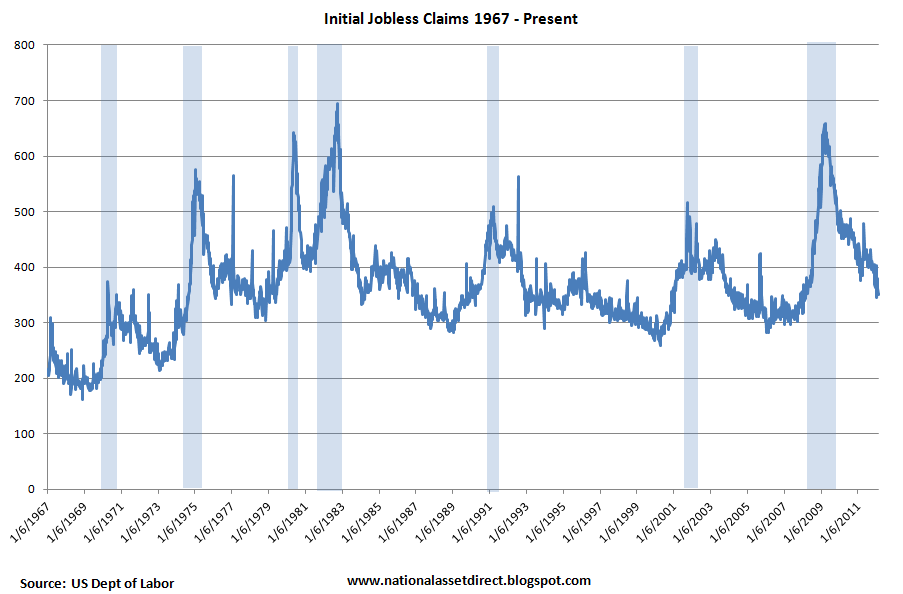
Markets are slightly better after a mixed bag of economic reports this morning. Personal income and spending were lower than expected, while the jobless report was slightly better. Initial Jobless Claims definitely seem to have found a new level around 350k, which for all intents and purposes represents “normalcy.”

Bonds and mortgage backs sold off on the data, continuing the slide that began after The Bernank offered his testimony yesterday.

Today is the first Thursday of the month, and that means retailers are releasing their same-store sales numbers for February. Reports are still coming in, but WalMart, Target, and the Gap are all up smartly on their reports. The unusually warm weather in the Northeast may have played a part in the comps. Most retailers have a January fiscal year, so some are announcing their fiscal year earnings as well.

So a default is not a default? According to ISDA that is the case. Bought credit default swaps on Greek sovereign debt? No credit event for you!

Remember the days of 5% commissions and going to the library to research a stock? – why there has never been a better time to be an individual investor.

Chart:  Initial Jobless Claims over the years:

The Bearded One Speaks

Prepared Testimony

Morning Report

Vital Statistics:

Last Change Percent
S&P Futures 1373.3 1.9 0.14%
Eurostoxx Index 2531.5 11.8 0.47%
Oil (WTI) 106.82 0.3 0.25%
LIBOR 0.4843 -0.003 -0.67%
US Dollar Index (DXY) 78.171 -0.076 -0.10%
10 Year Govt Bond Yield 1.92% -0.02%

World markets are slightly firmer this morning on the back of in increased commitment from the ECB to lend to European banks. The ECB said it will lend 529.5 billion euros, much higher than previous commitments and higher than economists were predicting. Most sovereign yields are lower this morning with the exception of Portugal, which is blowing out again.

4Q GDP (this is the 2nd of 3 reports) came in at 3% vs the initial 2.8% reports. Personal consumption improved to 2.1%. The GDP price index and core PCE came in higher than expected. Bonds and mortgage backed securities are slightly stronger on the data.

The banking system is on the mend. The FDIC released its quarterly report on the state of the banking system yesterday, noting that lending has increased and problem loans have decreased. Profits have increased, but decreases in loan-loss provisions have been the main driver in that increase. Return on Assets is a paltry .76%, as financial repression (Bill Gross’s term for ZIRP) continues to weigh on bank profitability.

HUD Secretary Shaun Donovan testified before the Senate Committee on Banking, Housing and Urban Affairs yesterday. The questioning focused on the health of the FHA and Administration initiatives to help prevent foreclosures. The second panel included acting FHFA Director DeMarco, and the questioning focused on allowing principal modifications for Fannie and Freddie loans. This issue has been a bone of contention between the liberal wing of the Democratic Party who want mass principal forgiveness and DeMarco who is charged with maximizing value for taxpayers.

Morning Report

Vital Statistics:

Last Change Percent
S&P Futures 1368.0 0.7 0.05%
Eurostoxx Index 2503.2 -9.9 -0.39%
Oil (WTI) 108.16 -0.4 -0.37%
LIBOR 0.4875 -0.002 -0.33%
US Dollar Index (DXY) 78.411 -0.123 -0.16%
10 Year Govt Bond Yield 1.91% -0.02%

Markets gave back most of their earlier gains on the back of a disappointing Durable Goods report. January Durable goods orders dropped 4% and durables ex-transportation dropped 3.2%. Cap goods were also weaker than expected.

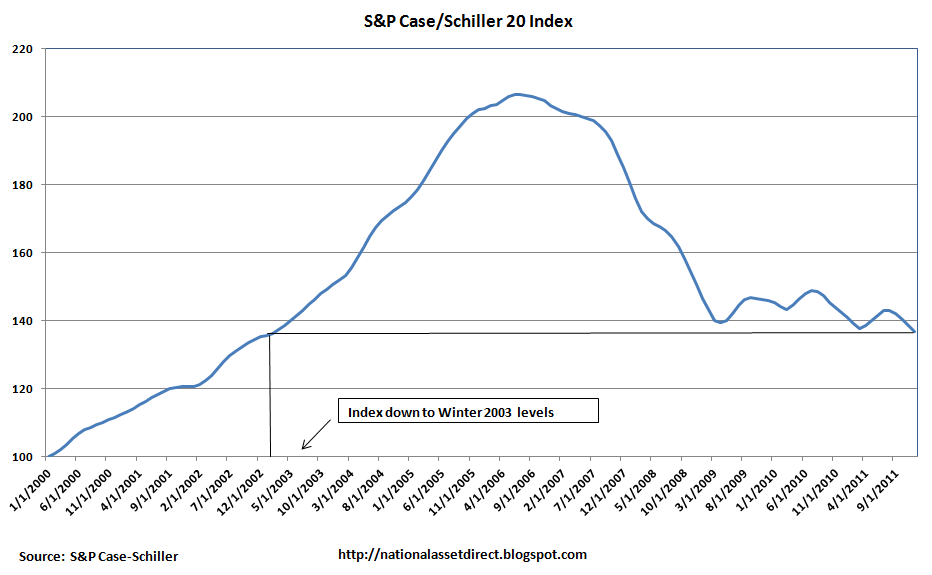
S&P / Case-Schiller for December came in down 4% YOY. Atlanta showed the biggest decline, while Detroit showed the biggest gains. A couple of highlights from the report:

“After a prior three years of accelerated decline, the past two years has been a story of a housing market that is bottoming out but has not yet stabilized. Up until today’s report we had believed the crisis lows for the composites were behind us, with the 10-City Composite originally hitting a low in April 2009 and the 20-City Composite in March 2011. Now it looks like neither was the case, as both hit new record lows in December 2011. The National Composite fell by 3.8% in the fourth quarter alone, and is down 33.8% from its 2nd quarter 2006 peak. It also recorded a new record low.”

“In general, most of the regions also posted weak data in December. Eighteen of the cities saw average home prices fall in December over November. Seventeen of the cities have seen monthly declines for at least three consecutive months. In addition to both monthly composites, 10 of the cities saw home prices fall by more than 1.0% during the month of December. The pick-up in the economy has simply not been strong enough to keep home prices stabilized. If anything it looks like we might have reentered a period of decline as we begin 2012.”

Yesterday, we got Warren Buffet’s letter to shareholders; today we get Bill Gross’s investment outlook. The theme is defensive investing, which makes sense for a bond guy when interest rates are as low as they can go. Since the early 80s, the Fed has been printing money and providing bond guys like Gross built-in capital gains in addition to income. Bill’s punch line:  “Recognize zero bound limits and systemic debt risk in global financial markets. Accept financial repression but avoid its impact when and where possible.”

The FHA has released some details on the pilot REO-to-Rental program for the Hardest-Hit Areas. They are auctioning of 320MM of properties in 8 MSAs.  The FHA is recognizing the recent strength in rental prices as well as the glut of foreclosed properties and attempting to solve two problems at once. We’ll see if this gets any traction.

Chart:  S&P Case-Schiller Index:

Morning Report

Vital Statistics:

Last Change Percent
S&P Futures 1356.2 -7.1 -0.52%
Eurostoxx Index 2493.5 -30.2 -1.20%
Oil (WTI) 108.64 -1.1 -1.03%
LIBOR 0.4891 -0.002 -0.31%
US Dollar Index (DXY) 78.594 0.194 0.25%
10 Year Govt Bond Yield 1.92% -0.06%

Markets are weaker this morning after the G20 nations refused to increase support for the IMF. Oil is taking a breather after being on a tear for the last 3 weeks. Bond futures and mortgage backed securities are firmer this morning.

For people interested in the World According to Warren, here is his annual letter to shareholders. This annual letter, along with Bill Gross of PIMCO’s letters, are pretty much required reading on the Street. Buffetpalooza (the annual Berkshire Hathaway shareholder meeting) is May 5 which is when all of his admirers descend upon Omaha and paint the town red. Warren’s annual report gives you all the tips on the best shopping and root beer floats in Omaha. Don’t miss the newspaper toss.

Speaking of letters, Paul Singer (of Elliott Associates FD: my old boss) tends to pontificate on his view of politics and the economy.  Dealbook has the juicy parts.

Rick Santorum’s economic plan.  Cut taxes, cut spending.  Krugman must be tearing his hair out.

Lots of economic data this week.  Pending Home Sales and Dallas Fed are later today.

Morning Report

Vital Statistics:

Last Change Percent
S&P Futures 1365.3 2.4 0.18%
Eurostoxx Index 2519.3 11.2 0.45%
Oil (WTI) 108.3 0.5 0.44%
LIBOR 0.4906 0.000 0.00%
US Dollar Index (DXY) 78.505 -0.130 -0.17%
10 Year Govt Bond Yield 1.98% -0.02%

Slow news day.  Stock futures are up slightly as bonds and oil continue to rally. No economic data this morning until 10:00 when we get Michigan Consumer Confidence and New Home Sales.

Radar Logic released its December Monthly Housing Report yesterday. The report notes that prices declined 6.8% while transaction count increased 19.6%. While the transaction count was boosted by technical factors relating to the homebuyer tax credit expiration, there is a sense that sellers are becoming more realistic and are willing to hit bids from bargain-hunters. Is this is the beginning of the Great Capitulation? The report notes that the recently-listed RPX futures are indicating the bottom is here and that prices should start rising in summer of 2013.

A tiff between Bank of America and Fannie Mae? The bank will no longer send new originations to Fannie Mae and will either send them to Freddie Mac or retain them on their own balance sheet. Fannie Mae’s lawsuit regarding shoddy origination at Countrywide presumably drove this decision. Does this mean we are finally going to have a national discussion over the American Dream Commitment?

A slew of important economic data will be released next week with Durable Goods, Case-Schiller, Consumer Confidence, GDP, Personal Income, Personal Spending, Construction Spending, ISM and more.

Morning Report

Vital Statistics:

Last Change Percent
S&P Futures 1355.9 0.0 0.00%
Eurostoxx Index 2513.0 -6.0 -0.24%
Oil (WTI) 106.31 0.0 0.03%
LIBOR 0.4906 -0.001 -0.20%
US Dollar Index (DXY) 78.971 -0.254 -0.32%
10 Year Govt Bond Yield 2.03% 0.02%

Markets are flat on a better than expected jobs report. Initial Jobless claims were 351k vs 355k expected, and continuing claims dropped to 3,392k vs 3,455k expected. The FHFA House Price Index will be released at 10:00 am and the Kansas City Fed Manufacturing Activity Index will be released at 11:00. Bonds and MBS are flat-to-slightly lower.

Freddie Mac released its February Economic Outlook yesterday. Punch line: Housing is recovering gradually. Interesting statistic from the report regarding affordability:  “At the end of 2011, a family earning the median family income had almost double the income necessary to qualify for a conventional loan covering 80% of a median-priced existing singly-family home.” Mortgage applications rose by 4.1% in January, and 80% of those were for refinancings. We are entering a seasonally strong period for house prices – it will be interesting to see if low rates and low prices finally pull people off the sidelines.

For a glass-half empty view, look here. Mark Hanson makes a very good point – that when a stock doesn’t do what it is supposed to do in response to news or events traders will key on that and position accordingly. A market darling that “beats” earnings expectations but doesn’t go up is a great short candidate. Mark makes the same point with housing – we have record low interest rates and affordability, yet housing isn’t going up. Which means it is going lower.

A few years ago, everyone was talking about the yen carry trade. Japanese companies would borrow yen for basically nothing and invest in higher yielding assets overseas, typically in Europe. Traders would watch the Euro / Yen cross rate like hawks, and every time the euro weakened against the yen, world markets would roll over. After the financial crisis drove everyone into Treasuries, people have been wondering when the dollar carry trade would take over. Well, it looks like that day has come. J.P. Morgan has been picking up European MBS to find some yield. While a $72 billion bet on foreign MBS is a drop in the bucket, if JPM is doing it, so is everyone else.


Morning Report

Vital Statistics:

Last Change Percent
S&P Futures 1359.4 -0.7 -0.05%
Eurostoxx Index 2526.7 -14.9 -0.59%
Oil (WTI) 106.1 -0.2 -0.14%
LIBOR 0.4916 -0.001 -0.20%
US Dollar Index (DXY) 79.286 0.178 0.23%
10 Year Govt Bond Yield 2.05% -0.01%

Markets are weaker this morning on a weaker than expected economic report out of Europe and a lousy forecast from Dell. Mortgage applications fell 4.5% for the week ending Feb 17. Existing Home Sales will be released at 10:00 am.

Obama has laid out the broad brush strokes for a corporate tax overhaul. He plans on lowering the statutory rate to 28%, while eliminating loopholes. His plan will benefit domestic manufacturers and he will target the energy sector for more revenues.  It looks like he is proposing some sort of AMT for corporations, with a minimum tax for overseas earnings. The plan will be revenue-enhancing.

Of course, the devil is always in the details, and hopefully the administration is smart enough to draw a distinction between overseas production meant to be sold overseas and outsourcing to cut costs. He could end up hurting US competitiveness if he doesn’t think this through.

The FHFA sent a letter outlining its plan for the GSEs aptly titled “The Next Chapter in a story that Needs an Ending.” It is a strategic document, not a step-by-step plan. They intend to build a new infrastructure for the secondary market, gradually reduce the footprint of Fannie and Freddie, while maintaining foreclosure prevention activities and credit availability.

With the S&P 500 rallying, bonds have sold off a bit, driving best-ex mortgage rates back over 4%. FWIW (and I am not a big technical analysis guy) it appears the March Treasury futures are stuck in a 140-145 range, which implies a yield range of 1.85% to 2.05%. We are again at the top end of that range. As I have mentioned before, the S&P 500 is right up against resistance and looks like it wants to break out. The Fed has been stepping into the MBS market when rates hit these levels, so we’ll see if that continues.