Morning Report

Vital Statistics:

Last Change Percent
S&P Futures 1363.6 3.9 0.29%
Eurostoxx Index 2532.8 -17.4 -0.68%
Oil (WTI) 105.04 1.8 1.74%
LIBOR 0.4926 -0.001 -0.10%
US Dollar Index (DXY) 79.145 0.005 0.01%
10 Year Govt Bond Yield 2.03% 0.03%

We have a deal in Greece. Bondholders had to take a slightly bigger haircut – 53% vs 50% already agreed to. The $170 billion will be more than enough for Greece to meet its payment at the end of March. The Eurostoxx index is down slightly on the news – another case of “buy the rumor, sell the fact.”

Are we out of the woods with Greece?  No. Greece intends to hold elections in the next few months, and there is nothing preventing a new government from undoing all of the austerity measures imposed for this deal.

The Chicago Fed released its National Activity Index this morning. It came in at .22, which indicates the economy is growing faster than its historical trend.  An index value of zero means the economy is growing at its historical trend.  Employment and Production were large positive components, while Consumption and Housing were negative components. December was revised higher as well.

The Home Despot reported better than expected earnings this morning, which should be another positive indicator for housing and the economy. Macy’s also reported a strong holiday selling season.

Economic data on tap this week:  Existing Home Sales on Wed, Initial Jobless Claims on Thurs, New Home Sales on Fri.

Morning Report

Vital Statistics:

Last Change Percent
S&P Futures 1356.5 1.7 0.13%
Eurostoxx Index 2522.1 32.8 1.32%
Oil (WTI) 102.95 0.6 0.63%
LIBOR 0.4931 0.000 0.00%
US Dollar Index (DXY) 79.214 -0.165 -0.21%
10 Year Govt Bond Yield 2.02% 0.04%

World stock markets are rising this morning on optimism of a Greek deal and tame inflation numbers.  The Consumer Price Index showed a 2.9% rise year on year, indicating inflation (at least as measured by the CPI) remains in check. Leading Economic Indicators comes out at 10:00 this morning.  The Street is looking for a .5% increase. Bonds and mortgage backed securities are lower.

For those who follow technicals, the S&P 500 is right at resistance.  Expect large intraday volatility as stops get triggered.

The CFPB wants to regulate debt collectors and credit reporting agencies. This would extend from payday lenders to the large credit reporting agencies like Fair Issac, home of the FICO score.

Slow news day ahead of a 3 day weekend.


Morning Report

Vital Statistics:

Last Change Percent
S&P Futures 1341.4 -0.8 -0.06%
Eurostoxx Index 2471.7 -22.2 -0.89%
Oil (WTI) 101.61 -0.2 -0.19%
LIBOR 0.4931 -0.002 -0.40%
US Dollar Index (DXY) 79.952 0.225 0.28%
10 Year Govt Bond Yield 1.96% 0.03%

Global equity markets are weaker this morning as European leaders delay a vote on the Greek bailout until 2/20.  The finance leaders were able to squeeze some more concessions from political leaders, but there are still differences over surveillance and control. Separately, Moody’s threatened a downgrade of the global banking sector. Bonds and mortgage backed securities are slightly lower as well.

GM posted a record profit! I am sure tomorrow’s editorial pages will be filled with columns praising the auto bailout and using this earnings announcement as justification. Well, if you repudiate your debt and get rid of all that pesky interest, you had better post record earnings.  GM’s numbers were still below estimates and the stock is down a couple of percent pre-open. As an aside, Chrysler has to issue senior secured debt at 8%.  That is a usurious rate for senior secured debt. See, that is what happens when you re-order the priority of creditors. Investors remember.

Economic data this morning:  Producer Price Index more or less in line with expectations, running at 4.1% annually.  Initial Jobless Claims continue to fall, coming in at 348k vs 365k expected. We are more or less back in the historical “normal” range. Housing starts came in at 699k, above expectations, but still very low. In prior recessions, housing starts bottomed at 750k – 850k.  The last time we were above 1 million units was June of 2008.  1.5 million is normal. The lack of residential construction has been the achilles heel of the recovery so far.

Chart:  Housing Starts:

The minutes of the FOMC meeting were released yesterday. They really don’t add anything to what was said in the press conference after the rate decision.  The minutes don’t really address the question most had regarding the recent good economic data. “Many participants noted some indicators bearing on the economy’s recent performance had shown greater-than-expected improvement, but a number noted less favorable data…” The tone of the minutes was that the economy was improving, albeit slowly, and there is no reason to take our foot off the gas for the moment.  Maybe the Fed believes the Greek negotiations are simply a big kabuki dance and that a default is unavoidable.

RealtyTrac has released its U.S. Foreclosure Market Report for January 2012. Key Quote: “Although overall foreclosure activity was down from a year ago for the 16th straight month in January, we continue to see signs on a local and regional level that the frozen-up foreclosure process is beginning to thaw.” They predict increasing foreclosures in the coming months especially given the settlements in early Feb between the nation’s largest lenders and 49 state attorney generals. Clearing out the shadow inventory of foreclosed homes is a necessary but not sufficient condition for a recovery in house prices.

Morning Report

Vital Statistics

Last Change Percent
S&P Futures 1352.7 5.0 0.37%
Eurostoxx Index 2504.6 16.3 0.65%
Oil (WTI) 101.52 0.8 0.77%
LIBOR 0.4951 -0.003 -0.50%
US Dollar Index (DXY) 79.543 0.159 0.20%
10 Year Govt Bond Yield 1.93% -0.01%

Markets are higher this morning on statements from the Bank of China regarding support for the European bailout and its willingness to help. Concerns about an eventual Greek deal are offsetting some of these gains. Bonds and mortgage backed securities are flat.

Mortgage Loan Delinquencies are increasing again, according to TransUnion. 64% of MSAs reported increases, which was flat compared to Q3, but much higher than Q2.  There are seasonal factors at work here, and the continuing decline in real estate prices are certainly playing a part, but that is not an encouraging data point economically. As if the foreclosure pipeline wasn’t big enough already.

Not that the markets really care, but it looks like we have a payroll tax deal.

The Empire State Manufacturing Index came in at stronger than expected. This is a touchy-feely indicator of general business conditions put out by the New York Fed.  This index is notoriously volatile, so big moves should be taken with a grain of salt, but it shows that the expansion is gaining momentum in New York State.  Separately, industrial production was flat and capacity utilization unexpectedly fell.

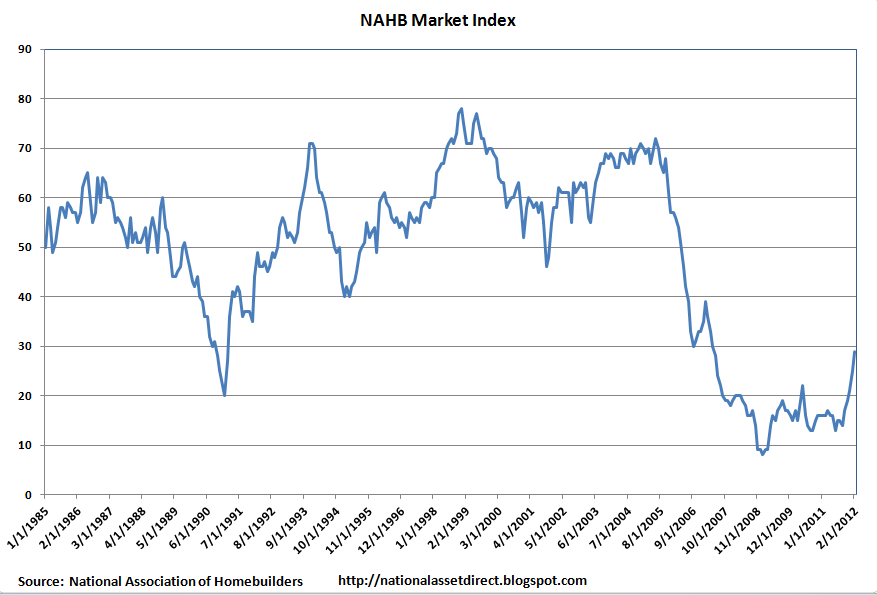
The National Association of Home Builders will release their market index at 10:00 am. Residential construction has been the missing piece of the recovery, but has been showing signs of life lately.  Earnings reports from the homebuilders have been constructive.

The FOMC minutes will be released this afternoon. I am very curious to see why the Fed is behaving as if the economy is rolling over, while the data suggest otherwise.

Last, Ezra Klein at the Washington Post has a story on how the World Cup affects trading.  I can attest to this personally, having been a block trader at Bear Stearns in London for a number of years.  When England was playing a match, the phones would stop ringing and everyone had their backs to their screens, watching the match.  You could actually see major stocks like British Petroleum and Vodafone stop trading.  As an American, it was strange to watch.

****EDIT

The National Association of Homebuilders released their market index at 10:00 am.  The index came in better than expected and it looks like conditions are improving at an accelerating rate.

Chart:  NAHB Market Index:

Morning Report

Vital Statistics:

Last Change Percent
S&P Futures 1344.3 -4.8 -0.36%
Eurostoxx Index 2486.5 -5.1 -0.20%
Oil (WTI) 101.08 0.2 0.17%
LIBOR 0.4976 -0.005 -0.99%
US Dollar Index (DXY) 79.279 0.144 0.18%
10 Year Govt Bond Yield 1.94% -0.03%

Markets are a touch weaker after a disappointing retail sales number. Advance retail sales for January were up .4% vs. expectations of .8%.  S&P futures sold off slightly on the number while bonds and mortgage backed securities rallied. For those who follow charts, the S&P is right up against resistance at the 1350 level.  If we break through, the next stop is 1600 or so.

European markets are flat in spite of Moody’s downgrades of Spain, Portugal, and Italy yesterday. The ratings agencies have been behind the curve for the whole crisis. European finance ministers are set to meet in Brussels tomorrow to approve a second Greek bailout.

Andrew Ross Sorkin has a good article on the Volcker Rule and the Costs of Good Intentions. At issue is where one draws the line between bona fide market making and proprietary trading. Bona Fide market making serves a purpose in that it keeps trading costs down and adds liquidity to the market. (FWIW, Paul Volcker doesn’t necessarily think this is a good thing). The crux of the issue is whether investment banks will be allowed to maintain an inventory of product. If they aren’t permitted to maintain any inventory of any size, then all trades will be agency trades.  In other words, if the bank can’t find the other side of your trade, you’re out of luck.

The CFPB has laid out a broad outline of some of the changes it expects to make for mortgage servicers. The initial steps will involve changes to billing statements – new rules to make it clearer when resets will occur, better contact information, and a statement from HUD.  An example of the new template is here.  The rules will also address forced-place insurance, where servicers can put a homeowner in a new, more expensive insurance plan if they fall behind in their payments.

Does anyone find it ironic that the rule which sets new tax rates on dividends is named after a guy who’s company doesn’t pay them?

Morning Report

Vital Statistics:

Last Change Percent
S&P Futures 1349.1 8.5 0.63%
Eurostoxx Index 2495.7 14.9 0.60%
Oil (WTI) 100.32 1.6 1.67%
LIBOR 0.5026 -0.003 -0.67%
US Dollar Index (DXY) 78.775 -0.229 -0.29%
10 Year Govt Bond Yield 1.99% 0.01%

World markets are rallying on the positive Greek austerity vote over the weekend.  European finance ministers will meet on Wednesday to approve the second bailout plan.  Does this mean the crisis in Greece is over?  Not really.  Bondholders have to accept the proposed haircuts and if there are holdouts (and the holdout trade is a staple of distressed hedge funds), there will still be risk of default.

Heard on the Street has a good piece on corporate profit margins and what that means for the economy.  Productivity has been falling, and that perversely can portend good things.  After the financial collapse, companies dramatically cut their workforces and held off on capital spending unless it was absolutely necessary.  As demand returned, companies squeezed as much output as they could from existing resources.  They held off hiring and making investment in productivity-increasing capital. Stocks have reacted positively to growth in profit margins as revenues increased while costs stayed stagnant.  This was reflected in the productivity numbers (which measure amount of output per input).  Lately, productivity increases have been smaller and smaller, meaning that effect has largely been played out.  This means if companies want to meet increased demand, they have to hire – their existing workforces are maxed out.  Which bodes well for unemployment and wages.  What does that mean for corporate profits and stocks?  It means that the top line (revenues) will have to drive profit growth.  Tepid economic growth will mean stagnant profits.

The SEC has launched an “informal inquiry” into the private equity industry. What a shock. It must be nice to have government agencies with subpoena power to conduct oppo research. (Couldn’t the NYT find a more menacing picture of Henry Kravis?)

No economic data today.  I am very interested to see the minutes of the FOMC meeting on Wednesday.

Morning Report

Vital Statistics:

Last Change Percent
S&P Futures 1335.3 -13.0 -0.96%
Eurostoxx Index 2475.6 -46.8 -1.85%
Oil (WTI) 98.15 -1.7 -1.69%
LIBOR 0.506 -0.004 -0.78%
US Dollar Index (DXY) 79.112 0.495 0.63%
10 Year Govt Bond Yield 1.97% -0.07%

Stock markets are weaker across the board as Greek austerity talks hit a snag. A party leader in Greece is now saying he won’t support austerity measures agreed upon.  The Germans are holding Greece’s feet to the fire with a “no disbursement without implementation” stand.  Greek sovereign debt is more or less flat.  Portuguese debt still trades like a 1999-vintage .com with another big rally today.  Their 10 year bond yield has blown out from 12.5% to over 18% and then back to 12.7% in about 4 weeks on no news.  So much for “safe, boring, risk-free,” sovereign debt trading.  S&P futures are down 13 points.  The S&P 500 has gone from 1200 to 1350 on more or less a straight 45-degree line, so I wouldn’t fall out of my chair with shock if we had a retracement.

In economic data, the trade deficit increased again.  Imports and exports increased, but imports increased by $3 billion while exports increased by $1.2 billion, to net out at a $48.8 billion trade deficit.  $26.9 was with China. The full year 2011 numbers are included in the release as well. Takeaway – the consumer is returning. Pre-crisis, the trad deficit was in a 55 – 65 billion range.  In summer of 2009, it dropped to 25 billion.  So a smaller trade deficit isn’t necessarily a good thing.

Next week we have Retail Sales, Capacity Utilization, Industrial Production, PPI&CPI, FOMC minutes, and leading indicators.  Earnings season is more or less over until the retailers with January fiscals start reporting.  Still, a couple of big names will report – Deere, GM, and CF Industries.

Have a good weekend!

Morning Report

Vital Statistics:

Last Change Percent
S&P Futures 1347.8 0.8 0.06%
Eurostoxx Index 2535.2 22.2 0.88%
Oil (WTI) 99.73 1.0 1.03%
LIBOR 0.51 -0.003 -0.63%
US Dollar Index (DXY) 78.556 -0.182 -0.23%
10 Year Govt Bond Yield 2.04% 0.06%

Markets are up slightly on a better than expected initial jobless report. Initial Jobless claims were 358k last week versus 370k expected.  The ECB maintained rates and Draghi sounded bearish tones regarding the European economy.  Headlines are coming across right now that claim Greek leaders have agreed on an austerity package.

Bloomberg is reporting (on the pay site, not the free site) that the price of Bakken shale oil has fallen out of bed (down 25%) in the last week.  There are no futures contracts on Bakken so it can’t be traded, but it demonstrates how volatile oil can be.  The reason seems to be a lack of demand from the refineries, so the oil is backing up with nowhere to put it. Refineries are probably changing over from heating oil production to gasoline production right about now.  I plotted the prices of Brent, WTI, and Bakken oil over the past year so you can see the volatility.

It looks like we have a settlement with the banks and the state AG’s over foreclosures.  $26 billion from 5 banks.  $20 billion is to be used to cut principal balances and to refi current, but underwater, homeowners.  So, of the AGs and the banks, who won?  Both.  The AGs get their scalp, and the banks will be able to count losses already taken towards the settlement. (You owe $100 on your $70 home.  I’ll be a nice guy and cut your principal to $90.  Of course, I probably am already carrying the loan at 90 on my books anyway).  On the refis, the banks will be simply cutting the interest rate on a $100 loan, which stays marked at $100. So no write downs there either.  My guess is this will be earnings-neutral near term and may cause analysts to take down next year’s numbers a little. But that’s it.  So you might want to resist the urge to take some SKFs (Proshares Ultrashort Financial ETF) on the open.

Will it help support the housing market?  Maybe at the margin.  It is no silver bullet – consider my example above – will the homeowner who now owes $90 instead of $100 go out and spend more money?  Probably not. Plus a chunk of this is simply a direct transfer from the government to borrowers since Ally Bank (the old GMAC) is owned by the government.

Morning Report

Vital Statistics:

Last Change Percent
S&P Futures 1345.8 1.1 0.08%
Eurostoxx Index 2528.9 14.8 0.59%
Oil (WTI) 99.67 1.3 1.28%
LIBOR 0.5133 -0.007 -1.30%
US Dollar Index (DXY) 78.443 -0.110 -0.14%
10 Year Govt Bond Yield 1.99% 0.02%

Markets are flattish this morning as talks continue between Greece and its creditors. The WSJ is reporting that the ECB has agreed to exchange bonds it bought at a discount in the secondary market at a price less than par.  Greek 10 year yields are down a percentage point to 33.14%

The WSJ has a story this morning discussing how the energy boom is driving the economy. The story points out that the multiplier effect from this is huge – for every new worker employed in the oil and gas industry, another 4 jobs are created in support.  Obama will have to walk a fine line between mollifying his environmental base which hates fracking and the fact that the energy sector is one of the few bright spots in the economy overall.

One housing story that has not been getting a lot of play has been the perilous state of FHA’s reserves.  FHA’s cash reserves are below the 2% statutory limit and a bailout may be necessary if housing deteriorates further.  How will it affect housing?  My gut says that the government will quietly tell FHA to start unloading foreclosed homes in order to raise cash. This will undoubtedly complicate the government’s efforts to support the housing market.

Morning Report

Vital Statistics:

Last Change Percent
S&P Futures 1335.8 -3.3 -0.25%
Eurostoxx Index 2493.6 -14.3 -0.57%
Oil (WTI) 96.21 -0.7 -0.72%
LIBOR 0.52 -0.003 -0.62%
US Dollar Index (DXY) 79.03 -0.048 -0.06%
10 Year Govt Bond Yield 1.93% 0.03%

Markets are a touch weaker on disappointing economic date out of Germany and China.  Greek debt talks continue, and sovereign spreads in Europe are behaving.  Portugal has completely retraced the yield spike from a week ago.  Europe seems to be quieting down. That said, Europe isn’t “fixed” by any stretch, and still has tight credit issues.  The VIX (which is a fear index) has returned to pre-crisis levels, indicating Europe is fading into the background.  Of course contrarians view that as a sell signal.  (VIX is high – time to buy, VIX is low – time to go).

The SEC is trying to figure out a way to deal with money market funds.  It is ironic that the SEC is trying to find out a way to “stabilize money market funds” while the Fed is doing everything it can to destroy them.  The SEC is creating new capital guidelines which will hopefully allow money market funds to navigate the next financial crisis.  Unfortunately, with rates so low, money market funds can’t cover their costs and provide investors a non-negative return.  So the point may be moot – there may not be many money market funds left when the next crisis approaches.

No major economic data on tap today or tomorrow.  We will get initial jobless claims  and consumer sentiment data later this week.  Earnings season is winding down.