Morning Report

Vital Statistics:

Last Change Percent
S&P Futures 1396.3 -7.7 -0.55%
Eurostoxx Index 2575.8 -32.6 -1.25%
Oil (WTI) 107.1 -1.0 -0.92%
LIBOR 0.4742 0.001 0.11%
US Dollar Index (DXY) 79.766 0.297 0.37%
10 Year Govt Bond Yield 2.33% -0.04%

Markets are lower this morning on further evidence that the Chinese economy is slowing. Mining giant BHP-Billiton made comments overnight that China’s steel growth has flattened off and its big infrastructure build has come to an end. These comments, combined with increased fuel prices in China sent world equity and commodity markets lower.  Bond futures are higher.

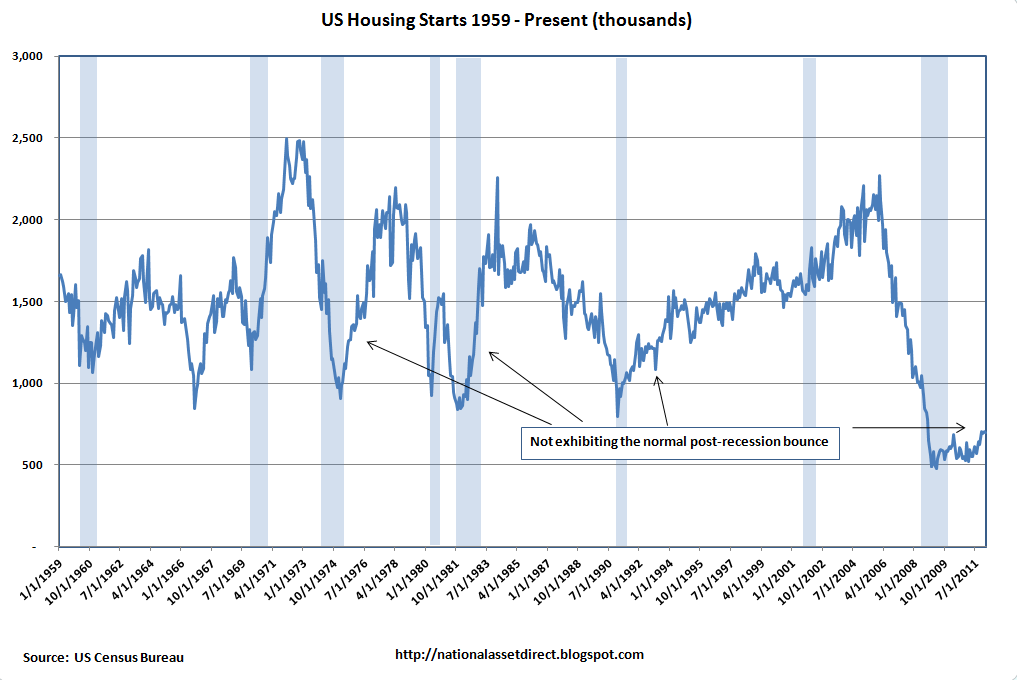
Housing starts came in at 700k, more or less in line with the levels for the past few months, and much lower than the 1.5 million or so that represents “normalcy.” Housing construction has been the achilles heel of the recovery and it looks like that will continue. The National Association of Homebuilders sentiment index continues to improve, but it has yet to be reflected in the numbers.

The FHFA released its fourth quarter Foreclosure Prevention and Refinance Report. HARP and HAMP activity has been declining after peaking in 1H10. Short sales and DILs are playing a larger role, while mods remain the focus. Recidivism rates (the knock on loan mods to begin with) have been steadily decreasing and are now in the 10%-15% range. Foreclosure starts have been falling since 3Q10, while foreclosure sales continue to run well below the start rate.  So while they haven’t been filling up the inventory of foreclosed homes as rapidly as they did in late 2010, they still are accumulating foreclosed property on a net basis. Someday, this inventory is going to hit the market. They provide a nice state-by-state analysis at the end that is worth checking out.

Chart:  Housing starts

Morning Report

Vital Statistics:

Last Change Percent
S&P Futures 1396.3 -2.2 -0.16%
Eurostoxx Index 2596.8 -11.5 -0.44%
Oil (WTI) 107.29 0.2 0.21%
LIBOR 0.4737 0.000 0.00%
US Dollar Index (DXY) 79.795 0.009 0.01%
10 Year Govt Bond Yield 2.26% -0.03%

Markets are quiet this morning after triple-witching last Friday. S&P futures are down a couple of points while bonds are up half a point. MBS are a up a tick.

Greek credit default swaps fixed at 21.75, which means sellers of protection owe 78.25%. So it appears that when all is said and done, that credit default swaps did in fact work as advertised.  Portugal, you’re up.

Merger Monday is back with a big deal in the logistics space – UPS is buying TNT for 6.8 billion, in a bid to create a Euro logistics company to rival DHL. UPS is paying a 54% premium to the undisturbed stock price, leaving some to question whether UPS is overpaying. But when companies are cash-rich and financing is cheap, you will see deal flow.

Speaking of cash-rich, supposedly Apple will disclose what they intend to do with their 100 billion in cash. Will Apple leave the trio of most-admired companies who don’t pay a dividend (Google, Berkshire Hathaway, and Apple)? The stock is currently halted.

The WSJ has an A1 article on the REO-to-Rental program. Ranieri is interested, as is Paulson.

Morning Report

Vital Statistics:

Last Change Percent
S&P Futures 1399.5 3.5 0.25%
Eurostoxx Index 2607.6 13.6 0.52%
Oil (WTI) 105.65 0.5 0.51%
LIBOR 0.4737 0.000 0.00%
US Dollar Index (DXY) 79.991 -0.159 -0.20%
10 Year Govt Bond Yield 2.32% 0.04%

Markets are slightly firmer after the consumer price index showed inflation is still behaving. The 10-year continues its slide and has backed up 40 basis points in the last two weeks. It feels like some major asset allocation trades are going on as investors sell bonds to buy stocks. For those keeping score, the 10 year yields 2.32%, versus a dividend yield of 2.27% on the S&P. So that move could have room to run.  Bloomberg is noting that the derivatives market is starting to price in Fed hikes in late 2013, nearly a year before the Fed’s current guidance of late 2014.

Industrial production was flat in Feb, below expectations, and capacity utilization was down slightly to 78.7% from 78.8%, also below expectations.

The NAHB Improving Markets Indicator predicts that 99 housing markets will improve in March, which is up from Feb.


Morning Report

Vital Statistics:

Last Change Percent
S&P Futures 1392.5 3.8 0.27%
Eurostoxx Index 2581.0 6.2 0.24%
Oil (WTI) 105.51 0.1 0.08%
LIBOR 0.4737 0.000 0.00%
US Dollar Index (DXY) 80.436 -0.129 -0.16%
10 Year Govt Bond Yield 2.33% 0.06%

Equity markets continue to rally as bonds sell off. The 10-year now stands at 2.33% after yielding around 1.9% last week. MBS are lower as well, with some lenders now best-exing at 4-1/8%. That is a big move in a short period of time.

The producer price index (a measure of wholesale inflation) and initial jobless claims came in as expected. Empire Manufacturing (a New York – based measure of business sentiment put out by the New York Fed) showed general business conditions are expanding at a moderate pace. Prices paid jumped as did average workweek. Sentiment is optimistic.

ISDA is going to hold its auction to set the payouts on Greek CDS. The early indications seem to be that 23 is going to be the price on the roughly $2.6 billion in swaps. According to Bloomberg, The Austrian government is holding the old maid here, and will have to inject 1 billion euros into KA Finanz AG (the “bad bank” of nationalized Kommunalkredit Austria AG) to cover losses on Greek swap payouts.

Foreclosures are set to increase, according to RealtyTrac, as some of the barriers are removed (especially the State AG settlement) According to Bloomberg, the shadow inventory of homes in foreclosures or about to become foreclosures is around 4.5 million units. I wonder what the economic effect will be when those people who have been living for free suddenly have to pay rent.

On the other hand, the NAR shows list prices and demand up, with inventory down in its latest Real Estate Trends report.  Total inventory is down 22% YOY, with list prices up 6.82% and age down 9.8%.  The recovery seems to be concentrated in the hardest hit areas – Florida and Arizona. Phoenix inventories are down 48% and list prices are up 21%. I have been hearing anecdotal evidence of strong investor interest in Phoenix property, and these numbers do bear that out.

Morning Report

Vital Statistics:

Last Change Percent
S&P Futures 1390.7 0.0 0.00%
Eurostoxx Index 2574.8 18.0 0.70%
Oil (WTI) 106.48 -0.2 -0.22%
LIBOR 0.4737 0.000 0.00%
US Dollar Index (DXY) 80.5 0.307 0.38%
10 Year Govt Bond Yield 2.28% 0.16%

S&P futures are flat this morning after yesterday’s furious rally on the back of the FOMC comments. Europe is playing catch-up. Bonds continue to sink as the market re-asses the probability of QEIII.  The 10 year has clearly fallen out of its 140-144 trading range, and it looks like 134 is the next stop. Mortgages are weaker as well.  As the 10 year sells off, it will be interesting to see if the Fed can hold up MBS.

The Fed left rates unchanged, but noted the recent economic strength and low inflation (since food and energy prices don’t matter). They re-affirmed their intention to maintain exceptionally low interest rates through late 2014. Operation Twist and the MBS re-investment will continue. People hoping for clues to QEIII didn’t get much except for a bland statement that the Fed will continue to review its securities holdings and adjust as necessary.

After the close yesterday, the Fed released the results of its stress-tests of the banking system. Citi, Suntrust, Ally and Metlife flunked.  The stress test was actually pretty tough – unemployment at 13%, a 50% crash in the stock market, and another 21% drop in house prices. 15 of the 19 banks examined would maintain capital ratios above regulatory minimums in that scenario. The detailed methodology is here.

This editorial from the NYT regarding Goldman reminds me of the way Michael Lewis described Salomon Brothers in Liar’s Poker.

Morning Report

Vital Statistics:

Last Change Percent
S&P Futures 1371.5 4.7 0.34%
Eurostoxx Index 2541.2 26.2 1.04%
Oil (WTI) 106.48 0.1 0.13%
LIBOR 0.4737 0.000 0.02%
US Dollar Index (DXY) 80.276 0.386 0.48%
10 Year Govt Bond Yield 2.06% 0.03%

Markets are a little stronger this morning on stronger German economic reports. US bond futures are down, while MBS are flat. Feb retail sales were in line with expectations, up 1.1%.

The National Mortgage Settlement will offer relief to underwater homeowners and those who were improperly foreclosed upon. Read the details about who will qualify here. The banks will get varying credit against the settlement based on the sort of principal forgiveness they do. They get full credit if they own the loan, and 45 cents if they service the loan. So the banks get credit against their settlement by passing losses to someone else? Why wouldn’t they pass off all of the settlement to investors in paper they service? Investors in MBS have to be seething right now.

CNBC has some data on the rental market and the purchase market, noting that prices are going in opposite directions in some localities. They note FHFA’s pilot program to turn REO properties into rentals. It will be interesting to see if the program works. My initial take on it was that FHFA was trying very hard to make the program uninteresting to pure financial investors.

The Fed will be releasing the latest stress-test results this week. Bloomberg notes that the Street is leaning negative, with the skew between puts and calls on the XLF the highest they have been since 2007. In plain English, that means that puts (or bets that the index will fall) are in more demand than calls (bets that the index will rise).

Morning Report

Vital Statistics:

Last Change Percent
S&P Futures 1366.0 -0.8 -0.06%
Eurostoxx Index 2507.1 -8.9 -0.35%
Oil (WTI) 106.09 -1.3 -1.22%
LIBOR 0.4736 0.000 0.00%
US Dollar Index (DXY) 79.976 -0.065 -0.08%
10 Year Govt Bond Yield 2.00% -0.03%

Markets are weaker this morning on the back of a disappointing report on Chinese exports and lower commodity prices. Oil is down a buck and a half, while bonds and mortgage backed securities are a touch higher.

Euro credit default swaps are higher this morning after ISDA declared the Greek exchange offer a “credit event.” The next event in Greece will be the auction on Mar 19, which will set the payout price for the bonds. Since most holders tendered their bonds, it will be a low volume event which opens the door for manipulation.

With the Greece resolution in place, market participants will begin to focus on the next problem child, widely believed to be Portugal. Portuguese yields are 13.7%. That said, EURIBOR / OIS (a measure of stress in the banking system) has been tightening steadily since the beginning of the year, and is trading at 54 basis points after peaking at 100 basis points in Dec.

Pacific Capital Bancorp is being bought by Mitsubishi UFJ Financial, which is the first bank deal in what seems like forever.

The king of data miners, Thomas (Flathead) Friedman has a column discussing the negative relationship between test scores and the percentage of GDP a country earns from natural resource extraction. In other words, if you don’t have a lot of natural resources (Taiwan, Japan), your students tend to do well, as opposed to, say, Saudi Arabia or Kuwait.  Columns like this always remind me of those “Vegas killer” betting systems you see advertised in fantasy football magazines in the late summer (always take the dog on Monday night, when the game is on artificial turf, and the NFC team won the Sunday night game…).  Correlation does not imply causation. Will our test scores go up if we stopped oil production in the US?  Of course not.

Morning Report

Vital Statistics

Last Change Percent
S&P Futures 1363.5 2.9 0.21%
Eurostoxx Index 2518.8 4.6 0.18%
Oil (WTI) 106.65 0.1 0.07%
LIBOR 0.4736 0.000 0.00%
US Dollar Index (DXY) 79.665 0.526 0.66%
10 Year Govt Bond Yield 2.04% 0.03%

Markets are rising this morning after Greece successfully completed its sovereign debt restructuring and the BLS released its jobs report. Over 95% of bondholders tendered after Greece said it would trigger a collective action clause compelling participation. This should pave the way for another 130 billion in aid. While the market clearly does not consider the crisis solved – the new bonds are trading at a 22% yield in the when-issued market – this should at least put Greece on the back burner for a while. The 10-year is down 6 ticks, while mortgages are flat.

The BLS released its February Employment Situation report at 8:30 this morning. Feb payrolls came in a bit higher than expected – 227k vs 210k expected. The unemployment rate was flat at 8.3% and in line with expectations. The labor force participation rate edged up slightly from its Jan lows. Earnings and hours were up a hair. Professional and Business services added the most jobs, along with health care. Government and construction were flat.

CoreLogic released its monthly Market Pulse yesterday (you need to register to get it, but it is free). They note the building economic strength and signs of improvement in the real estate market. They note that the recovery was initially driven by productivity-increasing capital investment, which allows companies to increase output without increasing hiring. Productivity growth is tapering off, which suggests that business has pretty much extracted all it can from existing employees and will need to start hiring to increase output.

The report notes that 25% of MSAs are now experiencing price increases. The ones that are lagging the most are the ones with clogged foreclosure pipelines – for the most part judicial foreclosure areas. Just more proof that politicians who want to slow foreclosures in the hopes that keeping supply off the market will stabilize prices are shooting themselves in the foot. Of course some politicians are incorrigible. To be fair, most of these measures are small-ball things that won’t change the dynamics of the housing market, but will allow the administration to say they are “doing something” about the housing crisis. For some reason, letting the market clear does not constitute “doing something.”

Do you look at Zillow to get an idea of what your house is worth? The Washington Post dissects the Z-estimate and its accuracy. Punch line: Neighborhoods with high turnover tend to have Z-estimates closer to actual sales prices than neighborhoods with lower turnover. While it can be a useful (and fun) number, take it with a grain of salt.

Morning Report

Vital Statistics:

Last Change Percent
S&P Futures 1361.8 9.0 0.67%
Eurostoxx Index 2494.7 33.9 1.38%
Oil (WTI) 106.55 0.4 0.37%
LIBOR 0.4736 -0.001 -0.21%
US Dollar Index (DXY) 79.298 -0.414 -0.52%
10 Year Govt Bond Yield 1.99% 0.02%

Markets are stronger this morning a strong economic report out of Germany and optimism that Greece’s debt swap will go through without major problems. Markets are continuing yesterday’s rally that was sparked by QEIII hopes. Initial Jobless Claims were 362k.

I was at the JP Morgan Securitized Products conference all day yesterday. Congressman David Schweikert (R-AZ) spoke regarding the regulatory environment. It is an election year, so expect more initiatives out of the administration to provide relief. A couple takeaways from his talk:

  • LIberals agitating for wholesale principal reductions are just conducting election – year posturing. Everyone in Congress is getting phone calls from their state pension funds (who are large holders or MBS) begging them not to do it. Liberals acknowledge in private they would annihilate pension funds and would do great damage to the future housing finance system if they allowed large-scale principal forgiveness in GSE paper. Which makes FHFA Director Ed DeMarco a very convenient figure at this point and means he probably isn’t going anywhere.
  • The MERS headache is generating preliminary discussion of a global settlement fund (a la asbestos or tobacco) to settle all of the claims coming from the financial crisis. Probably a low-probability event, but it is out there.
The other takeaways from JPM speakers.  (For the ATiM folks, a lot of this is going to be really “inside baseball”)
  • Origination margins have spiked – originators are probably making 3-4 points on new loans (pre-expenses)
  • QEIII will not do much for housing. The Fed is pushing on a string at this point. Fund managers are at record overweight levels on MBS, which means the Fed could spend a lot of money and not move mortgage rates (or affect house prices) all that much.
  • The Fed thought it would be cute to institute new fail charges right ahead of QE, thus adding a short squeeze to the mix. Dealers are having a tough time getting paper to satisfy the appetite of the Fed and won’t short due to the fail charges. This is part of what is driving MBS spreads so tight.
  • Ally is scaling back the correspondent business, while Wells and Citi are getting more aggressive. Chase overshot in downsizing correspondent lending and plans to increase it this year.
  • House prices will fall another 3% this year and that should mark the bottom
  • The government is probably going to experiment with a “first loss” tranche in conforming paper. Expect this in the next 3 – 6 months. This would accomplish two things – first it would start the process of handing off mortgage financing to private capital and it would give a market-based indication of what it should charge for its guarantee (its G-fee). The G-fee is set on the basis of politics and funding needs (for example, it was just raised 50 bp for 10 years to pay for the 2 month payroll tax extension). It would be subordinated paper that absorbs the first 5%, making FHA more of a re-insurer. Concern is demand for the first loss tranche.  Banks would have to reserve 100% for it, so hedge funds would have to buy it. The concern is that they don’t have the capacity.
  • JPM estimates the shadow inventory to be about 5.5 million homes and net demand for housing is 1.25 million per year. Household formation has fallen off a cliff.
  • Basel III requirements for MSRs are extremely harsh (MSR value over 10% Tier 1 becomes a capital deduction) Expect MSRs to remain very cheap. Banks are contemplating cutting servicing fees to 12 basis points.
  • Fan and Fred will remain wards of the state. It would take $250 – 300 billion to capitalize them and they already owe Treasury $160 billion. That is basically the enterprise value of Exxon Mobil. You can’t raise that kind of capital in the private sector.
  • Once the economy picks up steam, the fiscal problems will become front and center. We are looking at about half a trillion of contraction in early 2013, with the expiration of the Bush tax cuts ($250B), the sequestration due to the failure of the debt supercommittee ($100B) and the expiration of the payroll tax cut ($120B). Don’t be surprised if we fall into a recession early next year.
  • Household balance sheets are improving, (DTI ratios are falling) but this has been 100% due to defaults. Debt service ratios are at multi-decade lows due to low interest rates.

Morning Report

Vital Statistics:

Last Change Percent
S&P Futures 1350.8 -13.6 -1.00%
Eurostoxx Index 2486.6 -43.3 -1.71%
Oil (WTI) 105.36 -1.4 -1.27%
LIBOR 0.4746 0.000 0.00%
US Dollar Index (DXY) 79.749 0.449 0.57%
10 Year Govt Bond Yield 1.96% -0.05%

Markets are lower on concerns about global economic weakness. The European economy contracted in the 4th quarter, and concerns are mounting regarding China. Bonds and mortgage backed securities are stronger this morning.

Did the S&P 500 just fail at resistance again?

Some 20% of Greece’s private creditors will participate in the debt swap. These are the large European banks – Commerzbank, BNP Paribas, and the big Greek banks. These decisions were undoubtedly heavily influenced by politics, so I am not sure that they are a representative sample of the private creditors.

Greek Finance Minister Evangelos Venizelos said in an interview yesterday that “This is the best offer. This is the best offer because this is the only, the only existing offer.” Note the lack of “best and final” language. If enough holders are reading that statement to mean that Greece is prepared to go forward with a better deal if this one fails, then the 75% participation rate might become an issue. The business press will probably focus on the possibility of a disorderly default and not on the public negotiation between Greece and its creditors, so we could be in for some rough sailing.

Obama will hold a news conference this morning and it is rumored that another mortgage relief plan will be revealed. The plan would allow FHA refis at a reduced fee – from 1.15% to .55%.

No economic data this morning. No MR tomorrow as I will be in the City all day.