Morning Report

Vital Statistics:

Last Change Percent
S&P Futures 1403.9 5.7 0.41%
Eurostoxx Index 2471.7 19.0 0.77%
Oil (WTI) 103.52 0.7 0.72%
LIBOR 0.4682 0.000 0.00%
US Dollar Index (DXY) 78.81 -0.376 -0.47%
10 Year Govt Bond Yield 2.15% -0.01%
RPX Composite Real Estate Index 170.13 0.4

Markets are higher this morning on no major news except for the increase in the European firewall. There is probably an element of end-of-the-quarter window dressing to it as well.

Personal Income came in +.2%, lower than expectations, while Personal Spending increased .8% higher than expectations. Inflation data came in as expected. Overall, no reaction in the futures. Chicago Purchasing Manager, Michigan confidence, NAPM, and some revisions are coming out later this morning.

The NYT notes that Moody’s may lower the credit ratings for B of A, Citigroup, and Morgan Stanley in mid-May. The side effect of this downgrade would be to kill their derivatives businesses, as the lower rating will force them to put up much more collateral against their derivatives books, and force many large buy-side clients to trade elsewhere. This could be the impetus to turn Citi and B of A back into plain old commercial  banks.

Goldman is raising money for a new fund to buy distressed home loan bonds without government backing. The documents state this is a bet on improving fundamentals in U.S. housing. The story also goes on to say that Goldman bid on mortgage bonds from AIG in a Feb 8 auction, and decided to hold the merchandise instead of selling it. Most of these bonds are trading in the 50s. Non-agency MBS have done well this year as credit conditions have eased – enough that some funds are paring their bets.


Morning Report

Vital Statistics:

Last Change Percent
S&P Futures 1394.3 -5.9 -0.42%
Eurostoxx Index 2468.1 -28.6 -1.15%
Oil (WTI) 105.23 -0.2 -0.17%
LIBOR 0.4682 -0.002 -0.32%
US Dollar Index (DXY) 79.244 0.118 0.15%
10 Year Govt Bond Yield 2.16% -0.04%
RPX Composite Real Estate Index 169.77 0.0

Markets are weaker as S&P warns that Greece may have to restructure its debt again and a disappointing report from H&M. Best Buy reported better-than-expected earnings this morning and will close 50 stores.

The third revision to 4Q GDP was released this morning, unchanged from the 2nd revision at 3%.  Initial Jobless claims were slightly higher than expected at 359,000. Bloomberg Consumer Comfort and Kansas City Fed come out later this morning.

Bill Gross of PIMCO told Bloomberg that the Fed will probably concentrate on supporting MBS once Operation Twist ends in June. He referred to a “sterilized twist” where the Fed would buy current coupon MBS and simultaneously repo out the Treasuries. This would cause MBS spreads to tighten. So even if the sell off in Treasuries continues, mortgage rate may not rise as rapidly.

Bloomberg had a good interview with FHFA Acting Director Ed DeMarco regarding principal forgiveness on underwater homeowners. It certainly does not appear that a mass taxpayer-funded principal forgiveness, (or cramdown for investors) is in the cards. FHFA prefers to mod interest and term first in order to make an affordable payment. If they cut the principal and the house increases in value, the borrower gets all of the benefit. If they don’t cut the principal, then taxpayers share in that upside. Ed has been a pinata to the Left who want mass cramdowns.

American borrowers fear the Repo Man over everyone else, at least according to a TransUnion survey cited in the Washington Post. It used to be that the mortgage payment was the first priority, but with foreclosure pipelines so elongated, the car loan now takes priority.

Dealbook has been the go-to place for all things MF Global. Yesterday, regulators held a hearing with several top executives of MF, who took the Fifth. The CFO has apparently offered a proffer statement, which means he is negotiating to talk.

Morning Report

Vital Statistics:

Last Change Percent
S&P Futures 1407.2 0.8 0.06%
Eurostoxx Index 2522.2 -3.0 -0.12%
Oil (WTI) 106.12 -1.2 -1.13%
LIBOR 0.4697 -0.001 -0.21%
US Dollar Index (DXY) 79.086 0.039 0.05%
10 Year Govt Bond Yield 2.21% 0.02%
RPX Composite 169.78 0.2

Markets are flattish after Durable Goods orders, which came in below expectations. February Durable Goods came in at 2.2% vs 3% expectations. Bonds and mortgages are off slightly. June 10-year bond futures are trading at 138 after bouncing off a low of 135-05 last week. Mortgage applications also fell 2.7% for the week ending Mar 23 as the backup in mortgage rates hurt refinancings.

The American Bankers Association released its Real Estate Lending Survey yesterday. The survey of 185 respondents, of which the vast majority are small community banks, said that lending conditions at the end of 2011 are about the same as they were at the end of 2010, with regulatory uncertainty as the main concern. The average delinquency rate fell slightly over 2011.

Is Mark Zandi becoming the Abby Joseph Cohen of real estate and the economy? Seems so. The Washington Post locates a pocket of optimism in real estate, citing Zandi and some Northern Virginia Realtor. Washington DC real estate inhabits a world of its own, so I don’t think it necessarily applies nationwide.

Redwood Trust did another jumbo securitization yesterday, more evidence that the private label market is returning.

Any of the health care / legal experts care to weigh in on the day’s activities?

Ashot here…I’m adding a first person account from yesterday’s arguments. And here’s the link to the audio.

Impressions from inside the courtroom

Mark A. Hall

Wake Forest University

The room was packed and buzzing with excitement. Some people clearly had slept outside last night. Even some of the attorneys general from the challenger states had to stand in line to get in. In the way into the building, I spotted none other than Ken Cuccinelli, attorney general of Virginia and lead party in the Fourth Circuit case. Sitting in my same row in the courtroom was a virtual quorum of the Senate Finance Committee, including Senators Leahy, Baucus, Grassley, and Kerry.

Solicitor General Verrilli encountered some forceful challenges early on in his presentation In particular, Chief Justice Roberts and Justices Scalia and Alito raised concerns about the slippery slope problem, citing examples such as burial insurance, gym membership, and mandatory cell phones to help with police emergencies.

Perhaps one of the most memorable exchanges, and certainly one that will resonate in the media, involved a question from Justice Scalia asking Solicitor General Verrilli to define the market.

JUSTICE SCALIA: Could you define the market — everybody has to buy food sooner or later, so you define the market as food, therefore, everybody is in the market; therefore, you can make people buy broccoli.

GENERAL VERRILLI: No, that’s quite different. That’s quite different. The food market, while it shares that trait that everybody’s in it, it is not a market in which your participation is often unpredictable and often involuntary.

Students of the Court, and of effective rhetoric, know that how issues are framed is critical to how analysis and decisions proceed. Thus, much of the questioning throughout the morning addressed the issue of which of several markets the Court should regard as being regulated: the insurance market, all health services, or the portion of health services the uninsured people are likely to use. As another example of framing, Justice Alito countered the government’s position that the uninsured force others to pay for their care by noting that most people subject to the mandate are required to pay more into the insurance pool than they are expected to use. Justice Roberts also pointedly observed that the comprehensive insurance mandated by the law includes several services that many people never use, such as pediatric care and substance abuse treatment. So, it appears that cross subsidies are in the eye of the beholder.

None of the Justices appointed by Democratic presidents expressed any substantial concerns about the government’s commerce clause position—suggesting that their votes are secure, as has been speculated. Instead, they appeared to rise to the government’s defense. Toward the end of the first hour, Justice Sotomayor crisply defined the government’s three main lines of defense somewhat more clearly than even the Solicitor General had. About 15 minutes into the argument, Justice Breyer spoke up to offer the government some support. He observed that Congress created commerce where none previously existed when it started the Bank of the US, for instance, which Justice Marshall’s opinion in McCulloch v. Maryland famously upheld under the Necessary and Proper clause.

That was the first of two novel arguments Justice Breyer made that I don’t recall reading in the principal briefs. He also pressed several times an argument that should appeal to public health lawyers: what if there were a rampant contagious disease that threatened 10 million lives; couldn’t the government mandate vaccinations? If so, what does it matter that people who are forced to be vaccinated weren’t engaged in any commercial activity?

About 30 minutes in, the Lochner v. New York case was unexpectedly introduced into the arguments, in the form of questioning from Justice Scalia about whether the term “proper” in the Necessary and Proper clause has independent force. Chief Justice Roberts joined in, noting that the Court had earlier expressed concerns about unwieldy substantive due process jurisprudence only with regard to constitutional limits on states’ police plenary powers, and not with respect to limiting the federal government’s enumerated powers.

Tax arguments, on the other hand, received fairly short shrift in all of the arguments. There seems to be very little support, on either side of the Court’s ideological divide, for sustaining the individual mandate as an exercise of Congress’ taxing power. The challengers also reminded the Court that, if this were a tax, they still contend that it is unconstitutional as an unapportioned “direct tax.”

Both Paul Clement for the states and Michael Carvin for the private parties spoke smoothly and quickly. Justices Sotomayor and Breyer were especially active in challenging their positions, with Justices Kagan and Ginsburg also chiming in regularly. Especially notable, I think, were Justice Breyer’s several references to his concern that barring the federal government from mandating individual health insurance in this case might prevent it from responding effectively to a virulent epidemic.

One of my favorite moments, which drew hearty laughs, was this exchange with Justice Kagan: “Well, doesn’t that seem a little bit, Mr. Clement, [like] cutting the bologna thin? I mean health insurance exists only for the purpose of financing health care. The two are inextricably interlinked. We don’t get insurance so that we can stare at our insurance certificate. We get it so that we can go and access health care.”

I listened most attentively to questions for the challengers from the Court’s conservative wing. All eyes and ears were on Justice Kennedy, as a potential swing vote, and he spoke up early on (about 3 minutes in), raising a key point: is it “true that the noninsured young adult is, in fact, an actuarial reality insofar . . . health insurance companies figure risks? That person who is sitting at home in his or her living room doing nothing is an actuarial reality that can and must be measured for health service purposes; is that their argument?” Justice Kennedy repeated this sophisticated point later: “they are in the market in the sense that they are creating a risk that the market must account for.” And, near the end of the morning’s argument, he interjected (in response to the slippery slope concern that regulating here would allow the government to regulate anything): “I think it is true that if most questions in life are matters of degree, in the insurance and health care world, both markets — stipulate two markets — the young person who is uninsured is uniquely proximately very close to affecting the rates of insurance and the costs of providing medical care in a way that is not true in other industries. That’s my concern in the case.”

Later, Chief Justice Roberts challenged the analogy to requiring people to buy cars, noting that not everyone is in the car market, but they are all in the health care market. He made the same points several times in different ways. For instance, to Mr. Carvin: “I don’t think you’re addressing their main point, which is that they are not creating commerce in health care. It’s already there, and we are all going to need some kind of health care; most of us will at some point.” And, in response to Carvin’s analogy to mandatory mortgage insurance: “I don’t think that’s fair, because not everybody is going to enter the mortgage market. The government’s position is that almost everybody is going to enter the health care market.”

Morning Report

Vital Statistics:

Last Change Percent
S&P Futures 1413.8 -1.3 -0.09%
Eurostoxx Index 2543.8 3.9 0.15%
Oil (WTI) 107.1 0.1 0.07%
LIBOR 0.4707 -0.002 -0.42%
US Dollar Index (DXY) 79.023 0.041 0.05%
10 Year Govt Bond Yield 2.23% -0.02%
RPX Composite 169.62 -0.2

Markets are largely maintaining their gains after yesterday’s huge rally. Bonds and MBS are up slightly.

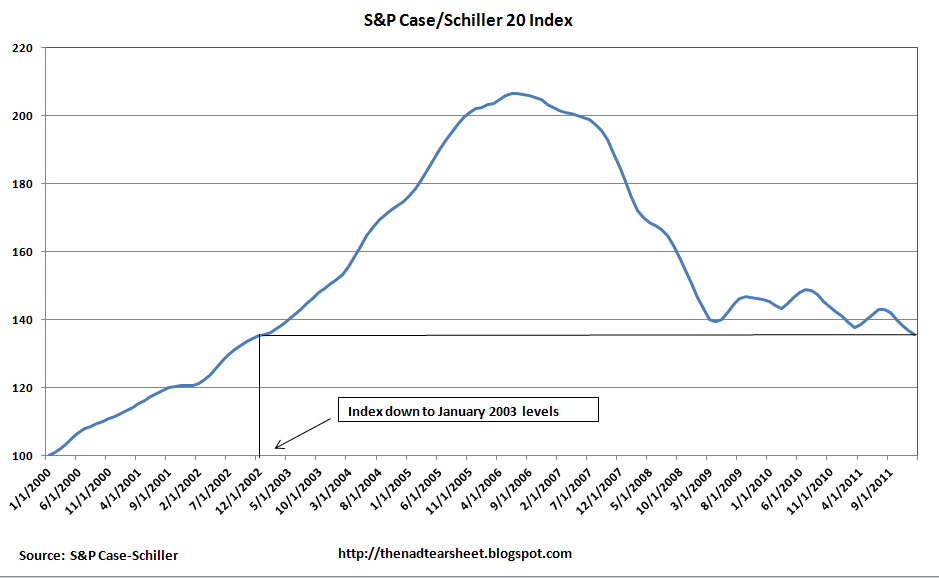
The S&P / Case-Schiller index showed a 3.8% decline year over year. Only Miami, Phoenix, and Washington DC reported increases. Atlanta was the outlier on the downside, with a nearly 15% decline YOY. Note that these are January numbers – Case-Schiller has a couple month lag.

Bloomberg has a story about bidding wars for homes in some parts of the US. While I had heard about bidding wars in the usual places – NYC and DC, this is the first I have heard about bidding wars in places like Seattle. The big question will be whether this is a permanent or temporary phenomenon. Supposedly the settlement with the State AGs ended foreclosure moratoriums, which means more supply is going to be dumped on the market. That said, I am hearing anecdotes of bidding wars in hard hit areas like Phoenix, at least in the $80k – $120k range.

On the other side of the coin, the Campbell / Inside Mortgage Finance survey notes that investors purchases are becoming a larger proportion of home sales, particularly short sales. This is being driven by the long financing timeline. Their Distressed Property Index shows that nearly half of home sales are distressed.

Chart:  S&P / Case-Schiller Composite Index

Morning Report

Vital Statistics:

Last Change Percent
S&P Futures 1403.7 9.6 0.69%
Eurostoxx Index 2537.3 11.9 0.47%
Oil (WTI) 107.2 0.3 0.31%
LIBOR 0.4727 -0.001 -0.11%
US Dollar Index (DXY) 79.272 -0.073 -0.09%
10 Year Govt Bond Yield 2.27% 0.04%
RPX Composite 169.79 0.1
Markets are generally higher this morning on no real news. Bonds and MBS are weaker as risk aversion continues to wane. Commodities are slightly higher.
The Chicago Fed National Activity Index came in  at -.09 in Feb, down from +.33 in Jan and below expectations. Essentially the index tells you whether the economy is growing above trend (positive number) or below trend (negative number).  It takes into account 85 different economic indicators. The biggest positive contributor was employment, while consumption and housing were the biggest negatives.
Meanwhile, Ben Bernake is saying the job market remains weak and the recent drops in unemployment are unlikely to continue.
Speaking of housing, KB Homes released numbers on Friday and the stock was pummeled, as the street was spooked by the lower new orders numbers. KB was blaming the number on their preferred lender (Met Life) exiting the market. Overall, the tone of the conference call was constructive, with the company noting several signs that the housing market is steadily improving.

Smoking Gun on Corzine and MF?

Apparently the government thinks so…

Wow, Jon.  You had it all, money and power. And threw it away.

Morning Report

Vital Statistics:

Last Change Percent
S&P Futures 1387.6 -1.3 -0.09%
Eurostoxx Index 2510.8 -19.5 -0.77%
Oil (WTI) 105.76 0.4 0.39%
LIBOR 0.4732 -0.001 -0.11%
US Dollar Index (DXY) 79.483 -0.253 -0.32%
10 Year Govt Bond Yield 2.25% -0.03%
RPX Composite Real Estate Index 169.74 0.0

Markets are flat this morning on a lack of news. Bonds and MBS continue to retrace their large move downward after the FOMC statement. New Home Sales are due at 10:00 am.

Radar Logic released their Monthly Housing Report yesterday, noting that price declines are slowing, but we are not at a bottom. Distressed sales declined 21.8%, although the settlement between the State AGs and the 5 big banks means that foreclosures are going to pick up again. Interestingly, while Radar Logic has the opinion that housing has yet to bottom, the Radar Logic futures indicate that real estate will stay flat in 2012 and 2013 and then start increasing. The RPX futures are very illiquid, so take what they say with a grain of salt, but still…

Bank of America is launching a pilot program for distressed homeowners, where they follow a Deed In Lieu process to turn over the title to the bank and then rent at sub-market rates for up to 3 years. Bank of America would then sell the properties to outside investors. Speaking of which, we should be hearing the results of the FHFA’s REO-to-Rental program soon. In my opinion, the government made it very difficult for investors to take a look, (you have to pay $250,000 just to find out basic information) which I found surprising.

In the “because I said so” category, Ben Bernake said the Fed’s easy monetary policy after the stock market bubble burst wasn’t responsible for the housing bubble.

As I noted yesterday, the homebuilders have quietly put in a huge rally since last fall. (Note to the business press:  there are more stocks in the US than Apple) Is the move over?  Perhaps.  KB Homes reported disappointing Q1 earnings and the stock is down 14% pre-open.

Etch-a-Sketch-gate was actually market-moving, believe it or not. Yesterday, shares of little Ohio Art (NASDAQ – OART) more than doubled on the prospect that Democrats will be buying Etch-a-Sketches en masse as props for upcoming election. The stock trades by appointment and has a miniscule market cap ($8.6 million), but there you go.

Morning Report

Vital Statistics:

Last Change Percent
S&P Futures 1389.6 -7.9 -0.57%
Eurostoxx Index 2531.7 -35.9 -1.40%
Oil (WTI) 104.88 -2.4 -2.23%
LIBOR 0.4737 -0.001 -0.11%
US Dollar Index (DXY) 79.851 0.194 0.24%
10 Year Govt Bond Yield 2.26% -0.03%

World equity markets are weaker after disappointing economic data from China and Europe. Initial Jobless Claims came in at 348k, more or less in line with expectations. The FHFA House Price Index and Leading Indicators come out at 10:00.  The FHFA is a narrower index than Case-Schiller or RPX in that they only focus on conforming mortgages.

How is the deleveraging of the consumer going?  Actually pretty well, according to one measure. Moody’s notes that the delinquency rate on credit cards reached 4.02% in Feb, the lowest rate since August of 2007. That number is even more impressive when you consider the seasonal factors – Feb is usually a bad month for credit card delinquencies.

One thing the consumer does not need is higher gasoline prices. While oil prices have continued to rally, crack spreads are pushing 10 year highs. Crack Spreads are the price differential between crude oil and the refined product. WTI 321 Crack Spreads are at $32 a barrel, pretty much erasing the decline from last year. Apparently a large chunk of US east coast refining capacity is going to be taken off line this summer, causing a shortage of gasoline on the East Coast.  For further details and analysis, click here. While people bemoan the lack of refining capacity, people forget that refining is in general a lousy business. Sunoco is looking to sell its Philadelphia refinery and will close it if they can’t find a buyer.  Sunoco got only $400 million for the sale of its Toledo OH refinery last year. So look for higher gas prices for the summer driving season.

For those keeping score at home, the XHB (Homebuilder ETF) has been on a tear since early October, gaining 77%.  Is the stock market signalling something the economic indicators have yet to reflect? For the record, I noted the the change in tone on KB Homes 3Q conference call which seemed to predict that life for the homebuilders was improving.  Also, someone made a punchy bet last Oct that paid off well.

Is an arcane rule change from the Fed influencing mortgage rates?  The Fed has changed the rules for failure to deliver in MBS transactions, adding a charge in addition to the interest a seller must pay on a fail. With interest rates so low, sellers had the incentive to short MBS instead of delivering from inventory. This rule change will force dealers to hold more inventory, which the Fed ultimately hopes will drive up prices.

Morning Report

Vital Statistics:

Last Change Percent
S&P Futures 1402.7 2.7 0.19%
Eurostoxx Index 2576.3 -0.4 -0.01%
Oil (WTI) 106.45 0.4 0.36%
LIBOR 0.4742 0.000 0.00%
US Dollar Index (DXY) 79.593 0.000 0.00%
10 Year Govt Bond Yield 2.34% -0.02%

World equity markets are higher this morning ahead of existing home sales data at 10:00am. Bonds are rallying as well, with the 10 year futures up 11 ticks, retracing some of the pounding it has taken over the last week.

Unsurprisingly, the Mortgage Bankers Association index of mortgage applications was down for the prior week, with refis down big. The average rate on a 30 year fixed rate loan was 4.19%.

The Federal Reserve released its financial statements for 2011 yesterday. Total assets were 2.92 trillion at the end of 2011, an increase of almost 500 billion. Total capital is 53.8B, and they distributed 77.4 billion to the US Treasury. They currently hold 895B worth of MBS, which is down 13% from last year.  So it appears they are not fully re-investing P&I payments.  Maiden Lane has been nearly cut in half and is down to 36B, when you include capitalized interest and all the other variable interest entities.

Speaking the the Fed, the WaPo has an article asking the question if Bernake is aggressive enough regarding unemployment. Naturally the inflation doves think he isn’t. Would QEIII lop a percentage point off of the unemployment rate? It is hard to make an argument that it would. A real market-clearing bottom in housing would do more to get the economy moving than more games from the Fed.

How would the major European banks have fared under the Fed’s stress-tests?  They would have passed, according to analysts at Barclay’s. Surprising result, unless they explicitly did not model another sovereign default.