Morning Report 6/13/12

Vital Statistics:

  Last Change Percent
S&P Futures  1314.8 -5.3 -0.40%
Eurostoxx Index 2142.0 -1.4 -0.07%
Oil (WTI) 82.79 -0.5 -0.64%
LIBOR 0.468 0.000 0.00%
US Dollar Index (DXY) 82.31 -0.115 -0.14%
10 Year Govt Bond Yield 1.68% 0.01%  
RPX Composite Real Estate Index 179.1 0.2  

Markets are lower this morning on disappointing retail sales data. April numbers were also revised downward. The Producer Price Index showed inflation at the wholesale level remains under control. Bonds and MBS are lower in spite of the soggy tape. Jamie Dimon gets his close-up today in front of the Senate Banking Committee.

The Lender Processing Services Home Price Index rose .9% in March.  This was the second consecutive monthly increase in the seasonally-adjusted index since 2006. The increase was broad-based geographically, with increases in almost every MSA. That said, March sales volume was extremely low – like mid-90s low – as inventory dried up.  I mentioned a WSJ article yesterday that attempted to address the question why volumes are so low if shadow inventory is so high. Negative Equity is largely the culprit. Also in the report, distressed sales (short sales / foreclosures) made up 40% of the transactions. CNBC notes that new laws like Nevada’s foreclosure-reform law are having the unintended (maybe not) consequence of delaying foreclosures and delaying the market-clearing process. California is debating a “Homeowner Bill of Rights” as well. The net result is that the supply of foreclosed properties will continue to be artificially held back and helps explain the low volume of transactions.

In a story that is guaranteed to hit a lot of ideological nerves, the Washington Post profiles a loan officer who claims Wells Fargo steered minority borrowers into no-doc subprime loans. Needless to say, Wells disagrees claiming they never did no-docs in the first place and that the borrowers wouldn’t have qualified for prime loans anyway. Ironically, she is now in the mortgage-relief business, which has come under scrutiny by the FTC for charging up-front fees and not delivering anything. Needless to say, this article will produce a lot of heated CRA vs bankster debate.

Morning Report 6/12/12

Vital Statistics:


Last

Change

Percent

S&P Futures 

1303.7

3.4

0.26%

Eurostoxx Index

2145.2

7.5

0.35%

Oil (WTI)

82.29

-0.4

-0.50%

LIBOR

0.468

0.000

0.00%

US Dollar Index (DXY)

82.53

0.013

0.02%

10 Year Govt Bond Yield

1.61%

0.02%


RPX Composite Real Estate Index

178.9

0.2


Markets are a touch higher this morning after yesterday’s sell-off. Federal Reserve Bank of Chicago President Charles Evans (who Jim Bianco called an uber-dove) said he supports more stimulus. The 10-year yield is back up to 1.61% and MBS are down about 1/4 of a point.

The National Federation of Independent Business Optimism Index ticked down in May. It came in at 94.4, vs 94.5 in the previous month, which is a historically low level. 51% of owners hired or tried to hire in the last three months and nearly 3/4 of those reported few or no qualified applicants for positions. The report has a pretty scathing indictment of Washington, with 22% of the respondents indicating taxes as the single most important problem. 20% reported poor sales, and 19% reported government red tape.

Excerpt from the report: “The Index did not go down by much, that’s the good news. The May reading is still at recession levels from an historical perspective, consistent with very anemic Gross Domestic Product (GDP) and employment growth. The calculus of spending decisions requires an estimate of future sales, tax rates, interest rates and credit availability, labor costs, health care costs, regulatory compliance costs, all of which are very uncertain, meaning that owners cannot make reliable estimates of what will happen to these factors. Most of this uncertainty is coming out of Washington, D.C. Owners can’t attach probabilities to outcomes or even decide which outcomes to consider.

The amount of political manipulation and evasion to guide the spending of billions of taxpayer dollars is disturbing to owners. Sixty (60) percent of those surveyed said now is a bad time to expand their businesses; one-in four of those owners cited political uncertainty as the main reason, second only to concerns about a weak economy. Investing in jobs or plant and equipment will remain at “maintenance” level until this is resolved.”


I would be surprised if this doesn’t become campaign fodder.

study from the Federal Reserve regarding changes in US family finances has been getting a lot of discussion – the median net worth of families has dropped nearly 40% from 2007 to 2010, putting them back where they were in 1992. Most of this is housing-driven, though stocks, student loans, and a drop in incomes are playing a part too.  A generation’s worth of wealth creation has been destroyed in 3 years. Of course much of that wealth was illusory, but it does speak to why confidence has been so lousy – the reverse wealth effect. Hopefully housing is in fact bottoming, which will reverse this effect. 

The WSJ addresses in interesting question:  if the shadow inventory is so high, why is the inventory of homes actually for sale at normal levels?  It turns out (unsurprisingly) that negative equity is the reason, but also the influx of professional investors scooping up inventory in the hardest-hit areas.  It also explains why prices are rising the most at the bottom end of the market – they have the most negative equity, so supply is the most constrained.

Chart:  NFIB Small Business Optimism Index:


Morning Report 6/11/12

Vital Statistics:

  Last Change Percent
S&P Futures  1328.3 6.3 0.48%
Eurostoxx Index 2169.7 25.8 1.20%
Oil (WTI) 85.09 1.0 1.18%
LIBOR 0.468 0.000 0.00%
US Dollar Index (DXY) 82.28 -0.229 -0.28%
10 Year Govt Bond Yield 1.63% 0.00%  
RPX Composite Real Estate Index 178.7 0.0  

Markets are up this morning on a potential bail out for the Spanish banks, although the initial euphoria is wearing off. When I checked in last night, the S&P futures were up 16 points.  Now they are up 6. During the US financial crisis, the one sure-fire trade was to fade any rally brought on by some sort of government rescue. The S&P futures would spike up on news that the government was intervening somewhere, and then would sell off as people realize the intervention is no panacea. US bonds clearly aren’t buying it, with the 10 year unch’d. MBS are flat as well.

While equity markets have rallied on the Spanish bailout, Spanish bond yields have not. After trading up to 6%, Spanish government yields are now over 6.4%. As Bill Gross has noted, the Spanish bond market is rigged, as the Spanish banks are encouraged to buy up debt auctions to make the demand for Spanish debt look better than it really is. 

Are we there yet? That is the title of CoreLogic’s June MarketPulse report on housing. While noting that previous seasonal strength in 2010 and 2011 ended up fading into year-end, CoreLogic postulates that the green shoots we are seeing indicate the market has turned for good. The caveat:  housing won’t really turn until the job market is fixed. 

Morning Report 6/8/12

Vital Statistics:


Last

Change

Percent

S&P Futures 

1302.7

-7.3

-0.56%

Eurostoxx Index

2143.7

0.6

0.03%

Oil (WTI)

82.22

-2.6

-3.07%

LIBOR

0.468

0.000

0.00%

US Dollar Index (DXY)

82.72

0.666

0.81%

10 Year Govt Bond Yield

1.56%

-0.08%


RPX Composite Real Estate Index

178.7

0.4


Markets are weaker this morning after some disappointing economic data out of Europe. I guess people were hoping for a little bit more out of the Bernank regarding further stimulus when he testified in front of Congress yesterday. The trade deficit narrowed as imports and exports fell by 1.7% and .8% respectively. Bonds and MBS are both up a little. Overall, it feels like a typical Summer Friday and I would expect most of the Street to be on the L.I.E. by noon.

The Fed voted yesterday to accept the Basel III framework. Rob Chrisman has a good piece on how Basel III will impact mortgage pricing. Essentially the new treatment of mortgage servicing rights will force big lenders like Wells to lower the price they are willing to pay for servicing released premiums. In plain English, this means that Basel III has imposed a higher cost on the banks that will be passed on to borrowers. The Fed estimates that the 19 largest US banks are about $50 billion short of meeting new capital requirements, but they also note that these rules will become fully implemented by 2019 and that most banks should be able to meet the new capital requirements through retained earnings and won’t need to raise more capital.

Fannie Mae notes in its National Housing Survey that consumer sentiment seems to be plateauing as we head into the summer selling season. Roughly 1/3 of the respondents expect home prices to rise in the next 12 months and 72% believe now is a good time to buy.

The FHA is planning to announce a bulk sale program today. However, they want to deter “vulture investors” by requiring that the loan buyer to wait 6 months to foreclose and to agree to keep at least half the REO for 3 years.

Morning Report 6/7/12

Vital Statistics:

  Last Change Percent
S&P Futures  1325.5 10.0 0.76%
Eurostoxx Index 2161.6 23.9 1.12%
Oil (WTI) 86.19 1.2 1.38%
LIBOR 0.468 0.000 0.00%
US Dollar Index (DXY) 82.02 -0.306 -0.37%
10 Year Govt Bond Yield 1.66% 0.00%  
RPX Composite Real Estate Index 178.3 0.2  

Markets are higher this morning after China cut interest rates to boost their economy. The benchmark lending rate will drop from 6.56% to 6.31%, effective tomorrow (such precision!). The allowed discount from the benchmark was widened from 10% to 20%.  Initial Jobless Claims in the US came in at 377k, more or less in line with expectations. Bonds and MBS are flat.

Given last Friday’s dismal jobs report, the market was definitely concerned about the Fed’s Beige Book survey which was released yesterday afternoon. Overall, the tone of the report did not confirm fears of an imminent slowdown. The Fed reported that “overall economic activity expanded at a moderate pace” and that “Economic outlooks remain positive, but contacts were slightly more guarded in their optimism.”

In another positive datapoint for the real estate industry, homebuilder Hovnanian reported better than expected earnings yesterday, with a 50% increase in backlog and a 52% increase in contracts. Perhaps this portends the rise in housing starts and construction we have been waiting for since 2008.

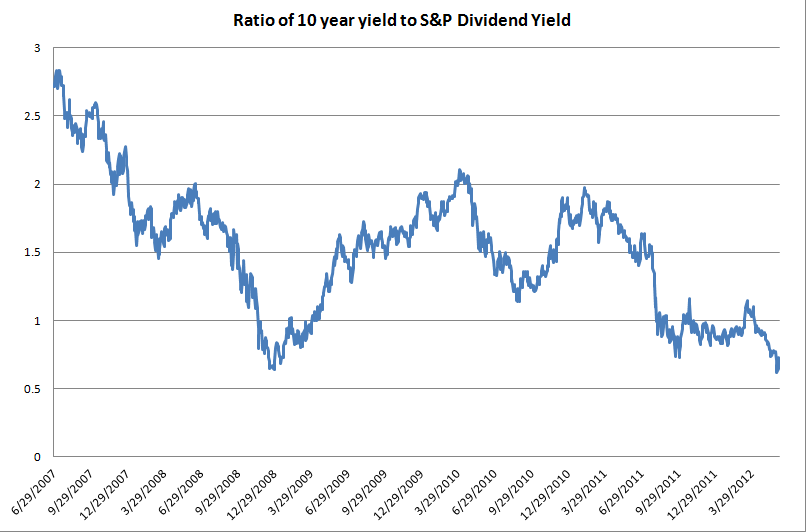
To get an idea how cheap stocks are compared to bonds right now, consider the fact that the 10 year yields about 1.65%, while the dividend yield on the S&P 500 is 2.2%. A dividend yield (let alone earnings yield) higher than the 10-year is a rare event. If you look at the ratio of the 10 year to the dividend yield, it reached  just over 60% last week, and the last couple times it reached that level (2008 and fall of 2011), it portended a huge stock market rally. At any rate, it seems to trigger asset allocation decisions and may account for some of the velocity of the moves in the S&P futures and the bond futures. It also means buy stocks and sell bonds.  Or borrow money long term.

Chart:  Ratio of the 10-year bond yield to the S&P 500 dividend yield:


Morning Report 6/6/12

Vital Statistics:

  Last Change Percent
S&P Futures  1295.7 10.6 0.82%
Eurostoxx Index 2128.5 41.2 1.97%
Oil (WTI) 85.15 0.9 1.02%
LIBOR 0.468 0.000 0.00%
US Dollar Index (DXY) 82.56 -0.265 -0.32%
10 Year Govt Bond Yield 1.59% 0.01%  
RPX Composite Real Estate Index 178.1 0.6  

S&P futures are higher this morning on hopes of further stimulus in Europe.  The ECB left interest rates unchanged. The world seems to be backing away from the ledge a little, selling government bonds and taking more risk. Mortgage rates moved lower only grudgingly last week, so we should expect them to stay more or less stable as the 10-year yield backs up. Nonfarm productivity came in lower than expected, as did unit labor costs. The Fed’s Beige Book will be released mid-afternoon.

CoreLogic’s April Home Price Index showed a year-over-year gain of about 1%.  Excluding distressed sales, they rose almost 2%. They also introduced a new metric – the Pending Home Price Index – which indicates the trend in prices. This month, the Pending HPI predicts another 2% from April to May. Month-on-month increases are normal seasonal behavior, but year on year increases are more a sign that prices are bottoming.

Clear Capital is reporting more or less the same thing in its June Home Data Index Market Report. It notes that national home prices grew on both a quarterly and yearly basis for the first time since August 2010. Dr Alex Villacorta, Director of Research said:  “While gains in national home prices over the quarter and year were minimal in May, there are encouraging trends continuing to play out and gaining momentum beneath the surface.  Strength in REO-only price trends as well as some early indications of price gains spreading from low tier sections to the mid, and higher priced homes is helping confirm that the country continues to make progress on its recovery, and we are expecting to see improvements extend of the next several months.” RTWT.

Given that the mortgage market more or less IS Fannie, Fred, and Ginnie the question now is what to do with them. The Community Mortgage Lenders Association has sent a white paper to the government recommending that we reduce the GSE’s involvement in the secondary market to around 33% and that there be an explicit backstop fee paid to the government. 

Morning Report 6/5/12

Vital Statistics:

  Last Change Percent
S&P Futures  1271.0 -2.0 -0.16%
Eurostoxx Index 2076.6 -2.4 -0.11%
Oil (WTI) 83.63 -0.4 -0.42%
LIBOR 0.468 0.001 0.21%
US Dollar Index (DXY) 82.89 0.328 0.40%
10 Year Govt Bond Yield 1.54% 0.02%  
RPX Composite Real Estate Index 177.6 -0.1  

Markets are flat after some disappointing economic data out of Europe. The Eurozone ISM survey came in at 46 and has been below 50 for the past 4 months, indicating a contraction in the manufacturing sector. The  US Non-Manufacturing ISM will be released at 10:00 am, with economists predicting a reading of 53.5. Equity markets seem to be stabilizing, so we are seeing Treasury investors back away from the ledge. MBS are lower as well.

Germany is becoming more amenable to some sort of pan-European banking coordination. Angela Merkel said: “So we will also talk about to what degree one has to bring the systemic banks under specific European supervision to keep national interests from playing too large a role.” This will be easier said than done, as countries tend to get very nationalistic when talking about banks. Good luck getting the French on board.

CSFB is predicting the Fed will continue monetary stimulus, with a continuation of Operation Twist and buying mortgages. I am not sure why Operation Twist needs to be continued – Europe has done more to lower long-term interest rates than the Fed could engineer. There has been speculation that the Fed could do a hybrid of sorts, where it sells short term paper and buys mortgage backed securities directly.

NPR has an article on the future of the American Dream – homeownership. While most of the article discusses the psychological differences between homebuyers during the bubble and homebuyers before the bubble, they have an interesting chart from showing how much cheaper it is to buy than rent. The chart shows ratio of the cost of homeownership vs the cost of renting since 1986.  The costs are now equal, even if you ignore the interest deduction.

Chart:  Rent vs Buy 


Morning Report 6/4/12

Vital Statistics:


Last

Change

Percent

S&P Futures 

1277.0

3.1

0.24%

Eurostoxx Index

2088.7

20.0

0.97%

Oil (WTI)

82.46

-0.8

-0.93%

LIBOR

0.468

0.001

0.21%

US Dollar Index (DXY)

82.74

-0.152

-0.18%

10 Year Govt Bond Yield

1.50%

0.05%


RPX Composite Real Estate Index

177.6

0.3


S&P futures are up 3 points after having been down 12 points in the overnight session. A drop in Euro sovereign yields seems to account for the better tone. China’s non-manufacturing PMI dropped to 55.2 in May from 56.1 in April, indicating that their economy is decelerating. The 10-year yield has increased to 1.5% and mortgage backed securities are down a tick.

This week will be a relatively data-light week, in contrast to last week (especially Friday). However, there will be lots of Fed-speak all week and investors will be parsing each statement for further clues regarding QE.  It may turn out that the Fed conducts Operation Twist by purchasing MBS instead of Treasuries.

One of the reasons why this recovery has proven to be so unsatisfying has been the lack of construction activity, which usually leads the economy out of a recession. The Atlantic has a chart that shows construction jobs as a percent of total jobs is at levels not seen since 1946.

Laurie Goodman of Amherst Securities weighs in on how regulators are creating a credit crunch.

Chart:  Construction jobs as a percent of total jobs:


Morning Report 6/1/12

Vital Statistics:


  Last Change Percent
S&P Futures  1282.1 -27.1 -2.07%
Eurostoxx Index 2076.9 -42.0 -1.98%
Oil (WTI) 83 -3.5 -4.08%
LIBOR 0.468 0.001 0.21%
US Dollar Index (DXY) 83.31 0.266 0.32%
10 Year Govt Bond Yield 1.46% -0.10%  
RPX Composite Real Estate Index 177.4 -0.1  

Ugly.  That is all you can say this morning.  Equity markets are reeling after a slew of disappointing economic reports this morning.  The 10-year is trading at 1.46%. MBS are trading higher as well. The German 2-year bund actually has a negative yield. 

The unemployment rate ticked up to 8.2% and the economy added just 69,000 jobs last month. The labor force participation rate rose to 63.8%, reversing April’s decline. The average workweek declined, which bodes ill for future hiring. 

With the massive rally in the 10-year, you would think Operation Twist would be put on the back burner. You would be wrong. Federal Reserve Bank of Boston head Eric Rosengren is advocating continuing Operation Twist (where the Fed buys long-dated bonds and sells short-dated paper in an attempt to lower long-term rates). Given the massive rally we have experienced in the 10 year, May’s jobs report should have been great. Anyone think June’s report is going to be great?

Facebook’s IPO is instructive in that it shows how the relationship between issuer and bank has become more important than the relationship between investor and investment bank. Many moons ago, when I was in business school, we used to ask why IPOs popped so much on day 1. A pop in the stock meant that issuers were leaving money on the table. One explanation was that while an investment bank would get a deal from an issuer maybe once every few years, they had to deal with their buy-side clients every day. So they were more interested in keeping Fidelity happy than they were in keeping XYZ.com happy. Which meant IPOs were usually under-priced. 

Fast forward to today:  Facebook was a disaster if you were an investor. But the investor’s loss was Facebook’s gain. The banks managed to sell as many shares as possible at as high a price as possible. What has changed?  IMO commissions and spreads. When I started in the business, institutions paid a nickle a share to trade a stock. Bid/Ask spreads were 1/8. Sales and trading was a lucrative business that was conducted over the phone.  Nowadays, you can trade inside the penny spread, and commissions are 1/4 of a cent a share. Everything is automated. Sales and trading is a loss-leader business, which means banks are more interested in keeping issuers happy than they are keeping investors happy. If Fidelity is mad, who cares?  Morgan Stanley isn’t making anything from them anyway…

Morning Report 5/31/12

Vital Statistics:

  Last Change Percent
S&P Futures  1309.6 1.0 0.08%
Eurostoxx Index 2124.7 8.5 0.40%
Oil (WTI) 87.6 -0.2 -0.25%
LIBOR 0.467 0.000 0.00%
US Dollar Index (DXY) 82.81 -0.212 -0.26%
10 Year Govt Bond Yield 1.59% -0.03%  
RPX Composite Real Estate Index 177.5 0.0  

Equity markets are flat after yesterday’s bloodbath, while bonds continue to rally.  The 10 year is trading at 1.59%. MBS are up as well. Lest anyone think this is strictly a US phenomenon, yields in the “safe” European countries like Switzerland, Denmark, Germany are even lower. On the other hand, Greek debt now yields 30.6%, which is pretty much the same level it was before default. 

Today is Jobs Day with a slew of labor-related economic releases at 8:30. Challenger has already said that announced job cuts were up 67% YOY in May.  This is a notoriously volatile index because one large employer (in this case HP) can dominate the month, so you have to focus on the trends and here 10 out of the last months showed increases. On the other hand, announced job cuts don’t always happen so take it with a grain of salt.  That said, there aren’t a lot of forward-looking labor measures out there.

Initial Jobless Claims came in at 383k, higher than the 370k estimate. The ADP Employment change report predicts 133k jobs were added in May.  1Q GDP was revised downward to 1.9%, in line with expectations. Consumption, exports, and residential fixed investment (finally!) drove Q1 GDP growth.

Delays in foreclosures and recent incentives by the Obama administration are making short sales more attractive to lenders than foreclosures.  Short sales were up 25% from a year ago as opposed to bank-owned sales which dropped 15%.  More aggressive pricing on the part of lenders is driving the increase.

Given the outsized rally in Treasuries yesterday, you would have expected a commensurate drop in mortgage rates.  But that didn’t happen. Mortgage rates are moving lower only grudgingly as rates fall, indicating that we may be reaching a floor, or at least further drops will be very hard to come by.