Morning Report 10/2/12

Vital Statistics:

  Last Change Percent
S&P Futures  1444.8 7.9 0.55%
Eurostoxx Index 2513.6 14.8 0.59%
Oil (WTI) 92.8 0.3 0.35%
LIBOR 0.354 -0.001 -0.35%
US Dollar Index (DXY) 79.67 -0.159 -0.20%
10 Year Govt Bond Yield 1.65% 0.02%  
RPX Composite Real Estate Index 194.5 0.3  

Markets are higher this morning on speculation Spain is preparing to ask the ECB to purchase its debt. The stock market definitely feels like the path of least resistance is up, though it could be the calm before the storm – Alcoa kicks off earnings season next week. Notable earnings warnings so far include Caterpillar and FedEx.  Bonds and MBS are down / flat.

Yesterday’s ISM Purchasing Managers Report was reasonably constructive.  The headline number of 51.1 means that the economy should expand at roughly 3% or so, at least according to historical trends.  Production and backlog were the weak spot, while employment and prices were areas of strength.

The Washington Post has an article which shows what the Fed is up against: Even though interest rates are at rock bottom levels, savings deposits continue to increase. Risk aversion and the desire to replenish lost savings are behind the phenomenon.  Even though the stock market has rallied, the lack of volume indicates that retail investors are not putting money to work there.  Aside from the risk appetite considerations, it also demonstrates why consumption remains weak. 

You know who loves this situation?  Corporate America.  As if on cue, I just received an email saying WellPoint is issuing $1.5 billion of senior unsecured 30 year convertible bonds tomorrow with a price talk of 2.5% – 3% coupon, 20% – 25% premium.  To put that in perspective, the 30 year government bond is at 2.8% and WLP pays a 1.9% dividend. Old time convertible arbs are shaking their collective heads at that one.

Finally, Bill Gross on budgetary crystal meth and the ring of fire.

Morning Report 10/1/12

Vital Statistics:

  Last Change Percent
S&P Futures  1439.0 4.8 0.33%
Eurostoxx Index 2480.9 26.7 1.09%
Oil (WTI) 91.72 -0.5 -0.51%
LIBOR 0.355 -0.003 -0.91%
US Dollar Index (DXY) 79.8 -0.135 -0.17%
10 Year Govt Bond Yield 1.62% -0.02%  
RPX Composite Real Estate Index 194.5 0.0  

Stock index futures are higher as we kick off the 4th quarter.  There are no major headlines or economic data this morning. Later this week, we will get the FOMC minutes from the last meeting, and Friday’s jobs report will have market moving potential. Bonds and MBS are up.

Will the fiscal cliff affect housing in any way?  Perhaps.  One provision in the expiring tax cuts is the 2007 Mortgage Forgiveness Debt Relief Act and Debt Cancellation which made the debt forgiveness in short sales non-taxable.  Typically debt forgiveness is considered taxable income.  If this provision goes away, short sales and mods with principal forgiveness may grind to a halt.

Meanwhile, HUD secretary Shaun Donovan was defending the mortgage interest deduction on the Sunday morning talk circuit over the weekend.

Morning Report 9/28/12

Vital Statistics:

Last Change Percent
S&P Futures 1433.2 -7.9 -0.55%
Eurostoxx Index 2470.5 -35.6 -1.42%
Oil (WTI) 91.65 -0.2 -0.22%
LIBOR 0.359 -0.002 -0.49%
US Dollar Index (DXY) 79.56 0.009 0.01%
10 Year Govt Bond Yield 1.61% -0.05%
RPX Composite Real Estate Index 194.5 0.0

Markets are weaker on no real news.  Personal Income came in weaker than expected and personal spending was in line with estimates. The .5% increase in spending was driven by a .4% increase in prices. Bonds are up about half a point and MBS are up 1/4.

On the back of the puzzling statistic showing a 17% increase in new home prices, BLS is now saying an additional 453k jobs were added in 2011, bringing the hiring estimate up from 1.9 million to 2.3 million. Is the obama administration playing jiggery-pokery with the economic data?  Well, that is one way to fix the economy.

Amidst all of the usual theories about the cause of the financial crisis (Glass-Steagall, nefarious bankers, Fannie and Fred) we have another – flaws in democracy itself.  He does sound a bit like Thomas (Flathead) Friedman in that he envies more authoritarian societies that are able to push through policies without much opposition.

Is QEIII going to do much for the real estate market? According to Thomas Flexner, global head of real estate at Citi, it won’t “do very much at all.”  Blame tight lending standards. Also, as g-fees increase that will offset part of the lower interest rate effect.

Morning Report 9/27/12

Vital Statistics:

  Last Change Percent
S&P Futures  1434.2 7.3 0.51%
Eurostoxx Index 2507.7 9.2 0.37%
Oil (WTI) 91.23 1.3 1.39%
LIBOR 0.36 -0.002 -0.55%
US Dollar Index (DXY) 79.74 -0.141 -0.18%
10 Year Govt Bond Yield 1.64% 0.03%  
RPX Composite Real Estate Index 194.5 0.1  


Markets are higher this morning on speculation of further stimulus measures out of China, in spite of some lousy economic data. Bonds and MBS are down.

2Q GDP was revised down to +1.3% from +1.7%. Big revision downward. Durable goods slumped 13% on a decline in aircraft orders.  Revisions were down across the board. About the only bright spot was a drop in initial jobless claims to 359k.  While some might dismiss the drop in durables as just normal volatility, I would point out that Caterpillar has already warned.  Speaking of which, we are getting pretty close to pre-announcement season, when companies that are going to miss their quarter fess up to the Street.  

Yesterday’s report from the Commerce Department noted that sales of new single-family houses in August were at a seasonally adjusted rate of 373k, up 28% from Aug 11.  The shocking statistic from the report was that the median sales price of a new home was 257k, up 17% from a year ago. The homebuilders aren’t reporting price increases like that –  KB Homes said sales prices were up 5% YOY in their 3Q results, while Lennar reported a 4% price increase.  Is it perhaps that bigger houses are being sold now and that accounts for the increase?  Nope – McMansion builder Toll Brothers reported prices increased only 1%, and we all know that the remaining problems in the real estate market are at the high end, where it is cheaper to buy than build. And if prices really were increasing 17% YOY, housing starts wouldn’t be 750k, half of the 1959-2002 average run rate.  So something fishy is going on – perhaps Commerce is trying to put out good statistics to help Obama’s campaign and intends to quietly revise the numbers downward once he gets elected.

The first time homebuyer is still struggling to get involved in the real estate market.  The latest NAR Confidence Index Report showed that first time homebuyers were only 31% of all sales, much lower than their typical 40% share.  Tight credit and cash buyers account for the drop. Buyer traffic has jumped considerably over the past year, while seller traffic has remained flat. 


Morning Report 9/26/12

Vital Statistics:

  Last Change Percent
S&P Futures  1433.8 -3.4 -0.24%
Eurostoxx Index 2512.3 -56.2 -2.19%
Oil (WTI) 89.94 -1.4 -1.57%
LIBOR 0.362 -0.001 -0.34%
US Dollar Index (DXY) 79.93 0.376 0.47%
10 Year Govt Bond Yield 1.64% -0.03%  
RPX Composite Real Estate Index 194.5 0.0  

Markets are weaker this morning as Europe sells off and commodities weaken. Spanish bond yields are back above 6%.  Perhaps the late summer lull in European news is over and it will take center stage again.  If so, the markets didn’t have much time to bask in the glow of QE infinity. This is pushing yields down on the 10 year, and MBS are up slightly. Volumes should be light today for the Jewish holiday.

The FHFA House Price index increased 3.7% annually in July. This index focuses on Fan and Fred conforming loans, so it is more of a “core” index than Radar Logic or Case-Schiller which are affected by sales at the extremes of valuation.  This index is much more stable – the peak to trough drop for the FHFA index was only 20%, vs. something like 33% for the other indices.


Unsurprisingly, Philly Fed President Charles Plosser doesn’t think much of QE Infinity. Plosser hits at the Fed’s credibility in an unusual way – “Conveying the idea that such action will have a substantive impact on labor markets and the speed of the recovery risks the Fed’s credibility.”  It is unusual in that we typically mean “inflation fighting” when we mention credibility.  Plosser is one of the most hawkish members of the Fed. He forecasts the economy will expand by 3% in 2013 and 2014, which is an aggressive forecast, to say the least. 

If noted that actual borrowing rates have not been affected by GE Infinity, even though MBS have moved, you would not be alone. This has been a continuing theme in the press, which brings with it the predictable questions of price gouging.  Part of the problem is that so much capacity has been taken out of the banking sector in the last 5 years that they cannot handle the volume.  Since most of these loans are refis, the banks view this boomlet as temporary and are reluctant to hire for fear that they will end up being overstaffed when rates start rising. 

Real “inside baseball” stuff, but University of Chicago professor Casey Mulligan discusses how our redistributive social safety net is skewing incentives to work, and also challenges Paul Krugman’s “Its the demand, stupid” argument.  

Morning Report 9/25/12

Vital Statistics:

  Last Change Percent
S&P Futures  1454.8 3.4 0.23%
Eurostoxx Index 2553.3 -4.6 -0.18%
Oil (WTI) 92.97 1.0 1.13%
LIBOR 0.364 -0.004 -1.02%
US Dollar Index (DXY) 79.5 -0.015 -0.02%
10 Year Govt Bond Yield 1.71% 0.00%  
RPX Composite Real Estate Index 194.5 -0.2  

Markets are up slightly on no real news. Caterpillar issued a profit warning based a drop in capital expenditures from the miners, which is a bad sign for the world economy, particularly China. Nevertheless, commodities are up this morning. Bonds and MBS are up small.  

The S&P / Case-Schiller index showed a 1.2% annual increase in July. They note the recent strength of the housing market and that inventory is down.  FWIW, the strategist at Radar Logic (the publisher of the RPX index) believes the strength is a head fake due to the large amount of shadow inventory.  One big question regarding shadow inventory is how much has been picked over?  Is the remaining shadow inventory the least salable garbage that nobody wants?  If so, will its liquidation matter that much to prices? How much of it is vacant dilapidated blight in places like Detroit and Toledo, which will never sell and will probably get demolished?

Chart:  Case-Schiller:


The Romney campaign has released its plan for the housing market. The most significant departure from the Obama administration is an end to REO-to-rentals.  A President Romney, observing that a ton of money has been raised to invest in resi, would simply sell the property as opposed to using various strategies like REO to rental to keep it off the market.  He would end TBTF Fan and Fred (he doesn’t say how) and he would usher in “sensible, but not overly complex financial regulation to allow banks to approve loans to families with good credit rather than rejecting their mortgage applications.”  I take it the last statement means we will finally learn what the government considers a “qualified mortgage.” Basically, the plan boils down to “hit the bid, stop trying to manipulate the real estate market, and make some decisions on how we are going to regulate the banks.”  

RBS has been implicated in the LIBOR scandal, along with Barclay’s. This time, it looks like RBS was not simply falsely reporting LIBOR during the financial crisis to prevent a bank run, it was doing it over a longer period to benefit positions.  Regulators might let the first case slide; they certainly won’t let the second one.

Yet another unintended consequence of ZIRP – the death of the “free” checking account. 

Morning Report 9/24/12

Vital Statistics:


Last

Change

Percent

S&P Futures 

1446.6

-5.3

-0.37%

Eurostoxx Index

2553.6

-23.5

-0.91%

Oil (WTI)

91.84

-1.1

-1.13%

LIBOR

0.367

-0.002

-0.54%

US Dollar Index (DXY)

79.59

0.265

0.33%

10 Year Govt Bond Yield

1.72%

-0.03%


RPX Composite Real Estate Index

194.5

-0.2


Markets are lower after a disappointing German business sentiment survey and some German officials criticized Spanish Prime Minister Rajoy’s foot-dragging on an aid package.  The financial industry jobs bleed continues – after BOA announced it would cut 16,000 jobs late last week, RBS is cutting another 300 and Nomura is reorganizing (read cutting jobs) in its Asian Finance Unit. According to Olivetree financials strategist, this is just the start. Bonds and MBS are up.

The Chicago Fed National Activity Index deteriorated in August, which was the 6th consecutive month activity was below trend. The number came in at – .87, which is below the – .7 mark.  If the 3 month moving average falls below .7, it typically means a recession has already started. FWIW, employment was not the big driver – it was production.

Lennar reported better than expected sales and profits this morning. Stuart Miller characterized the housing market as “The housing market has stabilized and the recovery is well underway.  Low mortgage rates, affordable home prices, increased buyer confidence and an extremely favorable rent-to-own comparison are driving growth in each of our markets.  Additionally, reduced foreclosures and declining distressed home inventory are further contributing to the improvement in the housing market.”  Granted, the homeboys are the biggest cheerleaders of real estate there is, but still…  BTW, KB Homes was up 16.5% on Friday after it reported a good quarter.  LEN is up 4% pre-open.

After the fact, Shelia Bair thinks Hank Paulson’s bazooka was too big.

Morning Report 9/21/12

Vital Statistics:

Last Change Percent
S&P Futures 1459.3 5.5 0.38%
Eurostoxx Index 2569.4 16.4 0.64%
Oil (WTI) 93.42 1.0 1.08%
LIBOR 0.369 -0.004 -1.01%
US Dollar Index (DXY) 79.11 -0.303 -0.38%
10 Year Govt Bond Yield 1.79% 0.02%
RPX Composite Real Estate Index 194.5 0.0

Markets are higher this morning on no real news.  Today is Triple Witching (the expiration of Sep index options and futures) so sometimes you get funny moves pre-open and on the close. There is no economic data this morning. Bonds are down a few ticks, while MBS are up a few.

KB Home reported good numbers last night, with 16% increase in revenues and a 33% increase in backlog. “It is clear that the recovery in housing is gaining momentum across the country as inventory levels are declining and home prices are on the rise.  In particular we are seeing dramatic improvement in California, where we are the state’s largest homebuilder, as the continued strengthening in the coastal markets is now spreading inland to Sacramento, the Central Valley, and the Inland Empire.”  The stock is up 2.5% pre-open.

While housing is definitely improving here, Europe still has to contend with its slow-motion bank run.  Which means that banks in Spain or Italy have to increase deposit rates to prevent capital from leaving, which naturally gets passed on to borrowers.  Which contracts credit in spite of what the ECB is trying to do.

The Senate is looking into high frequency trading. The regulators are looking into whether HFT increases volatility, which is the wrong question to ask.  The correct question to ask is if they are front-running orders – meaning if you enter your order to buy 200 shares of Apple stock via your Charles Schwab account, does someone see your buy order before it hits the exchange and are they stepping in front of you and buying the stock that is out there in the hopes of selling to you a penny or two higher?  Arbitraging the different exchanges is one thing – front running is another.  To put it in perspective, if I did that as a block trader, I would probably lose my job and maybe my Series 7 license if the regulators found out. This could become a battle royale, because the NYSE loves HFT because it is such a money maker.  And it is a private entity. However as Jack Reed points out, the capital markets are also a public good.  Meh, as much as I used to gripe about the specialists on the floor of the NYSE, they did serve a purpose.  But market-making, at least in the equity markets, is long gone.

Morning Report 9/20/12

Vital Statistics: 

  Last Change Percent
S&P Futures  1447.3 -5.9 -0.41%
Eurostoxx Index 2545.6 -22.1 -0.86%
Oil (WTI) 91.68 -0.3 -0.33%
LIBOR 0.373 -0.003 -0.73%
US Dollar Index (DXY) 79.48 0.423 0.54%
10 Year Govt Bond Yield 1.73% -0.04%  
RPX Composite Real Estate Index 194.1 -0.1  

Markets are lower this morning after some disappointing European reports and a soft initial jobless report. 383K people filed for unemployment last week, higher than the survey of 379k.  Last week was revised upward as well. Later this morning we will get Leading Economic Indicators. Bonds are up a point and MBS are up 1/4.

It looks like HUD paid out over $1B in false claims for its Preforeclosure Sale Program. The program ran from 9/10 to 8/11 and paid out $1.7B in total.  It was intended to help homeowners who must sell their home for less than it was worth, provided they had an unavoidable financial crisis, lived in the home and did not have sufficient income to make the payments. The IG sampled 80 random cases and found 3/4 failed to meet the criteria. Ironically, it may have been a blessing in disguise since the homes would have probably gone into foreclosure anyway and FHA would have lost more in that event. 

FHFA has sent to the Federal Register its approach for setting guarantee fees on a state-by-state basis, to account for the fact that foreclosures take longer and are more expensive in some states than others.  Housing advocates will undoubtedly object strongly to this measure. I guess they believe that borrowers in non-judicial states should subsidize borrowers in judicial states.

On the back of yesterday’s WaPo story highlighting the difficulty the Fed is having getting the benefits of QE to Main Street due to bottlenecks in mortgage origination, Bank of America announced they are cutting 16,000 jobs by year end, of which 3200 are in new mortgage origination. It is astounding how much national  capacity has been taken out of mortgage origination over the past 5 years. I suspect a lot of people will find themselves caught flat-footed when the turn happens.

Morning Report 9/19/12

Vital Statistics: 

  Last Change Percent
S&P Futures  1455.6 2.7 0.19%
Eurostoxx Index 2557.9 4.5 0.18%
Oil (WTI) 94.87 -0.4 -0.44%
LIBOR 0.376 -0.003 -0.79%
US Dollar Index (DXY) 79.39 0.141 0.18%
10 Year Govt Bond Yield 1.78% -0.02%  
RPX Composite Real Estate Index 194.3 0.7  

Markets are higher this morning after the Bank of Japan increased monetary stimulus.  This is in spite of a disappointing report on housing starts. Bonds are up half a point and MBS are up 1/4.

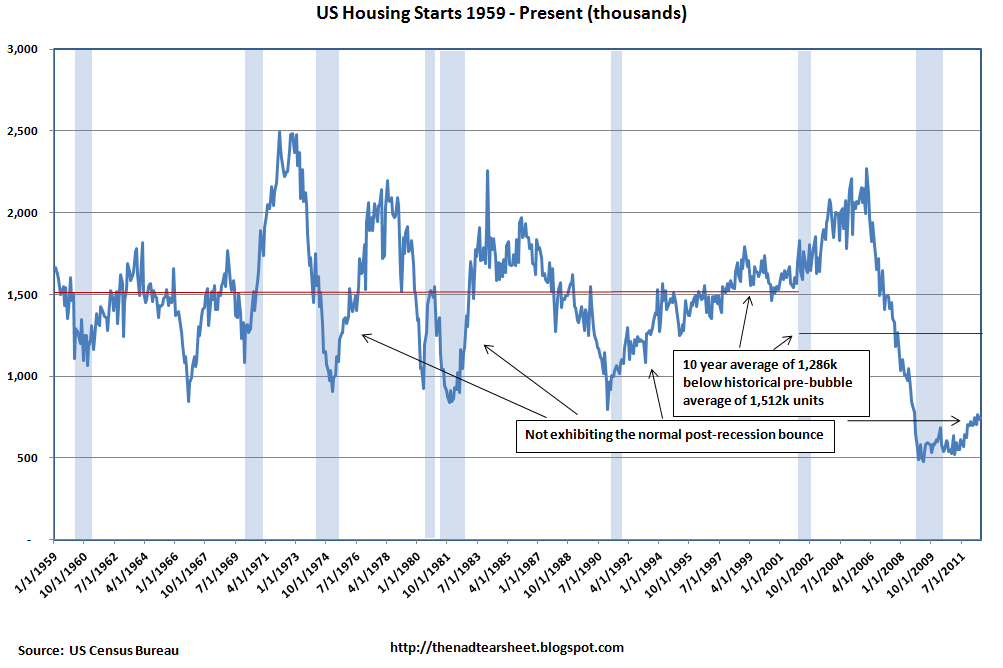
Housing starts climbed to an annual 750k pace in August, still roughly half of the pre-bubble average since we started keeping records in the late 50s.  To put that number in perspective, in 1959, we had just over 1.5 million housing starts with a population of 177.8M people. Fast forward today, starts are down 50%, while the population is up 75%.  Low household formation numbers combined with underwater homeowners is keeping demand low. That situation will not last forever – the low household formation numbers are creating pent-up demand that eventually gets released.  Even in a lousy economy, people still get married, have kids, and will need housing. We have underbuilt new housing for the past 10 years.

Chart:  Housing starts (1959 – Present)

 The recent QE-driven bull run in stocks has left many people skeptical, given that profitability may have peaked and Taxmageddon may usher in an early 2013 recession. Professional short-seller Jim Chanos is finding value traps in nat gas, iron ore, HP and Coinstar. Doug Kass mentioned Dell and Microsoft as short ideas on Bloomberg radio this am. 

WaPo has an article accusing the banks of price gouging in the latest round of QE. Basically so much capacity has been taken out of the mortgage banking industry that banks cannot handle the amount of business coming their way, especially as GMAC sits in bankruptcy and Bank of America pulled out of correspondent lending. Much of this new business is refinancing, which the banks view as temporary.  As a result they are reluctant to hire, knowing that the refi business is going to disappear once rates start backing up. Also, guarantee fees are increasing, which is working against what the Fed is trying to accomplish.