Latest interview on Blog Talk Radio. 7/1/13

I talk about the Fed, interest rates, and real estate.

http://www.blogtalkradio.com/capitalmarketstoday/2013/07/01/special-edition-market-turmoil-bond-market-interest-rates

Morning Report – Record outflows in bond funds 7/1/13

Vital Statistics:

Last Change Percent
S&P Futures 1607.5 8.2 0.51%
Eurostoxx Index 2618.1 15.5 0.60%
Oil (WTI) 97.87 1.3 1.36%
LIBOR 0.273 0.000 0.00%
US Dollar Index (DXY) 83.16 0.022 0.03%
10 Year Govt Bond Yield 2.53% 0.04%
Current Coupon Ginnie Mae TBA 102.3 -0.2
Current Coupon Fannie Mae TBA 101.3 -0.2
RPX Composite Real Estate Index 205.3 -0.2
BankRate 30 Year Fixed Rate Mortgage 4.39


Markets are higher on no real news. The Markit US Purchasing Managers Index came in a little lower than expected. Later this morning we will get construction spending and the ISM manufacturing. ISM could be market moving. Bonds and MBS are down.


This week is relatively data-light, with the 4th of July holiday in the middle. The highlight of the week will be the jobs report on Friday.


record $80 billion was pulled out of bond funds and bond ETF funds in the month of June, according to Trim Tabs. This record outflow is also based on people who follow the news closely. Q2 statements are coming out soon and a lot of people who don’t follow their investments closely may be in for a shock. Which means we could face another deluge of selling.


Delinquencies are falling again, with serious delinquencies dropping to 2.83% in the month of May, according to Fannie Mae’s monthly summary. Serious DQs were 3.57% a year ago. Separately, Citi paid just under $1 billion to settle buyback claims on mortgages originated from 2000 to 2012.


I will be on Capital Markets Today later this afternoon discussing the latest from the bond markets

Morning Report – First Time Homebuyer Sighting. 6/28/13

Vital Statistics:

  Last Change Percent
S&P Futures  1603.2 -3.4 -0.21%
Eurostoxx Index 2596.7 -23.2 -0.88%
Oil (WTI) 97.22 0.2 0.18%
LIBOR 0.273 -0.001 -0.33%
US Dollar Index (DXY) 82.83 -0.075 -0.09%
10 Year Govt Bond Yield 2.52% 0.05%  
Current Coupon Ginnie Mae TBA 102.1 -0.5  
Current Coupon Fannie Mae TBA 101.1 -0.4  
RPX Composite Real Estate Index 205.5 -0.2  
BankRate 30 Year Fixed Rate Mortgage 4.38    


Markets are down slightly on no real news. The NAPM-Milwaukee report came in better than expected. Bonds and MBS are down.
 
Big drop in mortgage rates yesterday. Bonds were up a bit, but this was a big move. Sounds like the pandemonium in the TBA market since last week is taking a breather. You had a period where mortgage REITs and originators were getting in each other’s way trying to sell TBAs. Perhaps the Great Mortgage REIT Convexity Hedge / Deleveraging Trade is finished, at least for the moment. Ginnie I / II spreads and Fannie / Gold spreads will tell the tale.
 
KB Home reported earnings yesterday, and gave some background on where they see the housing sector. There were two big takeaways from the conference call.  First, the increase in interest rates is not negatively affecting demand; in fact it is creating a “sense of urgency” among buyers. This comports exactly with what Lennar said on their call earlier this week. Second (and this is big), the first time homebuyer is back. KB Home is one of the lower price points for the homebuilders and focuses on the first time and move up buyer. 60% of their business is the first time homebuyer. If this is in fact the case (and Lennar also observed the same thing) this is the last step needed for a full, robust housing recovery. 
 
Pending Home Sales increased 6.7% to a 6 year high, according to NAR. These are contract signings, not sales, so they reflect the increase in rates over the month of May. We are finally seeing robust growth in the West. The Northeast was flat, but grew 14% year-over-year. The West grew 16%, but was flat year-over-year. Next month’s number will be very interesting because it will include the “Bernanke Scare”, which is becoming the euphemism for last week’s FOMC statement that scared the beejeezus out of the bond market. 

Morning Report – Bill Gross’ investment outlook and why the CRA disparate impact analysis is all wet. 6/27/13

Vital Statistics:

  Last Change Percent
S&P Futures  1604.5 9.0 0.56%
Eurostoxx Index 2604.7 1.9 0.07%
Oil (WTI) 95.87 0.4 0.39%
LIBOR 0.274 -0.002 -0.58%
US Dollar Index (DXY) 82.85 -0.128 -0.15%
10 Year Govt Bond Yield 2.49% -0.05%  
Current Coupon Ginnie Mae TBA 101.7 0.3  
Current Coupon Fannie Mae TBA 101.1 0.4  
RPX Composite Real Estate Index 205.6 0.2  
BankRate 30 Year Fixed Rate Mortgage 4.57    


Markets are up this morning as personal income comes in a little better than expected, and personal spending comes in at expectations. Initial Jobless Claims came in at 346k, more or less in line with expectations. Bonds and MBS are up.
 
The Corker – Warner Bill to wind down the GSEs is out. The full text of the bill (all 154 pages of it) are here. Punch line: GSEs are wound down, their liabilities are transferred to the taxpayer, some private entity will bear the first 10% loss on new securitizations, and the Federal Mortgage Insurance Corporation (FMIC) will re-insure losses over 10%. 
 
Bill Gross’s latest investment outlook takes the view that the recent spike in rates was overdone.Yes, there was too much risk in the system (read leverage) and the Fed needed to act to squeeze some of that out. But, he believes that the 10 year yield is probably 30 basis points too high and belongs at 2.2%. Reasons: (a) the Fed’s economic forecasts are too optimistic (remember, we just revised Q1 GDP downward yesterday from 2.6% to 1.8% after coming in at .4% in Q4). (b), the Fed wants higher inflation – 1% is too low, and finally, he makes the point that the Fed Funds rate is going nowhere until 2015 at the earliest. This anchor of Fed funds should hold down Treasuries, in his view. Color me unconvinced with that final argument – the 10 year has yielded over 4% in the context of a 25 basis point Fed Funds rate. In fact, since we have been at ZIRP, the average 10 year yield has been 2.65%. From 2009 to 2011, it average 3.25%. So, I don’t see any reason why it can’t go back to those levels. 
 
Insurance companies are suing HUD over the “disparate impact” rule – which says if statistically your lending to “underserved” groups doesn’t comport with the national statistics, you are guilty of discrimination, no questions asked. Here is the complaint. Of course, these sorts or analyses use FICO as the only relevant variable, which is incorrect – the volatility of prices in the neighborhood matters too. As a lender, you are short a put (if the house drops in price, the borrower can toss you the keys and walk away, yet if the house increases in price, you get the cash flow stream). That put must be priced, and you can see that the volatility of the real estate indices in places like San Bernardino is much higher than places like Milwaukee WI. Which means loans in San Bernardino should have higher rates than loans in Milwaukee WI to take into account the price of that put. It isn’t discrimination, it is the proper pricing of risk. 

Morning Report – Purchase Apps up in spite of rate rise 6/26/13

Morning Report

  Last Change Percent
S&P Futures  1587.9 6.5 0.41%
Eurostoxx Index 2599.1 55.8 2.19%
Oil (WTI) 94.88 -0.4 -0.46%
LIBOR 0.276 -0.001 -0.18%
US Dollar Index (DXY) 82.73 0.144 0.17%
10 Year Govt Bond Yield 2.53% -0.08%  
Current Coupon Ginnie Mae TBA 101.2 0.7  
Current Coupon Fannie Mae TBA 100.7 0.7  
RPX Composite Real Estate Index 205.5 0.2  
BankRate 30 Year Fixed Rate Mortgage 4.58    


Green on the screen in spite of a nasty downward revision in Q1 GDP. Stock futures are holding in while bonds are taking off, with the 10 year yield down 7 basis points from an hour ago. MBS are on the move as well.
 
The first estimate of Q1 GDP released in late April had growth at +2.5%. That number was revised downward to 2.4% the following month. The third and final revision came in this morning: +1.8%. Hardly robust. It makes you wonder what Bernanke was looking at when he announced QE was coming to a close. 
 
In spite of the bloodbath in bonds last week, mortgage applications fell only 3%. The MBA purchase index was up 2%. Refis dropped 5.2%. There has been two theories out there about the increase in rates – either (a) the higher rates are going to put people off and they will withdraw from the market or (b) the higher rates are going to get people off the fence, because rates and prices are going up. So far, it looks like its the latter.
 
One other rate rise datapoint: yesterday: The Conference Board Consumer Confidence Index came in at 81.4, the highest since winter of 2008. Dig into the internals, and you will see the expectations index jumped considerably – this index takes into account a respondent’s view of their own personal financial situation, and shows that so far, the increase in rates has yet to be felt. Of course credit card rates are fixed to prime, which hasn’t moved quite yet, but the early data shows the economy is taking the hike in rates in stride.
 
Lennar, the big homebuilder who reported better than expected quarterly numbers yesterday, sounded extremely bullish on its conference call. First, they see no evidence that rates are affecting home purchases yet, which comports with what we saw out of the MBA purchase numbers above. Second, they are spotting…. wait for it…. the first time home buyer. Lennar’s average price point is $255k, which puts them squarely in the “first time homebuyer” category. They are noticing “household decoupling” which is a fancy way of saying recent grads are moving out of their parents’ basements. One other interesting tidbit – their price increases were pretty much eaten by increased costs. While lumber did rally hard late last year and into early this year, it has fallen precipitously. So what was the other increased cost? Labor. There is a shortage of skilled labor in many geographical areas. Does that make them bearish? Absolutely not – rising middle class wages is exactly what the economy needs. 
 
Finally, Census put out new home sales data yesterday. Sales of new single family homes came in at a seasonally adjusted rate of 476,000 in May, up 2.1% from last month and 29% from a year ago. The median sales price was $263,900, while the average sales price was $307,800. These are increases of 10% and 18% respectively, but it is not based on any sort of repeat-sales methodology so you can’t extrapolate existing home price appreciation from it. The difference between mean and median is the widest it has been, which implies most of the action is in the luxury end of the market. There are 161,000 houses for sale at the end of May, which represents 4.1 months’ supply at current sales volumes. As you can see from the chart below, we are still at very, very depressed levels. 

Morning Report – Comforting thoughts about the recent rate rise 6/25/13

Vital Statistics:


Last

Change

Percent

S&P Futures 

1576.3

10.1

0.64%

Eurostoxx Index

2546.0

34.2

1.36%

Oil (WTI)

95.53

0.3

0.37%

LIBOR

0.276

-0.001

-0.23%

US Dollar Index (DXY)

82.29

-0.137

-0.17%

10 Year Govt Bond Yield

2.51%

-0.02%


Current Coupon Ginnie Mae TBA

100.2

-0.5


Current Coupon Fannie Mae TBA

100.7

0.4


RPX Composite Real Estate Index

205.3

0.3


BankRate 30 Year Fixed Rate Mortgage

4.51


Green on the screen after the 10 year bond recouped all of its early losses and ended up positive on the day. The Chinese central bank agreed to keep money-market rates at a “reasonable” level. Durable Goods orders came in at 3.6%, above the 3% estimate. Ex transportation, they were up .7%, above the consensus estimate. April numbers were revised up. Bonds and MBS are up.

Homebuilder Lennar reported 2Q earnings per share of $.61, ahead of the $.33 estimate. The numbers included a tax benefit, but even without the one-time item, earnings still beat estimates by ten cents. Deliveries were up 39%, new orders were up 27% and backlog was up 55%. Stuart Miller, the CEO addressed the recent increase in rates directly: “Against the backdrop of recent investor concerns over recent mortgage rate increases, we believe our second quarter results together with real-time feedback from our field associates continue to point towards a solid housing recovery….Demand in all of our markets continues to outpace supply…affordability remains high and despite recent interest rate increases, we have seen very little impact on sales or pricing.” The stock is up 4.5% pre-open.

Senators Corker and Warner plan to introduce their bill today to euthanize Fan and Fred. They will be replaced by the Federal Mortgage Insurance Corporation which will act as a re-insurer and not a primary insurer. How this will actually play out is anyone’s guess – right now there are no mortgage insurance entities big enough to replace F&F. Perhaps the answer will be to over-collateralize MBS backed by QM mortgages by 10% and then apply the FMIC insurance. Obviously Dodd-Frank will have to weigh in on that one, and they are still figuring that part out. 

Lender Processing Services reported that April home prices were up 1.5% from March and 8.1% year-over-year. We are starting to see the Midwestern states start to show up in the top 10. California and Nevada are still #1 and #2 as usual. The LPS HPI is a little different than the other indices like Case-Shiller in that it applies a normalization process to REO and short sales in order to come up with a non-distressed index.

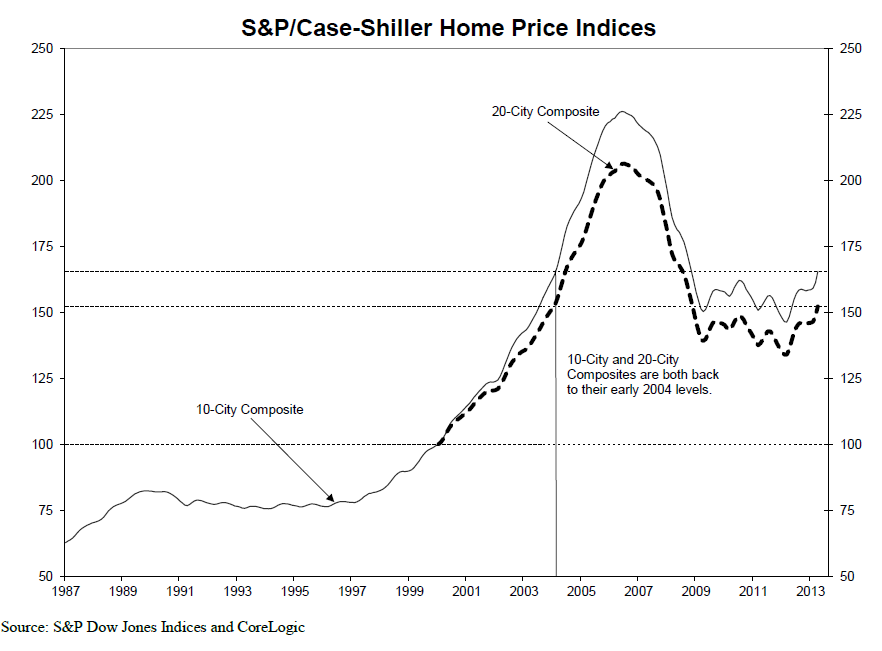
Case-Shiller reported home prices increased 1.72% month-over-month and 12.05% year-over year. This was the highest gain in the history of the Case-Shiller indices. David Blitzer of Case-Shiller addressed the recent increase in rates: “Last week’s comments from the Fed and the resulting sharp increase in Treasury yields sparked fears that rising mortgage rates will damage the housing rebound. Home buyers have survived rising mortgage rates in the past, often by shifting from fixed rate to adjustable rate loans. In the housing boom, bust, and recovery, banks’ credit quality standards were more important than the level of mortgage rates. The most recent Fed Senior Loan Officer Opinion Survey shows that some banks are easing credit restrictions. Given this, the recovery should continue.”

The FHFA Home price Index reported an increase of .7% month-over-month and 7.4% year-over year. Remember, each of these indices (LPS, Case-Shiller, and FHFA) have different methodologies and samples. FHFA looks only at properties with a conforming mortgage, which eliminates jumbos, distressed, cash-only, etc. This index is more of a “central tendency” index than Case-Shiller or LPS.

Image

Morning Report – What to watch for in economics this week 6/24/13

Vital Statistics:

  Last Change Percent
S&P Futures  1568.5 -15.6 -0.98%
Eurostoxx Index 2502.6 -46.9 -1.84%
Oil (WTI) 93.38 -0.3 -0.33%
LIBOR 0.277 0.004 1.47%
US Dollar Index (DXY) 82.8 0.483 0.59%
10 Year Govt Bond Yield 2.64% 0.11%  
Current Coupon Ginnie Mae TBA 99.5 -1.6  
Current Coupon Fannie Mae TBA 99.38 -1.1  
RPX Composite Real Estate Index 205 0.2  
BankRate 30 Year Fixed Rate Mortgage 4.36    


A sea of red to greet investors this morning. The SPUs are down 15, and the the 10 year is down close to a point. MBS are down as well, with the FNCL 3.5s below par. We should be best-exing into a 4% security at this point, and are well on our way to hitting 4.5s.
 
The back up in yields is not only a US phenomenon. The UK gilt and the Canadian 10 year have been moving almost in lockstep with the US 10 year. Japanese and German yields are up small, but not as much as us. For those keeping score at home, the 10 year yield increased 40 basis points last week. 
 
Economically, we have a lot of stuff coming up this week, although not much is market moving. The big question is whether the back up in interest rates is affecting the economy.Watch the consumer confidence numbers (Conference Board on Wed, Michigan on Friday) to see if the jump in interest rates is affecting people’s perception of their own financial situation. Pending Home Sales on Thursday is another one – that should affect contract signings over the past month and will give a clue as to whether the hike in rates is affecting the purchase market. On Thursday, we also get personal income and personal spending. 
 
Bond mutual funds and ETFs had record withdrawals in June, according to Trim Tabs. So far, over $47 billion has exited bond funds. This withdrawal exceeds the record set in October 2008 at the height of the financial crisis. Where that money goes is the $100,000 question. 
 
The Chicago Fed National Activity Index improved somewhat in May, although it is still negative and the the 3 month moving average is getting dangerously close to recession territory.


Morning Report – Dissecting the Bernank 6/21/13

Vital Statistics:

  Last Change Percent
S&P Futures  1590.7 6.8 0.43%
Eurostoxx Index 2595.4 9.0 0.35%
Oil (WTI) 95.37 0.2 0.24%
LIBOR 0.273 0.000 0.07%
US Dollar Index (DXY) 82.08 0.168 0.21%
10 Year Govt Bond Yield 2.39% -0.03%  
Current Coupon Ginnie Mae TBA 102.3 -0.7  
Current Coupon Fannie Mae TBA 101.8 0.3  
RPX Composite Real Estate Index 204.8 0.3  
BankRate 30 Year Fixed Rate Mortgage 4.24    


Markets are higher this morning after yesterday’s bloodbath. There is no economic data this morning. Bonds and MBS are up small.
 
Mortgage rates are up 30 basis points this week so far. We should be best-exing into 4% coupons soon if not already. Will the higher rates crush the purchase market? Well, the National Association of Realtors reported May Existing home sales rose 4.2% to a seasonally-adjusted 5.18% annual rate. The median home price rocketed 15.4% year-over-year. Days on market fell to 41 days from 46 days in April. During the month of May, the 10 year went from 1.67% to 2.13% and the 30 year mortgage went from 3.43% to 4.10%. So, at least on the purchase front, so far, so good. 
 
The sell-off in bonds has been dramatic. Is it overdone? IMO, not really. Two things in Bernake’s press conference jumped out at me. First, was that the Fed expects the labor market to improve slowly and for inflation to remain moderated. And if the economy acts as expected, they will start tapering QE by the end of the year and fully exit by mid 2014. In other words, the default path is to exit QE, and it will take exceptionally weak economic news to change that. I think going into the FOMC meeting, the market was discounting the possibility that the default path was to continue QE and it would take strong economic data to change that. That possibility has now been taken off the table.
 
Second, when asked about his concern over the recent increase in interest rates, Bernake said that their economic forecasts were done in the past few days, so they take into account the recent spike in rates. He went on to characterize the increase in rates as “increasing for the right reasons” – i.e. economic strength and the markets getting ahead of the Fed. 
 
The next question is “how high can rates go?” Well, if you look at historical numbers, a lot higher. Below is a chart of the 10 year yield less the Fed Funds Target Rate since we went to ZIRP. The yield curve had been a lot steeper in the past few years. 


Finally, I recently did an interview on Capital Markets Today, where I talked about the Fed, shadow inventory, mortgage rates, and the real estate market. It is a deeper dive into what the Fed had to say (it was done right after the FOMC release). Check it out.


Morning Report – Why household formation is still lagging 6/19/13

Vital Statistics:


Last

Change

Percent

S&P Futures 

1649.5

-2.1

-0.21%

Eurostoxx Index

2654.8

-11.8

-0.44%

Oil (WTI)

97.95

+0.2

+0.23%

LIBOR

0.273

0.000

0.00%

US Dollar Index (DXY)

80.92

-0.031

-0.04%

10 Year Govt Bond Yield

2.198%

+0.02%


Current Coupon Ginnie Mae TBA

104.5

-0.1


Current Coupon Fannie Mae TBA

103.1

-0.1


RPX Composite Real Estate Index

203.4

0.5


BankRate 30 Year Fixed Rate Mortgage

4.01


Markets are flattish as we await the FOMC decision, which should be out around 2:00 pm EST. Bonds and MBS are flat
 
Mortgage applications fell 3.3% last week, which is surprising since rates fell 9 bps. The purchase index fell 3% while the refi index fell 3.4%.
 
The CoreLogic Market Pulse has lots of good things in it this month. One article notes that prices are adjusting more quickly in this cycle as opposed to historical cycles. They also expect gains to moderate in the red-hot West Coast markets as previously underwater homeowners put their properties on the market. They also are hearing that professional investors believe some of these market to be overheated and are looking to exit. This could be good for originators as the cash buyers become a smaller percentage of buyers.
 
Wells Fargo recently held a conference call on the housing market. They see the Fed starting to move towards tapering QE towards the end of the year, but believe it will be gradual. They make an interesting point regarding the low household formation numbers – that they remain depressed because the jobs that are being created are not quality jobs. They are low paying / temporary jobs that will not really give a boost to housing demand. 
Image

Another interesting tidbit – although it seems like the refi boom is over, it turns out that half of the outstanding mortgages in the U.S. have interest rates of 5% or more.

And finally, Treasury Secretary Jack Lew has re-done his signature from OOoooooooOO to something a bit more legible. His new John Hancock will be gracing your dollar bills shortly.

Morning Report – The Bernank is leaving the building 6/18/13

Vital Statistics:


Last

Change

Percent

S&P Futures 

1641.8

8.1

0.51%

Eurostoxx Index

2654.8

-11.8

-0.44%

Oil (WTI)

97.95

+0.2

+0.23%

LIBOR

0.273

0.000

0.00%

US Dollar Index (DXY)

80.92

-0.031

-0.04%

10 Year Govt Bond Yield

2.198%

+0.02%


Current Coupon Ginnie Mae TBA

104.5

-0.3


Current Coupon Fannie Mae TBA

103.1

-0.2


RPX Composite Real Estate Index

203.4

0.5


BankRate 30 Year Fixed Rate Mortgage

3.98.05


Markets are generally higher as we begin the two day FOMC meeting. Bonds and MBS are down small.
 
Housing starts came in at 914k, lower than the 950k expectation. May starts were revised down to 856k. Multi-fam drove the decrease, and really accounts for the volatility of the index lately. SFR construction has been steadily growing from 520k to 620k over the past year. Wet weather in the Midwest may have dampened the number a bit. Building permits came in at 975k, as expected. Overall, it shows the housing market is continuing to recover, but we are still at very depressed levels. These sort of numbers are often seen at the absolute bottom of recessions. It may be too early to jump to conclusions, but perhaps the hike in interest rates over the past six weeks is starting to bite. 
 
The housing starts number stands in contrast to the National Association of Homebuilders sentiment survey which jumped 8 points to a reading of 52, the first “net positive” number since 2006. 
 
The consumer price index came in at +.1% on the headline number, and + .2% ex food and energy. This number is still too low to please the Fed as they would like to see annual inflation in the 2% to 2.5% range. 
 
On Charlie Rose, Obama said that “Ben Bernake has stayed on as Federal Reserve Chairman longer than he wanted,” giving the clearest signal that the Bernank is going to leave when his term expires early next year. The two names mentioned have been ex Treasury Secretary Larry Summers and Vice Chair Janet Yellen. Yellen is the overwhelming favorite, and she is a bigger dove than Bernake. Something to keep in mind when you start thinking about QE tapering. That said, the current voting members on the Fed are very dovish on balance. Oh, and one other thing – she doesn’t believe the Fed’s interest rate policy has a role in bubble prevention. She would rather rely on supervision and regulation as the main line of defense against bubbles. Of course, with the stock market bubble and the real estate bubble so fresh in our minds, she will likely preside over the bursting of the Treasury bond bubble.